Births Deaths Marriages, Enslaved People, Land, Maternal Kin, Newspaper Articles, Other Documents, Paternal Kin, Photographs, Virginia

The life of Joseph R. Holmes, radical.

I’ve written of Joseph R. Holmesdeath. What of his life? The details are sketchy and poorly documented. Nonetheless, here is what I know.

  • Joseph R. Holmes was born circa 1838, probably in Charlotte County, Virginia. His parents are listed as Payton and Nancy Holmes on his death certificate. I don’t know what the “R” stood for.
  • According to Luther Porter Jackson, Joseph had a brother named Watt. According to my great-aunt Julia Allen Holmes, he also had a brother named Jasper Holmes, born circa 1841, who was her grandfather.
  • The “Inventory and Appraisal of the Personal Estate of Capt. John H. Marshall,” filed in Charlotte in June 1857, lists 20 “Negroes,” including Joe, $600; Peyton, $900; and Nancy, $1000. There’s no Jasper. Nor are there any children bearing the names of Nancy’s younger children, some of whom who were born before 1857. Thus, though I’m tempted, I can’t draw any conclusions about whether these enslaved people are Joseph R. Holmes and his parents.
  • Joseph probably was last owned by John H. Marshall’s son, judge Hunter Holmes Marshall, whose plantation “Roxabel” was (and still is) located about five miles west of Charlotte Court House.
  • Joseph learned to read and write most likely as a child, as he exhibited a well-formed penmanship when in his mid-20s.
  • He was trained as a shoemaker or cobbler.  In Negro Office-Holders in Virginia 1865-1895, Luther Porter Jackson
    asserted that brother Watt was also a shoemaker and that Joseph was “hired out by his master to engage in shoemaking by traveling from plantation to plantation.”
  • However, according to “Shooting in Charlotte Court House,” published in volume VIII, number 2, of The Southsider quarterly, Joseph served as a butler for Marshall, then became a cobbler and opened a shop on the Kings Highway (now U.S. Route 360) near Dupree’s old store.
  • Some time around 1865, Joseph married Mary Clark, born about 1849 to Simon and Jina Clark of Charlotte County. The couple had at least four children: Payton (1865), Louisa (1866), Joseph (1867) and William H. Holmes (August 1868).
  • Tax records filed in Charlotte Court House for 1866 list Joseph R. Holmes in District #2 (T.M. Jones, revenue commissioner), paying one black poll tax, as well as taxes on four hogs valued at $5 and $20 worth of real property. I have not found a deed for this property.
  • In 1867, Joseph R. Holmes was elected to represent Charlotte and Halifax Counties at Virginia’s Constitutional Convention. In A List of the Officers and Members of the Virginia Constitutional Convention, Holmes is
    described:  “… Jos. R. Holmes. Colored. Shoemaker. Can read and write a little. Ignorant. Bad character.” [This comes from an unfortunately unattributed photocopy of a page from a scholarly journal. I’ll hunt down the source.]
  • Charlotte County tax records for 1867 show Joseph R. Holmes living at A.J. Johnson’s in District #2, paying only a black poll tax. (This seems to indicate that he was landless and working as either a sharecropper or tenant farmer.)
  • In 1867, he registered to vote at Clements’ in Charlotte Court House. (So did Watt Carter, who may have been Joseph’s stepfather.)
  • On 2 May 1868, Joseph Holmes purchased 11 1/2 acres in Charlotte County from A.J. Johnson for $92. The metes and bounds: “beginning at a corner on John R. Baileys on the Roanoke Valley Extension Rail Road marked as the plat (A) and thence along the Road South 15 W 22 poles to a corner at B. thence off the Road a New line S 70 E 17 poles to corner chestnut oak S 25 E 46 poles to pointers on John P. Dickersons line, thence his line N 55 E 44 poles to pointers on William H. Fulkers line thence N 57 W 80 poles to the beginning.”
  • An entry for August 1868 in the Charlotte County birth register shows a son William H. born to Mary and Joe Holmes. Joe’s occupation was listed as “radicalism.”
  • A letter Joseph wrote on 22 August 1868 is preserved among Freedmen’s Bureau records. In it, he requested of Thomas Leahey, Assistant Subassistant Commissioner at the Bureau’s office in Farmville, Virginia, that a school be established in the Keysville area. The plea was effective, and there’s a 24 November letter in the records from Leahey to Holmes enclosing vouchers for rent for the school, as well as triplicate leases for “Mrs. Jenkins'” signature. “I send them in your charge (believing you call to the D.O. daily) in order there may be no delay.”
  • An anonymous article in the 23 November 1868 Richmond Whig, signed “Roanoke,” reported a visit to Charlotte County and, among comments about African-Americans and politics, stated: “They seem to be realizing the fact that politics won’t fill their empty stomachs nor clothe their naked bodies, and those who have been idle during the summer and did not make hay while the sun shone, meet with no sympathy and are left out ‘in the cold.’ I passed by the shop of our former representative, ‘Hon.’ Joseph Holmes, a few days ago; he was busily at work pegging away at a pair of boots. I told him I thought he was much better at making a boot than a constitution; and as he was anxious to make a pair for me, I believe, he agreed with me.”
  • On 3 May 1869, Joseph was shot and killed in front of Charlotte County Courthouse by a group of men that included John M. Marshall, Griffin S. Marshall, William Boyd and M.C. Morris. The Marshalls were sons of his former master.
  • In the 1870 census of Walton, Charlotte County: Wat Carter, 70, wife Nancy, 70, and children Mary, 23, Liza, 17, and Wat, 16; plus Payton, 4, Louisa, 3, and Joseph Homes, 2, and Fannie Clark, 60. I strongly suspect that Nancy Carter was Joseph Holmes’ mother and Wat, his stepfather. The young children are clearly Joseph’s. Mary may have been his half-sister, but more likely was his widow.) The younger Wat is likely the “Watt” referred to L.P. Jackson’s book.
  • Joseph Holmes, age 12, son of Joe and Mary Holmes, died 11 March 1880 in Charlotte County.
  • H.C. Williamson’s Memoirs of a Statesman: Being an Account of the Events in the Career of a Mississippi Journalist-Legislator were published by descendant Fred Thompson (actor and failed Republican presidential candidate) in 1964. In reminiscing about his youth, Williamson wrote: “Among the bolder of this presumptuous class of Negroes in my native county was one named Joe Holmes, a saddle-colored shoe cobbler, who occupied a small hut on the side of the public road a few miles from our home. Holmes aspired to the office of representative in the State Legislature and insolently asserted his equality ‘with any white man.’ Feeling that he was protected in his new-found rights by his white allies, he denounced, in public harangues throughout the county, the men who had so lately been the masters and believed themselves secure in control of that government which they had constructed and hitherto maintained. Such a condition prevailing over all the Southern States prompted the organization and active operations of that secret society of native, white southern men known as the Ku Klux Klan, which proved to be the salvation of the remnant left of southern homes and southern civilization. I remember passing Holmes’ shop one dae day and seeing nailed to the door the picture of crossbones and skull (the sign of the Ku Klux Klan, as I afterwards learned). But this did not deter him in the least. A short time thereafter, he fell in the Court House door, pierced with a leaden messenger of death from an unknown source, as he was entering to make an inflammatory speech to a horde of Negroes assembled.”

Birth, death, marriage and court records at Charlotte County Courthouse, Charlotte Court House, Virginia; other records as noted. Thanks, as always, for the incalculably valuable assistance of Kathy Liston.

Standard
Births Deaths Marriages, Business, North Carolina, Paternal Kin, Photographs

UPDATE: Row Q.

Aunt Ninas stone

A couple of weeks ago, I blogged about looking for my cousin Nina Frances Faison Hardy‘s unmarked grave and wanting to honor her by placing a stone. Today, I got a text from my cousin and an email from my mother with photos. My cousins’ business, Eastern Carolina Vault Company, installed the marker today and, after 45 years, A’nt Nina’s final resting place is no longer lost.

Eastern Carolina Vault at work

My cousins L., left, and T., right, and a helper install Nina Hardy’s gravestone today at Rest Haven cemetery, Wilson NC. When A’nt Nina arrived in Wilson from Wayne County circa 1910, she lived for a while with Jesse and Sarah Henderson Jacobs, who reared L. and T.’s great-grandfather Jesse “Jack” Henderson and his nieces, my grandmother and her sister Mamie.

Standard
Births Deaths Marriages, Newspaper Articles, North Carolina, Paternal Kin

Flimflammed?

Wilson_News_10_26_1899_Wm_COley_flimflam

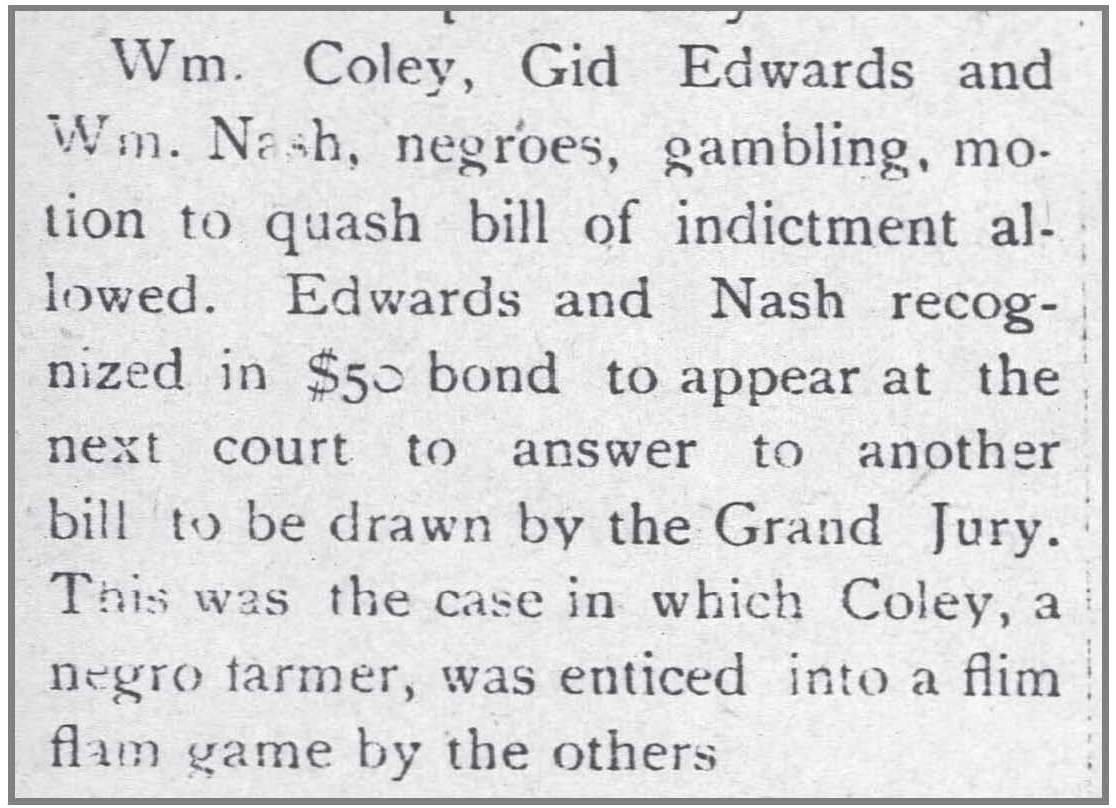
Wilson Daily Times, 26 October 1899.

The whole sorry story appeared in the 27 October 1899 edition of the paper. William Coley was Napoleon Hagans‘ oldest (perhaps) son, born about 1867 in Wayne County to Winnie Coley, and I originally thought that he was the one bamboozled. With closer reading, though, I noticed that this William Coley was still living in Wayne County in 1899 and was described as an “old negro.” Napoleon’s son was in his early 30s and living in Wilson at the time, so I’ve revised my opinion.

While I’m at it, though, here’s what I know about “my” William Coley:

I can’t find him in the 1870 census, but in the 1880 census of Nahunta, Wayne County, Winnie Coley is listed with sons Nathan, 19, and Willie, 12.

On 25 Feb 1891, Cain Artis applied for a marriage license in Wilson County for William Coley, son of Napoleon Hagans and Winney Coley, both living, and Minnie Woodard, daughter of Alfred and Sarah Woodard.  The marriage was performed on 26 Feb 1891 by Presbyterian minister George Carson, with Cain Artis and Hilliard Ellis as witnesses.  Cain was William’s half-brother; his mother was also Winnie Coley.  Further, Cain’s father, Adam Artis, married Napoleon Hagans’ half-sister, Frances Seaberry.

In the 1900 census of Wilson, Wilson County, Willie Coley, 30, is listed with wife Minnie, 30, children Effie M., 8, and James M., 6, mother Winnie Coley, 65, and sister Zilley Coley, 38.

William seems to have been missed again in the 1910 census. Sometime between 1900 and 1920, his wife Minnie died, and he married a woman named Mary. It also seems likely that son James died during this period, as there is no World War I draft registration for him. Daughter Effie Mae married Arthur McCarter on 27 February 1910 in Wilson.

In the 1920 census of Wilson, Wilson County, living on Roberson Street: Will Coley, 50, wife Mary, 47, and granddaughters Ruth and Nannie Coley. Will worked as a public house mover. Minnie Ruth and Nannie Mae were actually McCarters, daughters of William’s daughter Effie (also known as Ethel) Coley McCarter. As I have not found Effie or her husband in the 1920 census, they may have died early as well.

Cain Artis died 23 March 1917 in Wilson County of pulmonary tuberculosis.  His death certificate, for which William “W.M.” Coley provided information, noted that Cain was colored, was born March 1851 to Adam T. Artis and Winnie Coley, was married, and was a farmer.

William Coley himself died 26 Jan 1928 at the age 61 of the same dread disease that killed his brother Cain. His wife Mary Coley informed the registrar that he was the son of Pole Hagans and Winnie Coley, was a farmer, and resided at Route 3, Wilson.

Standard
Births Deaths Marriages, North Carolina, Paternal Kin

Delayed birth certificates.

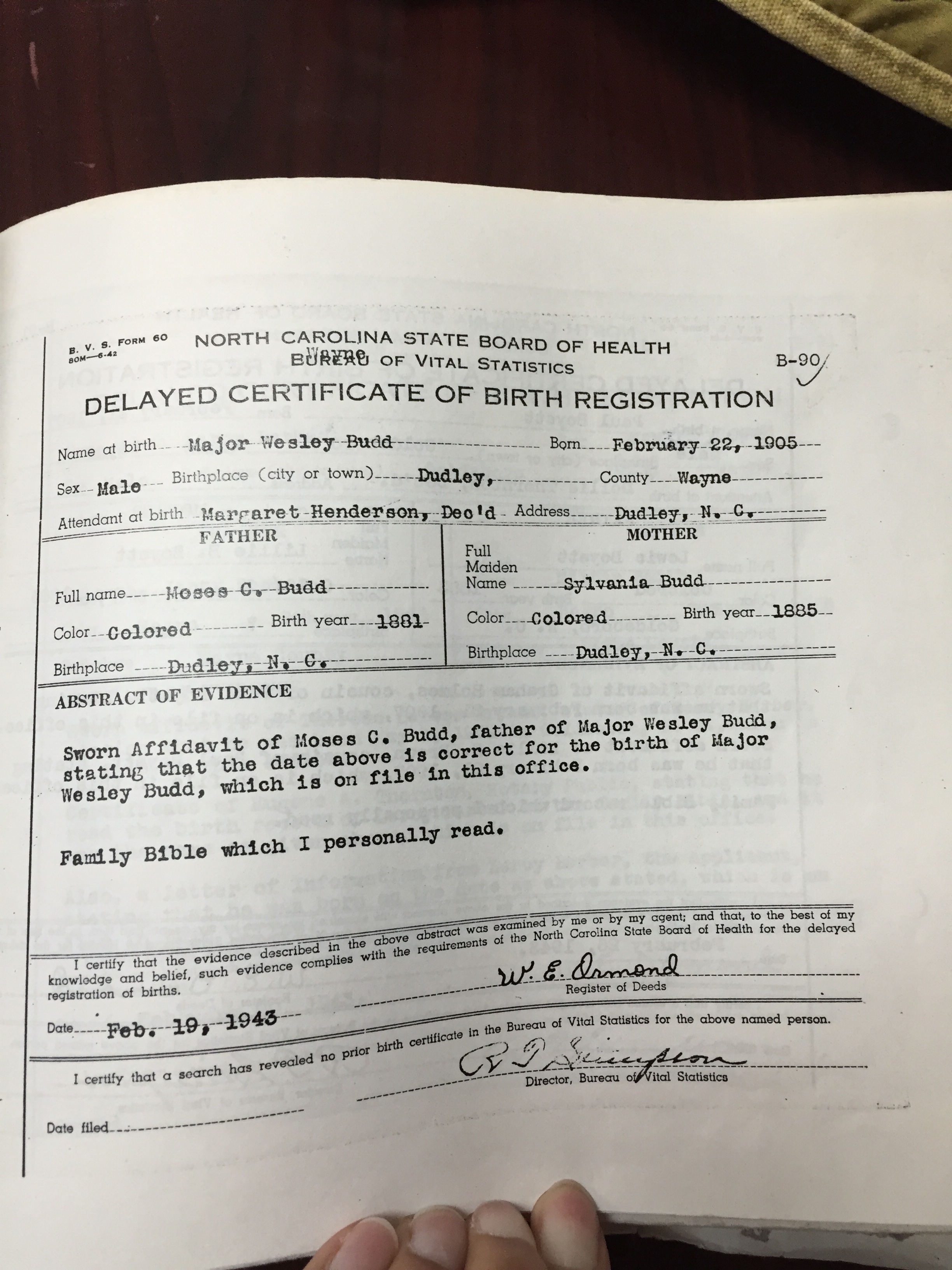
When I was home last week, I had some time to kill, so I spent an hour or so in the Wayne County Register of Deeds office, flipping through Delayed Birth registers. North Carolina did not mandate vital records until 1913, but people born before that year could obtain a “delayed” certificate if they could provide certain proof of their birthdate.

What struck me:

  • Certificate after certificate relied upon an entry in a family Bible to substantiate a birth date. Where have all these Good Books gone??? Who’s got them now?
  • The evidence of family midwives. For example, Major Wesley Budd’s delayed birth certificate cites my great-great-great-grandmother Margaret Henderson as the midwife for his 1905 birth; my great-great-grandmother Vicey Aldridge delivered her brother-in-law Joseph Aldridge‘s daughter Mary Eliza in 1906; and Frances Aldridge (which one?) delivered Joseph’s son William B. Aldridge in 1911.
  • My great-grandfather’s sister Catherine Aldridge Davis obtained two delayed birth certificates. The first, issued 10 February 1943, was based on affidavits from her sister Lenora Henderson and a family friend named W.N. Anderson. (She was described as “colored” in this document.) The second, issued 30 November 1943, was based on the affidavits of her sisters Frances Newsome and Lenora Henderson and of a New York Justice of the Peace who swore that he had examined her family Bible.  (In that one, she was described as “American Indian.”)
  • Mathew Aldridge‘s daughter Mamie Jael‘s delayed birth certificate was issued on the basis of affidavits provided by her cousins, Mary J. Simmons and Annie B. Hogans. (This isn’t Annie B. Watson Hogans, mother of Daniel Simmons‘ wife, Annie Irene Hogans — she died in 1906.) How were Hogans and Simmons related to Mamie Aldridge? And why is Mathew’s middle name listed as Augusta, when every other reference I’ve seen shows middle initial W.?
  • Further evidence of the sway of my great-grandfather Thomas Aldrich over his siblings — his sister Christena Lenora used his preferred alternate name spelling rather than “Aldridge” when she applied for a delayed birth certificate. Nora offered as evidence the license for her marriage to Henry Henderson and affidavits from her brother Johnnie and cousin A.J. Carter. Who was A.J. Carter??

FullSizeRender

Standard
Births Deaths Marriages, Free People of Color, North Carolina, Paternal Kin

She was named after …

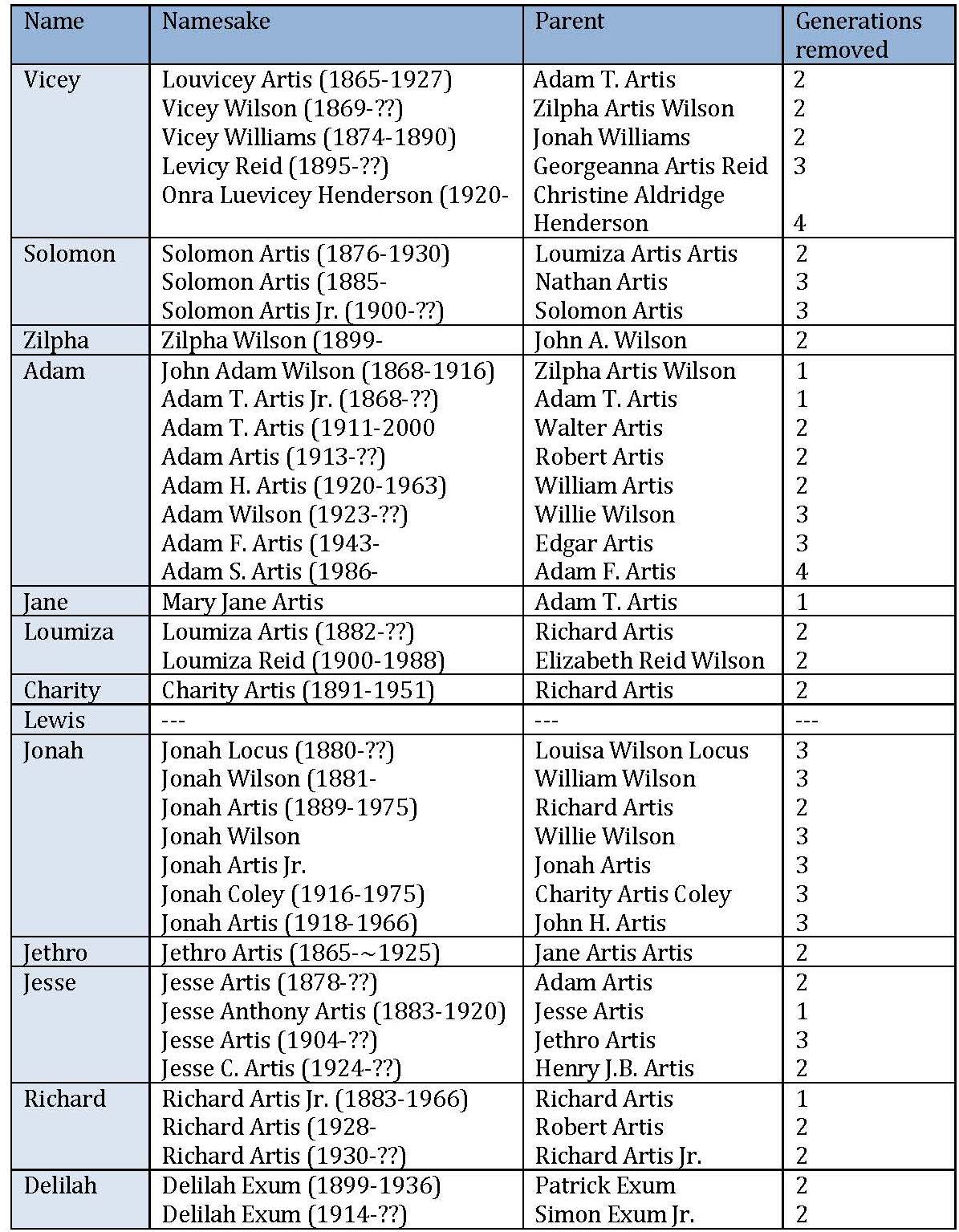
As in many early American families,  the descendants of Solomon and Vicey Artis Williams honored their forebears and living kin by naming children after them. The practice did not begin with them, and it is intriguing to speculate about which of the names that Vicey bestowed upon her offspring had been handed down from earlier generations.

The chart below sets forth all known namesakes of Solomon, Vicey or their children Zilpha, Adam, Jane, Loumiza, Charity, Lewis, Jonah, Jethro, Jesse, Richard and Delilah.

Match

Standard
Births Deaths Marriages, North Carolina, Paternal Kin, Photographs

Row Q.

Less than an hour after we got from the WCGS meeting last night, I received an email from president Joan Howell. I’d mentioned to her that I was trying to locate an unmarked grave at Rest Haven, she’d offered to check her records, and there it was: Nina F. Hardy, Section 3, Lot 20, Q in the street, Space 4.

This is how the morning went:

  • My father and I drove over to Rest Haven, but quickly realized that there was no way to determine where A’nt Nina’s grave was just by looking.
  • We got back in the car and crossed town to Maplewood Cemetery, where the City of Wilson Cemetery Commission is headquartered. The manager provided a chart and a print-out and a good suggestion. “Walk about halfway up Q,” she said. “Then call me and tell me what headstones you see.” [Sidenote: Q was once a track running through Sections 3 and 4 of the cemetery, like P and R to either side of it. Years ago, Q and the other odd-lettered rows were closed off and converted to burial space. The designation “Q in the street” means that A’nt Nina’s grave lies under what was once a pathway.]
  • Back to Rest Haven. A few minutes and a call later, we had the general location of A’nt Nina’s grave between those of Rev. Calvin Harris Boykin and Annie Thompson. I snapped a shot or two, though there is nothing much to see. [Cemetery employees can pinpoint graves, but none were available at the time.]
  • No time like the present, so we headed to our cousin L.H.’s house. His family owns a vault business that does a sideline in gravestones. I ordered a simple flat granite marker to be inscribed with A’nt Nina’s name, birth and death dates; my dad wrote a check (I’d left mine in Georgia, and L.H. doesn’t truck with credit cards); and it was done. I kissed L.H.’s new grandson, and he promised to send me a photo when the marker is installed. [L.H. remembers A’nt Nina. I don’t know why that surprised me. When they arrived in Wilson from Wayne County, Nina and L.H.’s grandfather, Jesse “Jack” Henderson, both lived with Jesse and Sarah Henderson Jacobs on Elba Street.]

IMG_5217

My father standing at the approximate location of Nina Hardy’s grave this morning. Rest Haven cemetery, Wilson, North Carolina.

Standard
Births Deaths Marriages, Maternal Kin, Newspaper Articles, North Carolina

Archie Weaver departs this life.

statesville_record_6_2_1933_archie_weaver

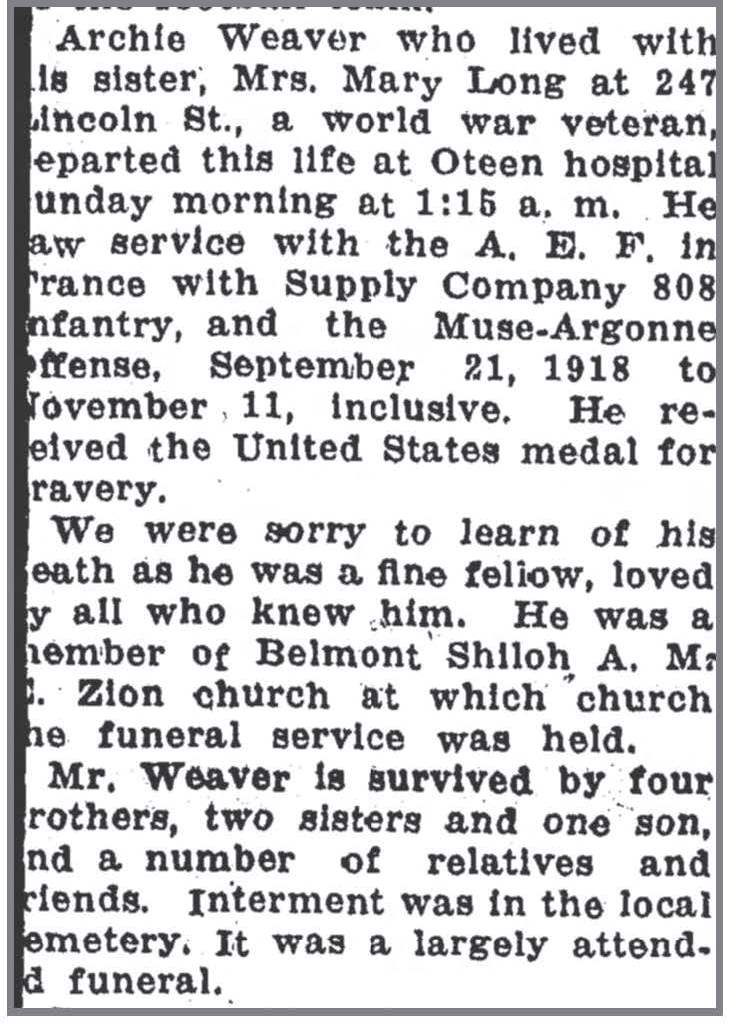
Statesville Record, 2 June 1933.

My grandmother, for one, would not have agreed with this glowing assessment of Archie Weaver as hail-fellow-well-met and certainly would have put the lie to “loved by all who knew him.”

I’ll repeat it: Jay’s daddy had TB, and he just gave it to them. To my aunt and Jay. But he lived years and years and years after both of them died. But he give them all this stuff. Oh, I could not stand him. She was my special aunt because she had boys, and she didn’t have any girls. And she just took me over her house, you know, and let me do things that girls did, you know. 

In other words, for her money, Arch Weaver killed her beloved aunt Elethea and favorite cousin, Irving “Jay” McNeely Weaver. Though she was right that Arch survived “years and years and years” — eleven, to be exact — after Elethea, Jay, in fact, outlived his father by five months. No matter. They died, and much too soon for her.

Interview of Margaret C. Allen by Lisa Y. Henderson, all rights reserved.

Standard
Births Deaths Marriages, Enslaved People, Maternal Kin, Newspaper Articles, North Carolina

Collateral kin: the Hamptons.

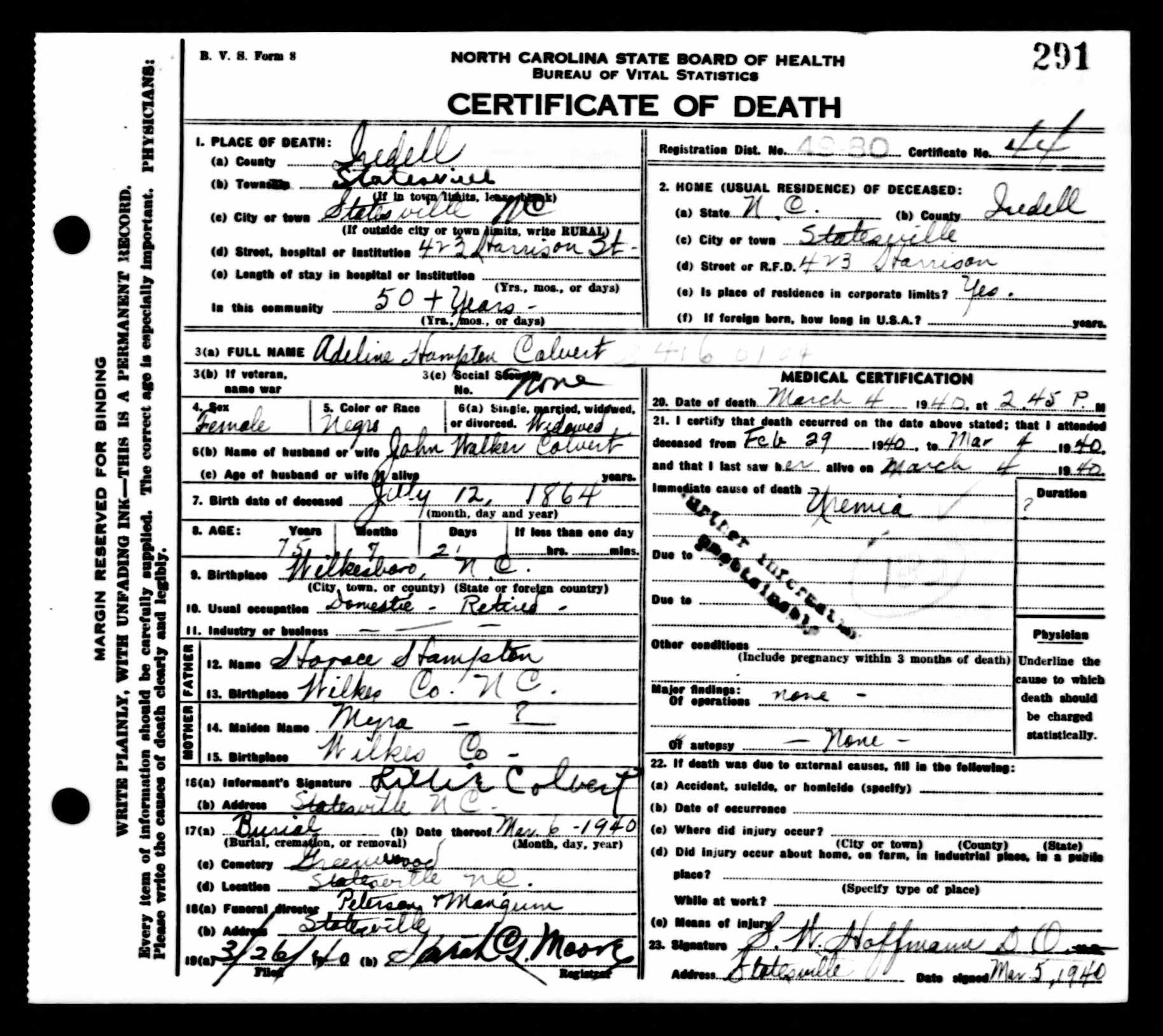
On 30 Jan 1905, in Statesville, North Carolina, my great-great-grandfather John W. Colvert married Adeline Hampton.  The marriage was performed by J.H. Pressley, the same Presbyterian minister who would marry John’s son Lon and Caroline McNeely a year later.  John and Adeline had had four daughters together. Selma Eugenia, Ida Mae, Lillie Mae and Henrietta were born between 1889 and 1893, and I don’t know what kept John and Addie from marrying for so long — or finally induced them to tie the knot. Separate or apart, I’ve found none in the 1900 census.

Addie’s whole family, in fact, is elusive in enumeration records. Her marriage license and death certificate reveal that she was born about 1864 in Wilkes County, North Carolina — northwest of Iredell — to Horace and Myra Hampton. (Other death certificates report Myra’s maiden name as Russell.) In the 1880 census of Wilkes, Addie appears in Wilkesboro township with her parents, younger siblings Vance, Josephine and Henry, and nephews and niece Arthur, Horace and Emma Hampton. Ten years earlier, however, in the 1870 census, Horace and Myra cannot be found, and Addie seems to be living in a household headed by much older siblings.

The 1890 census has perished, but Horace Hampton, “the veteran bridge keeper,” appears in a brief congratulatory article in the Wilkesboro Chronicle on the prosperity and good behavior of the county’s colored people.

Wilkseboro_Chronicle_1_14_1891_Horace_Hampton

Wilkesboro Chronicle, 14 January 1891.

Unfortunately, the family’s next mention is an obituary for Myra Hampton, which reveals a surprising number of siblings for Addie. Most of the children were adults before Emancipation, thus do not appear in census records with their parents. Also, though Myra’s age is given as “about 80,” the 1880 census suggests that she was closer to 70 at the time of her death.

Wilkesboro_Chronicle_1_3_1900_Myra_Hampton

Wilkesboro Chronicle, 3 January 1900.

Just over a year later, the Chronicle mocked Horace Hampton’s efforts to reclaim his position as bridge tender on the Yadkin River.

Wilkesboro_Chronicle_4_3_1901_H_Hampton_bridge

Wilkesboro Chronicle, 3 April 1901.

In June 1905, less than six months after his next-to-youngest daughter finally married the father of her children, Horace Hampton passed away.

Wilkesboro_Chronicle_6_14_1905_H_Hampton

Wilkesboro Chronicle, 14 June 1905.

 Adeline “Addie” Hampton Colvert outlived her husband by almost 20 years. She is buried next to him in Green Street cemetery in Statesville.

Adeline H Colvert death cert

Standard
Births Deaths Marriages, Maternal Kin, North Carolina, Other Documents

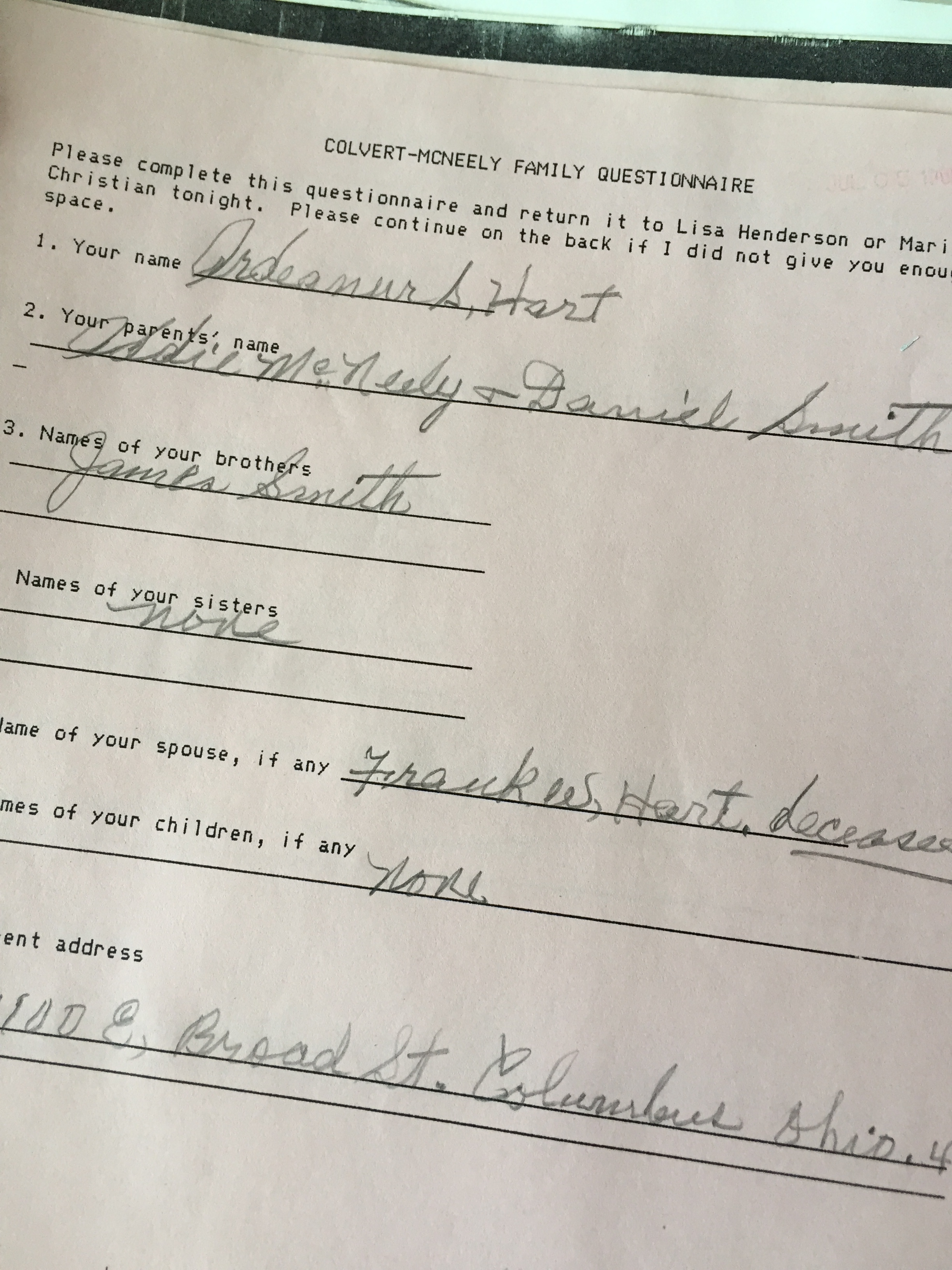
Name of your spouse, if any.

The new tenant wants access to the shed, so I trudged over to clean it out this morning. On the floor, behind a bicycle and some galvanized pails, I found two dusty three-ring binders. The papers in them were beginning to yellow and were foxing on the outer leaves, but basically in good shape. One contained notes and articles related to my graduate thesis — fodder for http://www.ncfpc.net — and the other contained copies of some of my earliest genealogical research, stuff I’d long thought lost.

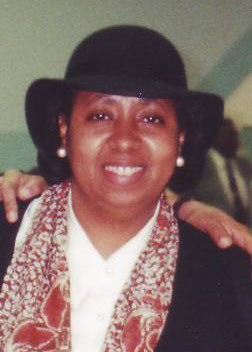
Among other things, there was a stack of the questionnaires distributed at the 1986 Colvert-McNeely family reunion in Statesville. That was the reunion at which I snapped this photo of Cousin Ardeanur S. Hart. Had she …?

Ha! Yes, she had:

IMG_5141 copy

And just like that, her husband’s name — Frank W. Hart.

Standard