Births Deaths Marriages, Enslaved People, Free People of Color, Land, Newspaper Articles, Paternal Kin

Six acres on the south side of the road.

Goldsboro_Messenger_3_10_1884_Sol_Wms_estate_debtors_notice

Goldsboro Messenger, 10 March 1884.

 Gboro Messenger 9 11 1884 Wms v Artis

Goldsboro Messenger, 11 September 1884.

Solomon Williams‘ son (and estate administrator) Jonah Williams placed these notices in a local newspaper. Solomon’s six acres could not be meaningfully divided among the eight children that survived him. Ruffin Bridge is another name for Peacock’s Bridge, which spans Contentnea Creek on the Wilson-Greene Counties border. It is not at all clear to me, however, which road would have been regarded as the road from Goldsboro to the bridge.

Standard
Education, Enslaved People, Land, North Carolina, Oral History, Paternal Kin, Photographs

Meeting the Saulses.

All week, I was pressed. Wave after wave of thunderstorms had been crashing over eastern North Carolina, tornadoes swirling in their wake. The rain didn’t stop until the night before I flew in, and I knew that Contentnea Creek floods early and often. Friday dawned bright and blue though. I headed down Highway 58, excitement brimming like the sheets of water standing in fields on both sides of the pavement. Though several roads around Stantonsburg were still closed, my path was clear, and I pulled into the Saulses’ driveway at the stroke of 10 A.M.

Cousin Andrew Sauls is a reserved man, but welcoming and friendly, and he and his wife, Cousin Jannettie, put me quickly at ease. They were curious about my connection to Daniel Artis and the Saulses, and as I began to explain about Vicey and Sylvania and Adam T., we realized that he had known many of “my” Artises as a young man. In addition to farming hundreds of acres northwest of Snow Hill, his father, Isaac Sauls Jr., bought, rehabbed and sold farms, was a skilled carpenter, and operated several businesses. In 1947, after a short-lived stint operating a funeral home in Snow Hill, Isaac bought a saw mill, refurbished it, and began cutting lumber the following year. Cousin Andrew started working there as a ten year-old and recalled that the factory made good money for more than 20 years because there was a high demand for raw lumber. In those days, he said, “I didn’t know nair black person had a brick house in Greene County. Nor hardly any white ones.” People needed lumber for home repairs and to build tobacco barns and other out buildings. Though most of the Saulses’ customers were white, they also sold to many black farmers in Greene and surrounding counties, including Les, William and Walter Artis in Wayne County. Brothers William and Walter were sons of Adam T. and Frances Seaberry Artis, and Leslie, son of Napoleon Artis, was their nephew. (William, Walter and Napoleon were brothers of my great-great-grandmother, Louvicey Artis Aldridge. All were grandchildren of Vicey Artis Williams, who was Daniel Artis’ sister.)  Cousin Isaac recalled Les as one of the richest black men in Wayne County, and the first he knew of to own a Cadillac. He laughed as he recounted hauling a load of lumber to Walter Artis as a 17 year-old and being offered some liquor. Isaac Sauls Jr. also operated a “stick mill” that cut tobacco sticks for farmers during the summer months.

After a while, Cousin Andrew’s only surviving sibling, sister Hattie, who lives nearby in the “home house,” joined us and chimed in as Andrew talked about their father’s and grandfather’s achievements. He has an astounding memory and reeled off the dates and details of land purchases dating back ninety years to his father’s first acquisition of 57 acres for $400 in 1924. Today the family owns about 440 acres, which it leases to another farmer. When I mentioned his great-uncle Cain “C.D.” Sauls‘ involvement with an African-American bank in Wilson, he astonished me by exclaiming, “I remember my daddy talking about that! It went under. I think he said it was Stanback and Reid.” [And sure enough, J.D. Reid and H.S. Stanback were the bank officers convicted of the fraud that led to the bank’s failure.]

According to Cousin Andrew, in 1929, Isaac Sauls Jr. leased land to the state for the erection of a Rosenwald school. That school served African-American students in the area from 1930 until 1959. When it closed, Cousin Isaac bought the building and converted it into a house in which his son William lived until his death. The structure now stands a few hundred feet north of Cousin Andrew’s house. [Here for National Register of Historic Places nomination form for another Rosenwald school in Greene County.]

IMG_5186

Cousin Hattie spoke of C.D. Sauls’ ownership of several businesses in Snow Hill, including a hotel and a funeral home. She was not sure if he was a formally educated man, but he appeared to be. He was on personal terms with Booker T. Washington and traveled to Tuskegee Institute to speak on occasion. He also owned shares in a cotton mill in Concord, North Carolina. (This would have been the ill-fated Coleman Manufacturing Company.) He apparently occasionally contibuted a column to a newspaper in Kinston, and she promised to send me a copy of an article.  Later, when I mentioned that my mother had taught at North Greene Elementary School for a few years when she first came to North Carolina, Cousin Hattie asked if she knew Annie Edwards Moye, who’d taught there for 45 years. (Annie Moye was a descendant of Clara Artis Edwards, daughter of Daniel Artis.) I didn’t know the answer at the time, but soon learned that my mother in fact had commuted to Greene County with Mrs. Moye and other teachers who lived in Wilson!

Neither his father nor his grandfather had much education, said Cousin Andrew, but they were smart and shrewd and skilled and able to form strong business relationships on the strength of their word. Isaac Sr., born at the start of the Civil War to the enslaved daughter of a free-born, land-owning man and his enslaved wife, was a master carpenter who began to accumulate land at an early age and passed his drive and determination on to his children. One hundred and fifty years later, his gift shines in his grandson Andrew.

me and AS

Cousin Andrew and me at Artis Town cemetery, 2 May 2014.

Standard
Births Deaths Marriages, Enslaved People, Maternal Kin, North Carolina, Other Documents, Photographs

Cousin Rufus McNeely.

Lucinda McNeely‘s son John Rufus McNeely and Emeline Atwell registered their 11-year cohabitation in 1866. John and Emeline’s youngest son, born in 1873, was Rufus Alexander McNeely. He died in 1964.

Image

This photo of Rufus is attached to the Ancestry.com public family tree of jeromemurray128. I’ve reached out unsuccessfully several times with offers to share information about the McNeelys. Perhaps he’ll see this post and get in touch. In the meantime, I hope he won’t mind me sharing this wonderful snapshot!

Standard
Births Deaths Marriages, Enslaved People, Free People of Color, Land, North Carolina, Paternal Kin, Photographs

Family cemeteries, no. 13: Artis Town.

We passed Edwards cemetery on the left, rounded the curve, and there, just where I suspected, was the turn-off onto a farm road leading to Artis Town cemetery. The graveyard is a rectangle of green amid bare spring fields, neatly mowed. A row of weedy trees bristles down one side, broken limbs scattered from recent storms. The oldest stones tilt sideways or sprawl toppled on their backs, but the cemetery is obviously cared for. It lies at the heart of what was once known as Artis Town, a hundred or more acres between Highway 58 and Speights Bridge Road on which lived and farmed Artises and Edwardses in every direction, descendants of Daniel Artis, who bought the land in the 1800s. There was even a racetrack here, said my cousin, where men would line up horses and buggies for weekend contests. As time went by, however, the land got “swindled down.”

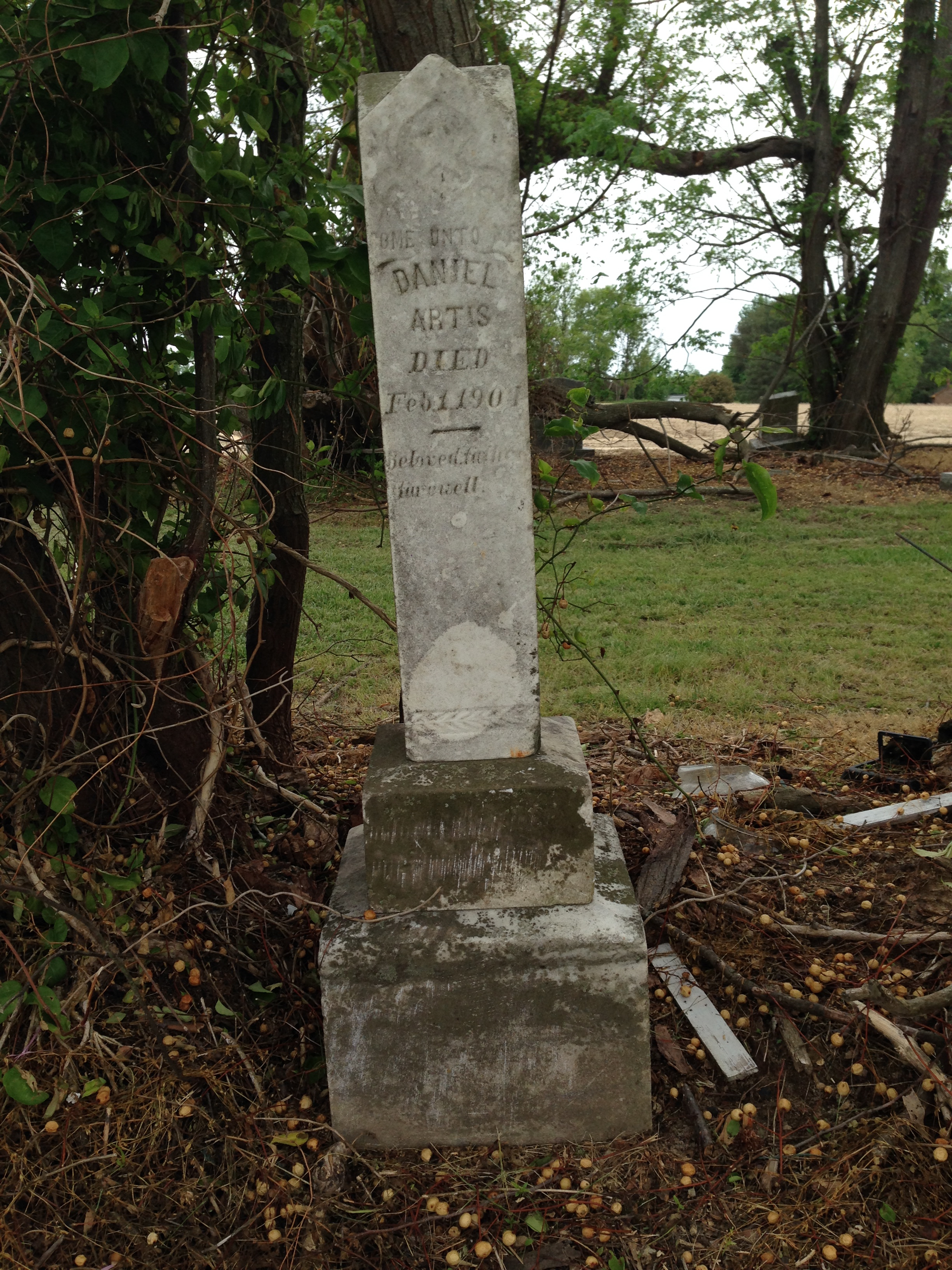
Daniel Artis’ headstone stands in a shadowy pocket underneath a chinaberry tree, the grave itself sprinkled with wrinkled yellow fruit. The small white marble obelisk is a testament to Daniel’s prosperity and the esteem in which his offspring held him.

IMG_5197

I did not locate stones for any of Daniel’s children in the graveyard, though surely some are buried there. (Daughter Clara Artis Edwards is buried in the nearby Edwards cemetery.) Many markers memorialize the deaths of descendants of Loderick Artis and Prior Ann Artis Sauls Thompson, including Loderick’s daughter Sarah Artis Speight:

IMG_5192

and son, Manceson Artis:

IMG_5210

and daughter Hannah Artis Mitchell, as well as Prior Ann’s daughter Mariah Sauls Edwards:

IMG_5195

and a host of other Saulses, Forbeses, Artises, Speights and Mitchells descended from Daniel Artis.

Photos taken by Lisa Y. Henderson, 2 May 2014.

Standard
Civil War, Enslaved People, Free People of Color, North Carolina, Oral History, Paternal Kin

Daniel was always spoken of with respect and love.

I recently received a comment from a reader in response to my posts on the Daniel Artis family. She was hesitant to contact me because her ancestor John Lane had owned slaves — quite possibly some of the people I’ve written about — but was anxious to share a story about Daniel that had been passed down in her family for 150 years. I was surprised and excited to read her message and encouraged her to get in touch. Here’s our April 28 exchange:

Hi, Tammi! Please forgive my excitement and inability to wait for your response. I’m traveling to NC next week to meet some of my newfound Sauls relatives — descendants of Daniel Artis. I’m just beside myself wondering about John Lane — whom I believe apprenticed several of Daniel’s sister Sylvania’s children and might have owned Sylvania’s husband, Guy Lane. I know you’re busy, but I hope you’ll be able to touch base soon. Thanks again!

——

Lisa, thank you for getting back to me! … Yes, apparently there were a few children apprenticed. I recall, I think, five or six on one census. The younger Daniel Artis was 17 years old on, I think, the 1860 census in my g-g-grandfather John Lane’s home. From my family’s handed down stories, the little Daniel was my g-g-g-uncle Christopher Lane’s body servant. Christopher was one of John’s sons and only about seven years older than little Daniel. So they kind of grew up together. The story is that when they both grew up Christopher went to War and Daniel was allowed to go with him as his servant because Christopher was an officer. Only officers could take a servant with them. Daniel was considered free before the war although an apprentice as you probably know. Well, Christopher was captured by the northern troops and taken to their POW camp at Fort Pulaski, Ga. He died there from dysentery. The thing that my family is grateful for is that Daniel went to the camp with Christopher and stayed with him until his death, never leaving his side. When he died, Daniel made his way back to Bull Head, NC to let Christopher’s family and his father John Lane know what happened to him. Daniel was always spoken of with respect and love for what he did for Christopher.

I thank you so much for replying to me, Lisa, because I’ve always wanted to thank his descendants for what Daniel did and for his devotion to our family in such a terrible time. I always wondered if the Daniel Artis next door who was older was related to little Daniel. I saw on the census that he owned property near John Lane, my relative. I hope this information helps some, and I wish all of his relatives happiness and blessings.

——

What a pleasure to hear from you! The Daniel you speak of was the older Daniel’s nephew. “Your” Daniel was the son of Sylvania Artis, a free woman of color, and Guy Lane, her enslaved husband. My direct ancestor, Vicey Artis, was the sister of Sylvania and Daniel the elder. Vicey also married a slave, Solomon Williams. Most of their children were apprenticed by Silas Bryant, a close neighbor of John Lane’s. Daniel the elder’s wife was enslaved, as were their children.

Thanks so much for sharing the story about Daniel the younger. I had no idea that he served in the War. I need to look in my files, but I don’t think I know much about him, though I recall that he married Eliza Faircloth. I do not know of any his descendants either. I grew up in Wilson NC, but with no knowledge of my Greene County links. During a visit home this weekend, I’m going down to Bull Head to meet some Saulses and visit Artis Town cemetery, which is where Daniel the elder was buried in 1905. I’ll keep you posted on anything I find about Daniel the younger.

If you are willing, I would love to share Daniel and Christopher’s story on my blog. I so appreciate your coming forth with this bit of history. Researching African-Americans is generally incredibly difficult, and so much lies locked away with other families. I always dream that someone will contact me just like you did!

Best wishes, keep in touch, and thanks again!

——

I’d be honored for you to use Daniel’s story, of course. I’ve also dreamed and wanted for years to find his relatives, as I mentioned, so I could thank all of them. To be honest, I don’t know if the younger Daniel was enlisted or just went along as an aide to Christopher. I’m only learning recently about the service of black troops both Confederate and Union. I don’t think Daniel was enlisted but I may be wrong. I’ve found the Saulses in many of my genealogy searches but not able to make a connection directly to the Lanes. I can’t remember if I mentioned but my genealogy research came to a brick wall with my g-g-grandfather John Lane. No one anywhere, not even Ancestry.com knows who his father was for sure. I have hints but nothing else. It’s all fascinating.

I can only imagine the difficulty there must be tracing African American genealogy, but I see DNA is being used which is great. It’s part of why I find Scuffalong so interesting. There’s so much information. I really love hearing about Vicey, Sylvania and the elder Daniel since their names have come up so often in my own research. And so happy to meet you, a descendant! Many of my Lane ancestors ended up in Wilson, NC after leaving Bull Head. I’m not sure why, but there were many there in my research including a great-grandmother of mine. Please pay my respects at the Artis Cemetery, to their memory, Lisa, when you visit it. Feel free to write me anytime, if you have any thoughts or questions or just to say hello!

——

CCLane Page 2

Christopher C. Lane enlisted in the 3rd North Carolina Infantry on 23 April 1861 at Snow Hill, Greene County. He was wounded at Gettysburg on September 1863, recuperated at home, then returned to war. He was captured 12 May 1864 at the Battle of the Wilderness, Virginia, and sent to Fort Delaware. In August, in retaliation for the Confederate Army’s imprisonment of Union officers as  human shields in Charleston, U.S. Secretary of War Edwin Stanton sent 600 Confederate officers to Morris Island, South Carolina, to serve as human shields. Lane was among them. After 45 days, the men were transferred to Fort Pulaski, Georgia, and imprisoned in dismal conditions. Christopher Lane died there on 8 December 1864.

I have found no record of Daniel Artis’ service to Christopher Lane during the Civil War, which is not surprising. He was not a soldier; he would not have enlisted. The role of body servants in the early days of the War is the subject of intense debate, and Artis’ status as a free man of color, rather than a slave, further complicates any assessment of his motives (or volition) in following Lane to war.

Many thanks to Tammi Lane for reaching out and sharing a part of Daniel Artis’ life that would otherwise be lost to his family.

——

Image found at http://www.fold3.com.

Standard
Births Deaths Marriages, Enslaved People, Land, Maternal Kin, North Carolina

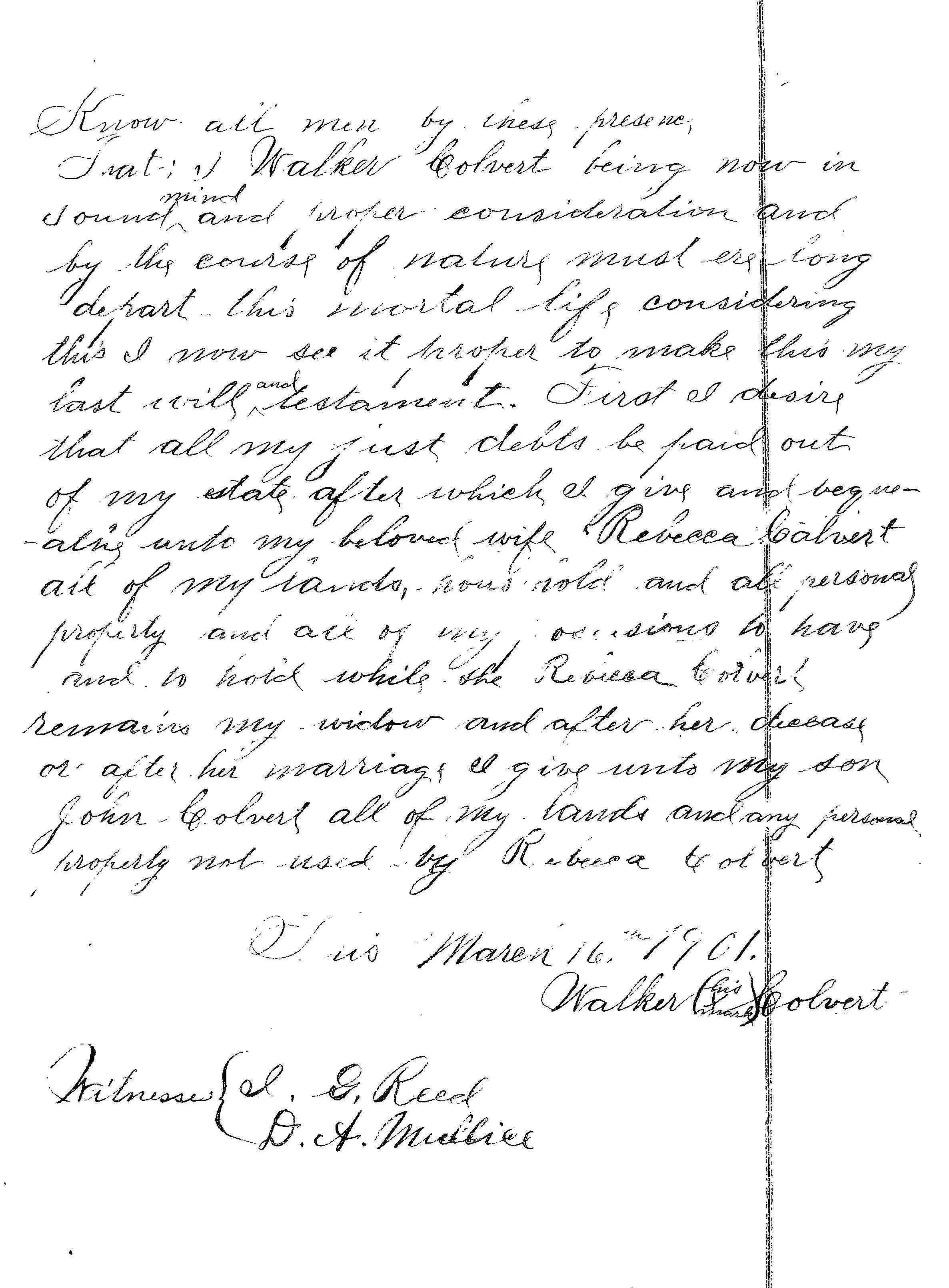
All of my possessions to have and to hold.

COLVERT -- W Colvert Will_Page_1

COLVERT -- W Colvert Will_Page_2

Born 40 years into American independence, and less than ten after the importation of African slaves was banned, Walker Colvert could have prayed for, but never foreseen, that he would gain his freedom just past the midpoint of his life and that he would die possessed of something to leave his wife and son.


Standard

It could stand some hard pruning, and the music is awfully jaunty, and if there’s any mention of slaves at all, I missed it. (After all, this is a plantation tour.) Needless to say, I might have done this differently. Nonetheless, for the light it sheds on the larger community in which my ancestors lived, I hold my tongue and present.

Enslaved People, Free People of Color, North Carolina, Other Documents, Paternal Kin

The husband might become a slave of his children.

To the Honorable the General Assembly of the State of North Carolina now in Session – The Petition of Lovedy Henderson a free woman of color, respectfully represents that your Petitioner intermarried some years since with a certain man of color by the name of Horace, then a slave, but with the consent of his owner. That since their marriage by care and industry, she has been enabled to purchase her said husband at the price of Eight Hundred & Seventy dollars of Hugh and John G. McLaurin Executors of Duncan McLaurin deceased. That she has paid the purchase money & has a Bill of Sale duly executed by the said Executors. That your Petitioner now has two children by her said Husband & as by possibility her husband might become the slave of her children, your petitioner is induced to ask the interference of your honorable body, as the only tribunal authorized to grant the relief prayed for. Your Petitioner would not presume to ask this indulgence in her favour, in contravention to the policy of the Laws of the Land, but from the peculiar circumstances of her case & the belief that she will be enabled to establish for her Husband such a Character as to entitle him to the favourable notice of your honorable body. For this, she relied on the certificates of highly respectable gentlemen both in Fayetteville & the City of Raleigh, where they have lived since their intermarriage. Your Petitioner therefore prays the passage of an Act, emancipating her said husband Horace Henderson, and she in duty bound will ever pray &c. /s/ Lovdy Ann Henderson

We Hugh McLaurin & John C. McLaurin Executors of Duncan McLaurin dec’d unite in soliciting the passage of an Act for the emancipation of Horace Henderson as prayed for by his wife and we are free to say that we have long known said Horace who is a Barber and a boy of unexceptionable good character and of industrious & moral habits. /s/ H. MacLaurin for himself and John C. MacLaurin

We the undersigned citizens of Fayetteville freely unite in soliciting the General Assembly to pass an Act emancipating the negro man Horace, that we have known said Horace as a Barber & a Boy of good character, industrious habits and as we believe of the strictest integrity. /s/ J.H. Hooper, John MacRae, John Kelly, Thos. L. Hybart, [illegible] Cochran, John Lippitt, D.A. Saltmarsh, Chas. B. Jones, [illegible] Hawley, William S. Latta, Jas. Huske, Duncan Smith, Henry W. Ayer

We the undersigned citizens of Raleigh freely unite in soliciting the General Assembly to pas an Act emancipating the negro man Horace, that he has lived in the place for the last three or four years as a Barber, and has conducted himself with the utmost propriety, that in his deportment he is humble & polite, free as we believe from any improper intercourse with slaves, industrious & honest. /s/ M. Stokes, R.M. Saunders, Jo. Gales, B.W. Daniel, Geo. Simpson, J. Brown, John Primrose, Hazlett Wyle, Richard Smith, S. Birdsall, Jno. G. Marshall, A. Williams, Fabius J. Haywood, Robert Staniroy

Ninety years after this petition was filed, a Horace Henderson was born into my extended family, but I know no connection between my Hendersons, who were originally of Onslow County, and Lovedy Ann Henderson.

——

General Assembly Session Records, November 1832-January 1833, Box 5, North Carolina State Archives.

This family is found in the 1850 census of Greensboro, Guilford County: Horace H. Henderson, 40, barber, and wife Love, 39, both born in Fayetteville; children James, 18, farmer, Mary Ann, 17, and Timothy, 14, born in Raleigh; and Albert, 10, Sarah, 8, Thomas, 4, and Alexander, 3, born in Greensboro; all mulatto.


Standard
Births Deaths Marriages, Civil War, Enslaved People, Military, North Carolina, Other Documents, Paternal Kin

They would not have taken them in church.

Part II of Bailham and Hannah Sauls Speight’s pension application file arrived today, and here are some extracts from witnesses deposed 4 June 1904:

  • Hannah Speight – “I claim pension as the widow of Bailham Speight but who served during the Civil War in the U.S. Army under the name of Bailham Edwards.” His brother Lafayette Edwards “lives at Bull Head which is eight miles from Goldsboro.” “I was born on Appletree Swamp near the town of Stauntonberg, Greene County. N.C. and was a slave; was owned by Lawrence Brown. I am the daughter of Rosetta Sauls. My father was Sheppard Sauls. I was known as Hannah Sauls prior to my marriage to Bailham Speight. … [A]fter our marriage we lived as husband and wife till he died December the 21st 1902.” “My husband was born and raised in Greene County. He was about six years older than I was still I knew him before he was grown….” “After his discharge he went to Georgia and was there just twelve months I do not know in what part of Georgia he was. No, I guess it was South Carolina where he went for he went away with Capt. Bill Taylor to work turpentine. … I married my husband about four years after the close of the war and we were married in the month of November in Snow Hill….” Married at Rebecca Bess’ house. She is deceased, as are witnesses Martha Sheppard, Luke Sheppard, and Charles Moseley. Maria Lofton did not witness, but could testify to marriage. She lives on Dr. Parrott’s plantation near Falling Creek. Amos Ellis, Lafayette Edwards, and Violet Edwards would have heard of the marriage, as would Isaac Lynch. … “My husband was raised five miles from Snow Hill on the Betsey Edwards place.” “My husband had a woman before the war. She might be called a slave wife and her name was Jennie. My husband told me she died in Newbern about the close of the war.” “At date of death of my husband I had one child under 16, viz., George Speight and he was fourteen on the 26th of last September. I never had George’s age set down by I remembered it all the same and I have always celebrated the twenty sixth of September as being his birthday and I am absolutely sure that he is now fourteen going on fifteen.” Midwife Mariah Moore lived one mile from Kinston in Harveytown. “After my marriage I lived for twelve months on the place of Dr. John Harvey and then I moved down here; moved here in the Fall of 1870 and have been here ever since. Everybody both white and black know me around here.” Deposition A.
  • Hannah Speight — Sixty-one years of age and lives four miles from Kinston. “I have had eleven children – ten by Bailham Speight and one by Loderick Artist. I never lived with Loderick Artist for during the time he came to see me I was living in the house with my mother and father. We were engaged to be married but after he got me in trouble he went and married another woman. He married her before I married Bailham Speight. He married a woman named Mandy and lived with her till he died ten years ago. He died in the neighborhood of Speights Bridge. No, I never went under the name of Artist nor was I ever known as his wife and never lived with him a day. Our relations were all of a secret nature.” Deposition B.
  • Rosetta Sauls – “I think I am 85; I can do no work and live with my grandson.” “Hannah Speight is my daughter.” … “I did not see her married because she married in Snow Hill and I was living in the country but Bailham come and got her from her my house and took her to Snow Hill where they were married and then they came right back to my house where they lived some three or four months and then they moved in a house to themselves.” “No, my daughter was never married to Loderick Artist and they never did live together but he was the father of her oldest child. He deceived my daughter and got a child by her and then went and married Mandy. All the time he was keeping company with my daughter she was living with me. My daughter never went under the name of Artist nor did she ever go under any name except Sauls and Speight. …” “Bailham Speight and Hannah were both members of the Baptist Church and had they been living improperly and not regularly married they would not have taken them in church.”
  • Lemon Speight – “On the 27th of last April I was 37 years of age.” Farmer four miles from Kinston. “Hannah Speight is my mother. I am the son of Loderick Artist who died ten years go. He never married my mother and I am the only child she ever had except those belonging to Bailham Speight. My father had a wife and her name was Mandy.” “I was married December the 12th 1889 and my brother George was born September the 26th 1889.”

And a letter dictated by Bailham Speight himself:

February 11th 1896, Kinston N.C.

Mr. I.S. Kurtz       Dear Sir, Relative to my age and the way that my name has been spelled. Now I wished to informs you that I used to belong to the old man names Edwards before the war (white) Therefore I enlisted in the Military Services of the United states. I enlisted by the name of Bailham Edwards and I answered at roll call. Bailham Edwards. But the Yankees, they called the name some what like this. Balum Edwards. But however you is speaking to the same man after all. …” [The letter is written in a very florid hand, and the signature does not show his “X.” However, other documents reveal that Bailham Speight could not, in fact, read or write.]

Standard
Births Deaths Marriages, Enslaved People, Newspaper Articles, North Carolina, Photographs

Miss Speight & Mister Kenny.

My earliest memory: I am wrapped in a red blanket, slightly faded, edged in satin. The air is chilly. The light, low and pink-gold. It is morning, and I am being carried across the street to Miss Speight and Mr. Kenny’s house. They lived at 1400, and we lived at 1401, and I cannot be more than two years old.

My mother says that I cannot remember this. It must be an implanted recollection. I don’t think so, but perhaps. There is no question, though, that I retain other vignettes from the brief time that Nina Speight kept me: a canister of Morton salt on a kitchen table; a bag of wooden blocks on a shelf; a Maxwell House can brimming with snuff juice; a thin chenille spread over a four-poster bed; the dimness of the back room shared by the Speights’ teenaged grandsons. We left Carolina Street when I was nine, but my memories of my years at the edge of East Wilson are warm and tinged with gold.  Miss Speight and Mister Kenny loved and nurtured me early and rooted me firmly in the traditions of a Southern community in transition. They passed away within months of each other in 1982 — ironically, the year that I, too, left Wilson, for college.

Kenneth___Nina_Speight

Nina and Kenneth Speight.

——

Nina Darden Speight was born in 1901 in Black Creek township, Wilson County, to Crawford F. and Mattie Woodard Darden. Her family names indicate deep roots in southeastern Wilson County, which was part of Edgecombe before 1855. Her father, born about 1869, was the youngest of several children born to Howell Darden and Esther (or Easter) Bass, and the only child born free. (Esther’s maiden name also appears as “Jordan” on the marriage license of one of her children.)  On 11 August 1866, Howell and Easter registered their cohabitation with a county justice of the peace and thereby legalized their 18-year marriage. Their older children included Warren (born circa 1849, married Louisa Dew), Eliza (born circa 1852, married Henry Dortch), Martin (born circa 1853, married Jane Dew) and Toby Darden (born circa 1858.) Esther Darden died 1870-1880, and Howell Darden between 1880 and 1900.

Evidence that Howell Darden and Esther Bass were both owned by James A. Barnes may be found in the abstract of his will, dated October 14, 1848 and probated at February Court, 1849 in Edgecombe County. Among other property real and personal, Barnes’ wife Sarah received a life interest in several slaves — Mary, Esther and Charles — whose ownership would revert to nephew Theophilus Bass upon her death. To McKinley Darden, Barnes bequeathed “Negro Howell.” [Other enslaved people mentioned in Barnes’ will included Tom, Amos, Babe, Silvia, Ransom, Rose, Dinah, Jack, Jordan, Randy, Abraham, Rody, Alexander, Bob and Gatsey (the only slave to be sold.) Their relationships to Esther and Howell may never be known.]

Nina Speight’s mother Mattie Woodard Darden was born about 1873 in Wayne County to William and Vicey Woodard. She died 7 May 1935 in Wilson County. Crawford Darden died 3 August 1934.

Kenneth Speight was born about 1891 in Speight Bridge township, Greene County, North Carolina, to Callie and Holland Speight. (Some records show a 1899 or 1900 birth year, but he appears in the 1900 census as an 8 year-old.) His father Callie was born about 1855; his mother Holland, about 1860. Callie was the son of Callie (1825) and Allie Speight (1827). In the 1870 census of Greene County, the Callie and Allie Speight’s family is listed next to a wealthy white farmer named Abner Speight, who may have been their former owner.

In 1902, the Charlotte Observer ran an article by C.S. Wooten of LaGrange, North Carolina, “Old Southern Families: Farmers of Wayne and Greene,” a reminiscence about the “old plantations” and “typical Southern gentlemen” of those parts, including Abner Speight:

James Speight, a nephew of Jesse Speight, was Senator for Lenoir and Greene counties for ten years before the war. He married a niece of my father, Maj. Wooten. He was a splendid stump speaker, and I have seen him debate with lawyers on the stump and get the best of the discussion, indeed in those days the best politicians were farmers. His house was a nice place to visit. He always had a special brand of apple brandy made by Col. C.W. Stanton who could make as good brandy as was ever made. Edwin G. Speight, his cousin, was also Senator from Greene and Lenoir counties from 1842-1852. I was a small boy when he was a public man, but I have heard my father say he was a fine speaker and was a natural orator. His second wife was a daughter of Hon. Jake H. Bryan, of Raleigh, and he removed to Alabama where he died a few years ago. Abner Speight, a cousin of the above, was a large farmer, was a noble man and as good a citizen as the State ever had. He had two boys killed in the army, both bright, gallant young men. I have sometimes thought, suppose the South had not been checked in her onward march of prosperity and greatness what would we have been today. I have also thought that the gallant men, the flower of Southern chivalry that were sacrificed in that unhappy struggle were in vain, but I reckon not, for they by their gallantry and valor, have shed unfading justice upon Southern arms and have given her a name that will never be surpassed in the annals of mankind.

Callie and Holland Speight married about 1878, but little else is known of her. After Holland’s death just after 1900, Callie married Minnie Speight (1894-1947), daughter of Stephen and Dillie Woodard Speight, also of Greene County. In addition to Kenneth, Callie Speight’s children included Martha, Mary, Clara, Irwin, Charlie, Callie, Addie, Claud, Mary, Nancy, Flossie, Lewis, Clarence, Effie, Bessie, Pauline, George, Adell, Joe, James and Junius. Callie died after 1940.

——

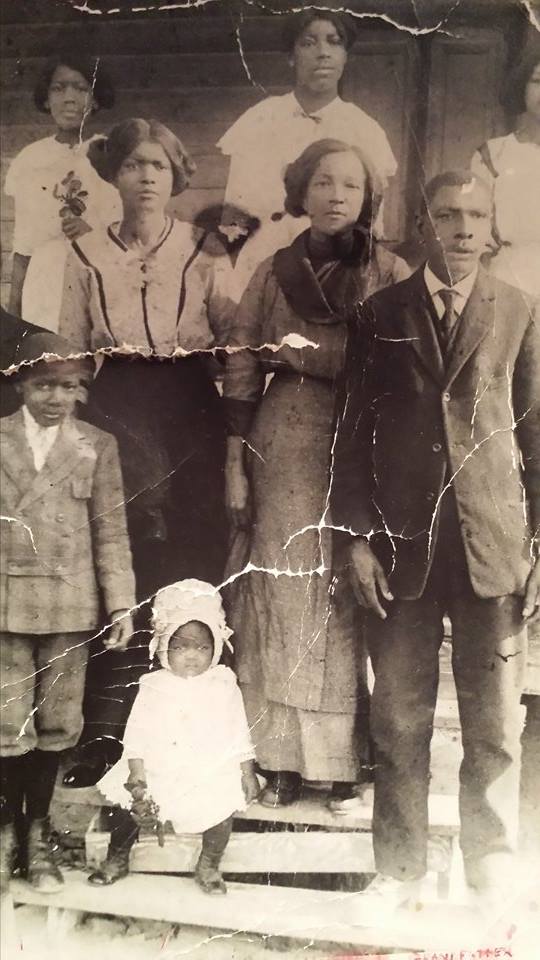
Postscript: After I posted this piece, the Speights’ grandson, whom I played with on his childhood visits from New York City, sent me another photograph. Nina Darden is standing at top left, holding a flower. Thanks, Tyrone, for both images!

Nina Darden

Standard