Civil War, Enslaved People, Free People of Color

What’s in a name?

When James Barnes’ will was probated in 1848 in Edgecombe County, North Carolina, and its provisions carried out, ownership of Howell, an enslaved man, transferred to McKinley Darden. In the 1870 census, Howell Darden, his wife Esther, and their children appear in Black Creek township in Wilson County, North Carolina. Howell had adopted the last name of the family that had owned him most of his adult life. His choice, however, was the not only one available to freedmen. Unbeknownst to slaveowners, many enslaved people claimed surnames even during slavery, though these names were not recognized legally. Some former slaves cemented links to kin by taking the surnames their mothers or fathers used. Others adopted the name of their last master, or reached back to earlier owners, perhaps from their childhood. Still others declined to acknowledge their former bondage altogether, and took names related to a skilled trade, a physical feature, a famous figure, or some other personal idiosyncracy.

Researchers attempting to trace African-American family lines often hit a brick wall at 1870. Having identified an ancestor reported in that census, they invariably ponder the question: how can I find the parents and siblings of this newly freed person? Answering these questions requires flexibility and a willingness to consider indirect sources. Marriage and death records may reveal close familial relationships among people with different surnames. For example, Vicey Artis, a free woman of color, and her enslaved husband Solomon Williams lived separately in the area of northeastern Wayne County and southwestern Greene County, North Carolina. Vicey appears in the 1850 and 1860 censuses with several children named Artis. Vicey and Solomon recorded their cohabitation in 1866, when most of their children were adults. Examination of marriage and death records reveals that some of Vicey and Solomon’s children (who were all free-born) assumed their father’s last name after his emancipation and others (especially the older ones) retained their mothers’. While nothing immediately obvious links Jonah Williams of Wilson and Adam Artis of Nahunta, vital records and other documents establish that they were brothers.

Similarly, upon Emancipation, two of the children of Margaret McConnaughey and Edward Miller, formerly enslaved in Rowan County North Carolina, chose the surname McConnaughey and three, Miller. Margaret and her children had been owned by a McConnaughey. Death certificates, marriage records, and close examination of households in census records provide the clues that establish this family’s connections.

Researchers should also pay attention to groupings of first names.   Like whites during the era, former enslaved people often fortified the ties between generations by naming children after relatives. Thus the recurrence of certain given names among a group of families sharing the same surname could indicate kinship. For example, the fact that Benjamin Barnes’ son Calvin, born about 1836, named two sons Redmond and Andrew could indicate a sibling relationship between Benjamin, Redmond and Andrew Barnes, all born circa 1820 and listed near one another in the 1870 census of Wilson County. That the elder Redmond also had a son named Calvin further supports the possibility. In addition, when comparing documents, keeping an eye out for familiar first names may help identify freedmen who changed their surnames, perhaps rejecting one that had been chosen too hastily or that had not chosen for themselves. For example, the Isom, Guilford, Robert, Jackson, and Lewis Bynum who registered cohabitations in Wilson County in 1866 appear in the 1870 census and after as Isom, Guilford, Robert, Jackson and Lewis Ellis.

Also remember that freedmen who shared a surname and common former owner were not necessarily kin. A grouping of one hundred enslaved people may have comprised a dozen or more — many more — unrelated families. For example, Mack Coley of Wayne County, North Carolina, was the grandson of Winnie Coley and of Sallie Coley Yelverton. Several of Winnie Coley’s children were fathered by Peter Coley. Trying to understand how these Coleys — all of whom appear to have belonged to a single former master — relate to one another (or don’t) is a daunting task.

Civil war pension records are another rich source of evidence about naming choices and family ties. Consider this passage from the Confederate pension application of Jim Ellis Dew of Wilson County, North Carolina:

“It was at the time we were making ‘sorgum’ that I was sent to the war. I belonged to my master Mr. Hickman Ellis who married a Miss Dew. You know missus, the white folks are not as strong as the niggers and Mr. Jonathan Dew, brother to my missus, was not very well, and they let him draw a man to go in his place and they drew me. I was sent to Fort Fisher and went to work throwing up breastworks. … We stayed on the island for while. After a while, I came home. While I was in the war I was known as Jim Dew, but when I came back from the war I was called by my old name “Jim Ellis” because I belonged to my missus.”

Similarly, the file containing the Union Army pension application of Baalam Speight’s widow Hannah Sauls Speight reveals that Baalam had enlisted as Baalam Edwards, his owner’s surname, but later adopted his father’s surname Speight. His brother Lafayette, on the other hand, had kept Edwards as his name. A witness named Lewis Harper testified that he had a brother named Loderick Artis. (Artis, born enslaved, had taken his free father’s surname.)

Though researching enslaved ancestry is almost always difficult, creative consideration of the available evidence often yields surprising rewards. Marriage records for people born into slavery often show surnames for both parents that are different from the child being married. Cross-reference siblings, and you’ll often find a completely different set of surnames. Be careful when trying to match former enslave people to their kinfolk and their masters. Reasons for choosing names were varied and inscrutable, and people tried on different identities for a few years. Empowering for them — maddening for us!

(For a more in-depth analysis of slave naming practices and patterns, see Eugene D. Genovese’s Roll, Jordan, Roll: The World the Slaves Made and Herbert Gutman’s The Black Family in Slavery and Freedom.)

Standard
Enslaved People, North Carolina, Paternal Kin, Photographs

Appie Ward Hagans.

I’ve talked all around Apsilla (or, perhaps, Apsaline) “Appie” Ward Hagans here and here and here. So here she is:

Aspilla Ward Hagans

Appie and her twin Mittie Roena Ward were born 19 April 1849 near Stantonsburg, Wilson County, to David G.W. Ward and Sarah Ward, an enslaved woman. They likely spent their early years in and around this house. How and when Appie met her husband, Napoleon Hagans, who lived in northeast Wayne County perhaps 7 miles from the Ward plantation, is unknown. I have not located their marriage license. Appie and Napoleon had two sons, Henry Edward Hagans (1868-1926) and William Scarlett Hagans (1869-1946).

Appie left little trace in official records, appearing in two census enumerations and on a couple of deeds with her husband. She died 12 April 1895 and is buried near their home in northern Wayne County.

Photo courtesy of William E. Hagans.

Standard
Enslaved People, Maternal Kin, North Carolina

McNeelys enumerated.

Perhaps he ticked them off on his fingers: “One female, aged 24 to 36. … One female, under ten years of age. … Three males, all under ten….” The enumerator for the 1840 federal census of Rowan County dutifully recorded the information that Samuel McNeely provided, inking in  small numerals in the appropriate column under “SLAVES.” The adult female was Lucinda. The female child was her daughter Alice, and two of the males were her sons John and Julius. It is likely that the third boy was also Lucinda’s, as Samuel was not likely to have purchased a small child and Alice was too young to bear children.

Samuel died in 1843 and, under the terms of his will, son John W. McNeely inherited slaves Lucinda and her offspring. In the 1850 slave schedule, John reported owning eight slaves: a 34 year-old black female [Lucinda]; a 19 year-old black female [Alice]; a 17 year-old black male [John]; a 14 year-old black male [the third boy above, name unknown]; a 12 year-old black male [Julius]; a 9 year-old mulatto male [Henry, Lucinda’s son by John W. McNeely]; a 2 year-old mulatto male [Joseph Archy, Alice’s son]; and a 1 year-old black female [probably Alice’s daughter Mary].

In 1860, John W. McNeely reported only seven slaves: a 44 year-old black female [Lucinda]; an 11 year-old black female [Mary]; a 22 year-old black male [Julius]; a 19 year-old mulatto male [Henry]; a 12 year-old mulatto male [Archy]; a 9 year-old black male [Alexander “Sandy,” who was probably Alice’s son]; and a 7 year-old black male [John Stanhope, who was probably Alice’s son.]  The same seven appear, by name finally, in the 1863 Confederate tax valuation. [A vexatious question: Where was John Rufus in 1860 and 1863? When he married in 1866, he reported John W. McNeely as his former owner. Had he in fact spent his final years of servitude under a different master?]

And then came freedom. In the 1870 census of Atwell township, Rowan County, at household #294: Lucinda McNeely, age 54, domestic servant; Henry McNeely, 29, school teacher; Joseph A. McNeely, 22, farm laborer; and Elizabeth McNeely, 13, “attends school.” [According to my grandmother, this Elizabeth was Henry’s daughter, abandoned by her mother at his doorstep.] At #295: Julius McNeely, 32, farm laborer; wife Mary McNeely, 25, “keeps house”; and nephews Alex’r McNeely, 17, farm laborer; and John S. McNeely, 18, farm laborer. [On the other side, at #292: John W. McNeely, 63, and wife Mary, 63, and at #293: Henry W. McNeely, 35; wife Nancy E., 24; and children Margaret, 3, and John W., 1. This Henry W. McNeely, son of James H. McNeely, was John W.’s cousin, though the exact relationship is unclear.]

Standard
Enslaved People, Free People of Color, Land, Newspaper Articles, North Carolina, Paternal Kin, Vocation

Black carpenter makes name for himself.

I’ve been pulling together a descendant chart for Daniel Artis. In part, I want to keep the names straight and, in part, I’m trying to see if I’m related to any of the other Edwardses, Saulses or Artises I grew up with. Tonight I Googled some random names from this family and up popped this, published just three days ago in Kinston.com, the on-line version of the Kinston Free Press. Andrew Sauls’ father was Isaac Sauls, son of Isaac Sauls, son of Prior Ann Artis Sauls Thompson, daughter of Daniel Artis, brother of my great-great-great-great-grandmother Vicey Artis Williams.

[Update, 7 March 2014: I emailed the Free Press journalist and two days later — yesterday — got a call from Andrew Sauls himself! He lives on land his grandfather bought in 1920 (plus 400 more); confirmed that the Artis Town sign is gone; knew M.’s grandfather, “Cousin Booker T.,” well; and promised to show me around Sauls-Edwards-Artis territory next time I’m home!  — LYH]

Standard
Enslaved People, Land, North Carolina, Other Documents, Photographs

Dr. Ward’s house. And me.

After my recent rediscovery of a Confederate map that revealed the locations of several plantations significant to my genealogical research, I began searching for more information about John Lane, Silas Bryant and David G.W. Ward‘s landholdings. Pretty quickly, I found a link to a copy of a nomination form for the National Register of Historic Places Inventory, submitted for the Ward-Applewhite-Thompson house near Stantonsburg, North Carolina. This Greek Revival house, dating back to about 1859, was owned and occupied by several of the area’s leading planters — including “country doctor” D.G.W. Ward, who purchased it in 1857 — and it and its outbuildings are little changed from their antebellum forms.

As I read the detailed architectural description of the house and its setting, a tiny kernel of recognition began to form in the back of my mind. A big, white, two-story house? Set well back from the road? Just outside Stantonsburg? Could it …?

I scoured the maps attached to the nomination form, trying to lay them over the current topography. State Road 1539 … that would be Sand Pit Road today …  just east of a fork in the road and just north of the Norfolk & Southern Railroad (which was not there in Ward’s time) … and there it is, just like I remember.

sand pit road

Yes. Like I remember.

I’ve BEEN in this house. Many times, though long ago.

Growing up, my sister and I were very close to my father’s sister’s daughters. Our local family was quite small, but my cousin’s father came from a big family with deep Wilson County roots. Her grandmother had nearly a dozen siblings — whom we also called “aunt” and “uncle” — and we were often invited to attend their family gatherings. I remember best the delectable Easter, Thanksgiving and Christmas dinners gathered around tables groaning with food, but there were also the annual 4th of July family reunions at Aunt Minnie’s out in the country near Stantonsburg. The Barneses were tenant farmers for an absentee landowner and rented his large two-story house. We’d pull off the road into a sandy circular drive and park under the trees alongside cars with New York and New Jersey plates. I vividly remember my cousin’s great-uncles and cousins tending a barbecue pit in which a split pig roasted, chickens strutting among them.  A screened side porch protected platter after platter of home-grown, home-cooked goodness.  My memories of the interior of the house are vague: a central staircase, two large front rooms, the kitchen in back. (The staircase I remember mostly because, carefully tending a tall glass of lemonade, I missed a riser and slid down their length, smacking my ribcage against the steps and knocking the wind out of myself.)

I couldn’t believe it. It is exciting enough to identify D.G.W. Ward’s house and find that it is still standing, but to realize that I knew the house at which Appie and Mittie Ward had lived and worked as the enslaved children of their own father was uncanny.

IMG_4960Ward-Applewhite-Thompson House today.

Photo taken by Lisa Y. Henderson, February 2014.

Standard
Births Deaths Marriages, Enslaved People, Free People of Color, North Carolina, Paternal Kin, Photographs

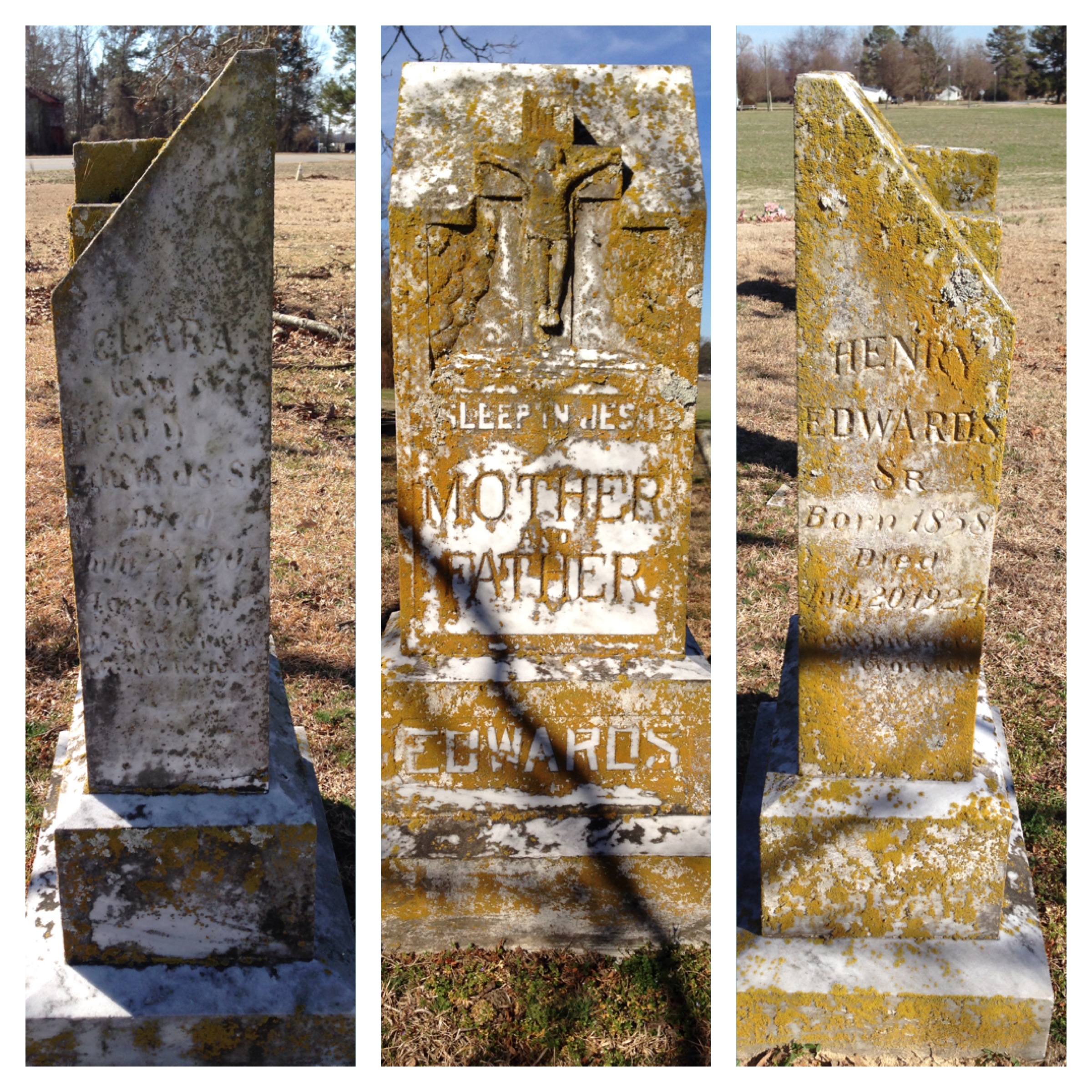
Family cemeteries, no. 9: Daniel Artis’ Edwardses.

A right turn out of my parents’ neighborhood puts me onto Highway 58. Head southeast, cross the edge of Stantonsburg, over Contentnea Creek and the Greene County line, and, 13 miles from home, you reach Lane Road. Turn left, round the curve, and there, neatly marked and kept, is the Edwards cemetery. Here are buried Daniel Artis‘ daughter Clara, her husband Henry Edwards, and their descendants.

Image

Photo taken today, Lisa Y. Henderson.

Standard
Births Deaths Marriages, Enslaved People, North Carolina, Paternal Kin

Finding the Wards.

This is what we knew:  Joseph Henry Ward, born circa 1870 in or near Wilson, North Carolina, was the son of Napoleon Hagans and a sister of Napoleon’s wife, Apsilla Ward Hagans.  I couldn’t find him in the 1870 or 1880 censuses, but by 1900 he was listed in Indianapolis, Indiana, working as a physician.

The hunt for Joe Ward’s people thus began.

In the 1910 census of Indianapolis, a nephew, Augustus Moody, born about 1893, is listed in the Ward household. I searched for Augustus in 1900 and found him in Washington DC in this household: William Moody (born 1872), wife Sarah S. (1876) and children Augustus (June 1894) and Crist (1896), plus sister-in-law Minerva Vaughn (1890), mother-in-law Mittie Vaughn (1854), and mother Fannie Harris (1854) — all born in North Carolina.  Soooo …  Augustus’ mother was Sarah S. Moody, and Sarah’s mother was Mittie Vaughn.  Okay, and how was Joe Ward related to these folks?

I went back to the 1880 census of Wilson County and found: Sarah Darden (57, mother), Algia Vaughn (23, son-in-law), Mittie (22, daughter), Joseph (8), Sarah (6), and Macinda (5 mos.), the last three Sarah’s grandchildren.  From this I deduced that Mittie Vaughn, daughter of Sarah Darden, had at least two children, Joseph and Sarah, before 1880.  I then located young Sarah’s marriage license to William Moody, which listed her maiden name as Ward.  So Joseph and Sarah were listed in the 1880 census in their stepfather’s name, not their mother’s, and “Joseph Vaughn,” son of Mittie Vaughn, is in fact the Joseph Ward I was looking for.

How did I know Algernon was a stepfather? He was only 22 years old when he married Mitty Finch,  27, in Wilson on May 6, 1879.  (Finch?!?!?! That’s an as-yet unexplained anomaly.) I also found a cohabitation registration for grandmother Sarah Ward and Sam Darden, dated 12 July 1866. This registration, which formalized the marriages of ex-slaves, noted that they had been married five years, well after the births of Sarah’s children Mittie and Appie. If Sam was not their father, who was?

The first clue: in 1902, when William S. Hagans (son of Napoleon and Appie Ward Hagans) registered to vote in Wayne County, North Carolina, under the state’s grandfather clause, he named “Dr. Ward” as his qualifying ancestor. I didn’t know what to make of that — I couldn’t find a Dr. Ward in Wayne County — so I laid it to the side for a bit.

Then I found a reference to Appie and Mittie’s previously unknown brother. On 16 June 1870, Henry Ward, son of D.G.W. Ward and Sarah Darden, married Sarah Forbes in Wilson, North Carolina.  If we assume that Henry, Appie and Mittie had the same father, who is this D.G.W. Ward? Was he the “Dr. Ward” that William claimed as his qualifying ancestor under the grandfather clause?

In the 1860 census, D.G.W. Ward (45) and wife Adline (19) appear in Speights district, Greene County, which borders Wilson County to the southeast. Ward reported owning $26,500 in real property and a whopping $112,000 in personal property! (As the 1860 slave census shows, this wealth largely consisted of 54 slaves.) He was one of the, if not the, wealthiest men in the county. And he was a physician. Here, indeed, was Dr. Ward.

David George Washington Ward was married twice — perhaps circa 1840 to Mariah H. Vines, who died after having one child; then to Emily Adeline Moye in 1859. Between those marriages, he fathered at least three children with Sarah, an enslaved woman.

Standard
Enslaved People, Free People of Color, Land, North Carolina, Other Documents, Paternal Kin

Confederate map tells all.

Years ago — 10? 15? — I ordered copies of two Confederate field maps from the fine folks at Wilson County Genealogical Society. (The originals are held at North Carolina State Archives.) The maps feature not only geographic markers, such as creeks and towns, but the names of landowners throughout the region. I remember intently scanning the area around modern-day Eureka, hunting for signs of my Artises and finding none. (Celia Artis is on one of the maps, but she’s not “mine.”) Disappointed, I folded them away in a box.

A couple of days ago, I stumbled across the maps while reorganizing some files. I let my eyes drift a little further afield and

SILAS BRYANT! JOHN LANE! DR. WARD!

jumped off the page.

Just like that, the locations of the farms on which Vicey Artis‘ children, including Adam, were apprenticed; Sylvania Artischildren were apprenticed; and Mittie Ward and Apsilla Ward Hagans were enslaved (by their father.) Not only that — with a little extrapolation from the 1860 census, I can determine approximately where my people were living during the War.

Here’s the first map (with my annotations in unfortunate grayscale, click to enlarge):

Confederate_Field_Map_2 annotated

The left edge of the map is defined by the Wilmington & Weldon Railroad. (2) Nahunta, bottom left and now the town of Fremont, is exactly halfway between Wilson, seat of Wilson County, and Goldsboro, seat of Wayne County. Follow the road east out of Nahunta on what is now NC 222, and you’ll see (3) Martinsville, now Eureka. Angle southeast from Eureka on what is now Faro Road, then veer right at the fork onto what is now Lindell Road. (See “B. Mooring”? Frances Seaberry and her family are listed near his household in the 1860 census.) After crossing a north-south road, pre-Lindell takes a sharp turn north. Drag your finger straight across from the bend and you’ll touch two squared names — Silas Bryant and John Lane.

Here is Bryant’s household in the 1850 census of Greene County:

silas bryant 1850

And on the next page:

john lane 1860

As reflected on the map, Silas Bryant and John Lane lived in close proximity, and, on their land, sisters Sylvania and Vicey Artis, who owned no property. My great-great-great-grandfather Adam Artis and his sisters Charity and Jane are listed in Bryant’s household, which suggests that they served him as involuntary apprentices under North Carolina’s laws governing the labor of the children of unmarried free women of color. (Both Sylvania and Vicey were married, of course, but to enslaved men — relationships that were not recognized under the law.) The 1860 census suggests that John Lane also had apprentices, Sylvania’s younger children. Lane may also have owned their father, Guy, who adopted the surname Lane after emancipation.

[And remember this?: “On 20 Aug 1853, in Greene County NC, Silas Bryant sold Daniel Artis for $325 120 acres adjacent to the mouth of a lane at the dividing line between said Bryant and John Lane, the Bull Branch, and the mouth of Sellers Branch.” I think Daniel was Vicey and Sylvania’s brother.]

Where is this now? Just inside the Greene County line, dotted at left, Highway 58 crosses over Speights Bridge Road. The second road on the left is the same one shown on the field map and is still called Lane Road. (9) marks the approximate location of Silas Bryant’s home and (10), John Lane’s.

Screen shot 2014-02-12 at 10.56.56 AM

Due north of Lane and Bryant, across Contentnea Creek is another boxed name, Dr. Ward. This was David George Washington Ward, physician, wealthy planter, and owner of twin daughters, Mittie and Appie, whose mother was an enslaved woman named Sarah. (More about the Wards elsewhere.)

Just inside the Greene County line, a few miles southeast of Stantonsburg in Wilson County, (11) marks the approximate location of Dr. Ward’s house today. [Update: Actually, it’s the approximate location of Dr. Ward’s name on the map. His house was, and is, in Wilson County close to Stantonsburg.]

Screen shot 2014-02-12 at 10.55.30 AM

Back on pre-NC 222, about a third of the way between Martinsville/Eureka and Stantonsburg, a road leads off to the east toward Watery Branch Church. (It still does — and is called Watery Branch Road.) Barely legible is the name of one of the few free people of color marked on the map: Celia Artis. Though not related by blood, at least in any immediate way, Adam Artis and his family are listed next to her in the 1860 census, and their descendants intermarried. (And share a cemetery that lies next to the road about where the C is in Celia.) Here, then, is the approximate location of Adam Artis’ earliest farmland. He later accumulated property all along the highway.

Other landmarks on the field map: (4) Toisnot Swamp (marked Creek here), a tributary of the Contentnea that flows down from Wilson County; (5) Contentnea Creek itself; (6) Black Creek, another Wilson County tributary; (7) Aycock Swamp, another tributary, upon whose banks Adam Artis’ brother-in-law and Appie Ward’s husband Napoleon Hagans built his house; and (8) Turner Swamp.

Standard
Births Deaths Marriages, Enslaved People, Maternal Kin, North Carolina, Other Documents

Where did they go?, no. 3: more McConnaugheys.

Simon, 57, $200 (rheumatism). Ceasar, 54, $400 (“crip.”). Perry, 45, $300 (“bad rupt.”). Isaac, 36, $1400. Charles, 32, $1450. Nelson, 32, $1450. Edward, 32, $1450. George, 31, $1450. Ellick, 26, $1500. Henry, 17, $1500. Thom, 14, $1200. Giles, 14, $1200. Dallas, 7, $400. Alfred, 4, $300. John, 25, $1500. Juber, 24, $1500. Nancy, 36, $1000. Ritta, 32, $1100. Harried, 23, $1200. Liza, 23, $1200. Laura, 11, $650. Louisa, 8, $400. Jennie, 4, $250. Ellen, 5 mo., $100. Allice, 3 mo., $200.

As did his brother John M. McConnaughey, James C. McConnaughey was required to pay taxes on the slaves enumerated by a Confederate tax assessor canvassing Rowan County, North Carolina, in 1863. James reported owning the 25 people listed above, whose total value was just over $23,000.  What were their links to one another? What were their links to John M. McConnaughey’s slaves?

Cohabitation records shed some light. In 1866, North Carolina afforded freedmen the right to legalize marriages made during slavery by appearing before county justices of the peace to register their relationships. Rowan County cohabitation registers not only record the names of the parties and the length of their marriage, but the former owners of each party. Listed below are registrants who named one of the McConnaugheys (John, James, or James’ son Joseph) as an owner:

George Hall (Dr. Joseph McConnaughey) and Mary Cowan (N.N. Nixon). 3 years.

Simon Hall (James C. McConnaughey) and Nancy McConnaughey (James C. McConnaughey). 20 years.

David Litaker (Elizabeth Litaker) and Hagar McConnaughey (John M. McConnaughey). 13 years.

Abram McConnaughey (John M. McConnaughey) and Eliza Barger (John Barger). 6 years.

Charles McConnaughey (James C. McConnaughey) and Lucinda Kerr (Dr. [illegible] Kerr). 15 years.

Edward McConnaughey (James C. McConnaughey) and Loretta McConnaughey (James C. McConnaughey). 4 years.

Nelson McConnaughey (James C. McConnaughey) and Martha Graham (James C. McConnaughey). 11 years.

Isaac McCorkle (Dr. Joseph McConnaughey) and Ann Kerr (George C. Barnes). 14 years.

George Washington Miller (John M. McConnaughey) and Eliza Catherine Kerr (John M. McConnaughey). 9 years.

Hezekiah Mitchell (Lueco Mitchell) and Louisiana McConnaughey (John M. McConnaughey). 6 years.

Except Martha Graham, the seven freedmen and women who named James C. McConnaughey as their former master are readily identifiable in his 1863 tax assessment. The two who named Joseph (George Hall and Isaac McCorkle) also appear to have been listed with James’ slaves in 1863. (There was no tax listing for Joseph McConnaughey, who did not inherit slaves from his father until 1864.)

Later Rowan County marriage records also disclose family relationships among McConnaughey’s bondsmen. These documents reveal that Simon Hall (who also used the name McConnaughey) and Nancy McConnaughey’s children included the 17 year-old Henry, 14 year-old Giles, 8 year-old Louisa, and probably 4 year-old Jennie listed in 1863. Further, when Jupiter “Juber” McConnaughey married in 1870, he listed his parents as Simon Hall and Cynthia McConnaughey. The age gap between Simon and Nancy suggests that she was his second wife, and Cynthia McConnaughey may have been first.

Perry McConnaughey was named on a marriage license as the father of Thomas McConnaughey, perhaps 14 year-old Thom above. If so, where was Thomas’ mother Rockey, who was also named as the mother of Alexander “Ellick” McConnaughey on an 1883 marriage license?  (Alexander gave his father as Toby McConnaughey.) Perry himself named his parents as John Henderson and Pricilla McConnaughey when he married in 1867. Alex and his first wife Judy share a household — no children — in the 1870 census of Atwell township, Rowan County.

Isaac appears twice in the 1870 census — once as Isaac McConeehugh, age 45, with wife Ann, 35, and sons Thomas, 4, and Edmon, 2, then a few households later as Isaac McCorcle, 45, with wife Ann, 42, and son Thomas, 4. (A reminder of the vagaries of the United States federal census.) Neither boy was born at the time of the 1863 tax list. Isaac and Ann married about 1852. Were there older children? Are they among those name in the tax list?

Both John M. McConnaughey and James C. McConnaughey owned slaves named Charles. The whereabouts of the Charles McConnaughey who formerly belonged to John are discussed here. The Charles in the 1863 list above would appear to be the Charles McConnaughey, 40, listed with wife Phillis and ten children in the 1870 census. Who, then, is the Charles who reported a 15-year marriage to Lucinda Kerr in 1866? Is Phillis Lucinda? If so, I have not found any other reference to her by that name, though there are plenty of references to “Phillis.”

Dallas McConnaughey named Edward and Ritta McConnaughey as his parents when he married in 1876, ten years after they registered their cohabitation. Sadly, Loretta “Ritta” may not have enjoyed freedom long. She does not appear with her husband and son in the 1870 census, when they are listed in the household of John M. McConnaughey in Mount Ulla, Rowan County.

Though Nelson and Martha McConnaughey’s cohabitation certificate seems to indicate that both were enslaved by James C. McConnaughey, evidence suggests that in fact, Martha and their children had a different owner. Neither Martha nor their oldest children David, born about 1859, and Maria, born about 1861, are  listed among James’ human property. (As an aside: Abram McConnaughey presided over the marriage of Nelson and Martha’s son David McConnaughey in 1879. Was he a relative?)

Harriet McConnaughey appears in the 1870 census of Locke township, Rowan County, with R. McConnaughey, a 55 year-old male, Mary McConnaughey, 35, and Hiram McConnaughey, 4. Harriet’s age is consistent with the “Harried” listed in 1863, but the other adults do not appear on that list, and relationships among them are indeterminate.

There’s a seven year-old Alice McConnaughey listed in John M. McConnaughey’s household in the 1870 census among an assortment of his and James’ former slaves. She is listed under Eliza McConnaughey’s name, as if her daughter. (This Eliza appears, at 23, too young to be the Eliza listed above, but in 1880 is listed as 39, so….)

In summary: in 1863, James C. McConnaughey’s 25 enslaved laborers comprised at least two intact families (Simon, his wife Nancy, their children, and his son; Edward and Ritta and their son); a father and son (Perry and Thom); at least three men married to women who were enslaved elsewhere (Isaac, Charles, Nelson); two apparently unmarried women (Harriet and Eliza); three possibly unmarried men (Caesar, George and John); and three or four children whose relationship to the others cannot be determined (Alfred, Laura, Ellen and Alice.)

Standard
Births Deaths Marriages, Enslaved People, Migration, Newspaper Articles, North Carolina, Paternal Kin

Mother Ward.

None of us knows the details of the arrangements, or the impact on their willing and unwilling participants, but it is clear that Napoleon Hagans had a messy personal life. His oldest child, William Coley, was born about 1860 to Winnie Coley, an enslaved woman who lived on the nearby farm of John Coley. Winnie had several additional children, fathered by Coley himself and by Napoleon’s brother-in-law Adam T. Artis. Around 1867 — no license has been found — Napoleon married Apsilla “Appie” Ward, born in 1849 to Sarah Ward, an enslaved woman, and her owner, David G. W. Ward, a wealthy physician living in northwest Greene County. Napoleon poured his ambition and wealth into his and Appie’s sons, Henry Edward (born 1868) and William Scarlett (born 1869). Both attended Howard University and settled into comfortable, distinguished livelihoods in farming, education and real estate.

Though Napoleon’s youngest was denied these advantages, he was arguably the most successful of all the sons.  Joseph Henry Ward was born 4 August 1870 in Wilson, North Carolina. (Or Wilson County, in any case.) His mother, Mittie Roena Ward, was Appie Ward Hagans’ twin. (Identical, it is said.) And Napoleon Hagans’ sister-in-law. I know nothing at all of her early years. In 1879, Mitty Finch (Finch? why?) married Virginia native Algernon Vaughn in Wilson. In 1880, the family’s household included Mittie’s mother, Sarah Darden; her husband Algie, a farm laborer; Mittie, a cook; and children Joseph, 8, Sarah, 6, and Macinda, 5 months.

By 1890, Joseph had struck out on his own and for reasons unknown landed in Indianapolis, Indiana. There, he went to work for a physician who would set him on his own path to a medical degree. Joseph’s half-sister Sarah married William Moody in Wilson in 1892 and, by the dawn of the new century, the Moodys and Mittie Vaughn were living in Washington DC. Soon after Mittie joined Joe Ward in Indianapolis, reverted to her maiden name (though keeping the title “Mrs.”), and began a peripatetic life that saw her in and out of the households of her children.

The Indianapolis Recorder, an African-American news weekly, kept close tabs on the mother of one of the city’s most illustrious residents:

Mrs. Mittie Ward, mother of Dr. J.H. Ward will leave today for Washington, D.C., to spend the winter with her daughter, Mrs. Sarah Moody. Her youngest daughter will remain in the city with her brother Dr. Ward.  [12 December 1903]

Ward-Artis.  On Wednesday June 22, at high noon the wedding of Miss Minerva Ward, the daughter of Mrs. Mittie Ward and sister of one of our prominent physicians Dr. Joseph H. Ward, and Mr. Dillard Artis, of Marion, will be celebrated in the presence of the immediate family and a few intimate friends. Rev. Morris Lewis assisted by Rev. T.A. Smythe will perform the ceremony. They will leave at 5 p.m. for Marion, where a wedding reception will be given from 8 to 11 p.m., at 920 S. Boot street, the home of the groom. The bride is well and favorably known in our city’s best circles and is a favorite in the younger social set. The groom is a prominent cement contractor of Marion and a highly respected citizen, owning a great deal of property, which he has accumulated by his industry and business tact. They will be at home at 920 S. Boot street, Marion.  [18 June 1910]

Mrs. Minerva Ward Artis of Marion, spent the holidays with her mother, Mrs. Mittie Ward, of the city.  [31 December 1910]

Mrs. Dillard Artis of Marion, was in the city a few days this week. Mrs. Artis is visiting her brother, Dr. J.H. Ward and her mother, Mrs. Mittie Ward.  [18 February 1911]

Dr. J. Ward of Indianapolis and Master Joseph were guests of his mother Mrs. Mittie Ward and sister Mrs. S.D. Artis of S. Boots street Wednesday.  [19 August 1911]

Mrs. Mittie Ward of Indianapolis, who has been the guest of her daughter for the past week Mrs. S.D. Artis returned home Saturday and on December 5, will leave for Washington, D.C. to spend the winter with her daughter.   [2 December 1911]

Dr. J.H. Ward of Indianapolis was called to this city [Marion, Indiana] the first part of this week to attend the bedside of his mother, Mrs. Mittie Ward, who is ill at the home of her daughter, Mrs. S.D. Artis, in South Boots street.  [25 November 1916]

Mittie Ward died of stroke in Washington, DC, in 1924. She was visiting her elder daughter Sarah Ward Moody and planning to travel to see the younger.

Image

Pittsburgh Courier, 19 April 1924.

Standard