
In honor of my enslaved ancestors, freed this day 151 years ago.
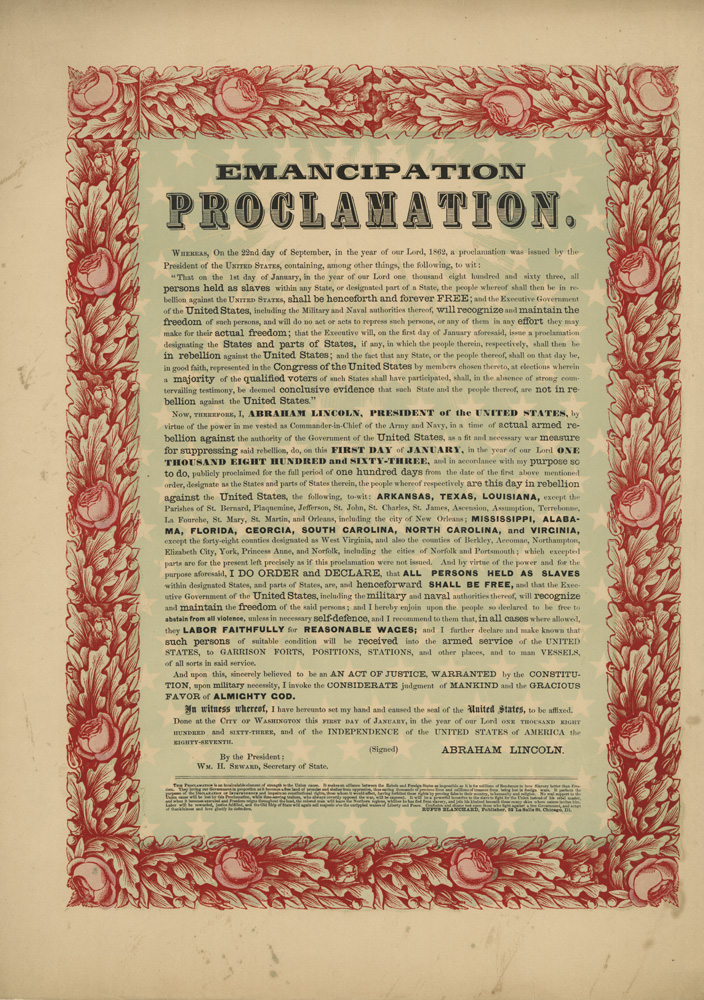
Color lithograph broadside, Chicago, Rufus Blanchard, circa 1864.
In honor of my enslaved ancestors, freed this day 151 years ago.
Color lithograph broadside, Chicago, Rufus Blanchard, circa 1864.
Two of Lucinda McNeely‘s sons are accounted for, but what of her older children, John and Alice?
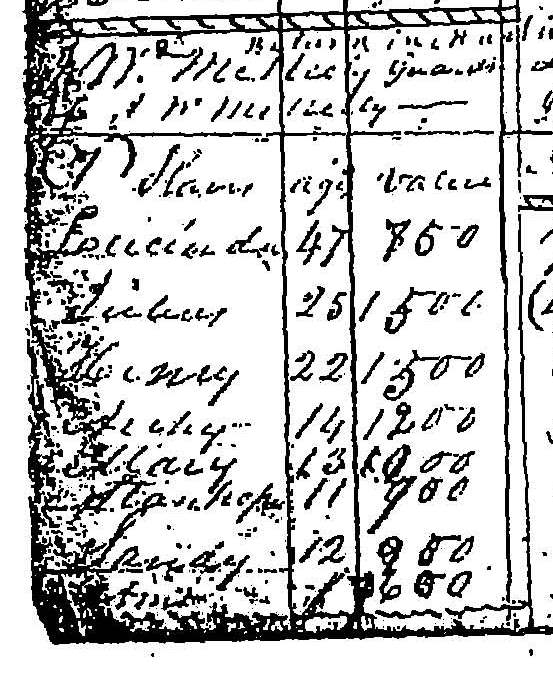
The record for Alice is frustratingly scant. I have found her exactly twice. Once, in the deed filed by Mary Kilpatrick when she sold Alice, Lucinda and John to Samuel and John McNeely in 1834. The McNeely’s slaves seem to have comprised a single extended family — Lucinda, her children, and grandchildren, and the grandchildren probably were all Alice’s. The four listed in the 1863 Rowan County tax assessment above are Archy, Mary, Stanhope and Sandy. Alice is not listed and is presumably dead. (Though, possibly, of course, sold away.)
Alice’s son Joseph Archy McNeely was born about 1849. In the 1870 census of Atwell township, Rowan County, 22 year-old farm laborer Joseph A. McNeely is listed in a household with Lucinda McNeely, 54 year-old domestic servant, Henry McNeely, 29, schoolteacher, and Elizabeth McNeely, 13. Three years later, Joseph Archy McNeely applied for a license to marry Ella Alexander and listed his parents as Henry Courtney and Aley McNeely. (This is the second known reference to Alice.) Over the next 22 years, the couple had at least eight children: Octavia J. (1874), Lucinda (1876), Ann J. (1879), Callie B. (1885), Julius L.A. (1891), Mary E. (1893) and Joseph Oliver (1896).
I have not been able to locate Alice’s daughter Mary after 1863, but in the 1870 census, her sons Sandy and Stanhope appear in their uncle Julius McNeely‘s household as Alexr. and John S. This is the last record I have of either.
Some years ago I decided that Lucinda’s son John was John Rufus McNeely, generally called Rufus, who died 1870-1880 in Rowan County. He married Emeline Atwell about 1855 and was father of five children: Mary, Betty, Charley, Henry and Rufus Alexander McNeely. John’s absence from the 1863 list mystifies me, though, and I’m not sure how I came to this conclusion. For now, I’m withholding sanction.
UPDATE, 26 January 2014: John Rufus McNeely’s 1866 cohabitation registration noted that he was the former slave of John W. McNeely. As the rest of J.W.’s slaves comprised a single family, I renew my conclusion that John Rufus was Lucinda McNeely’s son.
Ring the Court House bell at 10 o’clock every night and at all other times when necessary to alarm the citizens.
Arrest all slaves absent from home after the bell rings and after the calaboose is finished lock them up till day light. Give them 15 lashes and inform the magistrate of their names and owners.
Accept no pass unless the place or places where the slave is permitted to go is written in the same and arrest the slave if found off a direct line or road from one place to another.
Arrest all slaves engaged in a disturbance either with or without a pass.
A pass allowing a slave to visit his wife is good for one month and then must be taken up and another given or he will be arrested.
Iredell County slave ordinances, undated. North Carolina State Archives.
We finally made our way to a theatre to see “12 Years a Slave” today. Throughout this gripping, gut-wrenching film, this ran through my head: “These are my cousins. These are my cousins. These are my cousins.”
My 23andme Relative Finder is filled with matches who know only that their families lived in Mississippi or Louisiana. All my African-American lines are upper South, rooted in Virginia and North Carolina. The link is obvious. My DNA matches are the descendants of the mothers and fathers, aunts, uncles, cousins, and siblings of my ancestors, sold down South in America’s domestic slave trade. The connections are nearly impossible to recreate, the names lost to time, but I take comfort in the fact that the bonds remain detectable in blood and bone.
Jacob, age 65, $450. Abraham, age 45, $1100. Charles, age 25, $1500. George, age 24, $1500. Douglas, age 21, $1500. John, age 2, $150. Cephas, age 1, $100. Edwin, age 1, $100. Willy, infant, $100. Hagar, age 70, age $100. Margaret, age 42, $850. Caroline, age 23, $1200. Lucianna, age 20, $1200. Eliza, age 17, $1200. Mary Ann, age 13, $1000. Grace, age 10, $500. Martha, age 7, $350. Angeline, age 7, $350. Mag, age 3, $200.
These are the enslaved people — total value, $13,450 — that John M. McConnaughey reported to a Confederate tax assessor canvassing Rowan County, North Carolina, in 1863. Who were these 19 people? What were their links to one another?
Let’s start with the women. Hagar, at age 70, could have been the mother (or grandmother) of any or all of the McConnaughey slaves except Jacob. She was enumerated with McConnaughey in the 1850 slave schedule — 58 year-old mulatto female — and 1860 federal slave schedule — 68 year-old mulatto female. However, as detailed below, the composition of McConnaughey’s slaves changed extensively in the 1850s, and her relationship to others cannot be determined. In 1866, Hagar McConnaughey and David Litaker registered their 13-year cohabitation at the Rowan County courthouse, but she is not found in the 1870 census. Litaker appears as a single man, living in a household of white Litakers, and we can safely assume that Hagar had passed away. In 1867, when Benjamin McConnaughey married Adaline Gilliam, he listed his parents as March and Hagar McConnaughey. Here, perhaps, was Hagar’s first husband. Was he also owned by John M. McConnaughey?
Margaret was the mother or grandmother of at least six of McConnaughey’s slaves — George, Caroline, Mary Ann, Grace, Martha, Angeline and John — comprising a single extended family. Where was her husband? Among the small units of slaves like John McConnaughey’s (and the majority of other North Carolina slaveholders), husbands and wives rarely belonged to the same master or lived on the same farm. Death certificates and marriage records for several of Margaret’s children name Edward Miller as their father. (John’s father, however, is reputed to have been John McConnaughey himself.) The couple did not file their cohabitation, and Edward may have died before Emancipation. He probably had belonged to and lived on one of several neighboring farms owned by white Millers.
There are two other young women, “Lucianna” and Eliza, who were of an age to have been Margaret’s children. Were they? When Louisiana McConnaughey and Hezekiah Mitchell registered their six-year cohabitation in Rowan County in 1866, Louisiana noted that John McConnaughey had been her master. Three year-old Mag may have been Louisiana and Hezekiah’s child. If so, was she named for Margaret, possibly her grandmother? I haven’t found Louisiana, Hezekiah or Mag in the 1870 census or elsewhere, and have no evidence of their kinship to Margaret.
An Eliza McConnaughey appears in 1870 in the crazy-quilt household of John McConnaughey. McConnaughey never married and the only other white person reported under his roof was his nephew, Dr. Joseph L. McConnaughey, 34. The remainder of the household consisted of Peggy Ferran, 70 and blind; domestic servant/cook Eliza McConnaughey, 25, with her probable daughters, Alice, 7, and Rena, 4; 14 year-old Henry Ellis, a schoolboy; farm laborer Ed McConnaughey, 45; Dallas McConnaughey, 14; Harriet Barr, 40, also a domestic servant; and farm laborer-cum-schoolgirl (and my great-great-grandmother), Martha Miller, 14. Nearly all, it appears, were the former slaves of John McConnaughey (Martha and possibly Eliza) or of Joseph, who inherited them after his father James C. McConnaughey’s death in 1864 (Ed, Dallas, possibly Harriet, and possibly Eliza and her daughter Alice.)
Jacob did not register a cohabitation in Rowan County and does not appear under the surname McConnaughey in the 1870 census of the county.
In 1866 in Rowan County, Abram McConnaughey (the “Abraham” above) registered his six-year cohabitation with Eliza Barger. The family appears in the 1870 census of Mount Ulla, Rowan County: A. McConnaughey, 57, Eliza, 45, Peggy, 30, Francis, 14, Mitchel, 10, George, 4, and Charlotte McConnaughey, 1. (They are listed next door to Margaret McConnaughey, her granddaughter Angeline and son John.) In 1872, Abram married Phillis Cowan in Rowan County, and the license lists his parents as James Kerr and Esther McConnaughey. In 1893, he married again, to Jennie Rosebro, and gave his parents as James Kerr and Hester Ann Robinson. It is not clear who the parents are of the children listed in the household, and it seems possible that both Eliza and Peggy were, if not Abram’s wives, women by whom he had children. Two of Abram’s sons married in Rowan. William Giles McConnaughey, who married in 1867, listed his parents as Abram and Vina McConnaughey. The following year, James McConnaughey listed his parents as Abram and Phillis Lavina McConnaughey. In 1889, when Charlotte McConnaughey married Charles Brown in Rowan County, she listed her parents as Abram McConnaughey and Peggy Barber. (Is this the Peggy above?)
There are two Charles McConnaugheys in the 1870 census of Rowan County. One is a 36 year-old listed in the household of John Barger. Abram and Eliza McConnaughey’s cohabitation registration reveals that Eliza have been owned by John Barger (and her children with her.) If the Charles in Barger’s household was a son of Abraham and Eliza, he would not have been the Charles listed above. The other is a Charles McConnaughey, 40, listed with wife Phillis and ten children in Atwell township. This Charles is a little old to be the same as the one listed in 1863 and may instead have been the Charles owned by James C. McConnaughey.
Margaret McConnaughey’s son George is found in all post-Emancipation records as “George Miller,” having adopted his father’s surname. I have assumed that his wife, Eliza Kerr, and oldest child, Baldy Alexander Miller, born 1858, had a different owner. However, the cohabitation registration for George Washington Miller and Eliza Catherine Kerr seems to indicate that both were the former slaves of John M. McConnaughey. There was in Eliza of the right age in the 1863 list, but no young Baldy or Alex.
In 1870, the McDowell County censustaker enumerated a railroad laborer named Douglas McConaughy in a camp in Old Fort township. [He appears to have been working on the Mountain Division of the Western Railroad, a project that extended the railroad over the continental divide and connected both ends of the state.] Though his age is off by about six years, this may have been the Douglas listed among John M. McConnaughey’s slaves. Was Douglas also Margaret’s son? By age he could have been, but there is no evidence to prove so. (Of note, however: Mary Ann McConnaughey Miller named one of her sons James Douglas. For his uncle, perhaps?)
John McConnaughey was Margaret’s youngest son and is supposed to have been the son of John M. McConnaughey. He appears twice in the 1870 census, once with his mother and again in his sister Mary Ann Miller’s household.
Cephas, Edwin and Willy have not been found post-Emancipation.
Margaret McConnaughey’s six known children were born in 1835, 1840, 1847, 1853, 1855 and 1861. Given the gaps in their birth years, it is reasonable to assume that she bore additional children, perhaps Douglas (1842), Louisiana (1843) and Eliza (1846). (Though, of course, if Eliza were George Miller’s wife, she would not have been his sister.) Unfortunately, the available evidence is insufficient to establish these relationships or others among McConnaughey’s slaves.
In 1850, James Nicholson of northern Iredell County dictated a will that distributed 17 enslaved people – Milas, Dinah, Jack, Liza, Peter, Elix, Paris, Daniel, Carlos, Nelson, Lucinda, Joe, Manoe, Armstrong, Manless, Calvin and Sophie — among his heirs. I am descended from one, Lucinda, whose daughter Harriet was conceived after she joined Thomas A. Nicholson’s household. As I wrote here, Lucinda is found post-slavery only on death certificates of two of her children. What of the other 16? Are they any easier to trace?
In a word – no.
Mary Allison Nicholson received five slaves from her husband’s estate. Son Thomas received three outright and a share in five others. Son John McCombs Nicholson received four and a share in the same five. (It is not at all clear whether the groupings of these 17 people respected family units or were simply combinations devised with an eye for equal value.) Mary died in 1857 and, presumably, her property passed to her sons. However, in the 1860 slave schedule of Iredell County, only two Nicholson slaveholders appear: Thomas, who owned 13, and Martin T. Nicholson, who owned three. (Martin was Thomas’ brother-in-law and first cousin.) In the population schedule, Thomas reported owning $11,000 worth of personal property, a figure that would have included the value of his slaves. His brother John reported only $565. Had he sold his?
And the bigger question, where did Thomas’ slaves go after Emancipation? Freedmen did not always adopt the surnames of their immediate masters, of course, but in the 1870 census of Iredell County, only four black residents claimed the surname Nicholson. Eliza Nicholson, age 25, lived in the household of Thomas Nicholson’s son Wes. She presumably is the Liza of James’ estate. Manless Nicholson, 22, his wife (?) Maggie Nicholson, 24, and daughter Annie, 5, lived in Thomas’ household and worked for him. Manless had been jointly owned by Thomas and his brother. In Yadkin, the adjoining county, 35 year-old Alaxander Nicholson (probably the “Elix” above) is listed in the household of Isabel Cartwright. But that is it. No more.
Obviously, some people were simply inadvertently omitted from the 1870 schedule, such as Lucinda and her daughter Harriet, who were clearly living in Iredell then, and Milas Nicholson, who appears ten years later in Turnersburg township, Iredell County, as a 33 year-old with a wife and child. Also, the 1880 census of Deep Creek, Yadkin County, shows an 80 year-old Sophia Nicholson who may have been “Soffie.” (And was probably Manlius “Manless” Nicholson’s mother, as a Yadkin County marriage license and his death certificate indicate.) Of Dinah, Daniel, Nelson, Armstrong and the others, however, there is no trace, either in surrounding counties or under a different surname.
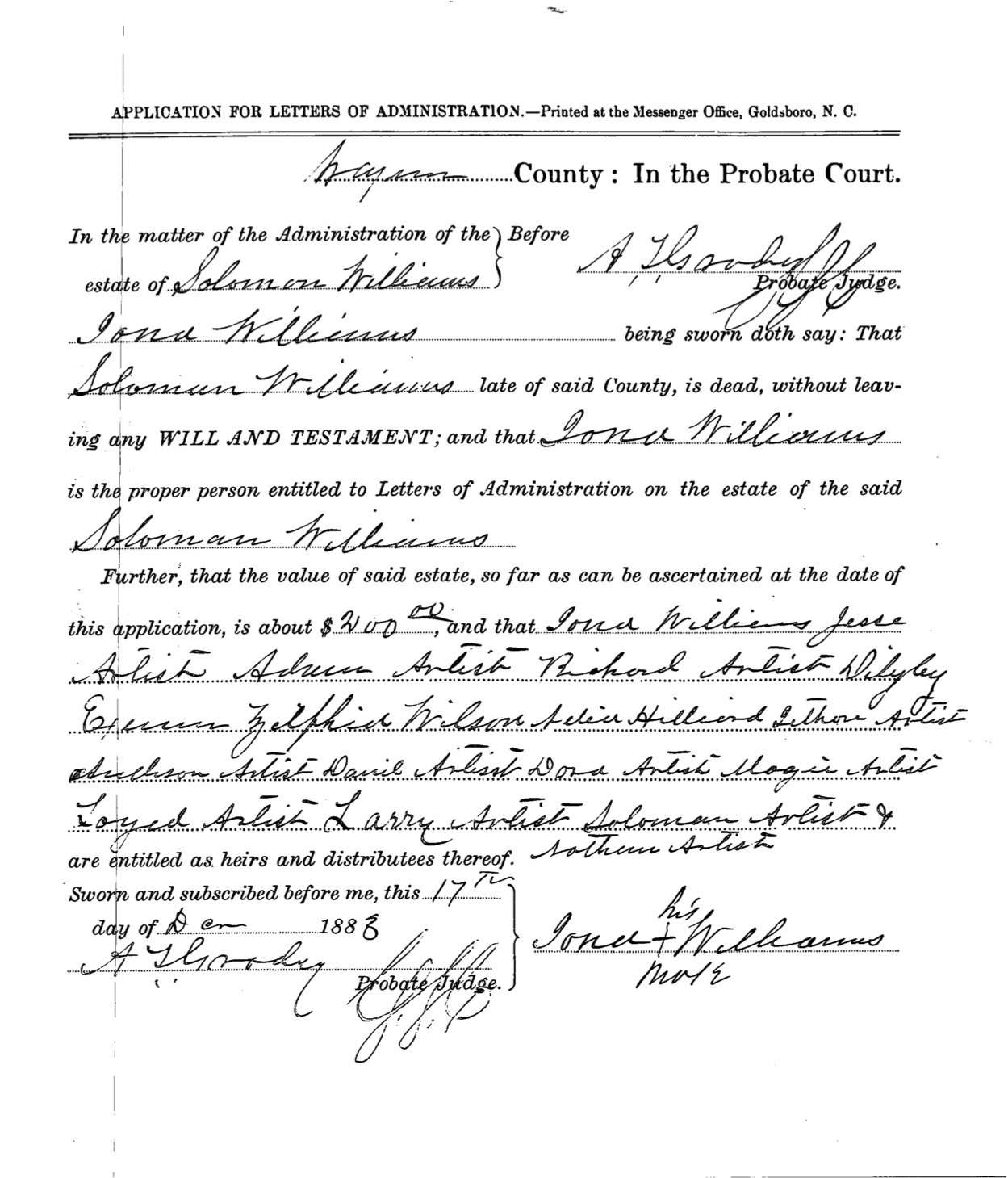
Vicey Artis, a free woman of color, and Solomon Williams, a slave, had eleven children together – Zilpha Artis Wilson, Adam Toussaint Artis, Jane Artis Artis, Loumiza Artis Artis, Charity Artis, Lewis Artis, Jonah Williams, Jethro Artis, Jesse Artis, Richard Artis and Delilah Williams Exum — before they were able to marry legally. On 31 August 1866, they registered their 35-year cohabitation in Wayne County. Vicey died soon after, but Solomon lived until 1883. The document above, found among Solomon’s estate papers, names son Jonah as administrator and lists his and Vicey’s six surviving children and the heirs of their deceased children.
Little is known about Solomon. He was born about 1800. A few slaveowning Williams families lived in Vicey Artis’ vicinity in Greene County, but there is no evidence to link Solomon to them. He appears in the 1870 and 1880 censuses of Nahunta township, Wayne County, heading households comprised of his daughters and their children, and is recorded as father on the marriage licenses of daughter Lomisy (Loumiza) Williams and son Adam Artis and the death certificates of children Jonah Williams, Richard Artis and Delila Exum.
Thanks to Marion “Monk” Moore and Joan Howell Waddell, I’ve been able to identify the approximate locations of several of the white farmer-landowners listed near Willis and Cherry Battle Barnes in the 1870 census. If the family remained in the general area in which they had been enslaved, Hugh B. Johnston’s speculation is correct.
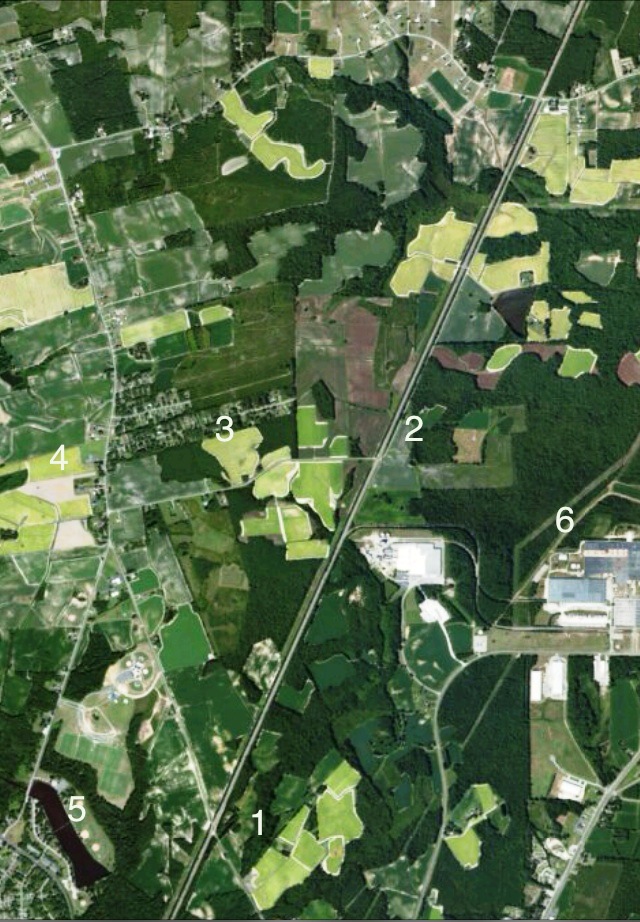
Toisnot Reservoir, a dammed stretch of Toisnot Swamp, today lies on the northern edge of the city of Wilson. Joshua Barnes, Alpheus Branch, Ceborn Farmer, Isaac Farmer and Jesse Farmer’s farms all lay north of the swamp and south of present-day Elm City in a corridor now defined by London Church Road, the CSX Railroad (then the Wilmington & Weldon) and US Highway 301. The Barneses lived somewhere in this area. In the photo above, the diagonal running top to bottom is the railroad, London Church Road bows to the left, and numbers mark the approximate locations of farms and modern landmarks: (1) Isaac Farmer land; (2) Seborn Farmer land; (3) Alpheus Branch land; (4) Joshua Barnes land; (5) Toisnot Reservoir; and (6) the Bridgestone-Firestone tire plant.
——
In a letter dated 11 January 2007, Waddell included a map of Wilson County with the above properties marked. Many thanks to her and Monk Moore.
——
Update, 23 June 2015: Joshua Barnes’ house is not only still standing, it’s been continuously occupied since the 1840s and was on the market just a few years ago. It’s located at 3415 London Church Road.

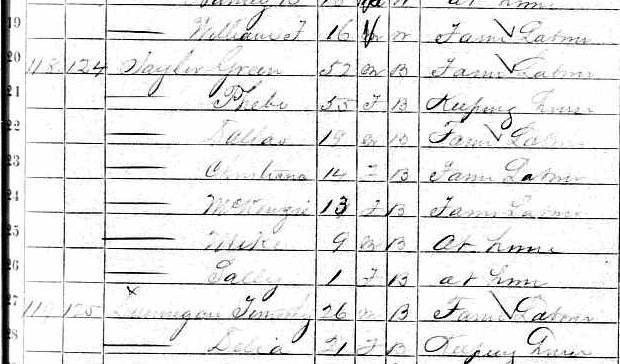
Sometime between the dissolution of their former master’s estate in 1856 and the arrival of the census taker in the early summer of 1870, Green and Fereby Taylor found their way to Lower Town Creek township (now the Pinetops area), Edgecombe County. In that year, their household included four children – Dallas, 19; Christiana, 14; Mckenzie, 13; Mike, 9; and Sally Taylor, 1. There is no sign of the older children – Peter and Henrietta – who had been listed with Fereby in the division of Kinchen Taylor’s slaves. Ten years later, Dallas and Mike had left, but Christiana, Kinsey and Sarah, as well grandchildren Nannie, 5, Carrie, 1, Lizzie, 8, Louisa, 5, and Isaiah Taylor, 2, remained at home. Of all these folk, only Mike Taylor has been found post-1880.
[Update: see this.]
I give and bequeath to my beloved son Thomas A. the following Negroes to wit Carlos Nelson Lucinda and Joe.
——
On 19 Nov 1850, James Nicholson wrote out his last will and testament. Two days later, before he could sign it, he slipped into death. The document was registered 19 Jun 1852 in Will Book 4, page 666 at the Iredell County Register of Deeds Office. Nicholson’s only heirs were his widow Mary Allison Nicholson and sons Thomas A. and John M. Nicholson. James left Thomas 185 acres and John 242 acres and gave them a 75-acre mill tract in common. Mary Nicholson received slaves Milas, Dinah, Jack, Liza and Peter; John received slaves Elix, Paris and Daniel; and Thomas received the four named above. In addition, James bequeathed Thomas and John slaves Manoe, Armstrong, Manless, Calvin and Soffie jointly.
Thomas A. Nicholson put Lucinda to work in his home preparing meals and otherwise caring for his family. As Thomas’ son James Lee Nicholson grew to adulthood, he took increasing notice of the woman who cooked his suppers, laundered his shirts and emptied his slops. In 1861, she gave birth to his first child, a daughter that she named Harriet Nicholson. Lucinda and Harriet remained in Thomas Nicholson’s household till Emancipation, when they were provided with a small house and other support.
As the story goes, Harriet did not learn her father’s identity until her mother Lucinda revealed it on her deathbed. Lee Nicholson passed away when Harriet was 10 years old, leaving a widow and two small boys. Lucinda may have died even earlier, as she has not been found in the 1870 census. She had one other child, a son named William H. Nicholson, whose father was Burwell Carson. Based on information supplied by Harriet, William’s death certificate lists Lucinda’s maiden name as Cowles. We know nothing else about her life.
 Scuffalong: Genealogy.