
I spoke by phone almost two hours yesterday with D.J., who reached out to me via Scuffalong. I started this blog for several reasons, an important one being the hope that others interested in the families I’m researching would find useful information and would reach out to collaborate. In just over a year, I’ve connected to several such people and, in addition to sharing my research, have gained access to invaluable leads and angles that I’d never considered. I was particularly happy to “meet” D.J. though, because she is also a cousin. We are descended to the same degree from two of Adam T. Artis‘ daughters — Louvicey and Lillie Beatrice — making us fourth cousins.
Category Archives: Free People of Color
Enlighten me; or how to obtain just dues.
In 1899, North Carolina passed a constitutional amendment that created new literacy and property restrictions on voting, but exempted those whose ancestors had the right to vote before the Civil War. The intent and impact of the amendment was to prevent generally poor and often illiterate African-Americans from voting, without disfranchising poor and illiterate whites:
Public Laws of North Carolina, 1899, chapter 218.
(Sec. 4.) Every person presenting himself for registration shall be able to read and write any section of the constitution in the English language and before he shall be entitled to vote he shall have paid on or before the first day of March of the year in which he proposes to vote his poll tax as prescribed by law for the previous year. Poll taxes shall be a lien only on assessed property and no process shall issue to enforce the collection of the same except against assessed property.
(Sec. 5.) No male person who was on January one, eighteen hundred and sixty-seven, or at any time prior thereto entitled to vote under the laws of any states in the United States wherein he then resided, and no lineal descendant of any such person, shall be denied the right to register and vote at any election in this state by reason of his failure to possess the educational qualification prescribed in section four of this article….
In 1902 — 112 years ago today — my great-great-grandfather John W. Aldridge, a steadfast if low-key supporter of local Republican politics, took pen in hand for a tight-jawed letter to the editor of a newspaper in the state capital:

Raleigh Morning Post, 15 October 1902.
——
The following “colored” men were among those who registered to vote in Wayne County in 1902. In accordance with Section 5, each was required to name the ancestor who “grandfathered” him in. Despite his very public protest, and his brothers’ successful registrations, John W. Aldridge’s name does not appear:
Joseph Aldridge, 36, Brogden, Robert Aldridge.
M.W. Aldridge, 45, Goldsboro, Robert Aldridge.
Robert Aldridge, 33, Brogden, Robert Aldridge.
Marshall Carter, 42, Brogden, Mike Carter. [Marshall Carter’s son Milford married John W. Aldridge’s daughter, Beulah.]
Williby Carter, 22, Brogden, Mike Carter. [Williby was Beulah Aldridge Carter‘s brother-in-law.]
H.E. Hagans, 34, Goldsboro, Napoleon Hagans. [Napoleon and Henry Hagans were the half-brother and nephew, respectively, of Frances Seaberry Artis, wife of Adam T. Artis.]
W.S. Hagans, 31, Nahunta, Dr. Ward. [William was another son of Napoleon. “Dr. Ward” was his white grandfather.]
John H. Jacob, 52, Brogden, Jesse Jacob. [Jesse and John Jacobs were the father and brother of Jesse A. Jacobs Jr., who married Sarah Henderson.]
Wiley Mozingo, 76, Goldsboro, Christopher Mozingo. [Wiley Mozingo’s daughter Patience Mozingo married Noah Artis, son of Adam T. Artis. His granddaughter Ora B. Mozingo married John W. Aldridge’s son, John J. Aldridge.]
Merchant brothers.
From the Wayne County section of the North Carolina Year Book and Business Directory, published by the News and Observer, Raleigh, 1904:
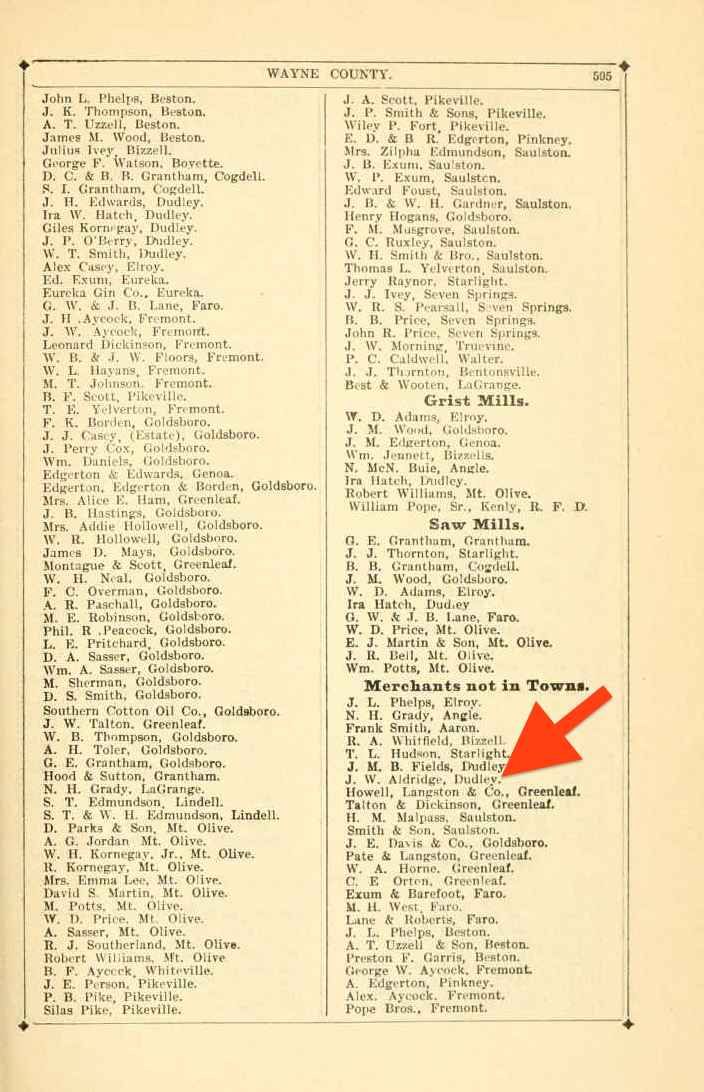
John W. Aldridge‘s brother Mathew “M.W.” Aldridge was listed under the merchant heading in the town of Goldsboro.
He was faithful in all his houses.
The Wilson Daily Times was an afternoon paper in my day. It was lying in the driveway when I arrived home from school, and I could read it first if I put it back like it was — pages squared and neatly folded. (Even today, I shudder at a sloppy newspaper, flipped inside out and pages sprawling.) The Daily Times‘ roots are in Zion’s Landmark, a semi-monthly newsletter begun in 1867 by Pleasant Daniel Gold. Elder Gold (1833-1920), pastor of Wilson Primitive Baptist Church, filled the periodical with sermons and homilies, ads for homeopathic remedies, testimonials, altar calls and, most enduringly, obituaries of Primitive Baptists throughout eastern North Carolina.
African-Americans did not often make it into the pages of the Landmark, but P.D. Gold held Jonah Williams in considerable esteem. Gold preached my great-great-great-great-uncle’s funeral and published in the Landmark a lengthy obituary by Brother Henry S. Reid, clerk at Turner Swamp Primitive Baptist Church:
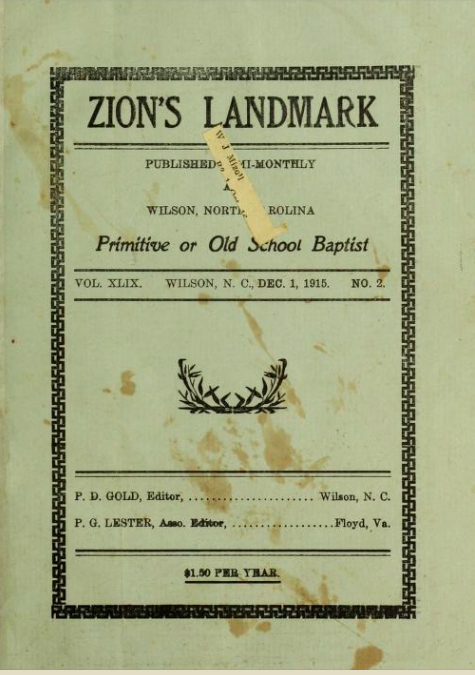


And what does this piece add to what I already know about Jonah Williams?
- A marriage date for him and Pleasant Battle — 4 January 1867.
- Some confusion about their children. I knew Pleasant had a slew of children from a previous marriage to Blount Battle. However, I had four children for Jonah and Pleasant — Clarissa (the surviving daughter referred to in the obit), Willie F. (1872-1895), Vicey (1874-1890), and J.W., whom I know only from a stone in the Williams’ cemetery plot. I’m thinking now that this is a foot marker, rather than a headstone, and I’ll revise my notes.
- Jonah joined Aycock Primitive Baptist Church, part of the Black Creek Association, around 1875.
- Around 1895, he and others were permitted to leave Aycock and form Turner Swamp Primitive Baptist Church, the first “organized colored” P.B. church in the area. The Black Creek Association ordained Jonah when he was called to serve at Turner Swamp.
- Elder P.D. Gold preached Jonah Williams’ funeral.
Text found at https://archive.org/details/zionslandmarkse4919unse_0
Daniel Artis, Union soldier?
Daniel Artis’ pension file arrived today, and I was puzzled. Was this either of “my” Daniels?
As detailed here, Daniel Artis, allegedly went to war as a body servant for Confederate officer Christopher C. Lane. There are two Daniel Artises. One was born about 1820 and would have been well into middle age when he trudged off to battle. On the other hand, his nephew Daniel Artis, Sylvania’s son, was born about 1843, and was in his prime when the Civil War erupted.
What does the file tell us? It’s a slim one, as pension application files go. Daniel’s request for assistance was rejected summarily, so there was no need to interview his neighbors and kin to corroborate his claims. Still, it is useful.
On 2 December 1901, the Board of Review received an application from DANIEL ARTIES, G 14 USCHA, and assigned it claim number 1277226. Milo B. Stevens & Company of Washington, D.C., a firm of attorneys specializing in pension claims, represented the old soldier. Daniel gave his address as P.O. Box 5, Greenville, Pitt Co., NC, and stated that he had enrolled in the Army in an unknown date in 1865 and been discharged on 11 December of the same year. Despite the Pitt County address, Artis granted Stevens power of attorney on a form sworn to in Wayne County — specifically, Eureka — in the presence of W.M. Exum and Philip Forte. I’m not clear on Exum’s identity, but Forte was a prominent African-American in the neighbor and himself a Union veteran. Further, Forte’s daughter Hannah married Daniel’s cousin Walter S. Artis, son of Adam and Frances Seaberry Artis. Simon S. Strother, the notary public who stamped Daniel’s application, was executor of Adam T. Artis’ estate.) At some point, a commissioner requested “personal description and name of owner” from Artis, but the response — which would have included an assertion of his freeborn status — is not found.

Daniel’s supporting declaration for invalid pension stated that he was 68 years old, that he had been discharged at Fort Macon, and that he was unable to support himself by manual labor due to “rheumatism in back and hip and piles and affected in the breast.” Daniel signed the document with an X.
And then the downer: “Rejection on the ground that the soldiers name is not borne on the rolls of Co G, 14th U.S.Col.H.A., as alleged, as shown by the report from the War Department.”

So, which Daniel is this? Several clues help eliminate Daniel the elder. First, he was born circa 1820, well before Daniel the applicant. Second, Daniel the elder owned significant property in Greene County and is not known to have lived in either Wayne or Pitt Counties. Last, and this applies to either, if Daniel served Christopher C. Lane during his time as an officer in Company A, 3rd North Carolina Artillery from about 1861 till his death in 1864, is it likely that he would have trudged home from Georgia, turned around, gone to New Bern, and enlisted in the Colored Troops in 1865?
My money is on Daniel, son of Sylvania Artis and Guy Lane. Here’s the little I know about him:
In the 1850 census of Greene County, next to white farmer John Lane, Silvany Artess is listed with her children Daniel, Mitchell, Meriah, Gui, and Penny Artess. Ten years later, John Lane’s household included Dannel, Mike, Penney, Dyner, Juley, and Washington Artis, who probably were his apprentices. Next door was 40 year-old Dannel Artis, the children’s uncle. On the other side, their mother Sylvania Artis.
Around 1861, Daniel went to war with John Lane’s son Christopher and returned home in 1864. Surely it is he, and not his 45 year-old uncle Daniel, that enlisted in the Union Army in 1865. His service was short-lived, and he apparently returned to Greene County after.
Guy Lane and Sylvania Artis formalized their marriage a year after he was emancipated, and by 1870 the family had moved several miles west into Nahunta district, Wayne County. There, Guy Lane and wife Silvania are shown in the census with children Daniel, Mike [Mitchell], Mariah, Guy, Penny, Dinah, Julie, Washington, and Alford.
In the 1880 census in Bull Doze [Bull Head] township, Greene County, Daniel Artis appears with his wife Eliza and children Emma D. and James W. I cannot find him in any census thereafter. However, if he is the Daniel Artis who applied for a Civil War pension, he was living in Wayne or Pitt County from 1900 until at least 1904. The notice below also seems to indicate that he was alive as late as 1905, when Dunk Lane and “Miss Dickerson” used his house as a place of assignation. This is the last evidence I have of Daniel Artis’ life.

Goldsboro Weekly Argus, 1 August 1907.
Family cemeteries, no. 15: Henderson-Aldridge.
There was another Aldridge cemetery, but its whereabouts are only vaguely remembered. Not far off Highway 117. A few miles north of Dudley. Robert Aldridge was buried there about 1899 and, presumably his wife Mary Eliza Balkcum Aldridge, too. There they remain, though others who died in that era were disinterred and moved to what is now known as the Henderson-Aldridge cemetery.
The oldest graves belong to Robert and Eliza’s son John W. Aldrich (1853-1910), his wife Vicey Artis Aldrich (1865-1927), and their daughters Lula Aldridge (1882-1918) and Amanda Aldridge Newsome. [“Aldrich” was the preferred spelling of son J. Thomas Aldrich, who erected the stones.] Most of the other graves belong to descendants of John and Vicey, or of John’s brother Robert Jr. and his offspring.

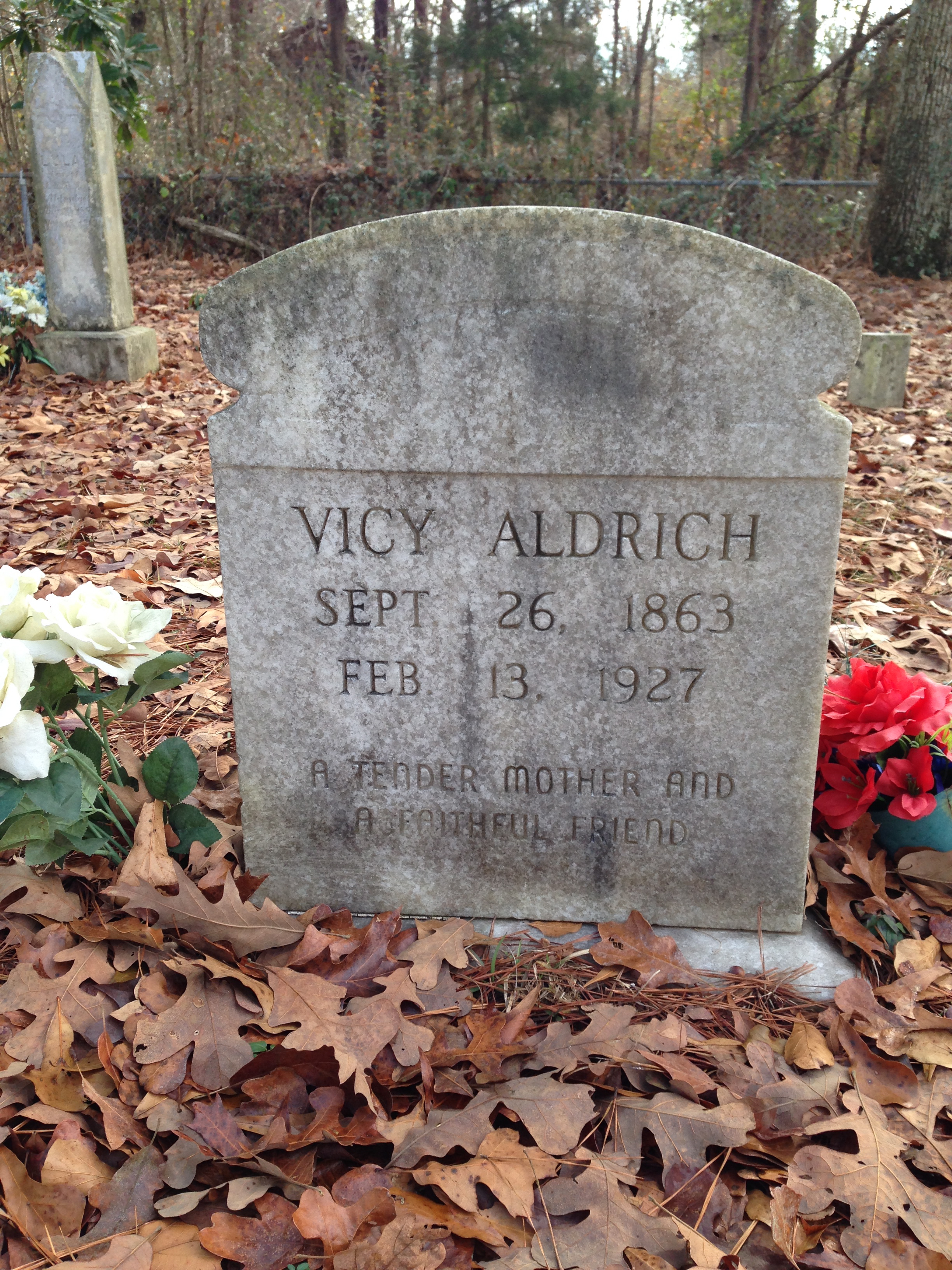
Burials include Catherine Aldridge Davis (1900-2009) and her son George E. Davis (1921-1964); Lenora Henderson (1902-1961) and husband Henry Lee Henderson (1901-1942); Aaron H. Henderson (1922-1943); Horace B. Henderson (1923-1984) and wife Katie Lee Henderson (1924-1963); Hoover Aldridge (1929-1970); Dr. James T. Aldrich (1890-1968) and wife Athalia F. Aldrich; Frances Newsome (1883-1961); Allen Aldridge (1908-1969); Milford Aldridge (1913-1985); Sarah Eliza Aldridge Powell (1918-1998); Paul Aldridge (1913-1947) and wife Lonie Mae Aldridge (1919-1940); Robert Aldridge (1865-1941); Lula Aldridge (1882-1919); Amanda A. Newsome (1892-1918); Bennie R. Aldridge Jr. (1940-2008); and, most recently, Isaiah Len Henderson (1998-2013) and Ross M. Sutton (1935-2013).
Photos by Lisa Y. Henderson, 2013.
Nothing could swerve him.
I felt sure that Napoleon Hagans‘ death had merited more than the brief mention I’d seen in the Goldsboro Headlight, and last night I found it:
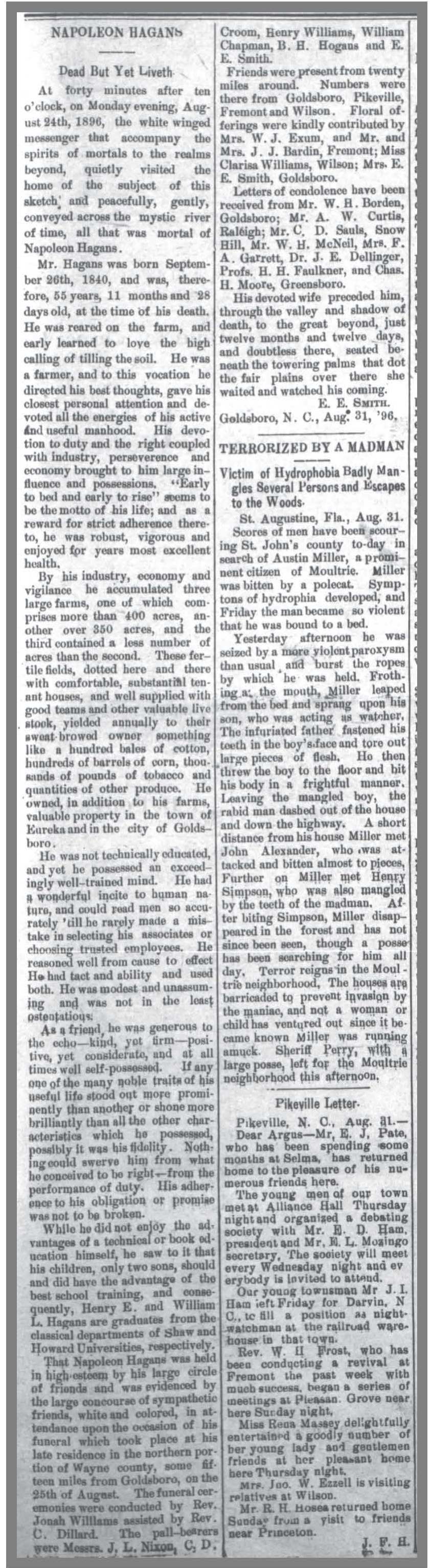
Goldsboro Daily Argus, 1 September 1896.
This shining eulogy was penned by Ezekiel Ezra “E.E.” Smith (1852-1933), college president, recent United States Ambassador to Liberia, and arguably the most accomplished of Wayne County’s 19th-century African American citizens. (Smith was born free in Duplin County, just to the south, but moved to Goldsboro as a young man, married a cousin of Napoleon’s daughter-in-law Lizzie Burnett Hagans, and was principal for a time of Goldsboro’s colored school.) Side-stepping the indelicate issue of Napoleon’s parentage, E.E. painted a glowing portrait of his friend’s virtues — his hard work, his astuteness, his self-built wealth, his determination to give his children what he lacked. Napoleon’s business acumen and successes won relationships across color lines and among North Carolina’s colored elite, and E.E. listed those who took part in the funeral or had taken the time to reach out to pay respects:
- Rev. Jonah Williams, Eureka. Jonah Williams was the elder of a Baptist church a few miles from Napoleon’s home (and a central figure in the establishment of Primitive Baptist congregations in the area) and had, like Napoleon, been involved in Republican politics. Jonah’s brother, Adam T. Artis, married Napoleon’s half-sister, Frances Seaberry.
- Rev. Clarence Dillard, Goldsboro. Clarence Dillard, Howard University Theology ’83, came to Goldsboro as a Presbyterian minister and was principal of the colored graded school at Napoleon’s death. (It is said that he traded a teaching position at Agricultural & Mechanical College for the Colored Race [now North Carolina Agricultural & Technical State University] to Napoleon’s son Henry E. Hagans for this job.) Dillard was active in Republican politics and was co-editor of a short-lived African-American newspaper in Goldsboro, The Voice.
- J.L. Nixon, Goldsboro. John Louis Nixon (1855-1919) was co-editor and manager of The Voice and, later, secretary of the Goldsboro-based United Church Benevolent Society and a mail clerk for the United States Postal Service. He was a native of Wilmington.
- C.D. Crooms, Goldsboro. Charles D. Crooms was a teacher and merchant.
- Henry Williams.
- William Chapman, Goldsboro. William Chapman (or Chatman) married Susan Burnett, mother-in-law of Napoleon’s son William S. Hagans.
- B.H. Hogans, Goldsboro. Benjamin Harrison Hogans (1865-1926) was a teacher, a trustee of Saint James AME Zion Church and, later, a mail carrier. He was born in Orange County and came to Goldsboro as a child with his parents Haywood and Zilpha Latta Hogans.
- E.E. Smith.
- Mrs. W.J. Exum, Fremont. Mary Burt Alston Exum, white, was the widow of William J. Exum (1825-1885), a prominent farmer and former slaveowner in northern Wayne County. Napoleon bought land from William (and Mary, after William’s death).
- Mr. and Mrs. J.J. Bardin, Fremont. John J. Bardin, white, was a druggist in Fremont.
- Miss Clarisa Williams, Wilson. Clarissa Williams, Jonah Williams’ daughter, was a teacher in Wilson.
- Mrs. E.E. Smith, Goldsboro. Willie Ann Burnett Smith, daughter of Dolly Burnett, was a cousin of Napoleon’s son William’s wife Lizzie E. Burnett. William Chapman was Willie Burnett Smith’s step-father.
- W.H. Borden, Goldsboro. William H. Borden (1841-1905), white, was president of Goldsboro Furniture Company.
- A.W. Curtis, Raleigh. Rev. A.W. Curtis, white, lead the Congregational Church mission in Raleigh.
- C.D. Sauls, Snow Hill. Cain D. Sauls (1864-1938) of Greene County wore many hats — farmer, merchant, newspaper columnist, banker, justice of the peace, and all-around businessman. He was the grandson of Daniel Artis, who was a first cousin of Adam T. Artis.
- W.H. McNeil, Greensboro. William H. McNeill was president of Suburban Investment Company of Greensboro and Piedmont Mutual Life Insurance Company. (The 18 July 1903 edition of Washington DC’s The Colored American reported that Mrs. W.H. McNeill had visited Mrs. F. Douglass at 1720 Fourteenth Street, NW.)
- Mrs. F.A. Garrett, Greensboro.
- J.E. Dellinger, Greensboro. J. Elmer Dellinger (1862-1920) was active in Republican politics and the development of Baptist Sunday Schools, was a physician, and taught chemistry at Agricultural & Mechanical College in Greensboro. He was also a manager of Suburban Investment Company. He was born in Lincoln County, North Carolina.
- H.H. Faulkner, Greensboro. Henry H. Faulkner was a school principal in Greensboro.
- Charles H. Moore, Greensboro. Moore was principal of the first graded school for African-American children in Greensboro.
Artis in Arkansas.
Surprisingly few of Adam Artis‘ 25+ children migrated out of North Carolina, perhaps because the family’s relative farming wealth and good standing in their community made life in North Carolina — even in the 19th century — attractive. Two who did strike out went West. Sort of. They went to Arkansas.
——
Augustus Kerney “Gus” Artis was born about 1857 to Adam and his wife Lucinda Jones. He was a mere toddler when his mother died, and he was reared primarily by Frances Seaberry Artis, whom Adam married in 1861. Gus inherited one-third of his mother’s share of the estate of her father Jacob Ing, a small nest egg that may nonetheless have represented the pinnacle of his wealth. In 1879, Gus married Rebecca Morgan in Wayne County. Though a 13 year-old girl is implausibly described as their daughter in the 1880 census, there is convincing evidence of a daughter Lena, born in 1882. What Gus did or where he was over the years after her birth is a mystery, for in 1893 he suddenly appears in the city directory of Little Rock, Arkansas, living at the corner of Allen and Elm in North Little Rock. (Which, by all accounts, was a swampy outpost known as Argenta at that time.) In 1898, Lena Artis married Charlie Hill in Pulaski County. By 1900, however, she was back in her parents’ house on Washington Avenue in North Little Rock. Farm laborer Gustice Artis and wife Mary R. (presumably Rebecca), married 19 years, are listed with Lena, 18, born in North Carolina, and Mary, 13, an adopted daughter born in Arkansas. By 1910, both daughters had left the household, though Mary reported them living. Augustus, then in his early 50s, worked as a laborer in a greenhouse. Lena, described as a widow, was living and working as a “dining room girl” in a Scott Street boarding house. I’ve found none of the Artises in the 1920 census, though Gus and Mary were still alive. Gus didn’t last much longer though. He died of heart disease 2 June 1921 in Brandie township, Pulaski County, and was buried in the “fraternal cemetery.” His death certificate lists his final occupation as “scavenger.”
——
Twenty-five miles east of North Little Rock, Gus’ younger sister Eliza Artis Everett also built a life far from her home. She was the twin of my great-great-grandmother Louvicey Artis Aldridge; the girls were born in 1865 to Adam Artis and his second wife Frances. I have not found their marriage license, but around 1890, Eliza married Haywood Everett. By 1900, they had migrated to Williams township, Lonoke County, Arkansas, and joined a veritable colony of Wayne County migrants, including Haywood’s elderly parents. Families listed near them in the census carried such familiar surnames as Barnes, Best and Coley. In 1910, the Everetts appear in the Richwoods section of the county. In 1920 and 1930, they are in Walls township. They never had children. On 10 October, 1936, Eliza Everett died of pancreatic cancer. Her husband remarried before she was cold in her grave.
——
Did Gus and Mary Rebecca Artis and Haywood and Eliza Everett migrate together in the late 1880s/early 1890s? Why Arkansas? Did Gus and family originally settle among other Wayne County families in Williams township, Lonoke County, before moving closer to Little Rock? And then there’s this — the Lonoke County Race War of 1897-1898?!?!
The Balkcum women.
In the name of God, Amen, I Hester Balkcum of the State of North Carolina and County of Sampson, being of sound mind & memory, but of feeble health, and knowing that all must die; do make & ordain this my Last Will & Testament. And first I give my body to the dust, to be buried in a decent manner and commend my spirit to the care of God who gave it, as a being infinitely wise & good. As for my worldly goods, my will is that they be disposed of as follows – (viz):
1st. I give & devise to my daughter Nancy Balkcum, thirty acres of land, to be laid off by the direction of my executor, from the eastern extremity of a tract lying on the southside of Beaver Dam swamp, so as to include the house in which she now lives, & a part of the cleared land to her & her heirs forever, in fee simple. I also give & bequeath to my said daughter Nancy the sum of Six dollars in money to be paid her by my executor.
2nd. I give & devise to my grandson, James Lucien Balkcum, son of my daughter Mariah, the residue of said tract of land, lying on Beaver Dam Swamp, after thirty acres as aforesaid shall have been given to my daughter Nancy, the said residue supposed to contain one hundred acres more or less with all the appurtenances thereunto belonging to said James L. Balkcum & his heirs forever in fee simple and I hereby revoke all gifts, grants and deeds of whatsoever nature or kind coming within the meaning & purview of these devises & declare them utterly void as having been done for temporary purposes & having had their effect I also give & bequeath unto said James Lucien Balkcum, one bed, bed-stead & furniture and one pot & skillet.
3rd. I give & bequeath unto my grand daughter Mary Ellen Johnson, daughter of my daughter Mariah, one bed and its necessary furniture and all my household & kitchen furniture not heretofore disposed of, with all clothes & cloths of every description, which I may leave at my decease.
4th. I give & bequeath unto my grand son, John Balkcum, one common Bible, or its equivalent in money
5th. I give & bequeath unto my two grand sons, Harman & Lemuel Balkcum, one common Bible each, or money sufficient to purchase the same
6th. It is my will that my Executor pay all my legal debts, and the above legacies, with the Expense of Administration out of such money or notes as may be left by me at my death and the overplus (if any) be given to my daughter Mariah for her own proper use or benefit.
7th. I hereby constitute & appoint my friend William L. Robinson Executor of this my last Will & Testament, hereby revoking all former Wills, Deeds, gifts or grants of what name or kind soever.
March the 9th day 1843 Hester X Balkcum
Signed, seal’d, publish’d & declared by the Testatrix to be her last Will & Testament in the presence of us, who were present at the signing of the same /s/ Isaiah Robinson /s/ Abner Robinson
State of North Carolina, Sampson County } Court of Pleas and Quarter Sessions, May Term 1843
There was the foregoing will duly proven in open court by the oath of Isaiah Robinson a subscribing witness & ordered to be recorded. /s/ Thomas J. Faison Clk
—–
About 1799, John Balkcum, a widower with two young children, married a woman named Hester in Duplin County NC. Her maiden name is unknown. John died in 1803, leaving as heirs only Hester and his children by his first wife, Tomsin and William. In 1804, Hester received a widow’s allotment and two years later is listed in a Duplin County tax digest with 450 acres.
In the next few years, Hester Balkcum gave birth to two daughters, Nancy and Mariah. She gave them the last name Balkcum, though neither was John’s child. It was the beginning of an unconventional family, with both Nancy and Mariah giving birth out of wedlock, and one or two of Nancy’s children fathered by a black or mixed-race man. (This last circumstance was unconventional, but not nearly as uncommon in antebellum America as one might imagine.) Hester appears only sporadically in census enumerations, but in 1830 “Hester Baucom” is listed in Duplin County heading a household that consisted of a female aged 50-59; one male under 5; two males 5-9; one male 10-14; one male 20-29; one female under 5; one female 15-19; one female 20-29; one female 30-39; all described as white. Ten years later, in the 1840 census of Sampson County, Hester does not appear, but her daughter Nancy Balkcom, aged 30-40, is listed, heading a household of two females aged 5-10 and one female aged 10-14, all white, and one slave.
——
When Hester died in the spring or early summer of 1843, her executor W.L. Robinson listed the debts owed her estate — all to family members — and her meager belongings. Her real property had dwindled considerably since the early days of her widowhood, and I catch a bit of feeling that the family was struggling.

——
Ten years later, Hester’s daughter Nancy felt poorly enough to dictate her own last will and testament:
In the name of God Amen, I Nancy Balkcum of the State of North Carolina & County of Sampson being of sound & perfect mind & memory but feeble in body & feeling that the sentence if Death which has been passed upon all will probably ere long be executed upon me think fit to make this my last will & testament as follows.
First I give my body to be buried in a decent manner without parade or vain shew & commend my spirit to him who gave it as a being infinitely wise & good.
As for my worldly goods my will is that they disposed of as follows
First. I give & bequeath unto my daughter Margaret Balkcum one bed bedstead & furniture (the bed on which I have usuly lain) one wheel & cards one table one sow & pigs & twenty dollars to be paid by my executors. This is for her services in waiting on me in my last sickness to her & her heirs forever
Secondly, I give & bequeath unto my two daughters Eliza & Mary one bed & furniture to them & their heirs forever
Thirdly I desire that my Son Harman be paid back all expence that he may incur in providing for me by my Executor
Fourthly, All the residue of my property both real & personal ( desire to be sold by my executor to the best advantage & after paying all my just debts & funeral expences that the proceeds of said sale be equally divided among all my children
Lastly I hereby make constitute & appoint my friend William L. Robinson Executor of this my last will & testament with full powers to execute the same according to the true intent & meaning thereof & I hereby revoke all former will this the 20th day of August 1853
Signed sealed published & declared by the Testatrix to be her last will & testament hereby revoking all former wills in the presents of us who witnessed the in the presents of the testatrix & of each oth /s/ Nathan Johnson, Joshua X Rackley Nancy X Balkcum
Nancy was dead within six months. The same William L. Robinson who had administered her mother’s estate handled hers, and his inventory reveals Nancy’s slightly better-furnished life.

Inventory of Nancy Balkcum’s estate, 1854.
The account of sale of the property is even more detailed. With the exception of two or three neighbors, all the buyers were Nancy’s children or other close family and they seem to have gotten bargain basement prices. Subtracting the $200 that Harmon Balkcum paid for Nancy’s 32 acres, the remainder of her worldly goods netted only $12.86.


Account of sale of Nancy Balkcum’s estate, 1854.
Documents found in estate files of Hester Balkcum and Nancy Balkcum, Estates Records, Sampson County Records, North Carolina State Archives.
A Seaberry clue.
Back in December, I went on a hunt for Artis cemeteries in the Eureka area. One that I found, just south of the others, holds the remains of William M. Artis and his family. Today, while I was sorting old documents, I ran across William’s death certificate. His place of birth, which I’ve surely read a hundred times, seized my eye:

“Family (Seabury)”? Was this graveyard originally the resting place of William’s maternal great-grandfather, Aaron Seaberry, who died just after 1910? Are there other Seaberrys here, including William’s mother Frances Seaberry Artis? (Who was erroneously referred to as Frances Hagans above. “Hagans” was her mother’s maiden name and the surname of her half-brother Napoleon Hagans. William’s age is off, too. He was 70 when he died.)
 Scuffalong: Genealogy.