Civil War, Free People of Color, Land, North Carolina, Other Documents, Paternal Kin

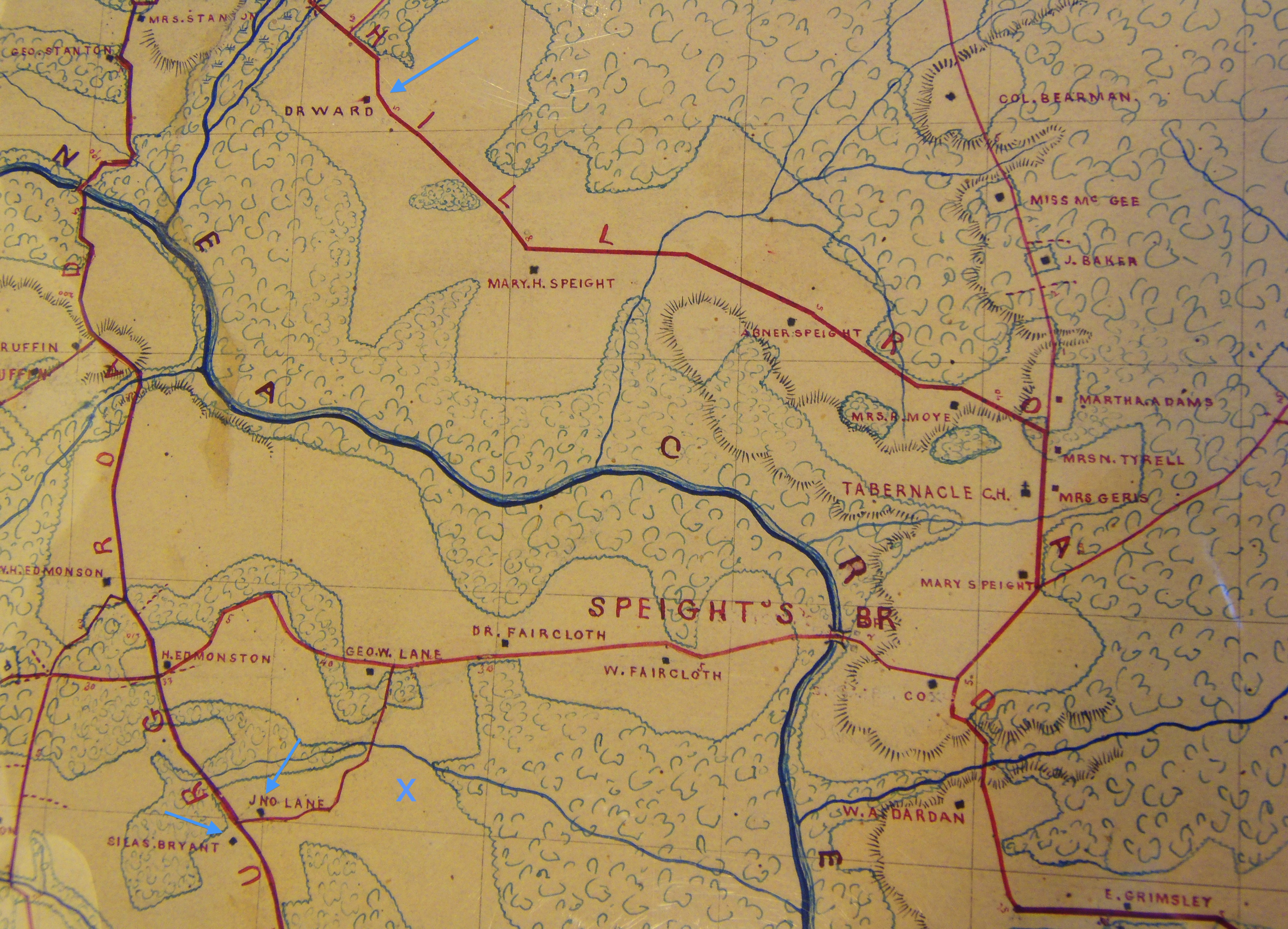
Map, in color.

Last time I was at the North Carolina State Archives, I went looking for the original of this Confederate field map. I didn’t find it, but Trisha Blount Hewitt did.

OLYMPUS DIGITAL CAMERA

Dr. David G.W. Ward’s plantation is just below Stantonsburg at the top, and Silas Bryant and John Lane’s farms — where the Artises were apprenticed — are bottom left. X marks the approximate spot of the Artis Town cemetery.

More thanks to Trisha.

Standard
Births Deaths Marriages, Free People of Color, North Carolina, Paternal Kin

Collateral kin: the Halls.

I was a child plagued by respiratory illness and nearly every winter endured a tough bout with bronchitis. When the worst was over, and I was in a recuperating stage, my mother returned to her teaching job, and I sometimes spent a few days at my Aunt Mildred’s house one street over.

Mildred Henderson Hall was not really my aunt. She was my grandmother’s first cousin, daughter of her uncle Jesse “Jack” Henderson. During my grandmother and father’s childhoods, Uncle Jack and his children were the only nearby Henderson relatives. By time I came along, Mildred, her youngest sister Doris Henderson Ward and some of their children were the only other Hendersons left in Wilson. Mildred’s youngest daughters were still at home when I was child, and I grew to know them and the younger of their two brothers best.

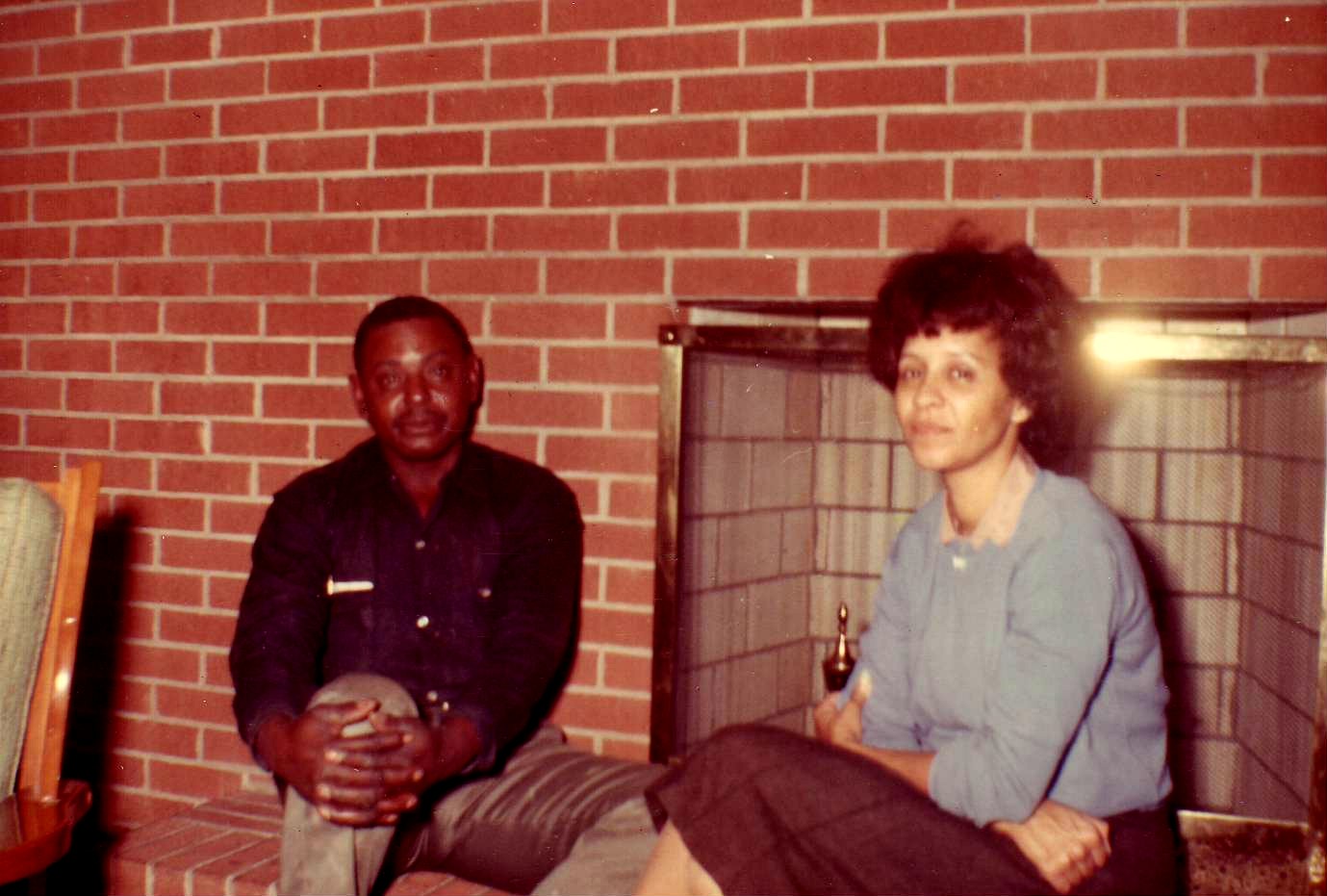
I loved my brief stays at Aunt Mildred’s, wrapped in blankets and installed on the couch in her wood-paneled den, drowsing before the television while she handled calls related to the family business. Occasionally, I got a glimpse of the teenaged Patricia, impossibly glamorous in my eyes, leaving for school. More often, Aunt Mildred’s husband, Louis Hall, would stop at home between jobs. He was not a tall man, but he seemed to me a big one. In later years he had a belly, but I think my impression came more from his persona than his actual size. He had a warm smile and a ready laugh, and I, who had no living grandfathers, was drawn to him.

Louis & Mildred Hall fireplace

Louis and Mildred Henderson Hall at home, probably mid-1960s.

Years later, as I researched a thesis examining the involuntary apprenticeship of free children of color, I grew familiar with all the free families of color in Wilson and Wayne Counties. I came upon a set of Halls from the Stantonsburg area and, curious, traced them forward. I was delighted to find that Uncle Louis was descended from this very family. Years after that, I was even happier to be able to provide my Hall cousins with rare documentation of their antebellum forebears’ births.

The family’s earliest known ancestor was Eliza Hall, a free woman of color born about 1820, probably in what was then the heel of southwest Edgecombe County. How she met James Bullock Woodard, a prosperous white farmer and slaveowner, is unknown, but by Eliza’s early 20s they had begun a relationship that would last at least a decade. A sympathetic relative of Woodard’s, perhaps feeling that blood is blood, recorded the births of James and Eliza’s children in her family’s Bible:

Ages of The children of Eliza Hall

William Henry Hall was born Feb the 11th 1844 Patrick Hall was born October the 6th 1845 Margaret ann Hall was born Feb the 12th 1847 Louiser Hall was born April the 9th 1849 Balam Hall was born Feb 7th 1851

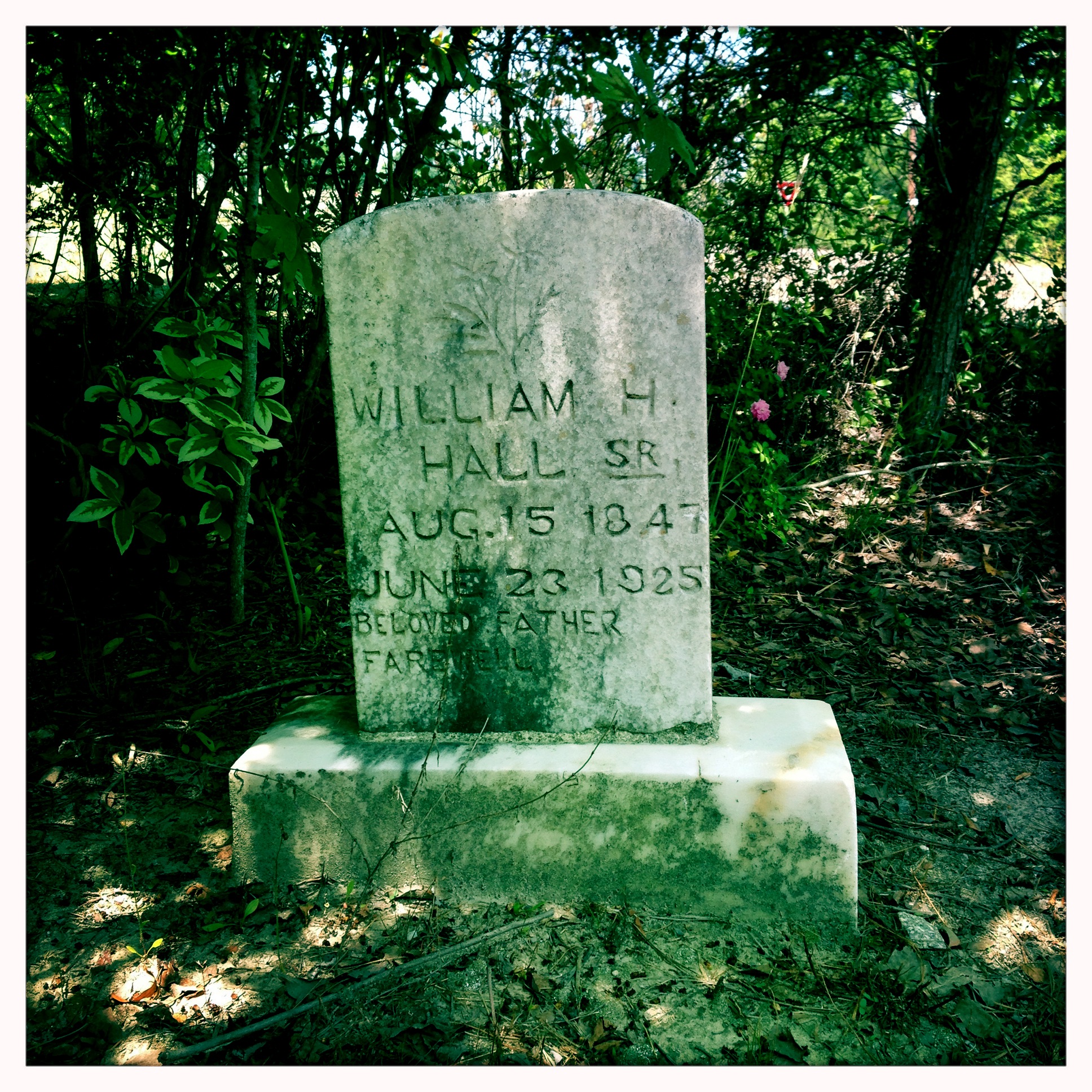
William H. Hall lived and farmed near Stantonsburg, Wilson County, most of his life. He married three times — to Lucy Barnes, Annie E. Smith and Mamie Artis — and had at least nine children. His fifth, more or less, was Robert Hall, born 18 July 1886. When Robert was about 4 years old, his father sold to trustees the quarter-acre of land upon which Bethel African Methodist Episcopal Zion Church was founded. William H. Hall spent his last years living in his son Robert’s household and died 23 June 1925.

On 7 January 1908 in Wilson County, Robert Hall married Katie Farmer, daughter of Robert and Marenda Bynum Farmer. (And Katie’s sister Ida married Robert’s brother Thomas Hall.) Robert supported his large family as his father had done, by farming. Uncle Louis, born in 1920, was Robert and Katie Hall’s fifth child. He and Aunt Mildred reared six children on Queen Street in Wilson as they built East Carolina Vault Company, a family-owned business that now employs third-generation Halls.

Wilson County is a small world of criss-crossing family lines, and Uncle Louis was not the only descendant of Eliza Hall that I knew. Once, I saw my cousin (his daughter) hugging my geometry teacher at the mall. They, in fact, are first cousins. Another of their first cousins was the assistant principal at my high school. And as I prepared this blogpost, I ran across a marriage license for a daughter of William H. Hall’s brother Balam and one of my cousins, Snow B. Sauls.

IMG_2194

William H. Hall is buried in the cemetery of the church he helped establish.

Photographs from collection of Lisa Y. Henderson; excerpt from Lewis Ellis Bible courtesy of Henry Powell; sources include birth and death certificates, World War I draft registration, deeds.


Standard
Civil War, Free People of Color, Newspaper Articles, North Carolina, Paternal Kin, Politics

He would be murdered if he did not cease.


Weekly Standard Raleigh 5 6 1868 Jacob Ing

Raleigh Weekly Standard, 6 May 1868.

Jacob Ing’s radical ideas surfaced well before Reconstruction. As made clear in his last will and testament, he had a long relationship with a free woman of color named Chaney Jones (also known as Hester or Easter Jones) and fathered several children for whom he provided. One, daughter Lucinda, was the first legal wife of my great-great-great-grandfather Adam T. Artis.

[Small world: Jacob Ing witnessed the last will and testament of Reubin Taylor of Nash and Edgecombe Counties and served as executor of the estate of Reubin’s sons Dempsey and Kinchen Taylor, who owned my great-great-grandparents.]

Standard
Free People of Color, North Carolina, Oral History, Paternal Kin, Photographs

Collateral Kin: the Carters.

One of the most rewarding results of my decades of genealogical sleuthing has been the development of a deep connection with many of my Carter cousins, descendants of Milford and Beulah Aldridge Carter. My grandmother talked often of the Carter family, to which she was connected both via the Aldridges and “Papa” Jesse Jacobs, who was Milford Carter’s uncle.

The Carters looked ‘bout like white folks. I didn’t really know all of  ‘em. I think it was nine of them boys. The three I knew was Milford and Johnnie and Harold, I think. They used to come to Wilson, but the older one [Willoughby] didn’t come up. But Milford, Harold — the two youngest ones come over and stayed with Annie Bell [Jacobs Gay, Papa’s daughter.] Johnnie – and Freddie, too.   When I’d go to Uncle Lucian’s, they lived not too far from there. But I never went to their house. I think Harold was the youngest one. ‘Cause that’s the one came to Wilson, and Albert, Annie Bell’s husband, got him a job down to the station driving a cab. And he got his own car, and he was down there for a long time. Harold. He’s the youngest one. Carter. All of them was great big.

There were indeed nine Carter brothers — Willoughby (1880), Ammie (1881), Freddie (1890), Milford (1893), Granger (1895), Lippman (1898), John Wesley (1899), Harold (1903) and Richard (1906) — plus a sister Florence (1887). (Florence’s son William Homer Camp Jr. married Onra L. Henderson, Beulah A. Carter’s niece and my grandmother’s double cousin.) The brothers were born in Sampson and Wayne Counties to Archie Marshall (or Marshall Archie) Carter and Margaret Frances Jacobs, sister of Jesse A. Jacobs Jr. Marshall Carter (1860-1926) was the son of William and Mary Cox Carter of Sampson County. (My grandmother also spoke of Marshall’s sister, Virginia Ann “Annie” Carter, who married Hardy Cox and was a close friend of “Mama” Sarah Henderson Jacobs Silver.) William Cox (1833- ca. 1875) was the son of Michael Carter (ca. 1805-ca. 1875) and his wife, Patience.

As attached as Papa was to my grandmother, he did not take her with him on visits home to Dudley, very likely in deference to the feelings of his nephew’s wife Beulah, who had little use for the child her brother Tom fathered out of wedlock.

When Papa was living, he used to go to Dudley down there to the mill where they ground corn and all down there.   They’d carry him around down there on horse and buggy, wagon, whatever it was. He was their uncle. Their mama’s brother. He’d go there every once in a while. But he didn’t never say nothing ‘bout taking me down there with him. I guess ‘cause Beulah, Milford’s wife, was my daddy’s sister, but she was kind of cool toward me. And he know he wasn’t gon carry Mamie.  So we didn’t never get to go down there with him. 

Early in their marriage, Beulah and Milford Carter lived in Wilson in a small house on Green Street whose yard touched those of Milford’s uncle and first cousin Annie Bell. The Carters’ second child, son Dewey Belvin, who died before his second birthday, was born during their short stay there.

Beulah stayed in Cora Miller’s house there on Green Street. A little house down there ‘cross from where we were staying, first house behind the church, near ‘bout on the corner there. And she and Milford were there.

After a few years shifting between Wayne to Duplin Counties, Milford moved his family north to Coatesville, Pennsylvania, and then New York City — first Brooklyn, then Queens — where he pursued a long career as a chef.

OLYMPUS DIGITAL CAMERA

Milford E. Carter, during his time as a chef at H. Hicks & Son, 30 West 57th Street, New York City.

Freddie, Freddie was the one that went to Atlanta for a year and day. Moonshine. And Johnnie was fat. And rosy. Like, you know, like if somebody say like, seeing a baby and say that it was “oh so fat, look like you pinch they cheek the blood pop out?” And just fair, and just that red look.

Johnnie Carter was also the brother that cared for my grandmother’s great-uncle, J. Lucian Henderson, and his wife Susan Henderson in their final infirmity. In June 1934, John W. Carter was named administrator and sole legatee of Lucian’s estate. Johnnie and his family lived near Lucian just west of Dudley, but I am not sure of the genesis of their close relationship.

The Carter boys was always nice. They come up here, come to stay with Annie Bell, Papa’s youngest daughter. They wasn’t here at the same time. They was driving cabs. So they used to come over all the time. I went with Harold down to Dudley once ‘cause he was going and coming back that same day. See, Uncle Lucian was sick, so I went down with him and come back.

1780668_10151973289313527_579699652_n

1911665_10151973293123527_1534360898_n

Top: John, Ammie, Wesley (a cousin), Richard, Granger, Richard Jr. and Harold Carter; bottom: Milford, John and Harold Carter; both 1955. Copies of photos courtesy of Dorothy Carter Blackman and Daniel M. Carter.

Interview of Hattie H. Ricks by Lisa Y. Henderson; all rights reserved.

Standard
Births Deaths Marriages, Free People of Color, Land, North Carolina, Other Documents

I did the best I could.

North Carolina } In the Superior Court October Term 1897

Sampson County }

Hardy A. Brewington, Joshua Brewington, Simon Brewington, Nathan Brewington, Nancy Goodman and her husband J.B. Goodman, Lucy Strickland and her husband J.S. Strickland, Eliza Manuel and her husband Alvin Manuel, Bashaby Brewington, Mary Wheeler, Lulu Brewington and Luther Brewington heirs at law of Raiford Brewington Jr. and Allen B. Brewington by his guardian Hardy A. Brewington, Plaintiffs

Jno. R. Jacobs, Rocia Lee Brewington and her husband J.A. Brewington, Lillie B. Brewington and her husband M.L. Brewington, and Jno. R. Jacobs, guardian ad litem of Della Jacobs and Lavinia Jacobs, Defendants

The plaintiffs complain of the defendants and allege:

I. That on the 20th day of Nov. A.D. 1890 Raiford Brewington & his wife Bashaby Brewington executed a deed to John R. Jacobs and his wife Polly Ann Jacobs for the following described tract of land to wit: Situate in Sampson County State of North Carolina and adjoining the lands of Nathan Brewington, James M. Parker and others and bounded as follows; Beginning at a stake on the lane and runs about S 550 yards to a stake at an old post oak stump the line of Jas. M. Parker & W. Royal thence west about 750 yards to a stake on the west wide of Beaver Dam swamp, thence up the edge of the swamp to a shortleaf pine at the ditch, thence East 750 yards to the beginning containing 75 acres more or less.

II. That the deed aforesaid is duly recorded in the office of the Register of Deeds of Sampson County Book 76 p 193 a copy of which deed is marked “Exhibit A” and hereto attached and made a part of this complaint, which deed does not convey the said lands in fee simple but upon certain stipulations and conditions in words as follows: — The said Raiford Brewington & wife Bashaby Brewington excepts their life time estate in said lands and the said John R. Jacobs and Polly Ann Jacobs and their heirs are to support the said Raiford Brewington and wife Bashaby Brewington and their son Allen B. Brewington during their natural life time and furnish them with good comfortable cloths. When the said John R. Jacobs and wife Polly Ann and their heirs fails to comply with the above obligations then their right and title to the aforesaid land shall be void and a further condition in said deed is that the said Raiford Brewington & wife Bashy shall have the use of said property during their life time but shall not sell any of said property not land unless it is agreeable with J.R. Jacobs & wife Polly Ann. Neither the said J.R. Jacobs and Polly Ann shall sell any of said property nor land unless it is agreeable with Raiford Brewington & wife Bashaby.

III. That upon the execution & delivery of said deed to wit on Nov 20th 1890 the said Jno. R. Jacobs & wife Polly Ann Jacobs went into possession of the lands described in said deed and exercised possession and full control of same until 1893 when Polly Ann Jacobs died, but during this period they did not fully comply with the conditions of said deed and Raiford Brewington & wife Bashaby were required to work and furnish their own support. After the death of Polly Ann Jacobs, her husband Jno. R. Jacobs & the heirs of Polly Ann Jacobs continued to live on the premises & exercise possession & full control of same until about Jan 1st 1896 when they quit the premises & furnished no further food or support in any way since to Raiford Brewington & wife Bashaby Brewington of their son Allen Brewington nor did the said Jno. R. Jacobs & the heirs of Polly Ann Jacobs comply with the conditions in said deed before they deserted the premises but instead wasted & used the provisions made & provided by the said Raiford Brewington & wife with whom the said Jno. R. Jacobs & family loved.

IV. That Polly Ann Jacobs is one of the children and heirs of Raiford Brewington & Bashaby Brewington and has been fully provided for by them before said deed was executed to them. That Allen Brewington one of the children is an idiot and the only heir not provided for by Raiford Brewington, and the lands conveyed to Jno. R. Jacobs & Polly Ann Jacobs in the deed set out above was the sahe of the Raiford Brewington estate that he intended for his son Allen Brewington and for himself and wife Bashaby Brewington as long as they should live.

V. That in January 1896 Raiford Brewington died leaving his wife Bashaby Brewington & son Allen Brewington with no one to support them, as Jno. R. Jacobs and the heirs of Polly An Jacobs had broken the conditions in said deed by leaving the premises & refusing to provide them any support.

VI. That if said deed shall remain in full force & effect, it would be in violation of the conditions in said deed, and contrary to the will and intent, and the express declaration of the grantors therein & would leave them without any means of support.

VII. That if said deed shall remain in full force and effect Jno. R. Jacobs and the heirs of Polly Ann Jacobs would thereby receive a double share of the estate of Raiford Brewington to wit: the share of Allen Brewington and the share of Polly Ann Jacobs which latter share had been allotted to her before the execution of said deed.

Wherefore the plaintiffs pray:

I. That the deed referred to in Article I of this Complaint be declared null and void and that a suitable person be appointed by the court to take the title of said land and hold the same in trust for Bashaby Brewington and her son Allen Brewington and the rents and profits therefrom be applied to the feeding, clothing & support of them as long as they both shall live and the remainder to the heirs at law of Raiford Brewington.

II. For cost and general relief – Lee & Butler attys for the plaintiffs.

Hardy A. Brewington being duly sworn according to law says that he has read the foregoing complaint or heard it read and that he knows the contents thereof to be true except such matters and things as are set out on information and belief and those he believes to be true.

Subscribed & sworn to before me this the 29 day of October 1897 /s/ H.A. Brewington

——

The file also contains notes from trial testimony:

Hardy Brewington — am son of Raiford Brewington – he had twelve children – Polly Ann Jacobs is my sister – My father gave her Polly Ann $300 in money & $100 in other property – My father never gave Allen Brewington anything – He is an idiot – 48 yrs old never did any work – My mother is living is 86 or 87 yrs old – not able to work – Allen lives with her – Jacobs & wife came into possession at date of deed They lived on the land with my mother 5 yrs – Polly Ann died about ’93 – Jacobs lived there 2 ½ yrs after death of wife – Jacobs went to Dudley in Wayne Co & has lived there ever since – My father was then living on the land – he died at 85 yrs – Jacobs provided very poorly for the old man wife & son provisions were poor & not plenty of it. Jacobs was liable to drink & will go off & leave them unprovided for in food & fuel. Land tolerably good when Jacobs took possession, pretty poor when he left He always had plenty to eat & good clothes – The Heirs of Polly Ann Jacobs left the old people neglected – Jacobs could have remained on the land & made them more comfortable – He cut timber & carried to Wilmington – and wasted the money – Myself & son have supported the old people since Jacobs my married defnts daughter – Jacobs has done nothing for them since ’95 – Have heard old man complain of being hungry – cold &c. – Raiford Brewington & wife did not consent to the mortgage didn’t know of it until six or eight months after – He said Jacobs had given a mortgage & he didn’t know what wd become of him – My father died in ’96 – My mother & Idiot have no means of support except this land – Whitney Royal wrote the deed – Jacobs moved from Dudley down on this land – Jacobs married 2nd time after about 1 ½ yr after wife’s death – Jacobs got money from Parker $30 & my father said he would see it paid. – Note given about 12 mos before mortgage

Jim Strickland — Live 2 ½ miles from place – I married Raiford Brewington’s daughter – He gave her $200 – Jacobs didn’t give them enough to eat – at all times – his clothes were common – Jacobs has done nothing for them since ’95 – Place was better when he came than when he left – Land not worth much now – Brother Hardy & son Arthur have been supporting them since Jacobs left

Arthur Brewington – Am son of Hardy Brewington Jacobs staid on the land about 5 years – The food was pretty poor like the most of us meat & bread – Before Jacobs went there could get as good a meal as anywhere – he wd leave land neglected – Drank every week – Raiford put me there after Jacobs left – Me & my father have been supporting the old people – They complained of want of food & fuel – I did the best I could under the circumstances – Jacobs could have done better than he did.

J.R. Jacobs – Am one of Defn’ts – When I went there but little provisions – fence gone down pretty much – I made a crop next I put 2000 [illegible] the spring I went there & clean out ditches I did the best I could – all eat at same table – He complained some like old people will do – Neither of them suffered for food or fuel I cut timber & carried to Wilmington – no profit – My wife lived about 4 yrs after I went there – I did the best I could – Arthur seemed to be their choice – We bargained for Arthur to go there & take my obligation with consent of old people – I was in debt in Clinton – I went to Parker to get the money – Old man helped to get up money – Old Man was present – gave boundaries &c — $35 note was to pay for guano – I owed Vann $25 for corn – I carried it home he carried it [illegible] – All of it was for money used on the place & for mule worked on place. Raiford [knew] all about it – I gave a lien on crop that year – The $35 mortgage was included in the $125 mortgage Raiford Brewington only once came here – The $125 mortgage was made on the plantation & he knew about it, and was willing to it – Judgmt agst me for Parker – 40 acres of cleared land on the place – Raiford Brewington asked me to cancel the deed I told him I didn’t [think] it right to do so. This was after my wife died.

J.L. Brewington – Raiford Brewington was my father – Hard to please he wanted something to drink He had a heap to feed – people & stock – Jacobs did the best he could The old man grumbled all the time – but had plenty to eat –

Jonathan Goodman – Live about ½ miles from the place – I saw the old man frequently – He lived as good as most any farmer – While Jacobs lived there – he lived as well as common run of people that had no more – Jacobs drank some – It seemed as if Jacobs wished to please him – he was off at times –

Mary Eliza Brewington – Raiford was my husbd father – I lived ½ mile from him I heard Raiford say it was a just debt as far as he [illegible] and he wanted Parker paid – The old people got along as well as one could expect

J.R. Parker – The $35 mortgage Raiford & Jacobs came to me & wanted to borrow some money – Raiford proposed to meet him in Clinton & make up the papers – which we did – I let Jacobs have some corn & bacon – This was cancelled to make up the $125 mortgage – The cash that I gave Jacobs – and the note for $35 with the money due me makes up the $125 – I know that Raiford knew of the $125 note & mortgage — $35 was all money – how much more I don’t know – over half of it – There was an indictment agst Jacobs for passing counterfeit money. Raiford came to me & didn’t say he would or wouldn’t sign the $125 –

Marshal Newman – Was J.P. – at time mortgage was made – Parker & Jacobs got me to write this mortgage – it was made at Nathan Brewington’s house Raiford was not present, and never said anything to me about it. Nathan Brewington’s was convenient to Jacobs –

Hardy Brewington (re-called) – We knew nothing about $125

——

Judgment for Hardy Brewington et al. The judge found that John and Polly Ann Jacobs had not complied fully with the terms of the deed and ordered that (1) the deed from the Brewingtons to the Jacobses be declared null and void; (2) Hardy Brewington be appointed trustee of the land for the sole use and benefit of Bashaby and Allen Brewington during their lifetimes; (3) after the deaths of Bashaby and Allen, Hardy was discharged from his trusteeship, and (4) John Jacobs and the Parkers were to pay court costs.

——

I’m not a Brewington or a Jacobs and have no direct link to any of the players in this sad intrafamily squabble over Polly Ann Brewington Jacobs’ estate. Nonetheless, as was the rule among free families of color in and around Dudley, Wayne County, there was multi-strand intertwining between these folks and my extended family:

  • Joshua L. Brewington, the J.L. who testified on behalf of John R. Jacobs, married Amelia Aldridge, sister of my great-great-grandfather John W. Aldridge.
  • John R. Jacobs was the older brother of “Papa,” Jesse A. Jacobs Jr., who married Sarah D. Henderson (my great-great-grandmother Loudie Henderson’s sister) and reared my grandmother.
  • John Jacobs’ sister Frances married Marshall Carter of Sampson County. Frances’ son Milford E. Carter married Beulah M. Aldridge, John W. Aldridge’s daughter. Another son, John W. Carter, cared for Lucian Henderson (brother of Sarah) and his wife in their old age and inherited their small farm.
  • Milford E. Carter Jr. married Jessie Bell Brewington, granddaughter of Hardy A. Brewington.
  • Michael and Ann Eliza Brewington Manuel’s son, Alonzo Manuel, married Sallie Wynn, daughter of Edward and Susan Henderson Wynn. Susan H. Wynn was the sister of my great-great-great-grandfather Lewis Henderson.
  • Michael and Ann Eliza Brewington Manuel’s daughter Celestial married Hillary B. Simmons after the death of his first wife, Ann Elizabeth Henderson, who was a sister of Sarah, Loudie and Lucian Henderson.
  • Raiford Brewington’s wife Bashaby was the daughter of Shadrach and Zilpha Hardin Manuel. Her kinship to Michael Manuel is not entirely clear to me, but research by others suggests that they were cousins.

From the file of Polly Ann Jacobs, Sampson County, North Carolina Estate Files 1663-1979, https://familysearch.org. Original, North Carolina State Archives.

Standard
Agriculture, Free People of Color, Land, Newspaper Articles, North Carolina, Paternal Kin, Politics

Our colored friend has grown richer.

Image

ImageGoldsboro Messenger, 21 October 1880.

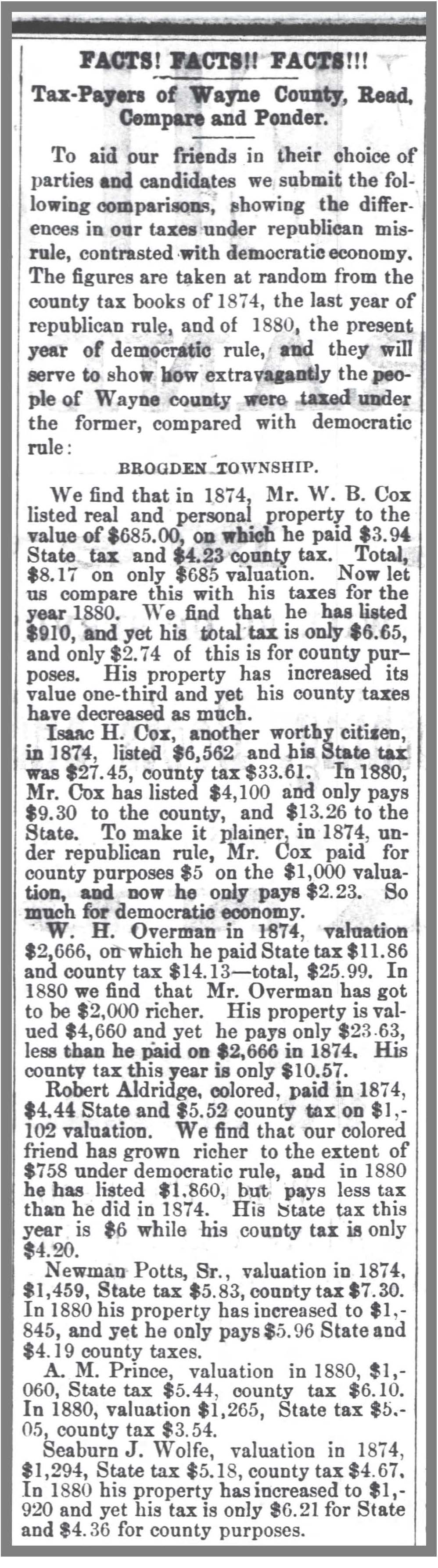
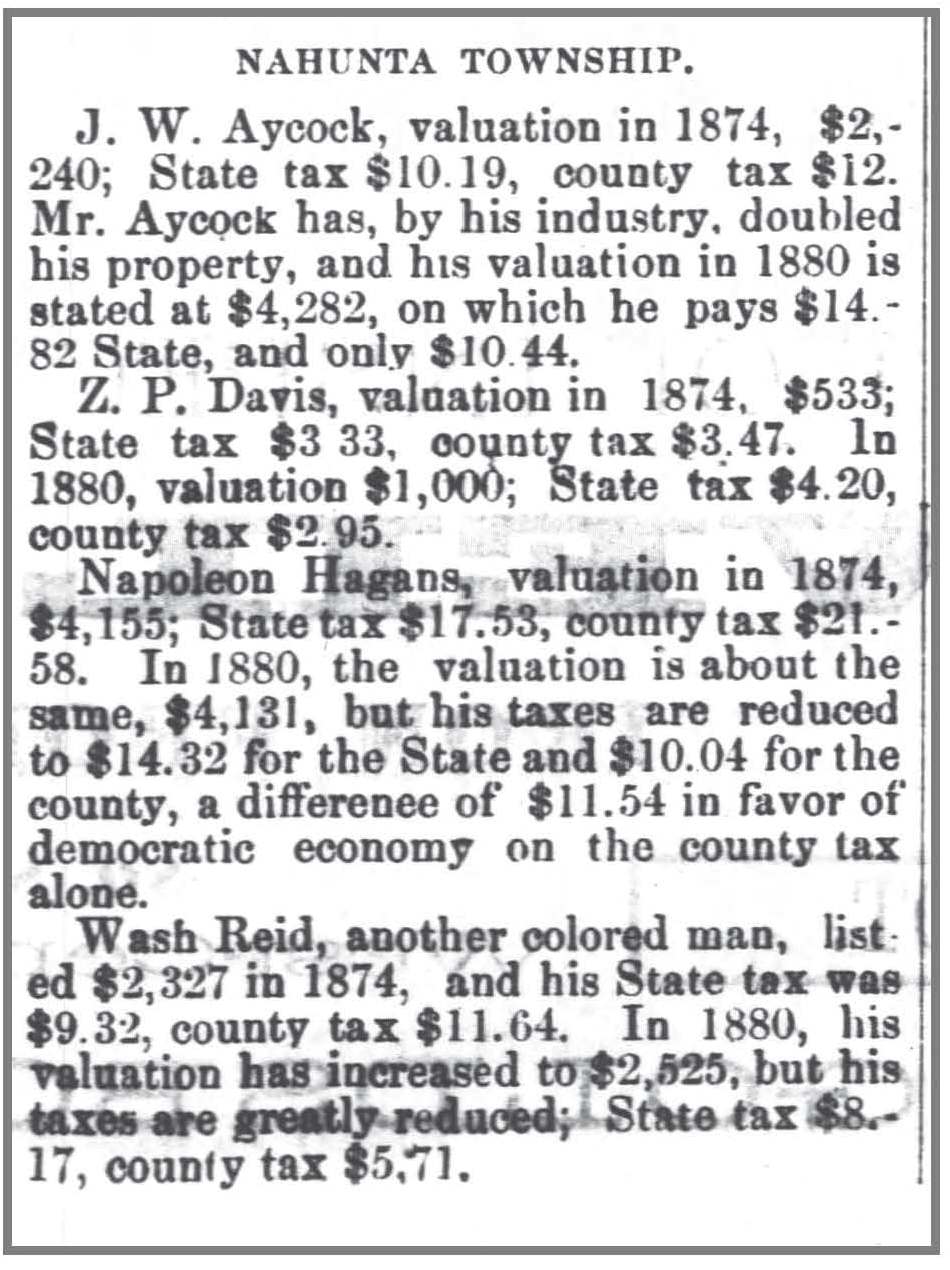
These propaganda pieces are part of a single article published to demonstrate that the rising tide of Democratic rule had floated all boats as land values increased while taxes fell. (In other words, the end of Republican rule meant more money in the pocket, as well as a foot on the neck of African-Americans.)

Two of the “colored friends” noted were my kin — my great-great-great-grandfather Robert Aldridge and Napoleon Hagans, the brother of my great-great-great-grandmother Frances Seaberry Artis. (And Washington Reid’s nephews William and Henry Reid, sons of John Reid, married Adam Artis’ niece Elizabeth Wilson and daughter Cora Artis, respectively.) Aldridge, Hagans and Reid (as well as Artis, Frances’ father Aaron Seaberry and Betty’s father John Wilson) were all prosperous free-born farmers.

Standard
Agriculture, Births Deaths Marriages, Free People of Color, Newspaper Articles, North Carolina, Paternal Kin

Well-to-do farmer — with lots of children.

An expanded version of the 47-children article that ran in the Statesville Landmark (and, indeed, all over North Carolina):

Image

Wilmington Messenger, 3 January 1906.

I still don’t know more than 25 or so of Adam Artis‘ children (which is gracious plenty) and don’t believe there were many more than that. But if he didn’t have 80+ grandchildren by 1906, he certainly had many, many more than that before all was said and done. (As always, I ignore the snark, but what is a “typical southern darkey”?)

Standard
Agriculture, Civil War, Free People of Color, North Carolina, Paternal Kin

Confederate Citizens File: Durant Dove.

Form of the estimate and assessment of agricultural products agreed upon by the assessor and tax-payer, and the value of the portion thereof to which the government is entitled, which is taxed in kind, in accordance with the provisions of Section 11 of “an Act to lay taxes for the common defence and carry on the government of the Confederate States,” said estimate and assessment to be made as soon as the crops are ready for market.

Rice — Quantity of gross crop. — 5 bush. Quality — #2. Tithe or one-tenth. — 1/2 bush. Value of one-tenth. — $2.00

Cured Fodder – Quantity of gross crop. — 700 lbs. Quality — #2. Tithe or one-tenth. — 70 lbs. Value of one-tenth. — $280

Ground peas – Quantity of gross crop. — 7 1/2 bush. Quality — #2. Tithe or one-tenth. — 3/4 bush. Value of one-tenth. — $4.50

I, Durant Dove of the County of Onslow and State of N.C. do swear that the above is a true statement and estimate of all the agricultural products produced by me during the year 1863, which are taxable by the provisions of the 11th section of the above stated act, including what may have been sold of consumed by me, and of the value of that portion of said crops to which the government is entitled. /s/ Durant X Dove

Sworn to and subscribed to before me the 28th day of November 1863, and I further certify that the above estimate and assessment has been agreed upon by said Dove and myself as a correct and true statement of the amount of his crops and the value of the portion to which the government is entitled. /s/ F. Thompson, Assessor.

——

The Confederate Papers Relating to Citizens or Business Firms, 1861-1865 (NARA M346), often called the “Confederate Citizens File,” is a collection of 650,000 vouchers and other documents relating to goods furnished or services rendered to the Confederate government by private individuals and businesses.


Standard
Agriculture, Civil War, Free People of Color, North Carolina, Paternal Kin

Confederate Citizens File: Mathew Aldridge.

Form of the estimate and assessment of agricultural products agreed upon by the assessor and tax-payer, and the value of the portion thereof to which the government is entitled, which is taxed in kind, in accordance with the provisions of Section 11 of “an Act to lay taxes for the common defence and carry on the government of the Confederate States,” said estimate and assessment to be made as soon as the crops are ready for market.

Mathew Aldridge

Cured Fodder Quantity of gross crop. — 1000 Tithe or one-tenth. – 100 Value of one-tenth. — $3.00

I, Mathew Aldridge of the County of Wayne and State of North Carolina do swear that the above is a true statement and estimate of all the agricultural products produced by me during the year 1863, which are taxable by the provisions of the 11th section of the above stated act, including what may have been sold of consumed by me, and of the value of that portion of said crops to which the government is entitled. /s/ Mathew X Aldridge

Sworn to and subscribed to before me the 3 day of December 1863, and I further certify that the above estimate and assessment has been agreed upon by said Mathew Aldridge and myself as a correct and true statement of the amount of his crops and the value of the portion to which the government is entitled. /s/ J.A. Lane, Assessor.

Confederate Papers Relating to Citizens or Business Firms, 1861-1865, National Archives and Records Administration.

Standard