Enslaved People, Free People of Color, North Carolina, Other Documents, Paternal Kin

The husband might become a slave of his children.

To the Honorable the General Assembly of the State of North Carolina now in Session – The Petition of Lovedy Henderson a free woman of color, respectfully represents that your Petitioner intermarried some years since with a certain man of color by the name of Horace, then a slave, but with the consent of his owner. That since their marriage by care and industry, she has been enabled to purchase her said husband at the price of Eight Hundred & Seventy dollars of Hugh and John G. McLaurin Executors of Duncan McLaurin deceased. That she has paid the purchase money & has a Bill of Sale duly executed by the said Executors. That your Petitioner now has two children by her said Husband & as by possibility her husband might become the slave of her children, your petitioner is induced to ask the interference of your honorable body, as the only tribunal authorized to grant the relief prayed for. Your Petitioner would not presume to ask this indulgence in her favour, in contravention to the policy of the Laws of the Land, but from the peculiar circumstances of her case & the belief that she will be enabled to establish for her Husband such a Character as to entitle him to the favourable notice of your honorable body. For this, she relied on the certificates of highly respectable gentlemen both in Fayetteville & the City of Raleigh, where they have lived since their intermarriage. Your Petitioner therefore prays the passage of an Act, emancipating her said husband Horace Henderson, and she in duty bound will ever pray &c. /s/ Lovdy Ann Henderson

We Hugh McLaurin & John C. McLaurin Executors of Duncan McLaurin dec’d unite in soliciting the passage of an Act for the emancipation of Horace Henderson as prayed for by his wife and we are free to say that we have long known said Horace who is a Barber and a boy of unexceptionable good character and of industrious & moral habits. /s/ H. MacLaurin for himself and John C. MacLaurin

We the undersigned citizens of Fayetteville freely unite in soliciting the General Assembly to pass an Act emancipating the negro man Horace, that we have known said Horace as a Barber & a Boy of good character, industrious habits and as we believe of the strictest integrity. /s/ J.H. Hooper, John MacRae, John Kelly, Thos. L. Hybart, [illegible] Cochran, John Lippitt, D.A. Saltmarsh, Chas. B. Jones, [illegible] Hawley, William S. Latta, Jas. Huske, Duncan Smith, Henry W. Ayer

We the undersigned citizens of Raleigh freely unite in soliciting the General Assembly to pas an Act emancipating the negro man Horace, that he has lived in the place for the last three or four years as a Barber, and has conducted himself with the utmost propriety, that in his deportment he is humble & polite, free as we believe from any improper intercourse with slaves, industrious & honest. /s/ M. Stokes, R.M. Saunders, Jo. Gales, B.W. Daniel, Geo. Simpson, J. Brown, John Primrose, Hazlett Wyle, Richard Smith, S. Birdsall, Jno. G. Marshall, A. Williams, Fabius J. Haywood, Robert Staniroy

Ninety years after this petition was filed, a Horace Henderson was born into my extended family, but I know no connection between my Hendersons, who were originally of Onslow County, and Lovedy Ann Henderson.

——

General Assembly Session Records, November 1832-January 1833, Box 5, North Carolina State Archives.

This family is found in the 1850 census of Greensboro, Guilford County: Horace H. Henderson, 40, barber, and wife Love, 39, both born in Fayetteville; children James, 18, farmer, Mary Ann, 17, and Timothy, 14, born in Raleigh; and Albert, 10, Sarah, 8, Thomas, 4, and Alexander, 3, born in Greensboro; all mulatto.


Standard
Agriculture, Free People of Color, Land, North Carolina, Other Documents, Paternal Kin

He never said he had any claims on the land.

The first in an occasional series excerpting testimony from the transcript of the trial in J.F. Coley v. Tom Artis, Wayne County Superior Court, November 1908. Paragraph breaks inserted for better readability.

The Plaintiff introduces W.S. Hagans, who being duly sworn testifies as follows:

I sold this land, the 30 acre, 24 acre, and the 9 1/3 acre pieces to Mr. Coley. Mr. Cook had been negotiating with me for the purchase of the 30 acre tract and the 24 acre tract. He did not want the 9 1/3 acre tract. I met Mr. Cook on several different occasions, until finally we met at Eureka one afternoon, he was considering it, and we finally decided on the deal. Mr. Cook was to give me $40.00 per acre for the the 30 acre tract, and the 24 acre tract. Before Mr. Cook did this however, he informed me that there was a missing link in the title, that he had found after investigating it. I told him that that was perfectly alright, as there had never been any question about it.

After our conference at Eureka, the day was set for me to meet him in Goldsboro, where he was to pay me the consideration, the price of the land, and I in turn to give him a deed for the land. He did not come on that day, but ‘phoned me at Fremont that he did not succeed in raising the money, but to please hold it open until tomorrow.

Early tomorrow morning, before sunrise, a bitter cold morning, the Defendant [Tom Artis] came to my house in Goldsboro. I asked him what brought him to town on such a cold morning, he said he came to bring a message from Mr. J.F. Coley, that Mr. Coley said that he wanted to buy that land, and would take all three of the tracts instead of two, said the Defendant to me, “that will be to your advantage.” The Defendant stated to me that Mr. Cook’s time was out yesterday. I expressed surprise that the Defendant should be familiar with those circumstances. Afterwards I said to the Defendant, that while Mr. Cook’s time was out yesterday, that Mr. Cook had phoned me yesterday & said he had a great effort to reach me, and finally did so asking me to hold the matter open until tomorrow. I told him that I would feel honor bound if Mr. Cook should come to me with the purchase price for the two tracts of land, to let him have it, although I would prefer selling the three tracts together. The Defendant said to me that if Mr. Cook got possession of this place that he the Defendant would not be able to stay there as Mr. Cook was a very disagreeable man to get along with. I told the Defendant that I would not deed this property to Mr. Cook, or to any one else until they made the same promise to me in reference to the Defendant’s staying where he has, that I made to my father in the presence of the Defendant.

The Defendant remained in shooting distance of me all of the day, waiting for me to see Mr. Cook that he might get from me a final message to take back to Mr. Coley. I saw Mr. Cook, and he informed me that the reason he couldn’t take it was that he had experienced great difficulty in raising that money. That money was hard. I was really glad of this, and so informed the Defendant, for I wanted to sell the three tracts if possible, together. Then I asked the Defendant to say to Mr. Coley on his return home, that I would meet him at the Defendant’s house on Friday, I think it was, but having business out there, I drove past, and got the Defendant and took him out to the Plaintiff’s place of business that was on Thursday, I went the day before the time set, and stated to the Defendant the object of my going down there, and asked him to go with me.

We went down there and Mr. Coley and I had a talk aside from the Defendant, and finally wound up in the Defendan’t presence. The conversation we had in the presence of Tom was Mr. Coley might have the three pieces of land, in consideration of $3250, and I take his paper. This was said in the Defendant’s immediate presence, he sitting on the buggy beside me. We left, the Defendant expressing himself as highly pleased that Mr. Coley had bought the three pieces of land, said he thought I had made a fine trade. He made no objection at any time to the sale of the land. He encouraged it all the while. He never intimated to me that he had any claims on this land of any kind. None whatever.

I got the land about 1899, deed of partition between my brother [Henry E. Hagans] and myself. After I got the land I rented that to the Defendant. The first year I think, I charged him 850 lb. of lint cotton, thinking all the while that my brother having acted for us both got 850 lb. for the two places, the 30 and the 24 acre lot.The Defendant informed me that my brother had been charging only 800 lb., and I agree to the 800 lb. He did not at any time when delivering this cotton say that he was paying it as interest and taxes. (Defendant objects.) He has never said anything about paying it as any way than rent. He has never mentioned taxes to me on that property. I listed that land and paid the taxes.

I had some work done on that house since I came in possession. The Defendant patched the roof and also built a porch. I do not wish to state that I had it built. I paid for the lumber. The Defendant did the work himself.

The Defendant came to my place in front of the gin house last fall, and said to me that he had understood that I was going to sell those three pieces of land down there, we called it the Tom Pig place, the Calv Pig place and the Adam [Artis] place. He said he wanted to buy the Tom Pig place or the 30 acre. He asked me if I would prefer selling it all together. I asked him what he would want to give me for the 30 acre tract piece, and he said he would give me $800.00 for it. I told him I couldn’t take that, as I had already been offered $40.00 an acre, or $2160 for the two places. He asked me to give him time that he might hear from his boys in Norfolk, that he was confident that he could raise the purchase price for the 30 acre tract, if not for it all. The Defendant and Durden Fort were present at the time. Durden Fort has since died. In payment of this land, Mr. Coley’s notes were security fort this property. Mr. Coley’s home place I think. 60 some odd acres in addition to what I sold was given as security. One note is due in January.

CROSS-EXAMINED.

Tom said to me, “I think you sold those three pieces of land well.” He said that on the buggy. Mr. Coley and I behind the barn talked about this land. He wanted to get the land for $3000. I had an idea that Mr. Coley was a pretty good trader, and wanted to get it as cheap as possible, and I told him behind the barn what three pieces I wanted to sell him them for. I didn’t have to go through any particular form, we didn’t close the thing out, we continued the conversation until we separated. The pieces of land were all understood. He said in the presence of Tom, “For the three pieces of land I will give you $3250.00.” I thought it was necessary to innumerate the three pieces so he would see what he was getting.

Tom has lived on that place ever since I had it. I don’t know to my personal knowledge if he lived off of it. I was in school at the time, or at any rate away from home. Durden Fort was present at the conversation we had. He died in the summer. I had him as a witness. I did not rent my land at the same price every year to every body, not necessarily, to some I did, some I didn’t. The reason I charged him 800 lb. was because my brother rented it to him for 800, and I thought it was all he was able to pay, and there were other considerations. There were other considerations that induced me to charge only 800 lb. of lint cotton for the land. (Plaintiff objects.) It arose out of a conversation I had with my father [Napoleon Hagans] and Tom. My father was in feeble health in 1896. He called my brother and myself under the cart shelter at the home place and said to us that he was not going to live long, and he did not know to which one of us, that is his two sons, would fall heir to that property. Tom was present. That was the land in controversy. (Plaintiff objects), but as long as the Defendant, whom he called “Pig” paid his rent, let him remain. We promised. He did not say how much rent. I did not know as far as I remember that Tom paid to my father 800 lb. of lint cotton. I don’t know. I would rather believe he did. (Plaintiff objects.)

Standard
Civil War, Enslaved People, Free People of Color

What’s in a name?

When James Barnes’ will was probated in 1848 in Edgecombe County, North Carolina, and its provisions carried out, ownership of Howell, an enslaved man, transferred to McKinley Darden. In the 1870 census, Howell Darden, his wife Esther, and their children appear in Black Creek township in Wilson County, North Carolina. Howell had adopted the last name of the family that had owned him most of his adult life. His choice, however, was the not only one available to freedmen. Unbeknownst to slaveowners, many enslaved people claimed surnames even during slavery, though these names were not recognized legally. Some former slaves cemented links to kin by taking the surnames their mothers or fathers used. Others adopted the name of their last master, or reached back to earlier owners, perhaps from their childhood. Still others declined to acknowledge their former bondage altogether, and took names related to a skilled trade, a physical feature, a famous figure, or some other personal idiosyncracy.

Researchers attempting to trace African-American family lines often hit a brick wall at 1870. Having identified an ancestor reported in that census, they invariably ponder the question: how can I find the parents and siblings of this newly freed person? Answering these questions requires flexibility and a willingness to consider indirect sources. Marriage and death records may reveal close familial relationships among people with different surnames. For example, Vicey Artis, a free woman of color, and her enslaved husband Solomon Williams lived separately in the area of northeastern Wayne County and southwestern Greene County, North Carolina. Vicey appears in the 1850 and 1860 censuses with several children named Artis. Vicey and Solomon recorded their cohabitation in 1866, when most of their children were adults. Examination of marriage and death records reveals that some of Vicey and Solomon’s children (who were all free-born) assumed their father’s last name after his emancipation and others (especially the older ones) retained their mothers’. While nothing immediately obvious links Jonah Williams of Wilson and Adam Artis of Nahunta, vital records and other documents establish that they were brothers.

Similarly, upon Emancipation, two of the children of Margaret McConnaughey and Edward Miller, formerly enslaved in Rowan County North Carolina, chose the surname McConnaughey and three, Miller. Margaret and her children had been owned by a McConnaughey. Death certificates, marriage records, and close examination of households in census records provide the clues that establish this family’s connections.

Researchers should also pay attention to groupings of first names.   Like whites during the era, former enslaved people often fortified the ties between generations by naming children after relatives. Thus the recurrence of certain given names among a group of families sharing the same surname could indicate kinship. For example, the fact that Benjamin Barnes’ son Calvin, born about 1836, named two sons Redmond and Andrew could indicate a sibling relationship between Benjamin, Redmond and Andrew Barnes, all born circa 1820 and listed near one another in the 1870 census of Wilson County. That the elder Redmond also had a son named Calvin further supports the possibility. In addition, when comparing documents, keeping an eye out for familiar first names may help identify freedmen who changed their surnames, perhaps rejecting one that had been chosen too hastily or that had not chosen for themselves. For example, the Isom, Guilford, Robert, Jackson, and Lewis Bynum who registered cohabitations in Wilson County in 1866 appear in the 1870 census and after as Isom, Guilford, Robert, Jackson and Lewis Ellis.

Also remember that freedmen who shared a surname and common former owner were not necessarily kin. A grouping of one hundred enslaved people may have comprised a dozen or more — many more — unrelated families. For example, Mack Coley of Wayne County, North Carolina, was the grandson of Winnie Coley and of Sallie Coley Yelverton. Several of Winnie Coley’s children were fathered by Peter Coley. Trying to understand how these Coleys — all of whom appear to have belonged to a single former master — relate to one another (or don’t) is a daunting task.

Civil war pension records are another rich source of evidence about naming choices and family ties. Consider this passage from the Confederate pension application of Jim Ellis Dew of Wilson County, North Carolina:

“It was at the time we were making ‘sorgum’ that I was sent to the war. I belonged to my master Mr. Hickman Ellis who married a Miss Dew. You know missus, the white folks are not as strong as the niggers and Mr. Jonathan Dew, brother to my missus, was not very well, and they let him draw a man to go in his place and they drew me. I was sent to Fort Fisher and went to work throwing up breastworks. … We stayed on the island for while. After a while, I came home. While I was in the war I was known as Jim Dew, but when I came back from the war I was called by my old name “Jim Ellis” because I belonged to my missus.”

Similarly, the file containing the Union Army pension application of Baalam Speight’s widow Hannah Sauls Speight reveals that Baalam had enlisted as Baalam Edwards, his owner’s surname, but later adopted his father’s surname Speight. His brother Lafayette, on the other hand, had kept Edwards as his name. A witness named Lewis Harper testified that he had a brother named Loderick Artis. (Artis, born enslaved, had taken his free father’s surname.)

Though researching enslaved ancestry is almost always difficult, creative consideration of the available evidence often yields surprising rewards. Marriage records for people born into slavery often show surnames for both parents that are different from the child being married. Cross-reference siblings, and you’ll often find a completely different set of surnames. Be careful when trying to match former enslave people to their kinfolk and their masters. Reasons for choosing names were varied and inscrutable, and people tried on different identities for a few years. Empowering for them — maddening for us!

(For a more in-depth analysis of slave naming practices and patterns, see Eugene D. Genovese’s Roll, Jordan, Roll: The World the Slaves Made and Herbert Gutman’s The Black Family in Slavery and Freedom.)

Standard
Free People of Color, Land, North Carolina, Paternal Kin, Photographs

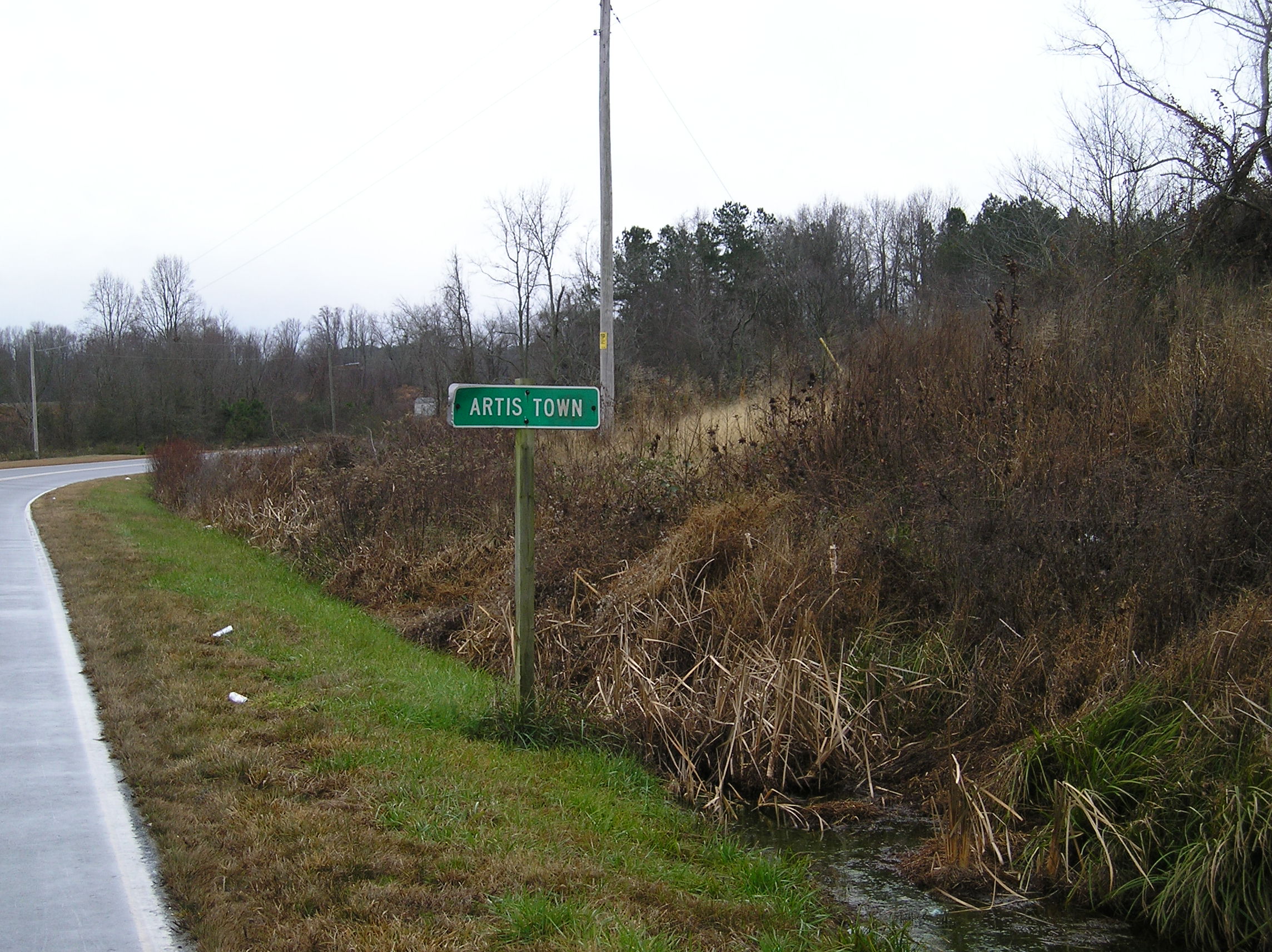
Artis Town, at last.

I checked first at the Court House. I had a hazy memory of a dusty, yellowed pull-down map hanging on a wall in the Register of Deeds office depicting Greene County townships in, perhaps, the 1950s. Most county roads were then unpaved, and the map bore witness to many now-abandoned crossroads and hamlets, including “Artis Town.” But the map was gone, cast aside in a reshuffling of office space that relegated Register of Deeds to the basement. The two ladies on duty — blue-permed and powder-fresh — interrupted their gossip (“He’s good as gold, but when he’s mad, he’ll … he’ll CATCH”) to help, gamely pulling two or three crumbling maps from storage, but none was what I sought. “Try EMS!,” one finally suggested, “They know all the roads.”

In the dim front office of a low brick building on the northern edge of Snow Hill, I explained myself: “I’m looking for a place in the road called Artis Town. There used to be a sign. Like, a green one with white letters. And it was somewhere off Speights Bridge Road, or maybe Lane Road, but I hunted up and down this morning and couldn’t find it.” The good old boys were puzzled. “Artis Town … Artis Town …” “Well, naw, I never heard of … Mike! You know where Artis Town is?” “Artis Town. Artis Town ….” An older man walked through the door and was put to the test. “Well, I think … hmmm. Hey. Call Donald. If he don’t know, don’t nobody.” … “Hey, Pam, is Donald — wait, you’re from out that way. Do you know where Artis Town is? … Okay … okay … okay. Donald? Yeah, Artis Town. … Okay … mm-hmm … that’s what Pam said. Okay, thankee.” And sure enough, it was in a bend of Lane Road, off Speights Bridge, and there had been a sign, and it was gone.

But I asked my mother about it, too, because she taught in Greene County for two years when she first came to North Carolina, and I thought maybe she’d heard of it. Her school had been in Walstonburg and probably drew students from Speights Bridge, and … “Let me look at my gazetteer.” She has the old version from the 1980s, which, of course, I pitched once I bought the shiny new one. And I’m regretting that surely, for Artis Town is marked quite clearly on her map, and I could have saved myself some gas and tire rubber had I consulted it. (Though I would have missed out on the helpful hospitality of the fine people of Snow Hill.)

I dug my old laptop out of storage today. It took a bit of searching, but finally: photos I took in December 2004 when I was wandering the roads of Greene County with no real purpose other than a penchant for what Least Heat-Moon calls “blue highways.” Almost ten years would pass before I’d connect Artis Town with my own Artises. The ancestors, though, are patient.

Image

Image

Photographs by Lisa Y. Henderson, 23 December 2004.

Standard
Free People of Color, Land, North Carolina, Other Documents, Paternal Kin

100 acres on Watery Branch.

Fourteen years into their marriage, Adam and Frances Seaberry Artis purchased three tracts of land totaling about 109 acres from her half-brother, Napoleon Hagans. All three are on or near Watery Branch, an east-flowing tributary of Contentnea Creek. The first two documents are a mortgage deed and deed of sale for two tracts on the creek. The third is a deed of sale for an additional nine acres nearby. Notably, this last is land upon which Adam had lived in prior years, as it contained the graves of his first wife, Lucinda Jones Artis, and a child.

—–

North Carolina, Wayne County  }  This indenture made this the 25th day of July AD 1874, between Adam T. Artis and wife Frances of the first part, and Napoleon Hagans of the second part, and all of the County and State above written, Witnesseth that the said parties of the first part for and in consideration of the sum of one dollar in hand paid by the said party of the second part, have bargained and sold and by these presents do convey unto the said party of the second part, and his heirs two tracts or parcels situated in the County of Wayne, and bounded as follows: viz: the first tract begins at a pine on the New Road in Willie Moorings line and runs with his line North 136 poles to a stake on the main run of Watery Branch, then up and with the various courses of the branch to the mouth of a small branch, then up the various courses of said branch to a stake, then E 20 poles to said new road, then with the same to the beginning, containing Eighty eight acres, more or less: the other tract begins at a stake in Cullen West’s line, and runs South 28 ¼ poles to a stake in said line Charity Bailey’s corner, then with his line West 67 ¼ poles to a stake Wm Bailey’s corner, then with his line West, 67 ¼ poles to the beginning, containing twelve and one fourths acres more or less _

And the said parties of the first part do for themselves and their heirs forever warrant and defend title to the above land, to the said party of the second part his heirs and assigns

The condition of the above deed is such whereas the above named Adam T. Artis is indebted to the said Napoleon Hagins in the amount of Fifteen hundred dollars, purchase money for the land herein conveyed, and for which said sum the said Artis has given promissory notes for $375.00 each, and payable in the manner following viz: the first note will be due on the 1st day of January AD 1876: at the same day and date the interest on the whole amount of the purchase money ($1500.00) from Jany 1st 1875 to that date will be paid annually on the first day of January. The amount of principal paid thereon to be deducted; the second note will be due on January 1st 1877, the third on January 1st 1878; and the fourth on Jany 1st 1879, and all are subject to the conditions set forth as to the first note above mentioned.

Now if the said Artis shall pay the interest as above set forth as they come due according to their tenor, then this deed to be void otherwise to be of full force and effect.

And upon the failure of said Artis to pay said noted and interest as above set forth as they severally fall due, then it shall be in the power of said Hagins to sell the land herein described after twenty days advertisement at the Court House door in Goldsboro and four other places in Wayne County, and after deducting the whole amount due him & the expenses of sale shall pay the balance if any to the said Artis or his legal representatives.

In testimony whereof the said parties of the first part have hereunto set their hands and seals the day and date first above written.

Witness: /s/ W.T. Faircloth             Adam X Artis, Frances X Artis

[Wife’s consent omitted.]

Deed Book 37, page 72, Wayne County Register of Deeds office.

—–

State of N. Carolina, Wayne County  } This indenture made this the 25th day of July in the year of Our Lord One thousand Eight hundred and Seventy four, between Napoleon Hagins and wife Absey Hagins of the first part and Adam T. Artis of the second part, all of the County and State aforesaid Witnesseth: that we said Hagins and wife parties of the first part for and in consideration of the sum of Fifteen hundred Dollars to us in hand paid by said Adam T. Artis  the receipt and payment whereof we said parties of the first part do by these presents hereby acknowledge ourselves fully satisfied content and paid before the ensealing signing and delivery of the same have bargained sold delivered given up conveyed unto said Artis his heirs and assigns two certain pieces or parcels of land lying in said County of Wayne on the South side of Watery Branch, the first tract adjoining the lands of Wiley Moring Charity Bailey and others, bounded as follows:  Beginning at a pine on the New Road in Willie Moring’s line and runs with said line N. 136 poles to a stake on the main run of Watery Branch, then up the various courses of the run as it meanders to the mouth of a small branch, then up the run of said small branch its various courses to a stake, then East 20 poles to said New Road, then with the same to the beginning, containing Eighty eight acres, more or less:

Also one other tract purchased from Wm. Bailey and wife Celia, adjoining the lands of Charity Bailey Wm. Bailey Cullen West and others bounded as follows: Beginning at a stake in Cullen West’s line and runs South 28 ¼ poles to a stake in said line Charity Bailey’s corner, then with her line West 69 ½ poles to a stake in said West’s other line, then with said line  N 28 ¼ to a stake, Wm Bailey’s corner then with his line W 69 ½  poles to the beginning, containing 12 ¼  acres more or less _

And we said Hagans and wife Absey parties of the first part do by these presents bind ourselves our heirs executors admrs & assigns forever free claims or encumbrances whatsoever

In testimony whereof we the said Hagins and wife have hereunto set our hands and affixed our seals, the day and date first mentioned.

Witness: /s/ W.T. Faircloth             Napoleon X Hagans, Absey X Hagans

[Wife’s consent omitted.]

Deed Book 37, page 74, Wayne County Register of Deeds office.

—–

North Carolina, Wayne County  }

This Deed made this thirty first day of October 1874 by Adam Artis and his wife Frances of Wayne County, and State of North Carolina to Napoleon Hagans of Wayne County, and State of North Carolina, Witnesseth that said Adam Artis in consideration of Two hundred & seventy five /100 Dollars, to them paid by said Napoleon Hagans, the receipt of which is hereby acknowledged, have bargained and sold and by these presents do bargain, sell and convey to said Napoleon Hagans and his heirs a tract of land in Wayne County, State of N.C. , adjoining the lands Bryant Yelverton & Jesse Mincey, and others, bounded as follows: viz: — Beginning at a stake on road in Yelverton’s line and runs S. 59 E. 51 ½ poles to a light stake in Yelverton’s line then N. 61 poles to another stake on said road then S. 54 W. with said road to the beginning containing 9 ¼ acres more or less.

Reserving a graveyard on said land, now paled in in which the said Adam Artis’ first wife & one child were buried.

To have and to Hold the aforesaid tract of land and all privileges and appurtenances thereto belonging to the said Napoleon Hagans and his heirs and assigns to them only

And the said parties of the first part do for themselves and their heirs forever warrant and defend title to the above land, to the said party of the second part his heirs and assigns to their only use and behalf

And this the said Adam Artis & wife Frances, covenant that they are seized of said premises in fee and have right to convey the same in fee simple, that the same are free from all incumbrances, and that they will warrant and defend the said title to the same, against the claims of all persons whatsoever

In testimony whereof, the said Adam Artis & wife Frances have known to set their hands and seals, the day and year above written  Adam X Artis, Frances X Artis

[Wife’s consent omitted.]

Deed Book 37, page 220, Wayne County Register of Deeds office.
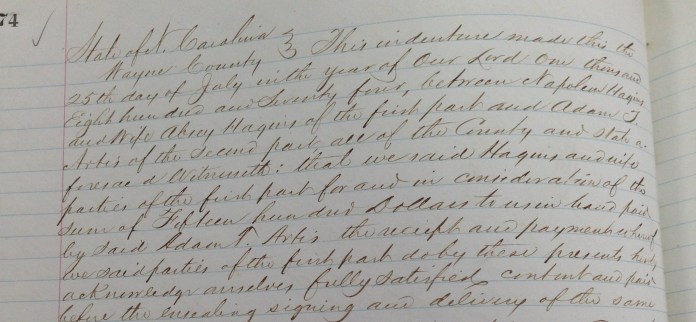
deed

Standard
Enslaved People, Free People of Color, Land, Newspaper Articles, North Carolina, Paternal Kin, Vocation

Black carpenter makes name for himself.

I’ve been pulling together a descendant chart for Daniel Artis. In part, I want to keep the names straight and, in part, I’m trying to see if I’m related to any of the other Edwardses, Saulses or Artises I grew up with. Tonight I Googled some random names from this family and up popped this, published just three days ago in Kinston.com, the on-line version of the Kinston Free Press. Andrew Sauls’ father was Isaac Sauls, son of Isaac Sauls, son of Prior Ann Artis Sauls Thompson, daughter of Daniel Artis, brother of my great-great-great-great-grandmother Vicey Artis Williams.

[Update, 7 March 2014: I emailed the Free Press journalist and two days later — yesterday — got a call from Andrew Sauls himself! He lives on land his grandfather bought in 1920 (plus 400 more); confirmed that the Artis Town sign is gone; knew M.’s grandfather, “Cousin Booker T.,” well; and promised to show me around Sauls-Edwards-Artis territory next time I’m home!  — LYH]

Standard
Free People of Color, North Carolina, Other Documents, Paternal Kin, Photographs, Rights

Jurors and judges of election.

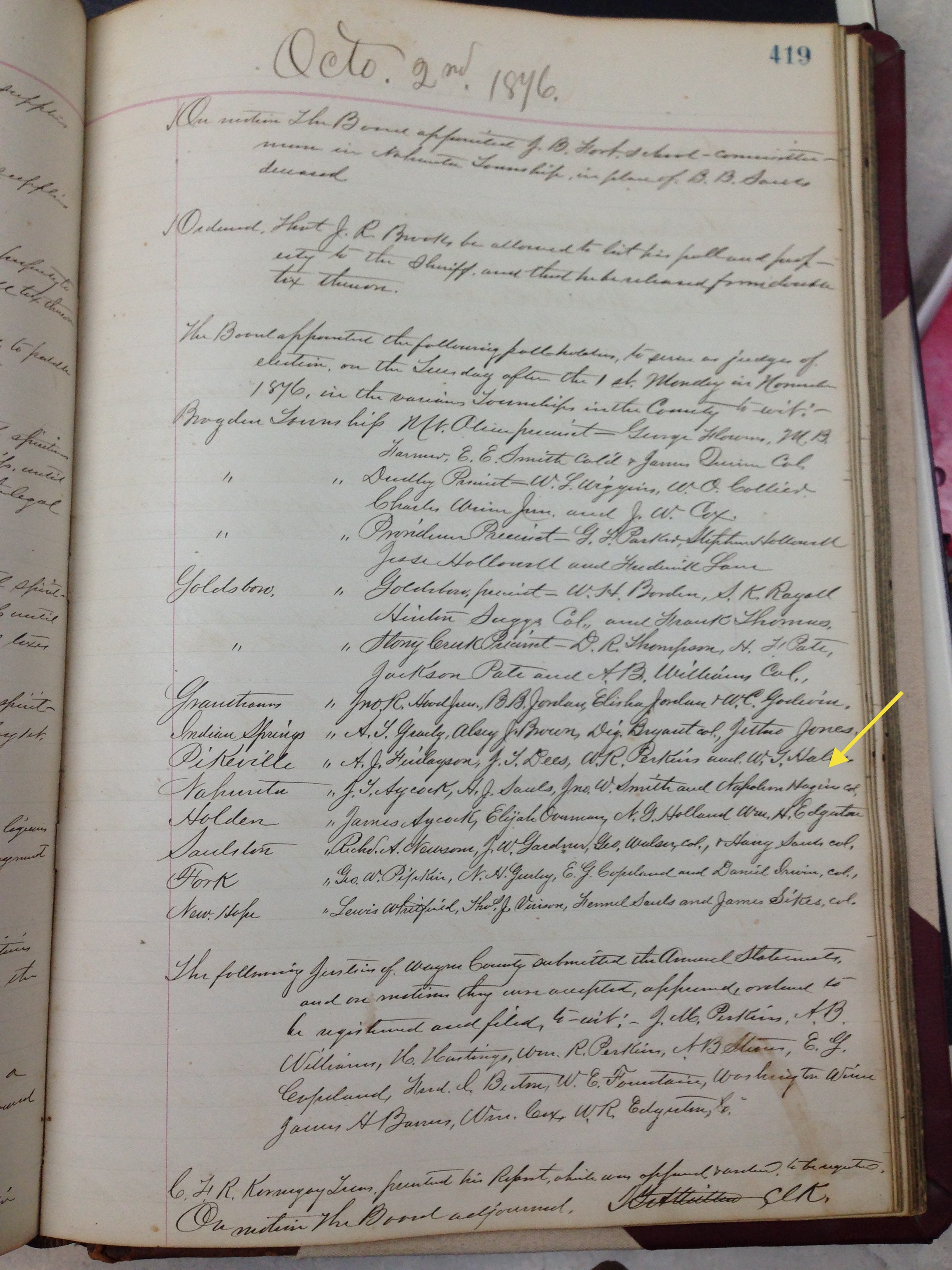
As tax-paying landowners, many African-American men in Wayne County, North Carolina, in the 1870s were called alongside white men to fulfill their civic duties. Here are two entries from Superior Court Minute Book 2:

ImageNapoleon Hagans of Nahunta township was appointed a judge of elections.

ImageMy great-great-great-grandfather Lewis Henderson drew jury duty for the first week of the next term of the superior court.

Superior Court Minute Book 2, Wayne County Register of Deeds Office, Goldsboro, North Carolina.

Standard
Births Deaths Marriages, Enslaved People, Free People of Color, North Carolina, Paternal Kin, Photographs

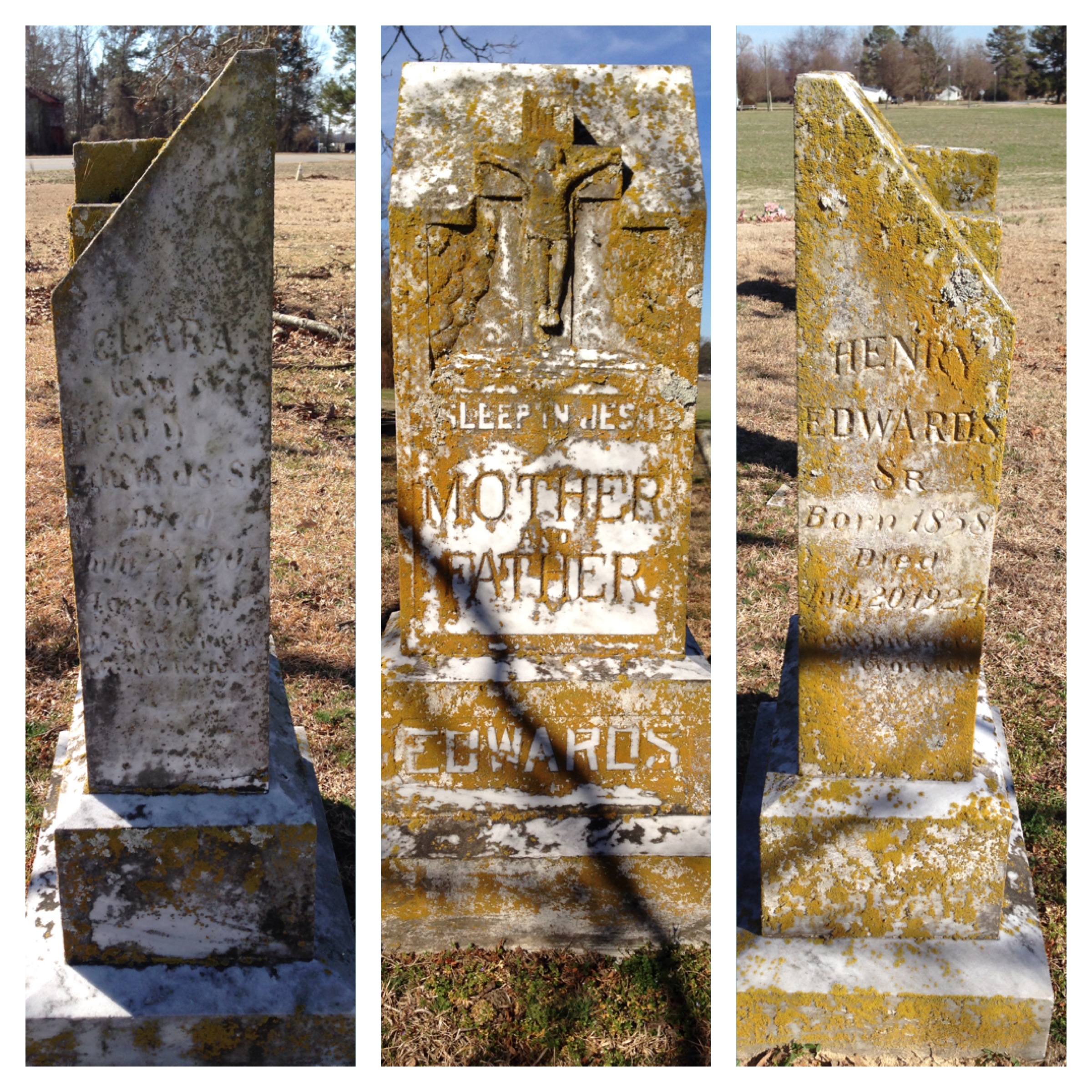
Family cemeteries, no. 9: Daniel Artis’ Edwardses.

A right turn out of my parents’ neighborhood puts me onto Highway 58. Head southeast, cross the edge of Stantonsburg, over Contentnea Creek and the Greene County line, and, 13 miles from home, you reach Lane Road. Turn left, round the curve, and there, neatly marked and kept, is the Edwards cemetery. Here are buried Daniel Artis‘ daughter Clara, her husband Henry Edwards, and their descendants.

Image

Photo taken today, Lisa Y. Henderson.

Standard
Free People of Color, Newspaper Articles, North Carolina, Paternal Kin, Politics

Alderman and poll holder.

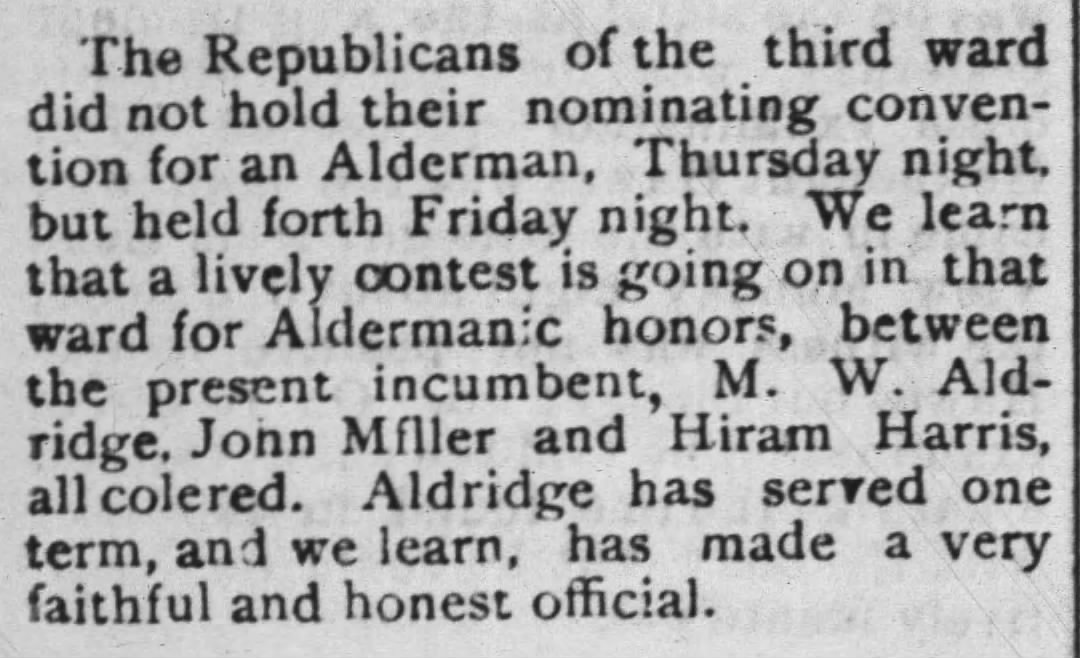
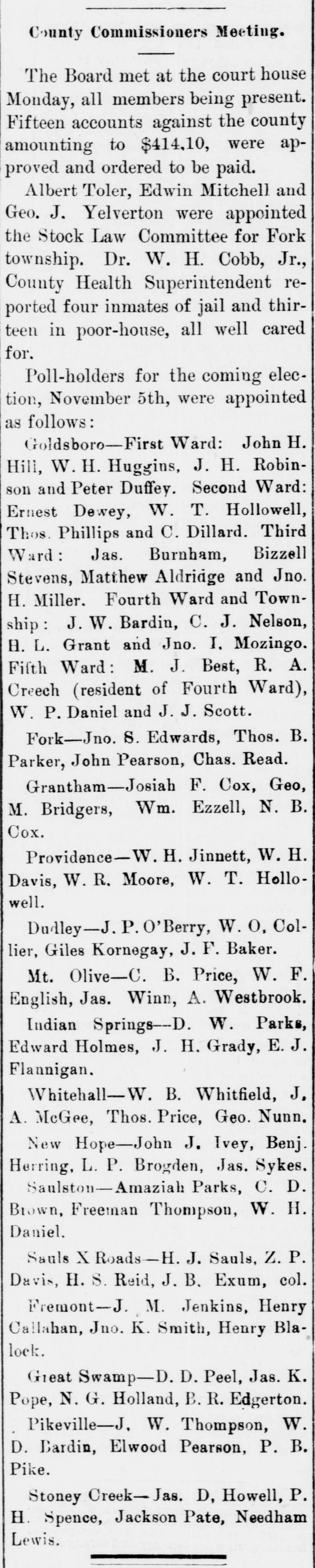
Despite the collapse of Reconstruction, African-Americans continued to participate in Wayne County’s political life through the end of the 19th century. Mathew W. Aldridge, in particular, was active in local governance, as announced in eastern North Carolina newspapers:

Wilm Msgr 4 27 1889

Wilmington Messenger, 27 April 1889.

Image

Goldsboro Headlight, 1 May 1889.

Image

Goldsboro Headlight, 8 May 1889.

Wilm Msgr 5 8 1889

Wilmington Messenger, 8 May 1889.

Image

Goldsboro Headlight, 8 October 1890.

Other notables: C[larence] Dillard (Presbyterian minister who arrived in Goldsboro in 1884, later principal of “colored school”); Bizzell Stevens (also a minister; like William S. Hagans, married into the Burnett family, a prominent free family of color in the antebellum era; later a postal clerk at Goldsboro post office); John Frank “J.F.” Baker (postmaster at the Dudley post office; married Mary Ann Aldridge, daughter of J. Matthew Aldridge; murdered); James Winn; and Henry S. “H.S.” Reid (son of Washington and Penninah Reid; member of large prominent free family of color.)

Standard