Births Deaths Marriages, Free People of Color, Land, North Carolina, Other Documents

I did the best I could.

North Carolina } In the Superior Court October Term 1897

Sampson County }

Hardy A. Brewington, Joshua Brewington, Simon Brewington, Nathan Brewington, Nancy Goodman and her husband J.B. Goodman, Lucy Strickland and her husband J.S. Strickland, Eliza Manuel and her husband Alvin Manuel, Bashaby Brewington, Mary Wheeler, Lulu Brewington and Luther Brewington heirs at law of Raiford Brewington Jr. and Allen B. Brewington by his guardian Hardy A. Brewington, Plaintiffs

Jno. R. Jacobs, Rocia Lee Brewington and her husband J.A. Brewington, Lillie B. Brewington and her husband M.L. Brewington, and Jno. R. Jacobs, guardian ad litem of Della Jacobs and Lavinia Jacobs, Defendants

The plaintiffs complain of the defendants and allege:

I. That on the 20th day of Nov. A.D. 1890 Raiford Brewington & his wife Bashaby Brewington executed a deed to John R. Jacobs and his wife Polly Ann Jacobs for the following described tract of land to wit: Situate in Sampson County State of North Carolina and adjoining the lands of Nathan Brewington, James M. Parker and others and bounded as follows; Beginning at a stake on the lane and runs about S 550 yards to a stake at an old post oak stump the line of Jas. M. Parker & W. Royal thence west about 750 yards to a stake on the west wide of Beaver Dam swamp, thence up the edge of the swamp to a shortleaf pine at the ditch, thence East 750 yards to the beginning containing 75 acres more or less.

II. That the deed aforesaid is duly recorded in the office of the Register of Deeds of Sampson County Book 76 p 193 a copy of which deed is marked “Exhibit A” and hereto attached and made a part of this complaint, which deed does not convey the said lands in fee simple but upon certain stipulations and conditions in words as follows: — The said Raiford Brewington & wife Bashaby Brewington excepts their life time estate in said lands and the said John R. Jacobs and Polly Ann Jacobs and their heirs are to support the said Raiford Brewington and wife Bashaby Brewington and their son Allen B. Brewington during their natural life time and furnish them with good comfortable cloths. When the said John R. Jacobs and wife Polly Ann and their heirs fails to comply with the above obligations then their right and title to the aforesaid land shall be void and a further condition in said deed is that the said Raiford Brewington & wife Bashy shall have the use of said property during their life time but shall not sell any of said property not land unless it is agreeable with J.R. Jacobs & wife Polly Ann. Neither the said J.R. Jacobs and Polly Ann shall sell any of said property nor land unless it is agreeable with Raiford Brewington & wife Bashaby.

III. That upon the execution & delivery of said deed to wit on Nov 20th 1890 the said Jno. R. Jacobs & wife Polly Ann Jacobs went into possession of the lands described in said deed and exercised possession and full control of same until 1893 when Polly Ann Jacobs died, but during this period they did not fully comply with the conditions of said deed and Raiford Brewington & wife Bashaby were required to work and furnish their own support. After the death of Polly Ann Jacobs, her husband Jno. R. Jacobs & the heirs of Polly Ann Jacobs continued to live on the premises & exercise possession & full control of same until about Jan 1st 1896 when they quit the premises & furnished no further food or support in any way since to Raiford Brewington & wife Bashaby Brewington of their son Allen Brewington nor did the said Jno. R. Jacobs & the heirs of Polly Ann Jacobs comply with the conditions in said deed before they deserted the premises but instead wasted & used the provisions made & provided by the said Raiford Brewington & wife with whom the said Jno. R. Jacobs & family loved.

IV. That Polly Ann Jacobs is one of the children and heirs of Raiford Brewington & Bashaby Brewington and has been fully provided for by them before said deed was executed to them. That Allen Brewington one of the children is an idiot and the only heir not provided for by Raiford Brewington, and the lands conveyed to Jno. R. Jacobs & Polly Ann Jacobs in the deed set out above was the sahe of the Raiford Brewington estate that he intended for his son Allen Brewington and for himself and wife Bashaby Brewington as long as they should live.

V. That in January 1896 Raiford Brewington died leaving his wife Bashaby Brewington & son Allen Brewington with no one to support them, as Jno. R. Jacobs and the heirs of Polly An Jacobs had broken the conditions in said deed by leaving the premises & refusing to provide them any support.

VI. That if said deed shall remain in full force & effect, it would be in violation of the conditions in said deed, and contrary to the will and intent, and the express declaration of the grantors therein & would leave them without any means of support.

VII. That if said deed shall remain in full force and effect Jno. R. Jacobs and the heirs of Polly Ann Jacobs would thereby receive a double share of the estate of Raiford Brewington to wit: the share of Allen Brewington and the share of Polly Ann Jacobs which latter share had been allotted to her before the execution of said deed.

Wherefore the plaintiffs pray:

I. That the deed referred to in Article I of this Complaint be declared null and void and that a suitable person be appointed by the court to take the title of said land and hold the same in trust for Bashaby Brewington and her son Allen Brewington and the rents and profits therefrom be applied to the feeding, clothing & support of them as long as they both shall live and the remainder to the heirs at law of Raiford Brewington.

II. For cost and general relief – Lee & Butler attys for the plaintiffs.

Hardy A. Brewington being duly sworn according to law says that he has read the foregoing complaint or heard it read and that he knows the contents thereof to be true except such matters and things as are set out on information and belief and those he believes to be true.

Subscribed & sworn to before me this the 29 day of October 1897 /s/ H.A. Brewington

——

The file also contains notes from trial testimony:

Hardy Brewington — am son of Raiford Brewington – he had twelve children – Polly Ann Jacobs is my sister – My father gave her Polly Ann $300 in money & $100 in other property – My father never gave Allen Brewington anything – He is an idiot – 48 yrs old never did any work – My mother is living is 86 or 87 yrs old – not able to work – Allen lives with her – Jacobs & wife came into possession at date of deed They lived on the land with my mother 5 yrs – Polly Ann died about ’93 – Jacobs lived there 2 ½ yrs after death of wife – Jacobs went to Dudley in Wayne Co & has lived there ever since – My father was then living on the land – he died at 85 yrs – Jacobs provided very poorly for the old man wife & son provisions were poor & not plenty of it. Jacobs was liable to drink & will go off & leave them unprovided for in food & fuel. Land tolerably good when Jacobs took possession, pretty poor when he left He always had plenty to eat & good clothes – The Heirs of Polly Ann Jacobs left the old people neglected – Jacobs could have remained on the land & made them more comfortable – He cut timber & carried to Wilmington – and wasted the money – Myself & son have supported the old people since Jacobs my married defnts daughter – Jacobs has done nothing for them since ’95 – Have heard old man complain of being hungry – cold &c. – Raiford Brewington & wife did not consent to the mortgage didn’t know of it until six or eight months after – He said Jacobs had given a mortgage & he didn’t know what wd become of him – My father died in ’96 – My mother & Idiot have no means of support except this land – Whitney Royal wrote the deed – Jacobs moved from Dudley down on this land – Jacobs married 2nd time after about 1 ½ yr after wife’s death – Jacobs got money from Parker $30 & my father said he would see it paid. – Note given about 12 mos before mortgage

Jim Strickland — Live 2 ½ miles from place – I married Raiford Brewington’s daughter – He gave her $200 – Jacobs didn’t give them enough to eat – at all times – his clothes were common – Jacobs has done nothing for them since ’95 – Place was better when he came than when he left – Land not worth much now – Brother Hardy & son Arthur have been supporting them since Jacobs left

Arthur Brewington – Am son of Hardy Brewington Jacobs staid on the land about 5 years – The food was pretty poor like the most of us meat & bread – Before Jacobs went there could get as good a meal as anywhere – he wd leave land neglected – Drank every week – Raiford put me there after Jacobs left – Me & my father have been supporting the old people – They complained of want of food & fuel – I did the best I could under the circumstances – Jacobs could have done better than he did.

J.R. Jacobs – Am one of Defn’ts – When I went there but little provisions – fence gone down pretty much – I made a crop next I put 2000 [illegible] the spring I went there & clean out ditches I did the best I could – all eat at same table – He complained some like old people will do – Neither of them suffered for food or fuel I cut timber & carried to Wilmington – no profit – My wife lived about 4 yrs after I went there – I did the best I could – Arthur seemed to be their choice – We bargained for Arthur to go there & take my obligation with consent of old people – I was in debt in Clinton – I went to Parker to get the money – Old man helped to get up money – Old Man was present – gave boundaries &c — $35 note was to pay for guano – I owed Vann $25 for corn – I carried it home he carried it [illegible] – All of it was for money used on the place & for mule worked on place. Raiford [knew] all about it – I gave a lien on crop that year – The $35 mortgage was included in the $125 mortgage Raiford Brewington only once came here – The $125 mortgage was made on the plantation & he knew about it, and was willing to it – Judgmt agst me for Parker – 40 acres of cleared land on the place – Raiford Brewington asked me to cancel the deed I told him I didn’t [think] it right to do so. This was after my wife died.

J.L. Brewington – Raiford Brewington was my father – Hard to please he wanted something to drink He had a heap to feed – people & stock – Jacobs did the best he could The old man grumbled all the time – but had plenty to eat –

Jonathan Goodman – Live about ½ miles from the place – I saw the old man frequently – He lived as good as most any farmer – While Jacobs lived there – he lived as well as common run of people that had no more – Jacobs drank some – It seemed as if Jacobs wished to please him – he was off at times –

Mary Eliza Brewington – Raiford was my husbd father – I lived ½ mile from him I heard Raiford say it was a just debt as far as he [illegible] and he wanted Parker paid – The old people got along as well as one could expect

J.R. Parker – The $35 mortgage Raiford & Jacobs came to me & wanted to borrow some money – Raiford proposed to meet him in Clinton & make up the papers – which we did – I let Jacobs have some corn & bacon – This was cancelled to make up the $125 mortgage – The cash that I gave Jacobs – and the note for $35 with the money due me makes up the $125 – I know that Raiford knew of the $125 note & mortgage — $35 was all money – how much more I don’t know – over half of it – There was an indictment agst Jacobs for passing counterfeit money. Raiford came to me & didn’t say he would or wouldn’t sign the $125 –

Marshal Newman – Was J.P. – at time mortgage was made – Parker & Jacobs got me to write this mortgage – it was made at Nathan Brewington’s house Raiford was not present, and never said anything to me about it. Nathan Brewington’s was convenient to Jacobs –

Hardy Brewington (re-called) – We knew nothing about $125

——

Judgment for Hardy Brewington et al. The judge found that John and Polly Ann Jacobs had not complied fully with the terms of the deed and ordered that (1) the deed from the Brewingtons to the Jacobses be declared null and void; (2) Hardy Brewington be appointed trustee of the land for the sole use and benefit of Bashaby and Allen Brewington during their lifetimes; (3) after the deaths of Bashaby and Allen, Hardy was discharged from his trusteeship, and (4) John Jacobs and the Parkers were to pay court costs.

——

I’m not a Brewington or a Jacobs and have no direct link to any of the players in this sad intrafamily squabble over Polly Ann Brewington Jacobs’ estate. Nonetheless, as was the rule among free families of color in and around Dudley, Wayne County, there was multi-strand intertwining between these folks and my extended family:

  • Joshua L. Brewington, the J.L. who testified on behalf of John R. Jacobs, married Amelia Aldridge, sister of my great-great-grandfather John W. Aldridge.
  • John R. Jacobs was the older brother of “Papa,” Jesse A. Jacobs Jr., who married Sarah D. Henderson (my great-great-grandmother Loudie Henderson’s sister) and reared my grandmother.
  • John Jacobs’ sister Frances married Marshall Carter of Sampson County. Frances’ son Milford E. Carter married Beulah M. Aldridge, John W. Aldridge’s daughter. Another son, John W. Carter, cared for Lucian Henderson (brother of Sarah) and his wife in their old age and inherited their small farm.
  • Milford E. Carter Jr. married Jessie Bell Brewington, granddaughter of Hardy A. Brewington.
  • Michael and Ann Eliza Brewington Manuel’s son, Alonzo Manuel, married Sallie Wynn, daughter of Edward and Susan Henderson Wynn. Susan H. Wynn was the sister of my great-great-great-grandfather Lewis Henderson.
  • Michael and Ann Eliza Brewington Manuel’s daughter Celestial married Hillary B. Simmons after the death of his first wife, Ann Elizabeth Henderson, who was a sister of Sarah, Loudie and Lucian Henderson.
  • Raiford Brewington’s wife Bashaby was the daughter of Shadrach and Zilpha Hardin Manuel. Her kinship to Michael Manuel is not entirely clear to me, but research by others suggests that they were cousins.

From the file of Polly Ann Jacobs, Sampson County, North Carolina Estate Files 1663-1979, https://familysearch.org. Original, North Carolina State Archives.
Standard
Agriculture, Free People of Color, Land, Newspaper Articles, North Carolina, Paternal Kin, Politics

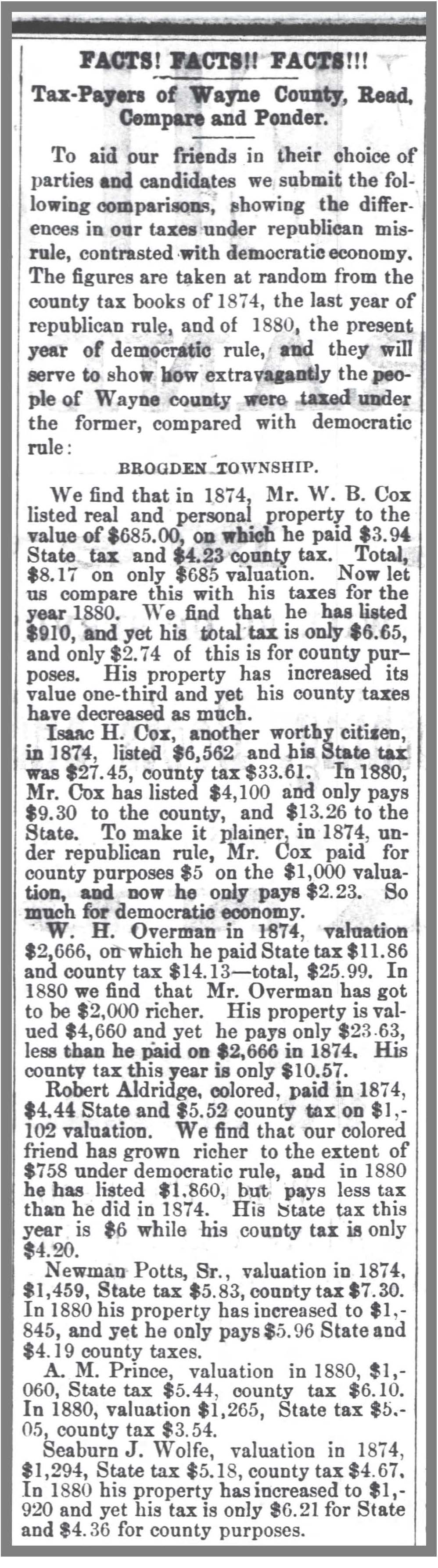
Our colored friend has grown richer.

Image

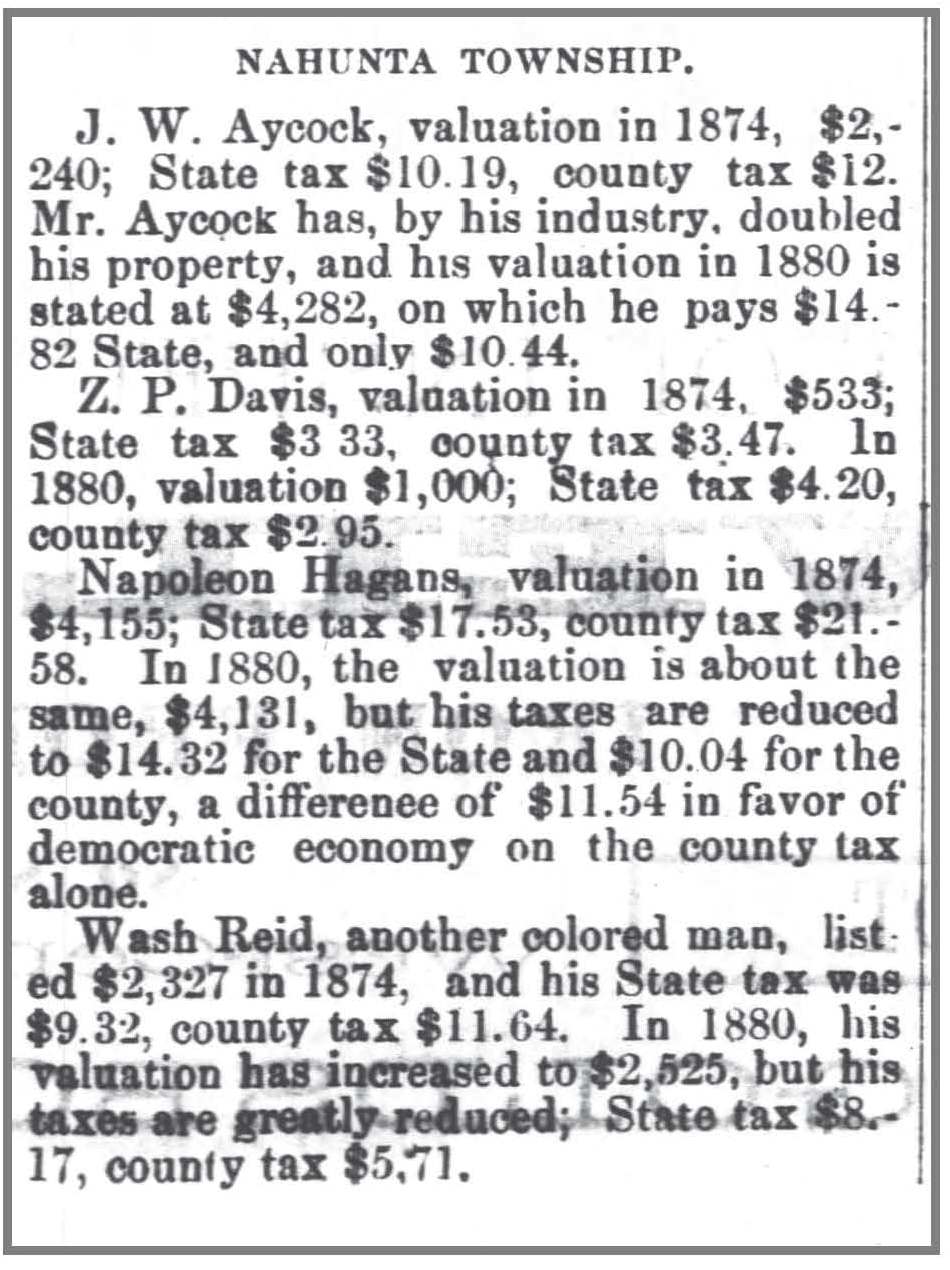
ImageGoldsboro Messenger, 21 October 1880.

These propaganda pieces are part of a single article published to demonstrate that the rising tide of Democratic rule had floated all boats as land values increased while taxes fell. (In other words, the end of Republican rule meant more money in the pocket, as well as a foot on the neck of African-Americans.)

Two of the “colored friends” noted were my kin — my great-great-great-grandfather Robert Aldridge and Napoleon Hagans, the brother of my great-great-great-grandmother Frances Seaberry Artis. (And Washington Reid’s nephews William and Henry Reid, sons of John Reid, married Adam Artis’ niece Elizabeth Wilson and daughter Cora Artis, respectively.) Aldridge, Hagans and Reid (as well as Artis, Frances’ father Aaron Seaberry and Betty’s father John Wilson) were all prosperous free-born farmers.

Standard
Business, Civil War, Enslaved People, Land, Maternal Kin, Newspaper Articles, North Carolina, Photographs

Eagle Mills.

An abstract from Heritage of Iredell County, Vol. I (1980) —

In 1846, peddlar Andrew Baggerly bought the old Francis Barnard mill tract on Hunting Creek in north Iredell County.  In 1849, he placed an ad in Salisbury’s Carolina Watchman: “Capital Wanted And If Not Obtained Then Valuable Property For Sale.”  He described the property as “the most valuable water power in the Southern Country … situated on Hunting Creek in Iredell County, twenty-eight miles west of Salisbury … [on] a never-failing stream, … remarkable for its purity, … [and] adapted to the manufacture of paper, to calico printing, to bleaching etc.”  Baggerly noted that there was a dam in place, an active sawmill, a grist mill soon to open, and a factory building about half-finished.

On 2 Mar 1850, Baggerly, James E.S. Morrison, William T. Gaither, William R. Feimster, William I. Colvert, G. Gaither Sr. and Andrew Morrison filed a deed for a 318 1/4-acre tract called the Eagle Mills place.  By 1852, the factory was operating with William I. Colvert as its agent.  It had 700 spindles and 12 looms and employed an overseer and 22 workers, 20 of whom were women. By 1854 the adjacent former Inscore Mill had been added to the works, and Baggerly claimed the “intrinsic and speculative value” of the complex was $2,700,000.  

In 1855, Baggerly advertised in Charlotte’s North Carolina Whig and in the Carolina Watchman, calling the complex “Eagle City, the Great Point of Attraction, Destined to be the great center of manufacturing interests in Western North Carolina and perhaps the United States.”  He deeded the president and Congress of the United States a ten-acre block in Eagle City called Eagle Square, located on Market Street.  

After Baggerly was forced to liquidate his assets during the Panic of 1857, William Colvert became the owner of his interest in Eagle Mills.  “According to tradition there was a tobacco factory, hotel, oil mill, and general store at Eagle Mills in addition to the grist mill and cotton factory.  A number of homes stood in the horseshoe bend above the mills and a church was eventually constructed on the edge of the settlement.”

In the spring of 1865, Stoneman’s raiders came upon Eagle Mills unexpectedly and burned it to the ground.  The mills were rebuilt, but Eagle Mills never recovered its former prosperity.  The cotton factory and grist mill operated until destroyed by fire in April 1894.  At that time, William I. Colvert, Robert S. Colvert, and James E.S. Morrison were the owners.  

The only remains at the site are gravestones in the church cemetery, traces of the main road to the mill, the grist mill’s foundation stones, and, a short distance upstream, remains of the stone supports where a covered bridge crossed the creek.

——

Sville_Record_and_Landmark_4_19_1894_Eagle_Mills

Statesville Record & Landmark, 19 April 1894.

——

When William I. Colvert took charge of Eagle Mills in 1852, my great-grandfather Walker Colvert was in his early 30s and father of a one year-old boy, John Walker Colvert. I don’t know exactly what kind of work Walker did for W.I., but they had grown up together, and Walker was an entrusted slave. Even if his primary labors were not at the cotton factory complex, I am certain that he spent considerable time in and around his master’s largest investment. So, too, would John Walker, who remained with W.I. after Emancipation. He is listed in W.I.’s household in the 1870 and 1880 censuses, and I suspect he stayed at Eagle Mills until the final fire closed down the works.

On a rainy December morning I cruised the backroads of northern Iredell County, drinking in the landscape that was home to my Colverts and Nicholsons for much of the 19th century. I made a left onto Eagle Mills Road, headed north. A sharp bend in the road and there, a bridge over Hunting Creek. I pulled over and, ignoring a No Trespassing sign, clambered down to the sandy bank. The waterway is too shallow and rocky to have been paddled or poled, but I imagine that Walker and John Walker knew its course very well. Hunting Creek powered Eagle Mills and was a direct link between W.I. Colvert’s lands and those of Thomas A. Nicholson, whose son James Lee married W.I.’s daughter and whose granddaughter, Harriet Nicholson, gave birth to John Walker Colvert’s first child.

IMG_4618

Photograph by Lisa Y. Henderson, December 2013.

Standard
Births Deaths Marriages, Free People of Color, Land, North Carolina, Paternal Kin, Photographs

Final resting place.

I wasn’t sure how I was going to get at it. GPS coordinates and satellite views showed the cemetery way back from the road on private property, without even a path to get to it. I took a chance, though, and pulled up in the driveway of the house closest to it. A wary, middle-aged white woman was settling an elderly woman into a car as I stepped out. I introduced myself and told her what I was looking for. “Goodness,” she said. “I remember a graveyard back up in the woods when I was child. You should ask my cousin J.”

Following her directions, I knocked on the house of a door perhaps a quarter-mile down Turner Swamp Road. J.S. answered with a quizzical, but friendly, greeting, and I repeated my quest. Minutes later, I was sitting in J.’s back room, waiting for him to change shoes and look for me some gloves and find the keys to his golf cart. We bounced along a farm path for several hundred yards, then followed the edge of the woods along a fallow field. Along the way, J. told me about his family’s long history on the land, and the small house and office, still standing, in which his forebears’ had lived. As we approached the final stretch, he cautioned me about the briers that we were going to have to fight through and pulled out some hand loppers to ease our path. The cemetery, he said, was there — in that bit of woods bulging out into the plowed-under field.

IMG_4797

When they were children, J. and his cousins roamed these woods at play. Though only a few markers were now visible, he recalled dozens of graves on this hillock. Turner Swamp runs just on the other side of the tree line nearby. Without too much difficulty, we cut our way in and angled toward the the single incongruity in this overgrown copse — a low iron fence surrounding a clutch of headstones. I made for the tallest one, a stone finger pointing heavenward through the brush. At its base:

IMG_4783

Elder Jonah Williams, brother of my great-great-great-grandfather Adam T. Artis.

IMG_4786

At his side, wife Pleasant Battle Williams. And his children Clarissa, J.W. and Willie nearby.

IMG_4789

In Glimpses of Wayne County, North Carolina: An Architectural History, authors Pezzoni and Smith note that the largely forgotten graveyard was believed to hold the remains of members of the Reid family. This is quite possibly true as Reids have lived in this area from the early 1800s to the present. As I followed J. through the brush and my eye grew accustomed to the contours of the ground beneath us, I could see evidence of thirty to forty graves, and there are likely many more. Had this been a church cemetery? Was Turner Swamp Baptist Church (or its predecessor) originally here, closer to the banks of the creek for which it is named? If this were once the Reid family’s graveyard — known 19th and early 20th century burial sites for this huge extended family are notably few — how had Jonah and his family come to be buried there?

IMG_4794

I am indebted to J.S. for the warmth and generosity shown to a stranger who showed up unannounced at his doorstep on a chilly December day, asking about graveyards. I have been at the receiving end of many acts of kindness in my genealogical sleuthings, but his offer of time and interest and knowledge — and golfcart — are unparalleled. He has invited me back anytime, and I intend to take him up on the offer.

Standard
Births Deaths Marriages, Enslaved People, Free People of Color, Land, Newspaper Articles, Paternal Kin

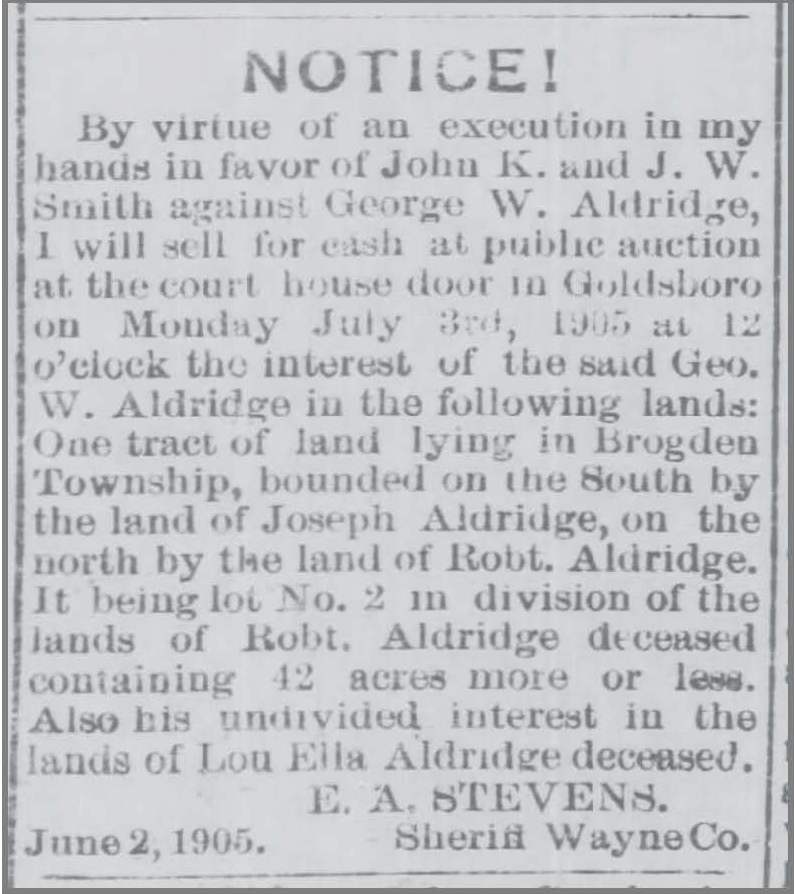
Six acres on the south side of the road.

Goldsboro_Messenger_3_10_1884_Sol_Wms_estate_debtors_notice

Goldsboro Messenger, 10 March 1884.

 Gboro Messenger 9 11 1884 Wms v Artis

Goldsboro Messenger, 11 September 1884.

Solomon Williams‘ son (and estate administrator) Jonah Williams placed these notices in a local newspaper. Solomon’s six acres could not be meaningfully divided among the eight children that survived him. Ruffin Bridge is another name for Peacock’s Bridge, which spans Contentnea Creek on the Wilson-Greene Counties border. It is not at all clear to me, however, which road would have been regarded as the road from Goldsboro to the bridge.

Standard
Education, Enslaved People, Land, North Carolina, Oral History, Paternal Kin, Photographs

Meeting the Saulses.

All week, I was pressed. Wave after wave of thunderstorms had been crashing over eastern North Carolina, tornadoes swirling in their wake. The rain didn’t stop until the night before I flew in, and I knew that Contentnea Creek floods early and often. Friday dawned bright and blue though. I headed down Highway 58, excitement brimming like the sheets of water standing in fields on both sides of the pavement. Though several roads around Stantonsburg were still closed, my path was clear, and I pulled into the Saulses’ driveway at the stroke of 10 A.M.

Cousin Andrew Sauls is a reserved man, but welcoming and friendly, and he and his wife, Cousin Jannettie, put me quickly at ease. They were curious about my connection to Daniel Artis and the Saulses, and as I began to explain about Vicey and Sylvania and Adam T., we realized that he had known many of “my” Artises as a young man. In addition to farming hundreds of acres northwest of Snow Hill, his father, Isaac Sauls Jr., bought, rehabbed and sold farms, was a skilled carpenter, and operated several businesses. In 1947, after a short-lived stint operating a funeral home in Snow Hill, Isaac bought a saw mill, refurbished it, and began cutting lumber the following year. Cousin Andrew started working there as a ten year-old and recalled that the factory made good money for more than 20 years because there was a high demand for raw lumber. In those days, he said, “I didn’t know nair black person had a brick house in Greene County. Nor hardly any white ones.” People needed lumber for home repairs and to build tobacco barns and other out buildings. Though most of the Saulses’ customers were white, they also sold to many black farmers in Greene and surrounding counties, including Les, William and Walter Artis in Wayne County. Brothers William and Walter were sons of Adam T. and Frances Seaberry Artis, and Leslie, son of Napoleon Artis, was their nephew. (William, Walter and Napoleon were brothers of my great-great-grandmother, Louvicey Artis Aldridge. All were grandchildren of Vicey Artis Williams, who was Daniel Artis’ sister.)  Cousin Isaac recalled Les as one of the richest black men in Wayne County, and the first he knew of to own a Cadillac. He laughed as he recounted hauling a load of lumber to Walter Artis as a 17 year-old and being offered some liquor. Isaac Sauls Jr. also operated a “stick mill” that cut tobacco sticks for farmers during the summer months.

After a while, Cousin Andrew’s only surviving sibling, sister Hattie, who lives nearby in the “home house,” joined us and chimed in as Andrew talked about their father’s and grandfather’s achievements. He has an astounding memory and reeled off the dates and details of land purchases dating back ninety years to his father’s first acquisition of 57 acres for $400 in 1924. Today the family owns about 440 acres, which it leases to another farmer. When I mentioned his great-uncle Cain “C.D.” Sauls‘ involvement with an African-American bank in Wilson, he astonished me by exclaiming, “I remember my daddy talking about that! It went under. I think he said it was Stanback and Reid.” [And sure enough, J.D. Reid and H.S. Stanback were the bank officers convicted of the fraud that led to the bank’s failure.]

According to Cousin Andrew, in 1929, Isaac Sauls Jr. leased land to the state for the erection of a Rosenwald school. That school served African-American students in the area from 1930 until 1959. When it closed, Cousin Isaac bought the building and converted it into a house in which his son William lived until his death. The structure now stands a few hundred feet north of Cousin Andrew’s house. [Here for National Register of Historic Places nomination form for another Rosenwald school in Greene County.]

IMG_5186

Cousin Hattie spoke of C.D. Sauls’ ownership of several businesses in Snow Hill, including a hotel and a funeral home. She was not sure if he was a formally educated man, but he appeared to be. He was on personal terms with Booker T. Washington and traveled to Tuskegee Institute to speak on occasion. He also owned shares in a cotton mill in Concord, North Carolina. (This would have been the ill-fated Coleman Manufacturing Company.) He apparently occasionally contibuted a column to a newspaper in Kinston, and she promised to send me a copy of an article.  Later, when I mentioned that my mother had taught at North Greene Elementary School for a few years when she first came to North Carolina, Cousin Hattie asked if she knew Annie Edwards Moye, who’d taught there for 45 years. (Annie Moye was a descendant of Clara Artis Edwards, daughter of Daniel Artis.) I didn’t know the answer at the time, but soon learned that my mother in fact had commuted to Greene County with Mrs. Moye and other teachers who lived in Wilson!

Neither his father nor his grandfather had much education, said Cousin Andrew, but they were smart and shrewd and skilled and able to form strong business relationships on the strength of their word. Isaac Sr., born at the start of the Civil War to the enslaved daughter of a free-born, land-owning man and his enslaved wife, was a master carpenter who began to accumulate land at an early age and passed his drive and determination on to his children. One hundred and fifty years later, his gift shines in his grandson Andrew.

me and AS

Cousin Andrew and me at Artis Town cemetery, 2 May 2014.

Standard
Births Deaths Marriages, Enslaved People, Free People of Color, Land, North Carolina, Paternal Kin, Photographs

Family cemeteries, no. 13: Artis Town.

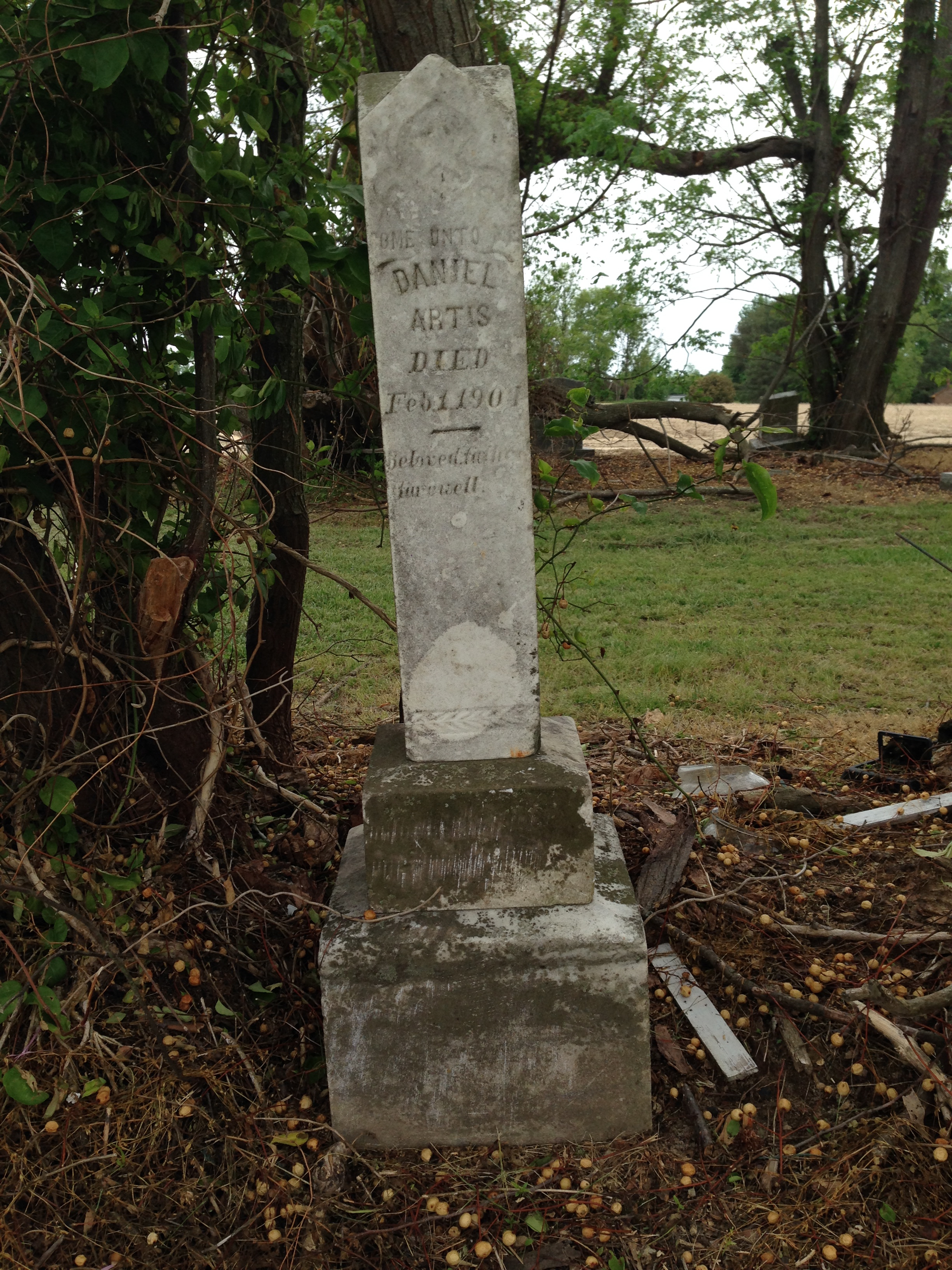
We passed Edwards cemetery on the left, rounded the curve, and there, just where I suspected, was the turn-off onto a farm road leading to Artis Town cemetery. The graveyard is a rectangle of green amid bare spring fields, neatly mowed. A row of weedy trees bristles down one side, broken limbs scattered from recent storms. The oldest stones tilt sideways or sprawl toppled on their backs, but the cemetery is obviously cared for. It lies at the heart of what was once known as Artis Town, a hundred or more acres between Highway 58 and Speights Bridge Road on which lived and farmed Artises and Edwardses in every direction, descendants of Daniel Artis, who bought the land in the 1800s. There was even a racetrack here, said my cousin, where men would line up horses and buggies for weekend contests. As time went by, however, the land got “swindled down.”

Daniel Artis’ headstone stands in a shadowy pocket underneath a chinaberry tree, the grave itself sprinkled with wrinkled yellow fruit. The small white marble obelisk is a testament to Daniel’s prosperity and the esteem in which his offspring held him.

IMG_5197

I did not locate stones for any of Daniel’s children in the graveyard, though surely some are buried there. (Daughter Clara Artis Edwards is buried in the nearby Edwards cemetery.) Many markers memorialize the deaths of descendants of Loderick Artis and Prior Ann Artis Sauls Thompson, including Loderick’s daughter Sarah Artis Speight:

IMG_5192

and son, Manceson Artis:

IMG_5210

and daughter Hannah Artis Mitchell, as well as Prior Ann’s daughter Mariah Sauls Edwards:

IMG_5195

and a host of other Saulses, Forbeses, Artises, Speights and Mitchells descended from Daniel Artis.

Photos taken by Lisa Y. Henderson, 2 May 2014.

Standard
Agriculture, Free People of Color, Land, North Carolina, Rights

But for marl.

I don’t know if I’m an Armwood or not, but (1) my great-great-great-great-grandfather James Henderson’s second wife, Louisa, was Henry Armwood’s cousin, (2) I’ve got a DNA match with one of Henry Armwood’s descendants, and (3) Inez Armwood Watson always said we were kin. Either way, I claim him just on the strength of the moxie he displayed when he, a tenant farmer, fought back against the landowner who sought to cheat him of his cotton.

Herring v. Armwood, 130 NC 177 (1902).

B.W. Herring filed this suit in Duplin County, North Carolina, to recover from William Henry Armwood two bales of cotton worth $81 that he alleged belonged to him. Armwood responded that the cotton was worth much more than $81 and that it was not Herring’s. Further, countered Armwood, he rented the farm on which the cotton was raised under this contract: “I, B.W. Herring, do hereby agree to rent my farm to Henry Armwood for the year of 1899 for five bales of cotton of the first picking, weighing five hundred pounds, or the equivalent in money. I do also agree to dig marl to the amount of two thousand bushels, more or less, and Henry Armwood agrees to haul the same and scatter on the land.” Armwood was to use the marl in lieu of commercial fertilizers to improve the land and increase crop yield. However, Herring refused to dig the marl, and Armwood’s crops suffered.

At trial, Herring testified that Armwood paid only three of five bales of cotton he owed in rent. Armwood took two more bales raised on the rented land to Ruffin Cameron’s to be ginned and those bales were seized. Herring’s testimony is somewhat confusingly recounted in the opinion, but he seems to assert that he did not agree to dig any marl for the 1899 crop, but that he used it as an experiment in 1898 on about 16 of the 40 acres he rented to Armwood.  Armwood countered: “It was agreed that the two thousand bushels of marl shoul dbe hauled on the crop for 1899. I lived on the plaintiff’s land in 1898, and hauled marl for 15 or 16 acres. The crops were increased by the use of the marl 50 to 75 per cent. I hauled the marl from Mr. Dan Lee Flowers. He had the bed, and furnished Mr. Faison Hicks, Mr. Ab Herring, Andrew Barfield, and others in the neighborhood. My crop was decreased by the failure to use the marl at least 50 per cent.” Herring objected to this testimony on the grounds that it was too remote, and the trial judge sustained the objection. Though Dan Lee Flowers testified in support of Armwood, the judge rendered a verdict and judgment for Herring. Armwood appealed.

The North Carolina Supreme Court neatly framed the issue: “The sole question involved in this appeal, when stripped of its technical paraphernalia, is whether an action for damages will lie for a breach of contract in failing to furnish fertilizers, whereby the yield of the crop was decreased, because such damage or failure in the yield will be too remote.” And decided: “… the conclusion is irresistible that a lessening in the yield would be the natural result of a failure to use the marl, if marl be beneficial to the growth and development of the crops, and that the lessened yield would be incidental to such breach, and therefore plaintiff would be liable.” Further, everybody knows that fertilizers increase yield and marl can greatly increase production. “… [i]f damages be recoverable for a breach of contract which decreased the yield, they can also be recovered for a breach of contract whereby the yield was not increased.” Armwood had a right to present his proof to the jury. Error in the lower court, and a new trial awarded.

Standard