Births Deaths Marriages, Land, Newspaper Articles, North Carolina, Oral History

Bert’s estate.

She wanted a baby badly.

My grandmother:  … that nephew, Dr. Lord’s son, that was Mr. Hart’s nephew.  He got what Bert had. Yes, indeed. ‘Cause, see, it was heir property. And see that’s why Bert tried so hard to have a child.  Because if she didn’t have a child, it was going to whoever had had a child.  You know. And I guess Alonzo did, you know, he was a nephew.  When Bert died, it went to him. See, all this property and everything that Mr. Hart owned there was his family’s stuff.  Wasn’t Grandma Hart’s.

And in 1941, when she nearly 40 years old, Bertha Hart Murdock had one:
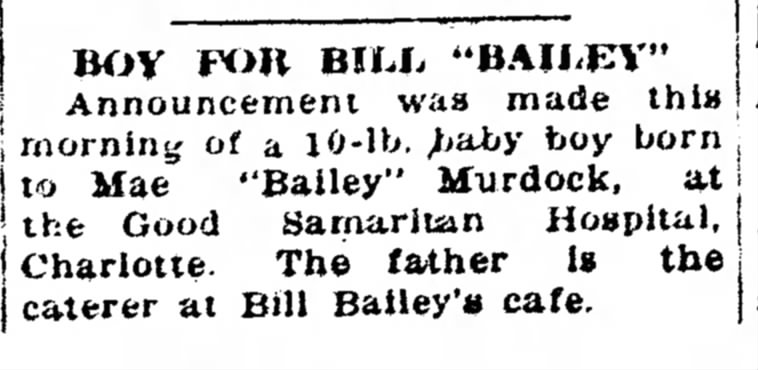
Image

Statesville Landmark, 2 April 1941.

But little William Alonzo Murdock died the day after he was born.

Still, the situation for Bert and her property was not as critical as my grandmother had believed. In Alonzo Hart’s original will, made 15 October 1928 in Statesville, he devised “the home place to my daughter Bertha Mae Hart and her bodily heirs, for ever, never to be sold and if she dies without bodilies heirs. Then it must be in trust for my sisters heirs to hold but never sell same.” The remainder of his property went to his sisters’ heirs.

Thirteen months later, as he languished in the state sanitorium in Quewhiffle, dying of tuberculosis, Hart dictated a codicil.  In somewhat opaque and ungrammatical phrasing, Hart “hereby enlarge[d] the privilege to and use at her own and released to her. In stead of one parcel or tract of land I do bequeath and devise to her following described lands, In Iredell North Carolina, 45 acres in Concord Township (Deatonsville) Also 2 lots with one house Statesville Township also 47 acres in Shiloh township and Crawford near Sumters place 22 acres in above township near home belong to the home resdue. I am in my right presence of mind and know what is best for my only and legal heir Bertha Mae Hart.”

In other words, Bertha’s inheritance was generous and unrestricted, and her cousin Alonzo Lord was not to receive anything at all. Things did not go smoothly, however. Hart’s unconventional wording opened the door to challenge, and Bertha was forced to defend her title.
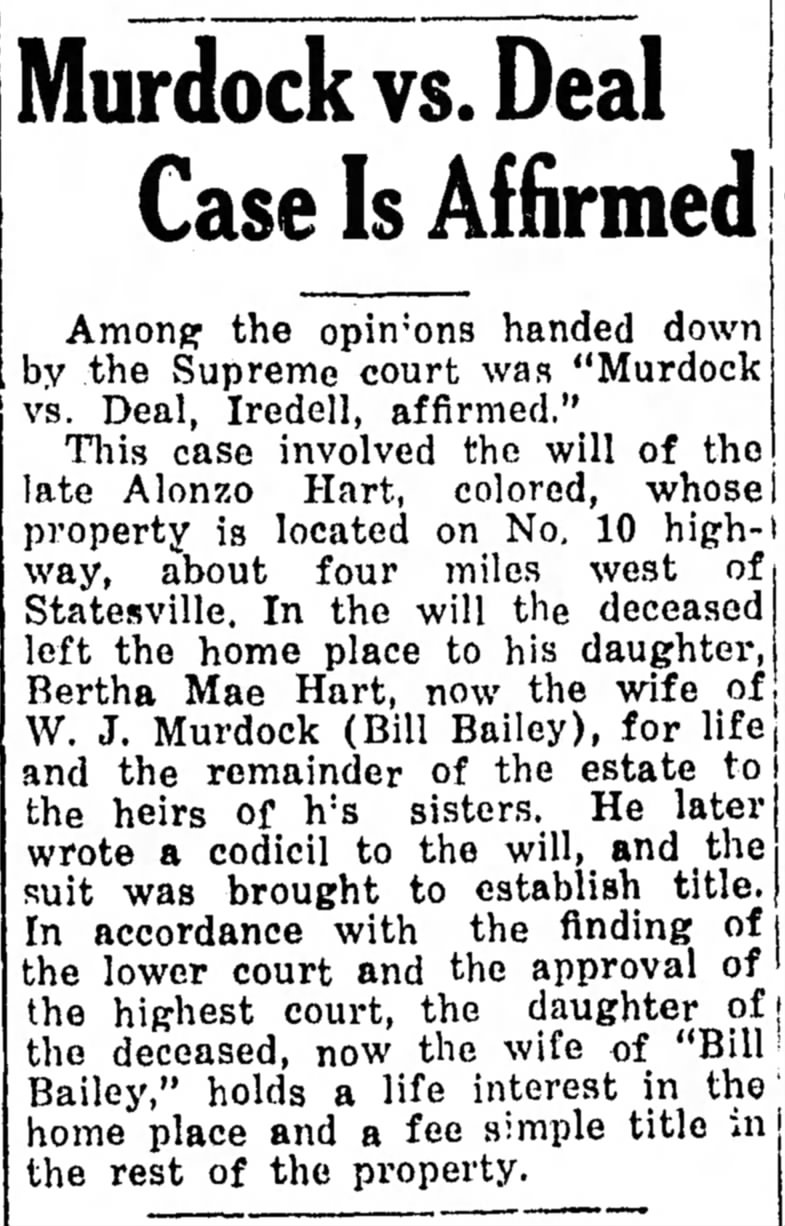
A Hart Est Suit Landmark 11 21 1935

Statesville Landmark, 21 November 1935.

Incredibly, this case went to the North Carolina Supreme Court: Murdock v. Deal208 N.C. 754, 756, 182 S.E. 466, 467 (1935).

By time Bertha died in 1955, her estate seems to have been much reduced, but still comprised some of Alonzo Hart’s land. The bulk of her estate went to Odessa A. Williams, who may have been her cousin. Her half-brother H. Golar Tomlin inherited only a half-interest in a lot. His daughter Annie LaVaughn Tomlin Schuyler received the other half. Another niece, Mattie Johnson, received the negligible sum of one dollar, which raises questions: who in the world was she? I only know of Golda’s one child. Was this in fact Mattie James, oldest daughter of Bert’s other half-brother, Lon Colvert? Why bother with a dollar? And why not give the other nieces, Louise Colvert Renwick, Margaret Colvert Allen, and Launie Colvert Jones, their own dollars?

Murdock Will 8 Jun 1955 R and L

Statesville Landmark, 8 June 1955.

The drama did not end with Bert’s death. In what looks to be the family’s own Bleak House saga, City of Statesville v. Credit and Loan Company, a corporation of the State of North Carolina; W.S. Nicholson and spouse, if any, and if they be deceased, then their unknown heirs, and if any of said unknown heirs be deceased, then their respective heirs, devisees, assignees, and spouses, if any; and the unknown heirs of Minnie Brawley, Florence Camp, Mollie Alexander, and Lula H. Lord, Deceased, and if any of said unknown heirs be deceased, then their respective heirs, devisees, assignees, and spouses, if any; and all other persons, firms and corporations who now have, or may hereafter have, and right title, claim or interest, in the real estate described herein, whether sane or insane, adult or minor, in esse, or in ventre sa mere, active corporations or dissolved corporations, foreign or domestic, 294 S.E.2nd 405, was not decided in the North Carolina Court of Appeals until 1982.

The first sentence of the decision: “The sole issue is whether plaintiff has a valid avigation easement over land owned by defendant.” An avigation easement is a property right acquired from a landowner for the use of air space above a specified height.  Alonzo Hart’s home property was located a few miles west of Statesville, adjacent to land now home to Statesville Regional Airport. (Brawley, Camp, Alexander and Lord were his sisters.) The City of Statesville’s claim that it held prescriptive easements was rejected, and partial summary judgment entered for the defendants.

——

Interview of Margaret C. Allen by Lisa Y. Henderson; all rights reserved.

Standard
Land, Maternal Kin, North Carolina, Other Documents

Where we lived: colored settlements.


Me:  And where was the area that was called Wallacetown?

My grandmother:  Mm-hmm. That was just out near where we lived. We lived out there.  And then there was like a stream or a branch or something where you crossed that thing, that was called Rabbittown.

Me: Okay.

Grandma: We lived in Wallacetown.

——

From the 1916 city directory of Statesville, North Carolina:

Popular Branch — a colored settlement southeast of Wallacetown [actually, it was “Poplar” Branch]

Rabbittown — a colored settlement southeast of Wallacetown

Wallacetown — a colored settlement southeast of the railway station

Rankinsville — a colored settlement to the right of the north end of Centre Street

Screen shot 2013-12-18 at 10.18.27 PM

Standard
Births Deaths Marriages, Land, North Carolina, Other Documents, Paternal Kin

The house and the lot on which they now live.

Buck Martin never married. At the end of his life, he and his bachelor brother Alfred lived together in the “home place,” perhaps the house they had grown up in, which Buck owned. Just down the road lived another unmarried brother, Dortch, and their widowed sister, Virginia “Jenny” Martin Herring.

A few months before his death, Buck drew up a will that insured that Alfred would keep a roof over his head and that, more importantly, his younger children and their mother, Sarah Barfield, would not be dispossessed of the house and acre of land upon which they lived. By its terms, the will provided that the Barfields could remain on the property for the duration of their lifetimes and those of their survivors, after which it would revert to his brothers or their heirs. In fact, they did not stay quite so long. Sarah Barfield died in 1942, and the property reverted to Buck’s brother Ira’s children. Lillie Barfield Holmes bought the house from them, but it later burned down.

MARTIN -- Buck Martin Will

[Sidenote: Buck Martin died 18 June 1928 of sarcoma of the right thigh. His brother Ira died of heart failure exactly ten days later.]

Standard
Land, North Carolina, Oral History, Other Documents, Paternal Kin

Where we lived: 114 West Lee Street.

My parents were skeptical.

Me: Well, what about where, up, like, Lee Street.  There were some black people that lived up that way.

My father: Where?

Me: On the other side of the tracks.  Lee Street.

My mother: There were?

My father: I don’t know.

Me: Uh-huh. That’s where your grandparents lived. That’s where their house was.

Him: Lee Street?

Me: Mm-hmm. Right. Like if you come up – what was the name of that restaurant that everybody used to talk about? Golden Leaf? The Golden something –

Him: Okay.

Me: If you take that street, and you cross over the track, and you go left, and then you can — you know how it kind of splits or something?

Him: Yeah. Wont no black folk in there.

Me: Yeah, it was.

Him: Where?

Me: That’s where the Taylors lived. There was a little section.

Him: Oh, that was when — you talking ‘bout way back in the day.

——

Back in the day, indeed. On 11 February 1896, for $550, George D. Green and his wife Ella sold Mike Taylor a lot in the town of Wilson. Situated on a corner, the parcel fronted 143 feet on Pine Street and 83 feet on Lee. In the 1900 census of the town of Wilson, Wilson County, neither streets nor house numbers are listed, but it’s reasonable to assume that the Taylors — Mike, a drayman; his wife Rachel, who did washing; and their children “Rodgrick,” Maggie, Mattie, Maddie, Bertha E., and Hennie G. — were living there, and the 1908-1909 Wilson city directory lists Taylor, a driver, at 114 West Lee.

The 1910 census of Wilson paints a clearer picture of the little enclave in which the Taylors lived. Though he did not note house numbers, the censustaker inked “Lee St” along the edge of Sheet 27A of his survey of Enumeration District 116. The page records 50 residents, of whom 30, living in five consecutive households, were black. With the Taylors were the families of Jim and Annie Parrott, John and Cora Norfleet, John and Pattie Lassiter, Sam and Maggie “Ennicks” [Ennis], and Frank and Lizzie Bullock. The men worked a variety of jobs: a blacksmith, two odd jobs laborers, a gardener, a drayman. The women were cooks or laundresses.

The censustaker’s path is not clear. The Taylors were on the corner at 114 West Lee. According to the 1908-09 directory, the Bullocks were in the next block at 202 West Lee. The Ennises — Maggie was Mike and Rachel’s daughter — lived in the small house built on the back of the Taylor lot at 409 North Pine. In the 1912-13 city directory, Pattie Lassiter is listed at 200 West Lee, but John Norfleet was at 306 E. Barnes, on the other side of downtown. The Parrotts are found in neither directory. In any case, it is clear that these families formed a tiny cluster, and this cluster was unique in its surroundings. On the enumeration sheets before and after that listing the Taylors and their neighbors, the residents are overwhelmingly white.

For most of the 20th century, Wilson maintained a well-defined residential segregation pattern, with black neighborhoods confined to the east side of the Atlantic Coast Line (later Seaboard Coast Line, now CSX) railroad. Daniel Hill, a mile or so west of downtown, was the notable exception. For first quarter of the century, however, African-Americans claimed another tiny toehold, now forgotten, just west of the tracks at Pine and Lee.

Image

Sanborn map of Wilson NC, September 1913.

The 1913 Sanborn map, the earliest detailing the neighborhood, reveals a relatively large one-story frame house with an L-shaped porch wrapping around its west front corner. By time the 1922 Sanborn map was drawn, the city’s street numbering system had changed, and the address was now 108 West Lee.  The Taylors had also added a small porch to the back of the house.

Rachel and Mike Taylor remained at 108 West Lee until their deaths in 1925 and 1927. The address is now a vacant lot.

Standard
Births Deaths Marriages, Land, Maternal Kin, Other Documents, Virginia

Where we lived: ten acres near Westover Church.

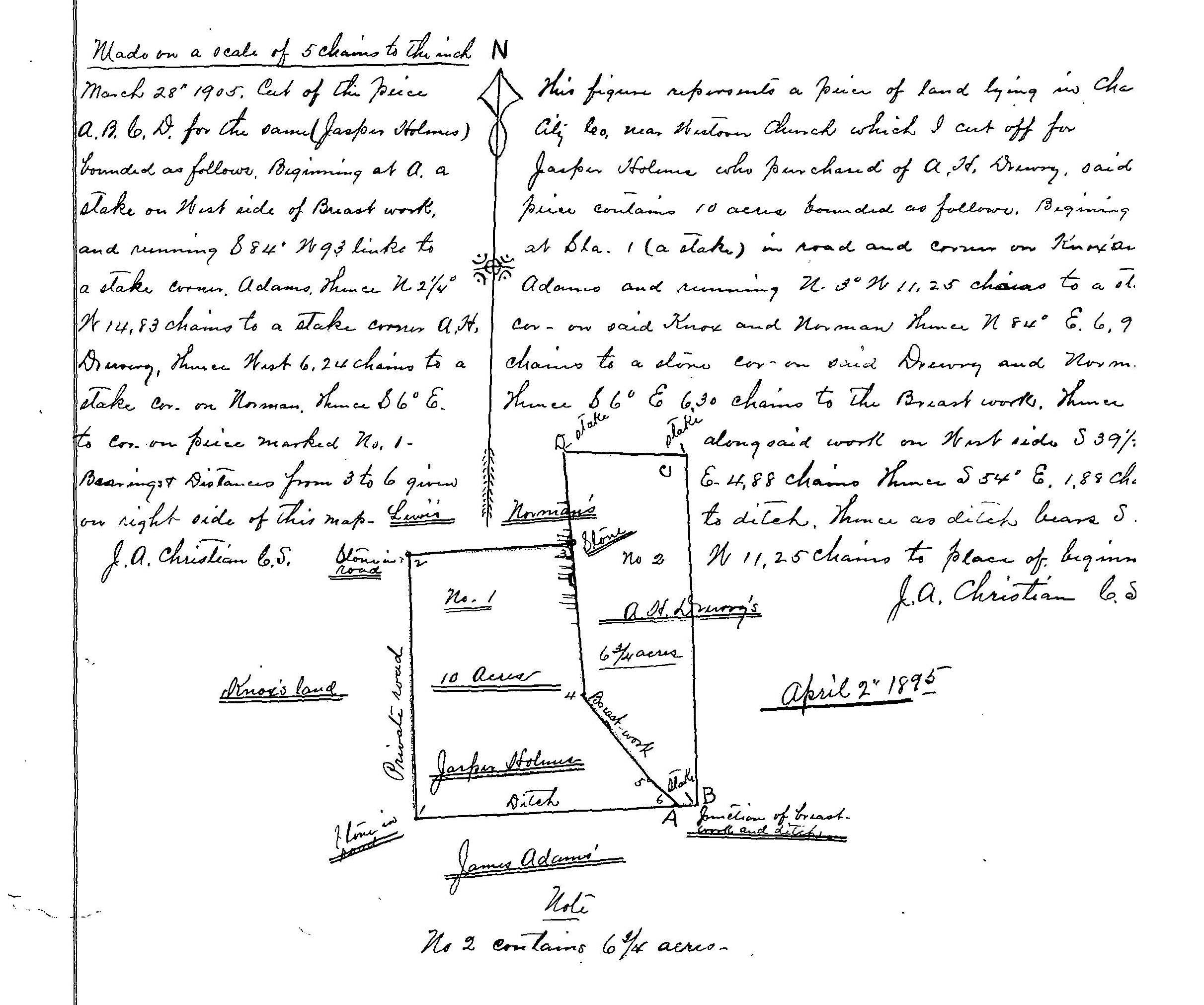
In 1909, ten years after their father’s death, sole surviving heirs Mary Agnes Holmes Allen and Julia Holmes sold two parcels that Jasper Holmes had purchased in 1873 and 1879. “This figure represents a piece of land lying in Cha City Co, near Westover Church” wrote the surveyor who laid off the land and prepared this plat:

Pages from ALLEN -- Estate Litigation Docs

Westover, dating back nearly 400 years, is one of the oldest Episcopal parishes in Virginia. The current church was built in 1631 and remains active. Confederate breastworks running between the church and Evelynton plantation, on the south side of John Tyler Memorial Highway, are still visible.

Standard
Land, North Carolina, Other Documents, Photographs

The death of Green Street.

As my father put it, all the “big dogs” lived on Green Street. The 600 block, which ran between Pender and Elba Streets, two blocks east of the railroad that cleaved town, was home to much of Wilson’s tiny African-American elite. There, real estate developers, clergymen, doctors, undertakers, educators, businessmen, craftsmen — and a veterinarian — built solid, two-story Queen Annes that loomed over the cottages and shotgun houses that otherwise lined East Wilson’s streets.  Booker T. Washington slept there.

Page_32

The north side of Green Street as depicted in a 1922 Sanborn map.

During my childhood, a half-century into its reign, Green Street was slipping, home to widowers and dowagers struggling to stay on top of the maintenance and expense imposed by multi-gabled roofs, ranks of single-paned windows, and wooden everything. Still, its historical distinction as black Wilson’s premier residential address held, and a drive down the block elicited a bit of pride and wonder.  In 1988, East Wilson, with Green Street its jewel, was nominated for inclusion in the National Register of Historic Places. Every house on the block depicted above was characterized as “contributing,” and the inventory list contained brief descriptions of the dwellings and their owners. #617, for example, was the Walter Hines house, a two-story “Queen Anne house with hip-roofed central block and projecting cross gables,” and Hines was described as “a prominent barber and property owner.”

Historic status, though, could not keep the wolves from the door. Even as the city’s Historic Properties Commission was wrapping up its work, East Wilson was emerging as an early victim of that defining scourge of the late 1980s — crack cocaine. As vulnerable old residents died off — or were whisked to safer quarters — crackheads and dealers sought refuge and concealment in the empty husks that remained. Squatters soiled their interiors and pried siding from the exteriors to feed fires for warmth. One caught ablaze, and then another, and repair and reclamation seemed fruitless undertakings.

This is the north side of Green Street now. The left edge of the frame is just west of #611. THERE IS NOT ANOTHER HOUSE UNTIL YOU GET TO #623. They are gone. Abandoned. Taken over. Burned down. Torn down. Gone.

IMG_4050

[Sidenote: 623 Green Street was built for Albert Gay, a porter at the Hotel Cherry downtown. Albert married Annie Bell Jacobs, daughter of Jesse A. Jacobs, Jr., and their descendants remain in the house. Charles Gay, next door, was Albert’s brother. And around the corner, in the small ell below Pilgrims Rest Primitive Baptist Church, 303 Elba.]

Photograph taken by Lisa Y. Henderson, October 2013.

Standard
Births Deaths Marriages, Free People of Color, Land, North Carolina, Other Documents, Paternal Kin

Zilpha’s will.

State of North Carolina, Wayne County    }   I, Zilphy Wilson, of the County and State, aforesaid begin of sound mind and memory, but considering the uncertainty of my earthly existence to make and declare this my last Will and Testament in manner and form following, that is to say: — That my Executor hereinafter named shall provide for my body a decent burial, suitable to the wishes of my relations and friends, and pay all funeral expenses together with my just debts out of the first money that may come into his hands as a part or parcel of my estate.

Item 1. I give and bequeath to my daughter Bettie Reid 7 acres of land to be cut off the North East corner of the tract of land on which I now reside for and during her natural life, and after her death to be equally divided between all of her children that she may have now, or may have living at the time of her death, the said Bettie Reid not to have possession of said Land until the debts against my estate are paid.

Item 2. I give devise and bequeath to my son Adam Wilson and my daughter Vicey Wilson, share and share alike all of the tract of Land on which I now live, with the exception of the seven acres given away in Item first of this will, with all the priviledges and appertances thereunto belonging for and during their natural like, should they both have heirs, then they to have their mother & Father part, and should Adam or Vicey only one of them leave heirs, then and in that case I give said land to the surviving heirs of that one to them and their heirs in the fee simple forever.

Item 3. I give and devise unto my son Adam Wilson and Vicy Wilson, share and share alike, all of my Household and Kichen furniture of every description Farming implements of every description, Tools of Mechanics &c &c, Stocks of all kinds, and all the poultry of kind to them and their heirs in fee simple forever.

Item 4. It is my will and I so direct, that my son Adam Wilson to retain possession of the whole of my land at yearly rental of seven hundred lbs. of lint cotton which is to be applied to the payment of the debts against my estate, as soon as said debts are paid, I direct that Bettie Reid be put in possession of the seven acres of land given to her in a former Item of this Will. I also desire that my daughter Bettie Reed become an equal heir in my household and kitchen furniture with my son Adam and daughter Vicey.   Changes made in Zilphia Wilson’s Will Oct[?] 4, 1893

Item 5. I give and devise unto William and Jonah Wilson children of William Wilson Sixty dollars to be paid to them when they arrive at lawful age.

Item 6. I give and devise unto Johney, Lominary, Levy, Laronzo Locus, Children Louisa Locus Sixty dollars to be paid to them as they arrive at lawful age.

Item 7. It is my will and so direct that the Legacies mentioned in Items 5 & 6 of this Will be assessed by my son Adam and my Daughter Vicy Wilson, and I direct that they pay to each one of the above mentioned heirs, as they arrive of lawful age their proportionable part of said Legacies with interest on the same from the time the debts of the estate are settled.

Lastly, I hereby constitute and appoint my brother Jonah Williams and my son Adam Wilson Executors to this my last Will and Testament, hereby revoking all the Wills heretofore made by me.    Zilphy X Wilson

Signed and sealed in the presence of Fred I. Becton and Thomas Artis, who witnessed the same at her request.  /s/ Richard H. Battle, Fred I. Becton

——

Zilpha Artis Wilson was born about 1828, the first known child of Vicey Artis and Solomon Williams. About 1855, she married John “Jack” Wilson, a free man of color of completely unknown origins. That year, Jack bought 55 acres in Wayne County from Zilpha’s brother Adam Artis and settled his family close to the Artises.

Zilpha and Jack Wilson’s children were William Wilson (1856), Louisa Wilson Locus (1858), Elizabeth “Betty” Wilson Reid (1864-1947), John Adam Wilson (1865-1916) and Vicey Wilson (1869).

Zilpha Wilson’s will was proved 17 December 1902 and recorded at page 421 of Will Book 2, Wayne County Superior Court.

Standard
Land, Other Documents, Paternal Kin, Photographs

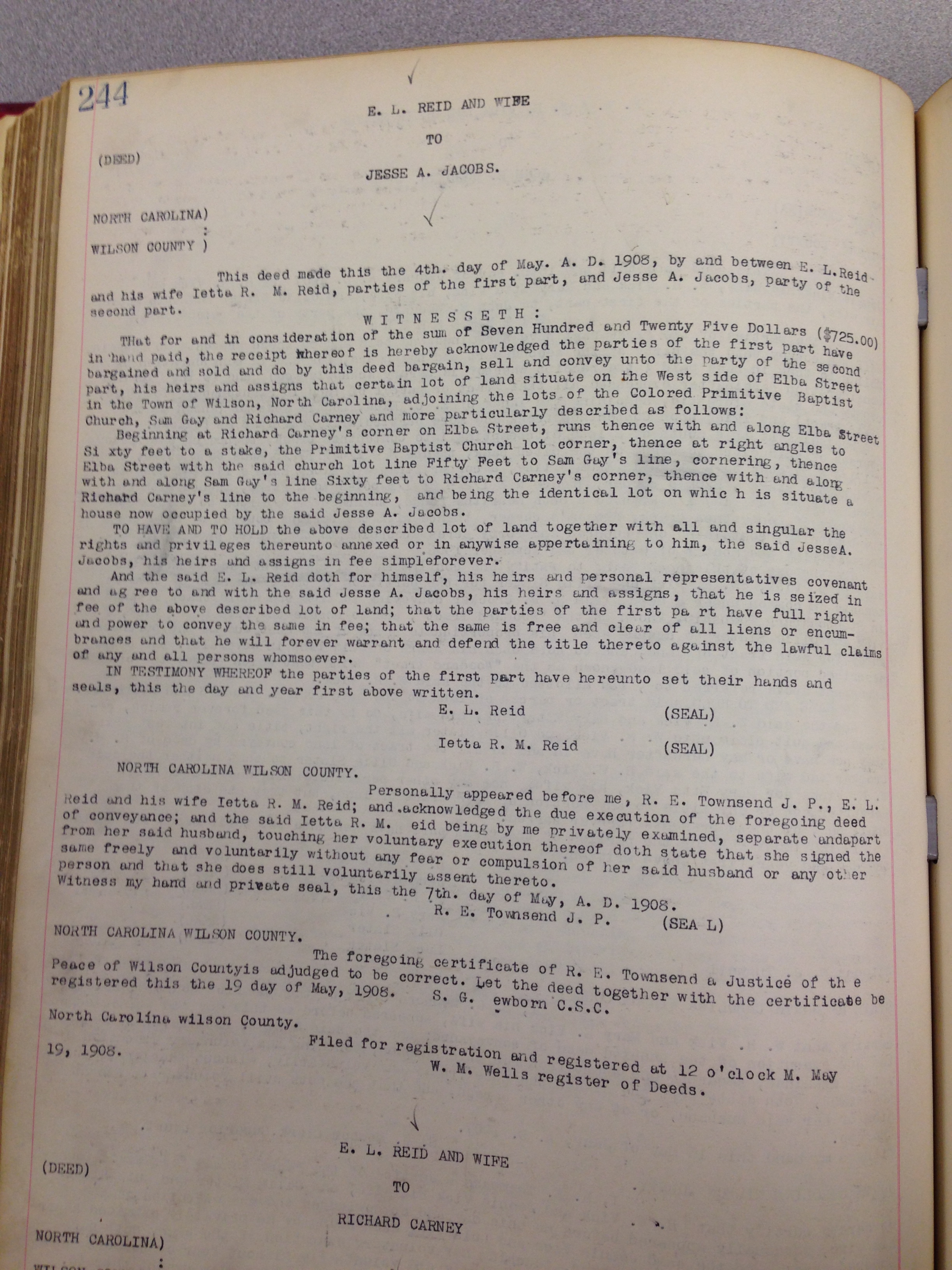
This deed.

Image

This is the deed for Jesse Jacobs‘ purchase of 303 Elba Street. He bought the house (in which he was already living) and lot for $725 from E.L. and Ietta R.M. Reid on 4 May 1908. (Elijah Reid, a veterinarian, was born into a free family of color from the opposite end of Wayne County than Jesse and Sarah Jacobs.) The same day, Jacobs gave George W. Connor, Trustee, a mortgage on the property, perhaps to secure a $400 loan he used to buy it.  Jacobs was to repay Connor at the rate of $2.50 per week. 

On 10 April 1917, the Jacobses arranged another mortgage on their Elba Street home, this time promising to repay W.A. Finch, Trustee, $395 at 6% interest. Circumstances intervened. By about 1922 or ’23, Jesse Jacobs was too ill to work. He died in 1926. Sarah and Hattie Jacobs, her great-niece (and my grandmother) paid what they could from their meager earnings as laundresses. When Sarah Jacobs died in early 1938, the house remained encumbered. Finch’s loan was not repaid until September of that year, most likely from the sale of the property.

Standard
Enslaved People, Land, North Carolina, Paternal Kin, Photographs

Where we lived: north of Wilson, near the railroad.

Thanks to Marion “Monk” Moore and Joan Howell Waddell, I’ve been able to identify the approximate locations of several of the white farmer-landowners listed near Willis and Cherry Battle Barnes in the 1870 census.  If the family remained in the general area in which they had been enslaved, Hugh B. Johnston’s speculation is correct.

toisnot

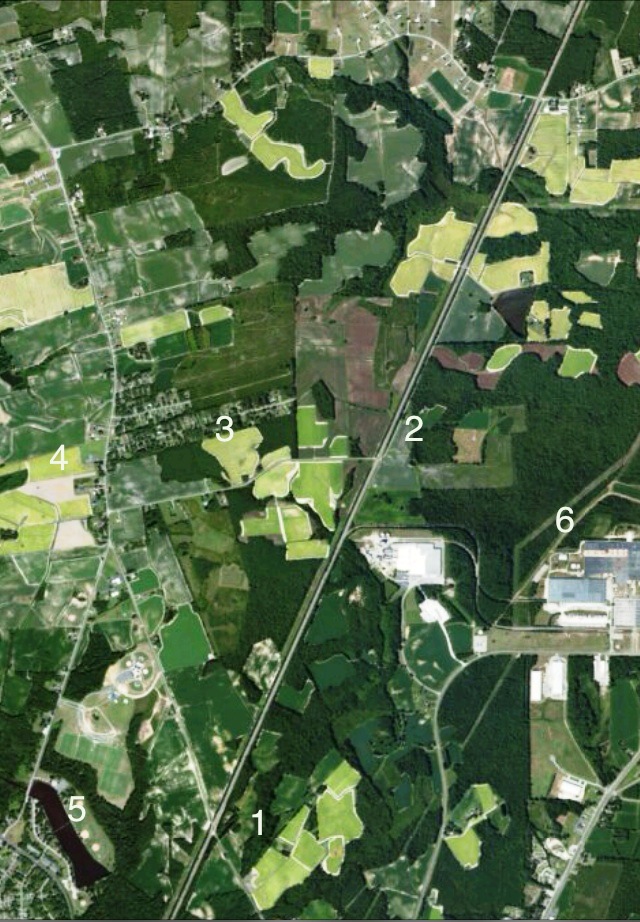
Toisnot Reservoir, a dammed stretch of Toisnot Swamp, today lies on the northern edge of the city of Wilson.  Joshua Barnes, Alpheus Branch, Ceborn Farmer, Isaac Farmer and Jesse Farmer’s farms all lay north of the swamp and south of present-day Elm City in a corridor now defined by London Church Road, the CSX Railroad (then the Wilmington & Weldon) and US Highway 301. The Barneses lived somewhere in this area. In the photo above, the diagonal running top to bottom is the railroad, London Church Road bows to the left, and numbers mark the approximate locations of farms and modern landmarks: (1) Isaac Farmer land; (2) Seborn Farmer land; (3) Alpheus Branch land; (4) Joshua Barnes land; (5) Toisnot Reservoir; and (6) the Bridgestone-Firestone tire plant.

——

In a letter dated 11 January 2007, Waddell included a map of Wilson County with the above properties marked. Many thanks to her and Monk Moore.

——

Update, 23 June 2015: Joshua Barnes’ house is not only still standing, it’s been continuously occupied since the 1840s and was on the market just a few years ago. It’s located at 3415 London Church Road.

Screen Shot 2015-06-22 at 10.17.53 PM

Standard