Enslaved People, Maternal Kin, North Carolina, Oral History, Religion

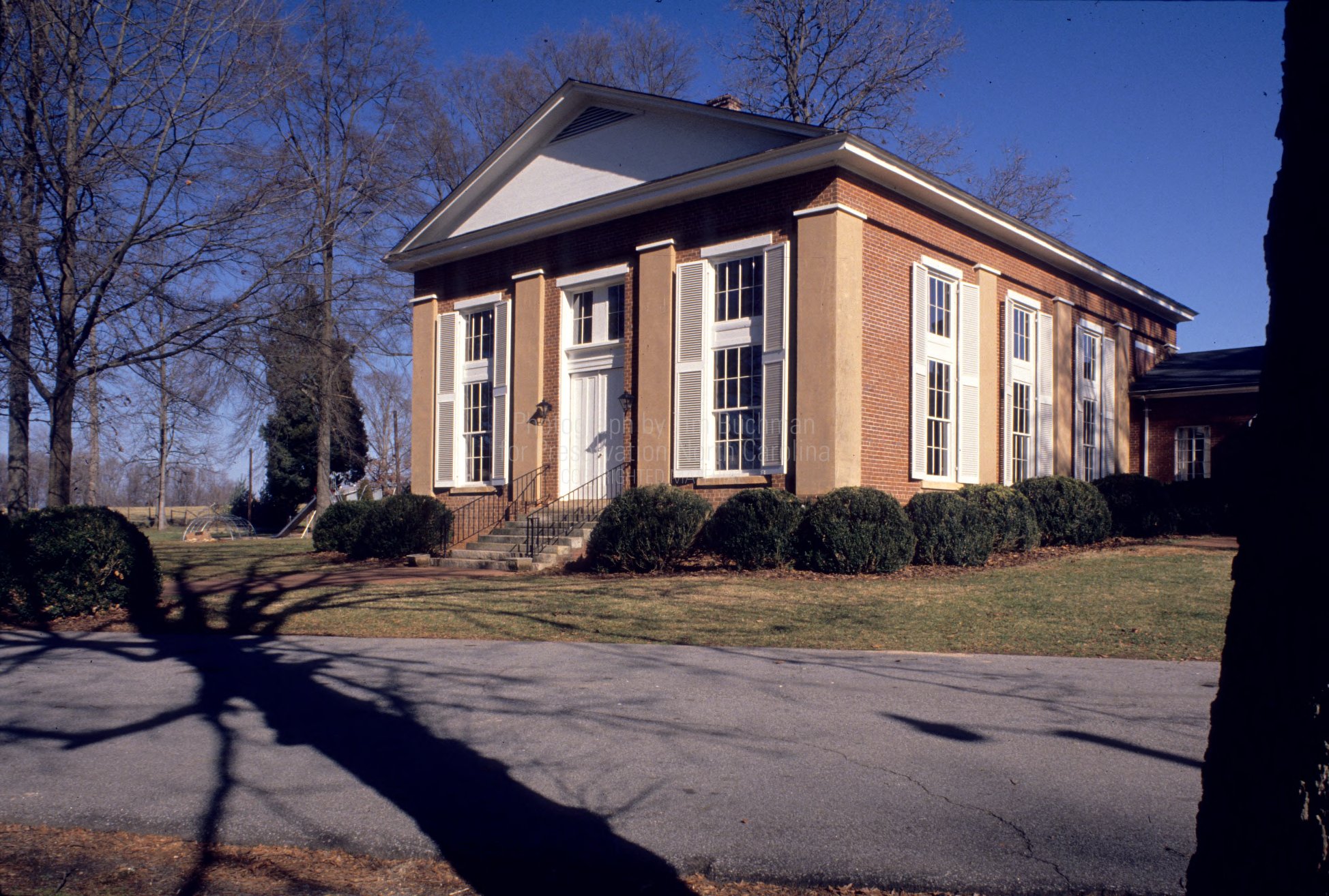
Church home, no. 8: Back Creek Presbyterian Church, Rowan County NC.

Founded in 1805, Back Creek Presbyterian Church is a historic church in Mount Ulla, North Carolina. In 1809, the congregation built a small log house of worship, which was replaced by the congregation’s present Greek Revival sanctuary in 1857. This building was added to the National Register of Historic Places in 1983.  — From http://en.wikipedia.org/wiki/Back_Creek_Presbyterian_Church_and_Cemetery
resolver

Back Creek was the church of my white McNeely forebears — John Wilson McNeely and his father Samuel.  In 1905, Rev. S.C. Alexander and John K. Goodman published History of Back Creek Presbyterian Church, Rowan County, N.C., for 100 Years. It is too much to call it a scintillating work, but its dramatic retelling of the church’s founding compels:

During the latter part of last century, infidelity spread like a contagion all over our country, from one end of it to the other. It gathered round the Church, and settled down upon it like a thick cloud of moral death Although far removed from the busy marts and thorough- fares of the world, this retired part of the Lord’s vineyard did not wholly escape the infection. A cold dead formality had well nigh chilled the vitals of true religion. But this state of things was not permitted to remain long. God heard and answered the prayers of his faithful servants. His life-giving spirit was sent forth with power, and breathed upon the valley of dry bones, and an army of living men stood up to praise Jehovah’s name. This was an important era in the history of our Church and country. It was a time when angels in heaven, and men on earth rejoiced together. It was a time when a most powerful and sudden death-stroke was given to the cause of infidelity. So that its hideous form has never since been reared so high in the majesty of its ugliness to pollute and annoy the Church Thyatira with her then widely extended limits, seemed to have been thoroughly aroused in those exciting times.

As in all communities, so in that venerable Church, there necessarily existed a great diversity of sentiment. The time had now come, when this diversity was to be fully manifested, The Revival of 1802, let it be remembered, was accompanied with many strange phenomena, such as “jerking,” “leaping,” “shouting,” “swooning,” and many such-like bodily exercises. Those who were possessed of more ardent zeal and strong affection, thought this a necessary part of the revival, and produced by the influence of the Spirit. While those of a more phlegmatic temperament, and less impulsive nature, looked upon it as dross around the precious metal; or rather, as the work of Satan trying to counterfeit and hinder the work of religion. Thus there were two parties formed, and each doubtless conscientiously thought they were right. Those who favored the “exercises” were called the “revival party,” as if they alone were desirous of promoting the cause of religion. While those who thought differently were called “opposers” or “anti-revivalists,” as if they wished to hold back the Gospel car. One party wished to have profound silence during public worship. It mattered not how eloquent the speaker was, or how powerful the movings of the Spirit, all must be quiet and still. The other party wished to give vent to their feelings in whatever way inclination might lead. If they felt happy they would shout aloud for joy, or if distressed they would cry out for mercy. The congregation ofttimes presenting the appearance of a Bochim-Babel.

Thus the matter went on for two or three years each party becoming more and more sensitive; and owing to the weakness of human nature, one seemed to exasperate the other, until it became evident to all that some final and decisive action should be taken for the welfare of the Church. A day of fasting and humiliation was appointed, that they might pray for wisdom to guide them in the path of duty, and that they might adopt some plan of action which would be for their peace and edification. The day was accordingly observed. At which meeting the Session was publicly charged with a neglect of their duty in permitting what was looked on by one party as disorder and confusion to exist in time of public worship. The Elders defended their conduct in a mild and Christian-like manner, but all to submit to the other. Thus the day seemed likely to close without having bettered their condition. But something must be done was the universal feeling. Whereupon, it was resolved unanimously, that all those who sympathized with the “Revival Party,” and acted under its influence, should be permitted to withdraw from the Congregation, and leave the other party in the quiet possession of their house and minister. This resolution was acted upon immediately, when about thirty families withdrew, including five Elders — all that Thyatira [Presbyterian Church] then had — men of whom the world might be proud. This was the birthday of Back Creek. The mother travailed with pain, and a noble daughter was born. —

Thus the infant colony, springing off from the western part of Thyatira principally, was left without a minister, and without a house in which to worship. But with zeal like theirs, with hearts so large, and hands so willing, all difficulties were soon removed, and their necessities met. They resolved to build a house in their midst, in which they could worship as their conscience dictated.

A year after Back Creek’s founding, my great-great-great-great-grandfather assumed a leadership role:

On the 27th of December, 1806, William Kilpatrick, Samuel McNeely, and George Andrew, were added to the list of Elders — men of whom we cannot speak too highly. Each was distinguished for his own excellency of character. When sitting in council about the welfare of the Church, it is said William Kilpatrick would devise ways and means for the prosperity of Zion. George Andrew would discourse on its practicability. He would present it in one aspect and then in another, in order that it might be weighed well, — while the venerable John Barr and Samuel McNeely who knew their Bible by heart, would decide whether it were right or not, or whether it would be for the general good. Thus each wheel in the machinery performed its part; and the consequence was, the Church like a healthy plant, grew and flourished, and became a praise in the land. In 1833, another addition was made to the Session by the election and ordination of William King, Thomas Mathews, John Houston, John M. Lowrance and Abner Adams. — Only two of this number are spared to be with us now. The other three have fallen asleep. They were men with whom you were all familiar. Their names are embalmed in your memories. Their excellencies are well known. — And you have long since mourned their loss.

Fifty years later, his son was elected deacon:

On August 10, 1856, the last public service, the last sermon was preached in the “Old Log Church,” built in 1811. The first Deacons in Back Creek Church were elected on May 22, 1858, viz:— Col. Alfred M. Goodman, Jno. F. Clodfelter, Jacob P. Goodman, Moses Lingle, James Miller and J. Wilson McNeely; and on the following June 27 they were regularly ordained and installed. Prior to this the financial,and temporal affairs of the Church were administered, (under the session) by a board of trustees elected by the Congregation, but not regularly ordained and installed into office as is now the more scriptural practice with Deacons.

Given the close association of the McNeelys with Back Creek, it is likely that their slaves also attended the church.

Before the emancipation of the Southern Negro he worshipped with his master in the same church, and enjoyed all the church privileges, consistent with the relations existing between the white and negro races; many of them being worthy members of the church. The gallery in this church was built for their express accommodation. Faithful attention was given to their moral and religious training. Frequently the minister in charge would preach a sermon specially to them; they leading and furnishing the music, of no inferior quality. And they were not forgotten in the Sabbath-School; separate classes were formed of them, taught by the whites. This relation and condition continued for some time after “freedom;” finally, they changed order of relation, and natural trend of events led to their separation from the church of the whites, and to their distinct organization; still, however, some reluctantly took this step.

I don’t know about the “natural trend” or the reluctance. In any case, my forebears remained in the larger fold for, as my grandmother put it, Henry W. McNeely, J. Wilson’s son and former slave — “when he moved to Statesville, when Mama’s daddy moved to Statesville, child, he ran that Presbyterian church.”

The early lists of church members do not determine the proportion of whites to colored.

In regard to the numerical strength of Back Creek, from time to time, complete records fail us. In 1829 the membership was 124, but it is not stated how many white.

In 1850 we numbered 136 white and 26 colored — total 162.

In 1864, 96 white and 74 colored — total 170.

In 1869, 58 white and 50 colored — total 108.

In 1880, 83 white and no colored — total 83.

In 1894, 77 white; in 1900, 90 white; and in 1905, 150 white.

Sometime after 1869, African-Americans left — or were put out of — Back Creek en masse. Hopefully, a little research will reveal their new church home.

Photograph at http://d.lib.ncsu.edu/collections/catalog/buch0494, all rights reserved.


Standard
Births Deaths Marriages, Maternal Kin, North Carolina, Photographs

Remembering Hayden Bently Renwick.

HB Renwick 001

Hayden Bently “Benny” Renwick was my great-aunt Louise Colvert Renwick‘s middle son and my mother’s favorite childhood cousin. He was a beloved and well-respected dean at the University of North Carolina at Chapel Hill and kept an avuncular eye over me during my four years there. His death was sudden and unexpected, and I miss him.

HB Renwick 003

Hayden B. Renwick (10 February 1935-2 September 2009)

Standard
Education, Maternal Kin, Paternal Kin

Higher learning.

A running list of pioneers in education among my maternal and paternal kin.

Cain D. Sauls, Tuskegee Institute?

Henry E. Hagans, Howard University, prep.; Shaw University, BA 1890.

William S. Hagans, Howard University, prep. 1889; college division, 1893; BA, law department, 1898.

Julia B. Morton Hagans, Howard University, Normal School, 1888.

Mack D. Coley, Hampton Institute, prep. 1890; Lincoln University, BA 1895.

Joseph H. Ward, Physico-Medical College, MD 1897; Indiana Medical College, MD 1900.

Vera L. Baker Holt, Scotia Seminary; Freedmen’s Hospital Training School, 1902.

Diana A. Adams Artis, Saint Agnes Hospital Training School, circa 1913.

Golar Colvert Bradshaw, Saint Augustine’s School, prep., circa 1913.

Harriet Colvert, Saint Agnes Hospital Training School; Good Samaritan Hospital Nursing School, 1915.

J. Thomas Aldridge [Aldrich], Shaw University, prep., BS ’17; Meharry Medical College, MD ’20.

Benjamin A. Harris Sr., Tuskegee Institute ’17.

Worth A. Williams, Biddle University [Johnson C. Smith University], prep., BS ’17; Howard University Dental College, ’21.

Hugh Jennings Williams, Biddle University, prep. (died 1913).

Oscar Randall, University of Illinois, BS Civil Engineering ’20.

Marion Allen Lomans, Saint Pauls College?

Arnetta Randall, Howard University, BA ’25.

Mary Louise Colvert Renwick.

Lena P. Jeffress Allen, Hampton Institute, prep., Ed. ’28; Virginia Union University.

Charles C. Coley, Howard University, BS ’30.

J. Maxwell Allen, Virginia Theological Seminary & College, BA; Howard University Dental College, ’34.

Margaret Colvert Allen, Hampton Institute, prep. ’30; Winston-Salem Teacher’s College, ’31.

John C. Allen Jr., Hampton Institute ’30.

Erskine G. Roberts, Northeastern University, Massachusetts Institute of Technology, BS, MS ’32.

Mary Roena Ward Roberts, Tuskegee Institute; University of Denver, BA ’34.

Irvin L. McCaine, Howard University, BS ’34; DDS, ’38?

William N. Hagans, Howard University; Virginia State College, BA ’35.

Frances McCampbell Hagans, Virginia State College, BA ’35.

Frances Sykes Goodman, Bennett College, BA ’35.

Leon M. Braswell Sr., Lincoln University, BS; Meharry Medical College, MD ’36.

Nita Allen Meyers Wilkerson, Hampton Institute, Nursing School, 1930s.

Leroy T. Barnes, University of Pennsylvania, BS ’39, MD ’43.

Frederick R. Randall, Howard University, BS ’42; Howard University Medical School, MD, 1940s.

Leland Newsome, Johnson C. Smith University, BA 1940s.

Azzalee Mallette Hines, Fayetteville State Teachers College, 1944.

Eugene Derricotte, University of Michigan, BS ’48.

Standard
Maternal Kin, Newspaper Articles, Oral History, Photographs, Virginia

Jasper Maxwell Allen.

My mother tells a story: the War was on, and her father had been sent overseas to serve. His older brother had come to Newport News for a visit, and the family gathered at her grandparents’ house. “We were in Grandma’s kitchen. I must have been about 5,” she says. “I remember it like yesterday. Of course, I knew he was a dentist, but to me he was just Uncle Mac. And I was telling everybody that I had a loose tooth, and he said, ‘Oh, let me see it.’ He put his hand by my mouth, and when he pulled it away, he opened his palm, and the tooth was in it! And I cried and I cried,” she says, laughing. “It didn’t hurt. I didn’t even feel it. But I guess I was so surprised!”

——

Jasper Maxwell Allen, the oldest son and second child of John C. and Mary Agnes Holmes Allen, was born in 1904 in Newport News, Virginia. Though he was named “Jasper” after his maternal grandfather, he was always known as “Maxwell” or “Mac.”

The 1910 census of Newport News shows the Allens at 748 21st Street.  John Allen, a painter at the shipyard, headed a household consisting of wife Mary and six children — Marion, Maxwell, Julia, John jr., Edith and Willie Allen — as well as an adopted son Jesse Jefferson (who was Agnes’ deceased sister Emma’s son.)

By the 1920 census, the family was living at 2107 Marshall Avenue in Newport News: John C. Allen, longshoreman on piers, with wife Mary, and children Marian, Maxwell, Julia, John, Willie, Edith and Nita.

Maxwell attended local elementary schools and graduated either John Marshall or Huntington High School in Newport News. He attended college at Virginia Theological Seminary and College.

In 1929, The Southern Workman, a journal published by Hampton Institute for more than 50 years, announced that on August 29 Lena P. Jeffress, who received a diploma in Education in ’28, married Mr. Maxwell Jasper Allen [sic]. Lena Poole Jeffress was the daughter of J. Murray and Lena Poole Jeffress of Charlotte Courthouse, Virginia. Presumably, Lena and Maxwell met during one of his visits home from school in Lynchburg.

A year later, the 1930 censustaker found the couple living in Washington, DC, at 3027 Sherman Avenue NW, where they boarded in the household of David Spencer.  Maxwell worked as a waiter in a restaurant and Lena as a clerk in an insurance office. It is likely that Maxwell had recently begun his studies at Howard University Dental College; he graduated in the Class of 1932.

On 2 June 1932, the Pittsburgh Courier‘s society page mentioned that a Danville couple had entertained members of a drama troupe from Virginia Theological Seminary and College. One of the performers in the play “A Servant in the House” was Maxwell Allen. [Is this the same Maxwell? I thought he was in dental school by then.]

On 16 June 1934, the Richmond Times-Dispatch reported that the Virginia State Board of Dental Examiners had announced that 34 candidates, including J. Maxwell Allen, had passed the examinations to practice dentistry in the state.

A 1934 issue of Howard’s The Dentoscope journal announced:

the-dentoscope-vol-14-sec-2

Allen’s arrival was heralded in the local newspaper : “Colored Dentist’s Office at Charlotte Courthouse.”

On 1 August 1937, the Richmond Times-Dispatch covered the 67th anniversary celebration of Morrison Grove Baptist Church, “The oldest church for Negroes in Charlotte County.” After a brief history of the church, the article noted that “[t]he Central Sunday School convention with convene at Morrison Grove Wednesday and Thursday. Member schools will have charge of the program Wednesday. Dr. J. Maxwell Allen will lead a discussion on “Training the Youths for Christian Services” and Rev. W.C. Currin will preach Wednesday night.”

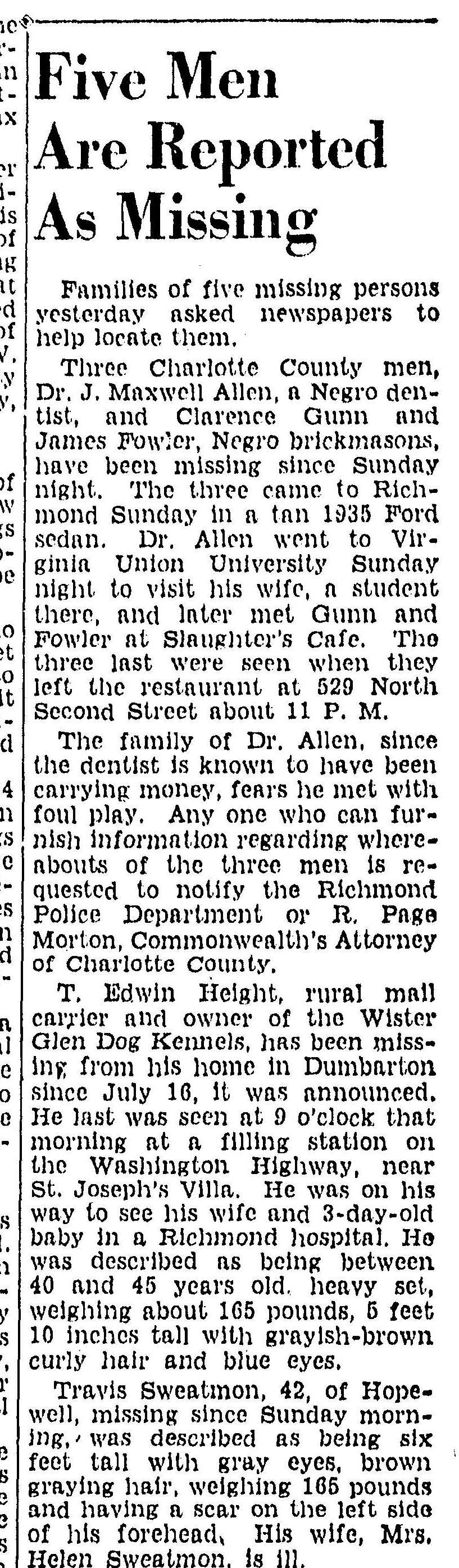
On 22 August 1939, the Richmond Times-Dispatch ran a short article concerning the alleged disappearance of Maxwell Allen, “Negro dentist,” following a visit to his wife at Virginia Union University. He had been carrying a significant amount of money, and the family feared foul play. Apparently, Maxwell resurfaced without incident, and the brouhaha died down. (My mother has never heard anything about this.)

The 1940 census of Charlotte Court House lists doctor of dentistry Maxwell J. Allen, 35; wife Lena P., a public school teacher, 35; and sons Maxwell J., Jr., 8, and Cameron L., 2; as well as Margarette Brown, 8, niece. Apparently, however, Maxwell tried out a practice in Lynchburg for a few years during this stretch. In Stickley and Amowitz’ The Lynchburg Dental Society Presents One Hundred Forty-Three Years of Dentistry: 1820-1963, published in 1964: “Dr. J. Maxwell Allen was a graduate of Howard University School of Dentristry. He practiced in Lynchburg at 912 Fifth Street in 1940 and 1941, moving from here to Charlotte Court House, Virginia.”

Maxwell Sr. and Maxwell Jr.(1938) 001

 Uncle Maxwell and younger son, Cameron, circa 1939.

On 23 February 1950, in a column in the Charlotte Gazette called “News of Interest of Colored Readers”: In observance of Negro History Week, the Rev. F.L. Patterson, pastor of Morrison Grove Church, arranged a very interesting meeting. Miss Betty Smith presided. Mrs. Charles G. Blackwell spoke on “The Negro in Education.” Other speakers were Mr. G. H. Binford, on the subject “The Negro in Politics and Economics”; Rev. F.L. Patterson, on “The Negro in Religion”; Dr. J. Maxwell Allen, on “The Negro in Fraternals and Dentistry.”

On 18 Aug 1959, Newport News’ Daily Press reported: “Dr. J. Maxwell Allen Sr., Negro, a former resident of Newport News, died early Sunday in a Lynchburg hospital following a short illness.  He is the son of Mrs. Mary H. Allen and the late J.C. Allen Sr., of Newport News. Surviving, in addition to his mother, are his wife, Lena P. Allen of Charlotte Court House; two sons, Maxwell Allen Jr. and Cameron Allen of New York City; a brother, William J. Allen, Newport News; three sisters, Mrs. Julia A. Maclin, Newport News, Mrs. Edith A. Anderson, Jetersville, and Mrs. Nita A. Wilkerson, Washington; a foster brother, Jesse H. Jefferson of Baltimore; and several nieces and nephews.  Funeral arrangements are incomplete.”

Per his death certificate, Uncle Maxwell died of cancer after a twelve-day stay in a Lynchburg hospital. He would have turned 56 the day after his death.  He was buried in Charlotte Court House in Union Cemetery, just down the road from his house and office. His wife Lena joined him there in 1998.

Standard
Education, Maternal Kin, Paternal Kin, Vocation

Registered nurses.

Many thanks to Renate Yarborough Sanders for bringing to my attention to “Early African American Registered Nurses in NC,” http://nursinghistory.appstate.edu/biographies/african-american-registered-nurses-nc-1903-1935. The page lists all known African-American nurses in the state, including my grandmother’s paternal aunt Henrietta Colvert and three other relatives.

The number presumably refers to the nurse’s license and the date to the date she was certified or registered. Henrietta Colvert was from Statesville, not Wilson, but moved to that eastern town by the early 1920s. I knew she trained at Saint Agnes, but was not aware that she also trained at Good Samaritan, a large African-American hospital in Charlotte.

#7794. Diana Ada Adams Artis. Wilson NC. October 13. Saint Agnes Hospital. 1926.

Diana Adams Artis was born in 1891 in Brooks County, Georgia. She married Columbus E. Artis, son of Adam T. and Amanda Aldridge Artis in 1914 in Washington DC, but later settled in Wilson. I assume that she worked at Mercy Hospital.

#7123. Henrietta Colvert. Wilson NC. April 15. Good Samaritan. 1925.

#11,104. Gwendolyn Sykes. Goldsboro NC. October 26. Lincoln Hospital. 1931.

Gwendolyn Sykes Carney, born 1909 in Goldsboro, North Carolina, was the daughter of William O’Berry Sykes and step-daughter of Gertrude Wynn Sykes.

Vera L. Baker. Graduate 1902, Freedmen’s Hospital, Washington DC. State Hospital, Goldsboro.

Vera L. Baker Holt, born 1879 in Dudley, North Carolina, was the daughter of John F. and Mary Ann Aldridge Baker.


Standard
Maternal Kin, Newspaper Articles, Virginia

They fear he met with foul play.

75 years ago today, this brief article appeared on the front page of the Richmond Times-Dispatch:

Richmond Times Dispatch 8 22 1939

Richmond Times-Dispatch, 22 August 1939.

What the –?

My great-uncle J. Maxwell Allen survived this incident, but what in the world happened? (If anything.) I can’t find any foolw-up in newspaper archives, and no one in my family has ever mentioned the disappearance of Uncle Mac.


Standard
Maternal Kin, Migration, Paternal Kin, Vocation

Punching the clock: factory workers and machine operators.

Hattie Artis Johnson, Norfolk VA — stemmer, tobacco factory, circa 1920; “bag maker,” circa 1930.

June Scott Artis, Stantonsburg NC – worked at box factory, circa 1910.

Henry J.B. Artis, Stantonsburg NC – worked at box factory, circa 1910.

Sylvester Watson, Wilson NC – tobacco worker, circa 1920.

Madie Taylor Barnes, New York NY – presser, dress factory, circa 1930.

Dorothy Barnes, New York NY – presser, dress factory, circa 1930.

Rachel Barnes, New York NY – presser, dress factory, circa 1930.

Mary Barnes Barnes Jones, Wilson NC – stemmer, tobacco factory, circa 1910.

Sylvester Barnes, Wilson NC – tobacco factory worker, circa 1936.

William I. Barnes, Wilson NC – husband of Madie Taylor Barnes; laborer, Export Leaf Tobacco Company, circa 1918.

William Bradshaw, Statesville NC – Statesville Furniture Factory worker, 1910s-1940s.

Aggie Colvert, Statesville NC — Statesville Furniture Factory worker, circa 1917; janitor, Statesville Flour Mills, 1920s-1930s.

James W. Cooper, Wilson NC – husband of Alberta Artis Cooper; fireman, Jas. I. Miller tobacco company.

Sarah Henderson Jacobs Silver, Wilson NC – occasional tobacco factory worker, 1920s.

Hattie Henderson Ricks, Wilson NC – tent factory, World War II.

Theodore Henderson, Goldsboro NC – laborer, Wayne Red Brick Company, circa 1917.

John Henderson, Goldsboro NC – factory hand, circa 1923.

William Henderson, Goldsboro NC – factory hand, circa 1923.

William H. Henderson, Mount Olive NC – Calypso Veneering Co., Calypso NC, 1940s.

James H. Henderson, Goldsboro NC – Kemp Specialty Furniture Ltd., 1940s.

Irving Houser, Bayonne NJ – husband of Emma McNeely Houser; oilworks fireman, circa 1920; machine operator, oil refinery, circa 1930.

Watt Kilpatrick, Winston-Salem NC – husband of Lizzie McNeely Kilpatrick; shape puller, R.J. Reynolds Tobacco Company, circa 1918.

Luther McNeely, Alexandria VA – laborer at Virginia Ship Building Corp, circa 1917.

John McNeely, Bayonne NJ – laborer at furniture factory, circa 1930.

Edward McNeely, Statesville NC – laborer, Statesville Furniture Factory, circa 1910.

Charles McNeely, New York NY – machine operator, mayonnaise factory, circa 1930.

Eugene Stockton, Statesville NC – husband of Ida Colvert Stockton; tobacco roller at tobacco factory, circa 1910.

Eliza T. Taylor, Wilson NC – tobacco factory worker.

Jordan T. Taylor, Wilson NC – husband of Eliza Taylor; tobacco warehouse worker.

The fifteenth in an occasional series exploring the ways in which my kinfolk made their livings in the 19th and early 20th centuries.


Standard
DNA, Maternal Kin, Paternal Kin

My family haplogroups.

MtDNA Haplogroups

H3 [widespread across Europe, second most common of the H lineages] — My father’s matrilineal haplogroup. Furthest known ancestor: Nancy Balkcum (1807-1854, Duplin County NC), my great-great-great-great-grandmother. Margaret Balkcum Henderson, whom I believe to be her daughter, is my father’s matrilineal ancestor. He is also descended from Mary Eliza Balkcum Aldridge, whom I believe to have been Margaret’s sister, and whose matrilineal descendant has also tested H3.

J1c2 [widespread, but low frequency, across Europe; also Middle East] — The haplogroup of my father’s mother’s father’s mother. Furthest known ancestor: Levisy Hagans Seaberry (~1824-~1875, Wayne County NC), my great-great-great-great-grandmother. (Or, if my conjecture is correct, her mother Leasy Hagans (1800-~1855, Nash County).

L2d1a [relatively uncommon, West African origin, also found in Yemen, Mauritania and Sudan] — My mother’s matrilineal haplogroup. Furthest known ancestor: Margaret McConnaughey Miller (1821-~1875, Rowan County NC), my great-great-great-grandmother.

L1c1a1a1b — The haplogroup of my mother’s father’s mother. Furthest known ancestor: Matilda Holmes (~1840, Charlotte County VA- 1885, Charles City County VA), maiden name unknown.

Y-DNA Haplogroups

J2b1 [southern Balkans and Anatolia] — My father’s patrilineal haplogroup. Furthest known ancestor: Green Taylor (1817-~1885, Nash County NC), my great-great-grandfather.

R1b1b2a1a [R1b1 is the most common of European lineages] — My father’s mother’s mother’s mother’s father’s haplogroup (as derived from a descendant of his brother.) Furthest known ancestor: James Henderson (1815-~1890, Onslow County NC).

R1b1b2a1a1 [ditto] — My mother’s brother’s haplogroup. Furthest known ancestor: John C. Allen Sr. (1876-1953, Charles City County VA), my great-grandfather. [Update, 7/22/2015: FTDNA classifies my uncle’s haplogroup as R-M269.]

Standard
Births Deaths Marriages, Maternal Kin, Migration, Other Documents

Funeral Program Friday: Matilda Whirley.

Not exactly a funeral program, but close enough:

Morning Star Baptist Church of Christ/In Remembrance.

MATILDA WHIRLEY.  December 7, 1910-March 5, 1992.  Matilda “Tillie” Whirley, one of Stephen and Emma Whirley’s eight children, was born on December 7, 1910 in Charles County, Virginia. She was educated in the public schools of Charles County until moving to Baltimore, Maryland. There she completed her education by attending evening classes.  For nineteen years, Miss Whirley worked as a housekeeper in the Ashburton section of Baltimore. She subsequently obtained employment at the University of Maryland, School of Dentistry from which she retired after working there for seventeen years.  At an early age Tillie received Christ as her personal Savior and became an active member of the New Vine Baptist Church in Charles County, Virginia. She was guided in the work of the church by her God-fearing parents. Her mother instructed her in baking the bread for the Lord’s Supper each month and Tillie, believing this was her sacred duty, continued baking the bread until she left Charles County.  After relocating to Baltimore, Maryland, Miss Whirley became affiliated with the Morning Star Baptist Church, under the pastorate of the late Reverend George Jacob Garnett. Because of her strong background as a servant of God, she became a great servant of mankind. At Morning Star, Miss Whirley was a member of the Senior Usher Board, Missionary Society, Samuel Ray Revival Choir, Church School, Building Fund, Lottie Henry Nurses’ Unit, Flower Circle, Women’s Ministry and Board of Christian Education. She was also a member, and later president, of the Pastor’s Aid and a loyal supporter of the Girl Scouts, Fuel Fund, Elevator Fund and any other fund or organization which would benefit her church or community.  Miss Whirley was a devoted, loving, effectual, caring Christian woman and was a friend to all who needed her. She freely gave wise and timely counsel, based on her life experiences, as she sought to make life go a bit smoother for her family, friends, church members, neighbors and co-workers. Miss Whirley was counted upon to be an integral part of church and community activities and participated and served wherever she could. Her dedication and love of God was evident in all she did. Miss Whirley was a good example of one of God’s servants; because of that, we take time to remember her this month.

Source: http://www.msbcoc.org/star/remember/matilda-whirley.asp

Standard