Births Deaths Marriages, Maternal Kin, North Carolina, Photographs

Remembering Launie Mae Colvert Jones.

Launie at school

Grandma:  Launie Mae was a mama’s baby.

Me:  Aunt Launie Mae was a mama’s baby?

Grandma:  Yes, Lord.  [I laugh.]  With all her soul.

——

My mother:  I thought Aunt Launie Mae looked more like Grandma Carrie than anybody. She looked the most like of her all the sisters.

——

Image

Remembering my great-aunt LAUNIE MAE COLVERT JONES (1910-1997) on her birthday.

Standard
Births Deaths Marriages, Maternal Kin, Paternal Kin

The TB.

My grandmother:   Jay’s daddy had TB, and he just gave it to them.  To my aunt and Jay.  But he lived years and years and years after both of them died.

——

Tuberculosis, once also called phthisis, is a common, and in many cases lethal, infectious disease caused by various strains of mycobacteria. Tuberculosis typically attacks the lungs, but can also affect other parts of the body. It is spread through the air when people with an active TB infection cough, sneeze, or otherwise transmit respiratory fluids through the air. The classic symptoms of active infection are a chronic cough with blood-tinged sputum, fever, night sweats, and weight loss (the latter giving rise to the old term “consumption.“)  Tuberculosis has been present in humans since antiquity.  Tuberculosis caused the most widespread public concern in the 19th and early 20th centuries as an endemic disease of the urban poor and was the leading cause of death in many cities in the early 1900s. By mid-century, the development of the antibiotic streptomycin made effective treatment and cure of TB a reality.

——

In memory of members of my extended family who succumbed to this disease:

Annie Locust Artis, age 28. Wayne County NC, 19 April 1915.

Minnie Clyde Sauls, age 25. Snow Hill NC, 12 May 1915.

Frances Artis Newsome, age 21. Wayne County NC, 9 May 1916.

Appie Artis, age 37. Wilson County NC, 28 May 1916.

Cain Artis, age 66. Wilson County NC, 23 March 1917.

Nettie Barnes, age 22. Wilson NC, 9 May 1917.

Toltie Forbes, age 21. Greene County NC, 18 June 1917.

Jesse Swinson Jr., age 28. Goldsboro NC, 1 July 1917.

William Barnes, age 28. Wilson NC, 6 August 1917.

Harriet Artis Brown, age 44. Wayne County NC, 6 November 1918.

Pelia N. Artis, age 11. Wayne County NC, 24 July 1919.

Charlie Barnes, age ____. Asheville NC, 28 July 1919.

Walter Clinton Artis, age 23. Wayne County NC, 15 November 1921.

Jarod C. Miller, age 21. Rowan County NC, 4 December 1921.

Elethea McNeely Weaver, age 33. Statesville NC, 10 October 1922.

Johnnie Swinson, age 32. Goldsboro NC, 25 December 1922.

Estell Artis, age 15. Wayne County NC, 20 February 1924.

John Henderson, age 63. Goldsboro NC, 8 August 1924.

Warland Barnes, age 19. Wilson NC, 4 Dec 1926.

William Coley, age 61. Near Wilson NC, 26 January 1928.

Jerrell R. Barnes, age 19. Wilson NC, 14 May 1928.

Napoleon Artis, age 21. Wayne County NC, 9 September 1928.

Sadie Holt Farrar, age 35. Greensboro NC, 13 October 1929.

T. Alonzo Hart, age 63. Quewhiffle NC, 17 December 1929.

Alberta Artis, age 23. Near Eureka NC, 9 June 1931.

Blonnie Barnes Zachary, age 24. Wilson NC, 10 January 1932.

James A. Aldridge, age 42. Near Wilson NC, 3 July 1932.

Ora Artis, age 62. Wayne County NC, 8 August 1933.

Irving McNeely Weaver, age 22.  Bayonne NJ, November 1933.

Malinda Applewhite Artis, age 40. Wilson County NC, 5 March 1936.

Joe Artis, age 62. Wayne County NC, 29 November 1939.

Viola Barnes, age 48. Wilson NC, 3 July 1943.

Liberty P. Artis, age 11. Stantonsburg NC, 10 July 1945.

Alphonso Artis, age 38. Goldsboro NC, 2 May 1946.

Paul Aldridge, age 34. Dudley NC, 8 June 1947.

Annie Marie Artis Sampson, age 27. Fremont NC, 12 June 1949.

Minnie Belle Artis, age 20. Stantonsburg NC, 4 April 1950.

Standard
Land, Maternal Kin, North Carolina, Other Documents

Where we lived: colored settlements.


Me:  And where was the area that was called Wallacetown?

My grandmother:  Mm-hmm. That was just out near where we lived. We lived out there.  And then there was like a stream or a branch or something where you crossed that thing, that was called Rabbittown.

Me: Okay.

Grandma: We lived in Wallacetown.

——

From the 1916 city directory of Statesville, North Carolina:

Popular Branch — a colored settlement southeast of Wallacetown [actually, it was “Poplar” Branch]

Rabbittown — a colored settlement southeast of Wallacetown

Wallacetown — a colored settlement southeast of the railway station

Rankinsville — a colored settlement to the right of the north end of Centre Street

Screen shot 2013-12-18 at 10.18.27 PM

Standard
Births Deaths Marriages, Maternal Kin, Newspaper Articles, North Carolina, Oral History, Photographs

Remembering Grandma Carrie.

McNEELY -- Carrie M Colvert with corsage

Me: In her pictures she always looked stern.

My mother: Grandma? 

Me: Carrie.

Ma: Grandma Carrie?  I know it.  But she was funny.  She was funny to me.  She could say some of the, she could say some funny stuff.  I know that’s where Mama gets it from.  The little sayings. 

Image

Statesville Landmark, 20 December 1957.

My grandmother didn’t think much of Charles V. Taylor:

Course she met this guy and married him that she had known him when she was a child.  Taylor.  And went to New Jersey.  She came back home, and Mama had high blood pressure, you know.  But she kept, her doctors kept it in check.  But he hadn’t let her go to the doctor for two times, and she had a stroke and died.  Oooo.  I could have killed that man.  I was so mad with that man I didn’t know what to do.  And when we went down there, Mama just got worse and worse.  She went to the hospital, and they did everything they could at the hospital, and then they let her come home.  And I went down there to see her one time, while she was at home, you know, and she couldn’t talk.  She couldn’t talk, I mean.  And she would try her best to tell me something.  And I just cried and cried and cried and cried and cried. And I didn’t know what she was trying to tell me.  So my sister lived not far from her.  And she was a cafeteria manager, but she would come to see Mama between the meals.  You know, in the morning breakfast and lunch, and then after dinner she’d come.  She really did take care of Mama when she was living with that Thing.  And she went to the hospital and stayed awhile, and he wouldn’t pay the hospital bill.  And I took a note out at the bank, and Louise paid her doctor’s bill and everything, and when she died, he tried to make us pay all the burial expenses.  And his brother came over there and told us, said, “Don’t you pay a penny.  ‘Cause he’s got money, and he’s supposed to use it for that.”  And said, “Don’t you do it.  Don’t you give it to him.”  And that man and the undertaker got together and planned all that stuff against us, you know.  The three of us.  It was terrible.  And Mama had a lot of beautiful clothes, you know, because this man bought her things.  And they were all in there looking at them.  I said, “I don’t want a thing.  I don’t want not one thing.”  I think I got a coat.  It was just like a spring coat.  It was lined.  And I think Louise insisted that I take it, but that was the only thing that I took.

——

McNEELY -- Carrie Colvert thoughtful

Remembering Caroline Martha Mary Fisher Valentine McNeely Colvert Taylor, who died 56 years ago today.

——

Interviews of my mother and Margaret C. Allen by Lisa Y. Henderson; all rights reserved.

Standard
Enslaved People, Maternal Kin, North Carolina, Other Documents, Rights

Accept no pass unless …

Ring the Court House bell at 10 o’clock every night and at all other times when necessary to alarm the citizens.

Arrest all slaves absent from home after the bell rings and after the calaboose is finished lock them up till day light. Give them 15 lashes and inform the magistrate of their names and owners.

Accept no pass unless the place or places where the slave is permitted to go is written in the same and arrest the slave if found off a direct line or road from one place to another.

Arrest all slaves engaged in a disturbance either with or without a pass.

A pass allowing a slave to visit his wife is good for one month and then must be taken up and another given or he will be arrested.

Iredell County slave ordinances, undated. North Carolina State Archives.

Standard
Births Deaths Marriages, Maternal Kin, Oral History, Photographs, Virginia, Vocation

He designed every house he built.

About ten years ago, when we were all in Newport News for a family reunion, I asked my uncle to take us on a tour of houses our grandfather built.

——

He designed every house he built. And there were a couple he designed that he didn’t build. I’ll show you those, too. One of them, he really hated to lose. That was a, Dr. Woodard was a dentist. I mean, a pharmacist. And so, he – that was one of the lots that Daddy had sold, and so I think Daddy was a little ticked with the guy. He sold him the lot and designed the house, then the man went to another contractor. But you know what was interesting at that time? There were about five or six good general contractors around, you know, that did small buildings. And Daddy was one of those, but these guys were pretty competitive. They had a decent market. Daddy built an average of about a house a year, I guess. The war cut him off, you know. He had to get reestablished after the war. But he had a friend named Buster Reynolds. And Buster Reynolds was reputed to have made his money in the numbers, and so when the numbers were getting real hot and heavy, when it was reputed that the Mafia was trying to take the numbers over, Buster got out. And he built this service station, and he had a Texaco franchise, and he had Daddy to build the station. And Texaco liked the work so much that Daddy built two more stations for Texaco. And both of the stations that were built in the black community are still up. They’re not gas stations anymore, but the buildings are still up. And the one that was built Overtown is gone. But even the station that was in the white community Texaco had him to build that one, too. And with the money Daddy bought – I’ll never forget – he bought an International truck, great big truck, to carry his materials around.

Texaco 2

——

… the churches that he used to do expansions and modernizations on all the time, but I know one of ‘em is gone, and I don’t know where the other one is. I know the one – he used to take me down to that one from time to time. But I don’t know where they are now. The thing he did throughout all of these communities – he had a strong maintenance clientele, but Daddy was a – you see these cabinet shops now? Well, Daddy used to make, put in new cabinet work in people’s kitchens for them. And, so, that’s what carried him through the winter. ‘Cause he would also do designs and drawings for other contractors. Like Jimmy’s daddy. Mr. Scott. He used to do most of their design work, he’d sit there and draw those drawings for them. But that’s what got him through the winter. That and he used to do a lot of maintenance. Put in new windows, cabinet work, doors. Put little small additions to houses. But that was generally for a white clientele. He used to do a lot of work for the shipyard management people up in North Huntington Heights.

——

This house Daddy was building when he died. He was building it for a family named Kramer. A white family. See the one with the little entrance and the white wrought iron?

House 1

1316 – 22nd Street

——

The 800 block of Hampton Avenue, this is where Daddy owned those lots. Slow down … this house right here. This tan house. 855. This house was built at that time for the Tynes family, which owned a very nice house and property up in the next block.

Hampton Avenue 1

855 Hampton Avenue

But the Tynes family ran into some – I guess it was financial difficulty. Anyway, that house was sold to Wendell Walker, who was a lawyer and a part of the Walker family. You know his father was a lawyer, who was William. And his son William jr. is Howard Walker’s father, who was my classmate. And then there were, like, four sons and a daughter, I believe it was. Three of ‘em were lawyers, and then Wendell and Phillip were lawyers. The son William was an engineer, but when he came back home, he was manager of Aberdeen. He went into real estate and insurance. Daddy sold him the lot, designed and built the house.

——

Hampton Avenue 3.1

819 Hampton Avenue

Let me tell you about this house right here. This house was the undoing. This house was built for his friend Leroy Ridley. And there were, I think, four lots – four or three lots. Leroy Ridley was the son of John Ridley, who founded Crown Savings Bank with Pa Pa Allen. Okay? But he became – one of the Ridley sons, he became the one who took over the bank. And the man turned out to be not the most moral and forthright businessman. He talked into Daddy into $5000 worth of extras in this house, which was almost the same size as the house. And then when it came time to close the deal, he refused to pay Daddy because he said Daddy had not duly executed the extensions in the contract to do that. And not only that – Daddy had borrowed money from his bank. The long and short of the story is the last of that was paid when Pa Pa’s estate was executed [in 1961, 13 years after John Allen’s death.] We told Mother to pay that loan off ‘cause she still owed a thousand dollars. But this house turned out to be what kept Daddy from building Mama her house. ‘Cause he was gon build it on another lot. See? But when he got caught in that deal, then he couldn’t. So then he had to sell off all the lots that he had for houses, okay? So that’s when he sold this lot – the Woodard lot. And designed that house for Dr. Woodard.

Me: This incredible – this house right here?

My uncle: Yes. That’s Daddy’s design.

My cousin, J: Wow!

Me: Sheeze. Oh, my God.

He did not do it. He designed it. Okay. See, this was an extra lot. This is another one of the large lots he had. You see what I’m saying? And this house was across the street, that was his pride and joy. That was a Cape Cod. But I’m saying, the Ridley house was a fantastic house. I mean, you know, the design was great, but anyway, so this was done for his buddy Picott. Mr. Picott. He was president — well, he wasn’t president – yes, well, he was, of Virginia Education Association, which was the black unit of the National Education Association. He was one of the guys who lost their jobs over the equal rights fight with Mr. Palmer for black teachers to have equal pay. And he left and moved to Richmond, and that’s when he sold his house. But that was a beautiful home. Solid oak floors, cabinetry that Daddy built. All of that, that house. But that’s the thing that – she won’t talk about it too much – but that’s the thing that really embittered Mother, was when she lost the opportunity to build her house because of that deal.

Hampton Avenue 2

816 Hampton Avenue

——

2107 Marshall Ave

2107 Marshall Avenue, my great-grandparents’ house.

You know, he did all that for his father. He put the addition – designed that addition to go on the back. Right behind the bathroom window. Okay, that’s where the bathroom was. And then Daddy designed and started that addition for the house. And that’s when he went to the Army. And they put that addition up there so – so the bottom addition was the barbershop, remember? You remember the beauty shop? Yeah, the bottom addition was the beauty shop, and the upper addition was the bedroom for Aunt Nita for the war. Pa Pa did that for his children.

——

House 3

3105 [I didn’t note the street name]

On the corner here, similar to the Kramer house. Designed it and built it. That was done for Dr. Fultz, who was a dentist. Actually, he was the school dentist. He built 3015. This at that time was a predominantly white neighborhood. Yeah, that’s the house. See that little carpentry he did? Those little arched doorways? That’s the original wood. That’s Daddy’s work.

——

Remembering John Christopher Allen, Jr., carpenter, draftsman, builder, contractor, father of five, grandfather of eight, great-grandfather of six, born 107 years ago today.

—–

Interview by Lisa Y. Henderson; all rights reserved. Photos taken by Lisa Y. Henderson, 2002.

Standard
Maternal Kin, Paternal Kin, Vocation

Where we worked: teamsters, drivers and draymen.

Lewis Colvert, Statesville NC – drayman, circa 1895.

Haywood Artis, Norfolk VA – driver, 1897.

Isham Smith, Goldsboro NC – husband of Nancy Henderson Smith; wagon driver, circa 1900.

Wesley Barnes, Wilson NC – teamster, 1900-1910; drayman, Tomlinson Co., circa 1919.

Mike Taylor, Wilson NC – drayman, circa 1900; drayman, circa 1908-1910s.

Dock Simmons, Logansport IN – teamster, 1900s-1920s; trucking, circa 1945.

Luther McNeely, Statesville NC – driver, dray wagon, circa 1910; driver, Statesville Grocery Company, 1916.

John W. Colvert, Statesville NC – dray wagon driver, circa 1910; driver, circa 1916; teamster, circa 1920.

William Henderson, Goldsboro NC – driver, circa 1916.

Jack Henderson, Wilson NC – transfer driver, Sam Vick, circa 1917; truck driver for woodyard, circa 1920; truck driver, Liggett & Myers tobacco company, 1930s-1940s.

Junius Allen, Newport News VA – drayman, circa 1920.

John Sampson, Goldsboro NC – husband of Cora Reid Sampson; drayman for city, circa 1920.

Bazel Holt, Greensboro NC – husband of Mamie Henderson Holt; driver, 1920s-1950s; Foster-Caveness, Inc., circa 1930.

John Long, Statesville NC – husband of Lizzie McNeely Long; railway truck driver, circa 1930.

James L. Henderson, Goldsboro NC – truck helper, “CoCola” plant, circa 1936.

Jimmie Reaves, Greenville NC – husband of Bertha Taylor Reaves; driver for department store, circa 1940.

——

“Drayman” — historically, the driver of a dray, a low, flat-bed wagon without sides, pulled generally by horses or mules and used to transport goods.

“Teamster” — historically, the driver of a wagon drawn by a team of draft animals, usually oxen, horses, or mules.

——

The fourth in an occasional series exploring the ways in which my kinfolk made their livings in the 19th and early 20th centuries.

Standard
Maternal Kin, Military, North Carolina, Other Documents

Ordered to report.

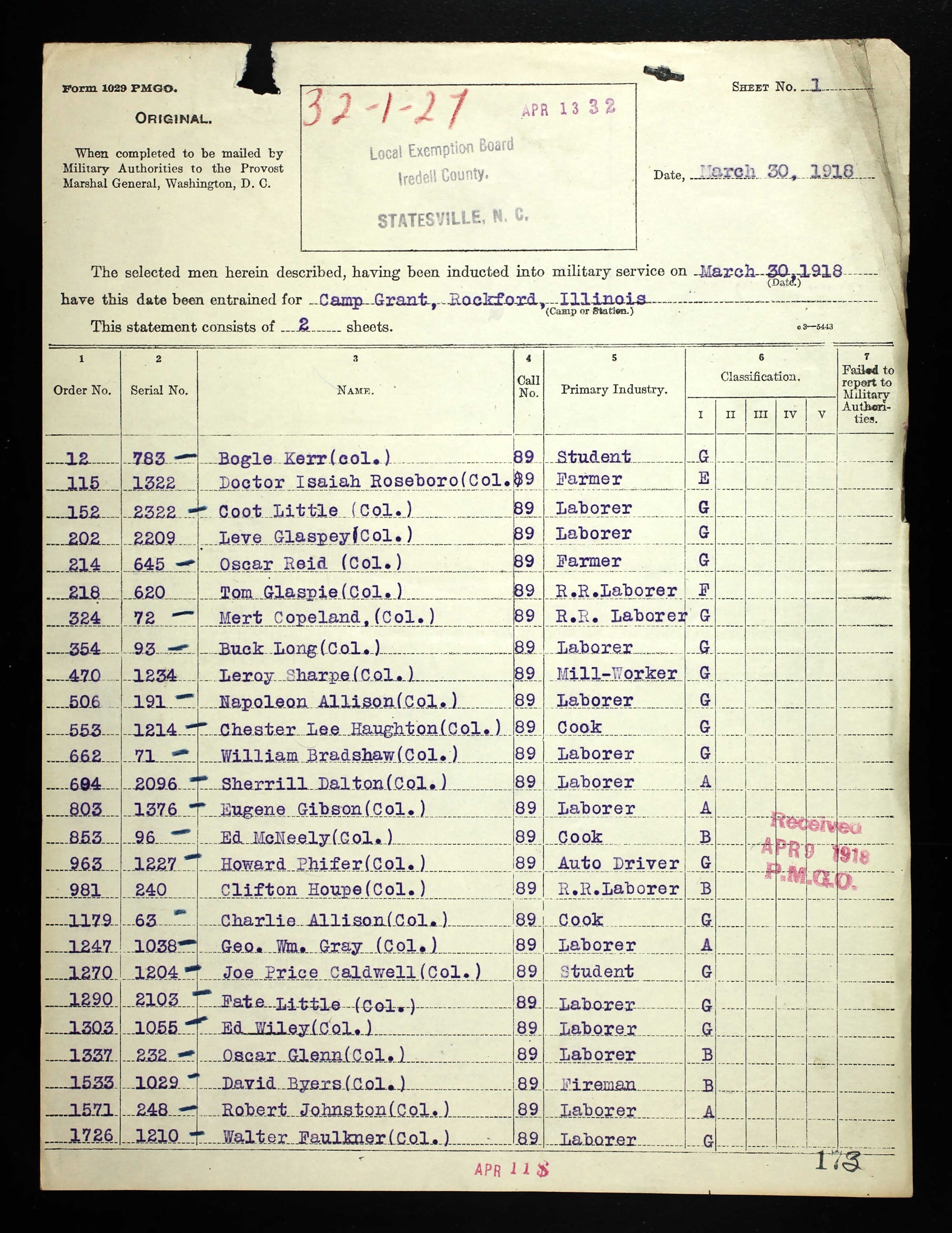
Image

This roster of African-American men from Iredell County inducted on March 30, 1918, and ordered to report to Camp Grant, Rockford, Illinois, included my grandmother’s maternal uncle, Ed McNeely, and brother-in-law William Bradshaw. (Bradshaw married Golar Colvert eight days after his induction.)

[War Department, Office of the Provost Marshal General, Selective Service System, 1917– 07/15/1919. Lists of Men Ordered to Report to Local Board for Military Service, 1917–1918. Records of the Selective Service System (World War I), Record Group 163. National Archives, Atlanta, Georgia.]

Standard
Education, Maternal Kin, North Carolina

Golar.

My great-aunt Golar Augusta Colvert, born in 1897. Her uncle Harvey Golar Tomlin, born in 1894.  My great-grandmother’s cousin, Goler Lee Miller, born in 1895.

Who were these people — all born within 25 miles of Salisbury, North Carolina — named for?

William Harvey Golar, the Canadian-born president of Livingstone College, a small, four-year institution in Salisbury affiliated with the African Methodist Episcopal Zion Church. Golar was appointed president in 1893 and was renowned for his energetic fundraising ability during his nearly 20 years of service.

Harriet Nicholson Tomlin Hart, mother of Golar T. and grandmother of Golar C., was an enthusiastic AMEZ, and I’m guessing that Goler’s parents George and Adline Miller were, too.

Standard