

Wishing you and your valentines the sweetest day.
Remembering my grandmother’s favorite cousin, Irving “Jay” McNeely Weaver.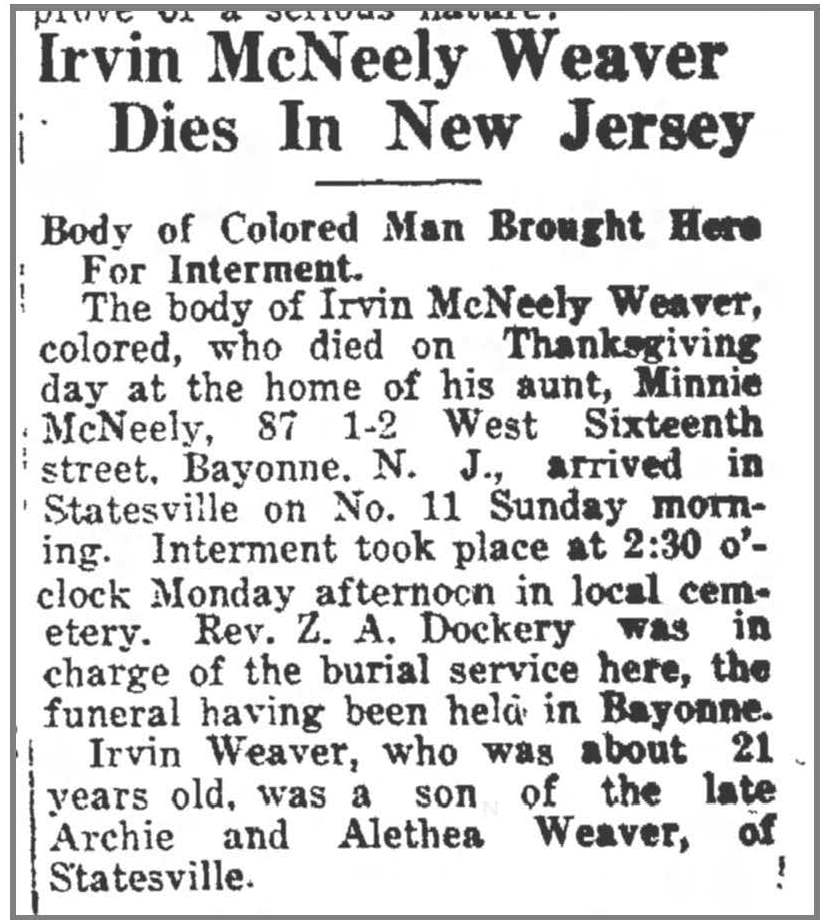
Statesville Record & Landmark, 5 December 1933.
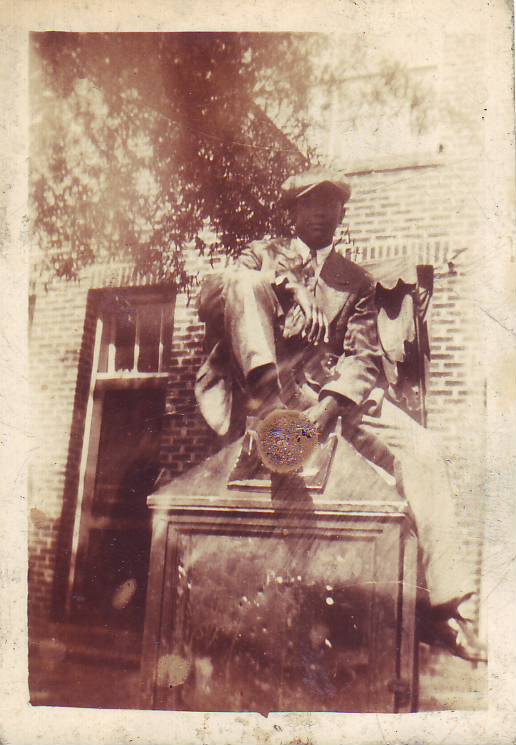
Jay as a boy, probably in Bayonne, New Jersey.
Photograph in collection of Lisa Y. Henderson.
Exactly 100 years ago today, Miss Viola Houser visited her brother and his wife, Irving and Emma McNeely Houser, in Bayonne, New Jersey.
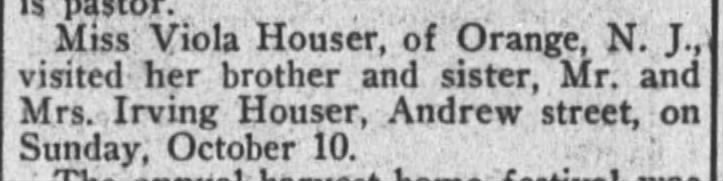
New York Age, 21 October 1915.
On the 65th anniversary of her death (and her brother Edward‘s), another account of the terrible death of my grandmother’s aunt, Elizabeth McNeely Kilpatrick Long:

Statesville Record & Landmark, 28 September 1950.
My grandmother: I had another cousin that died. A man named Jay. He was Aunt Elethea’s boy. She died when I was about 12 years old, I think. Anyway, she died, and she had three sons.
Me: That was Jay and Charles and William.
Another time:
My grandmother, looking at a photo: Now, who is that?
Me: That’s William, isn’t it? Elethea’s son?
My grandmother: Ah, yeah. Yeah. Bill.
Me: Bill.
My grandmother: No — that’s Charles. Boy, they were crazy about us. I mean, no man bed’ not even look at us. Bed’ not even look at us. You know how men can say things about women when they walk by? Child, they bed’ not say one thing about us. …
——
In 1942, Charles Edward McNeely filed for a delayed birth certificate in Iredell County. The document issued by the Register of Deeds reported that he was born 15 Jun 1904 to Eleather B. McNeely. No father is named. I have not found a birth certificate for Charles’ brother William “Bill” McNeely.
In the 1910 census of Statesville, Iredell County, on Salisbury, three little boys surnamed McNeeley were listed in the household of their grandparents, Sam and Mary Steelman. William was five, James was three, and Charlie was two. I once was pretty sure that these were Elethea’s boys, but I’m pulling back. Charles and Bill appear nowhere else in the census, but the ages of these boys are off. And who is James? (He’s not Jay/J.T. — Irving McNeely Weaver — whose father was Archie Weaver and who was not born until 1911 or 1912.)
I’ve found none of Elethea’s sons in the 1920 census, though they were probably living in their grandmother Martha McNeely‘s house in Statesville with their mother and aunts Minnie and Janie McNeely:

On 23 May 1926, Charles Edward McNeely, 22, married Willie Ann Davidson, 18, before witnesses Mary Louise Colvert, Levi Moss and Bertha Mae Hart. Louise, my grandmother’s older sister, was his first cousin. Bertha was the half-sister of my grandmother’s father. Charles listed his parents as Ed Stockton (living) and Letha McNeely (dead.) John Edward Stockton (1881-1955) was born in Iredell County to Alfred and Caroline Kerr Stockton. He was working as a bellhop at the Hotel Iredell at the time of Charles’ birth. I don’t know whether he was also Bill McNeely’s father.

Charles and Willie Ann’s marriage apparently did not take. In the 1930 census of Manhattan, New York County, New York, Charles M. McNeely, 26, and Willy M. McNeely, 22, were listed as boarders in household headed by Lucy R. Reid. Both were North Carolina-born and reported being married, though their wives were not enumerated with them. Charles worked as a machine operator in a mayonnaise factory and Willy as an elevator operator in a private house.
In 1940, Charles McNeely was still in Manhattan, but I lose sight of Bill. Thirty-six year-old Charles lived at 308 W. 127th Street, a lodging house run by Lillie Collins. He gave his occupation as steamship laborer.
On 29 September 1950, William and Charles McNeely are listed as nephews in the death notice of Edward McNeely of 454 Avenue C on September 28, 1950. Other survivors included wife Delphine (nee Peterson), sisters Emma Hauser [sic], Carrie Taylor and Minnie McNeely, nieces Ardeanur S. Hart and Lonnie [sic] Mae Jones, and nephews Henry and Erving Hauser [sic].
Charles McNeely, resident of north Harlem, died 1 Apr 1968. Four and a half months later, on 15 August, Bloomfield, New Jersey, resident William M. McNeely passed away. This William, however, was not Bill, but a son of William E. and Sarah L. McNeely. I have no evidence that either Charles or Bill had children.
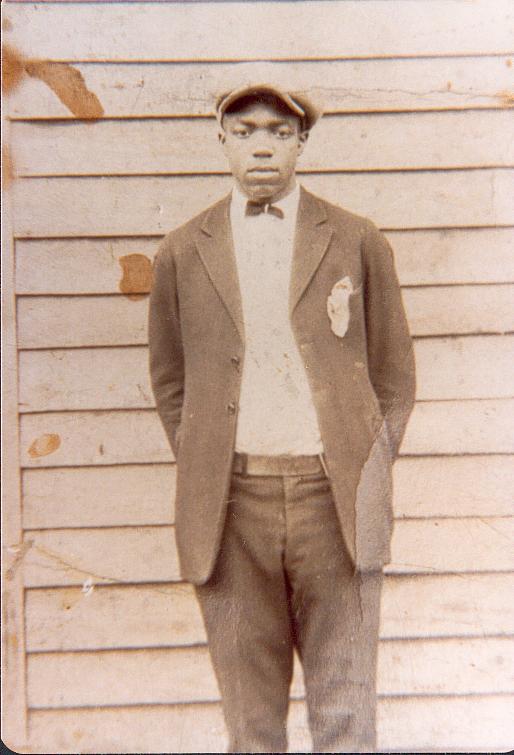
“No — that’s Charles.”
Interviews of Margaret C. Allen by Lisa Y. Henderson; photographs in the collection of Lisa Y. Henderson.
I came back from vacation to find a nice new match at Ancestry.com. R.M. and I are double eighth cousins, as I am descended from two children of Isham and Jane Rogers Randolph — Thomas I. Randolph (1722-1788), who married Jane Cary (1751-1774), and Susannah Randolph, who married Carter Henry Harrison (1736-1793). (Thomas Randolph, Susannah Randolph Harrison, and Bettie Randolph Railey’s sister Jane Randolph married Peter Jefferson and gave birth to Thomas Jefferson.)

Ancestry estimates our relationship as 5th-8th cousins and rates the match as “Good,” meaning that we share 6-12 cM. (Which is quite high for 8th cousins, but is attributable to (1) our double lineage and (2) luck.) That’s lower than I’d ordinarily pursue, but I’ll take it.
Most of my grandmother’s male McNeely first cousins were too old to have served in World War II. They were required to register nonetheless, and the draft cards I’ve found offer interesting little snapshots of their lives: 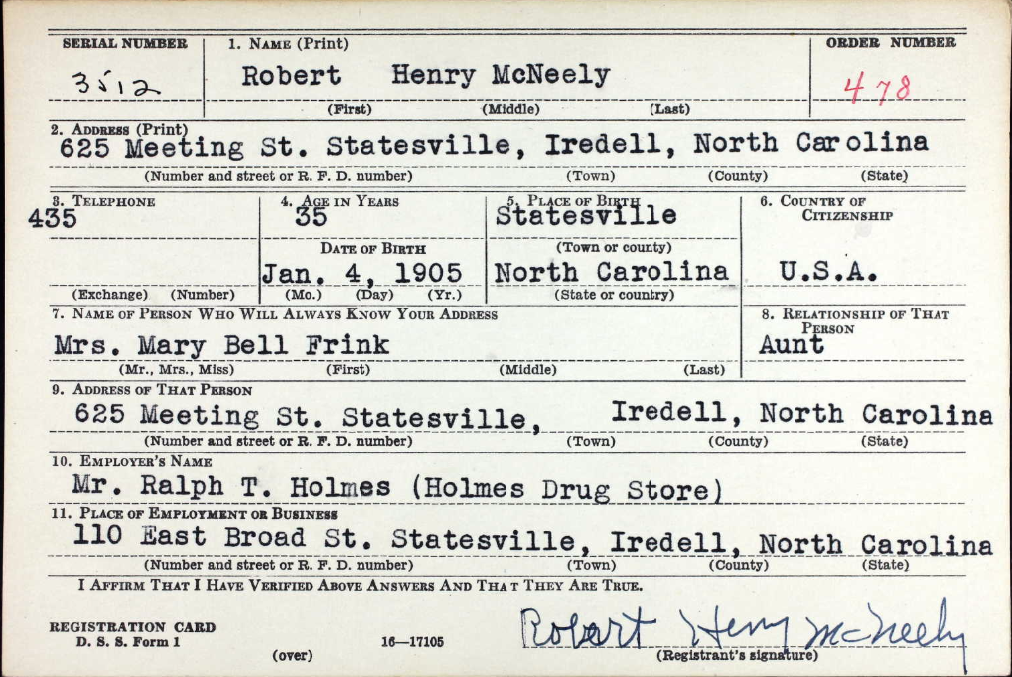
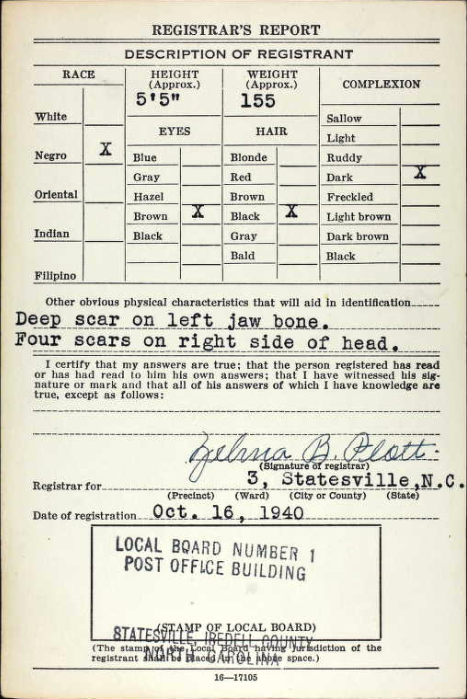
The scars on Robert Henry “Jinx” McNeely‘s head were external evidence of the skull fracture he received when his bicycle collided with an automobile in 1937. His aunt, Mary Bell Woods McNeely Frink, was his mother Margaret Woods McNeely’s sister, but she was also his stepmother, having married (and divorced) his father Luther McNeely after Margaret’s death. She is an interesting choice for “person who will always know your address,” as, as far as I know, Jinx’ wife Katie Woodsides McNeely was living at the time. Jinx started working as a drugstore porter, making customer deliveries and running errands on a bicycle, in his teens.
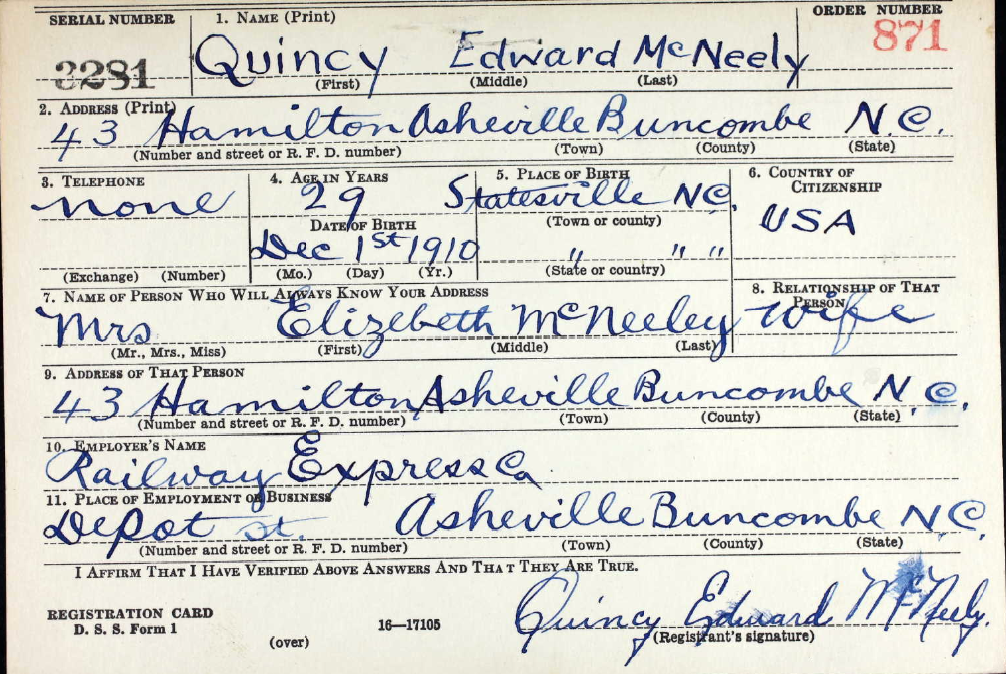

Though he was close to her age, my grandmother never knew her uncle Edward McNeely‘s son Quincy. Ed and his wife, Lucille Tomlin McNeely, divorced early, and by 1920 she and their son had moved 100 miles west to Asheville, North Carolina. Quincy married Addie Sims in 1930, then Elizabeth [last name unknown] by 1935. He does not appear to have fathered children, and he died in Detroit in 1966.


I’ve written of James “Red” McNeely alias Smith here. He was the cousin closest in age to my grandmother, but I heard her mention him only once. After their mother Addie McNeely Smith‘s death, aunt Minnie McNeely reared James and his older sister Ardeanur. He moved to High Point, perhaps in his early 20s, and may have been briefly married to a woman named Mildred. (They appear together in the 1930 census of High Point, but I haven’t found a license or anything else about her.) It did not last, and he had no children. Red was a pool room operator and died in 1960.
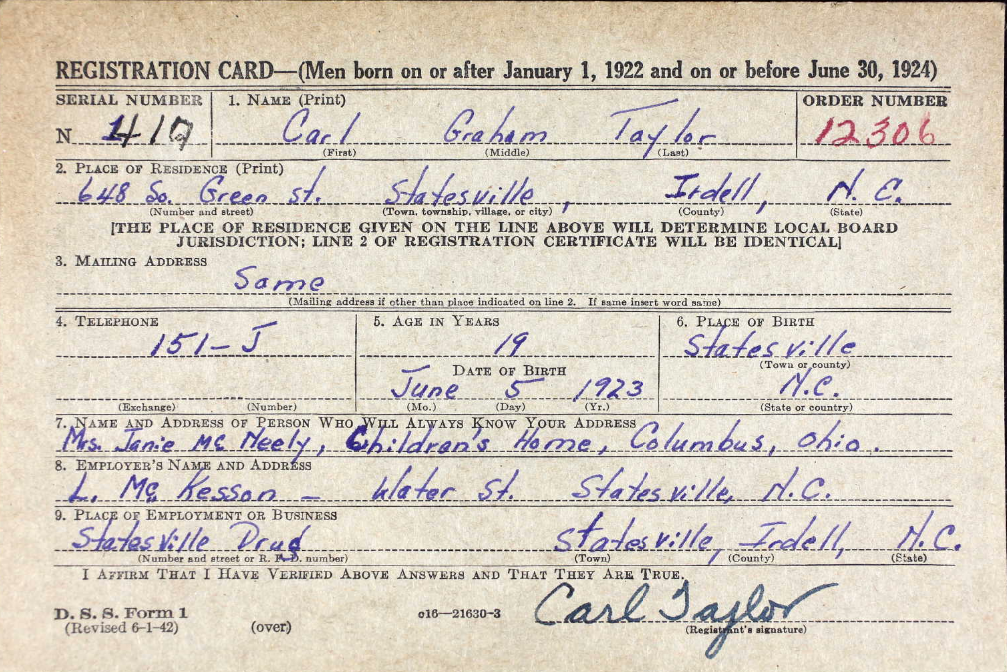

This really wrecks my notions about when the Columbus, Ohio, branch of my McNeely family really put down roots in that city. The card shows that in 1942, 19 year-old Carl Taylor was living in Statesville — in the household of his first cousin, Louise Colvert Renwick — but his mother Janie McNeely (not Taylor?) was living in Columbus and working at a Children’s Home. My inability to find Janie’s family in the 1940 census makes it difficult to pinpoint when she migrated north. In any case, she apparently moved back and forth between North Carolina and Ohio during the 1930s before settling permanently in Columbus, perhaps during the War.

My first question: why have I just found this 1940 census entry today?
My second: Cousin Ardeanur married a Jamaican????
Her age is way off — Ardeanur was 37, not 47 — but this is definitely my great-great-aunt Minnie McNeely, my grandmother’s first cousin Ardeanur Smith Hart, and Ardeanur’s mysterious husband Frank living right in Jersey City, the city next door to Bayonne (where Martha Miller McNeely and most of her children lived for greater or lesser stretches of time.) The address was 359 Pacific Avenue. A family of McKoys rented one apartment in the building, and the Harts, Aunt Minnie, and a William Macklin shared another, splitting the $30/month rent. Frank Hart, a naturalized citizen, worked as a butler in a private home and reported earning $500 in 1939. Ardeanur and Minnie were housekeepers in private homes earning $400 and $360 respectively. Macklin, an insurance agent, earned more than everybody else in the flat combined — $1700.
I still don’t know when Ardeanur married Frank Hart, but they reported that they’d been living at the same address five years before. This suggests they were married before 1935.
I don’t see Frank in earlier census records, but is this his arrival in the U.S. in 1922?

If so, did he leave his first wife back in Jamaica, or maybe Cuba?
This World War II draft registration card is definitely Ardeanur’s Frank:

The back of the card, dated 27 April 1942, described him as Negro, 5’8″ and 165 lbs., with a light brown complexion, brown eyes and black hair. It’s the last record I’ve found for Frank W. Hart.

359 Pacific Avenue, Jersey City, as seen from Google Street View. Per Zillow, the building was built in 1901.
Until my mother’s first cousins tested at 23andme, I had no way to distinguish her maternal and paternal matches. Though her thousand-plus hits are still mostly an anonymous mass, I have gained some small insights. Here are two examples:
Madame XX
I sent this woman a share request on 13 June 2012, just two months after I got my initial 23andme results. It’s been crickets ever since. She is either dead or does not give one damn about genealogy. And it kills me because she is estimated as my mother and uncle’s second cousin, sharing 280 cM, (3.76%) across 9 segments with her and 273 cM (3.67%) across 11 segments with him. This mystery woman also shares 2.16%, 7 segments, and 1.98 %, 6 segments, with my deceased aunt’s daughter and son. This is high. Per ISOGG, known second cousins share on average 3.125% and 212.5 cM.
Madame XX does not match either of my mother’s paternal first cousins, M.D. and J.A. Though it’s not an absolute certainty, it’s likely, then, that she is a match on my maternal grandmother’s side. (Without knowing who the Madame is, I can’t unequivocally declare her my mother’s second cousin, but I can say that the numbers are very low for half-first or first, once removed. However, see my Harrisons, where my mother shares 267 cM with her half-second cousin, for what’s possible.)
A second cousin is the child of one’s parents’ first cousins. My grandmother had relatively few full first cousins. In fact, she had exactly none on her father’s side. On her mother’s, there were lots of McNeely aunts and uncles, but relatively few children: Luther‘s son R. Henry McNeely (1903); Emma‘s children Wardenur (1913-1941), Henry (1915-1955), and Irving Houser Jr. (1920-2001); Addie‘s children Ardeanur (1903-1996) and James Smith (1906-1960); Elethea‘s sons William (1903-??), Charles (1904-1968), James (1906-bef. 1920?) and Irving McNeely (1911-1933); Edward‘s son Quincy McNeely (1910-1966); and Janie‘s children Sarah (1911-1937), Frances (1916-??), Willa (1918-) and William McNeely (1925-1965), and Carl Taylor (1923-1988).
We can eliminate all the aunts’ children off the bat. Madame XX’s maternal haplogroup is L0a1a2. My great-grandmother and her sisters were L2d1a and passed that mtDNA down to their children. As the haplogroups don’t match, the mystery lady is not a child of a McNeely daughter. That leaves the offspring of the McNeely sons. As far as I know, neither Henry McNeely, James Smith, William McNeely, Charles McNeely, James McNeely, Irving McNeely Weaver, nor Quincy McNeely had children. (Nor Wardenur Houser Jones, Ardeanur Smith Hart, Sarah McNeely Green, Frances McNeely Williams, and Willa McNeely Sims. Now that I write this out, it sounds crazy. How is it that so few of Henry and Martha McNeely‘s grandchildren had children?) That leaves Henry, Irving Houser, William McNeely or Carl Taylor as the parents of Madame XX. (Unless, of course, my grandmother had first cousins that she did not know of.)
As far as I know, Henry Houser had three sons, only one of whom is living. Irving Houser had one daughter, whom I need to contact independently. William McNeely had one son that I know of. Carl Taylor also had sons. Right now, then, Madame XX is either Irving’s daughter or the daughter of a completely unknown cousin.
L.W.
L.W., on the other hand, matches my mother, her brother and both their paternal first cousins, making him a solid bet for her father’s side. He’s considerably more distant than Madame XX, but a good match. At 23andme, he’s estimated at 3rd to 5th cousins (.44% shared across 3 segments) with my mother and uncle, and 3rd-6th cousin (.29% across 2 segments) to cousin M.D. Cousin J.A. does not show as L.W.’s match at 23andme, but does show a 13.4 cM match at Gedmatch.
L.W.’s mtDNA haplogroup is L3d1-5, and his Y is E1b1a. I can eliminate him then as a direct patrilineal descendant of my great-great-grandfather Edward C. Harrison or my great-great-grandmother Matilda Holmes. I don’t recognize any of the surnames he lists in his profile. And the states he lists — Kansas, Kentucky, Tennessee, Michigan, North Carolina — suggest that his ancestors moved out of Virginia (assuming that point of common origin) before Emancipation. Unfortunately, my knowledge of my own ancestors beyond the great-great-grandparent level on this side raises serious barriers to identification of our link to L.W. I know the names of the parents of Mary Brown Allen, born 1849 in Amelia County, Virginia, but little else. Jasper Holmes‘ parents were likely Peyton and Nancy Holmes, and they were probably from Charlotte County, as he was. I don’t even know his wife Matilda‘s maiden name though.
On 19 August 1868, Thomas Leahey, Assistant Sub Assistant Commissioner of the Bureau of Refugees, Freedmen & Abandoned Lands (better known as the Freedmen’s Bureau), took pen in hand:

Leahey’s brief letter suggests deep familiarity with Joseph R. Holmes, my great-great-grandfather Jasper Holmes‘ brother. He is telling Holmes that he has moved his office from Farmville to Charlotte Court House and wants Holmes to notify his “people” — the community he represented — where they can find Leahey. Leahey’s invitation to meet at any time implies previous visits, though to date I’ve found no evidence of them in Freedmen’s Bureau records. Leahey’s inquires “whether there is a School for colored Children at Keysville, and if there is not what are the prospects of getting up one.”
Just three days later, in a clear hand and with fairly sound grammar speaking to years of practiced literacy — though he was only three years out of slavery — Holmes replied. He advised that a small for-pay school operated in the Keysville area and expressed pleasure at Leahey’s interest in education. He apologized for not having been to see Leahey sooner — “I have been so busey” — and mentioned that he was headed to Richmond the following day. (Who was “Lut. Grayham” A lieutenant in the U.S. Army’s First Military District?) If “life last,” he promised, he would see Leahey on the next court day.

Apparently, Holmes and Leahey did meet, then and perhaps on other occasions. The next bit of correspondence found between them is dated 24 November 1868, when Leahey sent Holmes a voucher for school rent. Whether this is the private school Holmes referred to in his August letter or a school established by the Freedmen’s Bureau is not clear. Leahey asks that “Mrs. Jenkins” sign the rent voucher as well as triplicate leases for the school. (I haven’t found copies of either to date.)

Who was Mrs. Jenkins? Below is a short stretch of the 1870 census of Walton township, Charlotte County, Virginia. It shows part of Joseph Holmes’ former neighborhood, just west of the town of Keysville. “Former,” because Holmes had been shot dead on the steps of Charlotte Court House in May 1869, as detailed here. There are his children, Payton, Louisa and Joseph Holmes, living with the family of Wat and Nancy Carter, whom I believe to be Holmes’ mother and stepfather. Two households away is 30 year-old presumed widow Lucy Jenkins, white, “teaching school.” Jenkins, born in Virginia, was no Yankee schoolmarm; I’m searching for more about her. Her commitment to the little school at Keysville, even after Holmes’ assassination, evinces some mettle.

Records from “Virginia, Freedmen’s Bureau Field Office Records, 1865-1872,” database with images, www.familysearch.org, citing microfilm publication M1913, National Archives and Records Administration.
 Scuffalong: Genealogy.