

Journal and Guide (Norfolk, Va.), 30 April 1949.
——
In the 1930 census of Wilson, Wilson County: at 610 East Green Street, rented for $20/month, barber Roderick Taylor, 45; wife Mary, 39; and children Edna G., 8, Mary J., 4, and Roderick Jr., 1.
In the 1940 census of Wilson, Wilson County: at 607 East Green Street, barber Roderick Taylor, 58; wife Mary J., 50; and children Edna G., 18, Mary J., 14, and Roderick Jr., 12.
In the 1940 census of Wilson, Wilson County: at 1208 Atlantic, barber James Stokes, 45; wife Viola, 35; and children Frank, 18, tobacco factory laborer, Dorothy, 14, Thomas, 12, Annie M., 9, Jannie L., 7, Donnie, 5, and Carlton, 4.
In 1942, Frankin Roosevelt Stokes registered for the World War II draft in Wilson County. Per his registration card, he was born 21 November 1921 in Troupland [Treutlen] County, Georgia; resided at 1208 Atlanta [sic] Street; his mailing address was Carter Hall, Johnson C. Smith University, Charlotte; and his nearest relative was James Stokes, 1208 Atlanta Street.
On 9 June 1949, Frank Stokes, 26, of Wilson, son of James Stokes and Viola Reese Stokes, married Mary Joyce Taylor, 23, daughter of Roderick Taylor and Mary John Taylor, in Wilson. Presbyterian minister O.J. Hawkins performed the ceremony in the presence of Johnnie K. Boatwright, Sue Faucette, and Frances E. Williams.
In the 1950 census of Boulder, Boulder County, Colorado: at the University of Colorado, Franklin R. Stokes, 28, lodger.
In the 1955 Boulder, Colorado, city directory: Stokes Franklin R (Joyce M) lab Maaco Puget Sound h 1906 Pearl
Mary Joyce Taylor Stokes Crisp died 26 September 2006 in Mount Clemens, Michigan.




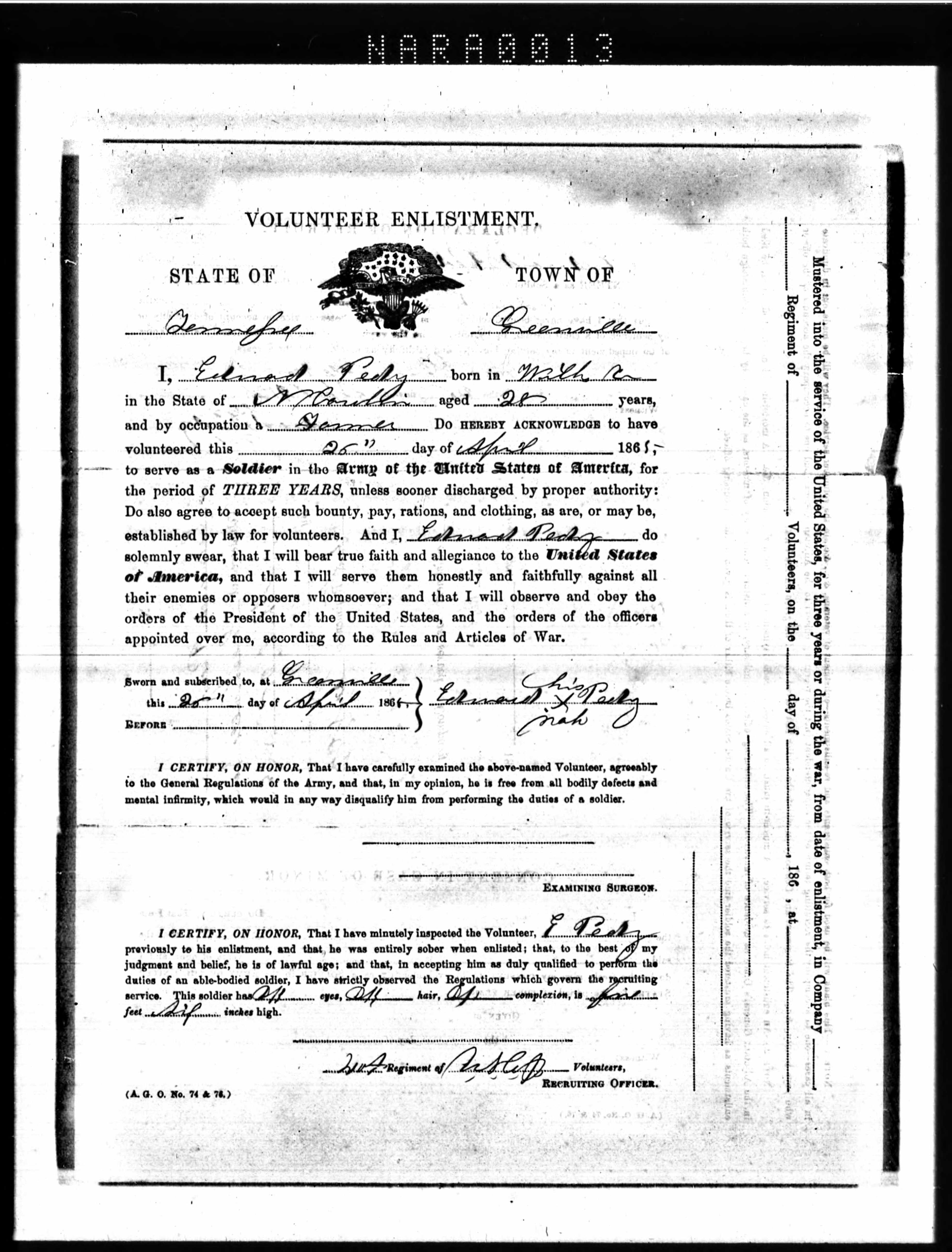
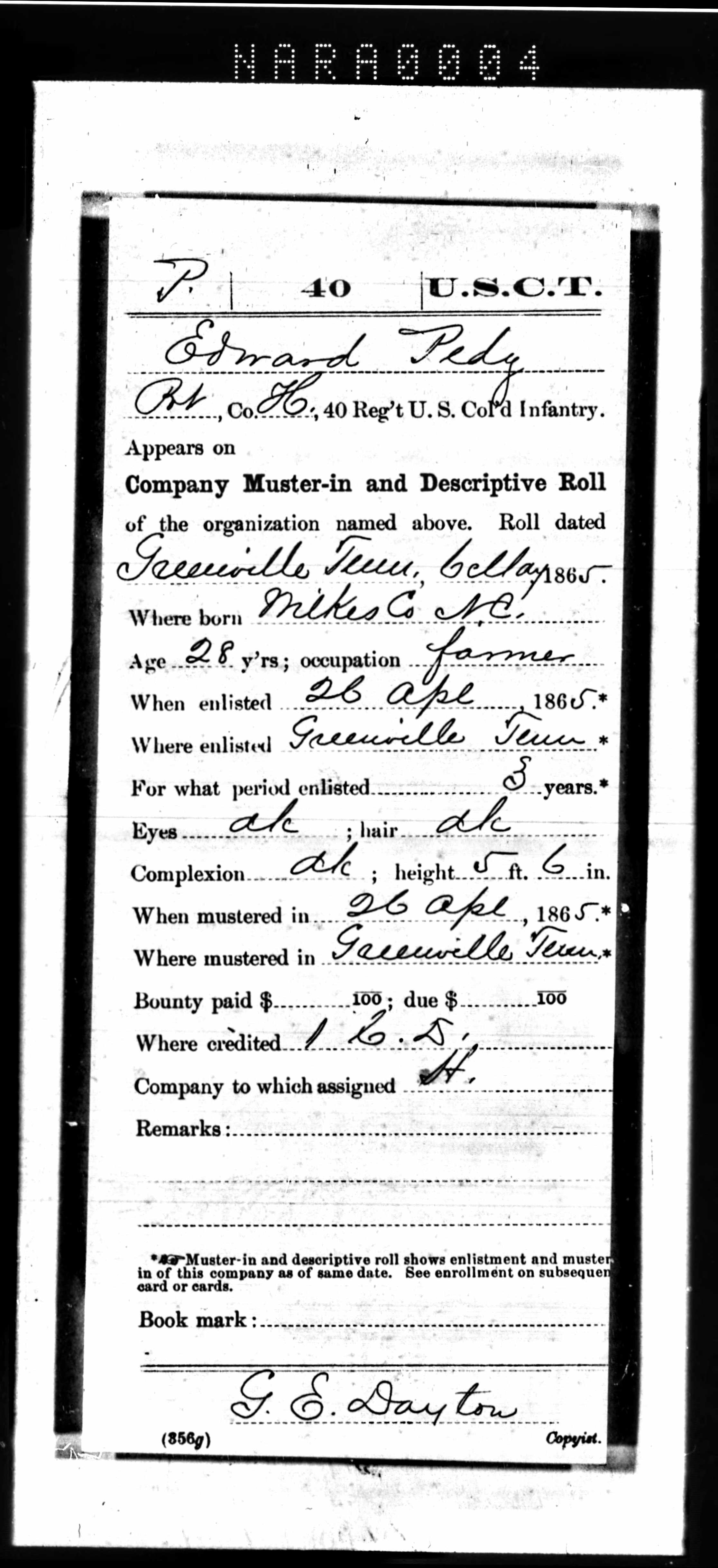 After mustering out in February 1866 at Chattanooga, Edmond Petty returned to Wilkes County, married and reared a family. In poor health and finally straitened, in 1883, Petty applied to the United States government for an invalid’s pension. He claimed disability as a result of suffering a sunstroke while drilling with his regiment.
 Petty’s disability affidavit provides rich details of his life. Prior to enlistment in the Army, he had lived “with B.F. Petty to whom I belonged in Wilkes County, State of North Carolina. I was there a slave.” (Benjamin F. Petty, who reported owning 23 enslaved persons in 1850, was one of the largest slaveholders in Wilkes County.) Since the war, he had lived in the Fishing Creek area of Wilkes County and had worked as a farmer when he was able. Petty claimed that his diminished eyesight and rheumatism were the result of sunstroke suffered while on duty at Greeneville and that, because of his condition, he was barely able to work.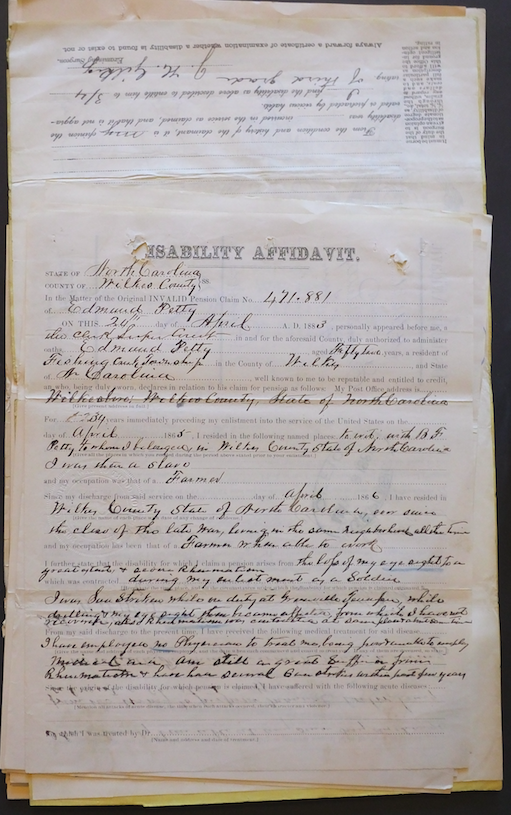
 Edmond Petty’s file comprises 84 pages of testimony by his fellow veterans, neighbors and doctors about Petty’s medical condition and its causes, as well as his ability to support himself. Said H.M. Wilder, for example, “I found him hauling wood in a small one horse wagon to the town of Statesville earning a meagre living.” In the end, he was awarded eight dollars a month for three-quarters disability due to rheumatism and one-quarter to heart trouble.The Record & Landmark published a sarcastic piece about Petty’s appeal of his initial pension award in an article that was reprinted across North Carolina’s Piedmont. The piece insinuates that Petty had done nothing to warrant his stipend, but more importantly reveals that Petty was the agent of his own emancipation. When

 Scuffalong: Genealogy.
