Births Deaths Marriages, Maternal Kin, Newspaper Articles, North Carolina, Oral History, Photographs

Remembering Grandma Carrie.

McNEELY -- Carrie M Colvert with corsage

Me: In her pictures she always looked stern.

My mother: Grandma? 

Me: Carrie.

Ma: Grandma Carrie?  I know it.  But she was funny.  She was funny to me.  She could say some of the, she could say some funny stuff.  I know that’s where Mama gets it from.  The little sayings. 

Image

Statesville Landmark, 20 December 1957.

My grandmother didn’t think much of Charles V. Taylor:

Course she met this guy and married him that she had known him when she was a child.  Taylor.  And went to New Jersey.  She came back home, and Mama had high blood pressure, you know.  But she kept, her doctors kept it in check.  But he hadn’t let her go to the doctor for two times, and she had a stroke and died.  Oooo.  I could have killed that man.  I was so mad with that man I didn’t know what to do.  And when we went down there, Mama just got worse and worse.  She went to the hospital, and they did everything they could at the hospital, and then they let her come home.  And I went down there to see her one time, while she was at home, you know, and she couldn’t talk.  She couldn’t talk, I mean.  And she would try her best to tell me something.  And I just cried and cried and cried and cried and cried. And I didn’t know what she was trying to tell me.  So my sister lived not far from her.  And she was a cafeteria manager, but she would come to see Mama between the meals.  You know, in the morning breakfast and lunch, and then after dinner she’d come.  She really did take care of Mama when she was living with that Thing.  And she went to the hospital and stayed awhile, and he wouldn’t pay the hospital bill.  And I took a note out at the bank, and Louise paid her doctor’s bill and everything, and when she died, he tried to make us pay all the burial expenses.  And his brother came over there and told us, said, “Don’t you pay a penny.  ‘Cause he’s got money, and he’s supposed to use it for that.”  And said, “Don’t you do it.  Don’t you give it to him.”  And that man and the undertaker got together and planned all that stuff against us, you know.  The three of us.  It was terrible.  And Mama had a lot of beautiful clothes, you know, because this man bought her things.  And they were all in there looking at them.  I said, “I don’t want a thing.  I don’t want not one thing.”  I think I got a coat.  It was just like a spring coat.  It was lined.  And I think Louise insisted that I take it, but that was the only thing that I took.

——

McNEELY -- Carrie Colvert thoughtful

Remembering Caroline Martha Mary Fisher Valentine McNeely Colvert Taylor, who died 56 years ago today.

——

Interviews of my mother and Margaret C. Allen by Lisa Y. Henderson; all rights reserved.

Standard
Births Deaths Marriages, Maternal Kin, Newspaper Articles, North Carolina, Oral History, Photographs, Vocation

Lon Colvert: straight and shady.

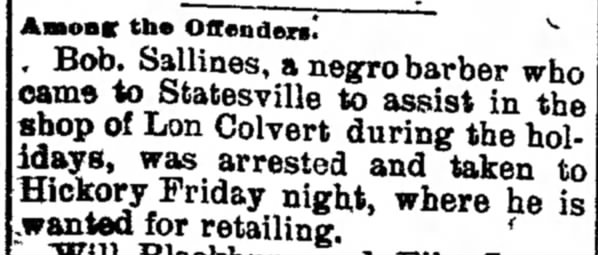
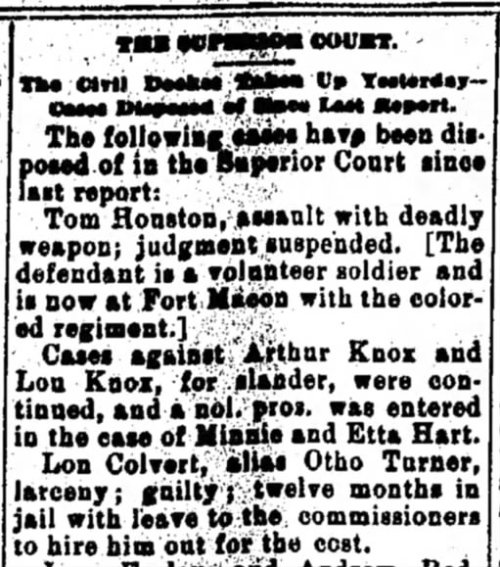
If reports are to be believed, Lon Colvert had a bit of a shaky start. “Otho Turner”?
Image

Statesville Landmark, 18 August 1898.
Carolina_Mascot_Sville_2_8_1900

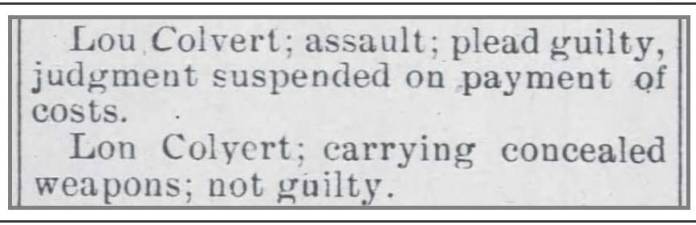
Statesville Carolina Mascot, 8 February 1900.

Lou Colvert was Lon’s uncle. No details on Lon packing. But he switched gears a bit.  To retailing, which specifically meant selling liquor — unauthorized.

Iredell County Superior Court —

Lon Colvert, retailing; guilty.  

— Statesville Landmark, 5 Nov 1901.

Another poor outcome.

“Cases Disposed of Since Monday — Some Recruits for the Chain Gang — A City Ordinance Held Invalid”

The following cases have been disposed of in the Superior Court since Monday:    …

Lon Colvert, convicted of retailing, was discharged on payment of the costs. 

— Statesville Landmark, 8 Nov 1901.

But somewhere along in here, he began to right his ship.

Notices of New Advertisements.

L.W. Colvert has moved his barber shop from Depot Hill to 109 east Broad street.

— Statesville Landmark, 23 Aug 1904.

It’s not clear when Lon first opened his barber shop, or how he got into the business, but it was a good move. Depot Hill was a few blocks south of downtown; the 100 block of East Broad was right at the heart of the business district. He had arrived.

Still, there were setbacks. (I read “liquor” in this “little pilgrimage,” but I could be wrong.)

“Played His Bondsman False and Will Spend his Holidays in Jail.”

Thursday afternoon a colored barber, Lon Colvert by name, braced Mr. J.P. Cathey for a horse and buggy with which to make a little pilgrimage that night, and Mr. Cathey refused.  Lon was just obliged to make that little run, so later he stated the case to Jo. Thomas.  Jo. is the colored individual who worked for Mr. Cathey then and who is now being boarded by the county.  Jo. slipped out with a horse and buggy.  Lon made his trip, came back, paid Jo. one plank, which he shoved down in his jeans, and then Jo. slept the sleep of the consciousless offender.

But the snow that fell during the interval between the exit and return of that buggy caused Jo’s little house of cards to tumble.  Next morning Mr. Cathey saw the tracks, asked Jo. who had got a buggy the night before, and Jo straightaway told the thing that was not.  So Mr. Cathey got off of Jo’s bond, which he had signed not long since, and now Jo. is behind bars.

— Statesville Landmark, 20 Dec 1904.

He pressed on.

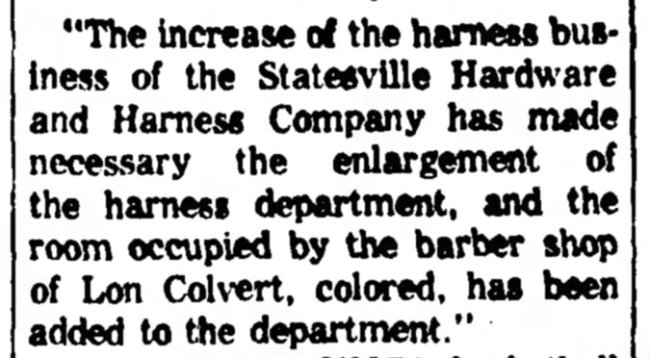
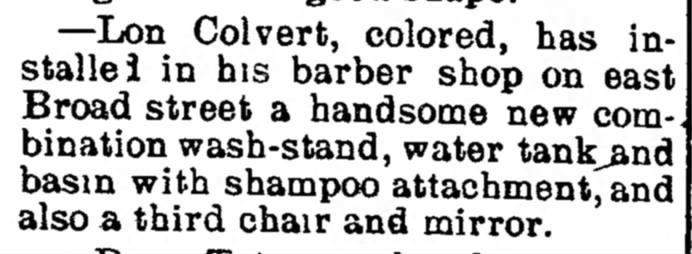
Lon Colvert, colored, has recently equipped his barber shop on east Broad street with a handsome two-chair dressing case and has made other improvements in the shop.

— Statesville Landmark, 1 Jan 1907.

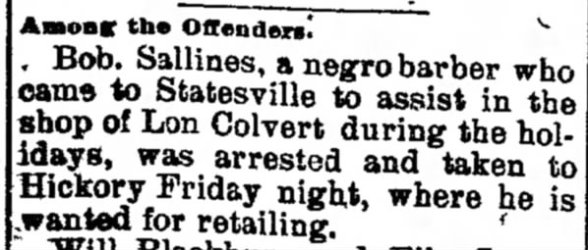
Occasionally, his friends let him down.
Image

Statesville Landmark, 1 January 1907.

But he had a new wife and a new baby to add to his first three, and the straight and narrow was starting to win.
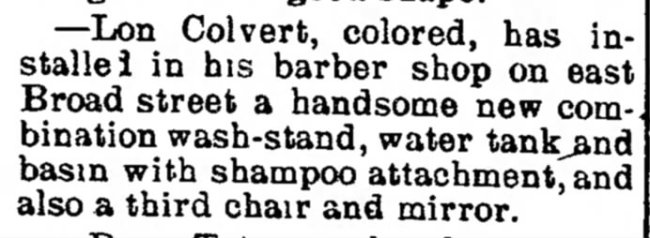
Image

Statesville Landmark, 7 May 1907.

Image

Statesville Landmark, 7 January 1910.

A momentary setback, no more. Lon moved his business back down Center Street toward the train depot and entered the golden age of his entrepreneurship, the period of my grandmother’s childhood.

Papa had a barber shop.  Well, of course, Papa did white customers. And, see, the trains came through Statesville going west to Kentucky and Tennessee and Asheville and all through there.  They came through, and they had, they would stop in Statesville to coal up and water up, you know.  There were people there to fill up that thing in the back where the coal was.  And there was another — it had great, big round things that they’d put in water.  And when those trains would stop for refueling, they would, there were a couple of men who would come. I can see Walker and my uncle and Papa standing, waiting for these men who were on the train to give them a shave and get back on the train in time.  And there wasn’t any need of anybody else coming in at that time ‘cause they couldn’t be waited on.  They were waiting for these conductors and maybe mailmen, but I know there would be at least three at a time.  And Papa would shave them.  And he made a lot of money.

Papa had a taxi, too. Walker drove it most of the time.  And then he would hire somebody to drive it other times.  And then when people had to go to Wilkesboro, Papa would take them.  Because Wilkesboro was a town north of Statesville. And there was no transportation out there.  No buses, no trains, or anything.  So when people would come on the train that were, what they call them, drummers, the salesmen, when they would come through, Papa would carry them up there. 

And he had this clean-and-press in the back of the barbershop. And, look, had on the window, on the store, ‘Press Your Clothes While You Wait.’  I can see those letters on there right now.  ‘Press Your Clothes While You Wait.’  And people would go in there, get their clothes pressed, you know.  And I know ‘barber shop’ was on the door….  ‘L.W. Colvert Barber Shop.’  ‘L.W.’ was on the side of this door, and ‘Colvert’ was on this side of the door.  They had a double door.

There were, of course, risks to doing business. Though I’m casting a side-eye at the carnie. (“H.G.” was Lon’s 21 year-old half-brother Golar, and I never knew he was a partner in the business.)

Damages for Scorching Suit — Court Cases.

Lon Colvert and H.G. Tomlin, doing a pressing club business under the name of Colvert & Tomlin, were before Justice Sloan Saturday in a case in which Chas. Moore, white, a member of the carnival, was asking $18 damage for them.  They pressed a suit for Moore and it was scorched, for which Moore asked damage.  The case was finally compromised by Colvert & Tomlin paying Moore $5 and $1.20 cost. 

— Statesville Landmark, 27 March 1917.

And there was the little matter of a charge of carrying a concealed weapon in 1919; a jury returned a not guilty verdict.  Still, a burglary at the shop was an omen. The good years were coming to an end. Lon was struck with encephalitis in the 1920s and was largely unable to work in his final years.
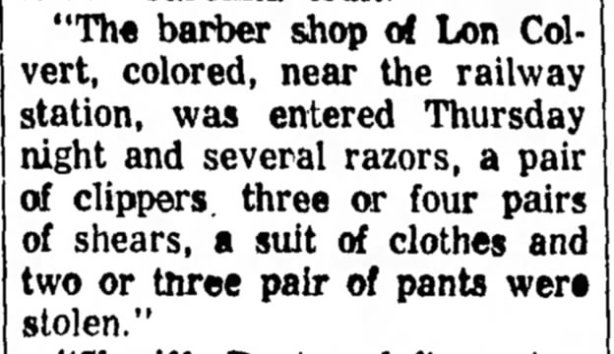
Image

Statesville Landmark, 25 September 1925.

By this time, Golda had embarked upon a peripatetic life in the Ohio Valley, and  Walker was left to keep his father’s businesses running.  He exercised his best judgment.

Walker Colvert, driver of the Wilkesboro jitney Steve Herman, driver of the Charlotte jitney, and Henry Metlock, driver of the Taylorsville jitney were charged with delivering passengers to the depot rather than the jitney station.  It appearing that all the violations were emergency calls, the defendants were discharged.

Statesville Landmark, 1 Mar 1926.

Lon Colvert died 23 October 1930.  “He was an old resident of Statesville,” his obituary noted, “and for a number of years had a barbershop on South Center street, near the Southern station.”
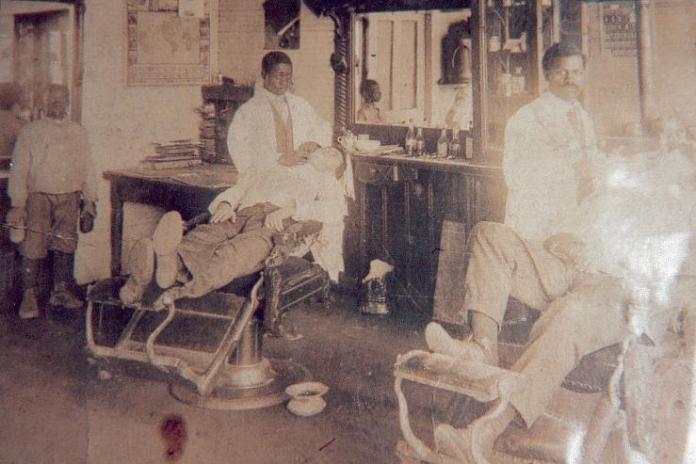
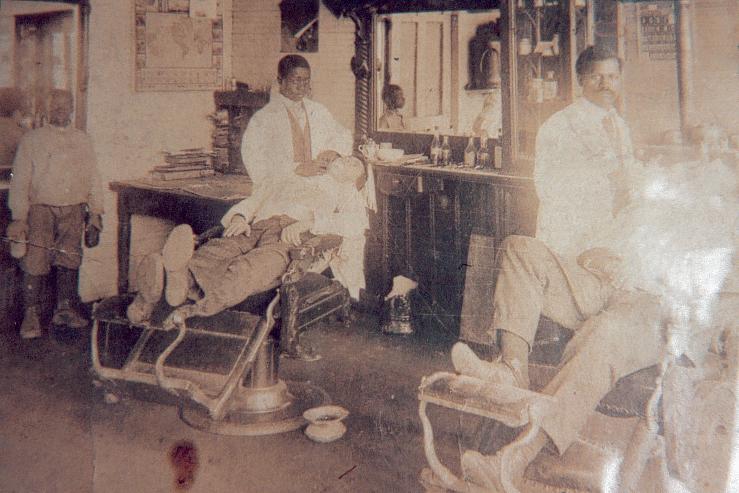
COLVERT -- Barbershop 2 The barbershop, 1918, when it was at 101 South Center Street. Walker Colvert, center, and L.W. Colvert, right.

——

Interview of Margaret C. Allen by Lisa Y. Henderson; all rights reserved. Copy of photograph in possession of Lisa Y. Henderson.

Standard
Maternal Kin, Newspaper Articles, North Carolina

Nicholson reunion.

These were Harriet Nicholson Hart‘s people, though I can guarantee you she was not there:

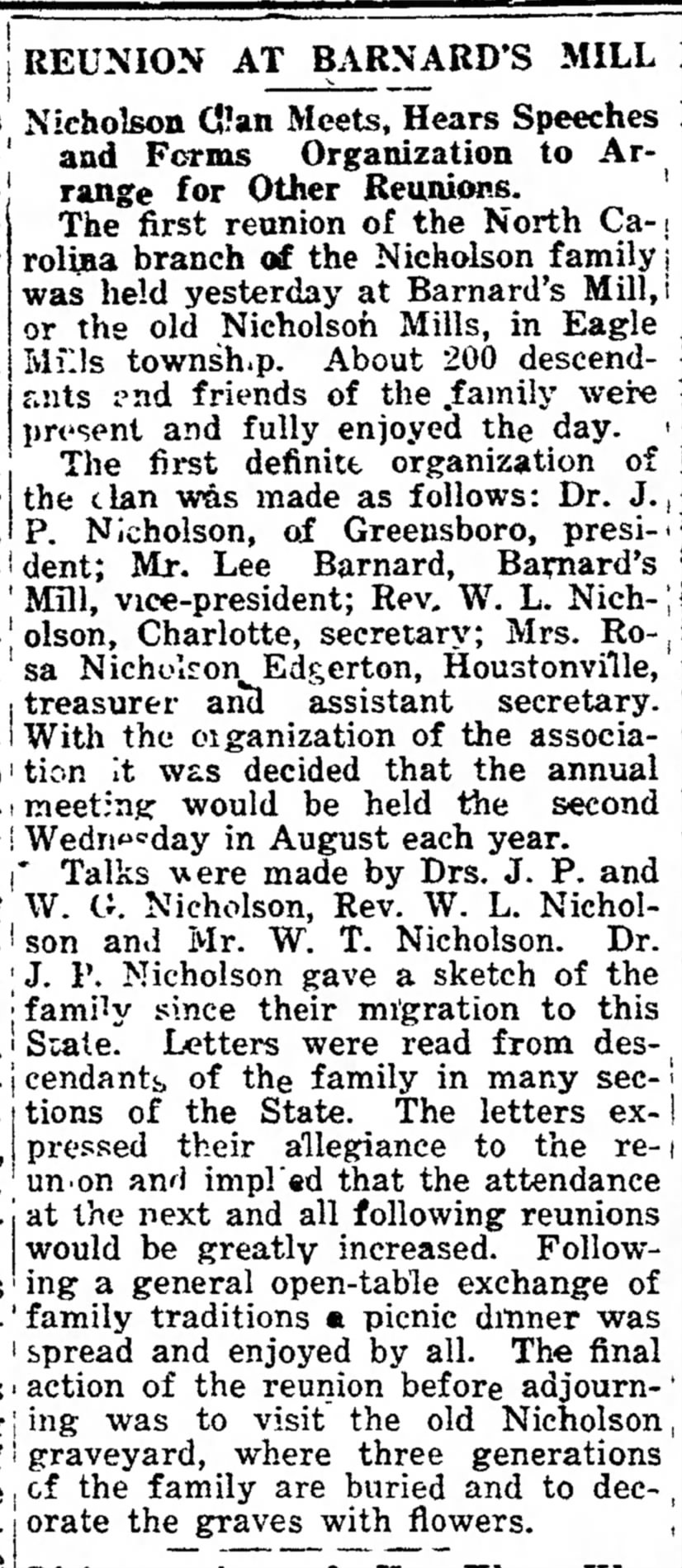
Nich Reunion 1 8 17 22

nich reunion 2 8 17 22

Statesville Landmark, 17 August 1922.

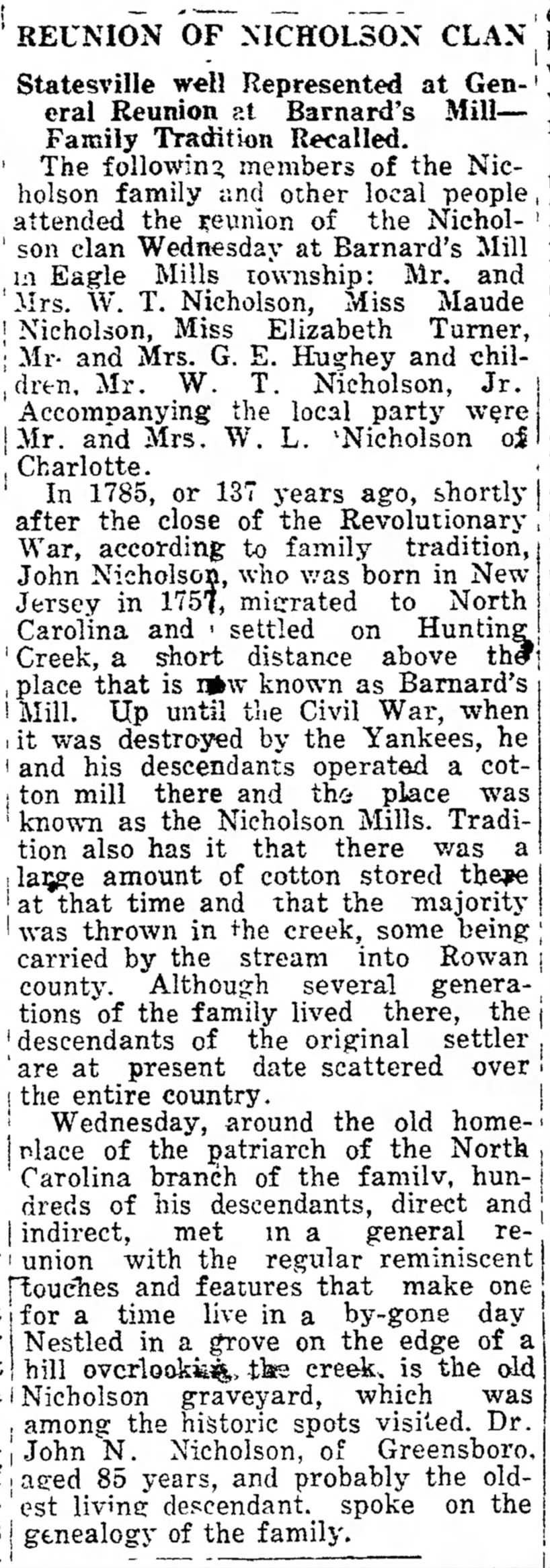
Nich Reunion 8 9 1923

Statesville Landmark, 9 August 1923.

Nich Reunion 8 12 1926

Statesville Landmark, 12 August 1926.

The North Carolina branch of the Nicholson Family descended from Revolutionary War veteran John Stockton Nicholson, born 1757 in Princeton, New Jersey, and his wives, Mary McComb Nicholson (1760- 1783) and Catherine Anne “Caty” Stevenson Nicholson (1766-1843).  The Nicholsons and Stevensons arrived in America from England in the mid-17th century.  The McCombs were perhaps Irish.  John and Mary had one child, James Nicholson (1783-1850). John and Caty had a passel: John Stockton Nicholson Jr. (1787-1868), Mary Nicholson Walker (1788-??), Elizabeth Nicholson Beeson (1790-??), Rebecca Nicholson Clampett (1793-1880), George Nicholson (1796-1802), Moses Pinckney Nicholson (1799-1844), Anderson Nicholson (1801-1879), Catherine Nicholson Clampitt (1804-1841), Phoebe Nicholson Barron (1806-1882), and Hannah Nicholson Idol (1811-1877).

Harriet was descended from both of John S. Nicholson’s wives. Mary’s son James married Mary Allison (1792-1857), daughter of Theophilus and Elizabeth Knox Allison, in 1815. They had two children, Thomas Allison Nicholson (1816-1886) and John McComb Nicholson (1820-??). Thomas married his first cousin, Rebecca Clampett Nicholson (1817-1903), daughter of Caty’s son John S. Nicholson Jr. and Mary Fultz.  Thomas and Rebecca’s children were: James Lee Nicholson (1841-1871), John Wesley Nicholson (1843-1913), Mary Jane Nicholson Smith (1846-1922), George Watson Nicholson (1848-1913) and Rebecca Ann (or Annie Rebecca) Nicholson Barnard (1860-1925). As detailed here, J. Lee Nicholson was Harriet’s father.

Nearly all of the reunion attendees mentioned by namein these articles were descended from Thomas A. Nicholson’s children Lee, George and Annie. Rev. W.L. and W.T. Nicholson, for example, were Lee’s sons, and the Barnards were Annie’s children and grandchildren. Dr. J.P. Nicholson, however, was Rebecca C. Nicholson Nicholson’s brother and Dr. W.G. Nicholson, her nephew. I’m not sure who the octogenarian John N. Nicholson was.

Standard
Births Deaths Marriages, Education, Migration, Military, Newspaper Articles, Other Documents, Paternal Kin, Photographs

Col. Oscar Randall.

There were surely many more veterans than that, I thought, and I started poking around my files, looking for men and women I might have missed. Oscar Randall was a possible World War I veteran, but his draft card cast doubt — he claimed a service exemption on the basis that he was “rejected by recruiting officer.”

Image

Nonetheless, I Googled Randall and was stunned to find that not only did he serve, he led troops in battle in France during World War I, received a Purple Heart for wounds sustained in Italy during the Second World War, and achieved the rank of colonel. The most amazing find: two photos of Randall from the Chicago Sun-Times archives for sale on eBay!  I ordered them immediately, and they arrived in yesterday’s mail.

The first photo, taken after the First World War, depicts a smooth-faced, heavy-jowled man in officer’s uniform. Its reverse carries a scrap of newspaper article, as well as a note that the photo was copied from a portrait hanging in Randall’s living room.

O Randall 1921

The second photo, taken in 1982, shows a solemn-faced old man, silver hair swept back from his forehead, his eyes rheumy but mouth set firmly. Light from a window creates a dramatic chiaroscuro. On the back: a slightly longer clipping from the same article, detailing the colonel’s military achievements.

O Randall 1982

Back O Randall 1982

Oscar Randall was born 30 November 1896 in Washington DC, the first of George and Fannie Aldridge Randall‘s children born after their migration from Wayne County, North Carolina. After the War, he returned to college and received a Bachelor of Science in Civil Engineering from the University of Illinois. (He served as president of Tau chapter, Alpha Phi Alpha Fraternity, while there.) Randall taught mathematics at Chicago’s DuSable High School for many years and also worked as a civil engineer for the city’s sanitation department. In the 1950’s, he served as Chief of the U.S. Military Mission to Liberia, which advised that country’s military on training and defense. He married twice, but had no children.

Oscar Randall died three years after his Chicago Sun-Times interview. He was 88 years old.

A memorial service for Oscar Randall, 88, a civil engineer, will be held at 11 a.m. June 9 in St. Thomas Episcopal Church, 3301 S. Wabash Ave. Mr. Randall, of the South Side, died April 8 in Veterans Administration Lakeside Medical Center. A native of Washington, D.C., Mr. Randall graduated from the University of Illinois and worked for the Chicago Sanitary District for nine years. Mr. Randall also taught mathematics at Du Sable High School. In 1918 he joined the 8th Illinois infantry regiment, one of the nation’s first black-led military units. He also served in World War II. Survivors include his wife, Hilda; a stepdaughter, Vera Levy; two stepgrandchildren; two stepgreat-grandchildren; three sisters; and a brother.  

— Chicago Tribune, 23 May 1985.

——

[Sidenote: Pete Souza, who photographed Cousin Oscar, is now Chief Official White House photographer for President Barack Obama and Director of the White House Photography Office.]

Standard
Births Deaths Marriages, Maternal Kin, Newspaper Articles, North Carolina, Oral History, Vocation

Bill Bailey’s life and times.

My grandmother did not mince words when it came to her aunt’s husband. William James “Bill Bailey” Murdock was “trashy.” “We couldn’t stand him,” she said. “He did everything illegal and got away with it.” I laughed, and thought, “Oh, Grandma. Really?”

Well, yes.

Consider this:

bill bailey youth 7 14 03 Statesville Landmark, 14 July 1903.

He was born William Bailey in Iredell County, the son of Lela Bailey, black, and John T. Murdock, white, both teenagers. His stepfather was Floyd Murdock, and he eventually adopted the surname, but he was known as “Bill Bailey” all his infamous life. His mother was a cook, and it is likely that he gained his culinary skills at her side. In 1920, he lived on Washington Street in Statesville’s Rabbit Town section with Lela and his first wife Hattie, biding his time as a flour mill laborer.

Two years later, Bill and his roadhouse merited their first in a long line of write-ups in the local newspaper:

11 27 1922 Roadhouse

Statesville Landmark, 27 November 1922.

Three months later, in March 1923, Ethel Wallace was arrested for shooting her husband — and the husband of her husband’s girlfriend — at Bill Bailey’s Emporium. Before this matter was even tried, Bill himself was arraigned on a charge of assault with a deadly weapon against Howard Houston. It didn’t stick. In February 1924, however, Bill plead guilty to bootlegging, was fined $50 and given two years’ probation. In January 1926, he was arrested for bootlegging again.

In December 1927, Bill was acquitted of assault with a deadly weapon in the shooting of “a colored girl” named Veola Knox and of transporting and possessing liquor, but fined $50 for assaulting Jim Moore. Two years later, on the day after Christmas, someone “severely carved up” Alfred Hough, slashed his jugular, outside Bill Bailey’s.

In July 1931, Bill was charged with manufacturing and possessing “home brew” — a barrel and 18 cases worth — on his premises just beyond the southern Statesville city limits. In November 1932, Crawford Scott was shot in the shoulder just passing by the place.  In 1934, three men were arrested for liquor possession at Bill Bailey’s, and 1936 brought this:

10 1 36 Liquor

Statesville Landmark, 1 October 1936. 

Nothing stuck.  As the Depression wound down and the War picked up, Bill Bailey’s reputation shifted from gutbucket to speakeasy to wholesome purveyor of steaks and libations to Statesville’s white middle class. Shootings and cuttings disappeared from the pages of the Landmark to be replaced by jovial accounts of “delightful fried chicken suppers” at Bill’s “popular resort,” enjoyed by society ladies, sportsmen, company men, and civic boosters alike.

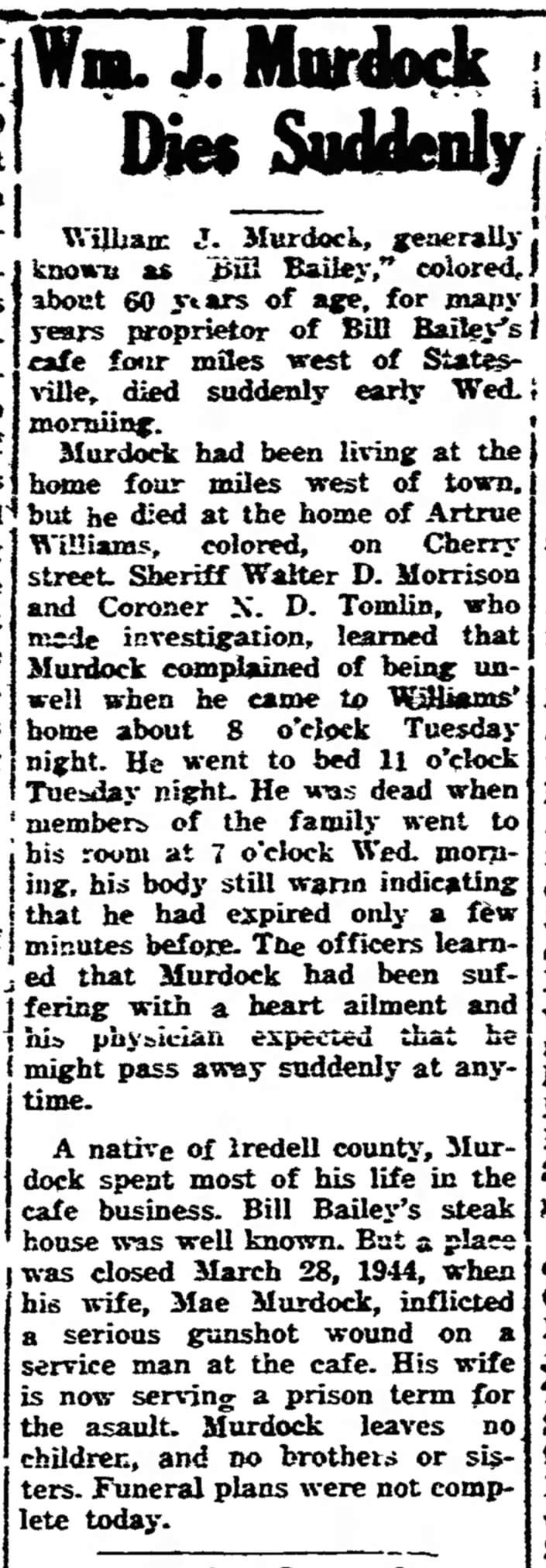
The bonhomie slammed to a halt on the night of March 28, 1944, when Bertha Hart “Aunt Bert” Murdock shot James Warren, a white serviceman out to celebrate leave with a juicy steak.  My mother’s cousin N. asserts that Bill and Bert thought that their clientele, not to mention his father’s relatives — who’d kept Bill out of prison during Prohibition and rewarded his good cooking with steady patronage — would stand by them. It did not happen.  The place shut down, and just over a year after wife’s conviction, Bill Bailey was dead.

Murdock died 12 6 1945 LandmarkStatesville Landmark, 6 December 1945.

Standard
Births Deaths Marriages, Migration, Newspaper Articles, North Carolina, Oral History, Paternal Kin, Virginia

We got strayed apart.

I was thinking about Cousin Tilithia when I was a little girl.  She had a restaurant large enough to work in and serve patrons.  It wasn’t real big, but they were serving patrons, and Mama carried me up there, and we spent the night there.  And whenever she’d come to Wilson she’d stay with us.  

Tilithia Godbold, she lived in Norfolk, and she married this man.  That wasn’t her children’s daddy.  King was her children’s daddy.  Godbold was the man she married later. He lived over in Rocky Mount, and he worked in the roundhouse or something.  I think he fixed the train, but he wasn’t the one on the train.  And Godbold, Tilithia’s husband, he stayed there in Rocky Mount.  ‘Cause Tilithia lived in Norfolk.  Her and her five or six girls or whatever it was, and she was running what they call the Strand Café.  And it was down on the first floor, and they lived up over it.  Go out there, and it was a sleeping compartment.  I was over there one time, and I remember it.  I think I was about seven or eight years old.  Went with Mama over there.  We was just running all over the place.  She had us waiting tables.  I wanted to wait tables. I was wondering, I asked Mama, “Well, why come we couldn’t have a place like that?”  And all that food!  Look like whatever the food was – I didn’t even know what it was ‘cause we ain’t never had none.  It was a whole lot of stuff, look like they had, I didn’t want it, but then I know it looked good, and we ate down there in the café.  

And another time Mama took me over there on the train to see her.  And it was right down in South Philadelphia where we went to their house.  Where they was staying.  And when I moved up here, her sister, she was telling me ‘bout how the children were there in Norfolk, her sister and all them.  I said, well, I could remember some of them, but I don’t remember what –  and I asked where some of the girls was.  Some of them in Norfolk and some of ‘em, one’s dead.  [Inaudible] the family.  We got strayed apart. 

——
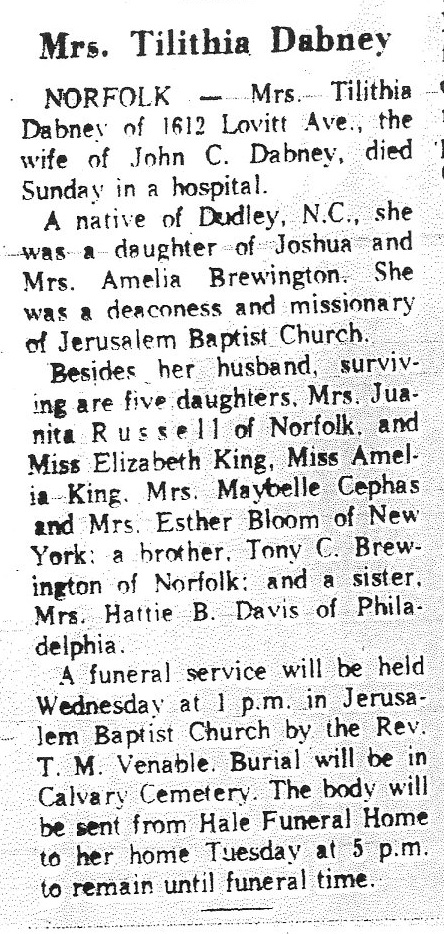
My grandmother reminisced fondly of “Ta-LIE-a-thy” and her cafe, but was not entirely sure how they were related. Not long into my research, I discovered that Tilithia Brewington King Godbold Dabney was born 1878 to Joshua and Amelia Aldridge Brewington. She was, then, the first cousin of my grandmother’s father, J. Thomas Aldridge. Tilithia married Emanuel King in 1898 and, by 1910, the couple and their daughters Juanita, Elizabeth, Amelia, May Bell and Tilithia had settled in Norfolk, Virginia. Tilithia and Emanuel divorced and, by 1920, she was married to railroad fireman Walter Godbold and running her cafe. Her marriage to Godbold did not last, and the 1930 census found him back in Rocky Mount NC (described as divorced) and her still in Norfolk, holding herself out to be a widow while maintaining the little restaurant at 426 Brambleton Avenue.
This was about all I could locate on Cousin Tilithia until 2009, when I met — genealogically speaking — B.J., a descendant of Tilithia’s sister Mattie Brewington Braswell (and my fourth cousin.)  Ours has been a most fecund collaboration, and it was she who discovered Tilithia’s obit and what had become of her daughters. My grandmother would have pleased to know that the branches of our family had found their way back from being “strayed apart.”

Image Virginian Pilot, 22 November 1965.

Interview of Hattie H. Ricks by Lisa Y. Henderson; all rights reserved.

Standard
Births Deaths Marriages, Maternal Kin, Newspaper Articles, Photographs, Virginia

Marion Allen Lomans.

She was the aunt for whom my aunt was named. She was a teacher. She married late and had no children. And she died when my mother was small. That was about all I knew about my grandfather’s oldest sister, Marion Ellen Allen Lomans.

My uncle let me copy a scarred and badly tinted photo:

Marion Lomans

She looked like an Allen sister, but I was no less mystified. (Frankly, other than Aunt Julia, they were all a bit mysterious — how did I never meet Aunt Edith?  Or Aunt Nita until I was an adult? Or even Uncle Buster, who lived right in Newport News?)

And then M., my mother’s first cousin, sent this picture, which charmed me to no end — Aunt Marion and her students at John Marshall School:

Marion Allen & class

And then I found her obituary:

MA_Lomans_Obit_Daily_Press_15_Apr_1942

Virginian Pilot, 15 November 1942.

And so I learned a few more things: that, despite her marriage to Mr. Lomans, a World War I veteran whom she had married “recently” and whose Christian names were actually Gillespie Garland, she was still living at home at the time of her death. That she was a member of the United Order of Tents (a secretive charitable organization founded by black women in the mid-19th century) and the Good Samaritans (another?). That she taught for only six years. That Aunt Tee — that’s Edith — was unmarried and living in New York City when Marion died.  That Marion died at Whittaker Memorial Hospital, an institution that her father served as a board member.  That she was buried from Zion Baptist,  the church that nurtured her father. Still, who was she?

Standard
Births Deaths Marriages, Maternal Kin, Migration, Newspaper Articles, North Carolina, Photographs

Sarah McNeely Green.

Image

There were three uncles, and some male cousins, but the McNeelys were basically a family of women.  My grandmother was the middle daughter of her mother’s three and grew up among six aunts who had many girls.

Janie McNeely, called “Dot,” was the youngest of Henry and Martha McNeely’s daughters.  Born in 1894, she worked as a laundress and reared her children in Statesville’s Rabbit Town section before migrating to Columbus, Ohio, in the 1940s.  Janie’s oldest child was Sarah Mae McNeely, born in 1911. She was followed by Frances V. McNeely (1913), Willa Louise McNeely (1918), Carl Graham Taylor (1923) and William Maurice McNeely (1925).

Sarah worked with her mother and sister at Statesville Laundry in the early 1930s. Soon after, she joined her grandmother, uncle John, aunt Emma and cousins in Bayonne, New Jersey, where she married a Mr. Green. (No one, including her obituary writer, seems to know his first name.)

Image

Statesville Landmark, 3 May 1937.

A few days later, in the Statesville Record‘s “News of Our Colored People”:

Image Statesville Record, 7 May 1937.

[Was Sarah survived by Mr. Green or not? Who was her father? And who were the extra aunt and all those uncles?]

Image

Photographs in the collection of Lisa Y. Henderson.

Standard