

Norfolk Journal & Guide, 20 April 1946.
Toney Cemore Brewington (1894-1973) was the son of Joshua and Amelia Aldridge Brewington and first cousin of my great-grandfather, J. Thomas Aldridge.
Norfolk Journal & Guide, 20 April 1946.
Toney Cemore Brewington (1894-1973) was the son of Joshua and Amelia Aldridge Brewington and first cousin of my great-grandfather, J. Thomas Aldridge.
Cousin B.J., my partner in all things Aldridge, sent me this clipping a few days ago from the 28 June 1952 edition of the Norfolk New Journal and Guide:
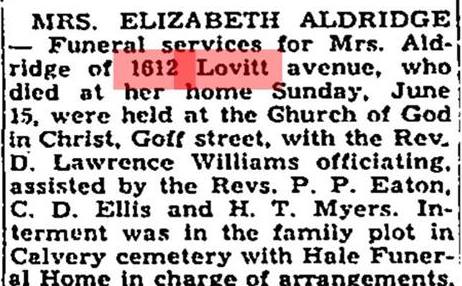
1612 Lovitt Avenue was the house in which Tilithia Brewington King Godbold Dabney had lived in her latter years. Who was this Elizabeth Aldridge? And who was in the family plot?
We quickly suspected that this was Lizzie Aldridge, sister of my great-great-grandfather John W. Aldridge and B.J.’s great-great-grandmother Amelia Aldridge Brewington, but knew little of Lizzie’s whereabouts as an adult. I’d wondered if our Lizzie was this woman, found in the 1900 census of Norfolk, Norfolk County, Virginia: North Carolina-born dressmaker Lizzie Aldridge, 30, shared a household with a boarder, William Hendricks, 36, a divorced day laborer. So there was some precedent to the speculation that Lizzie had migrated to Norfolk. But why the “Mrs.”? We don’t know for sure, but quickly determined that this death announcement was definitely for Lizzie Aldridge, daughter of Robert and Mary Eliza Balkcum Aldridge, and she seems to have been the longest-lived of their children. In other words, Elizabeth Aldridge was Tilithia Dabney’s aunt.
In the 1870 census of Brogden township, Wayne County: Robt. Aldridge, farmer, with wife Eliza, and children George, 18, John, 17, Amelia, 14, Mathew D., 13, David S., 12, Amanda, 10, Ella, 9 Eliza, Robert and Joseph, 7 months, plus farmhand Isham Gregory.
In the 1880 census of Brogden township, Wayne County: Robt. Aldridge, wife Elizar, and children Matthew, Sloan, Amanda, Louella, Lizzie, Robert, Joseph, and Fannie.
By 1898, Lizzie (and, it appears, her teenaged nephew Zebedee, John’s oldest son, and her sister Louella) had migrated to Norfolk, Virginia. Here are their listings in the city directory:

In the 1900 city directory, Louella remains at 100 Henry, but Zebedee, working as a fireman, is living with his aunt at 17 Nicholson. Nonetheless, as noted above the census taken that year showed Lizzie sharing a household only with a boarder.
On 4 July 1902, Wayne County Superior Court set off a dower and partitioned Robert Aldridge’s land among his wife and heirs. With Lot No. 10, Lizzie Aldridge received 32 acres on the Wilmington & Weldon Railroad and Stoney Run Branch valued at $193. (Louella, referred to as Louetta, received a similar share, but two years later it was divided among her siblings when she died without heirs.)
In the 1904 Norfolk city directory, Lizzie is at 17 Nicholson, but in 1906, she is listed at 100 Henry. As “Elizabeth Aldridge,” she is living at 100 Henry in the 1907 and 1908 directories, too.
In the 1910 census of Norfolk, Virginia: Elizabeth Aldridge is listed as the keeper of a lodging house at 100 Henry Street. She had nine lodgers, all born in North Carolina, and one of whom, 22 year-old Jessie Baker, may have been Jesse Frank Baker, son of Lizzie’s first cousin Mary Ann Aldridge Baker.
Per city directories, as early as 1913, Lizzie Aldridge was living at 852 Henry in Norfolk.
In the 1920 census of Monroe Ward, Norfolk, Virginia: at 852 Henry Street, Elizabeth Aldridge, 49, keeper of a lodging house, headed a household that included her 7 year-old adopted son Elisha Newton and eight lodgers aged 16 to 20, all North Carolina-born and working as longshoremen or, in one instance, a fireman on a boat.
In the 1930 census of Norfolk, Virginia: in rented quarters at 940 1/2 Hanson Avenue, 60 year-old laundress Elizabeth Aldridge, her adopted son Arther E. Newton, 18, and a boarder named Mack Rice, a longshoreman. Elizabeth claimed to be a widow who first married at age 21.
In the 1940 census of Norfolk, Virginia: at 938 1/2, Elizabeth Aldridge, 70, was herself a lodger in a household headed by Lena Forekey.
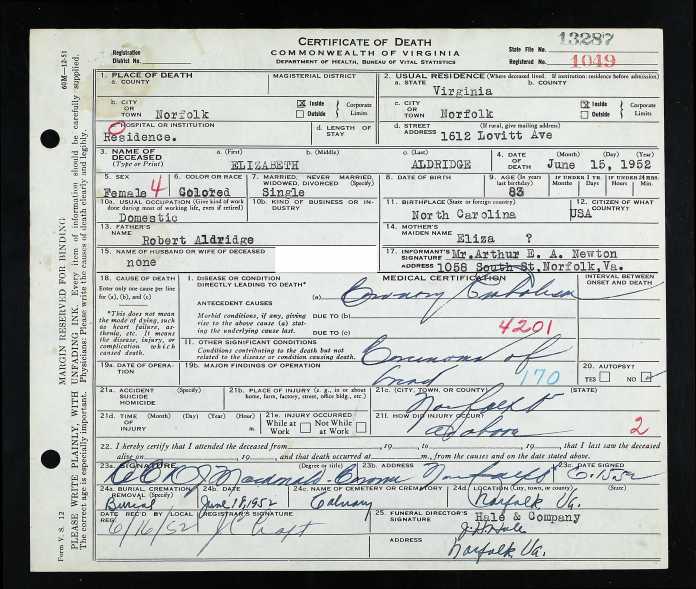
As for the “family plot,” B.J. discovered the following (probably partial) list of Aldridge family members buried together in Norfolk’s Calvary cemetery: Elizabeth Aldridge, Section 22, Block 22, Lot 182, Space SW 0 06/15/1952; John Dabney, Section 22, Block 22, Lot 182, Space W CTR 0 12/29/1974; Tilithia Dabney, Section 22, Block 22, Lot 182, Space NW 0 11/24/1965; and Arthur Newton, Section 22, Block 22, Lot 182, Space SE 0 09/09/1979.
I’ve written of Cousin Tilithia Brewington King Godbold Dabney here and here. Her restaurant in Norfolk, the Strand Cafe, made a deep impression on my grandmother, who laughingly recalled waiting tables there on childhood visits and being dazzled by Cousin Tilithia’s menu offerings.
Thanks to B.J., great-granddaughter of Tilithia’s sister Mattie Brewington Braswell, who found these Norfolk Journal & Guide articles, we now know more about the cafe:
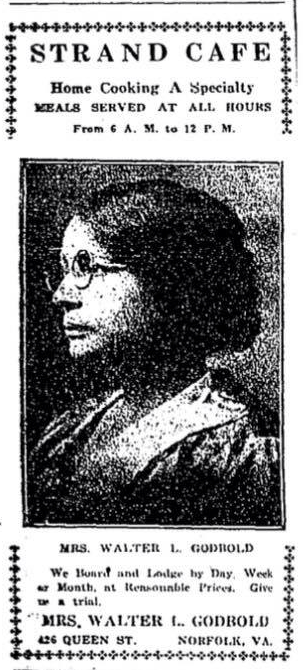
12 March 1921.
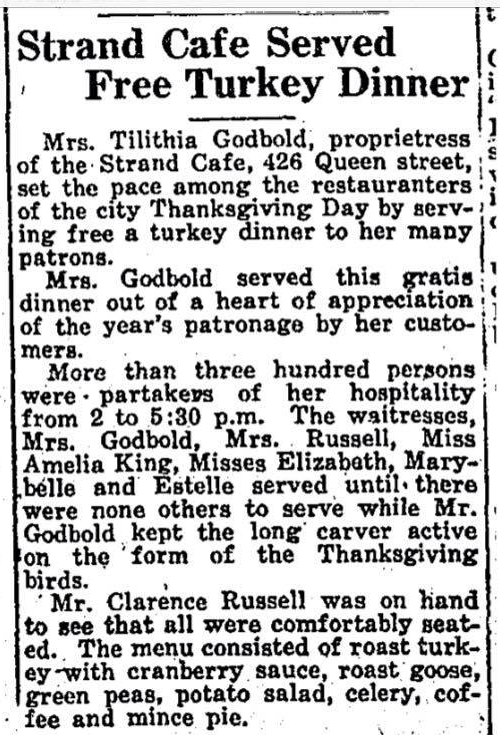
9 December 1922.
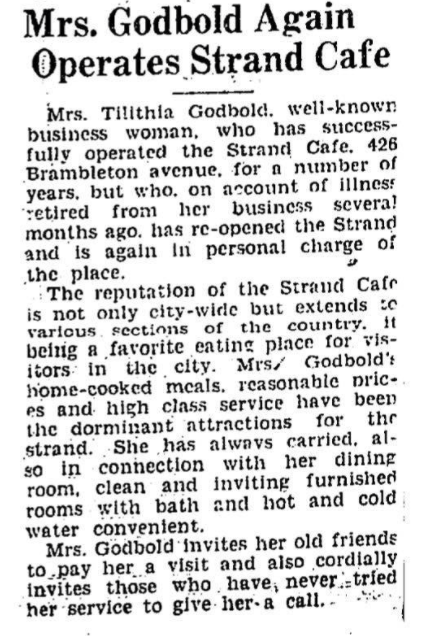
28 May 1927.
More from the Norfolk Journal & Guide — my great-uncles J. Maxwell Allen and William J. Allen.

21 July 1934.
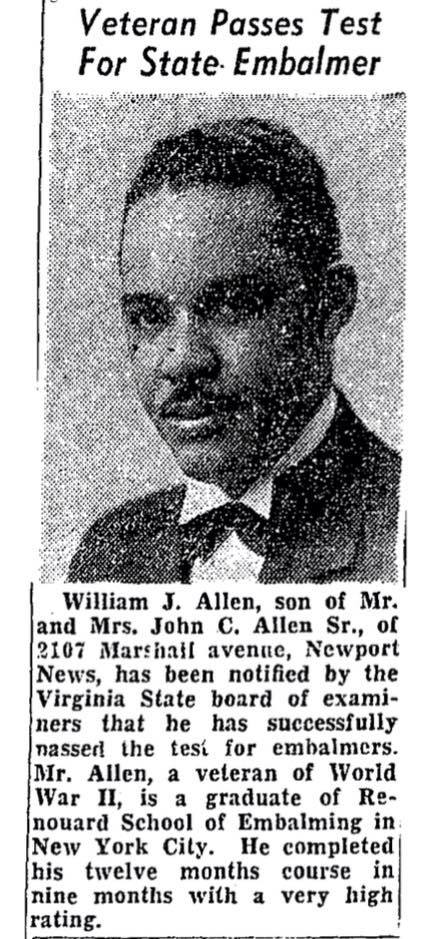
23 August 1947.
My Aldridge cousin Barbie Jones has access to an archive of early editions of the Norfolk Journal & Guide, an African-American newspaper. All morning, she’s been pelting me with gems pulled from the pasts of both my Aldridge-Brewington family and my mother’s close family in Newport News. Here’s the first — stay tuned!

Norfolk Journal & Guide, 20 March 1948.
All five of my grandparents’ children, just three days before my mother’s birthday.
I recently received an email from James Pratt, whose father, Charles A. Pratt, was in the Army’s 366th Infantry from the time it was organized at Fort Devens, Massachusetts, in 1941 until it disbanded in Italy in 1945. Pratt is retired and has devoted considerable time to researching the 366th.
“I had the opportunity to spend two days in Tuscany,” he wrote, “where the 366th is still remembered fondly by the citizens. In Sommocolonia, the townspeople have started a small museum about the Buffalo soldiers. I went to the American cemeteries in Florence and Nettuno and took photos of all the grave markers for the nearly 120 men of the 366th who are buried in Italy.” Pratt is trying to match the markers with photos of the soldiers and wants to do the same for the more than 130 soldiers of the 366th who were buried across the United States.

Ithaca Journal, 19 December 2015.
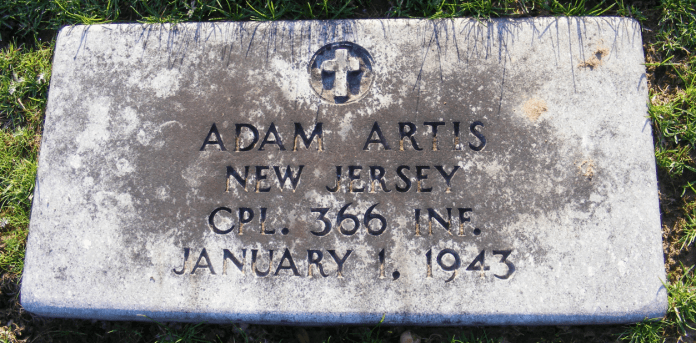
One of the 366th soldiers was Adam Artis, who enlisted in New Jersey, but was born in North Carolina. “Adam … lost his life while training in the U.S. He died on January 1, 1943.” Pratt is trying to find additional information about Adam Artis. He believes he had a son, Adam Artis Jr., who graduated from High School in East Orange, New Jersey, but has not been able to locate him.
The Artis branch of my family tree holds at least seven Adam Artises, including our patriarch Adam Toussaint Artis (1831-1919). If 366th Adam is one of ours, he is likely Adam, son of Adam T.’s son Robert E. Artis and his wife, Christana Simmons Artis. That Adam was born in 1913 near Black Creek, Wilson County. He appears in his parents’ household in the 1920 and 1930 censuses of Wilson County, but not thereafter. On 16 April 1941, Adam Artis, born in 1913 in North Carolina, enlisted in the Army in Newark, Essex County, New Jersey. (His brother Robert Arzell Artis, born 1908, appears in the 1940 census of Newark as an unmarried restaurant cook.) That Adam is buried in Glendale cemetery in Bloomfield, Essex County.
If this Adam had a son Adam Artis Jr., he may be the one born in 1942 whose senior portrait appears in the 1960 East Orange High School yearbook.
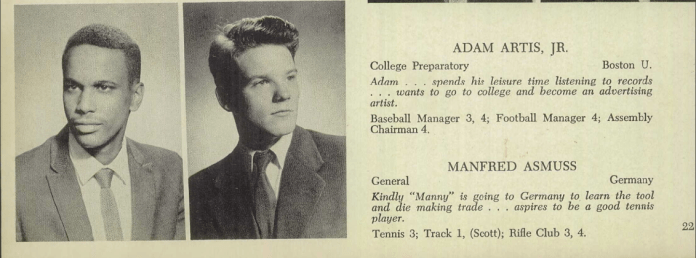
He is listed as a student in the 1961 Boston, Massachusetts, city directory and in later directories as a teacher in Cambridge and Boston city schools. Here he is in a booklet titled “The Boston Plan for Excellence in the Public Schools,” published in 1989.

This blog about William Monroe Trotter Elementary School mentions that it was the second magnet school in the U.S., and a comment enthuses about the plays Adam Artis produced. His impact also shines through in a testimonial posted by a former student on the blog, http://www.myblackteacher.net. Adam Artis Jr. is surely retired by now, but it is not clear to me whether he is still living. If he is, perhaps Scuffalong will reach him.
U.S. School Yearbooks, 1880-2012 [database on-line], http://www.ancestry.com.

Wilmington Messenger, 28 July 1900.
George White’s secretary was cousin William S. Hagans.

The Wilmington Messenger, 3 January 1906.
The Statesville Record & Landmark, 9 January 1906.
The Raleigh Enterprise, 11 January 1906.
The Union Republic (Winston-Salem), 11 January 1906.
The Dispatch (Lexington), 17 January 1906.
The Alamance Gleaner, 18 January 1906.
The Salisbury Evening Post, 20 January 1906.
This exaggerated, casually racist account was published in no fewer than seven North Carolina newspapers in January 1906. (Adam Artis was my great-great-great-grandfather, and he actually had more like 25 children.)

Goldsboro Daily Argus, 31 December 1905.
For decades, on January 1, African-American communities formally celebrated the anniversary of the Emancipation Proclamation. In 1905, under the leadership, in part, of William S. Hagans and Mack D. Coley, the “Educational, Agricultural and Industrial mass meeting” of Wayne County’s “colored citizens” issued an eight-point pledge:
(1) to be respectable;
(2) to endorse state policy to give all children, regardless of color, an education;
(3) to urge school attendance;
(4) to encourage teachers not only to teach, but to pay home visits and preach every manner of virtue and home improvement;
(5) to disapprove of shiftlessness;
(6) to condemn crime and encourage law-abiding conduct;
(7) to suggest that farmers carry insurance and to educate them; and
(8) to become more united as a race, to organize to buy land, and to help one another retire mortgages.
Remembering my grandmother’s favorite cousin, Irving “Jay” McNeely Weaver.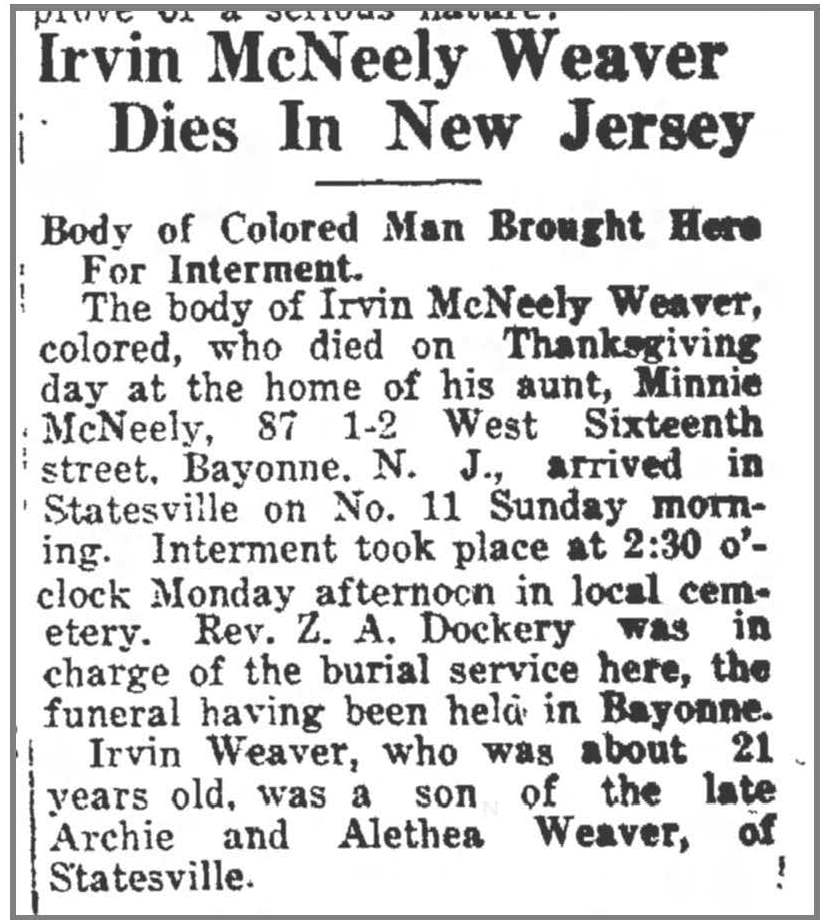
Statesville Record & Landmark, 5 December 1933.
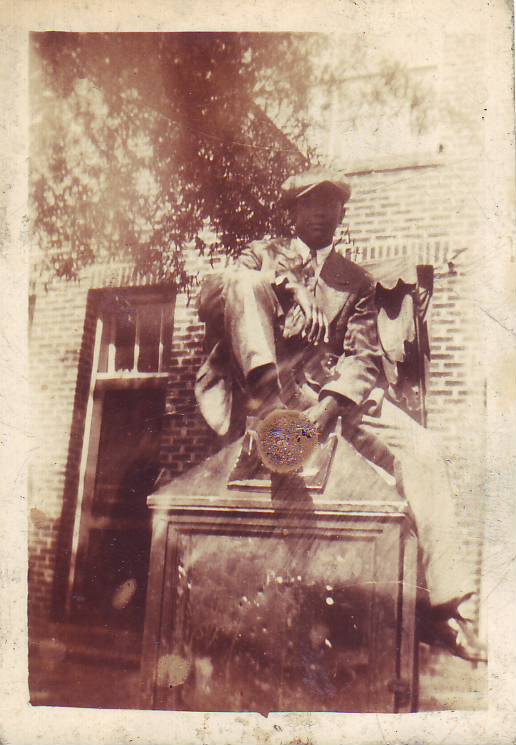
Jay as a boy, probably in Bayonne, New Jersey.
Photograph in collection of Lisa Y. Henderson.
 Scuffalong: Genealogy.