
Exactly 100 years ago today, Miss Viola Houser visited her brother and his wife, Irving and Emma McNeely Houser, in Bayonne, New Jersey.
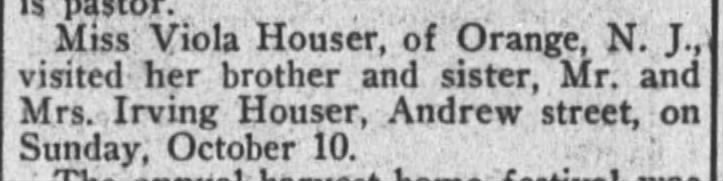
New York Age, 21 October 1915.
Exactly 100 years ago today, Miss Viola Houser visited her brother and his wife, Irving and Emma McNeely Houser, in Bayonne, New Jersey.
New York Age, 21 October 1915.
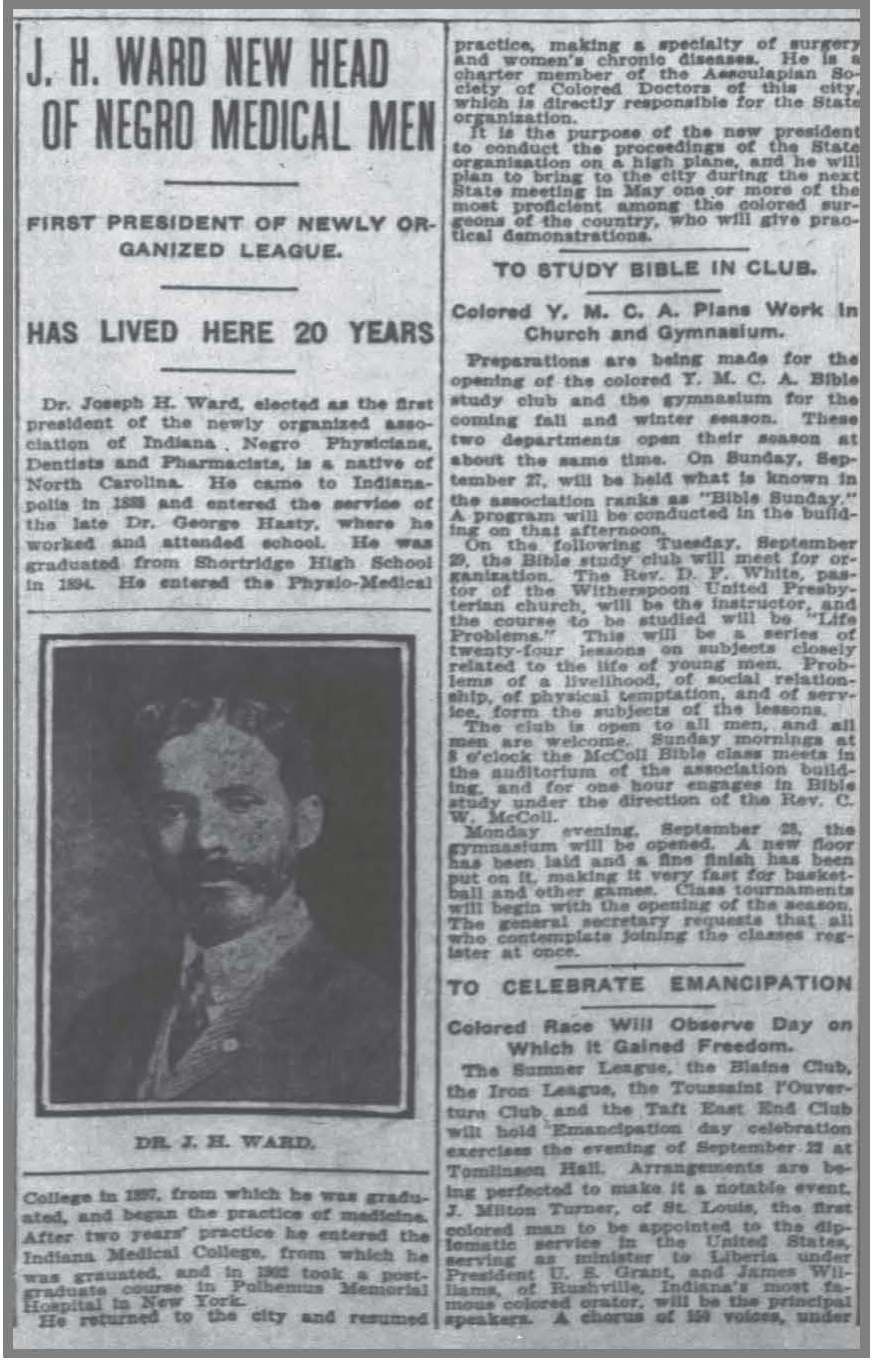
Indianapolis News, 18 September 1908.
Dr. Joseph H. Ward elected as the first president of the newly organized association of Indiana Negro Physicians, Dentists and Pharmacists.
In 1897, cousin Cain D. Sauls was one of two African-American members of a five-man delegation that traveled eastern North Carolina advocating for the “Snow Hill Railroad.”

Goldsboro Weekly Argus, 15 April 1897.
A little over a year later, North Carolina’s secretary of state approved the incorporation of the Great Eastern Railway Company, which planned to build and operate a 130+ mile railroad passing through Johnston, Wayne, Greene, Pitt, Beaufort and Hyde Counties. Among the 25 stockholders incorporating the railroad? C.D. Sauls!
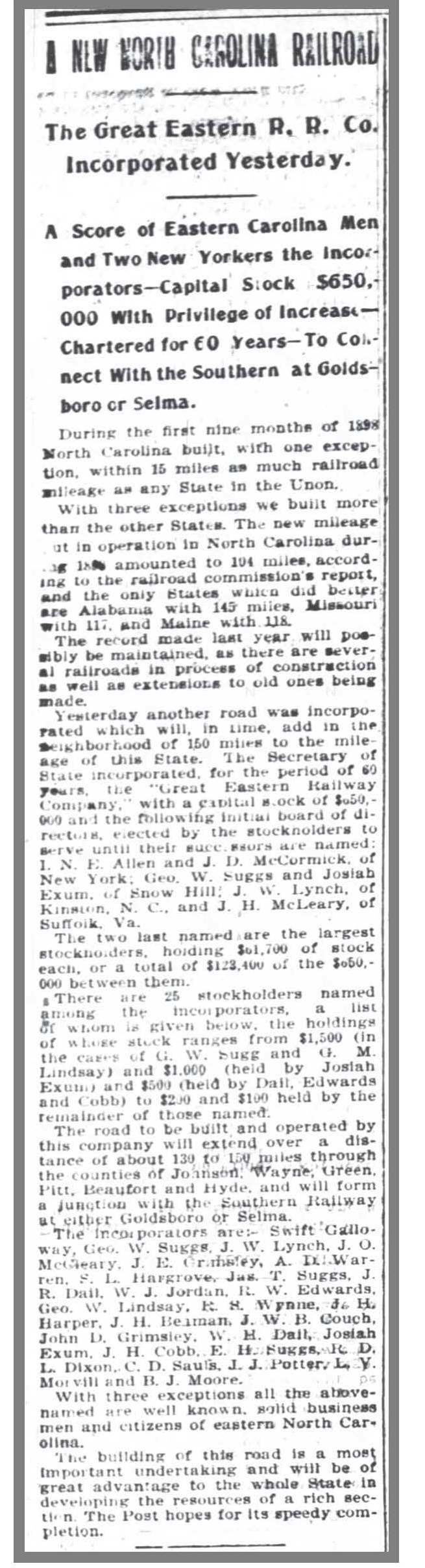
Raleigh Morning Post, 15 October 1898.
While Americans fought in Europe, a war with influenza raged at home.

Indianapolis News, 19 October 1918.
Dr. Joseph H. Ward returned to Indianapolis eight months later to find his wife Zella and daughter Mary Roena recovered, but his beloved son gone. The boy was nine years old.
——
Coda
My grandmother Mary Ward Roberts, whom we called Mur, would cry remembering when Buddy was taken away. She and her mother couldn’t follow the hearse because they were still sick. The purple cloth they put outside of the door to let people know that the house was infected with Spanish Influenza. Mur said that Buddy pointed his finger upward and said goodbye. Her father went into a deep depression in France and was hospitalized. When he returned from France, he had Buddy’s body exhumed to say a final farewell. Can you imagine? — Z.P., great-granddaughter of Joseph H. Ward
A “pre-election fracas”? What happened? And why did eight of black Goldsboro’s leading lights — including my great-great-great-uncle Matthew W. Aldridge and cousin William S. Hagans — feel compelled to take to the newspaper, hat in hand?

Goldsboro Daily Argus, 18 November 1896.
I didn’t find anything in the Goldsboro papers to which I have access, but two weeks before this letter was published, newspapers across the country ran a sensational story about Negroes “taking control” of Goldsboro after a “clash with whites.” The alleged cause? “An incendiary speech” made by none other than John Frank Baker, “a colored Republican of Dudley,” and husband of Mary Ann Aldridge Baker.

Independence Daily Reporter (Kansas), 4 November 1896.
Four months later, Frank Baker was assassinated, shot dead as he went about his work in a Dudley grocery.
Were Matthew Aldridge and William Hagans and their peers moved to pour oil on the waters because they feared the fallout from Baker’s outspokenness? (I have yet to find anything that touches on what he actually said.) Their letter is frustratingly vague about the events that gave rise to a “race riot” in Goldsboro, speaking only of the aftermath of a recent election. The message is difficult to digest, greased as it is with deferential supplications to the “better class of our white citizens” and anxious apologies for the “slight ripple upon the formally [sic] smooth surface” of race relations in Wayne County. Reading from a 21st century vantage point, it is easy to dismiss this letter as Uncle Tommery. There is an undoubted and substantial element of self-preservation and middle-class conservatism at work here, but their fear was surely real and well-placed.
——
On the 65th anniversary of her death (and her brother Edward‘s), another account of the terrible death of my grandmother’s aunt, Elizabeth McNeely Kilpatrick Long:

Statesville Record & Landmark, 28 September 1950.
Something brings me back to Anna J. Henderson Simmons. At no more than 20 years old, she left all the family she knew to follow her new husband 800 miles to Canada, where his Wayne County family had settled decades earlier. It is hard to get a sense of Anna’s life. Her husband Montreville Simmons achieved a measure of success as a farmer in central Indiana, but evidence suggests that he was a difficult man to live with. Did she ever see her birth family again? Probably not, and evidence suggests that her children had an uncertain grasp on the facts of her early years.
Here’s what I know of my great-great-great-grandfather Lewis Henderson‘s sister:
In the 1860 census of Westbrooks, Sampson County, North Carolina, appear James Henderson, mulatto carpenter; wife Eliza; and four children, Anna J., Susan, Hepsie, and Alexander. Eliza (or Louisa) Armwood, daughter of John and Susan Armwood, was James’ second wife.
Ten years later, the family had moved about 20 miles east-southeast and appear in the 1870 census of Faisons, Duplin County: James Henderson, 52, mulatto farmer; wife Eliza; and children Ann, 17, Susan, 16, Hepsey, 14, Aleck, 13, John H., 11, Nancy, 6, and Betty, 3, plus James’ son James, 27, and boarders James Ammons and Thomas Cox. (Were the latter two relatives of either James or, more likely, Eliza/Louisa?)
The following spring, on 3 March 1871, Anna Henderson married Montraville Simmons, 19, son of Calvin and Hepsie Whitley Simmons, in Duplin County. The license lists Anna’s parents as James Henderson and Louisa Armwood. Montraville had been born in Wayne or Duplin County and migrated to Chatham, Kent County, Ontario, Canada with his family in the 1850s. After the death of his first wife, Victoria Brown, whom he married in Chatham in 1865, Montraville returned to North Carolina for a new spouse. (There’s a suspicious marriage on 16 April 1848 in Oakland, Michigan, between 23 year-old Montreville Simmons of North Carolina and Harriet Lucas of Richmond, Ohio. Was this yet another early marriage for Anna’s Montraville?)

Duplin County, North Carolina, Marriage Register.
The family was captured in the 1881 census of Chatham, Kent County, Ontario, Canada: Montreville Simmons, 40, farmer; wife Annie, 29; and children Elizabeth, 8, Doctor T., 7, Susan M., 4, and Montreville, 2. All were born in the United States except Doctor and Montreville jr., who were born in Ontario, and all were Baptist. [Where in the U.S. was Susan born? Had Anna gone back to North Carolina? Or had the family lived some short period across the nearby border?]
Sometime in the next twenty years, the Simmonses cast their lot permanently as Americans. For reasons unknown, they settled near Logansport, Indiana, in rural Cass County north of Indianapolis. In the 1900 census of Eel township, on Park Avenue in Logansport, the census taker recorded farmer “Montville” Simmons, born April 1850, wife Anna, born March 1861, and sons James R., December 1879, Montville, June 1882, and Dock, December 1879. Montville and Anna were recorded as born in North Carolina; their sons in Canada. Montraville and Anna had been married 28 years and reported five of five children living. The family was described as black. [The evidence concerning the Simmons children is confusing. Census records name Elizabeth (born circa 1872), Doctor/Dock (born circa 1874), Susan M. (born circa 1877), James R. (born circa 1879), Montraville Jr. (born circa 1880) and Edward (born 1881.) However, records in Indiana indicate another daughter, Moncy, who died in 1942.]
Montraville Simmons was a successful farmer, but a life of material (if heavily mortgaged) comfort did not necessarily spell ease for Anna. Montraville’s name peppered the local paper regularly, as Pharos-Tribune reporters gleefully chronicled his clashes with neighbors and his personal peccadilloes.
Anna herself managed to stay out of print until 1905, when the ailing woman parachuted into a spat between her husband and his creditors. Headlines blared her surprising intervention, and it’s hard not to see Montraville’s hand as a puppet master in this 11th hour shenanigan.

Logansport Pharos Tribune, 22 December 1905.
Sadly (she was only about 50 years old) but perhaps mercifully, within six months, Anna Henderson Simmons was dead. Her death certificate, which contains some curious errors, reported that Annie Simmons, married, died 16 Jun 1906 in Cass County, of Basedow’s disease [now known as Graves’, a disease of the thyroid]. She was born 2 February 1856 in North Carolina and was buried at Free Union Baptist in Irvin township, Howard County, Indiana, by Kroeger & Strain, funeral directors. The informant for the certificate was Montraville Simmons. The father or the son? I don’t know, but it’s hard to believe that either reported Anna as white, though that’s what the certificate notes. It’s less hard to believe that Montraville Jr. might have misreported his mother’s parents as James Harrison and Eliza Henderson. He, after all, had surely never met them. (And when he married Jessie Winslow in Cass County in 1903, he cited his mother’s maiden name as Anna Harrison.)
On 18 June, the Pharos Tribune ran a brief obituary:

——
Who were Anna Henderson Simmons’ legacies? Is there a lost branch of Hendersons in middle Indiana?
In other words, improbable as it seems, Anna’s seven children produced a single grandchild, and he seems not to have any children. There are not, it seems, any Kokomo cousins.
Ummmm….

I have so, so many questions about this little blurb from the 1 April 1890 edition of the Raleigh State Chronicle.
Number one: were these men the David, Robert Jr., and Joseph Aldridge, born 1858, 1866 and 1869, who were the younger sons of Robert and Mary Eliza Balkcum Aldridge? (One and a half: if not, who were they?)
Two: Croatan Indians? (This is the name by which today’s Coharie Indians were known at the end of the nineteenth century.) The Aldridges?
Three: Voodooism?!?!! (For that matter, tramping and vagrancy? What were these Wayne County farmers doing in Wake County?)
Four: Can I find out what happened? I’ll need to get into Wake Superior Court records at the North Carolina State Archives.
Speaking of Tom Aldridge …
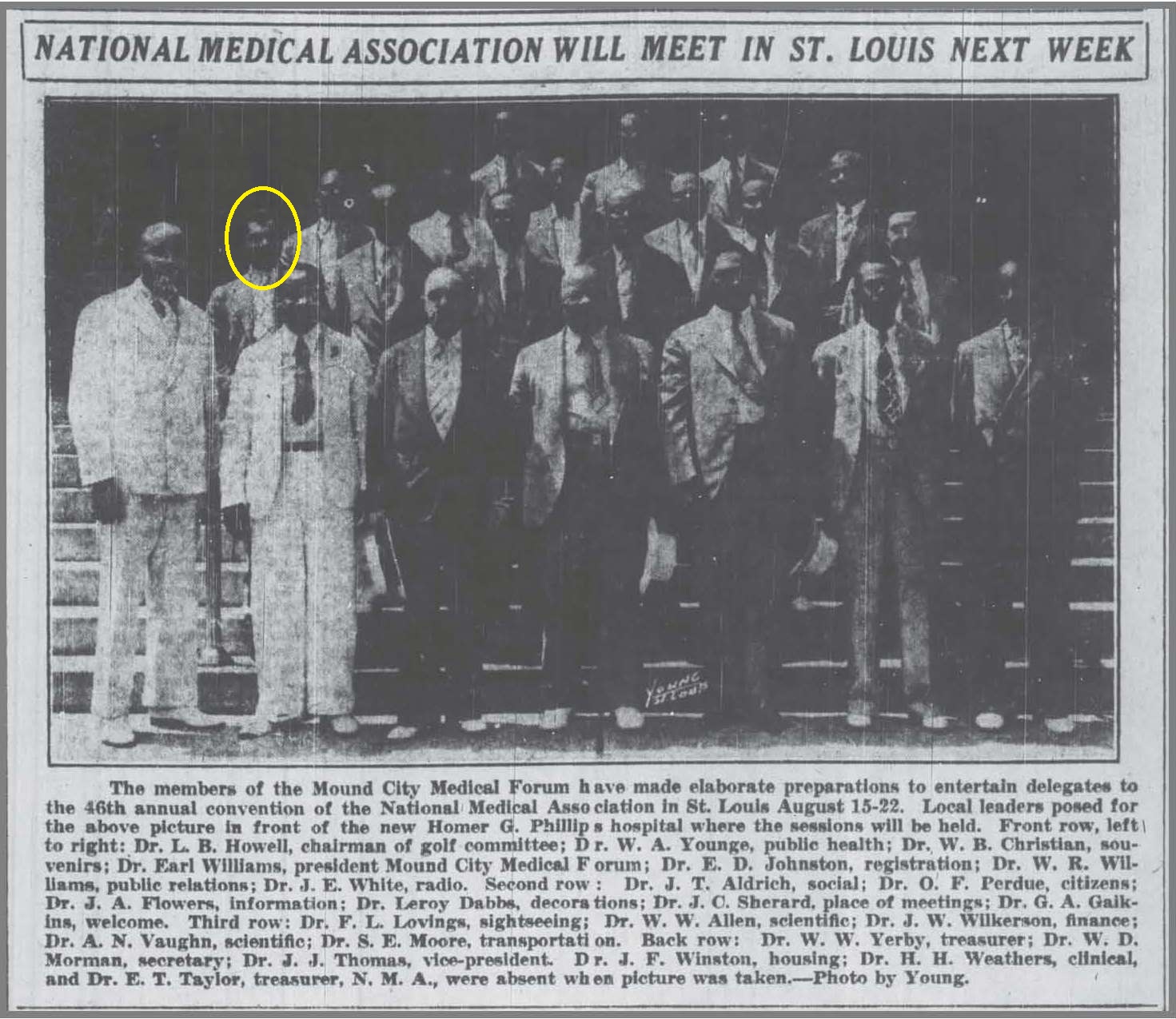
Pittsburgh Courier, 14 August 1937.
This is the earliest photograph I have seen of my great-grandfather, and he was 51 years old here. His hair, fallen over his forehead, seems thicker than in later studio portraits. Otherwise, disappointingly little detail can be seen. Twenty-four years later, he would be elected president of the National Medical Association.
Louise Daniel Hutchinson, scholar of black history, dies at 86
By Emily Langer, The Washington Post, 26 October 2014.
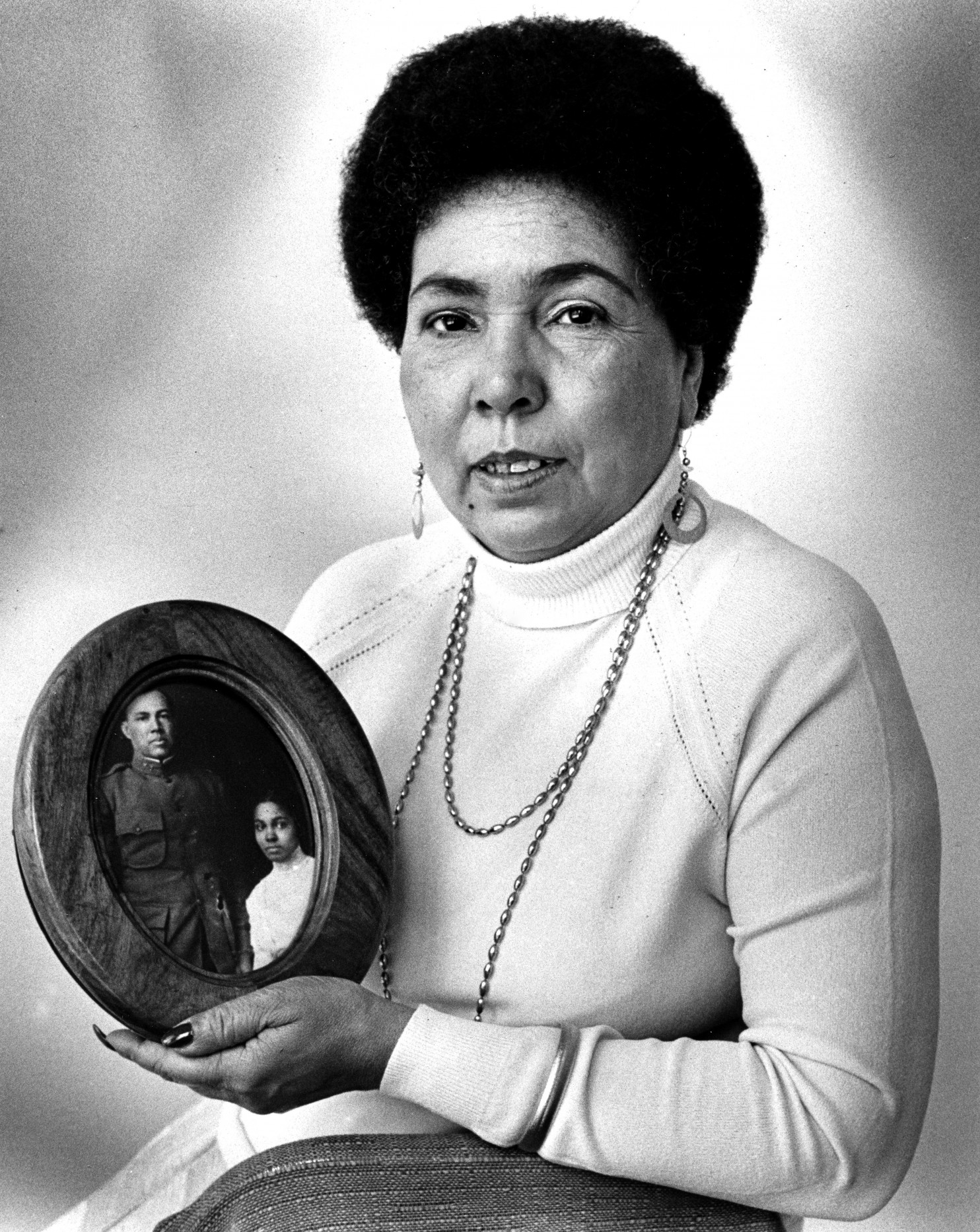
WASHINGTON — Louise Daniel Hutchinson, who gathered, documented and preserved African-American history during 13 years as director of research at the Smithsonian Institution’s Anacostia Community Museum in Southeast Washington, died Oct. 12 at her home in Washington. She was 86.
The cause was vascular dementia, said a daughter, Donna Marshall.
Mrs. Hutchinson spent much of her adult life working to collect and share with others the richness of African-American history in Washington and beyond. In 1974, after years of community activism, she joined the Anacostia Neighborhood Museum, as it was then known. She retired in 1987.
Under the leadership of founding director John Kinard, she oversaw exhibits covering years of history in the Anacostia community, the movement of blacks from Africa to overseas colonies, and the life and accomplishments of Frederick Douglass, the former slave, abolitionist and distinguished writer.
She took particular interest in documenting the lives of African-American women such as Anna Cooper, who was born into slavery and became a noted educator and equal rights advocate. “Even black history hasn’t given black women their proper place,” Hutchinson once told the New York Times.
Gail Lowe, the Anacostia Community Museum’s senior historian, credited Mrs. Hutchinson with elevating the work of the research department and using individual life stories to illuminate broader history. “In telling the local stories,” Lowe said in an interview, “she validated community experiences.” Mrs. Hutchinson was “a stickler for accuracy and authenticity,” Lowe said, and insisted researchers keep magnifying glasses on hand for the close inspection of old photographs. Hutchinson, Lowe recalled, spotted Harriet Tubman and W.E.B. Du Bois in previously unidentified images.
“Because of the level and depth of her work,” Lowe said, “she was able to … provide accurate, documented information that other researchers and scholars relied on.”
Louise Hazel Daniel, one of nine children, was born June 3, 1928, in Ridge, Maryland, and raised in the Shaw neighborhood of Washington. Her parents, Victor Hugo Daniel and Constance E.H. Daniel, were teachers and friends of the African-American intellectuals and educators George Washington Carver and Mary McLeod Bethune.
After graduating in 1946 from the old Armstrong Technical High School in Washington, Mrs. Hutchinson attended colleges including Howard University and did secretarial work before beginning her career in historical preservation. In the 1970s, she assisted curators at the Smithsonian’s National Portrait Gallery with the selection of paintings featuring prominent African-Americans, her daughter said.
Mrs. Hutchinson’s writings included the books “The Anacostia Story, 1608-1930″ in 1977, “Out of Africa: From West African Kingdoms to Colonization” in 1979 and “Anna J. Cooper: A Voice from the South” in 1981.
Mrs. Hutchinson’s daughter Laura Hutchinson died in infancy, and her son Mark Hutchinson died in 1974, at age 8, of a brain tumor.
Survivors include her husband of 64 years, Ellsworth Hutchinson Jr. of Washington; five children, Ronald Hutchinson of Fort Washington, Maryland, David Hutchinson of Clifton Park, New York, Donna Marshall of Laurel, Maryland, Dana McCoy of Washington and Victoria Boston of Clinton, Maryland; two brothers, John Daniel of Washington and Robert Daniel of Atlanta; a sister, C. Dorothea Lawson of Bay City, Texas; five grandchildren; and two great-grandchildren.
In addition to her museum work, Mrs. Hutchinson participated in such initiatives as the development of D.C. public school curriculum in the 1980s, which incorporated the roles of black leaders in local events.
“I have real concerns about accuracy of history,” she told The Washington Post. “I believe it must reflect [the] participation of all.”
——
 Scuffalong: Genealogy.