Births Deaths Marriages, Enslaved People, Maternal Kin, Newspaper Articles, North Carolina, Other Documents

Lewis Colvert, son or stepson?

Something’s been bothering me about Lewis “Lou” Colvert. My grandmother knew his son Aggie (pronounced “Adgie”) Colvert as her cousin, but just whose son was Lewis?

The first irregularity: as shown here, when Walker Colvert and Rebecca Parks registered their 13-year cohabitation in 1866, they did not list six year-old Lewis among their three children. Why not?

In the 1870 census of Union Grove, Iredell County, he’s there: Walker Colvert, wife Rebecca and Lewis Colvert, 10.  I haven’t found him in the 1880 census, but a year later, on 13 October 1881, he married Laura Sharpe in Statesville. References to him over the next 30+ years though are few.

On 11 October 1895, the Statesville Landmark printed a short piece about Lou suffering a head injury after being thrown from a wagon.

The census taker again missed Lewis for the 1900 census, but found his wife Laura Colbert, born 1851, and son Aggie, born 1888, living on Valley Street in Asheville, Buncombe County. Laura worked as a cook and described herself as a widow. And though he eluded the enumerator, Lewis was still in Statesville, as this snippet from a court calendar report demonstrates:

Carolina_Mascot_Sville_2_8_1900

Carolina Mascot (Statesville), 8 February 1900.

(Lon was his nephew, my great-grandfather.)

Walker Colvert died in 1905. His will, made in 1901, directed that all his land and personal property go first to his wife Rebecca and, after her death, to his son John Walker Colvert. No mention of Lewis.

In 1910, Lewis again sidestepped the census taker. Laura remained in Asheville. Though she lived until 1926, and I’ve found no evidence of a divorce, in April 1913, Lewis married Quiller Ward in Statesville. The marriage was short-lived. Lewis “Lou” Colvert died 27 March 1915 in Statesville. Lon W. Colvert provided the information for his death certificate — mother, Rebecca Colvert; father, unknown.

Lew Colvert Death Cert

Unknown. Not Walker Colvert. Neither here nor anywhere else is there a claim that Walker was Lewis’ father.

Here is my speculation: Walker Colvert was born at 1815. He married Rebecca Parks about 1853. At that time, he had a two year-old son, John Walker, whose mother was named Elvira Gray. (At nearly 40, however, Walker surely had children older than John. If so, their identities may never be known.) Rebecca was 24 years Walker’s junior and almost certainly belonged to a different master. She was about 16 when she gave birth to her first child with Walker, a daughter named Elvira, and daughter Lovina followed. Then, in 1861, she bore Lewis. As with every enslaved woman, Rebecca’s body was not her own. Perhaps she willingly conceived a child outside her relationship with Walker. Just as likely, that relationship was not uniformly recognized, and she submitted to someone else’s will. Walker reared the boy with his own children and gave him his surname, but did not claim him as a son.


Standard
Maternal Kin, Newspaper Articles, North Carolina

Justifiable homicide?

I am just about to have to side-eye my Rowan and Iredell County people. If my grandmother were still living, would I have the nerve to ask her about all this cutting and shooting and bootlegging?

WS_Union_Republican_3_18_1920_Watt_Kilaptrick_murder_charge

The Union Republican (Winston-Salem), 18 March 1920.

This is Aunt Lizzie’s husband!

WS_Union_Republican_3_4_1920_W_Kilpatrick_detail

The Union Republican (Winston-Salem), 4 March 1920.

As detailed here, Margaret L.E. “Lizzie” McNeely, my grandmother’s maternal aunt, married William Watt Kilpatrick in Statesville, Iredell County, in 1900. By 1920, their marriage had gone south, and 45 year-old Watt appeared in the census that year at 17 Roanoke Street in Winston-Salem, sharing a house with 32 year-old Miss Dora Freeman. Contrary to the news article, in the census Freeman was described as the “roomer.”

Standard
Births Deaths Marriages, Maternal Kin, Newspaper Articles, North Carolina

Double jeopardy.

Salisbury_Truth_4_23_1896_Cas_Brown_throat_slit

Salisbury Truth, 23 April 1896.

I can’t say for absolute certain, but I am pretty sure that the lucky man was William Caswell “Cas” Brown (1871-1934), husband of Mary Caroline Miller, both of Steele township, Rowan County, North Carolina. If so, the couple married two days after Hint Chambers succumbed and the day before this blurb was published.

Standard
Agriculture, Land, Maternal Kin, Newspaper Articles, North Carolina

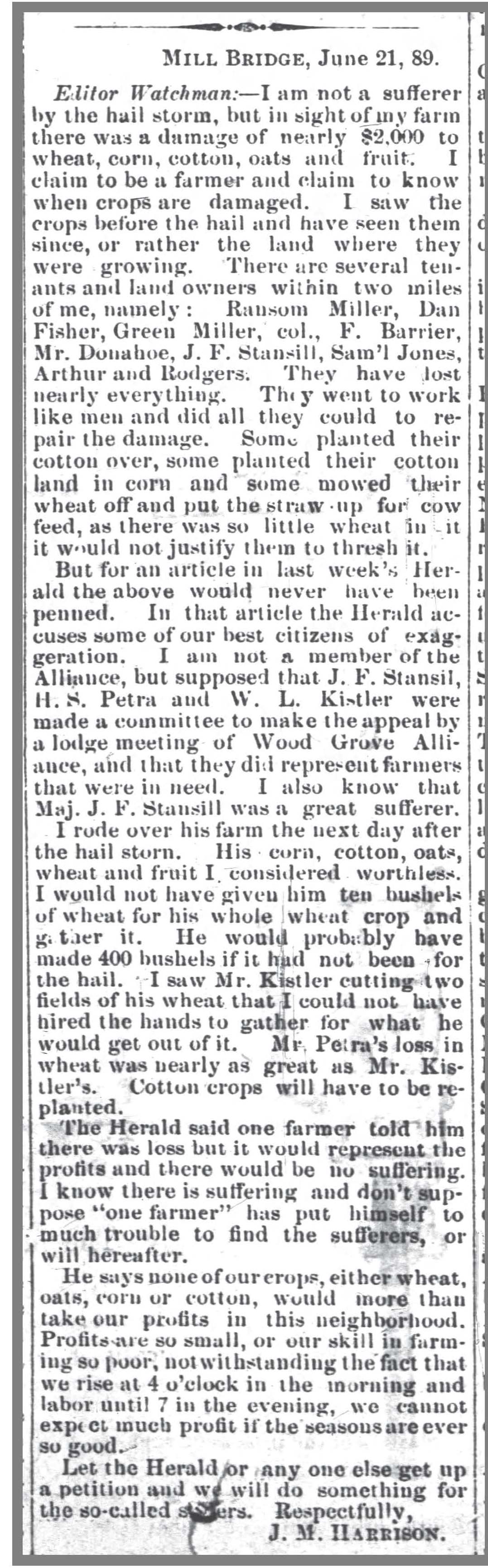
A sufferer by the hailstorm.

Carolina_Watchman_6_27_1889_hailstorm_ransom_miller

Carolina Watchman, 27 June 1889.

The Ransom Miller named above may not have been not “my” Ransom, but a white man. However, “Green Miller, col.” was definitely my great-great-grandmother Martha Miller McNeely‘s brother-in-law, husband of her sister Grace Adeline Miller Miller.

Two days earlier, a Winston-Salem newspaper had also posted an appeal for help for Rowan County’s devastated farmers.

WS_Progressive_Farmer_6_25_1889_appeal

Winston-Salem Progressive Farmer, 25 June 1889.

When it came down to it, however, despite having “lost nearly everything,” Green Miller somehow failed to benefit from the Wood Grove Alliance’s appeal.

Carolina_Watchman_7_11_1889_Wood_Grove_Alliance

Carolina Watchman, 11 July 1889.


Standard
Business, Newspaper Articles, North Carolina, Paternal Kin, Vocation

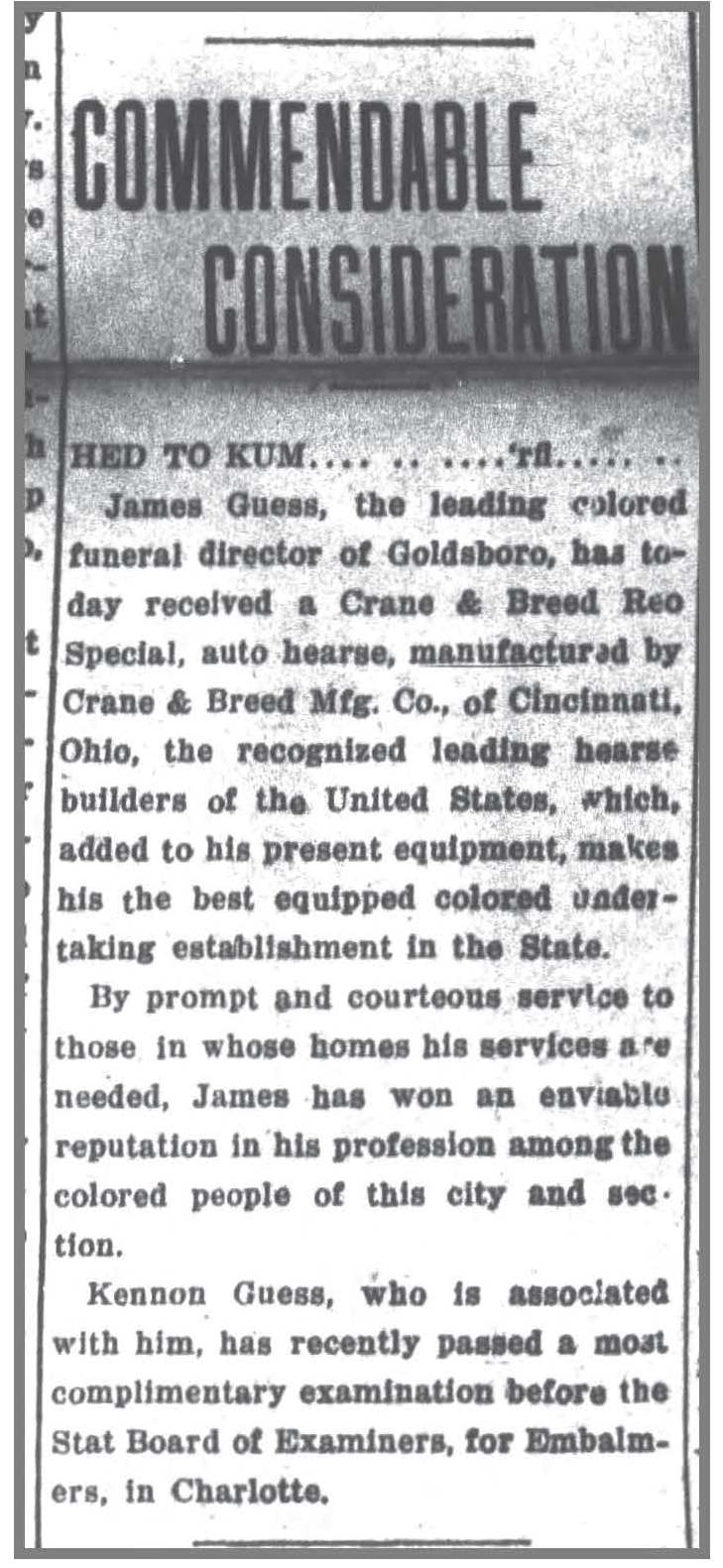
The leading colored funeral director.

Gboro_Daily_Argus_7_27_1920_James_Guess

Goldsboro Daily Argus, 27 July 1920.

 The esteemed James N. Guess was married to Annie Smith, daughter of Isham and Nancy Henderson Smith. [Small world moment: His nephew Kennon Guess married Esther Edwards of Greene County. I knew Mrs. Guess (later, Askew) as a first grade teacher at elementary school and as a neighbor in Wilson.]

Standard
Agriculture, Newspaper Articles, North Carolina, Paternal Kin

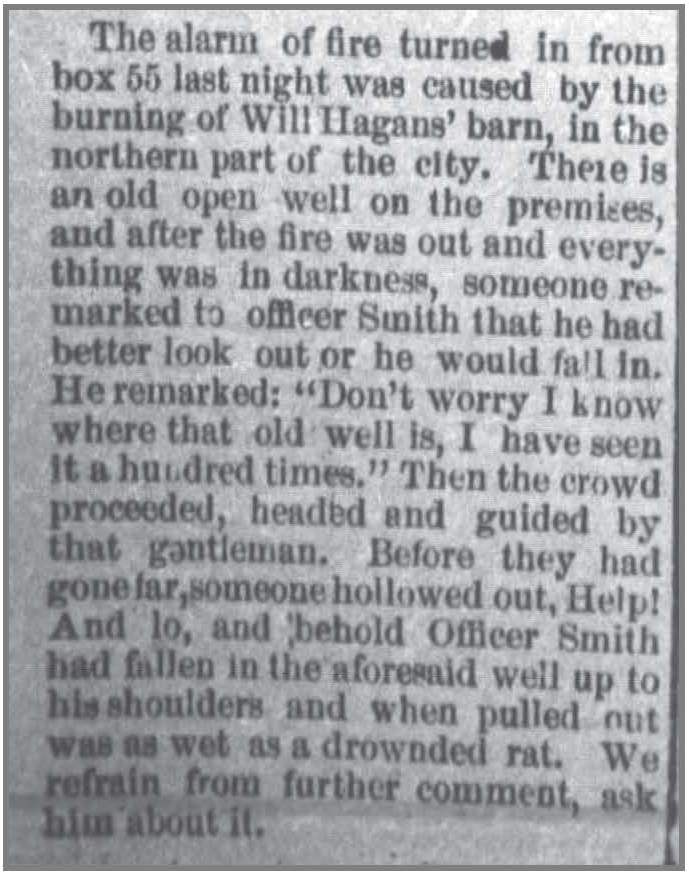
A burned barn, an old well, and Officer Smith.

Goldsboro_Daily_Argus_6_11_1904_hagans_barn

Goldsboro Daily Argus, 11 June 1904.

Beyond the story of Officer Smith’s swift comeuppance, there is “Will Hagans’ barn, in the northern part of the city.” William S. Hagans and his family lived in Goldsboro at this point, and his landholdings were 15 miles north in the area of Fremont and Eureka, near the Wilson County line. For what, then, did he use a barn in town?

Standard
Agriculture, Business, Free People of Color, Newspaper Articles, North Carolina, Paternal Kin

Tax trouble.

Gboro_Messenger_4_2_1877_tax_woes

Goldsboro Messenger, 2 April 1877.

Simmons & Aldridge??? I’m fairly certain that the Aldridge in this partnership was Robert Aldridge (though it could have been one of his older sons, George, Matthew and John) but which Simmons? Section 69 imposed penalties on “any manufacturer of tobacco or snuff” who failed to pay proper taxes on their products. Robert was said to have operated a brickyard near Dudley, but I’ve seen nothing else to suggest that he also had an interest in a tobacco cottage industry.

Standard
Births Deaths Marriages, Newspaper Articles, Paternal Kin, Photographs, Virginia

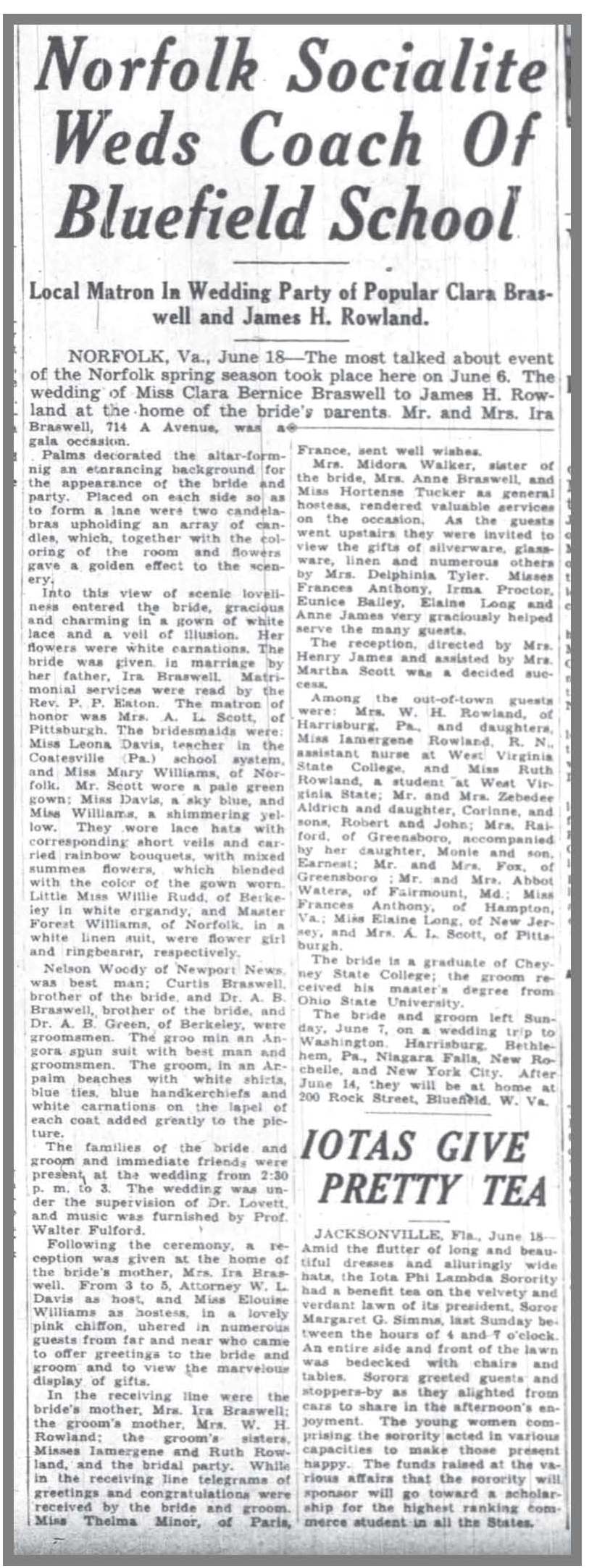
The most talked-about wedding.

Pittsburgh Courier 6 20 1936 Clara Braswell wedding

Pittsburgh Courier, 20 June 1936.

Socialite Clara B. Braswell‘s mother, Mattie Amelia Brewington Braswell, was a daughter of Joshua L. and Amelia Aldridge Brewington. Just after 1900, Mattie migrated to Norfolk, Virginia, where she married her husband, who was also a Wayne County native.  Several of her siblings also made the move, including Tilithia Brewington King Godbold Dabney, much-beloved by my grandmother. Among the out-of-town guests noted at Clara’s nuptials were Mattie Braswell’s first cousin and his wife, Zebedee and Jennie Ridley Aldridge, with three of their children. The son of John W. and Louvicey Artis Aldridge, Zebedee had also migrated from Dudley, Wayne County, to rural Brunswick County, Virginia, in the first decade of the 20th century. Zebedee and Jenny traveled a hundred miles from their farm to attend his cousin’s gala wedding, touching evidence of enduring ties among Robert and Mary Eliza Balkcum Aldridge‘s descendants.

Zebedee & Jennie Aldridge

Zebedee and Jennie Aldridge, probably 1940s.

Photo courtesy of L.D. Hutchinson. Hat tip to B. Jones for the article.

Standard
Births Deaths Marriages, Enslaved People, Land, Maternal Kin, Newspaper Articles, Other Documents, Paternal Kin, Photographs, Virginia

The life of Joseph R. Holmes, radical.

I’ve written of Joseph R. Holmesdeath. What of his life? The details are sketchy and poorly documented. Nonetheless, here is what I know.

  • Joseph R. Holmes was born circa 1838, probably in Charlotte County, Virginia. His parents are listed as Payton and Nancy Holmes on his death certificate. I don’t know what the “R” stood for.
  • According to Luther Porter Jackson, Joseph had a brother named Watt. According to my great-aunt Julia Allen Holmes, he also had a brother named Jasper Holmes, born circa 1841, who was her grandfather.
  • The “Inventory and Appraisal of the Personal Estate of Capt. John H. Marshall,” filed in Charlotte in June 1857, lists 20 “Negroes,” including Joe, $600; Peyton, $900; and Nancy, $1000. There’s no Jasper. Nor are there any children bearing the names of Nancy’s younger children, some of whom who were born before 1857. Thus, though I’m tempted, I can’t draw any conclusions about whether these enslaved people are Joseph R. Holmes and his parents.
  • Joseph probably was last owned by John H. Marshall’s son, judge Hunter Holmes Marshall, whose plantation “Roxabel” was (and still is) located about five miles west of Charlotte Court House.
  • Joseph learned to read and write most likely as a child, as he exhibited a well-formed penmanship when in his mid-20s.
  • He was trained as a shoemaker or cobbler.  In Negro Office-Holders in Virginia 1865-1895, Luther Porter Jackson
    asserted that brother Watt was also a shoemaker and that Joseph was “hired out by his master to engage in shoemaking by traveling from plantation to plantation.”
  • However, according to “Shooting in Charlotte Court House,” published in volume VIII, number 2, of The Southsider quarterly, Joseph served as a butler for Marshall, then became a cobbler and opened a shop on the Kings Highway (now U.S. Route 360) near Dupree’s old store.
  • Some time around 1865, Joseph married Mary Clark, born about 1849 to Simon and Jina Clark of Charlotte County. The couple had at least four children: Payton (1865), Louisa (1866), Joseph (1867) and William H. Holmes (August 1868).
  • Tax records filed in Charlotte Court House for 1866 list Joseph R. Holmes in District #2 (T.M. Jones, revenue commissioner), paying one black poll tax, as well as taxes on four hogs valued at $5 and $20 worth of real property. I have not found a deed for this property.
  • In 1867, Joseph R. Holmes was elected to represent Charlotte and Halifax Counties at Virginia’s Constitutional Convention. In A List of the Officers and Members of the Virginia Constitutional Convention, Holmes is
    described:  “… Jos. R. Holmes. Colored. Shoemaker. Can read and write a little. Ignorant. Bad character.” [This comes from an unfortunately unattributed photocopy of a page from a scholarly journal. I’ll hunt down the source.]
  • Charlotte County tax records for 1867 show Joseph R. Holmes living at A.J. Johnson’s in District #2, paying only a black poll tax. (This seems to indicate that he was landless and working as either a sharecropper or tenant farmer.)
  • In 1867, he registered to vote at Clements’ in Charlotte Court House. (So did Watt Carter, who may have been Joseph’s stepfather.)
  • On 2 May 1868, Joseph Holmes purchased 11 1/2 acres in Charlotte County from A.J. Johnson for $92. The metes and bounds: “beginning at a corner on John R. Baileys on the Roanoke Valley Extension Rail Road marked as the plat (A) and thence along the Road South 15 W 22 poles to a corner at B. thence off the Road a New line S 70 E 17 poles to corner chestnut oak S 25 E 46 poles to pointers on John P. Dickersons line, thence his line N 55 E 44 poles to pointers on William H. Fulkers line thence N 57 W 80 poles to the beginning.”
  • An entry for August 1868 in the Charlotte County birth register shows a son William H. born to Mary and Joe Holmes. Joe’s occupation was listed as “radicalism.”
  • A letter Joseph wrote on 22 August 1868 is preserved among Freedmen’s Bureau records. In it, he requested of Thomas Leahey, Assistant Subassistant Commissioner at the Bureau’s office in Farmville, Virginia, that a school be established in the Keysville area. The plea was effective, and there’s a 24 November letter in the records from Leahey to Holmes enclosing vouchers for rent for the school, as well as triplicate leases for “Mrs. Jenkins'” signature. “I send them in your charge (believing you call to the D.O. daily) in order there may be no delay.”
  • An anonymous article in the 23 November 1868 Richmond Whig, signed “Roanoke,” reported a visit to Charlotte County and, among comments about African-Americans and politics, stated: “They seem to be realizing the fact that politics won’t fill their empty stomachs nor clothe their naked bodies, and those who have been idle during the summer and did not make hay while the sun shone, meet with no sympathy and are left out ‘in the cold.’ I passed by the shop of our former representative, ‘Hon.’ Joseph Holmes, a few days ago; he was busily at work pegging away at a pair of boots. I told him I thought he was much better at making a boot than a constitution; and as he was anxious to make a pair for me, I believe, he agreed with me.”
  • On 3 May 1869, Joseph was shot and killed in front of Charlotte County Courthouse by a group of men that included John M. Marshall, Griffin S. Marshall, William Boyd and M.C. Morris. The Marshalls were sons of his former master.
  • In the 1870 census of Walton, Charlotte County: Wat Carter, 70, wife Nancy, 70, and children Mary, 23, Liza, 17, and Wat, 16; plus Payton, 4, Louisa, 3, and Joseph Homes, 2, and Fannie Clark, 60. I strongly suspect that Nancy Carter was Joseph Holmes’ mother and Wat, his stepfather. The young children are clearly Joseph’s. Mary may have been his half-sister, but more likely was his widow.) The younger Wat is likely the “Watt” referred to L.P. Jackson’s book.
  • Joseph Holmes, age 12, son of Joe and Mary Holmes, died 11 March 1880 in Charlotte County.
  • H.C. Williamson’s Memoirs of a Statesman: Being an Account of the Events in the Career of a Mississippi Journalist-Legislator were published by descendant Fred Thompson (actor and failed Republican presidential candidate) in 1964. In reminiscing about his youth, Williamson wrote: “Among the bolder of this presumptuous class of Negroes in my native county was one named Joe Holmes, a saddle-colored shoe cobbler, who occupied a small hut on the side of the public road a few miles from our home. Holmes aspired to the office of representative in the State Legislature and insolently asserted his equality ‘with any white man.’ Feeling that he was protected in his new-found rights by his white allies, he denounced, in public harangues throughout the county, the men who had so lately been the masters and believed themselves secure in control of that government which they had constructed and hitherto maintained. Such a condition prevailing over all the Southern States prompted the organization and active operations of that secret society of native, white southern men known as the Ku Klux Klan, which proved to be the salvation of the remnant left of southern homes and southern civilization. I remember passing Holmes’ shop one dae day and seeing nailed to the door the picture of crossbones and skull (the sign of the Ku Klux Klan, as I afterwards learned). But this did not deter him in the least. A short time thereafter, he fell in the Court House door, pierced with a leaden messenger of death from an unknown source, as he was entering to make an inflammatory speech to a horde of Negroes assembled.”

Birth, death, marriage and court records at Charlotte County Courthouse, Charlotte Court House, Virginia; other records as noted. Thanks, as always, for the incalculably valuable assistance of Kathy Liston.

Standard