
In which my cousin, the hapless Dock Simmons, is robbed by a hard-talking, hard-drinking highwaywoman:

Logansport Daily Tribune, 28 May 1910.
In which my cousin, the hapless Dock Simmons, is robbed by a hard-talking, hard-drinking highwaywoman:
Logansport Daily Tribune, 28 May 1910.
My grandmother’s maternal uncle, Edward Murray McNeely, made the local paper with his enthusiasm to fight in the Great War.

Statesville Sentinel, 12 April 1917.
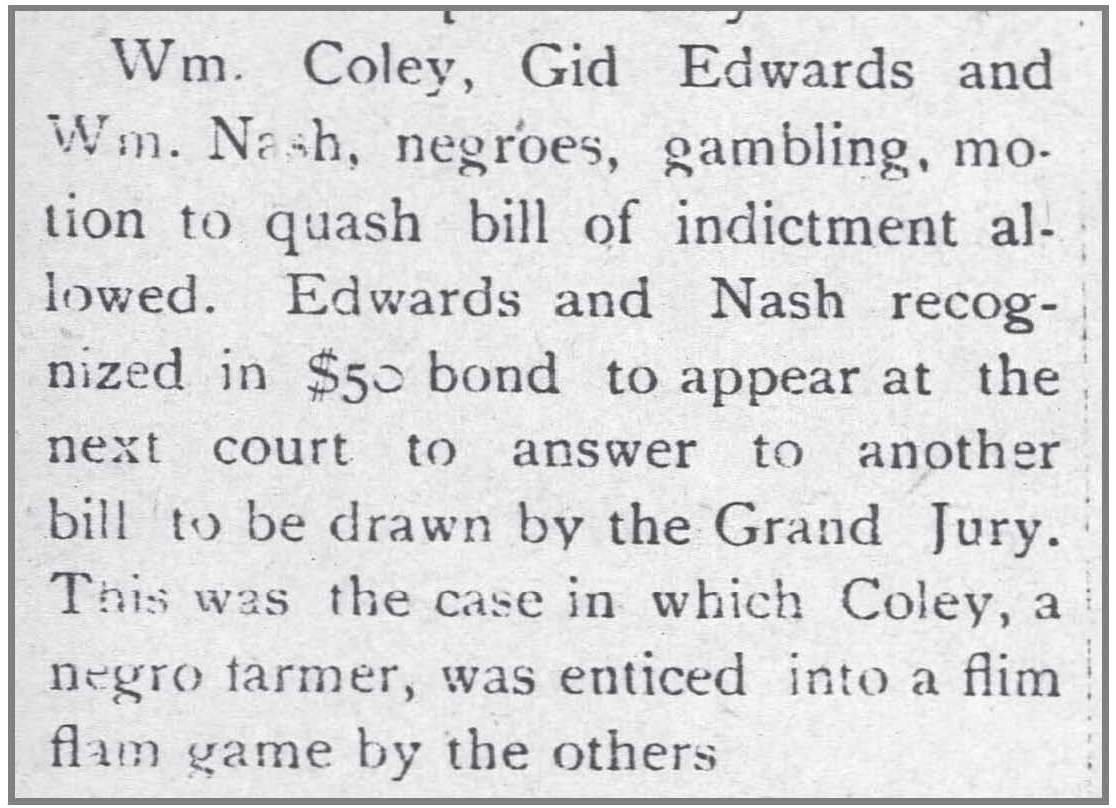
Wilson Daily Times, 26 October 1899.
The whole sorry story appeared in the 27 October 1899 edition of the paper. William Coley was Napoleon Hagans‘ oldest (perhaps) son, born about 1867 in Wayne County to Winnie Coley, and I originally thought that he was the one bamboozled. With closer reading, though, I noticed that this William Coley was still living in Wayne County in 1899 and was described as an “old negro.” Napoleon’s son was in his early 30s and living in Wilson at the time, so I’ve revised my opinion.
While I’m at it, though, here’s what I know about “my” William Coley:
I can’t find him in the 1870 census, but in the 1880 census of Nahunta, Wayne County, Winnie Coley is listed with sons Nathan, 19, and Willie, 12.
On 25 Feb 1891, Cain Artis applied for a marriage license in Wilson County for William Coley, son of Napoleon Hagans and Winney Coley, both living, and Minnie Woodard, daughter of Alfred and Sarah Woodard. The marriage was performed on 26 Feb 1891 by Presbyterian minister George Carson, with Cain Artis and Hilliard Ellis as witnesses. Cain was William’s half-brother; his mother was also Winnie Coley. Further, Cain’s father, Adam Artis, married Napoleon Hagans’ half-sister, Frances Seaberry.
In the 1900 census of Wilson, Wilson County, Willie Coley, 30, is listed with wife Minnie, 30, children Effie M., 8, and James M., 6, mother Winnie Coley, 65, and sister Zilley Coley, 38.
William seems to have been missed again in the 1910 census. Sometime between 1900 and 1920, his wife Minnie died, and he married a woman named Mary. It also seems likely that son James died during this period, as there is no World War I draft registration for him. Daughter Effie Mae married Arthur McCarter on 27 February 1910 in Wilson.
In the 1920 census of Wilson, Wilson County, living on Roberson Street: Will Coley, 50, wife Mary, 47, and granddaughters Ruth and Nannie Coley. Will worked as a public house mover. Minnie Ruth and Nannie Mae were actually McCarters, daughters of William’s daughter Effie (also known as Ethel) Coley McCarter. As I have not found Effie or her husband in the 1920 census, they may have died early as well.
Cain Artis died 23 March 1917 in Wilson County of pulmonary tuberculosis. His death certificate, for which William “W.M.” Coley provided information, noted that Cain was colored, was born March 1851 to Adam T. Artis and Winnie Coley, was married, and was a farmer.
William Coley himself died 26 Jan 1928 at the age 61 of the same dread disease that killed his brother Cain. His wife Mary Coley informed the registrar that he was the son of Pole Hagans and Winnie Coley, was a farmer, and resided at Route 3, Wilson.
Scrolling through old notes, I found two more Artises — Nathan and John — who migrated to Arkansas, probably in the 1880s.
Here’s what I know about them:
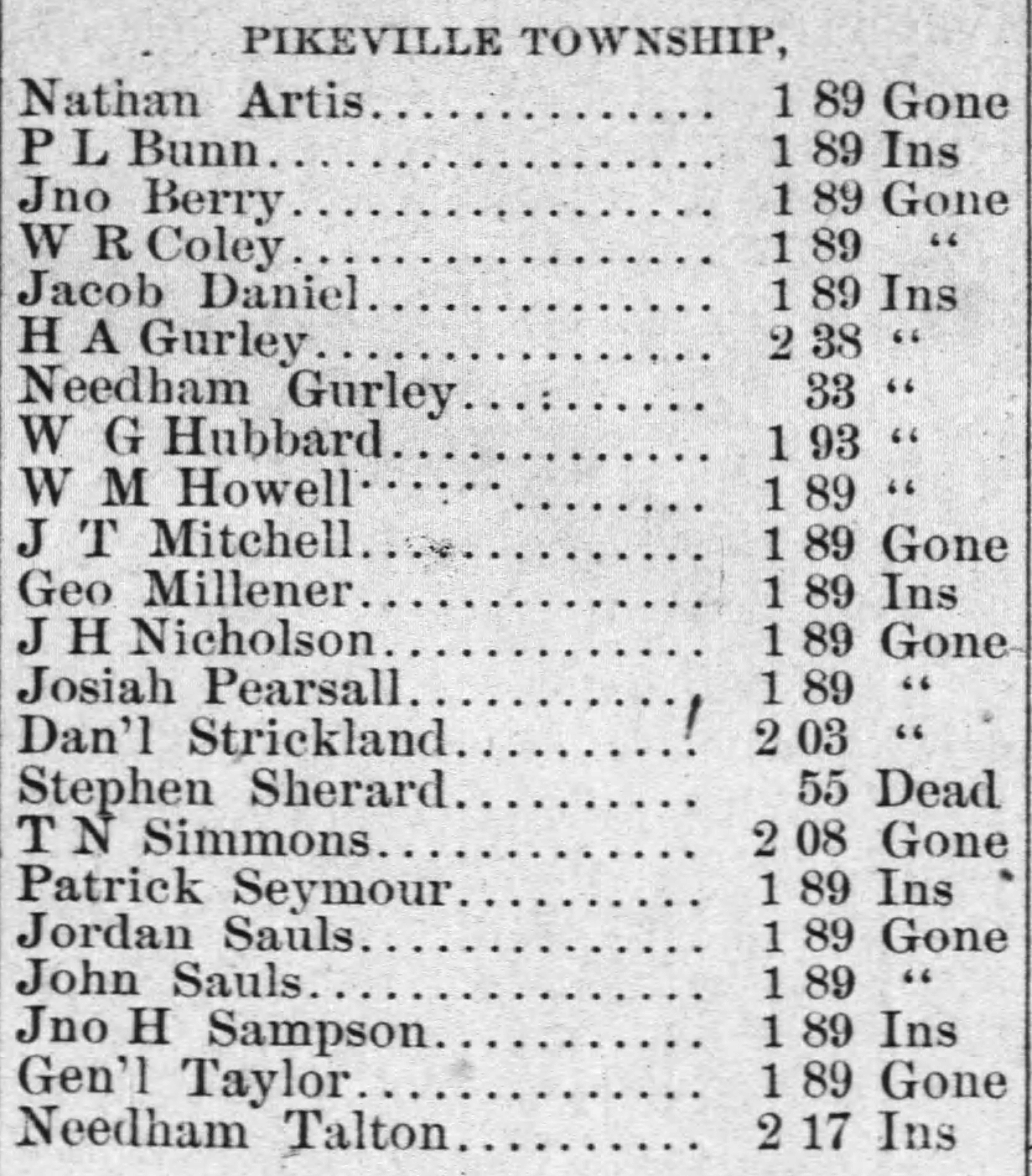
Goldsboro Headlight, 1893.
Back when I took terrible notes, I wrote this on a slip of paper: LUCY MATILDA LOVETT DIVINE.
All I remember about it is that my grandmother told me that this was the name of a Henderson relative. There aren’t any Lucys in the family, so I’m fairly certain she was talking about her grandmother — whose name actually was “Ludie” or “Loudie” and who died when my grandmother’s mother was a toddler. If I probed for more details, though, I didn’t record them.
A couple of days ago, I ran across this:

Wilson Advance, 27 July 1883.
What?!?!
I Googled “Matilda Love Divine” and found:
So what to make of this? Was Loudie Henderson really another of the “Matilda Love Divine” sisterhood? Who in the world was the original? And how did her name seize popular imagination?
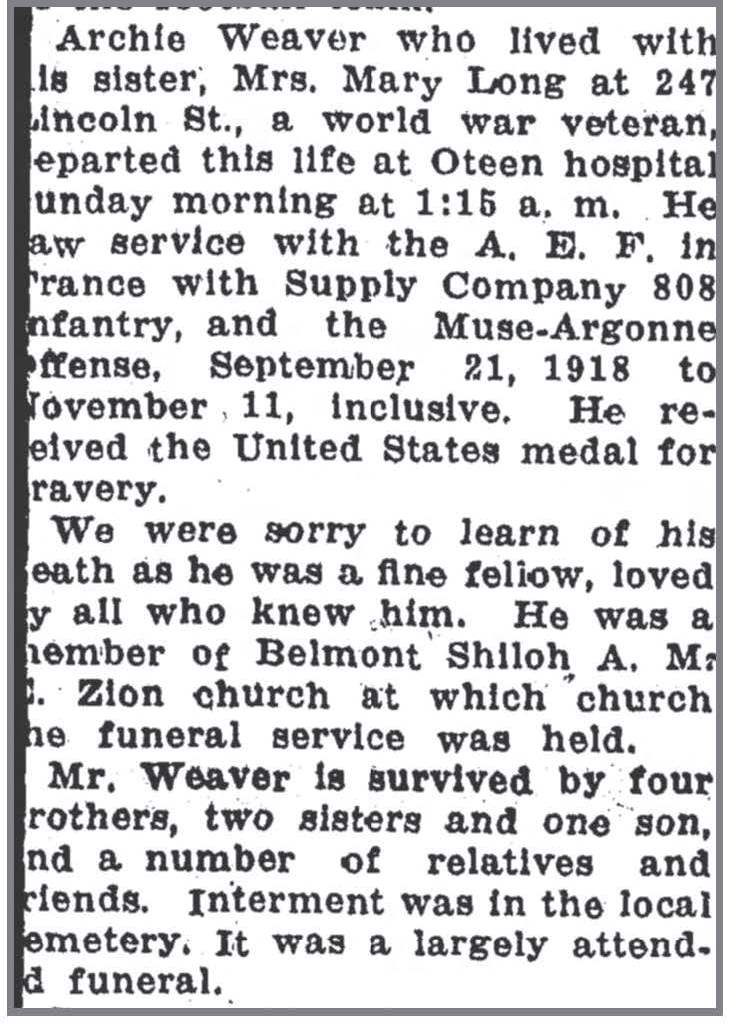
Statesville Record, 2 June 1933.
My grandmother, for one, would not have agreed with this glowing assessment of Archie Weaver as hail-fellow-well-met and certainly would have put the lie to “loved by all who knew him.”
I’ll repeat it: Jay’s daddy had TB, and he just gave it to them. To my aunt and Jay. But he lived years and years and years after both of them died. But he give them all this stuff. Oh, I could not stand him. She was my special aunt because she had boys, and she didn’t have any girls. And she just took me over her house, you know, and let me do things that girls did, you know.
In other words, for her money, Arch Weaver killed her beloved aunt Elethea and favorite cousin, Irving “Jay” McNeely Weaver. Though she was right that Arch survived “years and years and years” — eleven, to be exact — after Elethea, Jay, in fact, outlived his father by five months. No matter. They died, and much too soon for her.
Interview of Margaret C. Allen by Lisa Y. Henderson, all rights reserved.
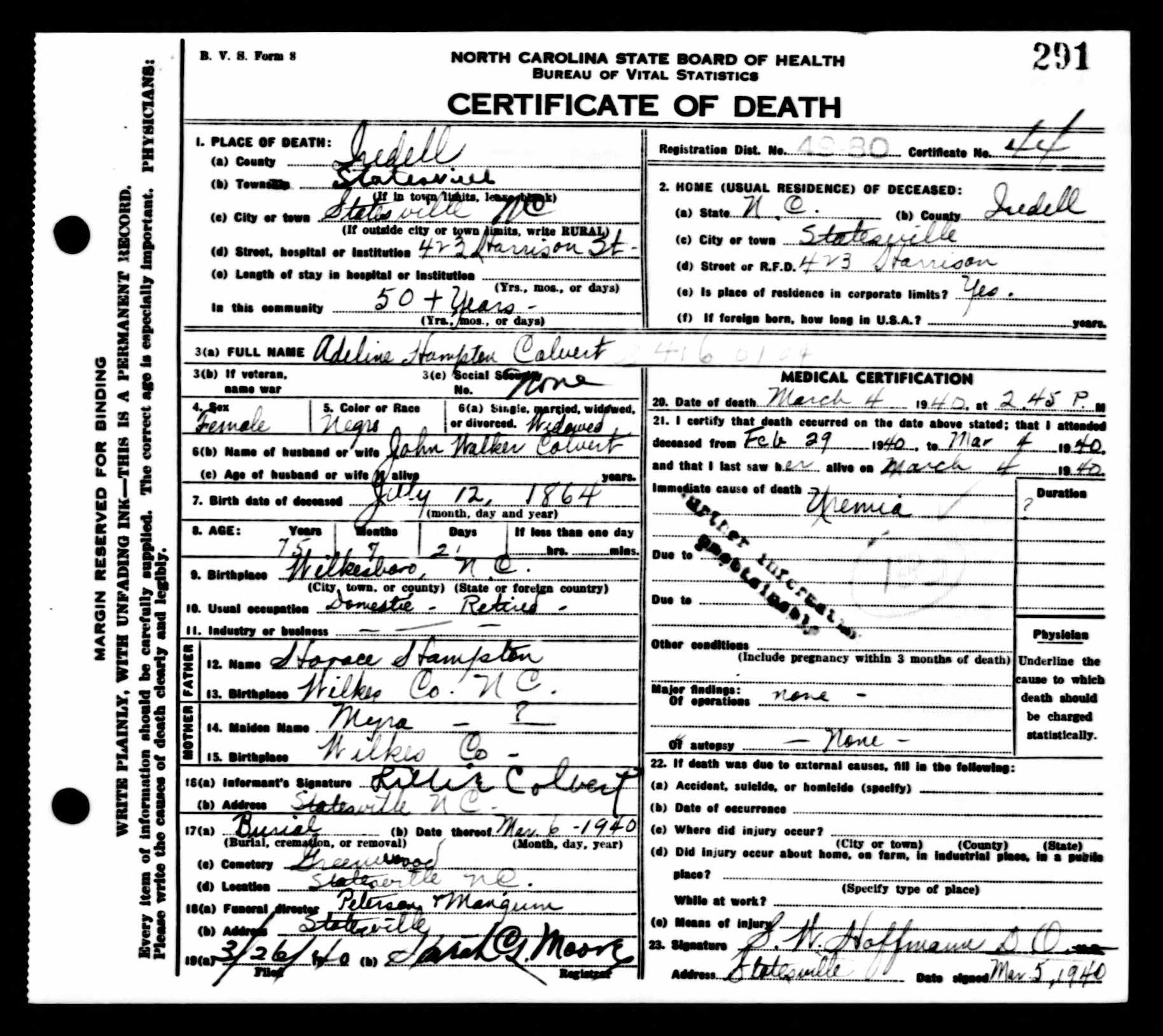
On 30 Jan 1905, in Statesville, North Carolina, my great-great-grandfather John W. Colvert married Adeline Hampton. The marriage was performed by J.H. Pressley, the same Presbyterian minister who would marry John’s son Lon and Caroline McNeely a year later. John and Adeline had had four daughters together. Selma Eugenia, Ida Mae, Lillie Mae and Henrietta were born between 1889 and 1893, and I don’t know what kept John and Addie from marrying for so long — or finally induced them to tie the knot. Separate or apart, I’ve found none in the 1900 census.
Addie’s whole family, in fact, is elusive in enumeration records. Her marriage license and death certificate reveal that she was born about 1864 in Wilkes County, North Carolina — northwest of Iredell — to Horace and Myra Hampton. (Other death certificates report Myra’s maiden name as Russell.) In the 1880 census of Wilkes, Addie appears in Wilkesboro township with her parents, younger siblings Vance, Josephine and Henry, and nephews and niece Arthur, Horace and Emma Hampton. Ten years earlier, however, in the 1870 census, Horace and Myra cannot be found, and Addie seems to be living in a household headed by much older siblings.
The 1890 census has perished, but Horace Hampton, “the veteran bridge keeper,” appears in a brief congratulatory article in the Wilkesboro Chronicle on the prosperity and good behavior of the county’s colored people.

Wilkesboro Chronicle, 14 January 1891.
Unfortunately, the family’s next mention is an obituary for Myra Hampton, which reveals a surprising number of siblings for Addie. Most of the children were adults before Emancipation, thus do not appear in census records with their parents. Also, though Myra’s age is given as “about 80,” the 1880 census suggests that she was closer to 70 at the time of her death.

Wilkesboro Chronicle, 3 January 1900.
Just over a year later, the Chronicle mocked Horace Hampton’s efforts to reclaim his position as bridge tender on the Yadkin River.

Wilkesboro Chronicle, 3 April 1901.
In June 1905, less than six months after his next-to-youngest daughter finally married the father of her children, Horace Hampton passed away.

Wilkesboro Chronicle, 14 June 1905.
Adeline “Addie” Hampton Colvert outlived her husband by almost 20 years. She is buried next to him in Green Street cemetery in Statesville.
For the better part of a year, the doings of Jonah Williams‘ daughter Clarissa regularly made the society columns of the African-American Raleigh Gazette:

Raleigh Gazette, 30 January 1897.

Raleigh Gazette, 19 June 1897.
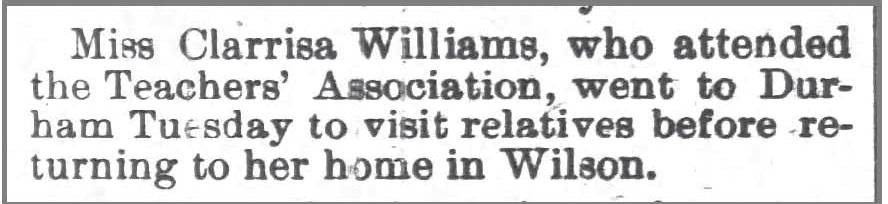
Raleigh Gazette, 26 June 1897.

Raleigh Gazette, 18 September 1897.
And then the paper folded.
More than 20 years passed before Clarissa next appeared in print. The “bright lady teacher” had fulfilled her promise and was elected principal of the Colored Graded School. Her tenure was not long, however. Clarissa Williams died of kidney disease on 26 October 1922, at the age of 51.

Wilson Daily Times, 24 September 1918.
In 1899, North Carolina passed a constitutional amendment that created new literacy and property restrictions on voting, but exempted those whose ancestors had the right to vote before the Civil War. The intent and impact of the amendment was to prevent generally poor and often illiterate African-Americans from voting, without disfranchising poor and illiterate whites:
Public Laws of North Carolina, 1899, chapter 218.
(Sec. 4.) Every person presenting himself for registration shall be able to read and write any section of the constitution in the English language and before he shall be entitled to vote he shall have paid on or before the first day of March of the year in which he proposes to vote his poll tax as prescribed by law for the previous year. Poll taxes shall be a lien only on assessed property and no process shall issue to enforce the collection of the same except against assessed property.
(Sec. 5.) No male person who was on January one, eighteen hundred and sixty-seven, or at any time prior thereto entitled to vote under the laws of any states in the United States wherein he then resided, and no lineal descendant of any such person, shall be denied the right to register and vote at any election in this state by reason of his failure to possess the educational qualification prescribed in section four of this article….
In 1902 — 112 years ago today — my great-great-grandfather John W. Aldridge, a steadfast if low-key supporter of local Republican politics, took pen in hand for a tight-jawed letter to the editor of a newspaper in the state capital:

Raleigh Morning Post, 15 October 1902.
——
The following “colored” men were among those who registered to vote in Wayne County in 1902. In accordance with Section 5, each was required to name the ancestor who “grandfathered” him in. Despite his very public protest, and his brothers’ successful registrations, John W. Aldridge’s name does not appear:
Joseph Aldridge, 36, Brogden, Robert Aldridge.
M.W. Aldridge, 45, Goldsboro, Robert Aldridge.
Robert Aldridge, 33, Brogden, Robert Aldridge.
Marshall Carter, 42, Brogden, Mike Carter. [Marshall Carter’s son Milford married John W. Aldridge’s daughter, Beulah.]
Williby Carter, 22, Brogden, Mike Carter. [Williby was Beulah Aldridge Carter‘s brother-in-law.]
H.E. Hagans, 34, Goldsboro, Napoleon Hagans. [Napoleon and Henry Hagans were the half-brother and nephew, respectively, of Frances Seaberry Artis, wife of Adam T. Artis.]
W.S. Hagans, 31, Nahunta, Dr. Ward. [William was another son of Napoleon. “Dr. Ward” was his white grandfather.]
John H. Jacob, 52, Brogden, Jesse Jacob. [Jesse and John Jacobs were the father and brother of Jesse A. Jacobs Jr., who married Sarah Henderson.]
Wiley Mozingo, 76, Goldsboro, Christopher Mozingo. [Wiley Mozingo’s daughter Patience Mozingo married Noah Artis, son of Adam T. Artis. His granddaughter Ora B. Mozingo married John W. Aldridge’s son, John J. Aldridge.]

 Scuffalong: Genealogy.