Maternal Kin, Migration, Newspaper Articles, North Carolina, Vocation

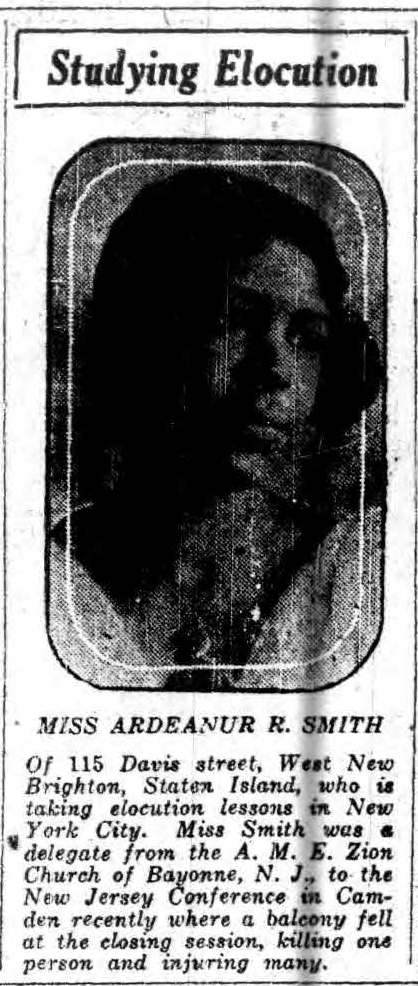
Ardeanur, elocutionist.

 Pitt_Courier_6_2_1928_Ardeanur_Smith

Pittsburgh Courier, 2 June 1928.

This brief blurb intrigues me any number of ways:

(1) Ardeanur R. Smith? This is the first I’ve seen of a middle initial for Cousin Ardeanur.

(2) Smith? My grandmother said Ardeanur married somebody she ran off with when she was a teenager. However, every mention of her I’ve found dating before 1947 — and she is elusive in official records — names her as Smith, her maiden name. In her uncle John McNeely’s 1947 obituary, she’s a Hart for the first time. I have no idea what Mr. Hart’s first name was, where they married, or how long they stayed that way.

(3) Elocution? This may absolutely be a function of me failing to ask the right questions, but, as much as I heard about Wardenur playing the organ on the radio, I never heard my grandmother speak of Ardeanur’s singing or speaking career.

(4) And who was Ardeanur’s publicist that he or she managed to get her name and photo in the Pittsburgh Courier? And not for the last time.

(5) Staten Island?

(6) “Where a balcony fell at the closing session”?!?!?

Standard
Migration, Newspaper Articles, North Carolina, Paternal Kin

That glorious climate of Arkansas.

Perhaps this sheds some light on Gus Artis and his sister Eliza Artis Everett‘s migration to Arkansas from North Carolina well after the Exoduster era:

Goldsboro_Headlight_11_6_1889_Arkansas_migrantsGoldsboro Headlight, 6 November 1889.

On 27 November 1889, the Wilson Mirror reprinted a Goldsboro Argus piece that described Williams and Herring as “railroad hirelings and speculators.” “However much the desire should be divided among our people — and by this we mean the white people — for the negro to exodus this country or remain, the solid, stubborn truth shall not be kept from the poor, deluded, half-informed negro, that this is his home, the climate of his nature; that our people are the most tolerant and generous in the world; and his best friends, and that, therefore, he should stay right here where his associations date back through the centuries; where his faults, and there are many (but who of us is without faults?) are borne with from custom; where his privileges as a free citizen are unquestioned and untrammeled, and where his destinies are linked by law with the whites, who, under a Democratic administration, have for twenty years paid 90 per cent. of his government and education, while he has furnished 90 per cent. of the crime and ignorance of the State.”

Best friends, indeed.

The 20 December 1889 issue of the Wilmington Messenger chimed in the mockery, noting that “Peg leg Williams and Silas Herring have not dissolved copartnership. Peg leg is now in [Goldsboro], and he and Silas are as active as bees in inducing the “coons” of this section to leave their homes of peace and plenty here, to go the far off miasmatic lands of the West, there to die like cattle with the black tongue.”

Robert “Peg-Leg” Williams is memorialized in 100 Americans Making Constitutional History: A Biographical History, edited by Melvin I. Urofsky. Described as the most famous and successful of Southern “emigrant agents, Mississippi-born Williams, a Civil War veteran, assisted 16,000 African-Americans in leaving North Carolina in the wake of discriminatory labor laws passed in 1889.

*Kizzy Herring Herring, who applied for her husband’s Civil War pension from Lonoke County, Arkansas, was another who left Wayne County for the West. So, I suspect was Guy Lane, Jr., son of Guy and Sylvania Artis Lane, who decamped from Wayne County to Memphis, Tennessee, sometime between 1880 and 1900. Did he just not quite make it to Arkansas? Or did he double back to the city after deciding that Arkansas did not suit?

Standard
Education, Maternal Kin, Newspaper Articles, North Carolina

David C. McNeely’s erratum.

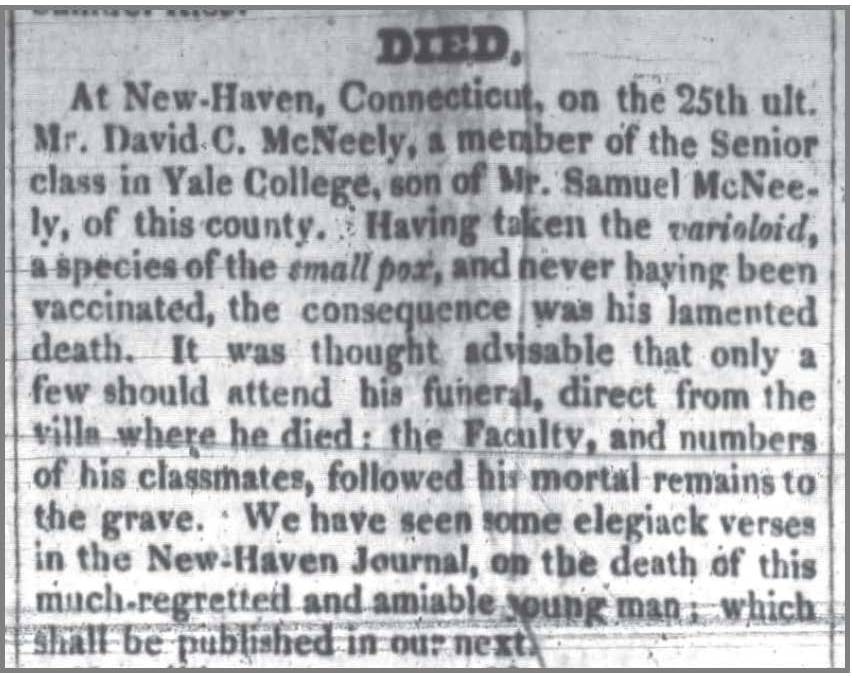
Eons ago, one of the first documents I found related to my great-great-great-grandfather John Wilson McNeely‘s family was an 1828 obituary for his brother David C. McNeely, a student at Yale College.

Western_Carolinian_4_22_1828_death_of_David_McNeely

Western Carolinian, 22 April 1828.

Wow, I marveled. There could not have been many Scotch-Irishmen from the backwoods of Piedmont North Carolina studying at Yale at that time.  What a terrible loss this must have been for John and his family. I entered David’s name into my Family Tree Maker tree alongside Samuel McNeely’s other children William and Acenith (or Acintha).

And then the other day, I found this:

Western_Carolinian_4_29_1828_David_McNeely_correction

Western Carolinian, 29 April 1828.

Oh. … Okay. … So all my sentiments hold — except the loss to John. David was not Samuel McNeely‘s son after all, but James McNeely’s.

If there was one James McNeely in Rowan County in the first quarter of the 19th century, there were a dozen, and I have been singularly unsuccessful at teasing apart and differentiating them. Evidence shows that Samuel and his son John W. had close relationships with several James. However, the will of Samuel’s father John McNeely (1724-1801) lists no heir named James, only John, Alexander and Samuel and their sister Ellinor McNeely Bell. It is past time that I pull together a chart or a list or a something that summarizes links I’ve found among these McNeelys and may reveal previously unnoticed clues.


Standard
Births Deaths Marriages, Land, Maternal Kin, Newspaper Articles, North Carolina

John W. McNeely’s heirs.

John Wilson McNeely died childless in July 1871. Or at least, you know, childless in any way that mattered to probate court. He had not made a will, so his heirs at law were his widow Mary McNeely McNeely and his two surviving siblings. His son Henry W. McNeely did not warrant notice.

In August, Joshua Miller, administrator of John’s estate, and Mary McNeely filed a Petition to sell Land for Assets against John’s brother William B. McNeely and sister Acintha McNeely or Corryer [or, as most commonly spelled, Corriher.]  McNeely’s debts totaled about $2000, and his estate was valued at only $800, of which $300 had been set off for his widow.  At death John had owned “about 235 acres on Catheys Creek in Rowan County adjoining the lands of Joshua Miller, Frederick Menus, Dr. F.A. Luckey, and others” and valued at about $7/acre.  This property was to descend to William, age 65, believed to be living somewhere Missouri, and Acintha McNeely or Corryer, age 60, living somewhere in Tennessee.

On 8 September, justice of the peace John Graham, J.M. Harrison, and S.A.D. Hart allotted a year’s provision to Mary McNeely, which included a mouse-colored mule worth $125, four horseloads of hay, 500 bundles of fodder, two hogs, one sow and four pigs, one old buggy and harness, 37 pounds of bacon, two bushels of Irish potatoes, one ax, an old washtub, one “foalding leg table,” one “old poplar cubbard & contents,” one waterbucket and washpan, a half dozen chairs, one candlestand, one bureau, an old looking glass, two beds and furniture, one small Bible, two Hymn books, four handtowels, and three “table cloth.”

William and Acintha were never located,* and, on 31 October, Joshua Miller sold the remainder of John’s personal property at auction. The items sold included a “crout” stand, 550 shingles, “sythes,” a log-chain, tanner’s knives, a cross-cut saw, ceiling-dogs, moulding planes, “clevis & strechers,” planes, “waggon cloth,” “hackel & chain oil,” a cultivator, a tar bucket, five sheep, nine hogs, a red calf, a blue calf, two cows, two horses, a mule, a bureau, mirror, a small table, two beds and furniture, a book case, a clock, two chests, two pairs of boots, shoe tools, sheep skins, a map, Scotts Bible, another Bible, a hymn book, 14 lots of books, a razor and strop, an armchair, ten chairs, one counterpane, a coon skin, two padlocks, a slate, and 240 1/2 acres of land sold at $10.80/acre for a total of $3266.19 1/4.

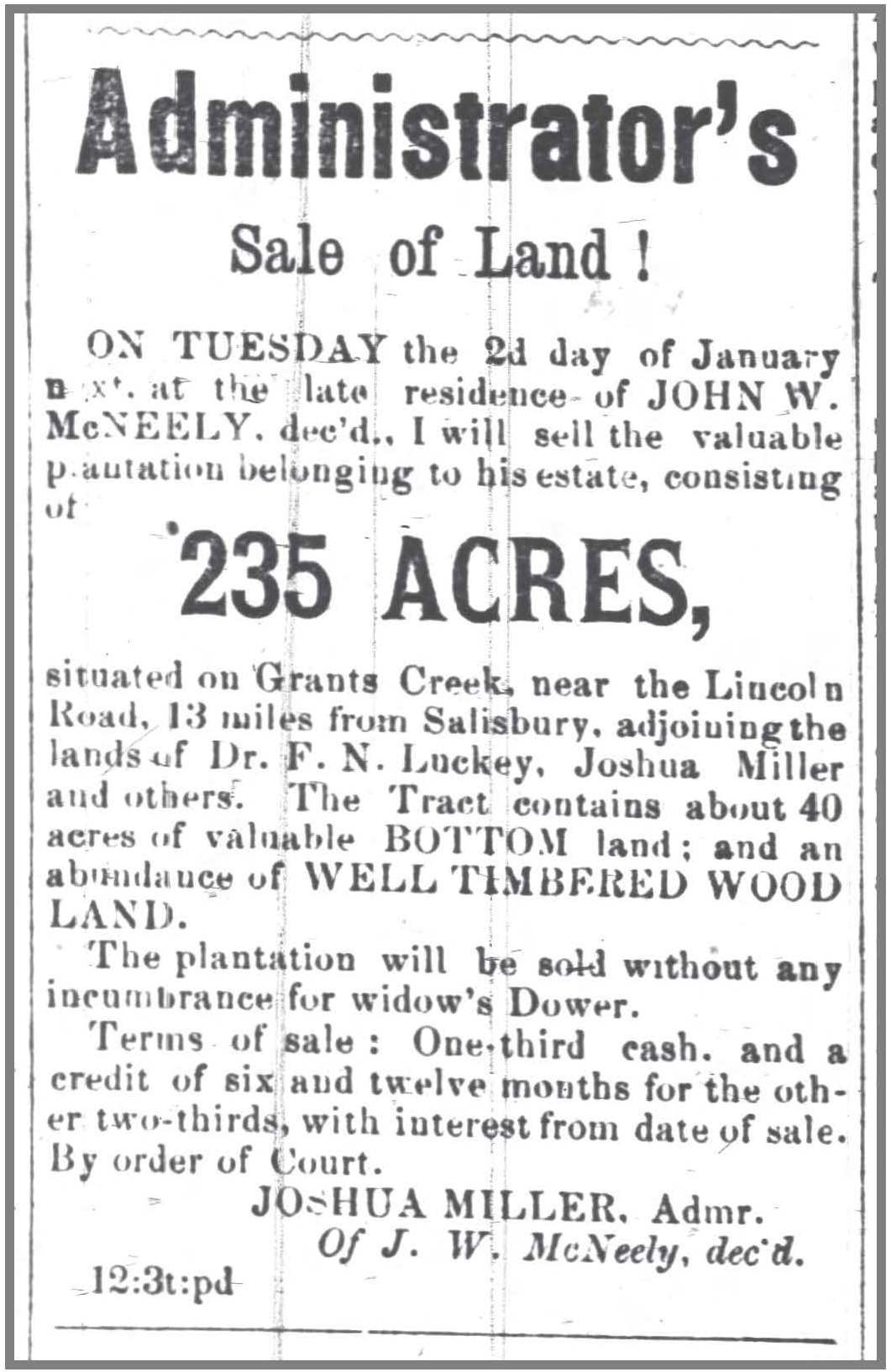
The land sale apparently did not go through, and six weeks later, Miller advertised the sale of 235 acres from John’s estate.

Carolina_Watchman_12_8_1871_Notice_Sale_JW_McNeely_land

Carolina Watchman, 8 December 1871.

It is likely that Henry McNeely’s mother Lucinda worked in John W. McNeely’s household until he died. The 1870 census of Atwell township, Rowan County, lists J. Wilson McNeely and wife Mary at household #292; Henry W. McNeely, wife and children, including a son John Wilson, at #293 (this Henry was NOT John W.’s son, though he was certainly a nephew by marriage and/or cousin); then Lucinda, her son Henry and two grandchildren at #294 and Lucinda’s son Julius, wife and nephews at #295. I have no doubt that Lucinda and her offspring lived on John McNeely’s land. Or that the sale of John’s 235 acres forced them off. By 1880, they were living just north in Mount Ulla township, where Julius bought a small farm.

*I have never found a trace of Acenith McNeely Corriher, but William Bell McNeely outlived his brother by 13 years. More later on his life in Iron County, Missouri.

Standard
Business, Newspaper Articles, Paternal Kin

Dr. Ward’s commendable enterprise.

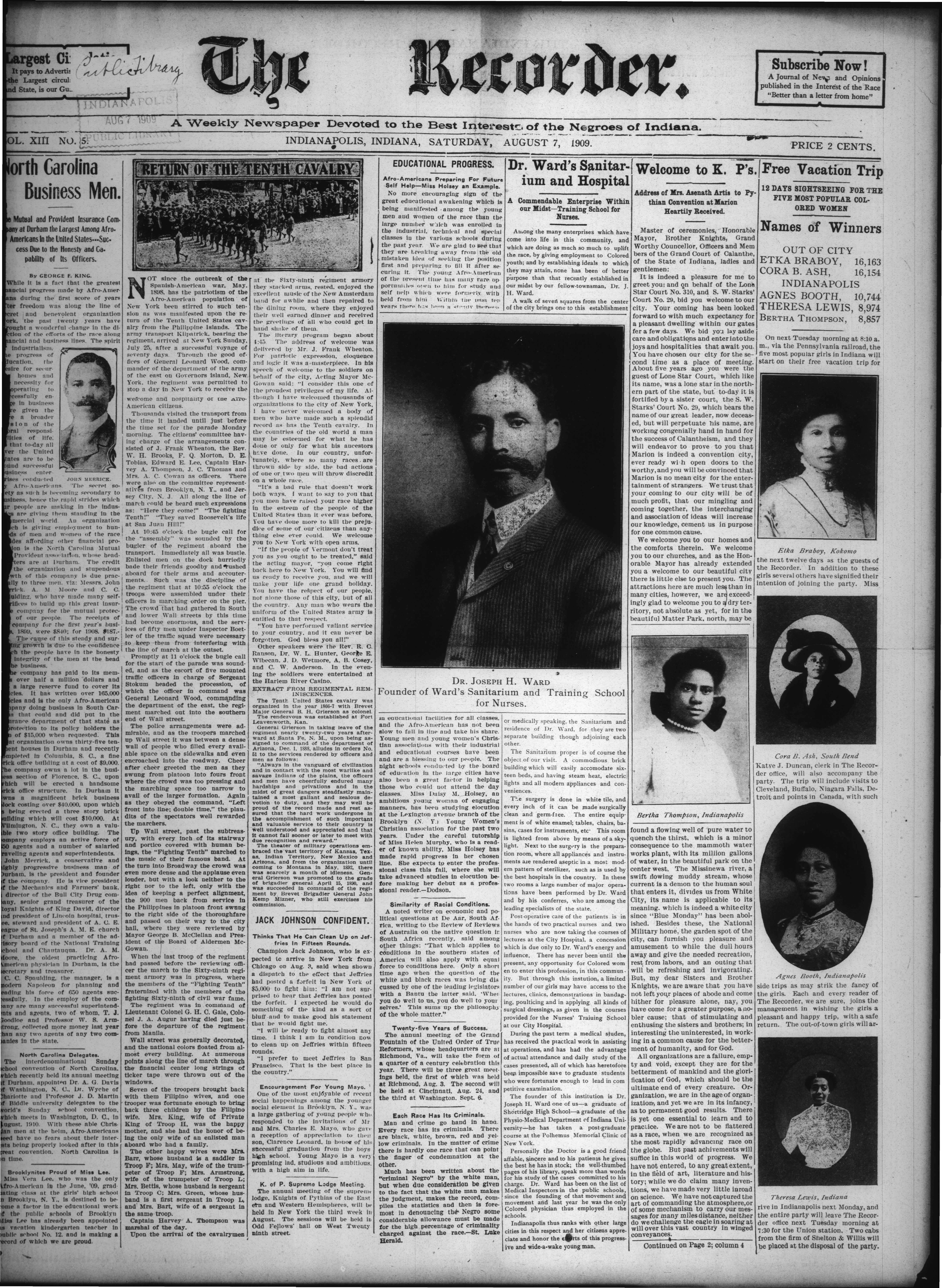
In which we learn that “among the many enterprises which have come into life in this community, and which are doing as much so much to uplift the race, by giving employment to Colored youth; and by establishing ideals to which they may attain, none has been of better purpose than that recent established in our midst by our fellow-townsman, Dr. J.H. Ward.”

JH Ward Ind Recorder 8 7 1909The Recorder, Indianapolis, 7 August 1909.


Standard
Newspaper Articles, Paternal Kin

A con man is back.

I was gobsmacked. My grandmother had a brother? A brother more than 40 years her junior? This is what my cousin’s former wife told me:

[In 2012,] a man called (and for the life of me I cannot find the slip of paper on which I wrote his name and phone number) and stated that he was the illegitimate child of Thomas Aldrich. He was trying to find out information about his family and for some reason he found me because of [my husband.] He was born in 1954 to Thomas. His mother was a young, Jewish nurse at the hospital in which Thomas practiced. Thomas was very generous and left a trust fund for his son. Therefore, when he was murdered, his son was provided for. His son currently owns 5 hotels around the country, one in Chicago, one in Los Angeles, but I cannot remember the others.

A welter of emotions overtook me. Wow. A long-lost great-uncle. A couple of times over the next eighteen months, I reached out to W. to prod her memory. In the meantime, I waited and hoped that Tom’s son would find me. Any Google search of my great-grandfather’s name will quickly link to me and my blogs, so I believed that there was a decent chance I’d hear from him. A couple of weeks ago, W. told me she’d remembered that the man’s name was Malcolm, but still could not recall more. The information was too thin for me to formulate a good search query, so I continued to wait.

And then, this week, W. emailed to say that she’d suddenly remembered this man’s last name, had looked him up, and had been stunned at what she found. There was a photo, which did not seem to match the “nearly white” appearance he’d ascribed to himself. (Did the segregated Homer G. Phillips Hospital even have white nurses?) But the clincher: Malcolm Aldrich, alias Malcolm Couch, alias a hundred other names and Social Security numbers, is a convicted felon many times over, a defendant in dozens of lawsuits, a specialist in real estate scams and schemes and general fraud. While I was waiting for a hit on my blog, Saint Louis television statement KVOM was reporting this scandalous news. And then this. Lord. And see this from 2009.

Well, damn.

It is certainly possible that Malcolm Aldrich, or Couch, or whatever, is both the son of James Thomas Aldrich [Aldridge] and a shady slickster. Either way, I’m keeping my distance.

Standard
Newspaper Articles, North Carolina, Paternal Kin

A splendid witness.

On 21 February 1903, pedestrians bustling about the streets of downtown Raleigh on a waning Saturday afternoon gazed in horror at a bleeding body crumpled in the middle of Fayetteville Street. Ernest Haywood, son of a prominent lawyer, had shot Ludlow Skinner, son of a well-known Baptist minister and “quiet and gentle as a woman,” in cold blood. (For the messy backstory, see here.) The crime, widely reported in newspapers across the state, captivated the public. Ned Barnes (1869-1912), son of Willis and Cherry Battle Barnes and brother of my great-grandmother Rachel B. Taylor, found himself thrust into the center of the months-long criminal court proceedings as the State’s star witness.

Only recently arrived in the capital, Ned was a drayman for the State Hospital, a ground-breaking psychiatric facility located just west of the city center. His duties that afternoon took him to the post office — and the very edge of the drama. Despite his evident efforts to stay out of white men’s business, he was drawn straight into the vortex.

Page_9

Sanborn Map of Raleigh, July 1903. The Post Office is the large blue building at lower right.

On 30 May 1903, the Raleigh Morning Post published Ned’s habeas corpus hearing testimony in its entirety. This serious matter required that the paper forgo the mocking dialect so often attributed to African-Americans of the era — regardless of their actual speech — and the transcript reveals an ideal witness,  straightforward, economical, willing to admit what he did not see. Ned’s language is respectful, but not obsequious. He does not take obsessive care with his “yes, sir” and “no, sir.” He answers only the question put before him and takes pains to deliver accuracy.

——

Evidence of Ned Barnes

“Examination of Ned Barnes by counsel for the defense:

Q: Ned, where did you live before you came to Raleigh?

A: Wilson, N.C.

Q: How long have you been in Raleigh?

A: About two years and a half.

Q: What is your business now?

A: Driving for the state hospital.

Q: Have you been in the employment of this institution since you came to Raleigh?

A: Yes, sir.

Q: Where were you on the afternoon of the difficulty between Messrs. Haywood and Skinner?

A: I was in the city here.

Q: Did you see it?

A: Yes sir.

Q: Tell about it in your own way. What you saw.

A: I had been up to the market taking some ladies to the market house and about four o’clock I started down to the post office to wait for the mail before going back. I drove down below the south end of the post office and turned my horse around. I placed the robe on this side and heard some one speak. I stood my carriage just above the north side of the steps near to the curbing. I saw Mr. Skinner strike Mr. Haywood on the right side of the face.

Q: How far away were you from them, just the width of the curbing?

A: Yes sir, right by the edge of the sidewalk, about 12 or 15 steps I reckon.

Q: Do you mean steps?

A: Yes sir, steps. It is wide across there.

Q: You mean just the width of the sidewalk from the little projection?

A: Yes sir.

Q: Did you hear what was said when you turned your carriage there?

A: No sir.

Q: Just as you turned your head you saw the blow?

A: Yes sir.

Q: What became of Mr. Haywood when stricken that way?

A: He staggered back against the curb which leads out from the post office and fell on his left hand, but recovered and went for his pistol and Mr. Skinner jumped back from him and raised his right hand in this position, and stopped and Mr. Haywood raised up and fired at him and Mr. Skinner wheeled and I never saw him any more.

Q: Was Mr. Skinner’s back to you on his side after he struck Mr. Haywood?

A: He seemed sideways to me.

Q: Which side was to you?

A: His right side was to me I think.

Q: Which side was towards Mr. Haywood?

A: His left side.

Q: You saw his left hand?

A: No sir, his right hand.

Q: He struck so that Mr. Haywood fell?

A: Yes sir.

Q: Did he raise his hand?

A: Yes sir.

Q: In that position Mr. Haywood fired the first shot?

A: Yes sir.

Q: He was standing this way?

A: Yes sir.

Q: How far away was Mr. Skinner from him when he fired the first shot?

A: About half way across the sidewalk.

Q: What did Mr. Skinner do when the first shot was fired?

A: He wheeled to go.

Q: Which way?

A: He wheeled this way and turned to go.

Q: After he turned to go what did he do, continue or stop?

A: I don’t know whether he stopped or not. I did not see him until I looked on my right hand side.

Q: You stayed in the carriage?

A: Yes sir.

Q: Why did you not see him after he turned to go?

A: He got behind my carriage.

Q: Which way was your horse’s face turned?

A: North towards the capitol.

Q: You say Mr. Skinner went behind your carriage?

A: Yes sir.

Q: Did you turn the carriage?

A: Yes.

Q: Where was he then?

A: He was in front of me going to the street car track.

Q: What did he do when the second shot was fired?

A: I did not see him, I was looking at Mr. Haywood.

Q: Was he off the sidewalk when the second shot was fired?

A: I don’t know I was looking at the man that had the pistol.

Q: Was it after the first or second shot that Mr. Skinner turned to go?

A: After the second shot.

Q: How far from the curbing was he?

A: About half way distant.

Q: That was after the second shot?

A: Yes sir.

Q: What part of him was at that time presented to Mr. Haywood?

A: His back was to him.

Q: After he got into the street?

A: Yes sir.

Q: Did you look at Mr. Skinner after he got into the street until he fell?

A: Yes sir.

Q: How did he go?

A: He crossed over the track then turned to his left and got to the low edge of the track and fell face first to the pavement.

Q: What became of Mr. Haywood?

A: He walked off the corner going to the Tucker building.

Q: Did you notice whether Mr. Haywood had his hat on?

A: He had it on when he passed from the sidewalk.

Q: At the time of the shooting, did he have it on then?

A: Yes sir, he got it on then.

Q: What do you mean by that, he got it on then?

A: It was knocked pretty near off and he gathered it up.

Q: Did you tell anybody about this occurrence?

A: No sir.

Q: How long was it before you told about it?

A: I did not make any atatement till I got to the asylum. Then I told Dr. Koy.

Q: Do you remember what you told him?

A: I told him I saw Mr. Skinner strike Mr. Haywood and I saw Mr. Haywood shoot him, and he didn’t ask me anything else.

Q: Did you tell any one else in town?

A: I told some one else, I don’t know who – this feller that runs the bar room, what is his name?

Q: Which bar do you mean?

A: Hamlet’s.

Q: You have told him since?

A: Yes sir, I told him.

Q: You did not tell him all the facts?

A: And I told another man, I don’t know who it is. I have seen him here.

Q: Was it Mr. Rogers?

A: No sir, it was a white man.

Q: What white man did you tell in town?

A: I don’t know his name, McDaniels or McDonald, I think.

Q: Where does he live?

A: Here in Raleigh.

Q: What is his business?

A: I don’t know, I see him around the Tucker building.

Q: Did you tell him you saw it?

A: He asked me what did you see, and I told him I did not care to make a statement. He said, “did you see Haywood shoot,” and I told him yes. I did not tell him anything else.

Q: Which Rogers did you tell?

A: He works in the Commercial building.

Q: What sort of a carriage did you have?

A: It was not exactly a carriage but was a one horse surrey.

Q: Did it have curtains on.

A: It had black curtains on.

Q: Were the side curtains off?

A: Yes sir.

Q: It was open except the back.

A: The front curtain was off I mean.

Q: It had the back curtain on.

A: The back curtain and the two back curtains.

Q: Just the width of the seat was closed?

A: Yes sir.

Q: All the others were open?

A: Yes sir.

Cross-examined by counsel for state:

Q: Where did your carriage enter Fayetteville street?

A: I came from the market to the post office.

Q: There you turned around?

A: Yes sir.

Q: How far did you come up the street before turning around?

A: Just to the end of the post office, up near the sidewalk, near the south steps.

Q: Did you turn your surrey towards the door of the court house?

A: Yes sir.

Q: Your horse’s head was where?

A: Towards the capitol.

Q: Where did you stop your horse?

A: Right there where I was.

Q: And where were you?

A: Sitting in the carriage.

Q: And where was the carriage?

A: Standing on the street.

Q: Near what part of the sidewalk?

A: Right at the edge of the sidewalk.

Q: Where was the location? Where was the horse standing?

A: Pretty near the post office building.

Q: Pretty near the front?

A: Yes sir.

Q: Near what part of the front?

A: The lower end of the south door.

Q: Where was the head of your horse?

A: Just above the lower steps of the post office.

Q: Just above the south steps?

A: Yes sir.

Q: So you had your back to the post office?

A: Yes sir.

Q: What first attracted your attention there?

A: I heard some one speak.

Q: Whom did you hear speak?

A: I don’t know which one, one of these men, I don’t know which one.

Q: Did you know Mr. Skinner?

A: I did not know him sir.

Q: Did you see him pass out of the post office building by your carriage?

A: No sir.

The following witnesses were called to prove the character of Ned Barnes, to-wit: R.G. Briggs, a manufacturer of Wilson [Ned had worked for him as a coachman]; F.W. Barnes, of Wilson; F.A. Woodard, of Wilson, former Congressman from that district; Walter Woodard, tobacco manufacturer of Wilson; Geo. D. Green, hardware merchant of Wilson; W.R. Crawford, steward of State Hospital, Raleigh.”

Three days later, in its summary of the proceedings, the Raleigh Farmer and Mechanic opined that Ned Barnes “made a splendid witness, and is an honest looking colored man, with a good face. The impression he made was excellent.”

——

The trial in State vs. Haywood unfolded in early fall. The first two weeks of October, crowds thronged the courthouse, the newspapermen among them jostling for prime spots to cover the action. Ned Barnes and other reprised their roles as witnesses, and a surprising verdict was rendered: Not Guilty.

BARNES -- Ned Barnes I

Ned Barnes, circa 1900.

No doubt relieved to move out of the glare of the spotlights trained on this notorious event, Ned returned to real life — his wife Louisa Gay Barnes; young children, Mattie (1895), Alice (1897), Ned Jr. (1900) and Howard (1902), and later Blonnie (1908) and Jerrel (1909); and work as a coachman. By 1910, however, he had given up driving, and the censustaker recorded his occupation as a porter at a club. Though a relatively young man, it is likely that his health had already begun to fail him. On the first day of December 1912, Ned Barnes drew a last breath and was released from the agony of acute uremia. He was 42 years old.

Photo courtesy of Katie C. Barnes.

Standard
Births Deaths Marriages, Education, Migration, Newspaper Articles, North Carolina, Other Documents, Paternal Kin

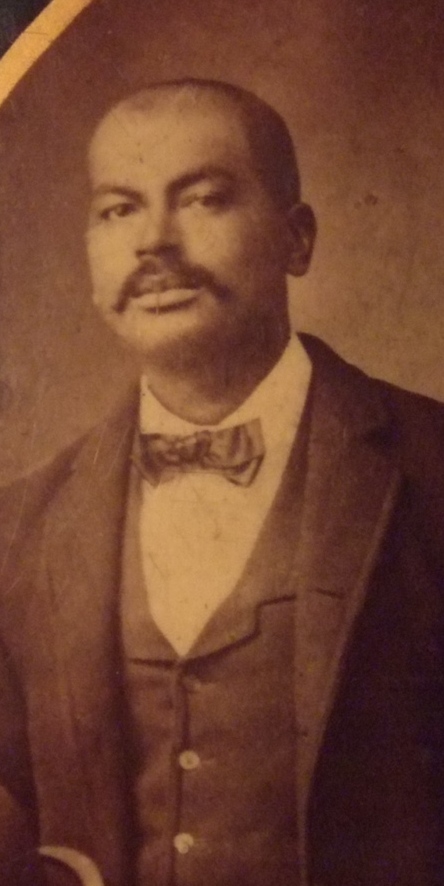
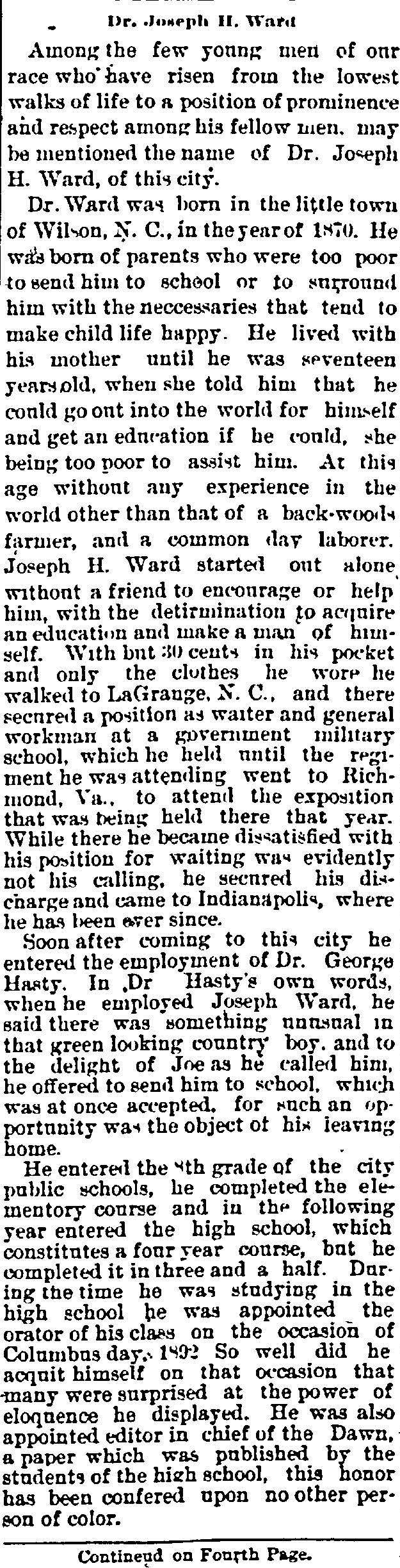
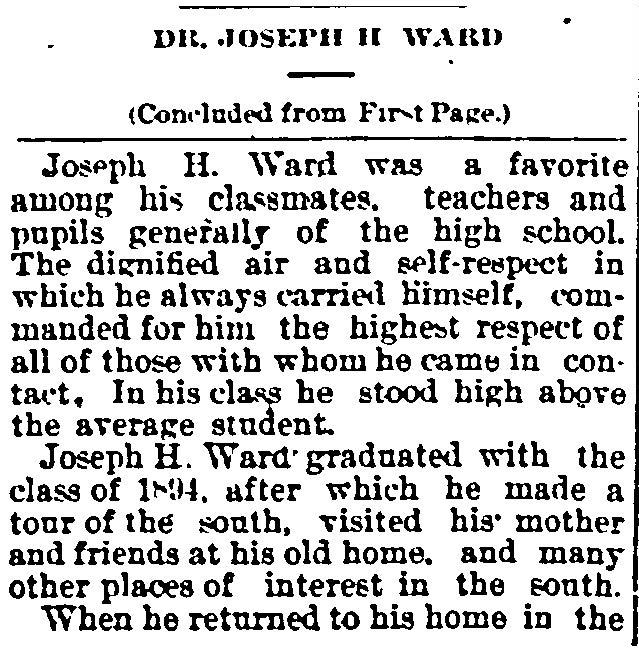
The rise of the Grand Chancellor; or “There was something unusual in that green looking country boy.”

In which the Indianapolis Freeman enlightens us regarding Joseph H. Ward‘s journey from Wilson, North Carolina, to Naptown:

Joseph H Ward Grand Chancellor Ind Freeman 7 22 1899

Joseph Ward early years 7 22 1899 Ind Freeman_Page_1

Joseph Ward early years 7 22 1899 Ind Freeman_Page_2

Joseph Ward early years 7 22 1899 Ind Freeman_Page_3

Indianapolis Freeman, 22 July 1899.

A few notes:

  • Joseph Ward’s mother might have been too poor to send him to school, but his father Napoleon Hagans, had he chosen to acknowledge him, certainly could have, as he sent his “legitimate” sons to Howard University.
  • The school in LaGrange at which he worked was most likely Davis Military Academy:  “By 1880 a second school for boys … Davis Military Academy, was founded by Colonel Adam C. Davis. “School Town” became La Grange’s nickname as the military school would eventually have an enrollment of 300 students from every state and even some foreign countries. The school also had a band, the only cadet orchestra in the country during that time. The school prospered, but an outbreak of meningitis closed it in 1889.”
  • Dr. George Hasty was a founder of the Physio-Medical College of Indianapolis, which Joseph Ward later attended.
  • Joseph graduated from High School No. 1, later known as Shortridge, an integrated institution.
  • A “tour of the south”? Really?
  • Do student records exist from the Physio-Medical College? The school closed in 1909.
  • Joseph’s first wife was Mamie I. Brown, an Indiana-born teacher. The 20 October 1900 issue of the Indianapolis Recorder reported: “Mrs. Mamie Ward, through her attorney O.V. Royal, was granted a divorce from her husband, Dr. J.H. Ward, in the Superior Court no. 1, and her maiden name was restored. Both parties are well known in society circles.” Four years later, Joseph married Zella Locklear.
Standard
Maternal Kin, Newspaper Articles, Oral History, Photographs, Virginia

Jasper Maxwell Allen.

My mother tells a story: the War was on, and her father had been sent overseas to serve. His older brother had come to Newport News for a visit, and the family gathered at her grandparents’ house. “We were in Grandma’s kitchen. I must have been about 5,” she says. “I remember it like yesterday. Of course, I knew he was a dentist, but to me he was just Uncle Mac. And I was telling everybody that I had a loose tooth, and he said, ‘Oh, let me see it.’ He put his hand by my mouth, and when he pulled it away, he opened his palm, and the tooth was in it! And I cried and I cried,” she says, laughing. “It didn’t hurt. I didn’t even feel it. But I guess I was so surprised!”

——

Jasper Maxwell Allen, the oldest son and second child of John C. and Mary Agnes Holmes Allen, was born in 1904 in Newport News, Virginia. Though he was named “Jasper” after his maternal grandfather, he was always known as “Maxwell” or “Mac.”

The 1910 census of Newport News shows the Allens at 748 21st Street.  John Allen, a painter at the shipyard, headed a household consisting of wife Mary and six children — Marion, Maxwell, Julia, John jr., Edith and Willie Allen — as well as an adopted son Jesse Jefferson (who was Agnes’ deceased sister Emma’s son.)

By the 1920 census, the family was living at 2107 Marshall Avenue in Newport News: John C. Allen, longshoreman on piers, with wife Mary, and children Marian, Maxwell, Julia, John, Willie, Edith and Nita.

Maxwell attended local elementary schools and graduated either John Marshall or Huntington High School in Newport News. He attended college at Virginia Theological Seminary and College.

In 1929, The Southern Workman, a journal published by Hampton Institute for more than 50 years, announced that on August 29 Lena P. Jeffress, who received a diploma in Education in ’28, married Mr. Maxwell Jasper Allen [sic]. Lena Poole Jeffress was the daughter of J. Murray and Lena Poole Jeffress of Charlotte Courthouse, Virginia. Presumably, Lena and Maxwell met during one of his visits home from school in Lynchburg.

A year later, the 1930 censustaker found the couple living in Washington, DC, at 3027 Sherman Avenue NW, where they boarded in the household of David Spencer.  Maxwell worked as a waiter in a restaurant and Lena as a clerk in an insurance office. It is likely that Maxwell had recently begun his studies at Howard University Dental College; he graduated in the Class of 1932.

On 2 June 1932, the Pittsburgh Courier‘s society page mentioned that a Danville couple had entertained members of a drama troupe from Virginia Theological Seminary and College. One of the performers in the play “A Servant in the House” was Maxwell Allen. [Is this the same Maxwell? I thought he was in dental school by then.]

On 16 June 1934, the Richmond Times-Dispatch reported that the Virginia State Board of Dental Examiners had announced that 34 candidates, including J. Maxwell Allen, had passed the examinations to practice dentistry in the state.

A 1934 issue of Howard’s The Dentoscope journal announced:

the-dentoscope-vol-14-sec-2

Allen’s arrival was heralded in the local newspaper : “Colored Dentist’s Office at Charlotte Courthouse.”

On 1 August 1937, the Richmond Times-Dispatch covered the 67th anniversary celebration of Morrison Grove Baptist Church, “The oldest church for Negroes in Charlotte County.” After a brief history of the church, the article noted that “[t]he Central Sunday School convention with convene at Morrison Grove Wednesday and Thursday. Member schools will have charge of the program Wednesday. Dr. J. Maxwell Allen will lead a discussion on “Training the Youths for Christian Services” and Rev. W.C. Currin will preach Wednesday night.”

On 22 August 1939, the Richmond Times-Dispatch ran a short article concerning the alleged disappearance of Maxwell Allen, “Negro dentist,” following a visit to his wife at Virginia Union University. He had been carrying a significant amount of money, and the family feared foul play. Apparently, Maxwell resurfaced without incident, and the brouhaha died down. (My mother has never heard anything about this.)

The 1940 census of Charlotte Court House lists doctor of dentistry Maxwell J. Allen, 35; wife Lena P., a public school teacher, 35; and sons Maxwell J., Jr., 8, and Cameron L., 2; as well as Margarette Brown, 8, niece. Apparently, however, Maxwell tried out a practice in Lynchburg for a few years during this stretch. In Stickley and Amowitz’ The Lynchburg Dental Society Presents One Hundred Forty-Three Years of Dentistry: 1820-1963, published in 1964: “Dr. J. Maxwell Allen was a graduate of Howard University School of Dentristry. He practiced in Lynchburg at 912 Fifth Street in 1940 and 1941, moving from here to Charlotte Court House, Virginia.”

Maxwell Sr. and Maxwell Jr.(1938) 001

 Uncle Maxwell and younger son, Cameron, circa 1939.

On 23 February 1950, in a column in the Charlotte Gazette called “News of Interest of Colored Readers”: In observance of Negro History Week, the Rev. F.L. Patterson, pastor of Morrison Grove Church, arranged a very interesting meeting. Miss Betty Smith presided. Mrs. Charles G. Blackwell spoke on “The Negro in Education.” Other speakers were Mr. G. H. Binford, on the subject “The Negro in Politics and Economics”; Rev. F.L. Patterson, on “The Negro in Religion”; Dr. J. Maxwell Allen, on “The Negro in Fraternals and Dentistry.”

On 18 Aug 1959, Newport News’ Daily Press reported: “Dr. J. Maxwell Allen Sr., Negro, a former resident of Newport News, died early Sunday in a Lynchburg hospital following a short illness.  He is the son of Mrs. Mary H. Allen and the late J.C. Allen Sr., of Newport News. Surviving, in addition to his mother, are his wife, Lena P. Allen of Charlotte Court House; two sons, Maxwell Allen Jr. and Cameron Allen of New York City; a brother, William J. Allen, Newport News; three sisters, Mrs. Julia A. Maclin, Newport News, Mrs. Edith A. Anderson, Jetersville, and Mrs. Nita A. Wilkerson, Washington; a foster brother, Jesse H. Jefferson of Baltimore; and several nieces and nephews.  Funeral arrangements are incomplete.”

Per his death certificate, Uncle Maxwell died of cancer after a twelve-day stay in a Lynchburg hospital. He would have turned 56 the day after his death.  He was buried in Charlotte Court House in Union Cemetery, just down the road from his house and office. His wife Lena joined him there in 1998.

Standard
Agriculture, Births Deaths Marriages, Business, Education, Land, Migration, Newspaper Articles, North Carolina, Other Documents, Paternal Kin, Photographs, Politics

William Scarlett Hagans.

William Scarlett Hagans, born about 1869, was the second of Napoleon and Appie Ward Hagans‘ sons. He is first found as “Snowbee” in the 1870 census of Nahunta, Wayne County, North Carolina, in a household headed by “Poland Hagans” with wife Apcilla.  (Next door was Jonah Williams, brother of Adam Artis.  Artis married Napoleon’s half-sister Frances Seaberry; they were my great-great-great-grandparents.) Two years later the censustaker reported Napoleon’s stepfather, Aaron Seaberry, with the family.

William and older brother Henry E. Hagans attended primary  school in Goldsboro. William then departed for Howard University in Washington, DC, where he completed the preparatory division in 1889, the college department in 1893 (when he was one of six graduates), and the Law Department in 1898 (from whence he received a Bachelor of Arts degree.)

In a glimpse at young William’s social life, here’s a brief from the 20 October 1888 edition of the Washington Bee: “A company of young ladies and gentlemen, composed of Misses Mamie Jones, Ella Perry, Mary Dabney, Emma Ingrim, Louise Chapman, Mamie Dorster and Messrs. St. Clairlind, E. Williston, W.S. Hagans, Benjamin Henderson, J.W. Whiteman, James Usher, H.L. Hyman, L.A. Leftwich, spent an evening of pleasure at Miss E. Alley Thornton’s residence with her uncle, Rev. W.H. Howard, No. 77 Defrees street northwest.”

On 27 September 1894, the Goldsboro Daily Argus printed an article about the confused state of affairs among Wayne County’s Republicans, noting that “old-line leaders” like Napoleon Hagans, Rev. C. Dillard and E.E. Smith opposed “fusion” with Populists. The piece also noted that Will S. Hagans had been nominated to “legislature.”

The 1895-96 Report of the Superintendent of Public Instruction included a report from A.L. Sumner, principal of the State Normal School at Goldsboro, who noted that the school enrolled 172 students from 13 counties. “The Dorr Lyceum [a mandatory Friday evening lecture] was placed under the supervision of Prof. W.S. Hagans. In this association the students were taught to appreciate, write and speak the masterpieces of our literature, to write essays and debate, and were made acquainted with the meanderings of parliamentary usage.” The school’s catalogue for that year listed as faculty Sumner, Miss L.S. Dorr, and W.S. Hagans, who taught Classical Latin, Natural Philosophy, Theory and Practice of Teaching, Arithmetic, North Carolina History, etc. [Sumner was also editor of the Headlight, a Baptist-affiliated newspaper that published wherever Sumner moved for work.]

Per the 21 May 1896 issue of the Mecklenburg Times, at the state Republican convention, W.S. Hagans was elected alternate delegate to the national convention.

On 20 March 1897, the Raleigh Gazette, in an article about a reception in Goldsboro for African-American state senator W. Lee Person of Hickory, noted that Professor W.S. Hagans “spoke in high terms of commendation and praise of the Senator and his colleagues, and assured them that the colored people of Goldsboro were wedded to them, and would ever honor them for the record made for their race in the General Assembly of the State.”

On 5 June 1897, the Raleigh Gazette commented: “We certainly regret to hear that our friend, Prof. W.S. Hagans of Goldsboro, was not endorsed for the postmastership there. He certainly is worthy of the place. We hope to see him appointed to some good salaried place in Washington yet.”

On 27 June 1898, William S. Hagans, 27, married Lizzie E. Burnett, 23, in Nahunta, probably at the Hagans house. Presbyterian minister Clarence Dillard officiated and neighbor J.D. Reid, brother H.E. Hagans, and sister-in-law J.B. Hagans witnessed. Burnett was a member of the large and locally prominent Burnett family, but her parentage is not clear.

BURNETT -- Lizzie Burnett Hagans

Lizzie E. Burnett Hagans

Lizzie Burnett Hagans gave birth to a daughter Daisy in about 1898. She died in infancy.

The 19 January 1899 edition of the Washington Evening Star ran a breathless review of the season’s judicial reception at the Taft White House. The lengthy recitation of invited guests included Mr. W.S. Hagans.

On 21 March 1899, Henry Hagans and William S. Hagans received proceeds from the partition of about 476 acres in Nahunta township, Wayne County, belonging to the estate of the late Napoleon Hagans.

William and Lizzie Hagans welcomed a daughter, Susan A., in September 1899. The child was named for Lizzie’s mother. (And the A perhaps was for “Apsilla,” William’s mother.)

On 11 October 1899, William purchased from Minnie and Effie Morgan a lot on Oak Street in Goldsboro adjoining that of Lizzie E. Hagans.

On 28 October 1899, the Colored American noted that William S. Hagans “has returned from Goldsboro, where he attended the funeral of a relative. Mrs. Hagans accompanied her husband here, and apartments have been taken at No. 1524 O street northwest.” (Whose funeral?!?!)

On 9 December 1899, in a short article titled “Mr. White as Host,” The Colored American informed all that “Thanksgiving tide was made more joyous by the genial and whole-souled hospitality dispensed on Thursday evening of last week by Congressman George H. White at his handsome home, 1418 18th street northwest. … Those who sat at the festal board were Register [of U.S. Treasury] J.W. Lyons, Recorder H.P. Cheatham, Ex-Senator John P. Green, Major Charles R. Douglass, Messrs. John H. Hannon, Henry Y. Arnett [clerk to Cheatham], S.E. Lacy, W.S. Hagans, Lewis H. Douglass and R.W. Thompson.”

A month later, on 13 January 1900, the Colored American announced that “Mr. W.S. Hagans has returned from a holiday visit to his home at Goldsboro NC.  The great prominence of Congressman White and the voluminous mail occasioned by it, is keeping Mr. Secretary quite busy these days.”

On 24 February 1900, the Washington Bee ran “A Pen and Pencil Club: Washington’s Literati Form an Organization for Mutual Improvement and Promotion of Good Fellowship” a “brilliant coterie of journalists and writers” met at the Southern Hotel and organized the nucleus of  the Pen and Pencil Club. Editor T. Thomas Fortune was placed on the honorary roll, reserved for “prominent out-of-town scholars and penman.” Active members L.H. Douglass [Lewis Henry Douglass, son of Frederick Douglass and Civil War Union officer], J.W. Cromwell [John Welsey Cromwell, educator, lawyer, journalist], C.R. Douglass [Charles Remond Douglass, son of Frederick Douglass], C.A. Fleetwood [Christian A. Fleetwood, major, U.S. Colored Troops], E.L. Thornton, T.J. Calloway [Thomas J. Calloway, journalist], E.E. Cooper [Edward E. Cooper, editor, Colored American], W. Calvin Chase [William Calvin Chase, lawyer, editor of the Washington Bee], A.L. Manly, Paul H. Bray, S.E. Lacy, F.G. Manly, J.N. Goins [journalist], J.G. Clayton, J.H. Wills, W.L. Pollard, John T. Haskins, W.M. Wilson, W.O. Lee, A.O. Stafford [Alphonso O. Stafford, folklorist, teacher], W. Bruce Evans [physician and educator], W.L. Houston [William L. Houston, attorney], Lucien H. White [music critic, editor], H.P. Slaughter, Kelly Miller [mathematician, “The Bard of the Potomac”], C.W. Williams, J.H. Paynter [John H. Paynter, journalist/author], W.C. Payne [vice-presidential candidate, National Liberty Party, 1904], W.S. Hagans, R.H. Terrell [Robert Herberton Terrell, lawyer, teacher and later judge] and others.

In the 1900 census of Goldsboro, Wayne County, the censustaker recorded William B. Hagins (November 1872), wife Lizzie E. (April 1874), and daughter Susan (August 1898).  William is listed as white; his wife and daughter as black.

On 3 May 1900,  in an article titled “Hagan’s Win Out,” the Goldsboro Weekly Argus noted that Will S. Hagans had been elected to the Republican district executive committee and his brother Henry E. Hagans as a delegate to the national convention.

In 1902, W.S. Hagans, age 34, registered to vote in Wayne County under the state’s grandfather clause. He named “Dr. Ward” as his qualifying ancestor. David G.W. Ward, a physician in Wilson County, was William’s maternal grandfather. William could have named his father Napoleon (as did his brother Henry), and I am certain the choice was deliberate.

On 7 October 1902, the Winston-Salem Journal reported that “leading negroes have issued a call for a negro convention to be held on October 16 in Raleigh to put out a ticket against the Republicans. The call expresses indignation at the treatment negroes are receiving at the hands of Republicans and heaps abuse on Senator [Jeter C.] Pritchard, who, they declare, must be defeated at all hazards. The following negroes sign the call: Jas. E. O’Hara, Scotland Harris, H.P. Cheatham, W. Lee Pearson, R.W.H. Leak, W.S. Hagans, S.G. Newsom, W.F. Young.”

Daughter Eva Mae Hagans was born 1 January 1903 in Goldsboro.

On 31 January 1903, the Colored American shone a spotlight on Goldsboro, “a progressive little town of 8000 inhabitants. It is historic,” it claimed, “for the peaceful relations existing between the races. The chief occupation of its people is trucking. Yet we have negroes who are rapidly forging their way to the front along all industrial lines. Our people own thousands of acres of forming land, as well as excellent city property…. Prof. H.E. Hagans, the principal of our State Normal School and also a farmer, is worth $20,000. Mr. W.S. Hagans, who is one of the most successful agriculturalists, is worth $20,000. …”

On 9 May 1903, The Colored American reported “Mr. W.S. Hagans, who has made a host of friends among Washingtonians by his genial bearing and sterling qualities, will indulge in an extensive hunting expedition in and about his North Carolina home during the Xmas holidays.  He will have as his guests Congressman White and Recorder Cheatham.”

Wm S Hagans in Goldsboro with dogs

William S. Hagans, perhaps with hunting dogs, Goldsboro.

On 13 January 1904, William S. Hagans purchased 38 acres in Wayne County from J.D. Reed [sic] and wife. Reid grew up with William near Fremont, had been a witness at his wedding, and was principal of the Colored Graded School in the nearby town of Wilson.

On 20 January 1904, W.S. Hagans and wife Lizzie deeded 25 acres to J.W. Johnson. This land had been purchased by Napoleon Hagans in 1883 from J.W. Aycock and wife Emma, B.F. Aycock and wife Sallie, and O.L. Yelverton and wife Susan G. for $270. The property was located on the “public road leading from Sauls Crossroads to Bull Head.”

On 9 June 1904, West Virginia’s Charleston Advocate ran an editorial by R.H. Thompson titled “In the National Field/ The Lily-White Situation in The South as Viewed through Northern Glasses.” In it, he decried the state of the Republican Party.  “… The action of the North Carolina republican convention was a crime. The summary turning-down administered to such war-horses as John C. Dancy, Henry P. Cheatham, James E. Shepard, Samuel H. Vick, J.E. Taylor, Isaac Smith, W.S. Hagans and others has been an outrage that requires an emphatic prefix to fittingly characterize it. Not a solitary colored man of all of North Carolina’s able gallery of political lights was chosen as a delegate to the national convention. Time was when the race’s political sun set in the piney woods and moonshining camps in the Blue Ridge mountains, but the ill-fated ascendancy of Jeter C. Pritchard and his coterie of lily-whites has gradually dimmed the luster of the Tar Heel Negro constellation, now there are few so poor to do it reverence. George H. White was wise in moving his lares and penates to the hospitable shores of New Jersey, and it is a mercy that the tired frame of John Hannon went over to its lasting place ere his failing eyes witnessed the downfall of the house of cards he and his faithful allies had created as so ruinous a cost. …”

Daughter Flora Irene Hagans was born in 1904, and Rosalie Lorene Hagans in 1907.

On 16 May 1907, William S. Hagans contributed a lengthy column to the Washington Post entitled (and subtitled): “At Issue with Adams/ Goldsboro Man Reviews Politics in North Carolina/ Hopeless for Republicans/ ‘Lily White’ Faction Arraigned for Treatment of Colored Vote – Conventions Held on Trains to Trick the Negroes – Ingratitude Alleged – 20,000 Colored Votes Will Not Submit.” Which pretty much sums up the article, which is aimed at rebutting comments made in an interview with Judge Spencer B. Adams of North Carolina. “Where you find the negro voting at all, he is doing as he has always done — voting the Republican ticket or the ticket that goes by that name. He is just as much a Republican in this State to-day as every, but that he is not so enthusiastic cannot be denied. This can be easily explained. It has been the custom in this State ever since the enfranchisement of the negro for him to follow the lead of a few white men calling themselves Republicans. He expected and got this leadership before the adoption of the Constitutional amendment in 1900, which disfranchised a large majority of colored citizens. Those who happened to be spared from the operations of this new law still looked for this same leadership but found it not — a clear case of being left in outer darkness.”

At the heart of Wayne County Superior Court proceedings stemming from the suit in J.F. Coley v. Tom Artis (1908) was a dispute over 30 acres of land.  Thomas “Tom Pig” Artis began renting the property in 1881 from W.J. Exum.  In 1892, Exum’s widow Mary sold it to Napoleon “Pole” Hagans.  In 1896, after Napoleon’s death, the land passed to his sons Henry and William S. Hagans.  In 1899, Henry sold his interest to his brother.  In 1908, William S. Hagans sold the 30 acres to J.F. Coley.  Coley filed suit when Tom Artis laid claim to it, arguing that Napoleon had sold it to him.  Tom claimed the 800 lbs. of cotton he tendered to Napoleon (and later, son William S. Hagans) was interest on a mortgage, but William Hagans and other witnesses maintained the payment was rent.  William Hagans testified that his father was in feeble health in 1896 when he called his sons together “under the cart shelter” to tell them he would not live long and did not know to whom the land would fall.  William testified that Pole asked them to let “Pig” stay on as long as he paid rent, and they promised to do so.  The court found for Coley and against Artis.

On 4 February 1909, the Goldsboro Weekly Argus announced that Will S. Hagans, “one of our best-known and most reputable colored citizens and who owns one of the best farms in the county, has been invited by the inaugural authorities at Washington to officiate as a marshal at the inauguration of President-elect Taft.” The article noted that the selection was particularly significant as Hagans had been “squelched” the local Republican chairman who selected “lily-white” delegates to the convention.

On 17 April 1909, the Indianapolis Freeman printed a nice, but erroneous, article lauding well-educated negro farmers and citing as prime example William S. Hagans, a Harvard graduate. William, of course, was no such thing. He was a proud graduate of Howard University. [Might his half-brother, Indianapolis physician Joseph H. Ward, have commented upon this mistake?]

On 19 May 1909, the Charleston (West Virginia) Evening Chronicle announced that Prof. William S. Hagans of Goldsboro would address the exercises of the Agricultural Literary Society during the tenth annual commencement at North Carolina Agricultural & Mechanical College for colored youth in Greensboro May 23-27.

On 3 June 1909, the New York Age reported that W.S. Hagans of Goldsboro had delivered the principal address at the exercises of the Agricultural Literary Society. Hagans was “one of the most successful and prosperous farmers” in North Carolina.

In the 1910 census of Goldsboro, Wayne County: W.S. Higgins [sic], 38, wife Mrs. W.S., 36, and children Sussie A., 11, Eva, 9, Flora, 6, and Loraine, 3.  All are listed as white.

Son William Napoleon Hagans was born 16 May 1910.

On 14 December 1911, the Greensboro Daily News covered a meeting of 750 members of the Grand Lodge of F. & A. A.M. “Prominent negroes” attending included Archdeacon H.B. Delaney, Prof. W.S. Hagans, C.C. Spaulding and ex-Congressman H.P. Cheatham.

On 7 August 1912, Will S. Hagans was listed on page 9 of the “List of Coloed [sic] Pole Tax paid by May the first for Nahunta Township,” which is now found in Wayne County Voting Records at the North Carolina State Archives.

Sometime during 1913, William Hagans moved his family from Goldsboro to Philadelphia, Pennsylvania. They settled in a rowhouse at 650 North 35th Street, and William entered the real estate business. Lizzie was probably already pregnant with their seventh child, but neither she nor the boy would live to know their new city. On January 11, 1914, Lizzie gave birth to a stillborn son, whom she and William named Henry Edward, after William’s brother. Eleven days later, Lizzie died of double pneumonia and nephritis, conditions brought on or exacerbated by her having carried a dead fetus for five weeks. She and little Henry were buried in the same grave in Eden Cemetery, just outside Philadelphia.

On 25 November 1914, the Weekly Argus ran a lengthy letter to the editor from “one of Wayne County’s best known colored citizens and properous land owners, as was his father before him” — none other than Will S. Hagans. After a self-effacing reference to “looking after his little affairs,” William gave a number of flattering nods to prominent citizens and to “the magnificent new court house.” He proclaimed his fondness for Goldsboro and asserted that only a desire to give his children the “very best school advantages” had compelled his move North. (One suspects, however, that much more in the state’s tense political climate was at play.)

Gboro_Weekly_Argus_11_25_1914 WS Hagans Good Citizen

On 26 January 1916, William Hagans sold his first cousin William M. Artis and wife Hannah two tracts on Turner Swamp in Nahunta township totaling 68 acres.

In the 1920 census of Philadephia, Pennsylvania, at 643 North 34th [sic, should read 33rd] Street, 49 year-old widowed real estate broker William S. Hagans and his children Eva M., 17, Flora I., 15, Rosalie L., 12, and William N., 9, all described as mulatto and born in NC.  Hagans owned this home, a three-story rowhouse in the Mantua neighborhood that is still standing.

William Hagans' children after 1913

William’s children Rosalie, Eva, Susan, Flora and William, Fairmount Park, Philadelphia, circa 1916.

The 10 November 1921 edition of the Philadelphia Inquirer reported that the Court of Common Pleas awarded $750 to Lillian Wolfersberger, who sued William S. Hagans for injuries received at 36th and Powelton. Wolfersberger, who was blind, was being led across the street when she was struck by Hagans’ vehicle.

In its 29 December 1925 issue, the Pittsburgh Courier announced that William S. Hagans was elected president of the Citizens’ Republican Club with no opposition. “Mr. Hagans is popular and competent and a banner year is anticipated by the Citizens.” He was reelected to the office several times.

On 16 March 1929, according to the Pittsburgh Courier, the Citizens’ Republican Club president William S. Hagans appointed a committee to discuss ways to form a “Big Brother movement” in Philadelphia. “The need for such an organization is apparent because the white society have no provision for handling Negro cases.”

In the 1930 census of Philadelphia, at 643 N. 33rd Street, widowed real estate broker William S. Hagans, 59, and children Flora I., 26, public school teacher; Lorena,23, real estate stenographer; and William N., 19, all described as white.  All born in NC, but children’s mother’s birthplace listed as NY.  The house was valued at $8000.  The Haganses were the only “white” family on the block.  All others were Negro.

On 18 January 1930, the Pittsburgh Courier ran an article lauding the Citizens’ Republican Club’s hosting a “fanfest and fed” for “varsity football players of color” from Philadelphia high schools. Dr. Charles Lewis, “father of the Howard-Lincoln classic … for the first time

In 1930, Alfred Gordon, M.D. published an essay titled “Frederick Douglass Memorial Hospital and Training School” in a slender volume called Philadelphia: World’s Medical Centre. After setting forth the history of the hospital, Gordon named W.S. Hagans as a member of its Board of Managers.

The Scranton Republican on 15 October 1931 reported that Governor Pinchot had announced the termination of 43 employees in an reorganization of the department of labor and industry. Among them: William S. Hagans, special investigator, Philadelphia, whose salary was $1000.

On 18 January 1932, the Delaware County Daily Times reported that a special committee of the Pennsylvania State Negro Council had presented to the state superintendent of public schools a resolution calling for the establishment of a vocational school in Philadelphia. William S. Hagans, president of the Citizens Republican Club was a committee member.

On 27 September 1932, the Harrisburg Telegraph reported that the Republican state chairman had appointed a Colored Voters Advisory Committee for the current campaign. Members included William S. Hagans of Philadelphia.

In 1933 in Philadelphia, William married Emma L. Titus. The Great Depression dealt the couple crippling blows, and William lost his home and other holdings. In the 1940 census of Philadelphia, at 650 – 57th Street, realtor William Hagans, 65, was renting an apartment for $40/week with wife Emma, 40, a public school teacher, and mother-in-law Ellen Titus, 70. (Assuming this address is North 57th, William’s final home was a flat in a three-story rowhouse just two blocks from the house my grandmother later owned at Wyalusing and North 56th.)

William Scarlett Hagans died in 1946 in Philadelphia.

Wm Scarlett Hagans portrait

William S. Hagans.

Personal photographs courtesy of W.E. Hagans and W.M. Moseley. Other sources as cited.

Standard