DNA, Maternal Kin, North Carolina, Photographs

L2 Legacy. (And well wishes!)

My niece turned 18 today. She’s the only one of my grandmother Margaret Colvert Allen‘s great-grandchildren to carry her mtDNA haplotype — L2d1a. I’m feeling some kind of way about that, and I shared my wistfulness with a group of researchers with whom I’m fortunate to co-administer a Facebook genealogy group. J. immediately replied that I should consider taking an mtDNA Full Sequence test at FTDNA. Though in the immediate sense the test is of limited genealogical use, as she wisely pointed out, the mtDNA database will never grow if none of us contributes to it.

Arising approximately 90,000 years ago, L2 is one of the oldest of the matrilineal haplogroups and is the most common African lineage.  L2d1a, however, is a relatively rare subclade. Google it, and three of the top five references are to this blog. I have no children and will not pass along Martha M. McNeely‘s matrilineage in that way. However, I can contribute to the understanding of its history and keep Martha’s legacy alive otherwise. Stay tuned, and Happy Birthday, S.D.J.!

18557_306271948526_5300904_n

Martha Margaret Miller McNeely’s L2d1a progeny — my grandmother, my sister, my niece, my mother, 1998.

Standard
Agriculture, Land, Newspaper Articles, North Carolina, Paternal Kin

No need for exodusting.

Napoleon Haganstestimony before a Senate committee was not his last word on the migration of African-American farmers out of North Carolina. Nine months later, he — or someone for him, in any case, as he was unlettered — penned a letter to the editor of the local newspaper, recounting his agricultural success and exhorting his “race” to cast down their buckets where they were. His sentiments were echoed by Jonah Williams, his friend, neighbor, pastor and brother-in-law’s brother. (Jonah, too, was illiterate. Both men, however, were strong believers in the value of education and saw that their children received the best they could afford. See here, here and here.)

Goldsboro_Messenger_12_30_1880_exodusting

Goldsboro Messenger, 30 December 1880.

Standard
Births Deaths Marriages, Maternal Kin, North Carolina, Oral History

Collateral kin: the Daltons.

Me: And you said he looked just like your dad. Your dad looked just like his father.

My grandmother: Papa looked just like him. And one thing, with all that white in him, he was brown like Grandpa.

Me: Unh-uh.

Grandma: And I don’t know who Mat and Golar and Walker’s mother was, but Walker was real dark. But handsome. Honey, he was one beautiful child and had this pretty hair. Curly. And it wouldn’t even keep a part or nothing in it. And he came home one time, and he had cut this part, cut this place through his hair. And he said his friends had parts in their hair, but his was so curly it wouldn’t stay. So he had to cut this part. Another time, that was just after Mama had married Papa. And she was just so crazy ‘bout him, he was such a pretty little boy. And she made him this velvet suit.

My aunt L.: Who, Walker?

Grandma: Walker. Fauntleroy. You know what a Fauntleroy suit is?

Me: Mm-hmm.

Grandma: She made him this Fauntleroy suit for commencement. And she said it had this little collar, you know [inaudible] collar. And said when Walker came out on the stage to do his part, he had stuffed all that collar on the inside of his coat and pulled them sleeves down. [Laughing.] Mama said, “See. Will you look at this young’un.” [Laughing.]

Me: ‘Cause they were fairly young, right, when —

Grandma: Yeah, they were six —  something like six, eight and ten. And they may have been younger than that.

Me: And their mother died?

Grandma: Yeah. I don’t know how she died. But her sisters were really nice to Mama. Oh, they were really nice to her. Mama loved them like her own sisters. They were so nice to her. And, see, they were sort of taking care of the children while Papa was in between two marriages you know.

COLVERT -- Walker Colvert Border

J. Walker Colvert II, perhaps in his early twenties.

——

So, who was Lon Colvert’s first wife? I know her name — Josephine Dalton — but little else.

In the 1880 census of Eagle Mills, Iredell County, one year-old Josapene Dalton is listed in the household of her parents, Anderson and Vincey Dalton, along with brother Andrew, 17; sister Mary B., 3; her great-grandmother, Mary Houston, 85; and a boarder named Joe Blackburn, 28. The family lived among a little cluster of Dalton households, the first headed by 67 year-old John H. Dalton, a white farmer. Dalton, born in Rockingham County, North Carolina, arrived in Iredell County in 1840’s. He married the daughter of Placebo Houston, a prominent planter, and is credited with introducing tobacco cultivation in Iredell County. According to a 8 April 1974 article in the Statesville Record and Landmark, by 1850 Dalton had established a tobacco plug factory that employed 17, but had to haul bright leaf tobacco from counties along the Virginia line. This scarcity drove his efforts to jumpstart local tobacco production. In 1858, John Hunter Dalton built Daltonia, described as “an imposing Greek Revival house whose richness and diversity of detail make it one of the most architecturally outstanding houses” in the county.  The 1860 census counted among Dalton’s possessions 57 slaves living in eight houses. Josephine Dalton’s father, and maybe her mother, were likely among them.

Josephine was born well after the Civil War — after Reconstruction even — but her family seems to have remained tethered to Daltonia for decades after Emancipation. [After I started this blog post, I traveled to Iredell County, met P.P., and visited Daltonia. That story, and more about Josephine’s family, is here.] Sometime around 1894 — I have not located a license — Josephine married Lon W. Colvert, an ambitious 19 year-old Eagle Mills native set to make his mark in the town of Statesville. [Update, 4/6/2015: license found.] The young family appears in the 1900 census of Statesville, Iredell County — Lon Colvert, 25, wife “Joseph,” 23, and children Gola, 5, Mattie, 4, and Walker, 2. No more than five years later, Josephine was dead.

Standard
Births Deaths Marriages, Migration, Newspaper Articles, North Carolina, Paternal Kin, Photographs, Virginia

Adam’s diaspora: Haywood Artis.

I’ve written here and here about the migration of Adam T. Artis‘ children Gus K. and Eliza to Arkansas. Though most of his 30 or so children remained in North Carolina, a few went in North. Or, at least, a little further north. One was Haywood Artis, born about 1870 to Adam and his wife Frances Seaberry Artis. He was my great-great-grandmother Vicey‘s full brother.
20150204_170518~2

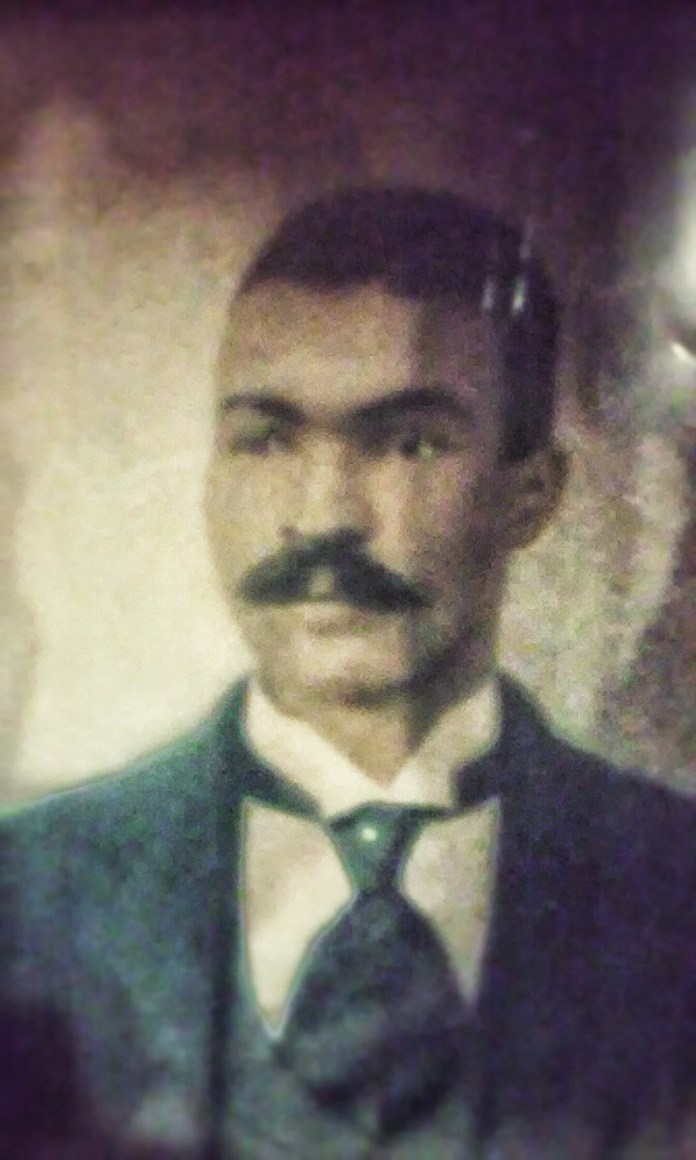
                          Haywood Artis

In the 1880 census of Nahunta, township, Wayne County, North Carolina, Adam Artis, widowed mulatto farmer, is listed with children Eliza, Dock, George Anner, Adam, Hayward, Emma, Walter, William, and Jesse, and four month-old grandson Frank Artis.  (I’ve never been able to determine whose child Frank is.]

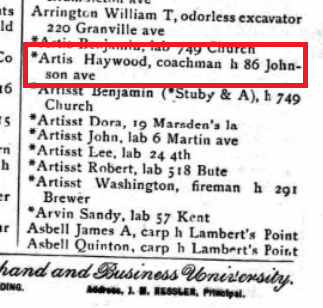
Haywood’s whereabouts over the next 15 years are unrecorded, though he was likely still living in his father’s home most of that time. However, at some point he joined the tide of migrants flowing into Tidewater Virginia, and, on 13 January 1897, in Norfolk, Virginia, Hayward Artis, age 26, born in North Carolina to A. and F. Artis, married Hattie E. Hawthorn, 23, born in Virginia to J. and E. Hawthorn. As early as 1897, Haywood began appearing in city directories for Norfolk, Virginia. Here, for example, is Hill’s City Directory for 1898:

Hartis

Haywood and Hattie and their children Bertha E., 3, and Jessie, 11 months, appeared in the 1900 census of Tanners Creek township, Norfolk County, Virginia. The family resided on Johnston Street, and Haywood worked as a porter at a jewelry store. Ten years later, they were in the same area. Haywood was working as a farm laborer, and Hattie reported four or her seven children living — Bertha, 12, Jessie, 11, Hattie, 8, and M. Willie, 2.

In the 1920 census of Monroe Ward, Norfolk, Haywood and Harriet Artis appear with children Elnora, 22, Jessie, 20, Hattie, 18, Willie Mae, 12, Haywood Jr., 8, and Charlie, 5.  Haywood was a farm operator on a truck farm, daughters Elnora and Hattie were stemmers at a tobacco factory, and son Jesse was a laborer for house builders.

By 1930, the Artises were renting a house at Calvert Street.  Heywood Artis headed an extended household that included wife Harriett, Haywood jr. (laborer at odd jobs), Charles, son-in-law Daniel Johnson (machinist for U.S. government) and his wife Hattie (bag maker at factory), cousins Henry Sample, Raymond G. Mickle, and Lois Sample, and granddaughters Mabel Johnson, 2, Olivia Washington, 15, and Lucille, 13, Bertha, 9, and Lois Brown, 6.

On 19 March 1955, Haywood Artis’ obituary appeared in the Norfolk Journal and Guide:

Haywood Artis, who has made his home in Norfolk for some 65 years, was buried following impressive funeral rites held at Hale’s funeral home March 7 with the Rev. W. H. Evans officiating.

Mr. Artis died March 4 at the home of his daughter, Mrs. Willie Mae Yancey, 2734 Beechmont avenue, after a long illness.

Mr. Artis, who was born in Goldsboro, NC, is survived by three daughters, Mesdames Elnora Brown, Hattie Johnson and Willie Mae Yancey, all of Norfolk, and a son, Hayward Jr., of New Jersey.

There are also 34 grandchildren, 33 great-grandchildren and other relatives and friends.

Interment was in Calvary Cemetery.

Thanks to B.G. for the copy of his great-great-grandfather Haywood Artis’ photograph.

Standard
Maternal Kin, North Carolina, Other Documents, Religion

Roadtrip chronicles, no. 7: Iredell County Public Library.

Iredell County Public Library has a nice local history and genealogy room, and during my sojourn I spent a nice hour or two there, disturbed only by the raucous banter of three students prepping for a nursing assistant exam. Anyway.

A back wall of cabinets contains files from the Homer Keever collection, and I found several of interest. Under “Black Churches,” I found a four-page handwritten document, apparently compiled by Alice Murphy Ramseur in 1973, entitled “Historial [sic] Data of Holy Cross Episcopal Church.” Holy Cross, of course, was the church my grandmother grew up in in Statesville. Its earliest services were held in 1887 in “the old brick storehouse on depot hill” and with success moved to the Good Samaritan Hall at 118 Garfield Street. This was all very interesting, and then: “May 24, 1899 the Bishop conmfirmed twelve Members they was William Pearson, Mrs Laura S. Pearson, Mrs. Lucy Chambers, Henry McKneely, Mrs Marther McKneely, Mr John Reeves, Mr. Will McCulland, Mrs Rebecca S. Allison, Mrs Clara S. Seaborn, Miss Carrie Bidding, Mr Mik Stevenson.”

Henry McNeely? What was this Presbyterian doing joining an Episcopal Church? Had Martha been an Episcopalian all along?

Here’s the entire piece, with thanks and acknowledgement to the library:

IMG_6072

IMG_6073

IMG_6074

IMG_6075

Standard
Maternal Kin, North Carolina, Other Documents, Politics, Rights

So that we may know their strength.

In 1868, Francis E. Shober was elected as a Democrat to the Forty-first United States Congress from North Carolina’s Sixth Congressional District. However, the election was contested by his Republican opponent, Nathaniel Boyden, who accused Democrats of placing ballot boxes at the polls that were not clearly marked; of intimidating and threatening Republican voters; and circulating a race-baiting forged document –  purporting to come from the chairman of the National Republican Executive Committee – designed to discourage freedmen from voting for Boyden: If we can elect Grant we will not need the negro vote again, and we can assure you our next Congress will inaugurate a system of colonization that will remove the negro from your midst. … By all means, get the negroes to register and enroll, so that we may know their strength.

House and Senate reports are the designated class of publications by which congressional committees formally report and make recommendations to the Senate or House concerning, among other things, their investigative or oversight activities.  These reports are publicly distributed as part of the official U.S. Serial Set record of each Congress. Documents related to Boyden v. Shober appear in the 41st Congressional Serial Set. Among several others, Ransom Miller gave testimony in the matter in Salisbury, North Carolina:

Ransom Miller testimony

In April 1870, the House of Representatives committee investigating the matter reported that although there was probably some minor intimidation and fraud, there was not enough to change the results of the election. Shober was seated and re-elected in 1870.

Adapted in part from http://ncpedia.org/biography/shober-francis-edwin

Standard
Maternal Kin, Newspaper Articles, North Carolina, Photographs

A terrible thought ….

I ran across this article in the 19 May 1933 edition of the Statesville Landmark detailing the tragic death of a boy playing in the Green Street (then Union Grove) cemetery.

Stville_Rec__amp__Landmark_5_19_1933_graveyard_death

“… Five pieces of marble — two in the base, two parallel upright pieces, seven inches apart, and a horizontal top piece.”

IMG_4585

I been all through this cemetery. There are relatively few markers there. This, however, still stands. It is the double headstone of my great-great-grandfather John W. Colvert and his wife Adeline Hampton Colvert. Though it is possible that there once were others, it is now the only one of its kind in Green Street. Was this the monument that killed Noisey Stevenson?

Standard
Enslaved People, Maternal Kin, North Carolina, Photographs, Religion

Roadtrip chronicles, no. 6: Western Rowan County churches.

In Church Home, no. 9, I wrote about Back Creek Presbyterian, the church that my great-great-great-great-grandfather Samuel McNeely helped found and lead. I wanted to see this lovely edifice, erected in 1857, for myself:

IMG_6157

And I wanted to walk its cemetery. I didn’t expect to see the graves of any of its many enslaved church members there, but thought I might find Samuel McNeely or his son John W. Dozens of McNeelys lie here, many John’s close kin and contemporaries, but I did not find markers for him or his father. (I later checked a Back Creek cemetery census at the Iredell County library. They are not listed.)

IMG_6163

Within a few miles of Back Creek stands its mother church, Thyatira Presbyterian. This lovely building was built 1858-1860, but the church dates to as early as 1747. There are McNeelys in Thyatira’s cemetery, too, and this is the church Samuel originally attended.

IMG_6155

Just up White Road from Thyatira is Mount Zion Missionary Baptist Church. I visited its cemetery in December 2013 and took photos of the the graves of descendants of Joseph Archy McNeely (my great-great-grandfather Henry McNeely‘s nephew), Mary Caroline McConnaughey Miller and John B. McConnaughey (siblings of Henry’s wife, my great-great-grandmother Martha Miller McNeely.) Green Miller and Ransom Miller’s lands were in the vicinity of this church.

IMG_6145

Photos taken by Lisa Y. Henderson, February 2015.

Standard
Enslaved People, Maternal Kin, North Carolina, Oral History, Photographs

Roadtrip chronicles, no. 5: Daltonia.

I saw that big, block of a white house, but I didn’t know what I was looking at. And, really, I wasn’t even much looking at it, because my whole attention was zeroed on a small building a couple hundred feet beside and behind it. A one and-a-half story log cabin sitting on fieldstone piers, mud-chinked, with small windows in the gable ends and central front door. In pristine condition. What was this?

IMG_6022

I turned to P.P., who shifted uncomfortably in her seat. “I don’t even want to say this,” she started, “but it’s true. It’s just so ugly.”

“Please do. Please do,” I urged.

“Well, the official story is that’s where the Daltons lived while they were building the house.”

The house — oh. This was Daltonia.

IMG_6027

“But that log cabin was Anse Dalton’s house.”

Wait. “Anse Dalton!? Anderson Dalton? That was — he was the father of my great-grandfather Lon W. Colvert‘s first wife, Josephine.”

“Yes, well, after the War, he was a driver for the Daltons. But in slavery …”

Yes? “In slavery, he was a — I hate to say it — he was used to breed slaves. That’s what they called this — ‘the slave farm.'”

I sat with that for a minute.

“It’s terrible,” she continued. “They thought, just like you can disposition an animal, you could breed people with certain traits. He had I-don’t-know-how-many children.”

I knew about slave breeding, of course. About the sexual coercion of both enslaved men and women, particularly in the Upper South. I’ve read slave narratives that speak of “stockmen,” but never expected to encounter one in my research. I thanked P.P. for her openness, for her willingness to share the stories that so often remain locked away from African-American descendants of enslaved people. Not long ago, I started working on a “collateral kin” post about the Daltons. I knew Josephine Dalton was born about 1878 to Anderson and Viney (or Vincey) Dalton; that her siblings included Andrew (1863), Mary Bell (1876), Millard (1880), Lizzie (1885) and Emma (1890); and that she was from the Harmony/Houstonville area. I’d stumbled upon articles about Daltonia and had conjectured that her parents had belonged to wealthy farmer John Hunter Dalton. I’d set the piece aside for a while though, because I had no specific evidence of the link beyond a shared surname. However, here was an oral history that not only placed Josephine’s father among Dalton’s slaves, but detailed the specific role he was forced to play in Daltonia’s economic and social structure.

P.P. did not know Anse Dalton, but Anse’s son Millard and her grandfather had grown up together. P.P. was reared in her grandfather’s household and vividly recalled Millard Dalton riding up to visit on his old white horse. “You can have her till I go home,” he’d tell her as he handed off the reins.

I can finish my Dalton piece now. Though I will never know the names of the children that Anderson fathered as a “stockman,” genealogical DNA testing may yet tell the tale, and I have a clearer picture of Josephine Dalton Colvert’s family and early life.

Photographs taken by Lisa Y. Henderson, February 2015.

Standard
Enslaved People, Land, Maternal Kin, North Carolina, Other Documents

Roadtrip chronicles, no. 4: Rowan County deeds.

My notes from an hour or so spent poking around the Rowan County Register of Deeds’ office:

  • No deeds filed by my Henry W. McNeely.
  • Julius McNeely bought his one and only parcel of land — the one his half-brother Henry’s children inherited — for $20 on 5 January 1876 from J.M. and H.E. Goodman.
  • In 1869, John W. McNeely applied for a homestead exemption. The application, filed at Deed Book 44, page 247, attached descriptions of his real and personal property. His real property consisted one tract of land bordered by Joshua Miller on the north, Frederick Menius on the east, “Dr. Luckey” and Ephraim Overcash on the south, and Jacob Shuliberinger and Mrs. Malissa Pool on the west, containing 235 acres and valued at $940.
  • On 7 January 1880, Ransom Miller, husband of Mary Ann McConnaughey, paid $900 to John S. Henderson, trustee for the estate of Archibald Henderson and Jane C. Boyden, for 135 acres. The land’s bounds lay on the north side of Sills Creek and touched on the Buffalo Big Road, crossed Second Creek and followed its meander to the intersection of Back Creek. On 1 December 1883, Ransom paid G.W. and C.C. Corriher $600 for 40 1/2 acres west of Neely’s Mill Road.
  • On 18 September 1889, Green E. Miller, husband of Grace Adeline Miller, paid $220 to John S. Henderson, trustee for the estate of Archibald Henderson and Jane C. Boyden, for about 22 acres. [Archibald Henderson Jr. and Jane C. Henderson Boyden were children of Salisbury lawyer Archibald Henderson. John Steele Henderson was Archibald Jr.’s son.] The plot description: “beginning at a stone in a field, South of where the said Green Miller now lives” running at one corner to a stake or stone in Ransom Miller’s line. The land was part of the Foster tract on the east side of Sill’s Creek and the west side of the Neely’s Mill Road, but not immediately adjoining either. Green had contracted to buy the property on 30 November 1886.
  • Oddly, on 28 May 1897, Green Miller and John Henderson sold 10 acres of the above tract to “Grace Adeline Miller, wife of Green Miller” for $100. [What was this about? Records seem to indicate that Adeline and Green remained married until her death in 1918. Why did he partition the land? And, why, if Green had purchased the full tract in 1889, was John Henderson listed as a grantor?]

Screen Shot 2015-02-15 at 3.06.40 PM

This section of the Cleveland, North Carolina, USGS quadrangle topographical map helps narrow the location of Ransom, Green and Adeline Miller’s properties in Steele township, Rowan County. (1) is the point at which (2) Second Creek branches into Back Creek and Sills Creek. That Ransom and Green’s lands adjoined supports a conclusion that Ransom was, in fact, the man referred to in the letter published in local newspapers about a damaging hailstorm in the area. The road running north-south is today called White Road. (3) marks the location of Mount Zion Missionary Baptist Church, attended to this day by descendants of Adeline’s daughter Mary Caroline Miller Brown, her brother John B. McConnaughey and cousins of Martha Miller McNeely‘s husband Henry W. McNeely.

Standard