Births Deaths Marriages, Free People of Color, North Carolina, Other Documents, Paternal Kin

Misinformation Monday, no. 10.

Another example of the pitfalls of unquestioning acceptance of federal population schedules at face value. What you see (1) may not be what it seems and (2) is not all there is. Here, I follow my great-great-great-grandfather Adam T. Artis over the arc of his life, as recorded in census records.

Adam Artis was born in 1831 to a free woman, Vicey Artis, and her enslaved husband, Solomon Williams, most likely in Wayne or Greene Counties, North Carolina. In the 1840 census of one of those counties, he, his mother and siblings are anonymous hashmarks under the heading “free colored people” alongside the name of a white head of household.

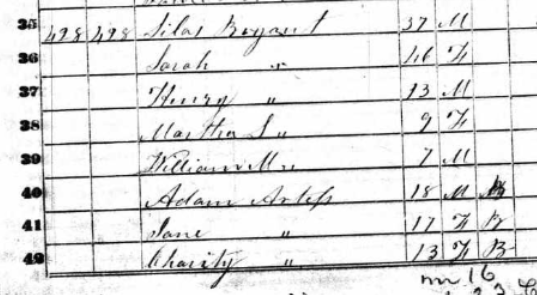
The 1850 census of Greene County is the first record of Adam’s existence:
AArtis 1850 Greene

White farmer Silas Bryant is the head of household. The other Bryants are presumably his wife and children. The significance of Adam Artess, Jane Artess and Charity Artess’ names listed below requires knowledge outside the four corners of the page. As I learned via subsequent research, Jane and Charity were Adam’s sisters. (Their mother and remaining siblings were listed next door at #429.) Though no bonds or other indenture documents survive, it is most likely that the Artis children were involuntarily apprenticed to Bryant until age 21 by the Greene County Court of Pleas and Quarter Sessions. Adam’s age is correct, so I assume that Jane’s and Charity’s are, too. The censustaker evinced some hesitation in describing Adam’s color, appearing to superimpose a B (black) over an M (mulatto.) This is a matter of some concern to descendants who deny that he was of African descent. No photographs of Adam survive, but his great-granddaughter D.B. told me she recalls seeing one in her childhood. It was later stored in a barn and ruined by rainwater. Adam, she said, was brown-skinned. Mulattohood was in the eye of the beholder, but I think it is safe to say that Adam had considerable African ancestry.

AArtis 1860 NNeuse Wayne

The 1860 census of the North Side of the Neuse River, Wayne County, tells a nuanced story. This entry contains the sole census reference to Adam’s skills as a carpenter, probably gained during his apprenticeship to Bryant. The $200 in personal property probably consisted mostly of the tools of his trade, and the $100 value of real property reflects his early land purchases. (I found a deed in Wayne County for Adam’s sale of ten acres to his brother-in-law John Wilson in 1855. The sale was a buyback, but Adam never recorded a deed for the original purchase.) Adam was a widower in 1860, and Kerney, Noah and Mary Jane were his children by deceased wife Lucinda Jones Artis. They were not his only children, however. His oldest two, Cain and Caroline, were enslaved alongside their mother Winnie Coley, and are not named in any census prior to 1870.) Jane Artis was Adam’s sister. Her age is about right, though his is off by a year or so. Her one month-old infant may have been daughter Cornelia, who is listed in the 1870 census as born in 1860. I’ve included two lines of the next household to highlight a common pitfall — making assumptions about relationships based on shared surnames. Though they were Artises and lived next door, Celia and Simon were not related to Adam Artis. At least, not in any immediate way. (Ultimately, nearly all Artises trace their lineage to a common ancestor in 17th-century Tidewater Virginia.) Adam’s son Jesse Artis testified directly to the matter in the trial in Coley v. Artis: “I don’t know that Tom and I are any kin. Just by marriage.”

So far, we’ve found basically accurate, if deceptively simple, census entries. 1870 is where the trouble starts. There’s this:

AArtis 1870 holden 1

But wait. There’s this, too:

AArtis 1870 holden 2

The first entry is found in the enumeration of Holden township, Wayne County. The second is in Nahunta. The first was taken 18 August by William R. Perkins. The second, 23 September. By William R. Perkins.

Huh?

I can’t begin to explain why Perkins rode the backlanes of northeast Wayne County twice and — in two different handwritings — recorded the same people living in the same houses as residents of different townships. Substantively, though, with a couple of exceptions, the two households attributed to Adam Artis are quite consistent. Adam and his wife Frances (Seaberry, whom he married in 1861) are shown with nine children whose ages are identical in both listings. The last six children were born to Frances, and some of their names take a gentle mauling between records. The oldest child was Ida, which is close to “Idar,” but not at all to the very modern-sounding “Jaden.” And who was Octavia/Tavious, a seven year-old male? Process of comparison and elimination identifies him as Napoleon Artis, often called Dock. Was Octavius his middle name? I’ve ever seen it used in any other place.

Fast forward ten years to 1880:

AArtis 1880 Nahunta 1880

Adam is again a widower, as wife Frances died shortly after the birth of son Jesse. Daughter Eliza is helping care for her eight siblings, plus grandbaby Frank, whose mother or father I have never been able to identify. (I have not even found clear evidence of Frank in any later record.) This living situation was not tenable, and Adam married again that very year to Amanda Aldridge, his son-in-law’s sister. Tragically, Adam and Amanda’s marriage was never recorded in a census record as she died days after the birth of her last child, Amanda Alberta, in 1899. Thus, Adam is a widower once more in 1900:
AArtis 1900

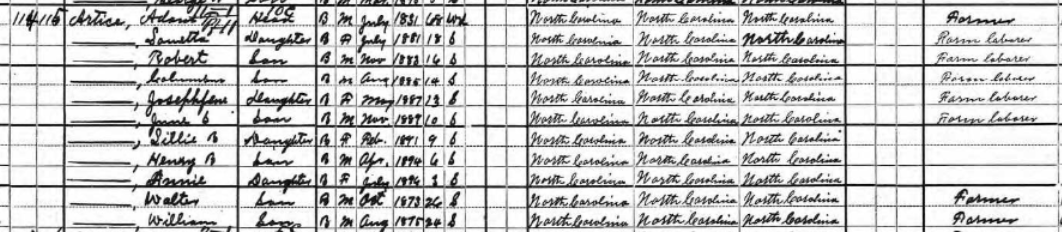
“Artice” is an alternate spelling of Artis seldom used by Artises themselves, but occasionally adopted by those recording them. In this record, two of Adam’s children with Frances, Walter and William, were still unmarried and living at home, but the remaining children are Amanda’s. Don’t be fooled by the absence of the infant Alberta. She survived her mother’s untimely death and was taken in by her half-sister Louvicey Artis Aldridge, who, presumably, nursed her along her own babies.

Adam remarried in 1903. The 1910 census accurately reflects his four legal marriages. (His informal relationship with Winnie Coley is omitted.) His latest (and last) bride, Katie Pettiford,  was 50+ years his junior. All of his older children have left (or fled) the nest except 12 year-old Annie Deliah Artis, whose status as “husband’s daughter” is carefully noted. Alphonzo Pinkney Artis was Adam’s last surviving child, though Katie reported giving birth to two others. Alberta was still with John and Vicey Aldridge — listed as “Elberta,” a “granddaughter,” speaking of misinformation — in their household at the other end of Wayne County in Brogden township. (Family stories say that this arrangement ended unhappily when Alberta learned, in her early teens, that she was not, in fact, Vicey and John Aldridge‘s child.)

1910 AArtis Nahunta Wayne

There is no 1920 census entry for Adam T. Artis. This father of nearly 30 children (23 of whom are listed with him in census records) and husband or partner of five (only two of whom show up in the census) died the 11th day of February, 1919.
Standard
Agriculture, Newspaper Articles, North Carolina, Paternal Kin

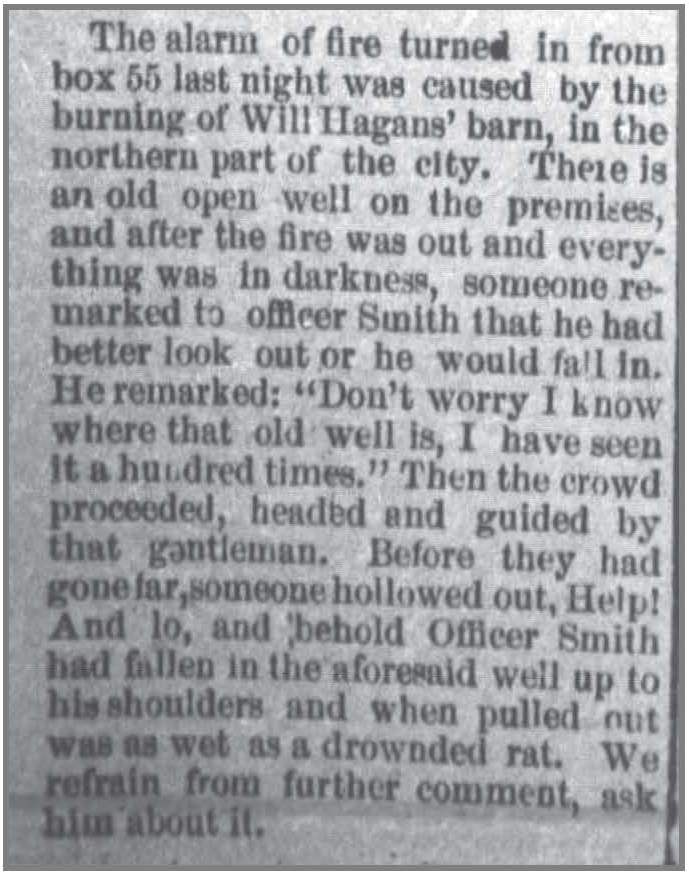
A burned barn, an old well, and Officer Smith.

Goldsboro_Daily_Argus_6_11_1904_hagans_barn

Goldsboro Daily Argus, 11 June 1904.

Beyond the story of Officer Smith’s swift comeuppance, there is “Will Hagans’ barn, in the northern part of the city.” William S. Hagans and his family lived in Goldsboro at this point, and his landholdings were 15 miles north in the area of Fremont and Eureka, near the Wilson County line. For what, then, did he use a barn in town?

Standard
Maternal Kin, North Carolina, Oral History, Photographs

Remembering Launie Mae Colvert Jones.

My maternal grandmother’s youngest sister, Launie Mae, would have turned 104 today.

Here she is, not long, I think, after she moved to Bayonne, New Jersey, around 1930. She met Georgia-born Isaiah James Jones, married, and reared seven children in Jersey City.

Launie Colvert 002

And here, a photo taken at the first Colvert-McNeely family reunion in 1978. Sweet and funny, this is how I best remember her.

Launie Colvert 001

Launie Colvert Jones (20 December 1910-2 August 1997)

Standard
Agriculture, Land, North Carolina, Other Documents, Paternal Kin

Maybe he might redeem it.

The fifth in an occasional series excerpting testimony from the transcript of the trial in J.F. Coley v. Tom Artis, Wayne County Superior Court, November 1908. 

Defendant introduces T.F. Jones, who being duly sworn, testifies:

I had a conversation with Napoleon Hagans about this land, the 30 acre piece. (Plaintiff objects to question and answer.) I got after Uncle ‘Pole to see me the land. I told him if he would give me a deed for both places, the Calv Pig, that is the 24 acre piece, and the Tom Pig place, the 30 acre piece, I would take them. He told me he would sell me the Calv Pig place, but the Tom Pig place he had promised to let Tom stay on that as long as he lived, that maybe he might redeem it. That about ended the conversation with us. I bought some timber off this land from Tom. Off of the 30 acre piece. I suppose Hagans knew about it. (Plaintiff objects.) I couldn’t say that Hagans saw me hauling the timber, I guess he saw me. (Plaintiff objects.) Hagans never made any objection. I had a conversation with Tom about this land along during that time, when Uncle ‘Pole Hagans first got rid of that Calv Pig place, about 15 years ago. I asked him if he wouldn’t sell his part, and what would he ask for it, (Plaintiff objects). He said he didn’t want to sell it, he expected to redeem it sometime. Last Fall I told him if he expected to get that mortgage he had better attend to it. He said he had boys in Norfolk, who would take it up; that he had confidence in Will Hagans. That if his boys let it slip out after he died, they could. (Plaintiff objects.)

CROSS EXAMINED.

Mr. W.J. Exum died about 1885. Tom is known as Pig. I don’t know why he was called Pig. I think they got “Pig” from “Diggs”. Some of his people ‘way back there, were named “Diggs”, and they got to calling it “Pig” for short. I remember when Napoleon Hagans died. I was down the Country. I left here in ’94, and came back in 1900. He died during that time. I got this timber 20 years ago. I was buying all I could, I don’t know how much I got. I got it by the tree. I went in 1881 and milled ’till 1890. Either ’81 or ’82. I bought the timber about that time. I didn’t know that the deed from Mrs. Exum to Hagans was executed before 1892.

——

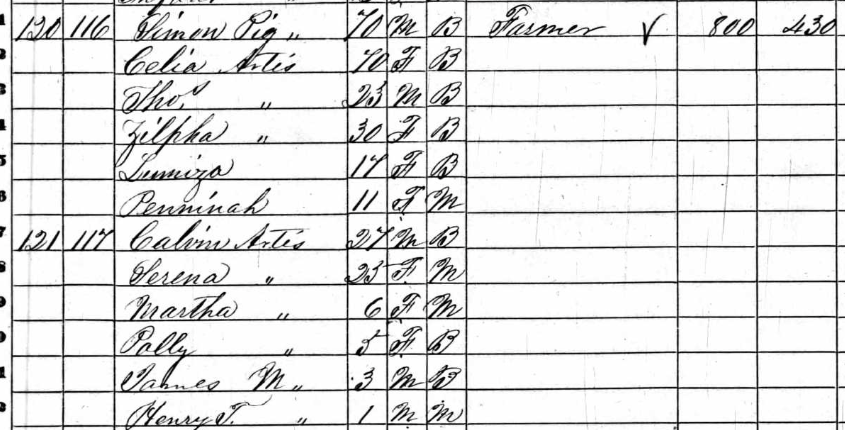
Jones’ explanation of Tom Artis’ nickname is unsatisfying. “Pig” from “Diggs”? In fact, Thomas and Calvin Artis took their name from their father, an enslaved man, who was called “Simon Pig.” Artis was the surname of their mother Celia, a free woman of color. Though I have found no other record that he was manumitted prior to Emancipation, Simon Pig Artis is listed as the head of his household in the 1860 census of Davis township, Wayne County. He reported (or was attributed with) $800 of real property and $430 of personal property. The land was almost surely his wife Celia’s; she is one of the earliest free colored property owners appearing in Wayne County deed books.

Screen Shot 2014-12-18 at 9.32.43 PM

Diggs, on the other hand, while a family surname, was that of Frances Artis Diggs, daughter of Tom and Calv’s oldest sister, Eliza Artis. Frances married Wilson (or William) Diggs in 1868 in Wayne County. (Two of Frances and Wilson’s granddaughters, Etta and Minnie Diggs, married a son, William M., and a grandson, Leslie, of Adam T. Artis. As discussed here, Adam and Celia Artis were not meaningfully related.)

Standard
Agriculture, Business, Free People of Color, Newspaper Articles, North Carolina, Paternal Kin

Tax trouble.

Gboro_Messenger_4_2_1877_tax_woes

Goldsboro Messenger, 2 April 1877.

Simmons & Aldridge??? I’m fairly certain that the Aldridge in this partnership was Robert Aldridge (though it could have been one of his older sons, George, Matthew and John) but which Simmons? Section 69 imposed penalties on “any manufacturer of tobacco or snuff” who failed to pay proper taxes on their products. Robert was said to have operated a brickyard near Dudley, but I’ve seen nothing else to suggest that he also had an interest in a tobacco cottage industry.

Standard
Education, North Carolina, Paternal Kin

Signature Saturday, no. 2: Lewis Henderson’s progeny.

Lewis and Margaret Henderson were surely unlettered, and I suspect that most of their children were, too. I have only been able to find handwriting samples for two.

Caswell C. Henderson was the most worldly of the siblings, having migrated to New York City in his mid 20s, engaged in local politics, and secured a patronage job at the United Customs House while in his 30s. From his 1893 marriage certificate to Emma D. Bentley:

Screen Shot 2014-12-05 at 5.29.12 PM

And from a letter he wrote in 1926 to his sister Sarah:

Screen Shot 2014-12-05 at 5.28.33 PMSarah Henderson Jacobs Silver was also literate, though her handwriting and grammar reveal the limits of her schooling. This signature appeared on the marriage license of her niece, Minnie Simmons Budd.

Screen Shot 2014-12-05 at 5.27.27 PM

Most families grow exponentially, but Lewis and Mag’s descendants underwent a bit of a bottleneck in the third generation. Of their nine children, only two — Ann Elizabeth and Loudie — had children that survived to adulthood. Those two produced five children (barely, as one died at age 19) who reached majority. Of the five, I have only found the signature of one. Jesse “Jack” Henderson, Loudie’s son, affixed his name to his Social Security application in 1936:

Screen Shot 2014-12-05 at 5.26.21 PM

Standard
Agriculture, Business, Free People of Color, Land, North Carolina, Paternal Kin

I stated the fact.

The fourth in an occasional series excerpting testimony from the transcript of the trial in J.F. Coley v. Tom Artis, Wayne County Superior Court, November 1908. Paragraph breaks inserted for better readability.

Plaintiff introduces John Rountree who being duly sworn, testifies as follows:

I know Tom Artis. I heard him say that the cotton was for rents. I heard that for the last 14 years. I collected the rent for W.S. Hagans for several years. I heard Tom alude to it as rents. I heard last September after the land was sold, that it was interest. I never heard anything but rents to that time. I had a conversation with Tom, and carried a message to Hagans for Tom. This last Fall Tom came over to the gin house where I was ginning, and said to me that he understood that Hagans was going to sell the 30 acres piece of land, and said to me to tell Hagans if he pleased not to sell till he gave him notice, because he wanted to buy it. I delivered that mesage to Hagans. Hagans said alright he would sell it to him as soon as anybody, but he didn’t want to sell one piece at the time. We didn’t talk about the sale to Coley.

CROSS EXAMINED.

I have lived at W.S. Hagans’ for about 18 years. I farm at Hagans’. I rent land. I pay him 1/3. I collected Tom’s rent along in the Fall. Hagans has asked me to go to Tom and ask him to send his rents. Uncle Tom sometime would bring the rent and Hagans wasn’t there, and he would give it to me to keep for Hagans. Tom called it rent when Pole Hagans was living. (Plaintiff objects.) I wasn’t there when he sent it to W.J. Exum. While Mr. Exum was living, I didn’t see Tom taking his cotton there. I didn’t tell Hgans that I would swear the old man always called it rent. I had no right to, I didn’t tell the lawyers I would swear to that. I stated the fact that he always called it rent. I told Tom that Hagans had sent me for the rent two or three times. I knew it was rent. I told Hagans that I had his rent from Tom. I told Coley that the old man called it rent last summer. They had me subpoenad before then. I told him Tom always called it rent. I told Mr. Coley’s lawyers that last summer. I never told Hagans, he knew it.

Standard
Births Deaths Marriages, North Carolina, Other Documents, Paternal Kin

Misinformation Monday, no. 9: the census edition.

Census records are the gateway to genealogical research for most people, and I am no exception. I can still remember hunkering over a microfilm reader in a dark corner of Davis Library in Chapel Hill, gaping at my great-great-great-grandparents’ names revealed in crabbed script in the 1910 federal population schedule. Like so many others, I squirmed impatiently for the release of the 1930 and 1940 censuses, anxious to determine what whos and wheres could be answered by the fresh infusion of data. As much as I have relied upon census data, however, I am acutely conscious of its limits. The census schedules are imperfect documents that qualify only barely as a primary resource. This is not to discount their usefulness for genealogical purposes. I’m just saying that — based as they are on a mishmash of personal knowledge, second-hand information, hearsay and rank speculation — they don’t prove much of anything about a person’s name, age, ethnicity, relationships, or occupation.

Here’s an example, courtesy of the 1920 census of Wilson, Wilson County, North Carolina:

1920 real

A husband and wife with two daughters, no? If you didn’t have reason to know better, you might accept this at face value. “Hattie May” happens to be my paternal grandmother, however, so I do know better. (She was Hattie Mae, by the way.) Let’s take each person one-by-one:

“Jessie Jacobs” was Jesse A. Jacobs Jr. He was actually born in 1856, so was 63 or 64 years old, not 60, when the census taker stopped by. He is described as “B,” which is a designation he never would have provided. I am fairly certain that his wife gave information for the household, and I am equally certain that she described everyone in it as “colored.” Jesse himself might have offered “Croatan,” as the multi-racial, ethnically Native American members of the Coharie tribe were then called.

“Sara Jacobs” was Sarah Henderson Jacobs. She was, indeed, Jesse’s wife. She was born in 1872, so her age is a little off, too. She was 47 or 48, not 42.

Mamie Jacobs” was born in 1907, so her age is basically correct. She was not, however, the daughter of either Jesse or Sarah Jacobs. Nor was she a Jacobs. She was the daughter of Bessie Henderson, who was the niece of Sarah H. Jacobs. In other words, Sarah was her great-aunt. Her mother died when she was three, and she was reared for her first eight years by her great-grandparents, Lewis and Margaret Balkcum Henderson. See:

Screen Shot 2014-12-07 at 5.35.21 PM

Here, in the 1910 census of Brogden township, Wayne County, North Carolina, is a correctly described family unit. (This, by the way, is the census entry that dropped my jaw so many years ago and got me hooked.) My great-great-great-grandfather Lewis Henderson, great-great-great-grandmother Margaret, great-grandmother Bessie, and great-aunt Mamie. (Bessie was more than seven months pregnant with my grandmother when the census taker showed up on April 18. And look at how many children Margaret had lost. Only three of nine surviving. It breaks your heart.)

Back to 1920: “Hattie May Jacobs” was born in 1910, so her age is basically correct, too. She spent her first eight months or so in her great-grandparents house, but when Bessie died in the late winter of 1911, Sarah and Jesse Jacobs took her to Wilson to live with them. Mamie remained in Wayne County until her great-grandparents died, then she, too, went to Wilson. She and Hattie were known as Jacobses as a result, and for years my grandmother believed she had been formally adopted. Well into adulthood, when she learned that she had not, she reverted to her birth mother’s surname, Henderson.

Fast forward twenty years to the 1930 census of Wilson, Wilson County. Have things gotten better?

Screen Shot 2014-12-07 at 7.18.54 PM

No. Sarah Jacobs was 58 years old, not 49. That was likely deliberate deception. Hattie, of course, was her great-niece, but their relationship was essentially mother-daughter and undoubtedly so reported to the census taker. Their occupations are not shown here, but Sarah was described as a laundress “at home” and my grandmother as a servant for a private family. The former accords with what I was told about Sarah’s work, but I have never heard that my grandmother worked as a maid. Most curious, however, is not what’s in this entry, but what is not. Namely, my two uncles. They were three and one in 1930, and I’ve found them listed nowhere else in the census either. A deliberate omission? A mistranscription? I don’t know, but it’s another stark example of the unreliability of census records.

So, three consecutive census schedules for one family and only the first reasonably accurate. As I’ll demonstrate in coming weeks, this was not the exception. Caveat emptor.

Standard
Agriculture, Free People of Color, Land, North Carolina, Other Documents, Paternal Kin

I never heard anything but “rent.”

The third in an occasional series excerpting testimony from the transcript of the trial in J.F. Coley v. Tom Artis, Wayne County Superior Court, November 1908. Paragraph breaks inserted for better readability.

Plaintiff introduces Jonah Reid who being duly sworn, testifies as follows:

I have heard Tom Artis say that he was going soon to pay his rent with cotton to [William S.] Hagans. I don’t know how often I have heard him speak of that, I have heard him say something about it several times when rent was due. I didn’t hear him say what lands. Some times he was cultivating the three pieces, sometimes the 30 acre piece. I am his son-in-law. I never lived with him. Live back of his house. Never heard him call it anything but rent cotton, not interest cotton. (Defendant objects.)

CROSS EXAMINED.

I told Hagans that I heard the old man say he was going to pay his rent, that was along in September, I think this past September. The only reason I told him was he asked me. He came by where I was working on the road. He asked me how long I had been in the family. I told him 16 years. He asked if I had ever heard anything but rent. I told him no. That’s why I told him. That’s all he asked me. Tom worked the three pieces, then afterwards the 30 acre piece. That’s all I remember Hagans said. I didn’t know there had been a suit about the land. Hadn’t had the suit yet. I said I didn’t like to say anything about my father-in-law. Hagans didn’t tell me that he Artis was claiming that he was paying interest. I just answered what he asked me. I told him I had never heard any thing but “Rents”.

——

Jonah Reid was married to Magnolia Artis (1871-1939), daughter of Thomas and Loumiza Artis Artis. Loumiza Artis was a sister of my great-great-great-grandfather Adam T. Artis. One of Adam Artis’ wives, Frances Seaberry, was William Hagans’ paternal aunt.


Standard