DNA, North Carolina, Paternal Kin

DNA Definites, no. 16: Henderson.

Hard on the heels of my first Henderson match* comes another.

K.H.’s family tree shows that he or she is a descendant of Susan Henderson Wynn, half-sister of my great-great-great-grandfather Lewis Henderson. I’ve reached out to the woman who administers K.H.’s account — bizarrely, she’s someone who reached out to me a year or ago about some Artis research she was doing for a friend — to confirm the connection.

*By this, I mean a Henderson who is not also an Aldridge. They are my double-cousins, and much closer on the Aldridge side.


Standard
Maternal Kin, Migration, Newspaper Articles, North Carolina, Vocation

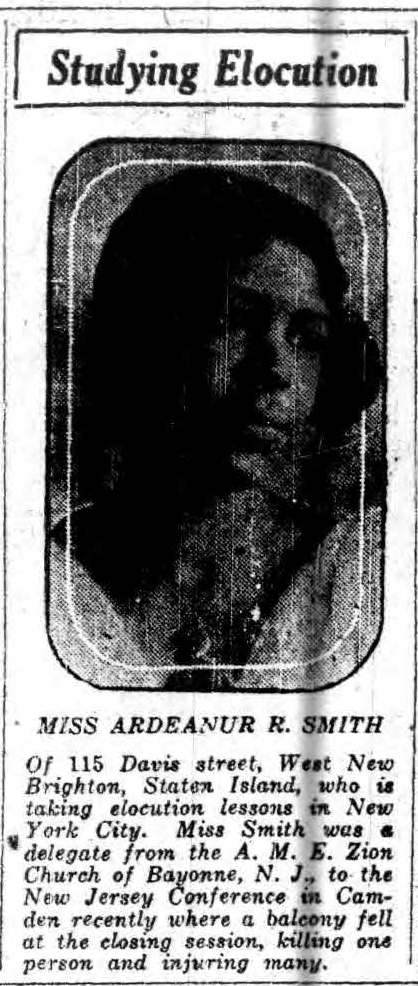
Ardeanur, elocutionist.

 Pitt_Courier_6_2_1928_Ardeanur_Smith

Pittsburgh Courier, 2 June 1928.

This brief blurb intrigues me any number of ways:

(1) Ardeanur R. Smith? This is the first I’ve seen of a middle initial for Cousin Ardeanur.

(2) Smith? My grandmother said Ardeanur married somebody she ran off with when she was a teenager. However, every mention of her I’ve found dating before 1947 — and she is elusive in official records — names her as Smith, her maiden name. In her uncle John McNeely’s 1947 obituary, she’s a Hart for the first time. I have no idea what Mr. Hart’s first name was, where they married, or how long they stayed that way.

(3) Elocution? This may absolutely be a function of me failing to ask the right questions, but, as much as I heard about Wardenur playing the organ on the radio, I never heard my grandmother speak of Ardeanur’s singing or speaking career.

(4) And who was Ardeanur’s publicist that he or she managed to get her name and photo in the Pittsburgh Courier? And not for the last time.

(5) Staten Island?

(6) “Where a balcony fell at the closing session”?!?!?

Standard
Migration, Newspaper Articles, North Carolina, Paternal Kin

That glorious climate of Arkansas.

Perhaps this sheds some light on Gus Artis and his sister Eliza Artis Everett‘s migration to Arkansas from North Carolina well after the Exoduster era:

Goldsboro_Headlight_11_6_1889_Arkansas_migrantsGoldsboro Headlight, 6 November 1889.

On 27 November 1889, the Wilson Mirror reprinted a Goldsboro Argus piece that described Williams and Herring as “railroad hirelings and speculators.” “However much the desire should be divided among our people — and by this we mean the white people — for the negro to exodus this country or remain, the solid, stubborn truth shall not be kept from the poor, deluded, half-informed negro, that this is his home, the climate of his nature; that our people are the most tolerant and generous in the world; and his best friends, and that, therefore, he should stay right here where his associations date back through the centuries; where his faults, and there are many (but who of us is without faults?) are borne with from custom; where his privileges as a free citizen are unquestioned and untrammeled, and where his destinies are linked by law with the whites, who, under a Democratic administration, have for twenty years paid 90 per cent. of his government and education, while he has furnished 90 per cent. of the crime and ignorance of the State.”

Best friends, indeed.

The 20 December 1889 issue of the Wilmington Messenger chimed in the mockery, noting that “Peg leg Williams and Silas Herring have not dissolved copartnership. Peg leg is now in [Goldsboro], and he and Silas are as active as bees in inducing the “coons” of this section to leave their homes of peace and plenty here, to go the far off miasmatic lands of the West, there to die like cattle with the black tongue.”

Robert “Peg-Leg” Williams is memorialized in 100 Americans Making Constitutional History: A Biographical History, edited by Melvin I. Urofsky. Described as the most famous and successful of Southern “emigrant agents, Mississippi-born Williams, a Civil War veteran, assisted 16,000 African-Americans in leaving North Carolina in the wake of discriminatory labor laws passed in 1889.

*Kizzy Herring Herring, who applied for her husband’s Civil War pension from Lonoke County, Arkansas, was another who left Wayne County for the West. So, I suspect was Guy Lane, Jr., son of Guy and Sylvania Artis Lane, who decamped from Wayne County to Memphis, Tennessee, sometime between 1880 and 1900. Did he just not quite make it to Arkansas? Or did he double back to the city after deciding that Arkansas did not suit?

Standard
Education, Maternal Kin, Newspaper Articles, North Carolina

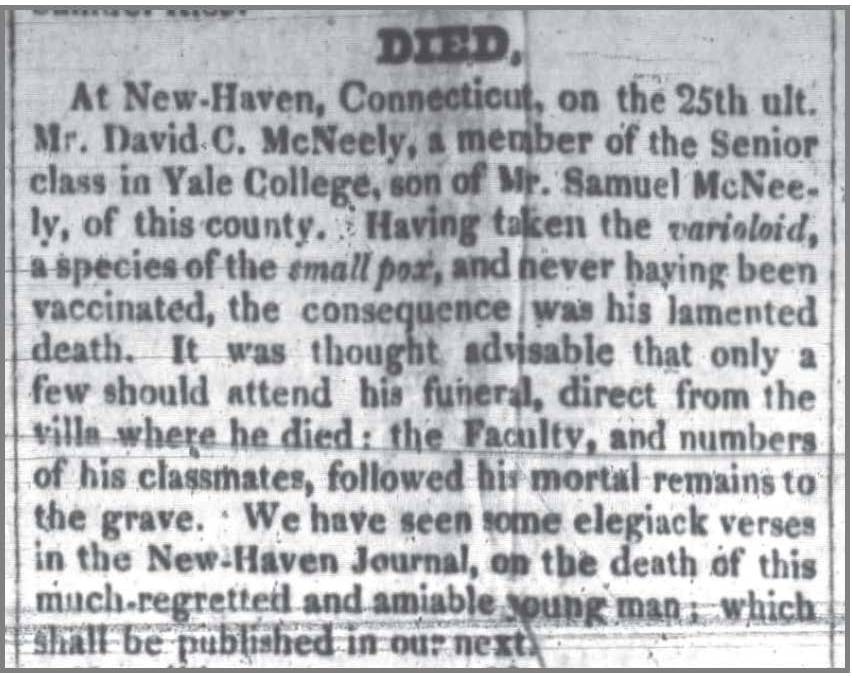
David C. McNeely’s erratum.

Eons ago, one of the first documents I found related to my great-great-great-grandfather John Wilson McNeely‘s family was an 1828 obituary for his brother David C. McNeely, a student at Yale College.

Western_Carolinian_4_22_1828_death_of_David_McNeely

Western Carolinian, 22 April 1828.

Wow, I marveled. There could not have been many Scotch-Irishmen from the backwoods of Piedmont North Carolina studying at Yale at that time.  What a terrible loss this must have been for John and his family. I entered David’s name into my Family Tree Maker tree alongside Samuel McNeely’s other children William and Acenith (or Acintha).

And then the other day, I found this:

Western_Carolinian_4_29_1828_David_McNeely_correction

Western Carolinian, 29 April 1828.

Oh. … Okay. … So all my sentiments hold — except the loss to John. David was not Samuel McNeely‘s son after all, but James McNeely’s.

If there was one James McNeely in Rowan County in the first quarter of the 19th century, there were a dozen, and I have been singularly unsuccessful at teasing apart and differentiating them. Evidence shows that Samuel and his son John W. had close relationships with several James. However, the will of Samuel’s father John McNeely (1724-1801) lists no heir named James, only John, Alexander and Samuel and their sister Ellinor McNeely Bell. It is past time that I pull together a chart or a list or a something that summarizes links I’ve found among these McNeelys and may reveal previously unnoticed clues.


Standard
North Carolina, Other Documents, Paternal Kin

Eureka! … Not.

I was flipping through an old notebook and came across this abstract of entries in the 1912-1913 city directory of Wilson, North Carolina:

Taylor, Bertha, laundress, h 114 w Lee

Taylor, Greenman, h Stantonsburg rd nr Rountree av

Taylor, Hennie, dom, h 114 w Lee

Taylor, Jordan, lab, h Stantonsburg rd nr Rountree av

Taylor, Mack, driver, h 114 w Lee

Taylor, Mattie, laundress, h 114 w Lee

Taylor, Robert, barber, h 114 w Lee

Taylor, Roderick, barber Paragon Shaving Parlor, h 114 w Lee

The house at 114 West Lee Street belonged to my great-grandfather Michael (“Mike,” not “Mack”) Taylor. Bertha, Hennie, and Mattie were his younger daughters. Roderick was his only son. Jordan and Greeman, over on Stantonsburg Road, were Mike’s niece Eliza’s husband and son. But who in the world was Robert Taylor?

Robert … Robert … An epiphany! Of course! This was Robert Perry, son of Mike’s wife Rachel‘s sister Centha Barnes Perry! The boy grew up in Mike and Rachel’s household and quite naturally he was sometimes known as Robert Taylor! … Right?

Well, perhaps, but this is not him. Robert Perry was only 9 years old in 1912. Not only would a child not have been plying a trade at that age, he would not be counted among the adults included in a city directory. (Even Rachel was omitted, as “dependent” homemakers did not make the cut either.)

So, who was this Robert Taylor who both lived in Mike Taylor’s house and worked in the same trade as Mike’s son Roderick?

Census records do not show an African-American Robert Taylor in all of Wilson County in the 1900 or 1910 censuses. In 1920, however, there is Robert Taylor, age 36, a laborer, with wife Mary G., age 29, living at 611 Green Street. Now this is really puzzling.

Two years earlier, when Roderick Taylor registered for the World War I draft, he stated his birth year as 1883, his occupation as barber, and his address as 611 East Green Street. There is no “Roderick Taylor” listed in the 1920 census, but in 1930, at 610 [sic, house numbers shifted in the early 1920s] Green Street, there is barber Roderick Taylor, 45, wife Mary J., 39, and three children.

While it is conceivable that there were both a Robert Taylor and Roderick Taylor of the same age, living in the same houses, with wives of the same name and age, and working in the same profession, it seems unlikely. Rather, in an era in which “Roderick” was rare name, an inattentive census taker or canvasser might easily have heard “Robert” when making his inquiries. Absent further independent evidence that a Robert Taylor existed, I conclude that Roderick’s doppelgänger is a figment of error.

Standard
Births Deaths Marriages, Land, Maternal Kin, Newspaper Articles, North Carolina

John W. McNeely’s heirs.

John Wilson McNeely died childless in July 1871. Or at least, you know, childless in any way that mattered to probate court. He had not made a will, so his heirs at law were his widow Mary McNeely McNeely and his two surviving siblings. His son Henry W. McNeely did not warrant notice.

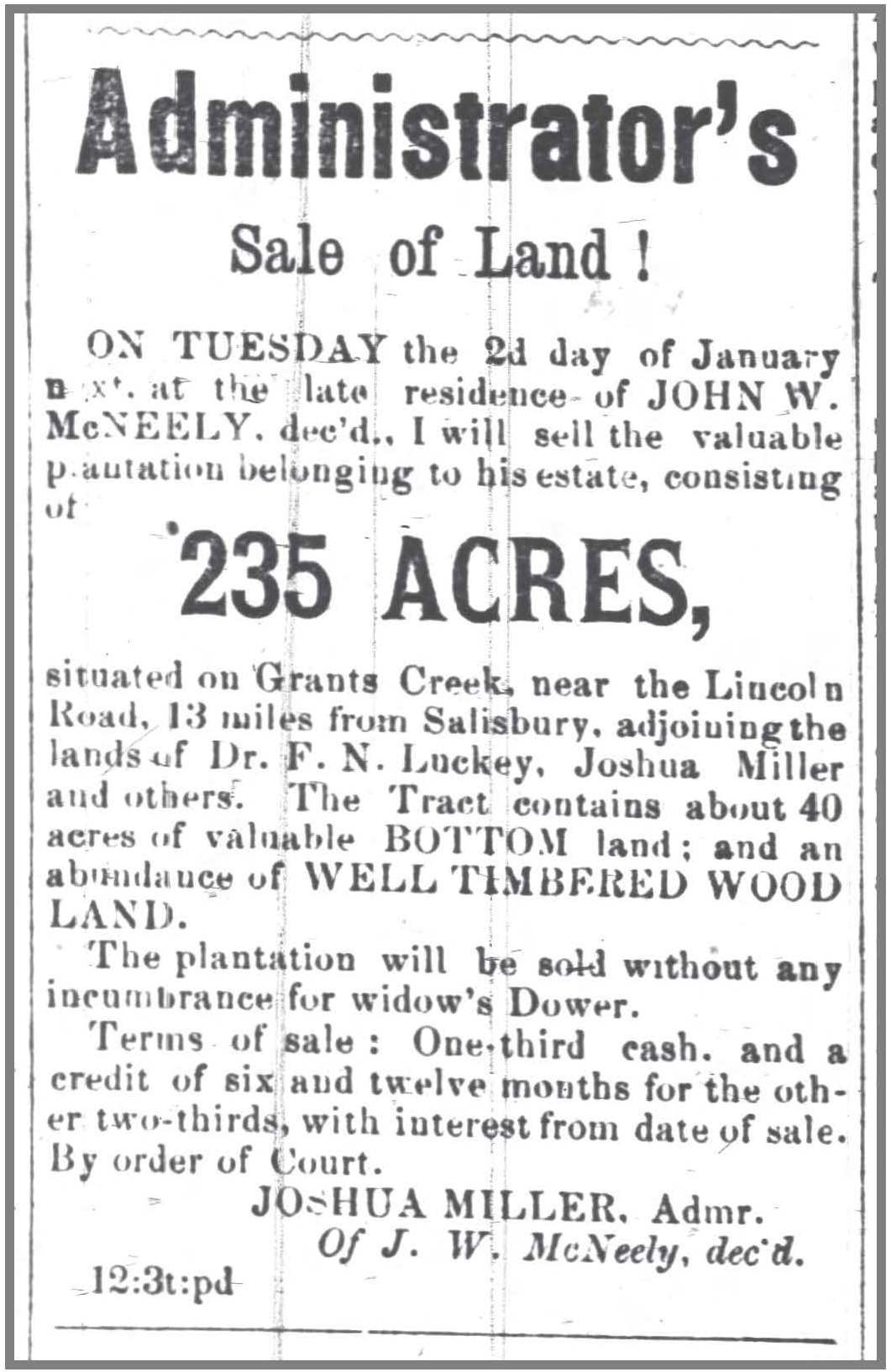
In August, Joshua Miller, administrator of John’s estate, and Mary McNeely filed a Petition to sell Land for Assets against John’s brother William B. McNeely and sister Acintha McNeely or Corryer [or, as most commonly spelled, Corriher.]  McNeely’s debts totaled about $2000, and his estate was valued at only $800, of which $300 had been set off for his widow.  At death John had owned “about 235 acres on Catheys Creek in Rowan County adjoining the lands of Joshua Miller, Frederick Menus, Dr. F.A. Luckey, and others” and valued at about $7/acre.  This property was to descend to William, age 65, believed to be living somewhere Missouri, and Acintha McNeely or Corryer, age 60, living somewhere in Tennessee.

On 8 September, justice of the peace John Graham, J.M. Harrison, and S.A.D. Hart allotted a year’s provision to Mary McNeely, which included a mouse-colored mule worth $125, four horseloads of hay, 500 bundles of fodder, two hogs, one sow and four pigs, one old buggy and harness, 37 pounds of bacon, two bushels of Irish potatoes, one ax, an old washtub, one “foalding leg table,” one “old poplar cubbard & contents,” one waterbucket and washpan, a half dozen chairs, one candlestand, one bureau, an old looking glass, two beds and furniture, one small Bible, two Hymn books, four handtowels, and three “table cloth.”

William and Acintha were never located,* and, on 31 October, Joshua Miller sold the remainder of John’s personal property at auction. The items sold included a “crout” stand, 550 shingles, “sythes,” a log-chain, tanner’s knives, a cross-cut saw, ceiling-dogs, moulding planes, “clevis & strechers,” planes, “waggon cloth,” “hackel & chain oil,” a cultivator, a tar bucket, five sheep, nine hogs, a red calf, a blue calf, two cows, two horses, a mule, a bureau, mirror, a small table, two beds and furniture, a book case, a clock, two chests, two pairs of boots, shoe tools, sheep skins, a map, Scotts Bible, another Bible, a hymn book, 14 lots of books, a razor and strop, an armchair, ten chairs, one counterpane, a coon skin, two padlocks, a slate, and 240 1/2 acres of land sold at $10.80/acre for a total of $3266.19 1/4.

The land sale apparently did not go through, and six weeks later, Miller advertised the sale of 235 acres from John’s estate.

Carolina_Watchman_12_8_1871_Notice_Sale_JW_McNeely_land

Carolina Watchman, 8 December 1871.

It is likely that Henry McNeely’s mother Lucinda worked in John W. McNeely’s household until he died. The 1870 census of Atwell township, Rowan County, lists J. Wilson McNeely and wife Mary at household #292; Henry W. McNeely, wife and children, including a son John Wilson, at #293 (this Henry was NOT John W.’s son, though he was certainly a nephew by marriage and/or cousin); then Lucinda, her son Henry and two grandchildren at #294 and Lucinda’s son Julius, wife and nephews at #295. I have no doubt that Lucinda and her offspring lived on John McNeely’s land. Or that the sale of John’s 235 acres forced them off. By 1880, they were living just north in Mount Ulla township, where Julius bought a small farm.

*I have never found a trace of Acenith McNeely Corriher, but William Bell McNeely outlived his brother by 13 years. More later on his life in Iron County, Missouri.

Standard
DNA, North Carolina, Paternal Kin

DNA Definites, no. 15: Henderson.

I spotted the match on Ancestry DNA back in February. A German surname. A family tree largely filled with what appeared to be Germans and Frenchmen. But interspersed among the list of ethnic origins — Nigeria, Mali, Ivory Coast/Mali, Senegal …? I examined the tree a little more closely, and — there — could it be? A name I recognized. A rather common name, but one that matched that of a grandson of Ann Elizabeth Henderson Simmons, my great-great-grandmother Loudie Henderson‘s sister.

I reached out.  I also emailed a cousin, the daughter of the named man’s sister, if she thought her uncle had offspring of that age, in that place. It was very possible, she said. This uncle had not been in touch much. He was believed to have assumed a sort of liminal identity — not quite white maybe, but far from black. He had married several times, she thought, and had died in California.

Months passed.

Then, at the beginning of September, I heard back from E.G. He doesn’t know much about his grandfather, the match, but wondered if I did. Yes, I replied, I do. Ancestry (with its usual underestimating) pegged E.G. and I as 5th to 8th cousins, but we are 4th. Our great-great-grandmothers were sisters. He is the first Henderson relative I have matched beyond my double-cousins (whom I match more closely as Aldridges), and the first in my own Lewis line beyond my immediate relatives.

Standard
Newspaper Articles, North Carolina, Paternal Kin

A splendid witness.

On 21 February 1903, pedestrians bustling about the streets of downtown Raleigh on a waning Saturday afternoon gazed in horror at a bleeding body crumpled in the middle of Fayetteville Street. Ernest Haywood, son of a prominent lawyer, had shot Ludlow Skinner, son of a well-known Baptist minister and “quiet and gentle as a woman,” in cold blood. (For the messy backstory, see here.) The crime, widely reported in newspapers across the state, captivated the public. Ned Barnes (1869-1912), son of Willis and Cherry Battle Barnes and brother of my great-grandmother Rachel B. Taylor, found himself thrust into the center of the months-long criminal court proceedings as the State’s star witness.

Only recently arrived in the capital, Ned was a drayman for the State Hospital, a ground-breaking psychiatric facility located just west of the city center. His duties that afternoon took him to the post office — and the very edge of the drama. Despite his evident efforts to stay out of white men’s business, he was drawn straight into the vortex.

Page_9

Sanborn Map of Raleigh, July 1903. The Post Office is the large blue building at lower right.

On 30 May 1903, the Raleigh Morning Post published Ned’s habeas corpus hearing testimony in its entirety. This serious matter required that the paper forgo the mocking dialect so often attributed to African-Americans of the era — regardless of their actual speech — and the transcript reveals an ideal witness,  straightforward, economical, willing to admit what he did not see. Ned’s language is respectful, but not obsequious. He does not take obsessive care with his “yes, sir” and “no, sir.” He answers only the question put before him and takes pains to deliver accuracy.

——

Evidence of Ned Barnes

“Examination of Ned Barnes by counsel for the defense:

Q: Ned, where did you live before you came to Raleigh?

A: Wilson, N.C.

Q: How long have you been in Raleigh?

A: About two years and a half.

Q: What is your business now?

A: Driving for the state hospital.

Q: Have you been in the employment of this institution since you came to Raleigh?

A: Yes, sir.

Q: Where were you on the afternoon of the difficulty between Messrs. Haywood and Skinner?

A: I was in the city here.

Q: Did you see it?

A: Yes sir.

Q: Tell about it in your own way. What you saw.

A: I had been up to the market taking some ladies to the market house and about four o’clock I started down to the post office to wait for the mail before going back. I drove down below the south end of the post office and turned my horse around. I placed the robe on this side and heard some one speak. I stood my carriage just above the north side of the steps near to the curbing. I saw Mr. Skinner strike Mr. Haywood on the right side of the face.

Q: How far away were you from them, just the width of the curbing?

A: Yes sir, right by the edge of the sidewalk, about 12 or 15 steps I reckon.

Q: Do you mean steps?

A: Yes sir, steps. It is wide across there.

Q: You mean just the width of the sidewalk from the little projection?

A: Yes sir.

Q: Did you hear what was said when you turned your carriage there?

A: No sir.

Q: Just as you turned your head you saw the blow?

A: Yes sir.

Q: What became of Mr. Haywood when stricken that way?

A: He staggered back against the curb which leads out from the post office and fell on his left hand, but recovered and went for his pistol and Mr. Skinner jumped back from him and raised his right hand in this position, and stopped and Mr. Haywood raised up and fired at him and Mr. Skinner wheeled and I never saw him any more.

Q: Was Mr. Skinner’s back to you on his side after he struck Mr. Haywood?

A: He seemed sideways to me.

Q: Which side was to you?

A: His right side was to me I think.

Q: Which side was towards Mr. Haywood?

A: His left side.

Q: You saw his left hand?

A: No sir, his right hand.

Q: He struck so that Mr. Haywood fell?

A: Yes sir.

Q: Did he raise his hand?

A: Yes sir.

Q: In that position Mr. Haywood fired the first shot?

A: Yes sir.

Q: He was standing this way?

A: Yes sir.

Q: How far away was Mr. Skinner from him when he fired the first shot?

A: About half way across the sidewalk.

Q: What did Mr. Skinner do when the first shot was fired?

A: He wheeled to go.

Q: Which way?

A: He wheeled this way and turned to go.

Q: After he turned to go what did he do, continue or stop?

A: I don’t know whether he stopped or not. I did not see him until I looked on my right hand side.

Q: You stayed in the carriage?

A: Yes sir.

Q: Why did you not see him after he turned to go?

A: He got behind my carriage.

Q: Which way was your horse’s face turned?

A: North towards the capitol.

Q: You say Mr. Skinner went behind your carriage?

A: Yes sir.

Q: Did you turn the carriage?

A: Yes.

Q: Where was he then?

A: He was in front of me going to the street car track.

Q: What did he do when the second shot was fired?

A: I did not see him, I was looking at Mr. Haywood.

Q: Was he off the sidewalk when the second shot was fired?

A: I don’t know I was looking at the man that had the pistol.

Q: Was it after the first or second shot that Mr. Skinner turned to go?

A: After the second shot.

Q: How far from the curbing was he?

A: About half way distant.

Q: That was after the second shot?

A: Yes sir.

Q: What part of him was at that time presented to Mr. Haywood?

A: His back was to him.

Q: After he got into the street?

A: Yes sir.

Q: Did you look at Mr. Skinner after he got into the street until he fell?

A: Yes sir.

Q: How did he go?

A: He crossed over the track then turned to his left and got to the low edge of the track and fell face first to the pavement.

Q: What became of Mr. Haywood?

A: He walked off the corner going to the Tucker building.

Q: Did you notice whether Mr. Haywood had his hat on?

A: He had it on when he passed from the sidewalk.

Q: At the time of the shooting, did he have it on then?

A: Yes sir, he got it on then.

Q: What do you mean by that, he got it on then?

A: It was knocked pretty near off and he gathered it up.

Q: Did you tell anybody about this occurrence?

A: No sir.

Q: How long was it before you told about it?

A: I did not make any atatement till I got to the asylum. Then I told Dr. Koy.

Q: Do you remember what you told him?

A: I told him I saw Mr. Skinner strike Mr. Haywood and I saw Mr. Haywood shoot him, and he didn’t ask me anything else.

Q: Did you tell any one else in town?

A: I told some one else, I don’t know who – this feller that runs the bar room, what is his name?

Q: Which bar do you mean?

A: Hamlet’s.

Q: You have told him since?

A: Yes sir, I told him.

Q: You did not tell him all the facts?

A: And I told another man, I don’t know who it is. I have seen him here.

Q: Was it Mr. Rogers?

A: No sir, it was a white man.

Q: What white man did you tell in town?

A: I don’t know his name, McDaniels or McDonald, I think.

Q: Where does he live?

A: Here in Raleigh.

Q: What is his business?

A: I don’t know, I see him around the Tucker building.

Q: Did you tell him you saw it?

A: He asked me what did you see, and I told him I did not care to make a statement. He said, “did you see Haywood shoot,” and I told him yes. I did not tell him anything else.

Q: Which Rogers did you tell?

A: He works in the Commercial building.

Q: What sort of a carriage did you have?

A: It was not exactly a carriage but was a one horse surrey.

Q: Did it have curtains on.

A: It had black curtains on.

Q: Were the side curtains off?

A: Yes sir.

Q: It was open except the back.

A: The front curtain was off I mean.

Q: It had the back curtain on.

A: The back curtain and the two back curtains.

Q: Just the width of the seat was closed?

A: Yes sir.

Q: All the others were open?

A: Yes sir.

Cross-examined by counsel for state:

Q: Where did your carriage enter Fayetteville street?

A: I came from the market to the post office.

Q: There you turned around?

A: Yes sir.

Q: How far did you come up the street before turning around?

A: Just to the end of the post office, up near the sidewalk, near the south steps.

Q: Did you turn your surrey towards the door of the court house?

A: Yes sir.

Q: Your horse’s head was where?

A: Towards the capitol.

Q: Where did you stop your horse?

A: Right there where I was.

Q: And where were you?

A: Sitting in the carriage.

Q: And where was the carriage?

A: Standing on the street.

Q: Near what part of the sidewalk?

A: Right at the edge of the sidewalk.

Q: Where was the location? Where was the horse standing?

A: Pretty near the post office building.

Q: Pretty near the front?

A: Yes sir.

Q: Near what part of the front?

A: The lower end of the south door.

Q: Where was the head of your horse?

A: Just above the lower steps of the post office.

Q: Just above the south steps?

A: Yes sir.

Q: So you had your back to the post office?

A: Yes sir.

Q: What first attracted your attention there?

A: I heard some one speak.

Q: Whom did you hear speak?

A: I don’t know which one, one of these men, I don’t know which one.

Q: Did you know Mr. Skinner?

A: I did not know him sir.

Q: Did you see him pass out of the post office building by your carriage?

A: No sir.

The following witnesses were called to prove the character of Ned Barnes, to-wit: R.G. Briggs, a manufacturer of Wilson [Ned had worked for him as a coachman]; F.W. Barnes, of Wilson; F.A. Woodard, of Wilson, former Congressman from that district; Walter Woodard, tobacco manufacturer of Wilson; Geo. D. Green, hardware merchant of Wilson; W.R. Crawford, steward of State Hospital, Raleigh.”

Three days later, in its summary of the proceedings, the Raleigh Farmer and Mechanic opined that Ned Barnes “made a splendid witness, and is an honest looking colored man, with a good face. The impression he made was excellent.”

——

The trial in State vs. Haywood unfolded in early fall. The first two weeks of October, crowds thronged the courthouse, the newspapermen among them jostling for prime spots to cover the action. Ned Barnes and other reprised their roles as witnesses, and a surprising verdict was rendered: Not Guilty.
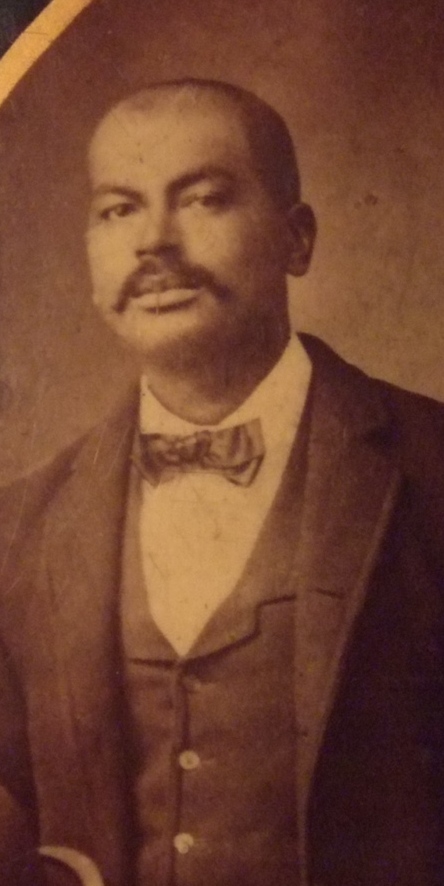
BARNES -- Ned Barnes I

Ned Barnes, circa 1900.

No doubt relieved to move out of the glare of the spotlights trained on this notorious event, Ned returned to real life — his wife Louisa Gay Barnes; young children, Mattie (1895), Alice (1897), Ned Jr. (1900) and Howard (1902), and later Blonnie (1908) and Jerrel (1909); and work as a coachman. By 1910, however, he had given up driving, and the censustaker recorded his occupation as a porter at a club. Though a relatively young man, it is likely that his health had already begun to fail him. On the first day of December 1912, Ned Barnes drew a last breath and was released from the agony of acute uremia. He was 42 years old.

Photo courtesy of Katie C. Barnes.

Standard
Enslaved People, Maternal Kin, North Carolina, Oral History, Religion

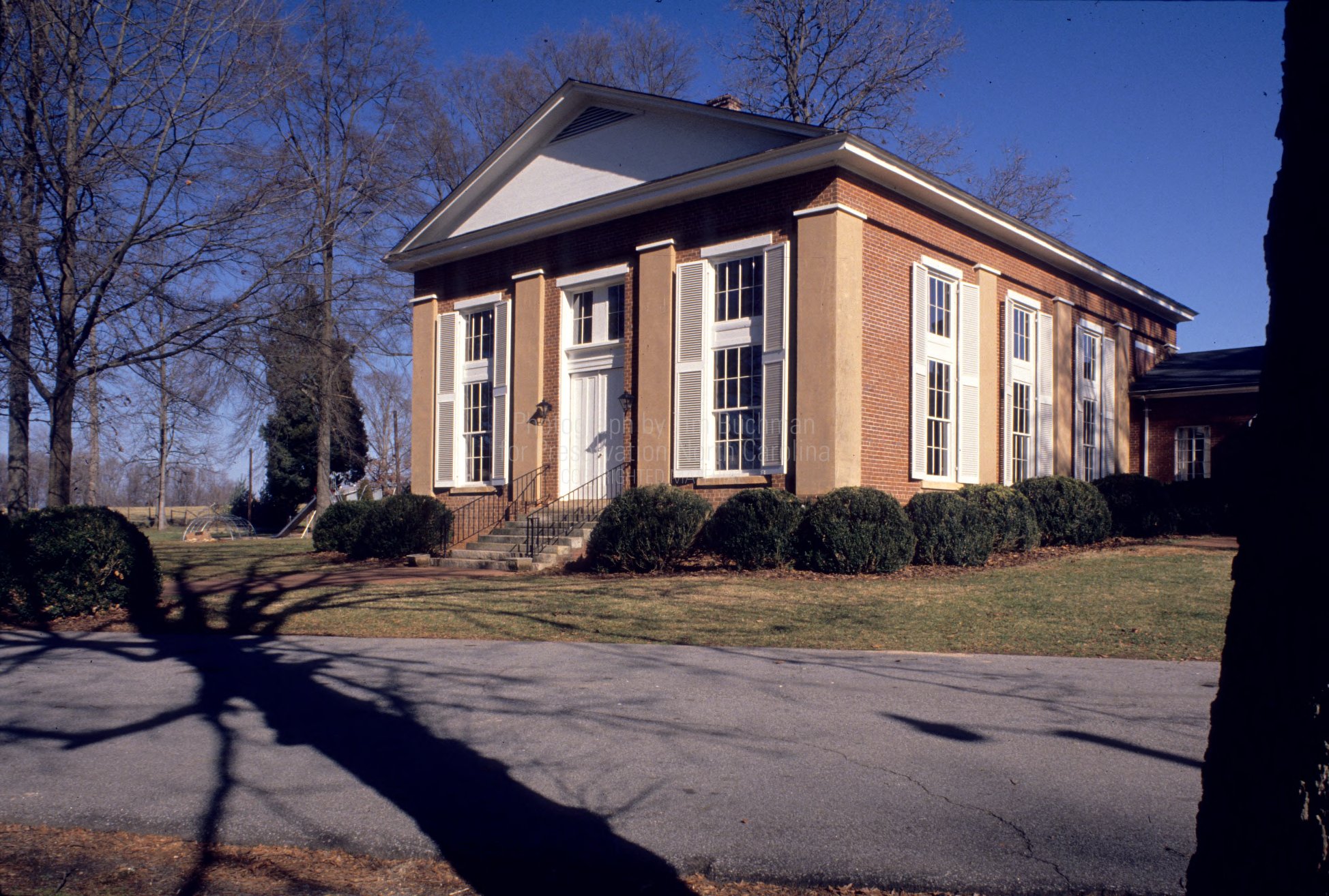
Church home, no. 8: Back Creek Presbyterian Church, Rowan County NC.

Founded in 1805, Back Creek Presbyterian Church is a historic church in Mount Ulla, North Carolina. In 1809, the congregation built a small log house of worship, which was replaced by the congregation’s present Greek Revival sanctuary in 1857. This building was added to the National Register of Historic Places in 1983.  — From http://en.wikipedia.org/wiki/Back_Creek_Presbyterian_Church_and_Cemetery

resolver

Back Creek was the church of my white McNeely forebears — John Wilson McNeely and his father Samuel.  In 1905, Rev. S.C. Alexander and John K. Goodman published History of Back Creek Presbyterian Church, Rowan County, N.C., for 100 Years. It is too much to call it a scintillating work, but its dramatic retelling of the church’s founding compels:

During the latter part of last century, infidelity spread like a contagion all over our country, from one end of it to the other. It gathered round the Church, and settled down upon it like a thick cloud of moral death Although far removed from the busy marts and thorough- fares of the world, this retired part of the Lord’s vineyard did not wholly escape the infection. A cold dead formality had well nigh chilled the vitals of true religion. But this state of things was not permitted to remain long. God heard and answered the prayers of his faithful servants. His life-giving spirit was sent forth with power, and breathed upon the valley of dry bones, and an army of living men stood up to praise Jehovah’s name. This was an important era in the history of our Church and country. It was a time when angels in heaven, and men on earth rejoiced together. It was a time when a most powerful and sudden death-stroke was given to the cause of infidelity. So that its hideous form has never since been reared so high in the majesty of its ugliness to pollute and annoy the Church Thyatira with her then widely extended limits, seemed to have been thoroughly aroused in those exciting times.

As in all communities, so in that venerable Church, there necessarily existed a great diversity of sentiment. The time had now come, when this diversity was to be fully manifested, The Revival of 1802, let it be remembered, was accompanied with many strange phenomena, such as “jerking,” “leaping,” “shouting,” “swooning,” and many such-like bodily exercises. Those who were possessed of more ardent zeal and strong affection, thought this a necessary part of the revival, and produced by the influence of the Spirit. While those of a more phlegmatic temperament, and less impulsive nature, looked upon it as dross around the precious metal; or rather, as the work of Satan trying to counterfeit and hinder the work of religion. Thus there were two parties formed, and each doubtless conscientiously thought they were right. Those who favored the “exercises” were called the “revival party,” as if they alone were desirous of promoting the cause of religion. While those who thought differently were called “opposers” or “anti-revivalists,” as if they wished to hold back the Gospel car. One party wished to have profound silence during public worship. It mattered not how eloquent the speaker was, or how powerful the movings of the Spirit, all must be quiet and still. The other party wished to give vent to their feelings in whatever way inclination might lead. If they felt happy they would shout aloud for joy, or if distressed they would cry out for mercy. The congregation ofttimes presenting the appearance of a Bochim-Babel.

Thus the matter went on for two or three years each party becoming more and more sensitive; and owing to the weakness of human nature, one seemed to exasperate the other, until it became evident to all that some final and decisive action should be taken for the welfare of the Church. A day of fasting and humiliation was appointed, that they might pray for wisdom to guide them in the path of duty, and that they might adopt some plan of action which would be for their peace and edification. The day was accordingly observed. At which meeting the Session was publicly charged with a neglect of their duty in permitting what was looked on by one party as disorder and confusion to exist in time of public worship. The Elders defended their conduct in a mild and Christian-like manner, but all to submit to the other. Thus the day seemed likely to close without having bettered their condition. But something must be done was the universal feeling. Whereupon, it was resolved unanimously, that all those who sympathized with the “Revival Party,” and acted under its influence, should be permitted to withdraw from the Congregation, and leave the other party in the quiet possession of their house and minister. This resolution was acted upon immediately, when about thirty families withdrew, including five Elders — all that Thyatira [Presbyterian Church] then had — men of whom the world might be proud. This was the birthday of Back Creek. The mother travailed with pain, and a noble daughter was born. —

Thus the infant colony, springing off from the western part of Thyatira principally, was left without a minister, and without a house in which to worship. But with zeal like theirs, with hearts so large, and hands so willing, all difficulties were soon removed, and their necessities met. They resolved to build a house in their midst, in which they could worship as their conscience dictated.

A year after Back Creek’s founding, my great-great-great-great-grandfather assumed a leadership role:

On the 27th of December, 1806, William Kilpatrick, Samuel McNeely, and George Andrew, were added to the list of Elders — men of whom we cannot speak too highly. Each was distinguished for his own excellency of character. When sitting in council about the welfare of the Church, it is said William Kilpatrick would devise ways and means for the prosperity of Zion. George Andrew would discourse on its practicability. He would present it in one aspect and then in another, in order that it might be weighed well, — while the venerable John Barr and Samuel McNeely who knew their Bible by heart, would decide whether it were right or not, or whether it would be for the general good. Thus each wheel in the machinery performed its part; and the consequence was, the Church like a healthy plant, grew and flourished, and became a praise in the land. In 1833, another addition was made to the Session by the election and ordination of William King, Thomas Mathews, John Houston, John M. Lowrance and Abner Adams. — Only two of this number are spared to be with us now. The other three have fallen asleep. They were men with whom you were all familiar. Their names are embalmed in your memories. Their excellencies are well known. — And you have long since mourned their loss.

Fifty years later, his son was elected deacon:

On August 10, 1856, the last public service, the last sermon was preached in the “Old Log Church,” built in 1811. The first Deacons in Back Creek Church were elected on May 22, 1858, viz:— Col. Alfred M. Goodman, Jno. F. Clodfelter, Jacob P. Goodman, Moses Lingle, James Miller and J. Wilson McNeely; and on the following June 27 they were regularly ordained and installed. Prior to this the financial,and temporal affairs of the Church were administered, (under the session) by a board of trustees elected by the Congregation, but not regularly ordained and installed into office as is now the more scriptural practice with Deacons.

Given the close association of the McNeelys with Back Creek, it is likely that their slaves also attended the church.

Before the emancipation of the Southern Negro he worshipped with his master in the same church, and enjoyed all the church privileges, consistent with the relations existing between the white and negro races; many of them being worthy members of the church. The gallery in this church was built for their express accommodation. Faithful attention was given to their moral and religious training. Frequently the minister in charge would preach a sermon specially to them; they leading and furnishing the music, of no inferior quality. And they were not forgotten in the Sabbath-School; separate classes were formed of them, taught by the whites. This relation and condition continued for some time after “freedom;” finally, they changed order of relation, and natural trend of events led to their separation from the church of the whites, and to their distinct organization; still, however, some reluctantly took this step.

I don’t know about the “natural trend” or the reluctance. In any case, my forebears remained in the larger fold for, as my grandmother put it, Henry W. McNeely, J. Wilson’s son and former slave — “when he moved to Statesville, when Mama’s daddy moved to Statesville, child, he ran that Presbyterian church.”

The early lists of church members do not determine the proportion of whites to colored.

In regard to the numerical strength of Back Creek, from time to time, complete records fail us. In 1829 the membership was 124, but it is not stated how many white.

In 1850 we numbered 136 white and 26 colored — total 162.

In 1864, 96 white and 74 colored — total 170.

In 1869, 58 white and 50 colored — total 108.

In 1880, 83 white and no colored — total 83.

In 1894, 77 white; in 1900, 90 white; and in 1905, 150 white.

Sometime after 1869, African-Americans left — or were put out of — Back Creek en masse. Hopefully, a little research will reveal their new church home.

Photograph at http://d.lib.ncsu.edu/collections/catalog/buch0494, all rights reserved.


Standard
Enslaved People, North Carolina, Paternal Kin

My Barneses.

Last night, I happened upon a fascinating newspaper source of information about Ned Barnes, brother (half-brother?) of my paternal great-grandmother, Rachel Barnes (or Battle) Taylor. Before I lay it out, though, a deeper introduction to the Barneses is in order.*

Willis Barnes and Cherry Battle registered their six-year cohabitation in Wilson County in 1866. The 1870 census found the family in Wilson township, Wilson County: farm laborer Willis Barnes, 30, wife Cherry, 25, and children Rachul, 7, West, 5, Jesse, 2, and Ned, 5 months. They remained in North Wilson township in the 1880 census: Willis Barnes, 42, wife Cherey, 40, “step-daughter” Rachel Battle, 17, Wesley, 15, Jesse, 13, Ned, 11, Eddie, 7, Mary, 4, and Willey Barnes, 1, plus niece Ellen Battle, 1.  [Very nearby were Hardy Battle, 58, and wife America Battle, 50. Relatives of Cherry?]

Cherry Battle Barnes died after 1880. In 1897, Willis married Fereby Barnes Artis, widow of Benjamin Artis. In the Wilson NC city directory of 1908-09, Willis is listed as a laborer living at 500 South Lodge. Two years later, he was living with his youngest daughter and her family. Willis Barnes died 15 September 1914 in Wilson, Wilson County. His death certificate notes that he was 73 years old, married and a farmer, and that he had been born in Nash County to Tony Eatman and Annie Eatman. Son Jesse Barnes was informant.

On 21 Sep 1882, H.G. Whitehead applied for a marriage license for Mike Taylor of Wilson, aged 20, colored, son of John [sic, his name was Green] Taylor and unknown mother, both living. [This makes no sense — mother is living, but unknown?] and Rachel Barnes of Wilson, age 19, colored, parents unknown, father dead, mother’s status not given. [No sense either, her parents were certainly known. The takeaway — the registrar was not very interested in the facts.]  On the same day, Louis Croom, Baptist minister, married Taylor and Barnes in Wilson before W.T. Battle and Edman Pool.  [Was W.T. Battle related to Rachel?  Is he the W. Turner Battle who married Louvina Knight in Wilson on 24 May 1875?]

Rachel and Mike Taylor had six children. Their first, and only son, Roderick, was born in 1883, followed by the improbably named Maggie (1885), Mattie (1887), and Madie (1888), then Bertha E. (1892) and Henrietta G. Taylor (1893). More about Rachel’s family elsewhere.

Wesley “West” Barnes married Ella Mercer on 4 June 1885 at her father Dempsey Mercer’s house in Wilson County. (The marriage license refers to him as “Sylvester” Barnes.) Wesley worked as a driver or drayman, and though he and Ella had at least seven children, I know the names only of five: Joseph Barnes (1885), Lucy Barnes Watson (1889-1959), Sylvester Barnes (1893-1936), Viola Barnes (1894-1943), and Charley Barnes (1896-??) West died of apoplexy in 1919.

Jesse Barnes married Ella Mercer’s sister Mary Mag Mercer on 1 April 1889. His brothers Wesley and Ned witnessed the ceremony. They had at least three children, Jesse Jr. (1890), Marnie (1892-1943), and Nettie (1895-1917). He died in 1916.

On 27 Oct 1891, J.T. Dean applied for a marriage license for Edward Barnes, 22, of Wilson, son of Willis and Cherry Barnes, and Louisa Gay, daughter of Samuel and Alice Gay.  The ceremony took place 29 Oct 1891 before J.W. Levy, AMEZ Church minister, at Samuel Gay’s.  Witnesses were S.H. Vick, Spencer Barnes, Thomas Davis. [This “Edward” is very definitely Ned Barnes, but the entry is confusing because the 1880 census shows Willis and Cherry with children Ned and Eddie (born about 1873). If there was an “Eddie,” he appears in no other records.] Ned worked as a coachman and around 1901 moved his family to Raleigh for better opportunities. Ned and Louisa Gay Barnes’ children included Mattie Radcliffe Barnes Hines (1895-1923), Alice Ida Barnes (1897-1969), Ned Barnes Jr. (1900), Howard Barnes (1902), Blonnie Barnes Zachary (1908-1932) and Jerrel Randolph Barnes (1909-1929). Ned died in Raleigh in 1912.

Mary Barnes is an enigmatic figure. She married first in Wilson County in 1893 to Pierce Barnes, son of Robert and Hannah Barnes, and then a man named Jones. She never had children of her own, but adopted her nephew, Robert Perry. She died almost 11 months to the day after her brother Wesley in 1919.

William “Willie” Barnes died of tuberculosis in 1917. It is not clear if he ever married or had children.

As detailed here, I believe Cherry Battle had one more child, daughter Lucinda “Cintha” Barnes. Cintha also died young, and her children were reared by her sisters.

 *Barnes is by far the most common surname in Wilson County. My cousin A.B. is descended from at least four separate Barnes lines, and any two given Barneses are more likely to be unrelated than not.

Standard