Agriculture, Civil War, Free People of Color, North Carolina, Paternal Kin

Confederate Citizens File: Mathew Aldridge.

Form of the estimate and assessment of agricultural products agreed upon by the assessor and tax-payer, and the value of the portion thereof to which the government is entitled, which is taxed in kind, in accordance with the provisions of Section 11 of “an Act to lay taxes for the common defence and carry on the government of the Confederate States,” said estimate and assessment to be made as soon as the crops are ready for market.

Mathew Aldridge

Cured Fodder Quantity of gross crop. — 1000 Tithe or one-tenth. – 100 Value of one-tenth. — $3.00

I, Mathew Aldridge of the County of Wayne and State of North Carolina do swear that the above is a true statement and estimate of all the agricultural products produced by me during the year 1863, which are taxable by the provisions of the 11th section of the above stated act, including what may have been sold of consumed by me, and of the value of that portion of said crops to which the government is entitled. /s/ Mathew X Aldridge

Sworn to and subscribed to before me the 3 day of December 1863, and I further certify that the above estimate and assessment has been agreed upon by said Mathew Aldridge and myself as a correct and true statement of the amount of his crops and the value of the portion to which the government is entitled. /s/ J.A. Lane, Assessor.

Confederate Papers Relating to Citizens or Business Firms, 1861-1865, National Archives and Records Administration.

Standard
Births Deaths Marriages, North Carolina, Oral History, Paternal Kin, Photographs

Mother Dear remembers.

The last time I saw my grandmother was on her 90th birthday. It was a bittersweet visit to Philadelphia that I talked about here. In happier times, though, I spent hours recording her recollections, especially those of her childhood. This is one of my favorite stories:

Papa told me to go in the house, and ask ‘em for some water, a pitcher. Talking ‘bout my daddy wanted some water. And the first time I ever seen a grapefruit was there. I said I’d never forget that. ‘Cause I went in that house and asked for some water, and I said “Daddy said” – I called him Papa. Anyway, he wanted to know if he could have some water. And the lady [school superintendent Charles L. Coon’s wife] said, “Yeah,” and she got a pitcher and a glass. And I took it on out there. So Papa stopped and drinked him some water, and I was just standing there while they was fixing the water, and I looked on that table, and all ‘round the table there by the plate they had a salt cellar and half a grapefruit and a cherry sitting in the middle. And that thing just looked so pretty, looked so good. And I said, “Unh, that’s a BIG orange!” I said, “Well, next time I go to the store I’m gon get me one, too.” And sho’ nuff, I asked Papa, when we left – I don’t remember whether it was, it wont that particular time, but we come out, and were on our way to Edmundson’s store, and he wanted me to go in and get a plug of tobacco. Part of a plug. And tell Old Man Edmundson to put it on the bill. So he waited, he was out there on a wagon, he had a little horse, and I went in and told Mr. Edmundson Papa wanted a, whatever amount it was, he didn’t get a whole plug, ‘cause I think it was three or four sections to a plug of tobacco, and for him to put it on the bill, and I said, “He said I could have a orange. And put that on the bill.” And it was boxes sitting up – I’ll never forget it – the boxes sitting up with all the oranges sitting up in there. And I got the biggest one out of the group. The one that wasn’t even orange. I made sure I was gon get me a big orange! I got that and come on back out there and got on the wagon and coming from Five Points to almost home, I was peeling that thing and peeling it ‘til I got it off, and it was SOUR, “Ugh, that’s a sour orange!” I never SEEN a orange that sour. From then on I didn’t want no big orange. And I never even said nothing ‘bout it. And I said, “Now, that didn’t look like, that’s a light-complected, yellow,” it’s not a dark orange, like a orange, and it was so big. And now I always get little oranges. TODAY. I don’t buy no big orange. ‘Cause the little ones is sweeter than the big ones. But, honey, that was a GRAPEFRUIT, and that was the first I’d ever known it was a grapefruit. We ain’t never had no grapefruit. And so, I told Mama that was a, ugh, sour orange. And I told her ‘bout what the Coons had on there when I went up there. And she said, “Well, that was a grapefruit.” “A grapefruit?” I said, “Well, what’s a grapefruit?” And she said, “It’s like a big orange. But you have to put sugar on it most time. It’s a little sour. It’s got a little twang to it.” She said, “But your daddy didn’t never like none, so I don’t care that much about it.” And I said, “A grapefruit? I got myself a grapefruit.” But, anyway, it was sour, but I learned the taste, you put a little sugar on it, makes a little bit sweeter. I swear, Lord, I think about those things that I did when I was little.

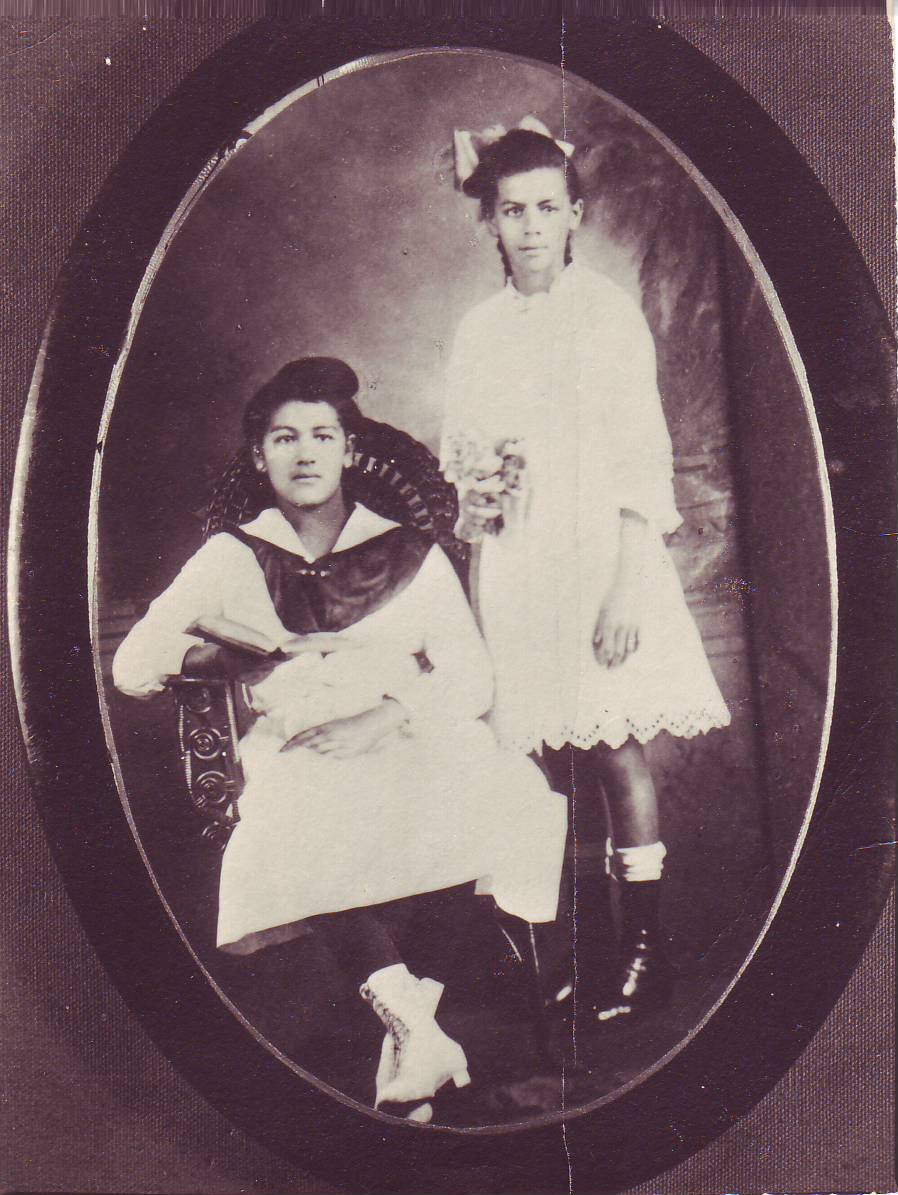
And here’s the only photo of her, little. She was about 10 years old, and her sister Mamie was 13:

Image

Mama made our little skirts and gathered skirts and blouses and every kind of thing, and sometimes Papa might buy one. But she measured your arms, see ‘bout what the sleeve is. I said, Lord, I’m glad them days gone. ‘Cause you couldn’t do nothing to suit … I don’t know, you couldn’t do nothing to suit the older people in them days, ‘cause they, what you ask, you didn’t have but so much, and every once in a while when you get a new piece of change, and you’d get something and you was glad ‘cause it was new, but not ‘cause it was fitting.   And that picture where me and Mamie, Mamie was sitting in the chair and I was standing up by it with that white dress on. Mamie sitting in the chair with her feet crossed …. Well, she had on a middy blouse, dress. It was all, it had a collar on it where had the tape running down there with the square collar and [inaudible]. And Mama made me that dress I had on out of her petticoat! She had, she used to sew a bit, and at that time embroidery wide pieces of cloth that come up, and the bottom part be all embroideried and scalloped all the way around there. Well, that dress I had on had all that scallop on there where Mama took her – she was wearing them hip underskirts, and where she was gathered up here, that had a band on it under there, and then this here was the whole yoke from halfway up to make this part, and she took that part and made me a dress.

Remembering my Mother Dear, Hattie Mae Henderson Ricks (6 June 1910-15 January 2001.)

——

Interview of Hattie H. Ricks by Lisa Y. Henderson; all rights reserved. Photos from collection of Lisa Y. Henderson.

Standard
Births Deaths Marriages, Free People of Color, Land, North Carolina, Paternal Kin, Photographs

Final resting place.

I wasn’t sure how I was going to get at it. GPS coordinates and satellite views showed the cemetery way back from the road on private property, without even a path to get to it. I took a chance, though, and pulled up in the driveway of the house closest to it. A wary, middle-aged white woman was settling an elderly woman into a car as I stepped out. I introduced myself and told her what I was looking for. “Goodness,” she said. “I remember a graveyard back up in the woods when I was child. You should ask my cousin J.”

Following her directions, I knocked on the house of a door perhaps a quarter-mile down Turner Swamp Road. J.S. answered with a quizzical, but friendly, greeting, and I repeated my quest. Minutes later, I was sitting in J.’s back room, waiting for him to change shoes and look for me some gloves and find the keys to his golf cart. We bounced along a farm path for several hundred yards, then followed the edge of the woods along a fallow field. Along the way, J. told me about his family’s long history on the land, and the small house and office, still standing, in which his forebears’ had lived. As we approached the final stretch, he cautioned me about the briers that we were going to have to fight through and pulled out some hand loppers to ease our path. The cemetery, he said, was there — in that bit of woods bulging out into the plowed-under field.

IMG_4797

When they were children, J. and his cousins roamed these woods at play. Though only a few markers were now visible, he recalled dozens of graves on this hillock. Turner Swamp runs just on the other side of the tree line nearby. Without too much difficulty, we cut our way in and angled toward the the single incongruity in this overgrown copse — a low iron fence surrounding a clutch of headstones. I made for the tallest one, a stone finger pointing heavenward through the brush. At its base:

IMG_4783

Elder Jonah Williams, brother of my great-great-great-grandfather Adam T. Artis.

IMG_4786

At his side, wife Pleasant Battle Williams. And his children Clarissa, J.W. and Willie nearby.

IMG_4789

In Glimpses of Wayne County, North Carolina: An Architectural History, authors Pezzoni and Smith note that the largely forgotten graveyard was believed to hold the remains of members of the Reid family. This is quite possibly true as Reids have lived in this area from the early 1800s to the present. As I followed J. through the brush and my eye grew accustomed to the contours of the ground beneath us, I could see evidence of thirty to forty graves, and there are likely many more. Had this been a church cemetery? Was Turner Swamp Baptist Church (or its predecessor) originally here, closer to the banks of the creek for which it is named? If this were once the Reid family’s graveyard — known 19th and early 20th century burial sites for this huge extended family are notably few — how had Jonah and his family come to be buried there?

IMG_4794

I am indebted to J.S. for the warmth and generosity shown to a stranger who showed up unannounced at his doorstep on a chilly December day, asking about graveyards. I have been at the receiving end of many acts of kindness in my genealogical sleuthings, but his offer of time and interest and knowledge — and golfcart — are unparalleled. He has invited me back anytime, and I intend to take him up on the offer.

Standard
Births Deaths Marriages, Newspaper Articles, North Carolina, Other Documents, Paternal Kin

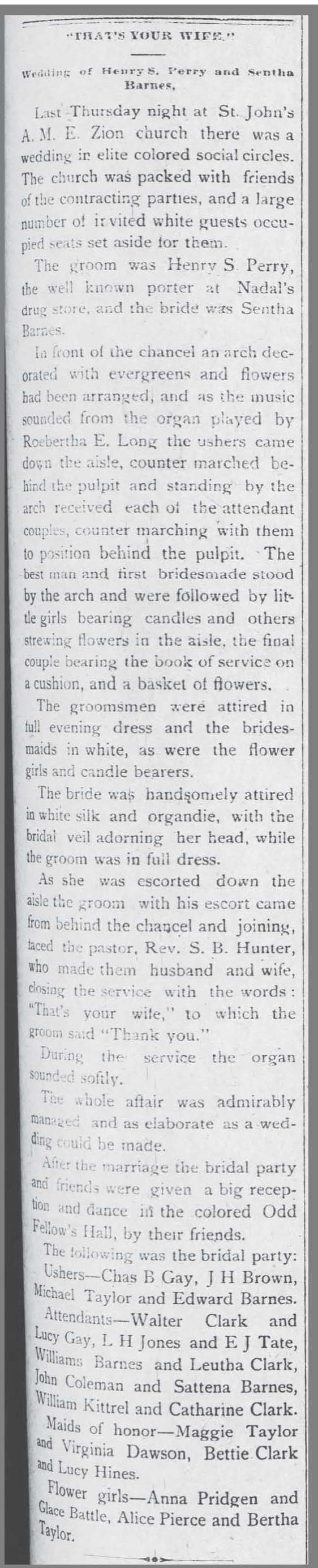
“That’s your wife.”; or, finding the Perrys.

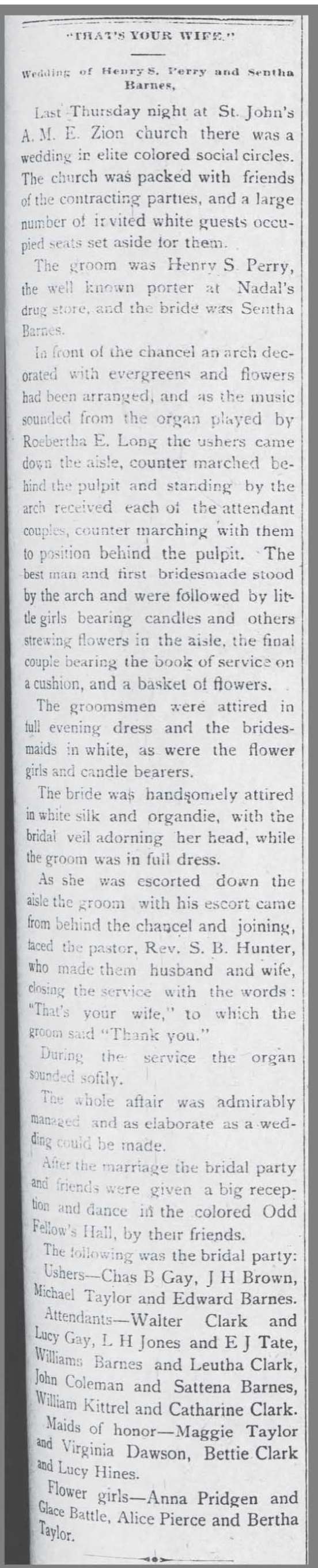
Image

Wilson News, 21 September 1899.

(Ignore the snark, which was par for the course for newspapers covering African-American social and cultural events.)

I came across this article using my great-grandfather’s name as a search term. Mike Taylor was an usher at this wedding and, look, so was his brother-in-law Edward Barnes. Mike’s daughter Maggie Taylor, my grandfather’s sister, then about 13, was a maid of honor, and his daughter Bertha Taylor, 7, was a flower girl. The bride and groom were Henry Perry and Centha Barnes. Were either of them related to the Taylors?

“Perry” rang a little bell. In the 1910 census of Wilson, Wilson County, living along the A.C.L. Railroad: 42 year-old railroad laborer Pierce Barnes, wife Mary, 34, adopted son Robert Perry, 8, and Mary’s father Willis Barnes, 72.  Mary was my great-grandmother Rachel Barnes Taylor‘s sister. In the 1920 census of Wilson, Wilson County, at 114 Lee Street: Mike H. Taylor, cook at cafe, wife Rachel and their son Tom Perry, 12.

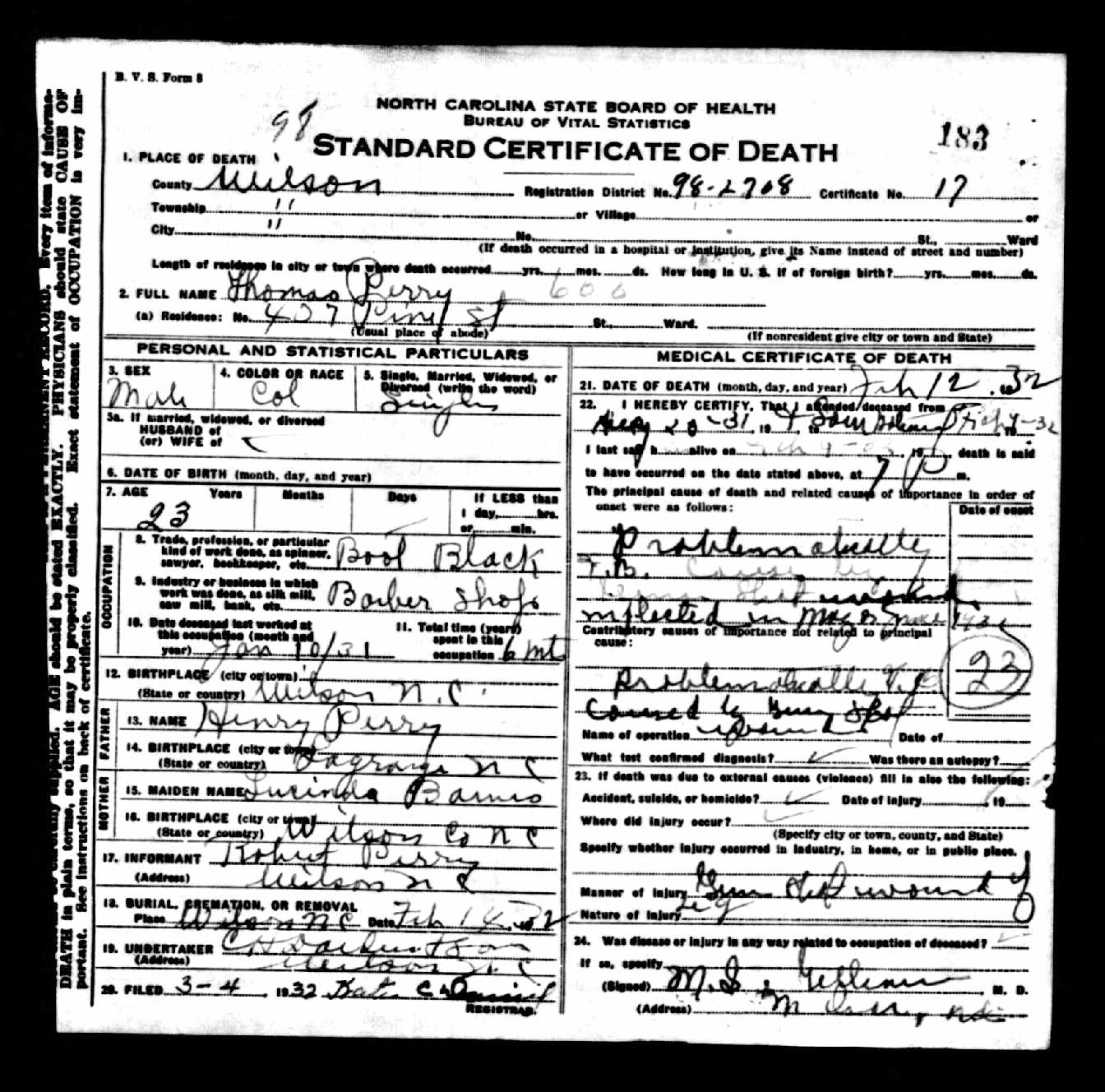
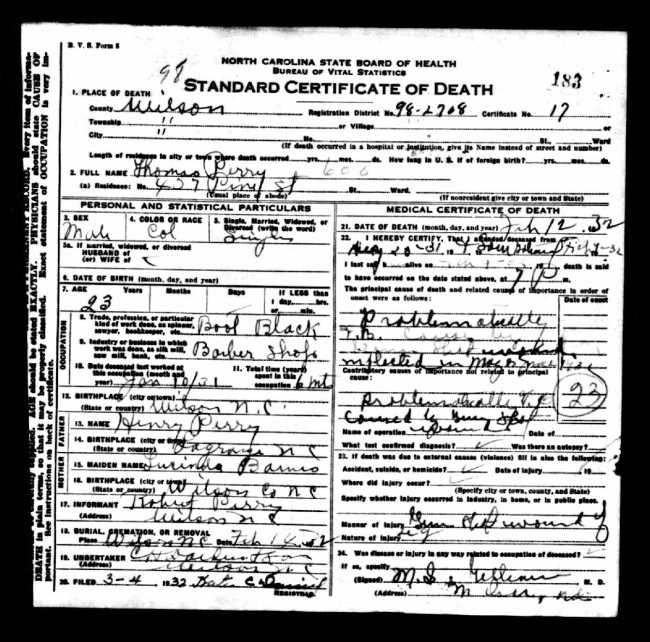
Then there was this death certificate:
Image

So Tom Perry was the son of the couple that married above. But what was Tom’s relationship to Robert Perry, who was adopted by Mary Barnes Barnes and served as informant for Tom’s death certificate? And how were the Perrys related to Mike Taylor or his wife Rachel Barnes Taylor?

I found Henry and Centha Barnes Perry’s 1899 marriage license. Henry was 24; Centha, 18. Both Henry’s parents were listed, but only her father, Willis Barnes, was.

In the 1880 census of Wilson township, Wilson County, Willis Barnes appears with his wife Cherry, six of their children (the youngest aged about 4) and a niece. By 1900, and probably long before, Cherry Battle Barnes was dead. Had she had one last child, Lucinda, called “Centha,” in 1881?

Let’s say Cherry died in or shortly after childbirth. Her oldest daughter Rachel, who married Mike Taylor in 1882, likely would have reared her baby sister with her own children. (The oldest, my grandfather, was born in 1883.) The 1890 census might have captured this family together, but those records were destroyed by fire. By 1900, Centha (“Sindie”) and her new husband Henry S. Perry were living together in Wilson, as yet childless. Ten years later, however, Henry was listed as a single man boarding at the New Briggs Hotel, where he worked as a bellboy.

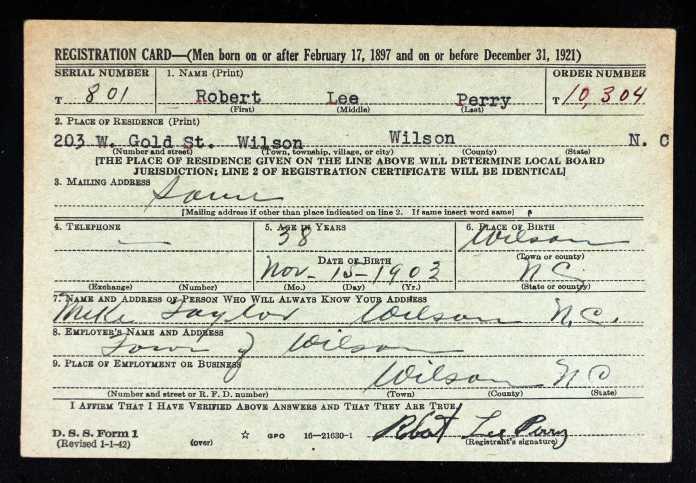
What happened in those ten years? The best guess is that Cintha, having given birth to at least two sons, Robert (1903) and Thomas (1908), died. Her children went to live with her mother’s relatives, just as she had done. The family, however, never quite recovered. Henry eventually remarried, but died in 1927 when his second set of children were still young. Tom, who worked as a boot black in a barbershop (perhaps the one in which my grandfather cut hair), was shot in the leg in the spring of 1931, then seems to have died of tuberculosis less than a year later. (Cause of death: “problematically T.B. caused by gun shot wound”? Wha?) Robert Perry worked as a grocery delivery boy for a while, then as a janitor for Carolina Telephone & Telegraph Company, but in 1930 was listed as a convict living at the Wilson County Stockade. He married a woman named Pauline, but it is not clear whether they had children. In 1942, he registered for the World War II draft:
TAYLOR -- RL Perry WW2 Draft Card

The back of the card notes that Robert Lee Perry was 5’11”, 155 lbs., had a scar under his left eye, and had brown eyes, black hair and a dark brown complexion. “Mike Taylor,” the person who would always know his address, was not the Mike Taylor who had been an usher at his parents’ wedding. Rather, he was that Mike’s son, Roderick “Mike” Taylor, Robert’s first cousin and my grandfather. Robert Perry died 15 May 1977. His death certificate lists no parents.

Standard
Business, Maternal Kin, Newspaper Articles, North Carolina

To look like new.

Mountain_Scout_Taylorsville_8_23_1916 Pressing Club

Mountain Scout (Taylorsville), 23 August 1916.

This ad appears several times in Taylorsville’s Mountain Scout in the latter half of 1916. Did Lon Colvert open a branch of his Statesville operation a few miles away in Alexander County?  Like barber shops, clothes cleaning and pressing businesses were frequently operated by African-Americans in the late 19th and early 20th-century South.

Standard
Births Deaths Marriages, Newspaper Articles, North Carolina, Paternal Kin, Politics, Rights

Remembering J. Frank Baker.

The myth goes something like this: John Frank Baker was the first black man elected to Congress from Wayne County. He never made it to Washington, assassinated as he attempted to board a train north for his swearing-in.

Something about this didn’t sit right with me.

Wayne County was part of the so-called Black Second, the Congressional district that encompassed most of northeast North Carolina’s majority-black counties during Reconstruction and into the early 20th century. The history of African-American political activity in the district is extensive and well-documented, and I couldn’t recall having read of Baker. A Google search quickly refreshed my recollection. North Carolina voters sent four black Congressmen to Washington in the nineteenth century: John Adams Hyman of Warren County (1875-1877), James Edward O’Hara of Enfield (1883-1887), Henry Plummer Cheatham of Littleton (1889-1893), and George Henry White of Tarboro (1897-1901). No Baker.

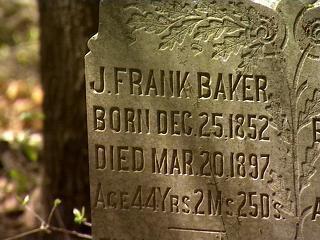
As his headstone reveals, J. Frank Baker died 20 March 1897, the same month that George H. White was sworn into the 55th Congress, having defeated white Democratic incumbent Frederick A. Woodard of Wilson. [Sidenote: My junior high school was named for Woodard.] Clearly, Frank Baker was never elected to Congress. Why, then, was he killed?

To call newspapers of the era racist is to say “the sky is blue.” Articles about African-Americans were condescending and mocking at best, derogatory and vicious most times. Objectivity was not a hallmark of journalism in the late 19th century in general, but if their names appeared in the local paper, African-Americans could generally expect the worst. Notwithstanding this general bleak picture, when consumed with a grain of salt, early newspapers can be an invaluable source of otherwise unrecorded information about black Americans.

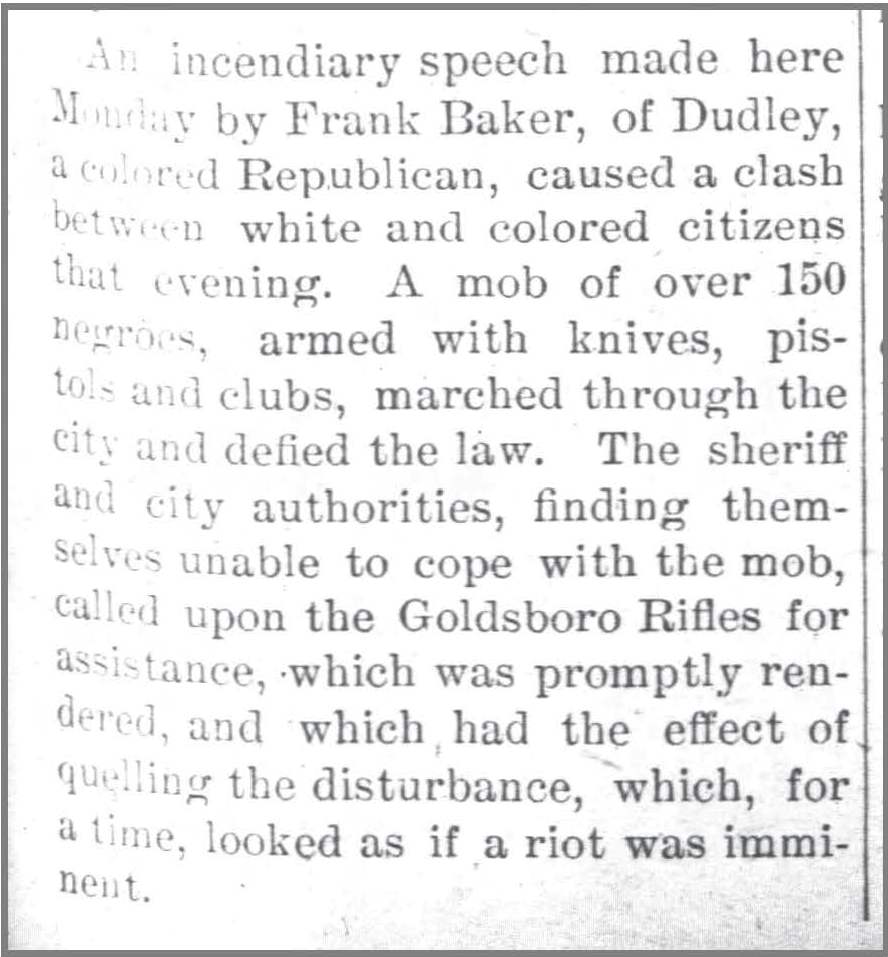
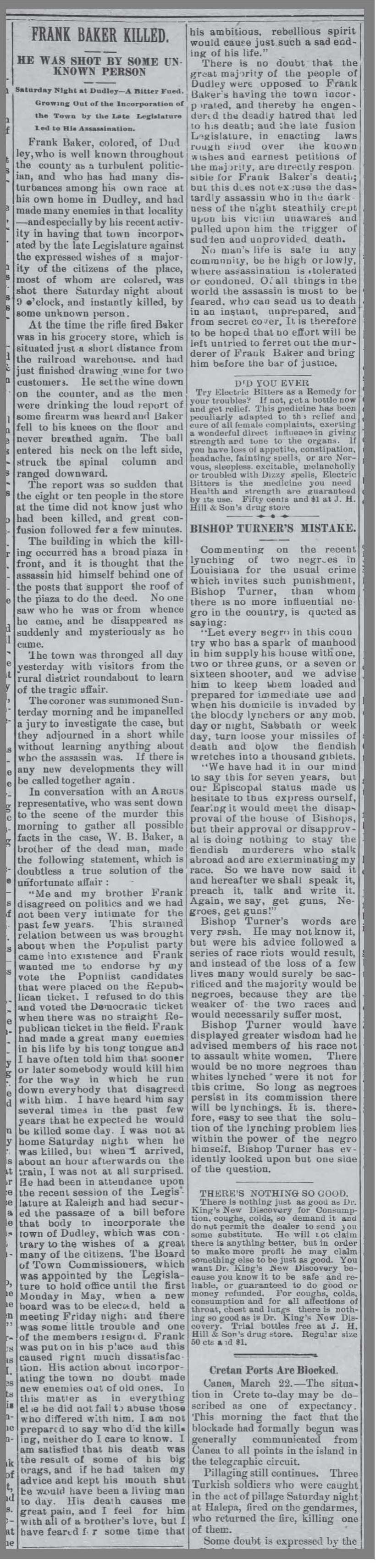
Frank Baker’s murder was covered in detail in the Goldsboro Headlight and the Weekly Argus, the rival newspapers operating in Wayne County at the time. Even before his death, however, his fiery advocacy seized the attention of the white community. This story was picked up by papers across the country:

Gboro_Headlight_11_5_1896_F_Baker

Goldsboro Headlight, 5 November 1896.

I don’t know what Baker was speaking about or why his words touched off such a response — if, in fact, “150 negroes” actually took the streets like this. It is clear, though, that he was a powerful and polarizing figure in Wayne County. And four months later he was dead. A Raleigh newspaper broke the story:

Raleigh_Daily_Trib_3_24_1897_F_Baker

Raleigh Daily Tribune, 24 March 1897.

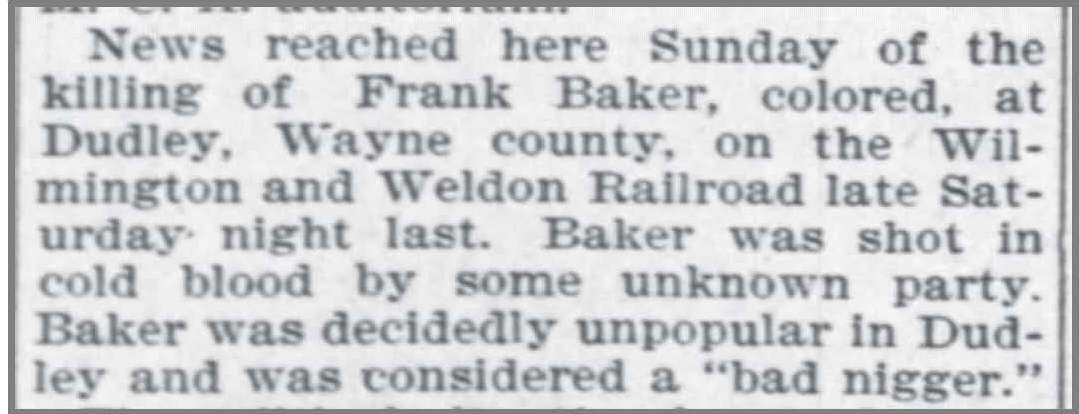
The tone set, the Goldsboro papers picked up the report:

Gboro_Weekly_Argus_3_25_1897_Frank_BakerGoldsboro Weekly Argus, 25 March 1897.

Assuming that the basic description of the murder is correct, we learn that Baker was not boarding a train when he was killed. Rather, he was minding customers at his grocery store, located near the railroad warehouse in Dudley. (The Headlight reported that the store belonged to Ira W. Hatch.) He was shot at fairly close range, but a room full of people saw nothing. Nonetheless, a wholly unbelievable statement attributed to his brother, W.B. Baker, placed the responsibility for Frank’s death on his own head. The reporter then emphasizes the “deadly hatred” that Baker engendered among his neighbors by insisting on legislation incorporating the town of Dudley. [Sidenote: don’t you have to love Bishop Henry McNeal Turner?]

Gboro_Weekly_Argus_4_29_1897__F_Baker_

Goldsboro Weekly Argus, 29 April 1897.

A month later, the wheels of justice were spinning uselessly, as newspapers indignantly proclaimed the innocence of two white men implicated — but not actually charged — in the crime. A week after W.B. Bowden’s good name was cleared, J. Will Grady was released when the “facts of his innocence were established.” On 27 May 1897, the Headlight tersely noted that the governor of North Carolina had offered a reward for the capture of Frank Baker’s killers. That’s the last I’ve found on the subject.

John Frank Baker was born about 1845. I don’t know much about his early life, but in 1879 he married Mary Ann Aldridge, daughter of J. Matthew and Catherine Boseman Aldridge, and likely first cousin to my great-great-grandfather John W. Aldridge. Frank Baker was not a Congressman. Nonetheless, he made his mark in Wayne County as an African-American politician capable of stirring the masses and willing to take on unpopular causes in an era in which even voicing opinions was a daring undertaking. He is not forgotten.

Image

——

Photo from Baker article posted at http://www.wral.com/news/local/story/116365/.

Standard
DNA, Free People of Color, North Carolina, Paternal Kin

DNAnigma, no. 2.1: Another Armwood.

I seldom check FTDNA, but last night I moseyed on to study the new My Origins feature. A glance in the corner of the screen showed a  new high match, an estimated 2nd to 4th cousin whom I’ll call L.A. I emailed him, and he quickly responded. We immediately identified Sampson County, North Carolina, as a potential point of commonality, and I asked his grandparents’ names. I looked them up and found that one was the offspring of John Wesley Faircloth and Laura Wynn (or Simmons). A little further research — and consultation with Stephen Maynor, my point man for all things Sampson County — revealed that Wesley Faircloth, born about 1856, was the son of Nancy Armwood. Again with these Armwoods!

Nancy was the daughter of John and Susan Armwood, and her sister Louisa (or Eliza) was my great-great-great-great-grandfather James Henderson‘s second wife. Am I an Armwood though?

While refreshing my recollection about this family — which has always frustrated my efforts to track them properly — I discovered a previously unnoticed tangle of intermarriages between and among the Armwoods, Wynns, Simmonses and a few Hendersons in northern Sampson and Duplin Counties and southern Wayne County.

The base couples:

  • Major Armwood (~1798-??) and wife Eliza [last name unknown] Armwood (~1806-??).
  • Richard Armwood (1832-??) and wife Mary Faircloth Armwood.
  • John Armwood (~1800-??) and wife Susan [maiden name unknown] Armwood (~1820-??).
  • James Simmons (1798-1860) and wife Winnie Medlin Simmons (??-1902).
  • Gray Winn (~1815-1850) and wife Sarah Greenfield Winn (1816-1909).

And the marriages and other relationships that flowed therefrom:

And this is just a generation or two of intermarriage. I’ve asked A.G., my other Armwood match, to test with 23andme so I can compare our matches and see if she matches my known Hendersons. Stay tuned….

Standard