Land, North Carolina, Oral History, Other Documents, Paternal Kin, Photographs

The lots.

Said my grandmother:

And Johnnie [Aldridge], he called me, and I was working to the hospital. And he called me and told me, at least he called the hospital and wanted to speak to me: “Well, if you want to see your daddy – you said you ain’t never seen him before – come down here. He’s down here now. So, don’t let him know I told you.” [Laughs.] So, I went down – I said, well, I’m gon go down there and see Silas Cox ‘bout selling the lots where Grandma Mag’s house was on. So, I got off. So, I got Mr. Fisher to take me down there. I said, “Mm, I wanna see that man.”

Image

My grandmother inherited two lots in Dudley from Sarah Henderson Jacobs Silver, her great-aunt and foster mother. (Because she had been informally adopted by Sarah and her husband Jesse Jacobs, my grandmother used the surname Jacobs until adulthood, when she reverted to Henderson.)

Mama had the lot where the house was, where Grandma Mag lived. Had that house built for her. The house they was staying in was up by the railroad, was just about to fall down. Somewhere down up there by where the Congregational Church is. And she built that house down there next to Babe Winn. I don’t think it was but one room. The porch, one room, and a little shed kitchen, a little, small, like a closet almost, and had the stove in it. Then had a stove in the room where she was, one of them round-bellied stoves where you take the top off and put wood in it. I remember that. And Sis Winn, her name was Annie, and she had a daughter, and she named her Annie after her. So they called the mother Sis, and they called the daughter Annie. And they were living in the house right next to her, Grandma Mag’s house. As I can remember. And after Grandma Mag died, the old preacher stayed in there and burnt it up.

I posted a query to my cousins:

Can someone tell me if the Dudley VFD was at its present location in the 1960s? I’m trying to figure out where two lots were on a 1967 plat. The plat mentions NC Secondary Road 1120 (which seems to run east-west), Simmons Street (abandoned) and Walnut Street (abandoned). James Newkirk and William Newkirk owned land on either side of where the fire station was on 1120. Thank you!

No luck.

Dudley Volunteer Fire Department is now on Highway 117 Alternate, south of its intersection with O’Berry Road.  A Google search revealed that O’Berry was formerly known as Secondary Road 1120, so I now know that the fire department has moved around the corner.  My father recalled that his mother’s lots were just west of the intersection, behind Silas Cox’s feed silos.

Here’s an aerial view of Dudley today: dudley intersection
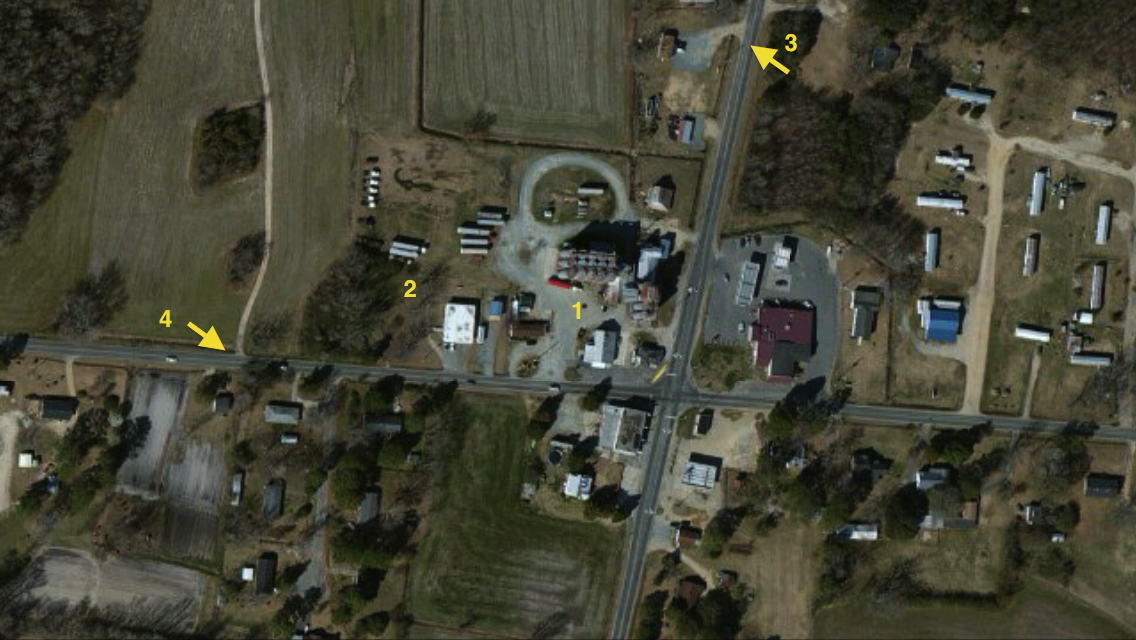
Other than Road 1120/O’Berry Road at (4), there’s not much of anything that matches the plat. However, with the clue about the (1) feed or fertilizer silos, I’ve identified (2) as the approximate location of Grandma Mag’s house and the lots. (3) is Highway 117 Alternate.

My grandmother finally sold her lots in the late 1960s, ending more than 90 years of land ownership in Dudley by my line of Hendersons.

——

Interviews of Hattie Henderson Ricks by Lisa Y. Henderson; all rights reserved. 

Standard
Enslaved People, Free People of Color, North Carolina, Other Documents, Paternal Kin

The husband might become a slave of his children.

To the Honorable the General Assembly of the State of North Carolina now in Session – The Petition of Lovedy Henderson a free woman of color, respectfully represents that your Petitioner intermarried some years since with a certain man of color by the name of Horace, then a slave, but with the consent of his owner. That since their marriage by care and industry, she has been enabled to purchase her said husband at the price of Eight Hundred & Seventy dollars of Hugh and John G. McLaurin Executors of Duncan McLaurin deceased. That she has paid the purchase money & has a Bill of Sale duly executed by the said Executors. That your Petitioner now has two children by her said Husband & as by possibility her husband might become the slave of her children, your petitioner is induced to ask the interference of your honorable body, as the only tribunal authorized to grant the relief prayed for. Your Petitioner would not presume to ask this indulgence in her favour, in contravention to the policy of the Laws of the Land, but from the peculiar circumstances of her case & the belief that she will be enabled to establish for her Husband such a Character as to entitle him to the favourable notice of your honorable body. For this, she relied on the certificates of highly respectable gentlemen both in Fayetteville & the City of Raleigh, where they have lived since their intermarriage. Your Petitioner therefore prays the passage of an Act, emancipating her said husband Horace Henderson, and she in duty bound will ever pray &c. /s/ Lovdy Ann Henderson

We Hugh McLaurin & John C. McLaurin Executors of Duncan McLaurin dec’d unite in soliciting the passage of an Act for the emancipation of Horace Henderson as prayed for by his wife and we are free to say that we have long known said Horace who is a Barber and a boy of unexceptionable good character and of industrious & moral habits. /s/ H. MacLaurin for himself and John C. MacLaurin

We the undersigned citizens of Fayetteville freely unite in soliciting the General Assembly to pass an Act emancipating the negro man Horace, that we have known said Horace as a Barber & a Boy of good character, industrious habits and as we believe of the strictest integrity. /s/ J.H. Hooper, John MacRae, John Kelly, Thos. L. Hybart, [illegible] Cochran, John Lippitt, D.A. Saltmarsh, Chas. B. Jones, [illegible] Hawley, William S. Latta, Jas. Huske, Duncan Smith, Henry W. Ayer

We the undersigned citizens of Raleigh freely unite in soliciting the General Assembly to pas an Act emancipating the negro man Horace, that he has lived in the place for the last three or four years as a Barber, and has conducted himself with the utmost propriety, that in his deportment he is humble & polite, free as we believe from any improper intercourse with slaves, industrious & honest. /s/ M. Stokes, R.M. Saunders, Jo. Gales, B.W. Daniel, Geo. Simpson, J. Brown, John Primrose, Hazlett Wyle, Richard Smith, S. Birdsall, Jno. G. Marshall, A. Williams, Fabius J. Haywood, Robert Staniroy

Ninety years after this petition was filed, a Horace Henderson was born into my extended family, but I know no connection between my Hendersons, who were originally of Onslow County, and Lovedy Ann Henderson.

——

General Assembly Session Records, November 1832-January 1833, Box 5, North Carolina State Archives.

This family is found in the 1850 census of Greensboro, Guilford County: Horace H. Henderson, 40, barber, and wife Love, 39, both born in Fayetteville; children James, 18, farmer, Mary Ann, 17, and Timothy, 14, born in Raleigh; and Albert, 10, Sarah, 8, Thomas, 4, and Alexander, 3, born in Greensboro; all mulatto.


Standard
Births Deaths Marriages, Civil War, Enslaved People, Military, North Carolina, Other Documents, Paternal Kin

They would not have taken them in church.

Part II of Bailham and Hannah Sauls Speight’s pension application file arrived today, and here are some extracts from witnesses deposed 4 June 1904:

  • Hannah Speight – “I claim pension as the widow of Bailham Speight but who served during the Civil War in the U.S. Army under the name of Bailham Edwards.” His brother Lafayette Edwards “lives at Bull Head which is eight miles from Goldsboro.” “I was born on Appletree Swamp near the town of Stauntonberg, Greene County. N.C. and was a slave; was owned by Lawrence Brown. I am the daughter of Rosetta Sauls. My father was Sheppard Sauls. I was known as Hannah Sauls prior to my marriage to Bailham Speight. … [A]fter our marriage we lived as husband and wife till he died December the 21st 1902.” “My husband was born and raised in Greene County. He was about six years older than I was still I knew him before he was grown….” “After his discharge he went to Georgia and was there just twelve months I do not know in what part of Georgia he was. No, I guess it was South Carolina where he went for he went away with Capt. Bill Taylor to work turpentine. … I married my husband about four years after the close of the war and we were married in the month of November in Snow Hill….” Married at Rebecca Bess’ house. She is deceased, as are witnesses Martha Sheppard, Luke Sheppard, and Charles Moseley. Maria Lofton did not witness, but could testify to marriage. She lives on Dr. Parrott’s plantation near Falling Creek. Amos Ellis, Lafayette Edwards, and Violet Edwards would have heard of the marriage, as would Isaac Lynch. … “My husband was raised five miles from Snow Hill on the Betsey Edwards place.” “My husband had a woman before the war. She might be called a slave wife and her name was Jennie. My husband told me she died in Newbern about the close of the war.” “At date of death of my husband I had one child under 16, viz., George Speight and he was fourteen on the 26th of last September. I never had George’s age set down by I remembered it all the same and I have always celebrated the twenty sixth of September as being his birthday and I am absolutely sure that he is now fourteen going on fifteen.” Midwife Mariah Moore lived one mile from Kinston in Harveytown. “After my marriage I lived for twelve months on the place of Dr. John Harvey and then I moved down here; moved here in the Fall of 1870 and have been here ever since. Everybody both white and black know me around here.” Deposition A.
  • Hannah Speight — Sixty-one years of age and lives four miles from Kinston. “I have had eleven children – ten by Bailham Speight and one by Loderick Artist. I never lived with Loderick Artist for during the time he came to see me I was living in the house with my mother and father. We were engaged to be married but after he got me in trouble he went and married another woman. He married her before I married Bailham Speight. He married a woman named Mandy and lived with her till he died ten years ago. He died in the neighborhood of Speights Bridge. No, I never went under the name of Artist nor was I ever known as his wife and never lived with him a day. Our relations were all of a secret nature.” Deposition B.
  • Rosetta Sauls – “I think I am 85; I can do no work and live with my grandson.” “Hannah Speight is my daughter.” … “I did not see her married because she married in Snow Hill and I was living in the country but Bailham come and got her from her my house and took her to Snow Hill where they were married and then they came right back to my house where they lived some three or four months and then they moved in a house to themselves.” “No, my daughter was never married to Loderick Artist and they never did live together but he was the father of her oldest child. He deceived my daughter and got a child by her and then went and married Mandy. All the time he was keeping company with my daughter she was living with me. My daughter never went under the name of Artist nor did she ever go under any name except Sauls and Speight. …” “Bailham Speight and Hannah were both members of the Baptist Church and had they been living improperly and not regularly married they would not have taken them in church.”
  • Lemon Speight – “On the 27th of last April I was 37 years of age.” Farmer four miles from Kinston. “Hannah Speight is my mother. I am the son of Loderick Artist who died ten years go. He never married my mother and I am the only child she ever had except those belonging to Bailham Speight. My father had a wife and her name was Mandy.” “I was married December the 12th 1889 and my brother George was born September the 26th 1889.”

And a letter dictated by Bailham Speight himself:

February 11th 1896, Kinston N.C.

Mr. I.S. Kurtz       Dear Sir, Relative to my age and the way that my name has been spelled. Now I wished to informs you that I used to belong to the old man names Edwards before the war (white) Therefore I enlisted in the Military Services of the United states. I enlisted by the name of Bailham Edwards and I answered at roll call. Bailham Edwards. But the Yankees, they called the name some what like this. Balum Edwards. But however you is speaking to the same man after all. …” [The letter is written in a very florid hand, and the signature does not show his “X.” However, other documents reveal that Bailham Speight could not, in fact, read or write.]

Standard
Births Deaths Marriages, North Carolina, Oral History, Paternal Kin, Photographs

Remembering Uncle Jesse.

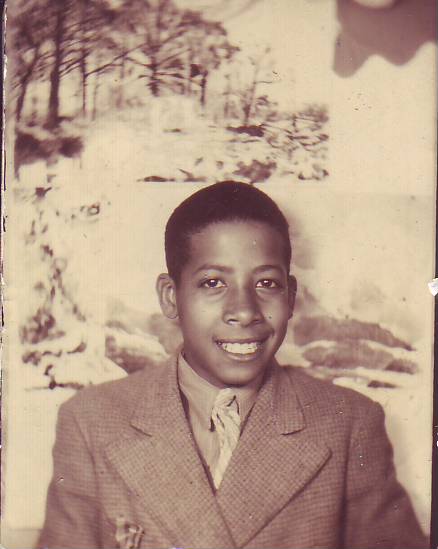
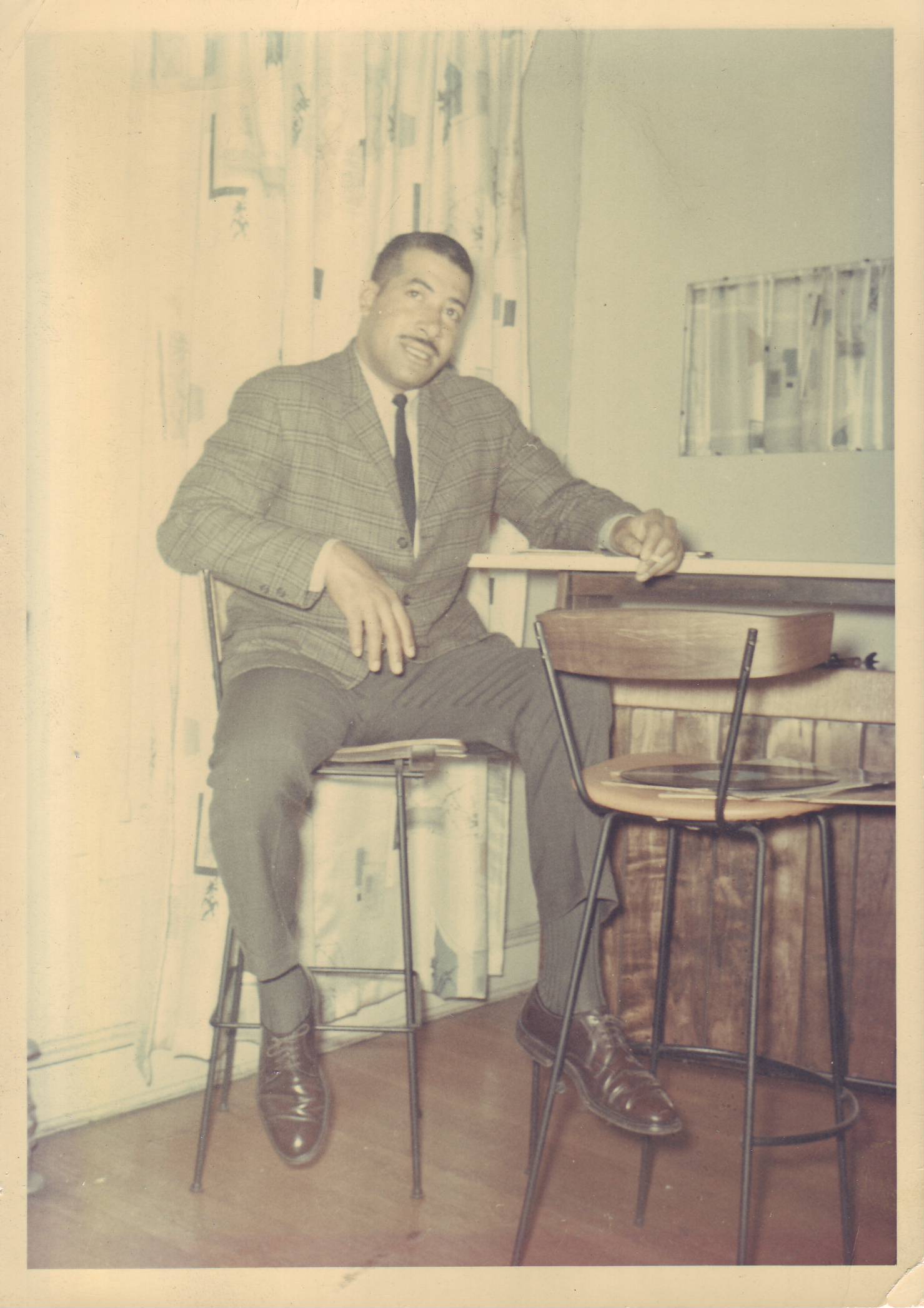
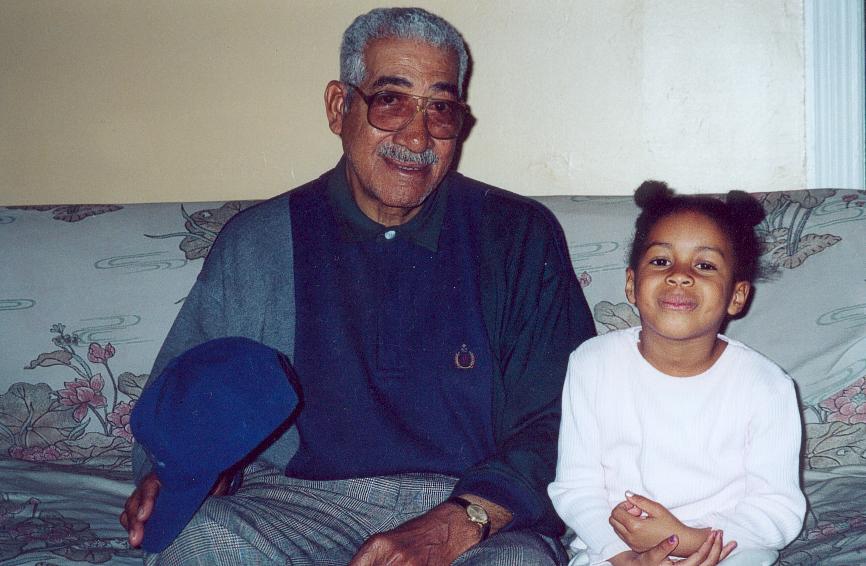
My grandmother’s second boy. Smooth. Dapper. Slick. Artistic. A chef. A painter. A hustler. A beloved uncle.

Happy birthday, Jesse Adam Henderson (17 April 1929-5 August 2005)!

ImageLucian and Jesse Henderson, circa 1932, Wilson NC.

Image

 Jesse, circa 1938, Wilson NC.

Image

 Circa 1944, Wilson NC.

Image

 With wife Jean and my grandmother, probably in the late 1950s, perhaps at the Jersey Shore.

Image

Always “clean,” posted at the bar, 1960s.

Image

One of my favorite photos of my uncle, with my niece, who adored him. Philadelphia, 2001.

Standard
Births Deaths Marriages, North Carolina, Paternal Kin, Photographs

In memoriam: Joseph F. Barfield (1933-2014).

 JFB

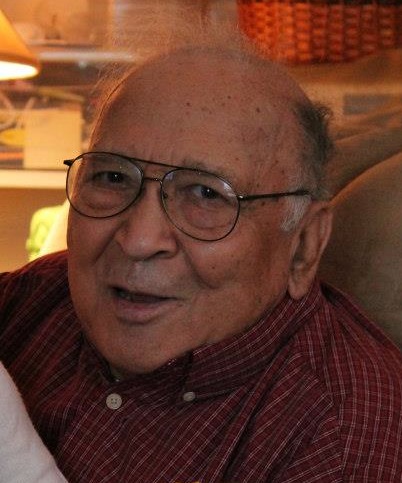
Joseph Franklin Barfield, son of Walter and Katie Kornegay Barfield, died 12 April 2014 in Fayetteville, North Carolina. Cousin Joseph was born in 1933 near Mount Olive, Wayne County, North Carolina, and served honorably in the United States Army. He is survived by his wife and loving children, grandchildren and great-grandchildren, as well as a sister and brother.

joseph & alton

Joseph F. Barfield and Alton H. Barfield, who passed almost exactly one year before his older brother.

——

Top photo courtesy of Richard J. Barfield; bottom photo courtesy of Jerilyn James Lee, with thanks to Alicia Barfield.

Standard
Births Deaths Marriages, Maternal Kin, Newspaper Articles, North Carolina, Other Documents

Cousin Red McNeely … or Smith.

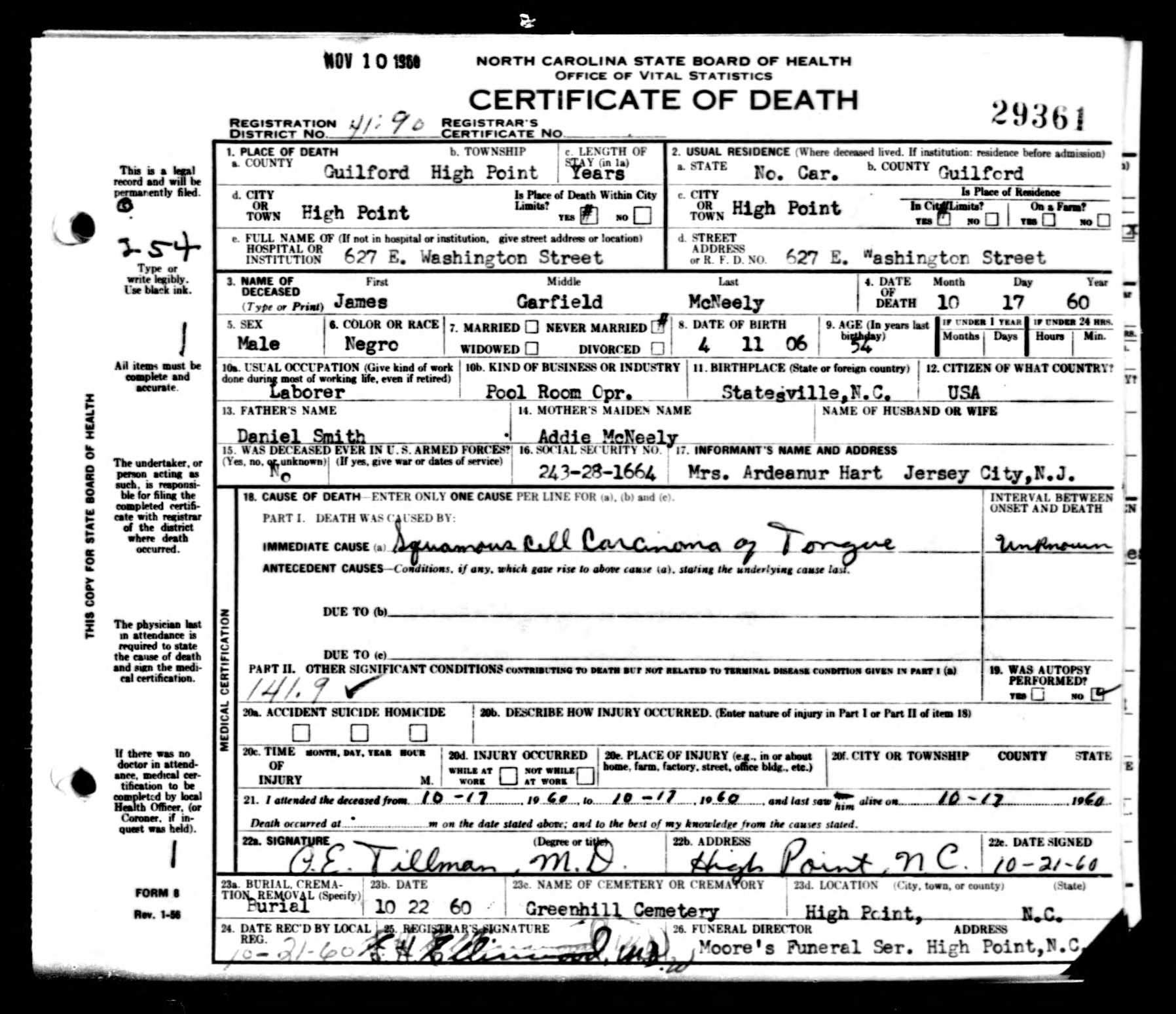
So, was he James Garfield Smith or James Garfield McNeely?

Addie Lucinda McNeely married Daniel Smith in Statesville NC on 2 October 1902. Their daughter Ardeanur Smith was born the following February and son James Garfield Smith on 11 April 1906. I have never found the family in the 1910 census and do not know how long Addie and Daniel remained together. When her uncle Julius McNeely’s estate opened, Addie Smith with her siblings was listed as one of the heirs. Unlike her married sisters, however, her husband’s name does not appear alongside hers. In 1917, mid-proceedings, Addie died — I’ve never found her death certificate either — and her name was struck through and was replaced by that of her children, “Ardenia” and James Smith.

I have not located James again with any certainty before 1942. (There’s a “James McNeelly” of the right age listed in the 1930 census of High Point NC, but he had a wife, which my James allegedly never had.) When he registered for the World War II draft, James gave his name as “James Garfield McNeely.” Why the shift from “Smith,” which he apparently never used as an adult? Though his birth year appears to be off by one year, this is clearly our man. He was born in Statesville, and Janie McNeely, his mother’s youngest sister, is named as his contact. (The neighborhood in which he lived and worked is now part of the Washington Street Historic District, and Club Carolina merited a brief mention in the application for historic status.)

James G McNeely

Cousin James disappears from the record again until his death certificate was filed. He was working at a pool room and living at the Kilby Hotel when he died. Ardeanur Hart of Jersey City NJ was informant and gave her brother’s name as James Garfield McNeely.

James G McNeely Death Cert

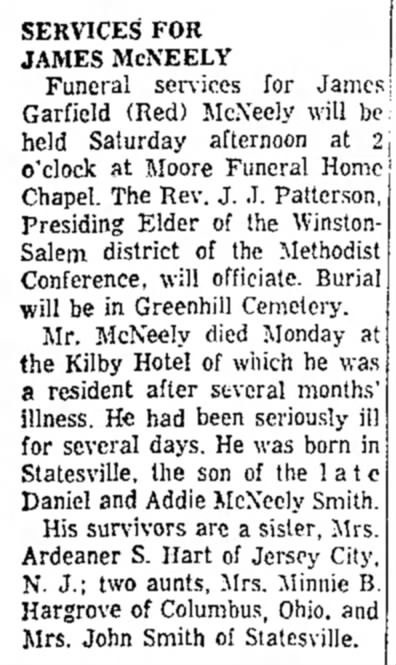
Here’s his obituary:

James G McNeely 21 October 1960 HP Enterprise

High Point Enterprise, 21 October 1960.

And a note of acknowledgment from his family. (Who in the world were the Martins and Griffins?):

JG McNeely HP Enterprise 11 13 1960

High Point Enterprise, 13 November 1960.

[Sidenote: The physician who signed James’ death certificate? Dr. O.E. Tillman? His son and I met in high school and became good friends in college. He married A.B., my roommate and closest college friend, and I was in their wedding. Dr. Tillman is now retired, but remains active in High Point civic affairs.]


Standard
Agriculture, Business, Newspaper Articles, North Carolina, Paternal Kin

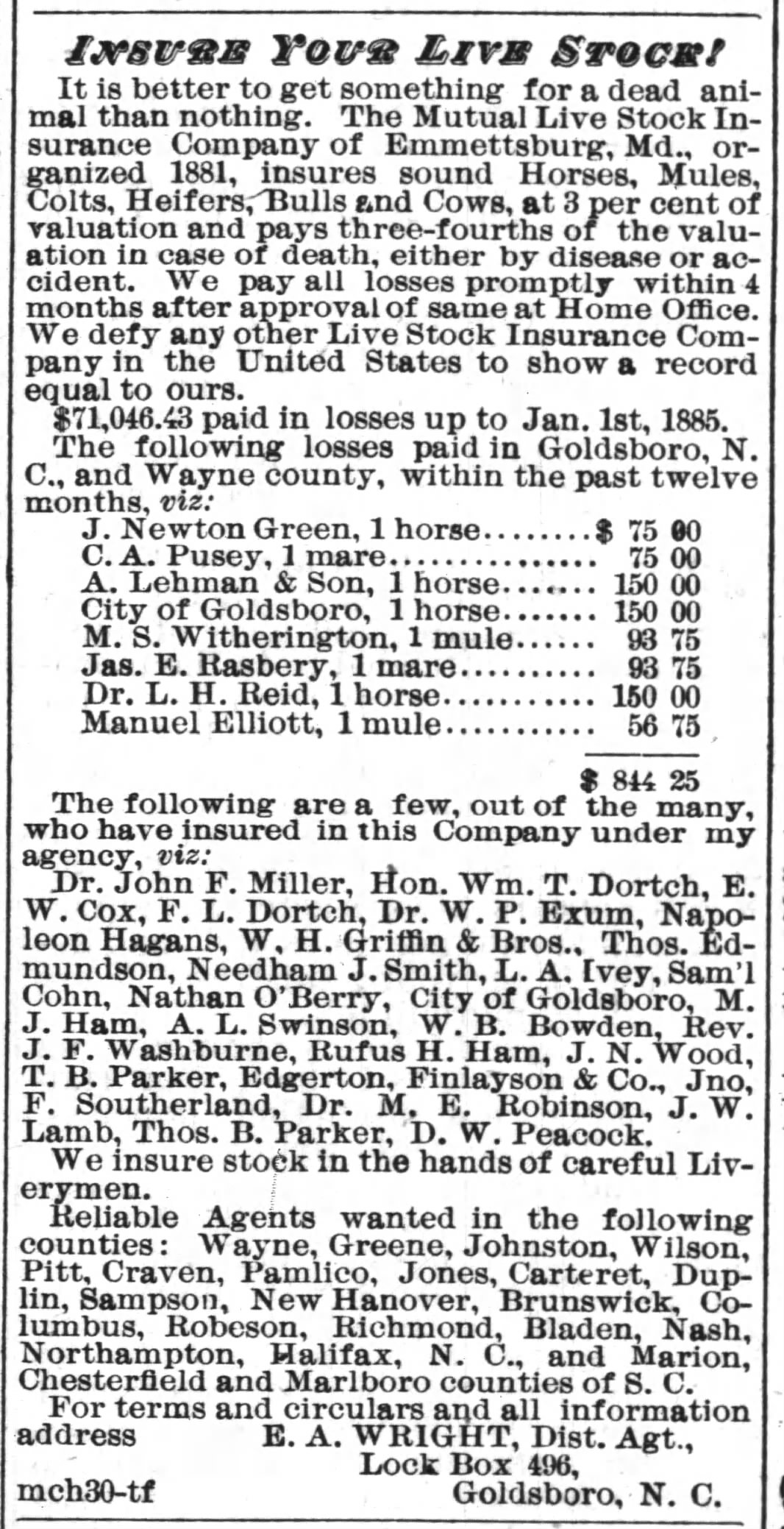
It is better to get something than nothing.


Image

Goldsboro Messenger, 30 March 1885.

Apparently, Napoleon Hagans was a big believer in insurance. The Insurance Press compiled life insurance claims paid out on a weekly basis, state by state. In the 9 September 1896 issue, the sole listing for North Carolina was: Fremont, Napoleon Hagans, $5000 — the payment he received after his wife Appie Ward Hagans’ death.

Standard
Agriculture, Free People of Color, Land, North Carolina, Other Documents, Paternal Kin

He never said he had any claims on the land.

The first in an occasional series excerpting testimony from the transcript of the trial in J.F. Coley v. Tom Artis, Wayne County Superior Court, November 1908. Paragraph breaks inserted for better readability.

The Plaintiff introduces W.S. Hagans, who being duly sworn testifies as follows:

I sold this land, the 30 acre, 24 acre, and the 9 1/3 acre pieces to Mr. Coley. Mr. Cook had been negotiating with me for the purchase of the 30 acre tract and the 24 acre tract. He did not want the 9 1/3 acre tract. I met Mr. Cook on several different occasions, until finally we met at Eureka one afternoon, he was considering it, and we finally decided on the deal. Mr. Cook was to give me $40.00 per acre for the the 30 acre tract, and the 24 acre tract. Before Mr. Cook did this however, he informed me that there was a missing link in the title, that he had found after investigating it. I told him that that was perfectly alright, as there had never been any question about it.

After our conference at Eureka, the day was set for me to meet him in Goldsboro, where he was to pay me the consideration, the price of the land, and I in turn to give him a deed for the land. He did not come on that day, but ‘phoned me at Fremont that he did not succeed in raising the money, but to please hold it open until tomorrow.

Early tomorrow morning, before sunrise, a bitter cold morning, the Defendant [Tom Artis] came to my house in Goldsboro. I asked him what brought him to town on such a cold morning, he said he came to bring a message from Mr. J.F. Coley, that Mr. Coley said that he wanted to buy that land, and would take all three of the tracts instead of two, said the Defendant to me, “that will be to your advantage.” The Defendant stated to me that Mr. Cook’s time was out yesterday. I expressed surprise that the Defendant should be familiar with those circumstances. Afterwards I said to the Defendant, that while Mr. Cook’s time was out yesterday, that Mr. Cook had phoned me yesterday & said he had a great effort to reach me, and finally did so asking me to hold the matter open until tomorrow. I told him that I would feel honor bound if Mr. Cook should come to me with the purchase price for the two tracts of land, to let him have it, although I would prefer selling the three tracts together. The Defendant said to me that if Mr. Cook got possession of this place that he the Defendant would not be able to stay there as Mr. Cook was a very disagreeable man to get along with. I told the Defendant that I would not deed this property to Mr. Cook, or to any one else until they made the same promise to me in reference to the Defendant’s staying where he has, that I made to my father in the presence of the Defendant.

The Defendant remained in shooting distance of me all of the day, waiting for me to see Mr. Cook that he might get from me a final message to take back to Mr. Coley. I saw Mr. Cook, and he informed me that the reason he couldn’t take it was that he had experienced great difficulty in raising that money. That money was hard. I was really glad of this, and so informed the Defendant, for I wanted to sell the three tracts if possible, together. Then I asked the Defendant to say to Mr. Coley on his return home, that I would meet him at the Defendant’s house on Friday, I think it was, but having business out there, I drove past, and got the Defendant and took him out to the Plaintiff’s place of business that was on Thursday, I went the day before the time set, and stated to the Defendant the object of my going down there, and asked him to go with me.

We went down there and Mr. Coley and I had a talk aside from the Defendant, and finally wound up in the Defendan’t presence. The conversation we had in the presence of Tom was Mr. Coley might have the three pieces of land, in consideration of $3250, and I take his paper. This was said in the Defendant’s immediate presence, he sitting on the buggy beside me. We left, the Defendant expressing himself as highly pleased that Mr. Coley had bought the three pieces of land, said he thought I had made a fine trade. He made no objection at any time to the sale of the land. He encouraged it all the while. He never intimated to me that he had any claims on this land of any kind. None whatever.

I got the land about 1899, deed of partition between my brother [Henry E. Hagans] and myself. After I got the land I rented that to the Defendant. The first year I think, I charged him 850 lb. of lint cotton, thinking all the while that my brother having acted for us both got 850 lb. for the two places, the 30 and the 24 acre lot.The Defendant informed me that my brother had been charging only 800 lb., and I agree to the 800 lb. He did not at any time when delivering this cotton say that he was paying it as interest and taxes. (Defendant objects.) He has never said anything about paying it as any way than rent. He has never mentioned taxes to me on that property. I listed that land and paid the taxes.

I had some work done on that house since I came in possession. The Defendant patched the roof and also built a porch. I do not wish to state that I had it built. I paid for the lumber. The Defendant did the work himself.

The Defendant came to my place in front of the gin house last fall, and said to me that he had understood that I was going to sell those three pieces of land down there, we called it the Tom Pig place, the Calv Pig place and the Adam [Artis] place. He said he wanted to buy the Tom Pig place or the 30 acre. He asked me if I would prefer selling it all together. I asked him what he would want to give me for the 30 acre tract piece, and he said he would give me $800.00 for it. I told him I couldn’t take that, as I had already been offered $40.00 an acre, or $2160 for the two places. He asked me to give him time that he might hear from his boys in Norfolk, that he was confident that he could raise the purchase price for the 30 acre tract, if not for it all. The Defendant and Durden Fort were present at the time. Durden Fort has since died. In payment of this land, Mr. Coley’s notes were security fort this property. Mr. Coley’s home place I think. 60 some odd acres in addition to what I sold was given as security. One note is due in January.

CROSS-EXAMINED.

Tom said to me, “I think you sold those three pieces of land well.” He said that on the buggy. Mr. Coley and I behind the barn talked about this land. He wanted to get the land for $3000. I had an idea that Mr. Coley was a pretty good trader, and wanted to get it as cheap as possible, and I told him behind the barn what three pieces I wanted to sell him them for. I didn’t have to go through any particular form, we didn’t close the thing out, we continued the conversation until we separated. The pieces of land were all understood. He said in the presence of Tom, “For the three pieces of land I will give you $3250.00.” I thought it was necessary to innumerate the three pieces so he would see what he was getting.

Tom has lived on that place ever since I had it. I don’t know to my personal knowledge if he lived off of it. I was in school at the time, or at any rate away from home. Durden Fort was present at the conversation we had. He died in the summer. I had him as a witness. I did not rent my land at the same price every year to every body, not necessarily, to some I did, some I didn’t. The reason I charged him 800 lb. was because my brother rented it to him for 800, and I thought it was all he was able to pay, and there were other considerations. There were other considerations that induced me to charge only 800 lb. of lint cotton for the land. (Plaintiff objects.) It arose out of a conversation I had with my father [Napoleon Hagans] and Tom. My father was in feeble health in 1896. He called my brother and myself under the cart shelter at the home place and said to us that he was not going to live long, and he did not know to which one of us, that is his two sons, would fall heir to that property. Tom was present. That was the land in controversy. (Plaintiff objects), but as long as the Defendant, whom he called “Pig” paid his rent, let him remain. We promised. He did not say how much rent. I did not know as far as I remember that Tom paid to my father 800 lb. of lint cotton. I don’t know. I would rather believe he did. (Plaintiff objects.)

Standard
Births Deaths Marriages, Enslaved People, Newspaper Articles, North Carolina, Photographs

Miss Speight & Mister Kenny.

My earliest memory: I am wrapped in a red blanket, slightly faded, edged in satin. The air is chilly. The light, low and pink-gold. It is morning, and I am being carried across the street to Miss Speight and Mr. Kenny’s house. They lived at 1400, and we lived at 1401, and I cannot be more than two years old.

My mother says that I cannot remember this. It must be an implanted recollection. I don’t think so, but perhaps. There is no question, though, that I retain other vignettes from the brief time that Nina Speight kept me: a canister of Morton salt on a kitchen table; a bag of wooden blocks on a shelf; a Maxwell House can brimming with snuff juice; a thin chenille spread over a four-poster bed; the dimness of the back room shared by the Speights’ teenaged grandsons. We left Carolina Street when I was nine, but my memories of my years at the edge of East Wilson are warm and tinged with gold.  Miss Speight and Mister Kenny loved and nurtured me early and rooted me firmly in the traditions of a Southern community in transition. They passed away within months of each other in 1982 — ironically, the year that I, too, left Wilson, for college.

Kenneth___Nina_Speight

Nina and Kenneth Speight.

——

Nina Darden Speight was born in 1901 in Black Creek township, Wilson County, to Crawford F. and Mattie Woodard Darden. Her family names indicate deep roots in southeastern Wilson County, which was part of Edgecombe before 1855. Her father, born about 1869, was the youngest of several children born to Howell Darden and Esther (or Easter) Bass, and the only child born free. (Esther’s maiden name also appears as “Jordan” on the marriage license of one of her children.)  On 11 August 1866, Howell and Easter registered their cohabitation with a county justice of the peace and thereby legalized their 18-year marriage. Their older children included Warren (born circa 1849, married Louisa Dew), Eliza (born circa 1852, married Henry Dortch), Martin (born circa 1853, married Jane Dew) and Toby Darden (born circa 1858.) Esther Darden died 1870-1880, and Howell Darden between 1880 and 1900.

Evidence that Howell Darden and Esther Bass were both owned by James A. Barnes may be found in the abstract of his will, dated October 14, 1848 and probated at February Court, 1849 in Edgecombe County. Among other property real and personal, Barnes’ wife Sarah received a life interest in several slaves — Mary, Esther and Charles — whose ownership would revert to nephew Theophilus Bass upon her death. To McKinley Darden, Barnes bequeathed “Negro Howell.” [Other enslaved people mentioned in Barnes’ will included Tom, Amos, Babe, Silvia, Ransom, Rose, Dinah, Jack, Jordan, Randy, Abraham, Rody, Alexander, Bob and Gatsey (the only slave to be sold.) Their relationships to Esther and Howell may never be known.]

Nina Speight’s mother Mattie Woodard Darden was born about 1873 in Wayne County to William and Vicey Woodard. She died 7 May 1935 in Wilson County. Crawford Darden died 3 August 1934.

Kenneth Speight was born about 1891 in Speight Bridge township, Greene County, North Carolina, to Callie and Holland Speight. (Some records show a 1899 or 1900 birth year, but he appears in the 1900 census as an 8 year-old.) His father Callie was born about 1855; his mother Holland, about 1860. Callie was the son of Callie (1825) and Allie Speight (1827). In the 1870 census of Greene County, the Callie and Allie Speight’s family is listed next to a wealthy white farmer named Abner Speight, who may have been their former owner.

In 1902, the Charlotte Observer ran an article by C.S. Wooten of LaGrange, North Carolina, “Old Southern Families: Farmers of Wayne and Greene,” a reminiscence about the “old plantations” and “typical Southern gentlemen” of those parts, including Abner Speight:

James Speight, a nephew of Jesse Speight, was Senator for Lenoir and Greene counties for ten years before the war. He married a niece of my father, Maj. Wooten. He was a splendid stump speaker, and I have seen him debate with lawyers on the stump and get the best of the discussion, indeed in those days the best politicians were farmers. His house was a nice place to visit. He always had a special brand of apple brandy made by Col. C.W. Stanton who could make as good brandy as was ever made. Edwin G. Speight, his cousin, was also Senator from Greene and Lenoir counties from 1842-1852. I was a small boy when he was a public man, but I have heard my father say he was a fine speaker and was a natural orator. His second wife was a daughter of Hon. Jake H. Bryan, of Raleigh, and he removed to Alabama where he died a few years ago. Abner Speight, a cousin of the above, was a large farmer, was a noble man and as good a citizen as the State ever had. He had two boys killed in the army, both bright, gallant young men. I have sometimes thought, suppose the South had not been checked in her onward march of prosperity and greatness what would we have been today. I have also thought that the gallant men, the flower of Southern chivalry that were sacrificed in that unhappy struggle were in vain, but I reckon not, for they by their gallantry and valor, have shed unfading justice upon Southern arms and have given her a name that will never be surpassed in the annals of mankind.

Callie and Holland Speight married about 1878, but little else is known of her. After Holland’s death just after 1900, Callie married Minnie Speight (1894-1947), daughter of Stephen and Dillie Woodard Speight, also of Greene County. In addition to Kenneth, Callie Speight’s children included Martha, Mary, Clara, Irwin, Charlie, Callie, Addie, Claud, Mary, Nancy, Flossie, Lewis, Clarence, Effie, Bessie, Pauline, George, Adell, Joe, James and Junius. Callie died after 1940.

——

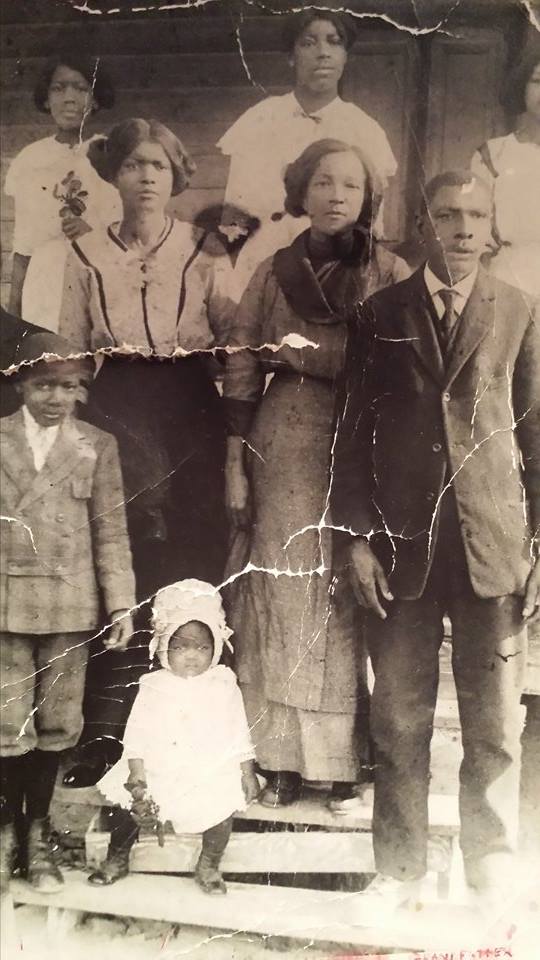
Postscript: After I posted this piece, the Speights’ grandson, whom I played with on his childhood visits from New York City, sent me another photograph. Nina Darden is standing at top left, holding a flower. Thanks, Tyrone, for both images!

Nina Darden

Standard
Births Deaths Marriages, Civil War, Military, North Carolina, Other Documents, Paternal Kin

I know they were married by law.

Feverish with malaria, friends and family at his side, Baalam Speight closed his eyes a final time on 21 December 1902, free of the pain that had wracked him for years. He left a widow, Hannah Sauls Speight, and nine children, but little otherwise to show for a lifetime of hard work. Hannah and youngest son, George Speight, just 13, faced uncertain times.

Baalam Speight was born about 1840 in Greene County. In the waning days of the Civil War, he and his brother Lafayette Edwards slipped away from their plantations to make their way to Morehead City, North Carolina. There, in March 1865, they enlisted in Company H, 14th United Stated States Colored Heavy Artillery. Baalam had not yet adopted his father’s surname and joined the army as “Baalam Edwards.” He and his company served garrison duty at Fort Macon until mustered out on 11 December 1865. In 1890 and again in 1892, 1895 and 1896, Baalam applied to the U.S. government for a veteran’s pension. Though he once been a “well developed, powerful built man,” he complained of “fluttering of the heart,” muscle pains, eye disease as a result of measles, rheumatism, lumbago, deafness and “misery in the head” attributable to exposure during his military service. Several doctor’s examinations concluded, however, that Baalam’s troubles were primarily attributable to old age, and his claims were rejected.

Despite Baalam’s failed attempts, Hannah Speight squared her shoulders and filed a widow’s claim in June 1903. It was assigned No. 786,944. Her burden? To prove that she and Baalam were legally married and never divorced. What might have been a straightforward task was complicated by the fact that Greene County’s courthouse had burned down with everything in it and the magistrate who had performed the ceremony was overworked and often drunk. Hannah turned to neighbors and friends to make her case, and nearly a dozen were deposed over the course of several days in August 1904. In addition to corroborating Hannah’s account of her marriage, they present a trove of personal information about the lives of Hannah and Baalam’s circle:

  • Mariah Moore – midwife; 78 years old in 1904;  lives near Kinston, Lenoir County; delivered Baalam and Hannah’s youngest son George Speight; her unnamed husband died in July 14 years ago.
  • Maria Loftin — about 62 years old, wife of Cornelius Loftin; lives near Kinston; lived on Harvey plantation at same time as Balaam Speight and recalled his marriage. “I used to patch his clothes before he was married … I was freed by Lincoln and staid on Bear Creek four years then I went to near Snow Hill on Harvey place where I met Baalam and I staid there two years.”
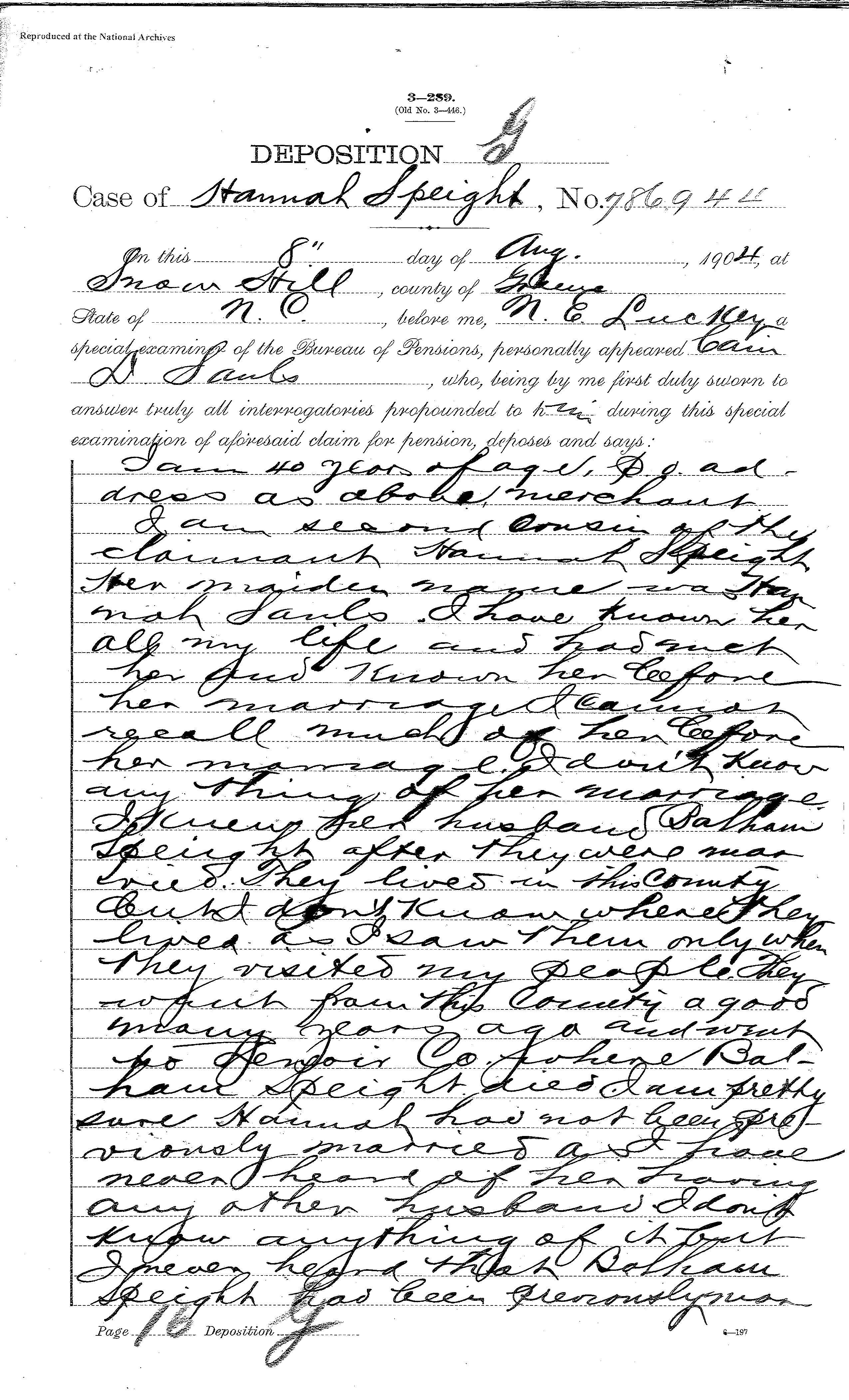
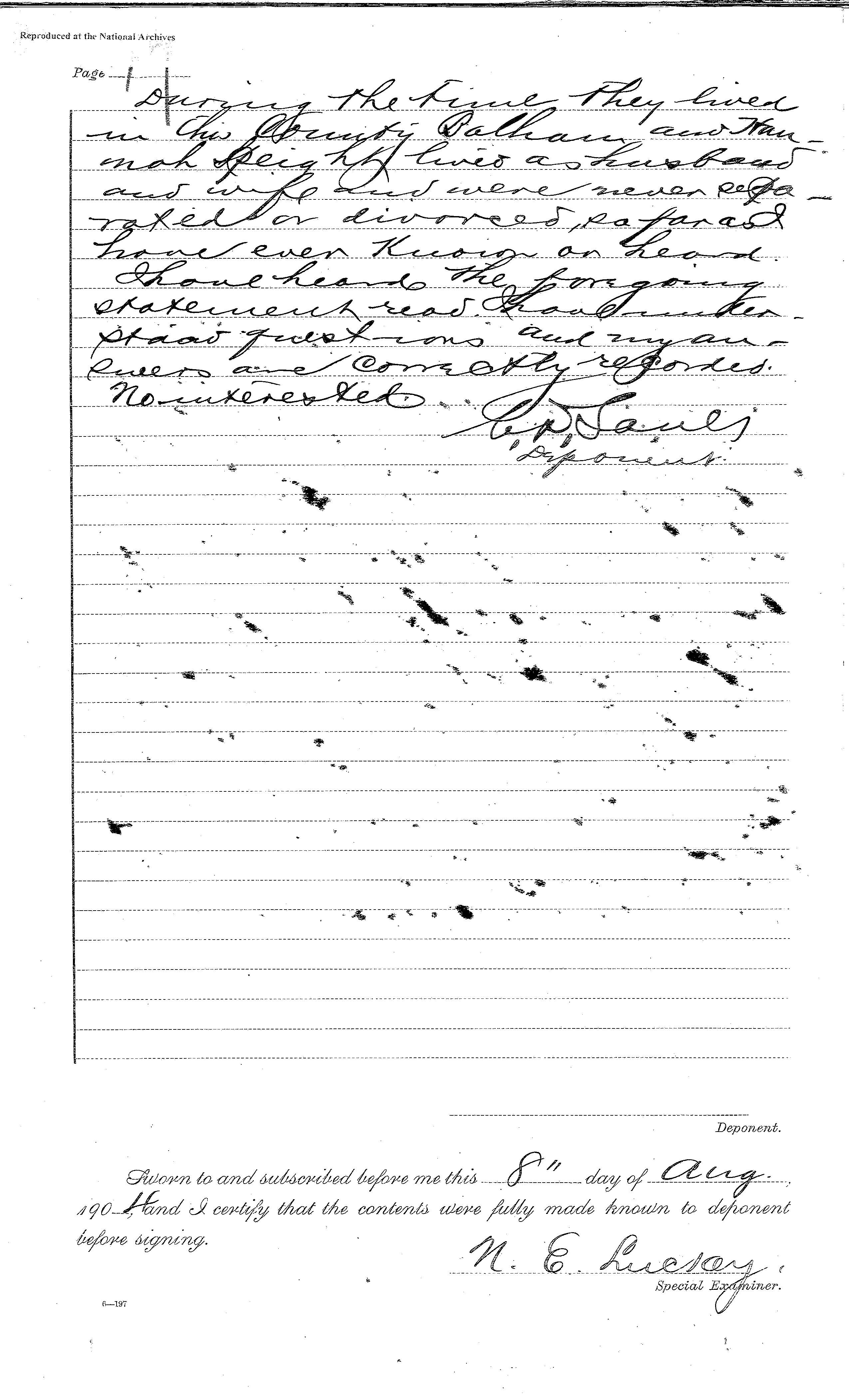
  • Cain D. Sauls – Lives in Snow Hill, Greene County NC. “I am 40 years of age … merchant. I am second cousin of the claimant Hannah Speight. Her maiden name was Hannah Sauls. I have known her all my life ….[She and Balham] lived in this county but I don’t know where they lived as I saw them only when they visited my people.” [Only witness who signed his own name. All others signed with X.]
  • Viola Edwards – Lives in Bull Head, Greene County. “I don’t know my age, am 50 or more. … Wife of LaFayette Edwards. … I lived just across the creek from [Hanna Sauls] when she married Baalam Speight. … I recollect that they were on the plantation next to the one I lived on at that time. It was the Rawls plantation …. I did not know Jennie the slave wife of Baalam Edwards ….”
  • Grace Harper – about 62 years old, wife of Lewis Harper, lives in Snow Hill. “I knew Balham Speight as a boy before he went away to go into the army. … I had known Hannah Sauls as a girl and lived in two miles of her before she married Balham Speight. … I think they had one child before they lived at Kinston … Yes Hannah had a child by Loderick Artist before her marriage to Balham Speight, but she did not marry or live with him or any other man until she married Balham. …”
  • Mary Shepard – About 70 years old, lives near Snow Hill. Widow of Marcus Shepard. “I knew [Hannah’s] aunt Becca [Best.] … They lived around here about two years after they were married and then moved away to Lenoir Co. … Baalam Speight was a brother of Fate Edwards. He was always called Baalam Speight. I think he was owned by Jim Edwards and that his father was Reddin Speight. … It seems to me that Hannah had a boy by Loderick Artist before her marriage to Baalam Speight …”
  • Lewis Harper – Lives in Snow Hill. “I am about 65 years of age … laborer…. I was born and raised in Greene County and knew Balham Speight as a boy. We lived about 3 miles apart and were right often together before he went away to go into the army. … I knew when Balham Speight was married to Hannah Sauls, it was not mighty long after the war. It may have been two or three years after. … They did not remain near Snow Hill very long until they moved to Kinston where they remained afterwards up to his death. … Hannah had a child by the man Loderick Artist a year and a half before she married Balham while she was living with her parents. … Loderick Artist was my brother and is dead.
  • LaFayette Edwards – 63 years of age, lives in Bull Head, Greene County. “I served as a corporal of Co. H, 14 U.S.C.H.A. and knew Baalam Edwards of that company; he was my brother and our father was Reddin Speight. In slave time I belonged to Ap. Edwards and he belonged to his brother Orfa Edwards. We were raised and enlisted, served and discharged together. After he came out of the army he worked in turpentine one year or so in S.C. or Georgia. … After that he came back and lived on Hill place near Kinston. But for two or three years after he came from the South he lived out near Snow Hill. He was married close to Jno. Harvey plantation to Hannah Sauls daughter of Shepard Sauls. … I know they were married by law as there was no taking up with each other in those days. … Before he married Hannah Baalam had lived with a woman named Jennie Suggs in slave time. She died while we were in the service. I did not go to the burial, but we were at Morehead City not far away when she died and heard of her death at the time.”
  • Peter Hood – 64 years old, farmer and pensioner, lives near Kinston. “I was a pvt. in Co H, 14 U.S.C.H.A. and knew Baalam Edwards. He was in my company and I was witness for him when he was trying to get pension. … He was a sort light complected spare somewhat tall man. I don’t know his height. I reckon he was about as tall as you (about 5 ft. 10 in.)”
  • Isaac Edwards alias Eddis — 67 year-old farmer. “I am not a pensioner but I served as a pvt. in Co. H, 14 U.S.C.H.A from Mch. 8, 1865 to Dec. 11, 1865. I knew a man named Baalam Edwards in my company. I had known him before we went into the army and we had both belonged to Betsy Edwards in slave time and lived not far apart. His father was Reddin Speight. He used the name of his mistress in the army and after he came out of the army he went by the name of his father Speight. … [H]e was married to a woman named Hannah Sauls. This was the first wife of Baalam Edwards except that he had a slave wife named Jennie.” “Baalam Edwards was not sick and did not get hurt in the army, except that he had mumps at Ft. Macon. He was a long slim, not very dark, dark hair and eyes. I am six feet high, he was not quite as tall as I am.”
  • Francis Williams — 70 year-old pensioner. “I was a corporal in Co. I, 14 U.S.C.H.A. and I knew Balham Speight. He was a member of my regiment.” [C.D. Sauls signed as witness.]

The testimony was satisfactory, and Hannah was granted a pension of $10/month.

A document in this pension file lists Baalam’s children as Charles, born 12 April 1870; Nancy Susan, 19 February 1872; Lizzie, 8 March 1874; Claiborn, 30 March 1876; Major, 27 September 1879; James, 8 April 1882; Franklin, 19 June 1885; Luvenia, 5 April 1887; and George Meade Speight, 26 September 1889. Census records reveal a tenth child, who was oldest. Lemon Speight’s Lenoir County death certificate lists his birthdate as 27 April 1867 — about a year-and-a-half before Baalam and Hannah married in late 1869. The certificate also names Baalam as Lemon’s father, but, as several witnesses testified, he was in fact the son of Loderick Artis.

The file reveals other tantalizing tidbits, in italics, related to my family. How were Loderick Artis and Lewis Harper brothers? On their mother’s side? Or through Loderick’s father Daniel Artis? Cain Sauls, who was Loderick’s nephew, testified that he was Hannah’s second cousin. Her parents were Rosetta Best and Sheppard Sauls. Who was Sheppard to Cain?

ARTIS -- CD Sauls Deposition_Page_1

ARTIS -- CD Sauls Deposition_Page_2

Deposition of Cain D. Sauls, 8 August 1904.

File #786944, Application of Hannah Speight for Widow’s Pension, National Archives and Records Administration. Hat tip to Trisha Blount Hewitt for pointing out the mention of Loderick Artis in Baalam Speight’s file, #988961, which is included in Hannah’s file.

Standard