Enslaved People, Free People of Color, Land, Newspaper Articles, North Carolina, Paternal Kin, Vocation

Black carpenter makes name for himself.

I’ve been pulling together a descendant chart for Daniel Artis. In part, I want to keep the names straight and, in part, I’m trying to see if I’m related to any of the other Edwardses, Saulses or Artises I grew up with. Tonight I Googled some random names from this family and up popped this, published just three days ago in Kinston.com, the on-line version of the Kinston Free Press. Andrew Sauls’ father was Isaac Sauls, son of Isaac Sauls, son of Prior Ann Artis Sauls Thompson, daughter of Daniel Artis, brother of my great-great-great-great-grandmother Vicey Artis Williams.

[Update, 7 March 2014: I emailed the Free Press journalist and two days later — yesterday — got a call from Andrew Sauls himself! He lives on land his grandfather bought in 1920 (plus 400 more); confirmed that the Artis Town sign is gone; knew M.’s grandfather, “Cousin Booker T.,” well; and promised to show me around Sauls-Edwards-Artis territory next time I’m home!  — LYH]

Standard
North Carolina, Paternal Kin

Long-lost cousins.

M. had the same first name — an unusual one in that time and place — and last initial as my first cousin. We met when I, a year too young, tagged along to my cousin’s Brownie Scout meetings. M. and I discovered that we lived down the street from one another and from then until my family moved away three years later, we were inseparable.

Several years ago, I did some basic genealogical research on M.’s mother’s family. Her grandfather was a Greene County Edwards, and I was able to trace his ancestry back to slavery. I gratified by the achievement, but nothing in what I found resonated on a personal level.

Fast forward to last week. While hunting for Artis Town, I revisited an Edwards cemetery that I first encountered five or ten years ago while driving Greene County back roads. As I noted here, this time I realized that these Edwardses were also Artises, descendants of Daniel, the brother of my great-great-great-great-grandmother Vicey Artis Williams. Standing there, mulling this over, I started thinking about M.’s family, her Edwardses, and wondering …

When I got back to my parents’ house, I hopped onto the internet. Twenty minutes, and a lot of scribbling and charting later, there it was. M.’s grandfather was the grandson of Mariah Sauls Edwards, who was the daughter of Prior Ann Artis Sauls Thompson, who was the daughter of Daniel Artis. In other words, M. is my cousin, too!

P.S. I figured all this out the day before M.’s birthday. A little present for us both.

P.P.S. An iron-clad childhood rule: “Don’t get in anybody’s car unless we have given you permission.” I broke it twice before the lesson took. The second and last time, I was about seven. I was playing down at M.’s house when her grandparents announced that they were about to ride down Greene County. I ran home to see if I could go with them. Nobody was home. I decided for myself and hopped in the car. I don’t remember much about the short visit — a white farmhouse on brick pillars standing on a slight hill, maybe? — but now I wonder. Was I visiting my own kin?

Standard
Free People of Color, North Carolina, Other Documents, Paternal Kin, Photographs, Rights

Jurors and judges of election.

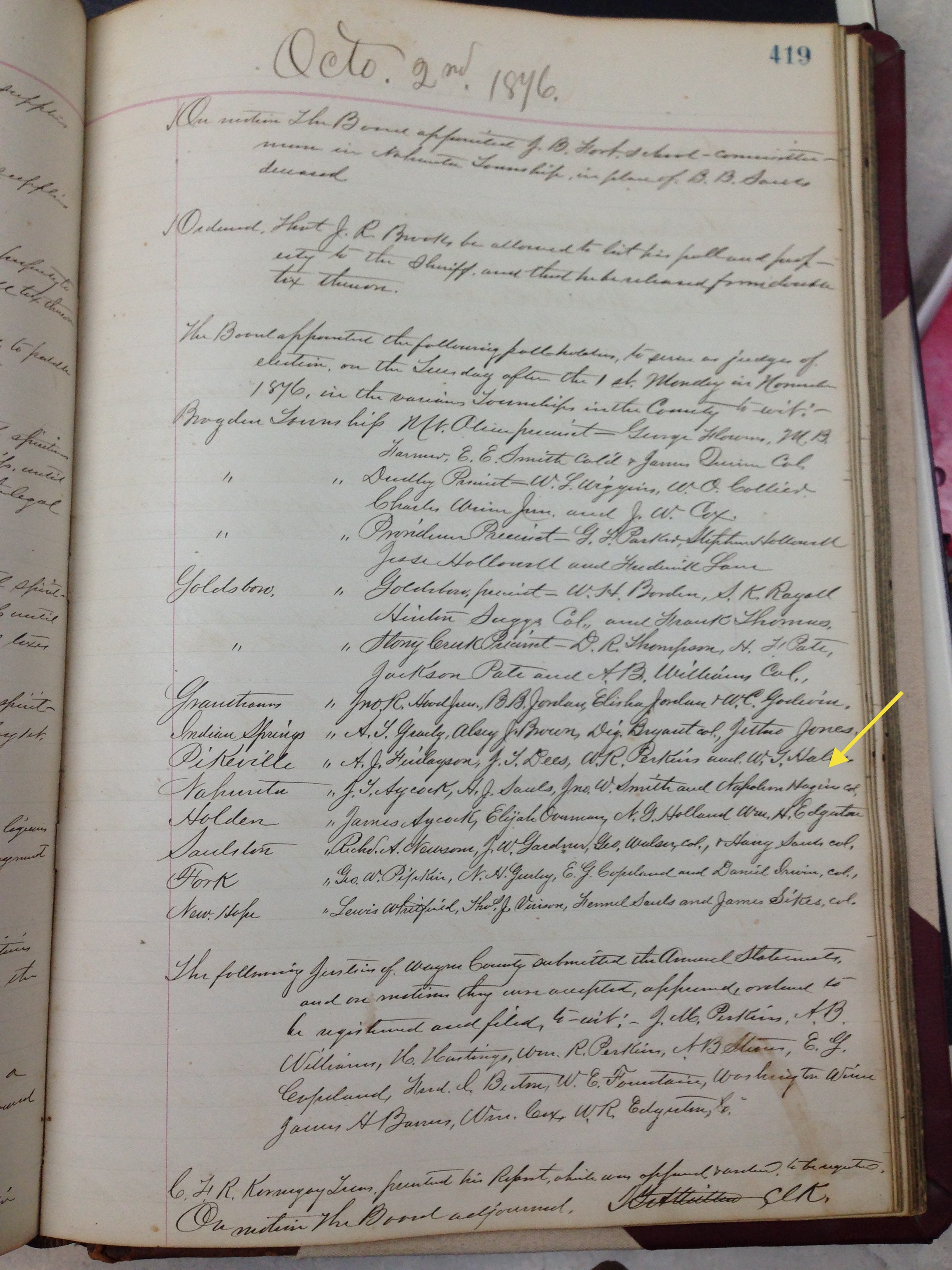
As tax-paying landowners, many African-American men in Wayne County, North Carolina, in the 1870s were called alongside white men to fulfill their civic duties. Here are two entries from Superior Court Minute Book 2:

ImageNapoleon Hagans of Nahunta township was appointed a judge of elections.

ImageMy great-great-great-grandfather Lewis Henderson drew jury duty for the first week of the next term of the superior court.

Superior Court Minute Book 2, Wayne County Register of Deeds Office, Goldsboro, North Carolina.

Standard
Enslaved People, Land, North Carolina, Other Documents, Photographs

Dr. Ward’s house. And me.

After my recent rediscovery of a Confederate map that revealed the locations of several plantations significant to my genealogical research, I began searching for more information about John Lane, Silas Bryant and David G.W. Ward‘s landholdings. Pretty quickly, I found a link to a copy of a nomination form for the National Register of Historic Places Inventory, submitted for the Ward-Applewhite-Thompson house near Stantonsburg, North Carolina. This Greek Revival house, dating back to about 1859, was owned and occupied by several of the area’s leading planters — including “country doctor” D.G.W. Ward, who purchased it in 1857 — and it and its outbuildings are little changed from their antebellum forms.

As I read the detailed architectural description of the house and its setting, a tiny kernel of recognition began to form in the back of my mind. A big, white, two-story house? Set well back from the road? Just outside Stantonsburg? Could it …?

I scoured the maps attached to the nomination form, trying to lay them over the current topography. State Road 1539 … that would be Sand Pit Road today …  just east of a fork in the road and just north of the Norfolk & Southern Railroad (which was not there in Ward’s time) … and there it is, just like I remember.

sand pit road

Yes. Like I remember.

I’ve BEEN in this house. Many times, though long ago.

Growing up, my sister and I were very close to my father’s sister’s daughters. Our local family was quite small, but my cousin’s father came from a big family with deep Wilson County roots. Her grandmother had nearly a dozen siblings — whom we also called “aunt” and “uncle” — and we were often invited to attend their family gatherings. I remember best the delectable Easter, Thanksgiving and Christmas dinners gathered around tables groaning with food, but there were also the annual 4th of July family reunions at Aunt Minnie’s out in the country near Stantonsburg. The Barneses were tenant farmers for an absentee landowner and rented his large two-story house. We’d pull off the road into a sandy circular drive and park under the trees alongside cars with New York and New Jersey plates. I vividly remember my cousin’s great-uncles and cousins tending a barbecue pit in which a split pig roasted, chickens strutting among them.  A screened side porch protected platter after platter of home-grown, home-cooked goodness.  My memories of the interior of the house are vague: a central staircase, two large front rooms, the kitchen in back. (The staircase I remember mostly because, carefully tending a tall glass of lemonade, I missed a riser and slid down their length, smacking my ribcage against the steps and knocking the wind out of myself.)

I couldn’t believe it. It is exciting enough to identify D.G.W. Ward’s house and find that it is still standing, but to realize that I knew the house at which Appie and Mittie Ward had lived and worked as the enslaved children of their own father was uncanny.

IMG_4960Ward-Applewhite-Thompson House today.

Photo taken by Lisa Y. Henderson, February 2014.

Standard
Births Deaths Marriages, Enslaved People, Free People of Color, North Carolina, Paternal Kin, Photographs

Family cemeteries, no. 9: Daniel Artis’ Edwardses.

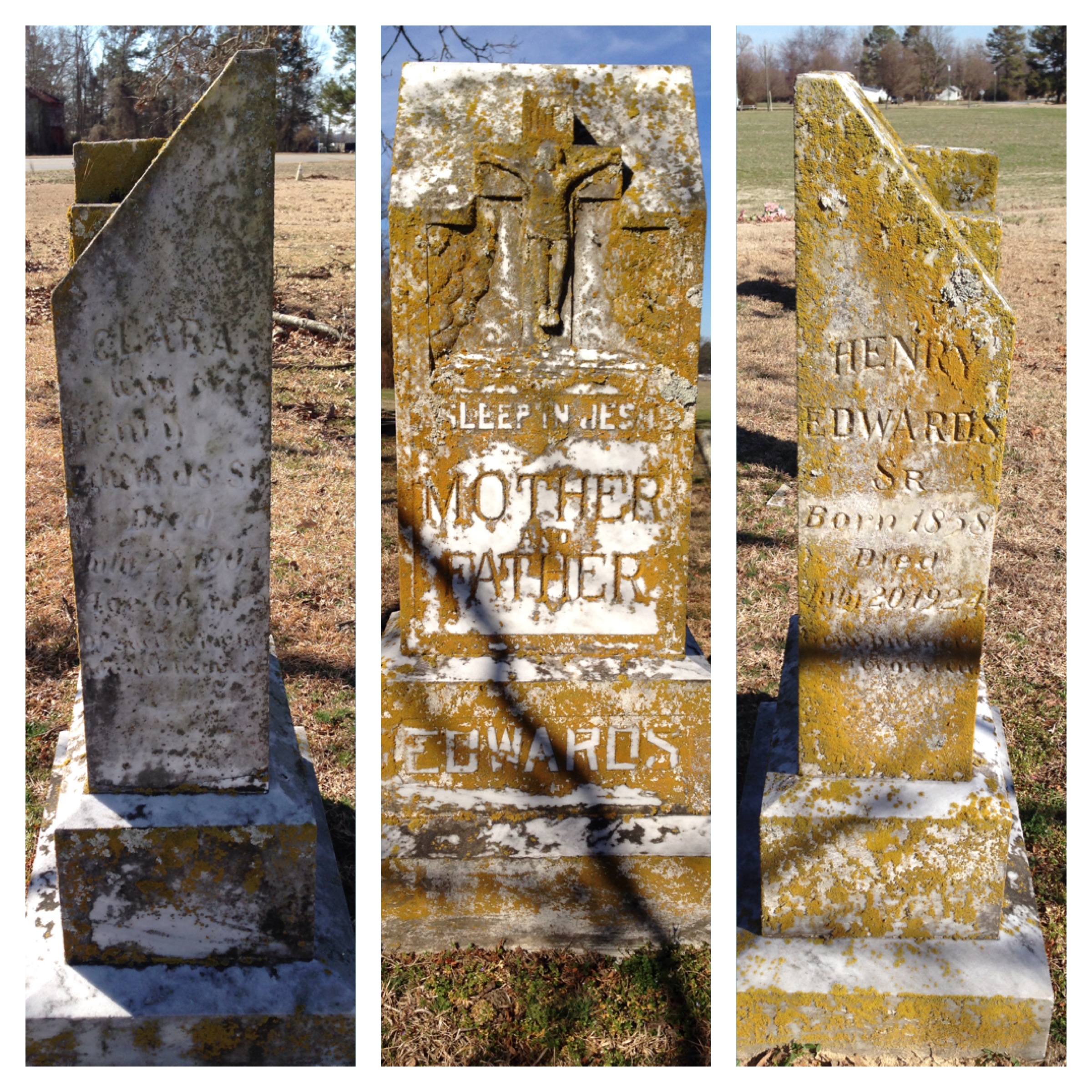
A right turn out of my parents’ neighborhood puts me onto Highway 58. Head southeast, cross the edge of Stantonsburg, over Contentnea Creek and the Greene County line, and, 13 miles from home, you reach Lane Road. Turn left, round the curve, and there, neatly marked and kept, is the Edwards cemetery. Here are buried Daniel Artis‘ daughter Clara, her husband Henry Edwards, and their descendants.

Image

Photo taken today, Lisa Y. Henderson.

Standard
Free People of Color, Newspaper Articles, North Carolina, Paternal Kin, Politics

Alderman and poll holder.

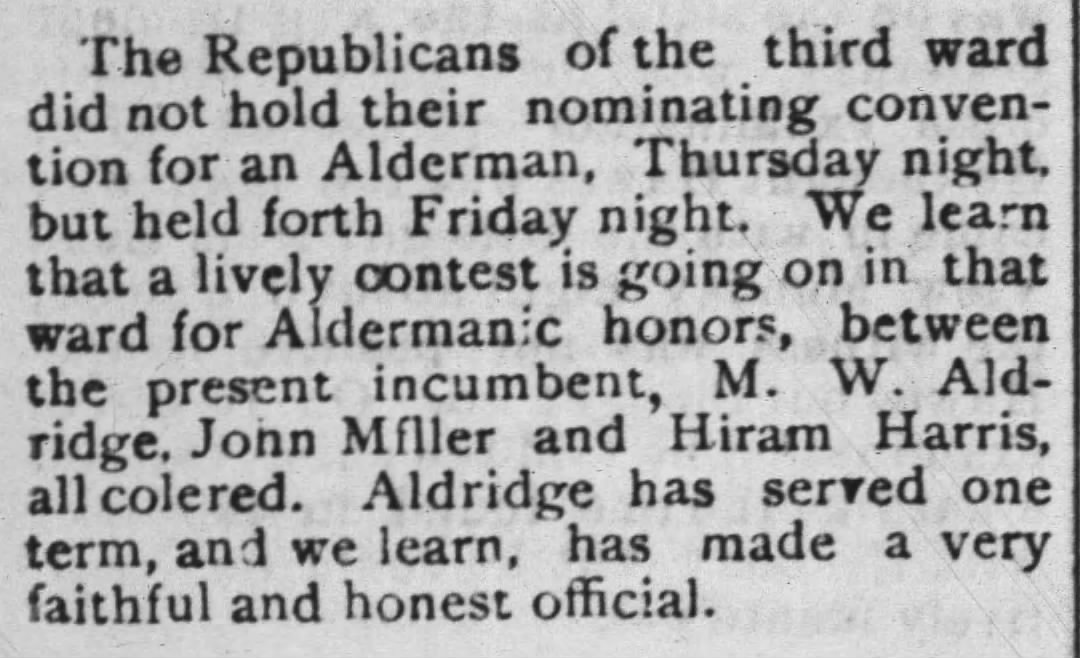
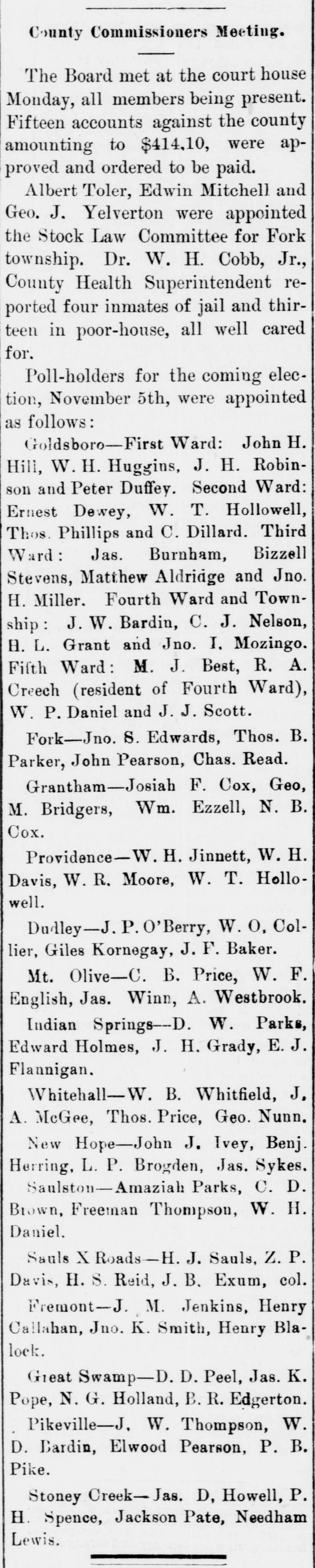
Despite the collapse of Reconstruction, African-Americans continued to participate in Wayne County’s political life through the end of the 19th century. Mathew W. Aldridge, in particular, was active in local governance, as announced in eastern North Carolina newspapers:

Wilm Msgr 4 27 1889

Wilmington Messenger, 27 April 1889.

Image

Goldsboro Headlight, 1 May 1889.

Image

Goldsboro Headlight, 8 May 1889.

Wilm Msgr 5 8 1889

Wilmington Messenger, 8 May 1889.

Image

Goldsboro Headlight, 8 October 1890.

Other notables: C[larence] Dillard (Presbyterian minister who arrived in Goldsboro in 1884, later principal of “colored school”); Bizzell Stevens (also a minister; like William S. Hagans, married into the Burnett family, a prominent free family of color in the antebellum era; later a postal clerk at Goldsboro post office); John Frank “J.F.” Baker (postmaster at the Dudley post office; married Mary Ann Aldridge, daughter of J. Matthew Aldridge; murdered); James Winn; and Henry S. “H.S.” Reid (son of Washington and Penninah Reid; member of large prominent free family of color.)

Standard
DNA, Maternal Kin, North Carolina

DNA Definites, no. 13: Nicholson.

For all I malign the inadequacies of Ancestry DNA, it has yielded up distant-relative matches in a way that 23andme has yet to touch. I did a search for “Nicholson” among my matches, and J.W.B. popped up. As I scanned his family tree, the name that snagged my eye first was “Jehu Idol.” I knew that name. I LOVED that name. So economical. So Biblical. So 18th century. And the husband of Hannah Nicholson, sister of John Stockton Nicholson Jr. and half-sister of James Nicholson. J.W.B. and I are 5th cousins, twice removed.

Standard
Maternal Kin, North Carolina, Oral History, Photographs

A bird’s eye view.

The bird’s-eye view map of Statesville, North Carolina, drawn in 1907, reveals a number of features in Lon W. Colvert‘s landscape (click for a closer look):

statesville_1872_annotated

At #1: near the intersection of Centre Street, 109 East Broad Street, early site of Colvert’s barbershop. At #2: Center Street AME Zion Church. At #3: Southern Railway station, built in 1906. Colvert had an earlier shop in the Depot Hill area near the depot.  At #4: the railroad.  The Colverts’ house was adjacent to the railroad in Wallacetown, southeast of the station, as was that of his in-laws, Henry and Martha McNeely.

Below, the current tenant at 109 East Broad:

Image

Photo by Lisa Y. Henderson, December 2013.

Standard
Births Deaths Marriages, Enslaved People, North Carolina, Paternal Kin

Finding the Wards.

This is what we knew:  Joseph Henry Ward, born circa 1870 in or near Wilson, North Carolina, was the son of Napoleon Hagans and a sister of Napoleon’s wife, Apsilla Ward Hagans.  I couldn’t find him in the 1870 or 1880 censuses, but by 1900 he was listed in Indianapolis, Indiana, working as a physician.

The hunt for Joe Ward’s people thus began.

In the 1910 census of Indianapolis, a nephew, Augustus Moody, born about 1893, is listed in the Ward household. I searched for Augustus in 1900 and found him in Washington DC in this household: William Moody (born 1872), wife Sarah S. (1876) and children Augustus (June 1894) and Crist (1896), plus sister-in-law Minerva Vaughn (1890), mother-in-law Mittie Vaughn (1854), and mother Fannie Harris (1854) — all born in North Carolina.  Soooo …  Augustus’ mother was Sarah S. Moody, and Sarah’s mother was Mittie Vaughn.  Okay, and how was Joe Ward related to these folks?

I went back to the 1880 census of Wilson County and found: Sarah Darden (57, mother), Algia Vaughn (23, son-in-law), Mittie (22, daughter), Joseph (8), Sarah (6), and Macinda (5 mos.), the last three Sarah’s grandchildren.  From this I deduced that Mittie Vaughn, daughter of Sarah Darden, had at least two children, Joseph and Sarah, before 1880.  I then located young Sarah’s marriage license to William Moody, which listed her maiden name as Ward.  So Joseph and Sarah were listed in the 1880 census in their stepfather’s name, not their mother’s, and “Joseph Vaughn,” son of Mittie Vaughn, is in fact the Joseph Ward I was looking for.

How did I know Algernon was a stepfather? He was only 22 years old when he married Mitty Finch,  27, in Wilson on May 6, 1879.  (Finch?!?!?! That’s an as-yet unexplained anomaly.) I also found a cohabitation registration for grandmother Sarah Ward and Sam Darden, dated 12 July 1866. This registration, which formalized the marriages of ex-slaves, noted that they had been married five years, well after the births of Sarah’s children Mittie and Appie. If Sam was not their father, who was?

The first clue: in 1902, when William S. Hagans (son of Napoleon and Appie Ward Hagans) registered to vote in Wayne County, North Carolina, under the state’s grandfather clause, he named “Dr. Ward” as his qualifying ancestor. I didn’t know what to make of that — I couldn’t find a Dr. Ward in Wayne County — so I laid it to the side for a bit.

Then I found a reference to Appie and Mittie’s previously unknown brother. On 16 June 1870, Henry Ward, son of D.G.W. Ward and Sarah Darden, married Sarah Forbes in Wilson, North Carolina.  If we assume that Henry, Appie and Mittie had the same father, who is this D.G.W. Ward? Was he the “Dr. Ward” that William claimed as his qualifying ancestor under the grandfather clause?

In the 1860 census, D.G.W. Ward (45) and wife Adline (19) appear in Speights district, Greene County, which borders Wilson County to the southeast. Ward reported owning $26,500 in real property and a whopping $112,000 in personal property! (As the 1860 slave census shows, this wealth largely consisted of 54 slaves.) He was one of the, if not the, wealthiest men in the county. And he was a physician. Here, indeed, was Dr. Ward.

David George Washington Ward was married twice — perhaps circa 1840 to Mariah H. Vines, who died after having one child; then to Emily Adeline Moye in 1859. Between those marriages, he fathered at least three children with Sarah, an enslaved woman.

Standard
DNA, Maternal Kin, North Carolina

DNA Definites, no. 12: Van Pool.

Iredell County, North Carolina, was settled in the mid-eighteenth century largely by Scots-Irish and German immigrants pushing down the spine of the Shenandoah Valley from the mid-Atlantic colonies. Interspersed among them, of course, were the omnipresent English, but also here and there a Dutch family. Such were the Van Pools, who settled first in Maryland before heading south in the mid-18th century.

Ancestry DNA estimates D.F.M. as my 5th-8th cousin. I would not have noticed her name among my hundreds of distant matches, but Shared Ancestor Hint — a comparison of family trees, and Ancestry’s best feature — brought her into sharp focus. To be precise, we are fifth cousins, once removed, both descendants of John Van Pool and his wife, Elizabeth Peyster Van Pool. I am descended from daughter Nancy Van Pool, who married Samuel McNeely, and D.F.M. from son David Van Pool. Nancy and Samuel McNeely’s son John W. McNeely fathered Henry W. McNeely, my maternal grandmother’s maternal grandfather.

Ancestry also estimates L.B. as my 5th-8th cousin, and I found him, too, via Shared Ancestor Hint. We are in fact 7th cousins, descended an equal number of generations from Jacob Van Pool and Elizabeth Hampton via sons John Van Pool and Henry Van Pool.

Standard