Enslaved People, Free People of Color, Land, North Carolina, Other Documents, Paternal Kin

Confederate map tells all.

Years ago — 10? 15? — I ordered copies of two Confederate field maps from the fine folks at Wilson County Genealogical Society. (The originals are held at North Carolina State Archives.) The maps feature not only geographic markers, such as creeks and towns, but the names of landowners throughout the region. I remember intently scanning the area around modern-day Eureka, hunting for signs of my Artises and finding none. (Celia Artis is on one of the maps, but she’s not “mine.”) Disappointed, I folded them away in a box.

A couple of days ago, I stumbled across the maps while reorganizing some files. I let my eyes drift a little further afield and

SILAS BRYANT! JOHN LANE! DR. WARD!

jumped off the page.

Just like that, the locations of the farms on which Vicey Artis‘ children, including Adam, were apprenticed; Sylvania Artischildren were apprenticed; and Mittie Ward and Apsilla Ward Hagans were enslaved (by their father.) Not only that — with a little extrapolation from the 1860 census, I can determine approximately where my people were living during the War.

Here’s the first map (with my annotations in unfortunate grayscale, click to enlarge):

Confederate_Field_Map_2 annotated

The left edge of the map is defined by the Wilmington & Weldon Railroad. (2) Nahunta, bottom left and now the town of Fremont, is exactly halfway between Wilson, seat of Wilson County, and Goldsboro, seat of Wayne County. Follow the road east out of Nahunta on what is now NC 222, and you’ll see (3) Martinsville, now Eureka. Angle southeast from Eureka on what is now Faro Road, then veer right at the fork onto what is now Lindell Road. (See “B. Mooring”? Frances Seaberry and her family are listed near his household in the 1860 census.) After crossing a north-south road, pre-Lindell takes a sharp turn north. Drag your finger straight across from the bend and you’ll touch two squared names — Silas Bryant and John Lane.

Here is Bryant’s household in the 1850 census of Greene County:

silas bryant 1850

And on the next page:

john lane 1860

As reflected on the map, Silas Bryant and John Lane lived in close proximity, and, on their land, sisters Sylvania and Vicey Artis, who owned no property. My great-great-great-grandfather Adam Artis and his sisters Charity and Jane are listed in Bryant’s household, which suggests that they served him as involuntary apprentices under North Carolina’s laws governing the labor of the children of unmarried free women of color. (Both Sylvania and Vicey were married, of course, but to enslaved men — relationships that were not recognized under the law.) The 1860 census suggests that John Lane also had apprentices, Sylvania’s younger children. Lane may also have owned their father, Guy, who adopted the surname Lane after emancipation.

[And remember this?: “On 20 Aug 1853, in Greene County NC, Silas Bryant sold Daniel Artis for $325 120 acres adjacent to the mouth of a lane at the dividing line between said Bryant and John Lane, the Bull Branch, and the mouth of Sellers Branch.” I think Daniel was Vicey and Sylvania’s brother.]

Where is this now? Just inside the Greene County line, dotted at left, Highway 58 crosses over Speights Bridge Road. The second road on the left is the same one shown on the field map and is still called Lane Road. (9) marks the approximate location of Silas Bryant’s home and (10), John Lane’s.

Screen shot 2014-02-12 at 10.56.56 AM

Due north of Lane and Bryant, across Contentnea Creek is another boxed name, Dr. Ward. This was David George Washington Ward, physician, wealthy planter, and owner of twin daughters, Mittie and Appie, whose mother was an enslaved woman named Sarah. (More about the Wards elsewhere.)

Just inside the Greene County line, a few miles southeast of Stantonsburg in Wilson County, (11) marks the approximate location of Dr. Ward’s house today. [Update: Actually, it’s the approximate location of Dr. Ward’s name on the map. His house was, and is, in Wilson County close to Stantonsburg.]

Screen shot 2014-02-12 at 10.55.30 AM

Back on pre-NC 222, about a third of the way between Martinsville/Eureka and Stantonsburg, a road leads off to the east toward Watery Branch Church. (It still does — and is called Watery Branch Road.) Barely legible is the name of one of the few free people of color marked on the map: Celia Artis. Though not related by blood, at least in any immediate way, Adam Artis and his family are listed next to her in the 1860 census, and their descendants intermarried. (And share a cemetery that lies next to the road about where the C is in Celia.) Here, then, is the approximate location of Adam Artis’ earliest farmland. He later accumulated property all along the highway.

Other landmarks on the field map: (4) Toisnot Swamp (marked Creek here), a tributary of the Contentnea that flows down from Wilson County; (5) Contentnea Creek itself; (6) Black Creek, another Wilson County tributary; (7) Aycock Swamp, another tributary, upon whose banks Adam Artis’ brother-in-law and Appie Ward’s husband Napoleon Hagans built his house; and (8) Turner Swamp.

Standard
Births Deaths Marriages, Maternal Kin, North Carolina, Oral History, Photographs, Virginia

Remembering Margaret Colvert Allen.

She gripped a balled handkerchief, or a tissue, in that hand almost always. You’d only notice that little finger, crooked up above the rest, when she made certain gestures, like smoothing her dress across her lap. It was a source of endless fascination when I was a child, and she would obliging turn her hand this way and that so we could get a closer look. Her pinkie finger, it was, curled permanently into a C-shape.

Here’s how it happened:

My grandmother:  Ooo, I had a lot of friends.  We had a lot of friends.  We could not visit people all in the neighborhood.  We could not go, the children came to our house.  You know, to play and all that kind of – to play ball.  We’d play ball in the evening, and they’d put me in the field because I couldn’t catch no ball on account of my finger.  [Laughs.]  I always had to go in the field.  Louise and Launie Mae were whizzes.  Louise was a terrible bad ball —  I mean, she could play some ball.  But Launie Mae was good, too.  But, honey, they’d put me out there way out there in the field where didn’t no – just as soon as I’d reach up to catch that ball that thing would knock it out.

Me:  Right. How did you hurt your finger?

My grandmother:  Ah, you know, they had windows that you’d put a stick under.

Me:  To prop them up?

My mother’s cousin: Didn’t have a sash.

My grandmother:  Yeah.  And I was in there playing and took that stick out there, and it broke something.  But anyway, Mama said she had gone to town.  That’s what they say when they went into Statesville.  And she said when she came back, Golar came out meeting her with me in her arms, and said she had on a little dress, and said she turned the dress up and blood was coming through the dress off me, you know, my finger and everything.  It scared her to death.  So they carried, she carried me to the doctor’s, and they put splints on to get it – it was broken, you know.  He put splints on.  But, see, I would pick ‘em off.

Me:  Just take it right off.

My grandmother:  Take ‘em off.  And take ‘em off.  And hold my hand like that.  [Balling her hand into a fist.]

Me:  Okay.  So that’s how it healed.  It healed closed.  How old were you then?  Real little?

My grandmother:  I guess I was little.  I don’t know how old I was.  Two, three.  I don’t know whether Launie Mae was there or not.  I know Louise was, but I don’t know ‘bout all of ‘em.  But, anyway, I was just big enough to crawl up to the window and pull the stick out.

I have many favored photos of my grandmother, and this is one of the last:

MCA

At home, in her easy chair, just back from church, with that little finger.

Remembering Margaret Colvert Allen (2 August 1908-11 February 2010).

Standard
Births Deaths Marriages, Maternal Kin, North Carolina, Photographs

Remembering Ardeanur Smith Hart.

She was the oldest of the McNeely grandchildren.

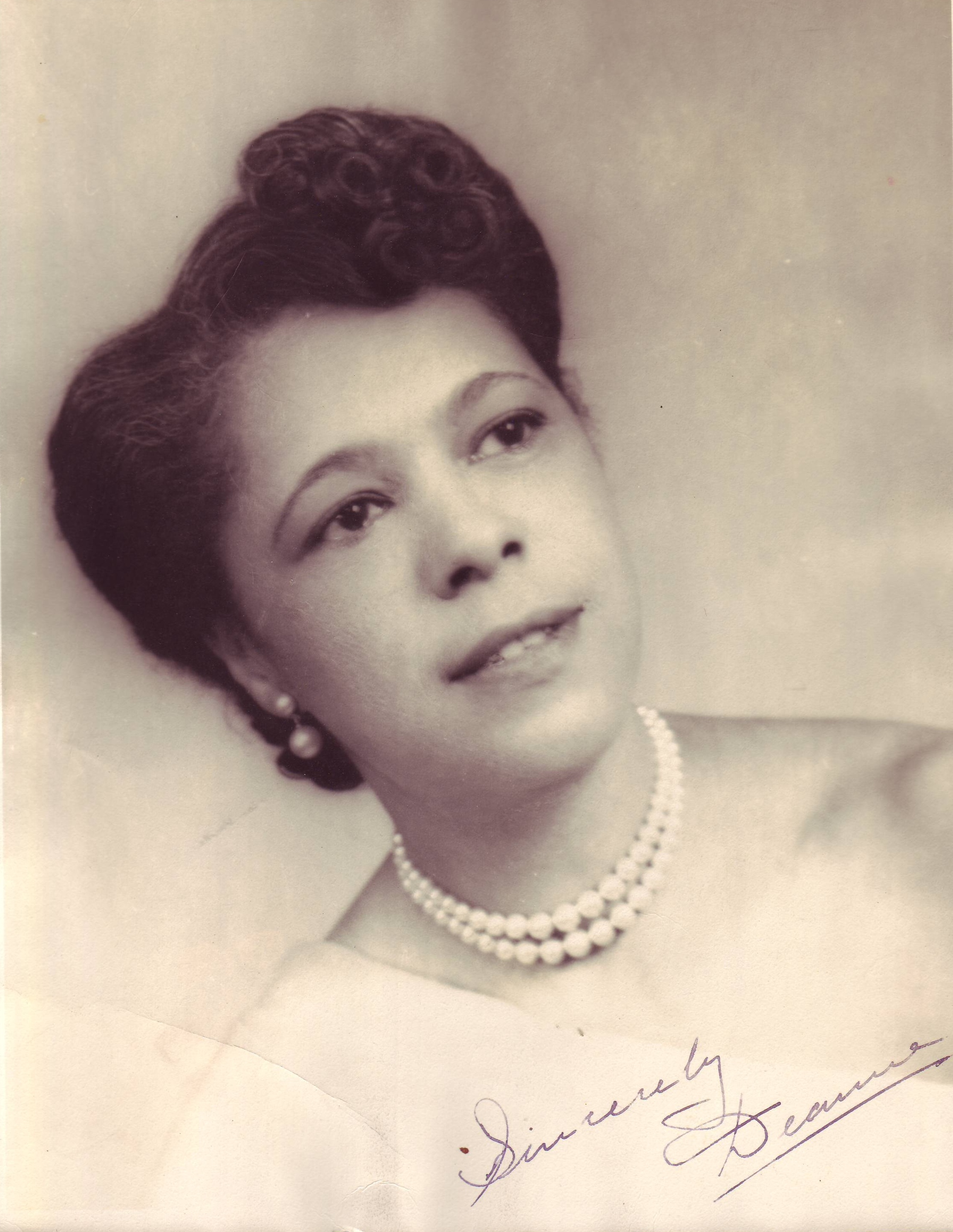
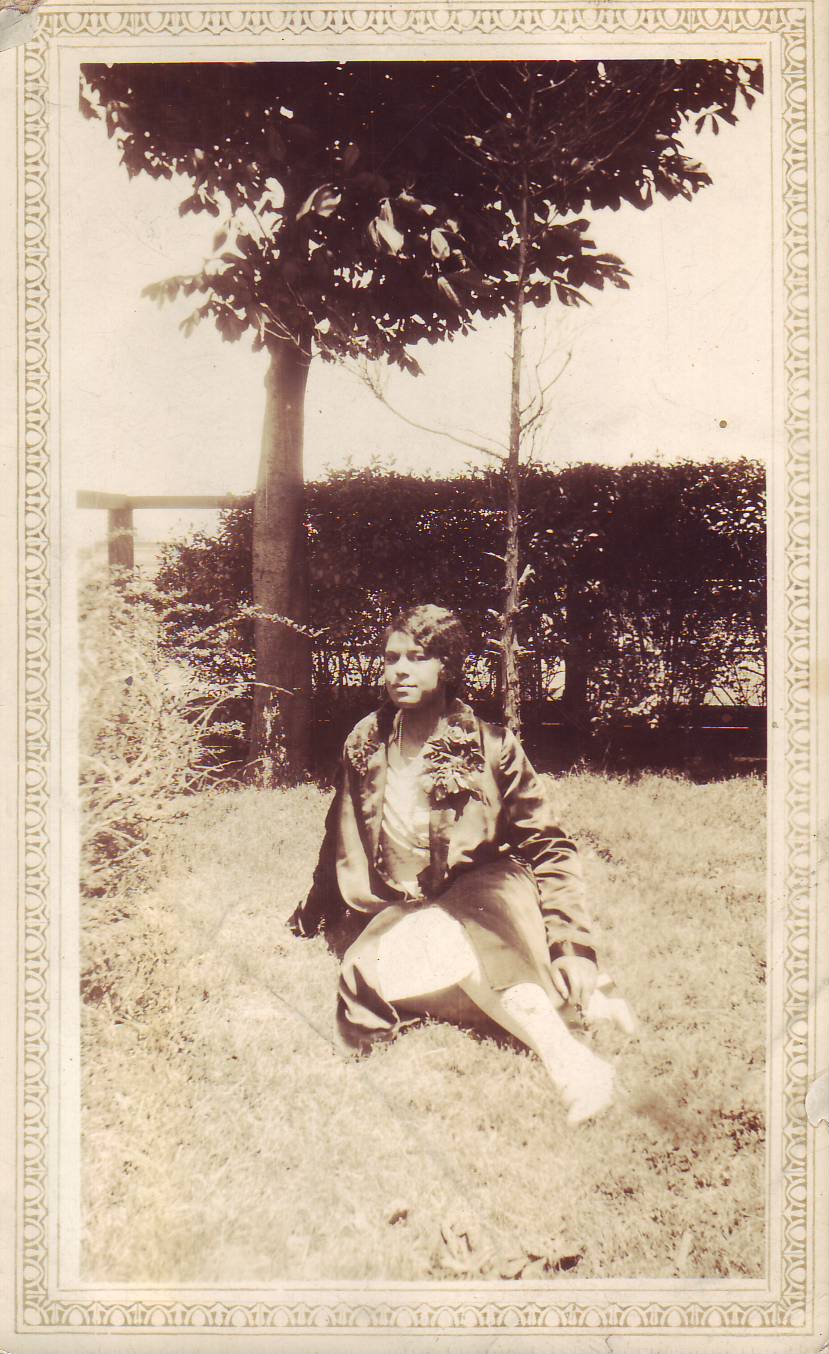
I can’t find the photo right now. The one I took at the last family reunion she attended in, perhaps, the mid-1980s. She was lovely. “Pulled,” as my friends say, with flawless caramel skin, steel grey hair swept in a neat chignon,* stately bosom encased in a champagne-colored lace sheath dress. Cousin Ardeanur Smith Hart, born one hundred twelve years ago today.

McNEELY -- Ardeanur Smith seatedArdeanur, circa 1928, Bayonne NJ.

McNEELY -- Ardeanur_Minnie_Louise_BertArdeanur; her aunt Minnie McNeely, who reared her after her mother’s death; her cousin Louise Colvert; a Murphy; and her uncle Lon Colvert’s sister, Bertha Hart. Statesville, mid-1920s.

McNEELY -- Ardeanur Smith with pearlsArdeanur Smith Hart (8 February 1902-14 January 1996).

*I found it. And I misremembered. Not a chignon, but a neat cap of curls.

Standard
Births Deaths Marriages, Enslaved People, Maternal Kin, North Carolina, Other Documents

Where did they go?, no. 3: more McConnaugheys.

Simon, 57, $200 (rheumatism). Ceasar, 54, $400 (“crip.”). Perry, 45, $300 (“bad rupt.”). Isaac, 36, $1400. Charles, 32, $1450. Nelson, 32, $1450. Edward, 32, $1450. George, 31, $1450. Ellick, 26, $1500. Henry, 17, $1500. Thom, 14, $1200. Giles, 14, $1200. Dallas, 7, $400. Alfred, 4, $300. John, 25, $1500. Juber, 24, $1500. Nancy, 36, $1000. Ritta, 32, $1100. Harried, 23, $1200. Liza, 23, $1200. Laura, 11, $650. Louisa, 8, $400. Jennie, 4, $250. Ellen, 5 mo., $100. Allice, 3 mo., $200.

As did his brother John M. McConnaughey, James C. McConnaughey was required to pay taxes on the slaves enumerated by a Confederate tax assessor canvassing Rowan County, North Carolina, in 1863. James reported owning the 25 people listed above, whose total value was just over $23,000.  What were their links to one another? What were their links to John M. McConnaughey’s slaves?

Cohabitation records shed some light. In 1866, North Carolina afforded freedmen the right to legalize marriages made during slavery by appearing before county justices of the peace to register their relationships. Rowan County cohabitation registers not only record the names of the parties and the length of their marriage, but the former owners of each party. Listed below are registrants who named one of the McConnaugheys (John, James, or James’ son Joseph) as an owner:

George Hall (Dr. Joseph McConnaughey) and Mary Cowan (N.N. Nixon). 3 years.

Simon Hall (James C. McConnaughey) and Nancy McConnaughey (James C. McConnaughey). 20 years.

David Litaker (Elizabeth Litaker) and Hagar McConnaughey (John M. McConnaughey). 13 years.

Abram McConnaughey (John M. McConnaughey) and Eliza Barger (John Barger). 6 years.

Charles McConnaughey (James C. McConnaughey) and Lucinda Kerr (Dr. [illegible] Kerr). 15 years.

Edward McConnaughey (James C. McConnaughey) and Loretta McConnaughey (James C. McConnaughey). 4 years.

Nelson McConnaughey (James C. McConnaughey) and Martha Graham (James C. McConnaughey). 11 years.

Isaac McCorkle (Dr. Joseph McConnaughey) and Ann Kerr (George C. Barnes). 14 years.

George Washington Miller (John M. McConnaughey) and Eliza Catherine Kerr (John M. McConnaughey). 9 years.

Hezekiah Mitchell (Lueco Mitchell) and Louisiana McConnaughey (John M. McConnaughey). 6 years.

Except Martha Graham, the seven freedmen and women who named James C. McConnaughey as their former master are readily identifiable in his 1863 tax assessment. The two who named Joseph (George Hall and Isaac McCorkle) also appear to have been listed with James’ slaves in 1863. (There was no tax listing for Joseph McConnaughey, who did not inherit slaves from his father until 1864.)

Later Rowan County marriage records also disclose family relationships among McConnaughey’s bondsmen. These documents reveal that Simon Hall (who also used the name McConnaughey) and Nancy McConnaughey’s children included the 17 year-old Henry, 14 year-old Giles, 8 year-old Louisa, and probably 4 year-old Jennie listed in 1863. Further, when Jupiter “Juber” McConnaughey married in 1870, he listed his parents as Simon Hall and Cynthia McConnaughey. The age gap between Simon and Nancy suggests that she was his second wife, and Cynthia McConnaughey may have been first.

Perry McConnaughey was named on a marriage license as the father of Thomas McConnaughey, perhaps 14 year-old Thom above. If so, where was Thomas’ mother Rockey, who was also named as the mother of Alexander “Ellick” McConnaughey on an 1883 marriage license?  (Alexander gave his father as Toby McConnaughey.) Perry himself named his parents as John Henderson and Pricilla McConnaughey when he married in 1867. Alex and his first wife Judy share a household — no children — in the 1870 census of Atwell township, Rowan County.

Isaac appears twice in the 1870 census — once as Isaac McConeehugh, age 45, with wife Ann, 35, and sons Thomas, 4, and Edmon, 2, then a few households later as Isaac McCorcle, 45, with wife Ann, 42, and son Thomas, 4. (A reminder of the vagaries of the United States federal census.) Neither boy was born at the time of the 1863 tax list. Isaac and Ann married about 1852. Were there older children? Are they among those name in the tax list?

Both John M. McConnaughey and James C. McConnaughey owned slaves named Charles. The whereabouts of the Charles McConnaughey who formerly belonged to John are discussed here. The Charles in the 1863 list above would appear to be the Charles McConnaughey, 40, listed with wife Phillis and ten children in the 1870 census. Who, then, is the Charles who reported a 15-year marriage to Lucinda Kerr in 1866? Is Phillis Lucinda? If so, I have not found any other reference to her by that name, though there are plenty of references to “Phillis.”

Dallas McConnaughey named Edward and Ritta McConnaughey as his parents when he married in 1876, ten years after they registered their cohabitation. Sadly, Loretta “Ritta” may not have enjoyed freedom long. She does not appear with her husband and son in the 1870 census, when they are listed in the household of John M. McConnaughey in Mount Ulla, Rowan County.

Though Nelson and Martha McConnaughey’s cohabitation certificate seems to indicate that both were enslaved by James C. McConnaughey, evidence suggests that in fact, Martha and their children had a different owner. Neither Martha nor their oldest children David, born about 1859, and Maria, born about 1861, are  listed among James’ human property. (As an aside: Abram McConnaughey presided over the marriage of Nelson and Martha’s son David McConnaughey in 1879. Was he a relative?)

Harriet McConnaughey appears in the 1870 census of Locke township, Rowan County, with R. McConnaughey, a 55 year-old male, Mary McConnaughey, 35, and Hiram McConnaughey, 4. Harriet’s age is consistent with the “Harried” listed in 1863, but the other adults do not appear on that list, and relationships among them are indeterminate.

There’s a seven year-old Alice McConnaughey listed in John M. McConnaughey’s household in the 1870 census among an assortment of his and James’ former slaves. She is listed under Eliza McConnaughey’s name, as if her daughter. (This Eliza appears, at 23, too young to be the Eliza listed above, but in 1880 is listed as 39, so….)

In summary: in 1863, James C. McConnaughey’s 25 enslaved laborers comprised at least two intact families (Simon, his wife Nancy, their children, and his son; Edward and Ritta and their son); a father and son (Perry and Thom); at least three men married to women who were enslaved elsewhere (Isaac, Charles, Nelson); two apparently unmarried women (Harriet and Eliza); three possibly unmarried men (Caesar, George and John); and three or four children whose relationship to the others cannot be determined (Alfred, Laura, Ellen and Alice.)

Standard
Land, North Carolina, Other Documents, Paternal Kin

68 acres on Turner Swamp.

At first glance, the document raises eyebrows. Brothers Walter and William Artis, successful farmers in their own right, were sharecroppers for William S. Hagans, their first cousin?

HAGANS -- Artis Cropper Contract (2)

A second document sheds some light:

HAGANS_--_William_Hagans_to_William_Artis_Deed

Three days before he signed the cropper agreement, William M. Artis and his brother’s wife Hannah Forte Artis signed an agreement for the purchase of the same 68 acres. (Why Hannah and not Walter??? He was very much alive.) The land was more explicitly described as: (1) a tract on Turner Swamp, known as the Jonah Reid place, that Hagans inherited from his father Napoleon Hagans; (2) a tract, known as the Daniel Reid place, that William Hagans purchased from J.D. Reid and was once part of the lands of Washington Reid, deceased; and (3) a lot of “mud land” on Spring Branch for marl (a lime-rich mud used to condition or de-acidify soil.) The purchase price? A seemingly extravagant $5000 — $300 due at signing, $700 in a year’s time, and the remaining $4000 in two notes payable at 6% interest in 1918 and 1919. (Five thousand dollars in 1916 adjusts to about $106,000 today. That’s considerable change.) It appears then that, per the cropper agreement, during the first year of the purchase agreement the Artis brothers agreed to pay $300 worth of any crops they produced on the land to Hagans. (In addition to the $300 paid him in January?)

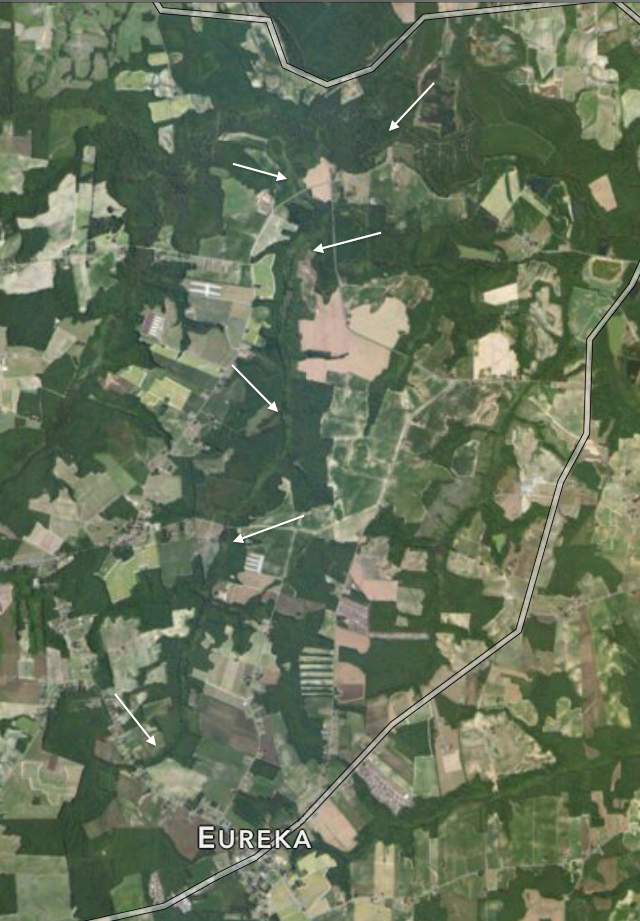
Napoleon Hagans built his house on a tract of land straddling Aycock Swamp, the next tributary over from Turner Swamp. (Both flow into Contentnea Creek.) Washington Reid’s mother Rhoda Reid was a well-t0-do free woman of color who owned considerable farmland in extreme northwestern Wayne County, perhaps the land that William Hagans eventually bought. The entire course of Turner Swamp runs only a few miles, the last stretch beyond Wayne’s borders into Wilson County. I am beginning to consider this area ground zero for the Reids. (Future project: a dig in the deeds.)

Turner_Swamp-1

A little hard to see, but the arrows point out the course of Turner Swamp. The green curve just below the lowest arrow marks the rise of the waterway, and the top arrow points out its approximate mouth just below Woodbridge Road in Wilson County. (And “swamp” it is. The soil of eastern North Carolina is flat and sandy or clay-ey, and the little branches off major creeks don’t so much flow as they do stand, with the barest perceptible current. Getting to their banks often requires boots — and a stout stick to beat back the cane and catbrier.)

Standard
Free People of Color, Land, North Carolina, Paternal Kin

Intersection.

Image

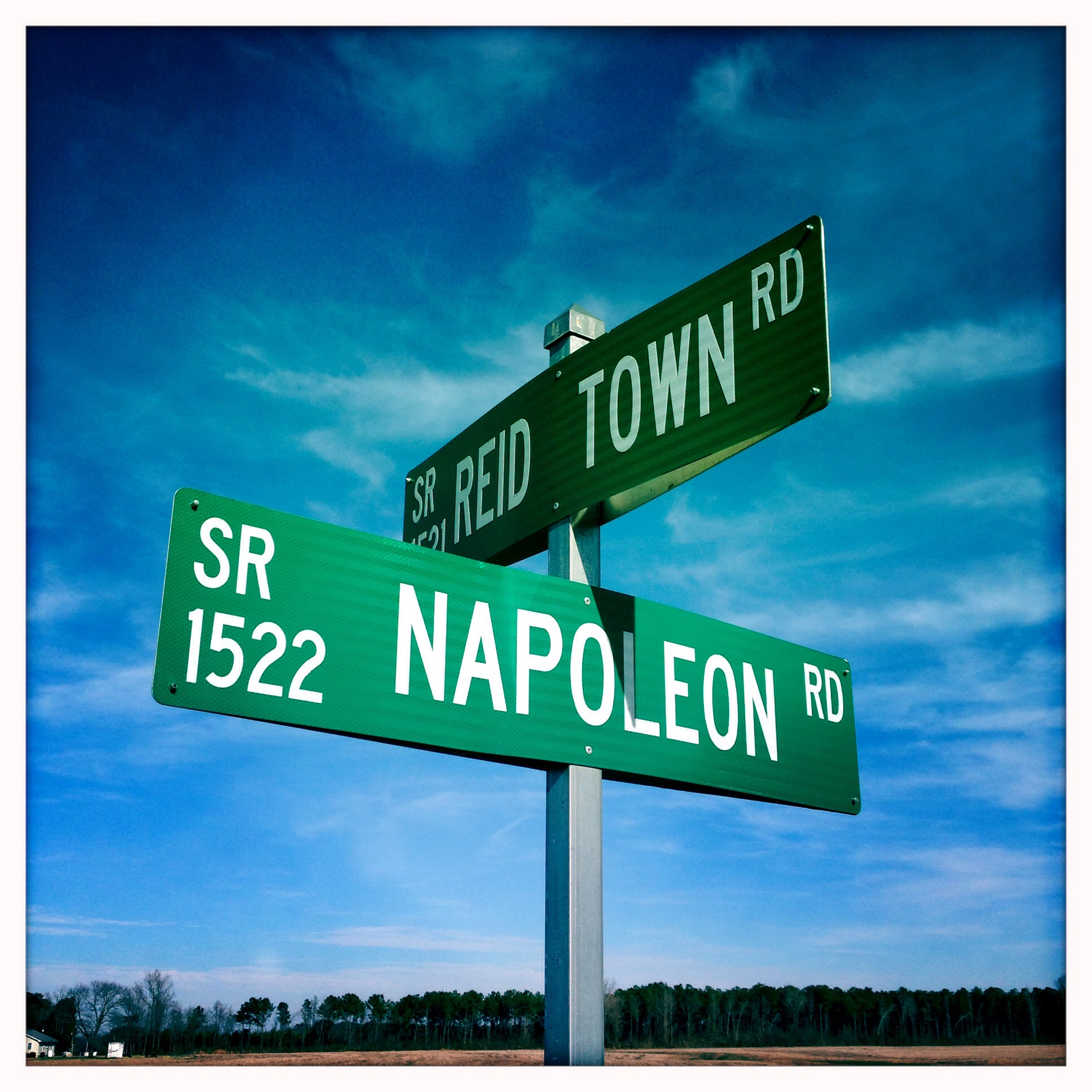
Napoleon Road is a bent elbow of a dirt lane running north west of Eureka in Wayne County. At its southern end, it debouches into Reidtown Road, so named for the free colored Reid family who lived in the area as early as the 1830s.  Napoleon Road is no longer than a mile or so, and there is one house on it. Napoleon Hagans built that house.

Rural roads did not have formal names until the county implemented its 911 system perhaps 20 years ago.  It is a testament to Napoleon Hagans’ stature that, nearly one hundred years after his death and three-quarters of a century after his descendants left the state, the majority landowner along what had been his road chose to memorialize him permanently.

Standard
DNA, Free People of Color, North Carolina, Paternal Kin

DNA definites, no. 11: Artis & Aldridge.

  • I am descended from John W. Aldridge and his wife, Louvicey Artis Aldridge, via son J. Thomas Aldridge. Louvicey Artis’ parents were Adam Artis and Frances Seaberry Artis.
  • K.H. is also descended from John W. Aldridge and Louvicey Artis Aldridge, via daughter Nora Aldridge Henderson. At 23andme, K.H. and I show a 4.4% match, estimated as second cousins. In fact, we are first cousins, twice removed. (Calculated on the Aldridge side. We are also Henderson cousins, but much more distantly.)
  • W.H. is also descended from John W. Aldridge and Louvicey Artis Aldridge, via daughter Nora Aldridge Henderson. Ancestry estimates that we are 3rd-4th cousins; 23andme estimates 2nd cousins (2.51% match). In fact, we are second cousins, once removed. (We are also distant Henderson cousins.)
  • E.H. is also descended from John W. Aldridge and Louvicey Artis Aldridge, via daughter Nora Aldridge Henderson. At 23andme, E.H. and I show a 1.75% match, estimated as 2nd-3rd cousins. In fact, we are second cousins, once removed. (Ditto re the Henderson relationship.)
  • S.D. is also descended from John W. Aldridge and Louvicey Artis Aldridge, via daughter Nora Aldridge Henderson. Ancestry estimates that S.D. and I are 4th-6th cousins. In fact, we are third cousins. (Ditto re the Henderson relationship.)
  • G.J. is also descended from John W. Aldridge and Louvicey Artis Aldridge, via daughter Correna Aldridge Newsome. Ancestry.com estimates that we are 4th-6th cousins. (Ancestry does not provide percentage shared.)  In fact, we are 3rd cousins, once removed.
  • B.L. is descended from Josephine Artis Sherrod, daughter of Adam Artis and Amanda Aldridge Artis. Amanda Aldridge was a sister of John W. Aldridge. B.L. and I are estimated at 2nd-3rd cousins and share 1.28% on 23andme. In fact, we are 3rd cousins, once removed, on the Aldridge side, and 2nd cousins, twice removed, on the Artis.
  • A.S. is also descended from Josephine Artis Sherrod. Ancestry estimates our relationship as 4th-6th cousins. In fact, we are 3rd cousins, once removed on the Artis side, and 4th cousins on the Aldridge side.
  • H.B. is descended from Henry J.B. Artis, son of Adam Artis and Amanda Aldridge Artis. Amanda was the sister of John W. Aldridge. Ancestry.com estimates our relationship as 4th-6th cousins. In fact, we are 2nd cousins, twice removed.
  • B.J. is descended from Mattie Brewington Braswell, daughter of Joshua Brewington and Amelia Aldridge Brewington. Amelia was a sister of John W. and Amanda Aldridge. B.J. and I estimated at 3rd-5th cousins and share .37%. In fact, we are 4th cousins. B.J. also matches G.J. at Ancestry, but not S.D.
  • R.M. is descended from Mathew W. Aldridge, who was John W. Aldridge’s brother. 23andme estimated that R.M. and I are 3rd to distant cousins and share .21%. In fact, we are 4th cousins. R.M. matches all the other Aldridge-Balkcum descendants on 23andme. She also matches D.D. at .46, 3rd-5th cousins.  This is particularly interesting because the father of D.D.’s great-grandmother was said to be Jesse F. Baker, son of John Frank Baker and Mary Ann Aldridge. Mary Ann Aldridge was the daughter of John Mathew Aldridge, who I believe to have been the brother of Robert Aldridge. Assuming this to be the connection between R.M. and D.D. are, in fact, 5th cousins. (Also: D.D.’s great-grandmother and my grandmother were daughters of Bessie Lee Henderson, so she matches me, my father, sister and 1st cousin on 23andme, as well as K.H.)
  • H.A. is descended from Mary Jane Artis Artis, daughter of Adam and Lucinda Jones Artis. At 23andme, H.A. and I show a .15% match, estimated at 3rd to distant cousins. We are, in fact, 4th cousins. H.A. also matches K.H. and B.L.
Standard
DNA, North Carolina, Paternal Kin

DNA Definites, no. 10: A windfall.

The end of last week brought three significant new 23andme.com matches. I’d been waiting impatiently for the results to post for all of them, and I wasn’t disappointed. In summary:

  • M.B. is my paternal first cousin. We show a 10.5% share across 31 segments. She matches, of course, my father and sister, but also our mysterious adoptee cousin S.A., and several more distant known relatives. Most exciting: she has a match that none of the rest of us has to a D.D., who’s descended from a Sampson County Balcum-Johnson marriage. That’s the first Balkcum DNA link I’ve found.
  • B.J. has been a close collaborator in my Aldridge research for several years. She’s descended from the sister of my great-great-grandfather John W. Aldridge, and 23andme correctly estimated our relationship as in the 3rd-5th range.
  • B.L. is from my hometown. I didn’t discover that we were related until I was in my 20s and had started researching my family. (My grandmother knew, of course, but wasn’t sure of the exact connection.) Her grandmother was the last of my great-great-great-grandfather Adam T. Artis’ children to pass away — in 1988, at age 101. There are some promising matches in her list that seem to be unique, too, including one to a Locus-Artis from the Nahunta area of Wayne County. 23andme predicted that we are in the 2nd-3rd cousin range, which is correct whether calculated from the Aldridge or Artis side.
Standard
Births Deaths Marriages, North Carolina, Paternal Kin, Photographs

Carrie Henderson Boseman Grantham.

My grandmother met none of Mama Sarah‘s sisters, but she know of them. Loudie, of course, her own grandmother. And Ann Elizabeth, mother of Minnie and Daniel and Dollie Simmons. And Carrie. Who was a little more elusive because she had no children that my grandmother knew of.  She was only a name Sarah mentioned.

I managed to find a few references to her. The earliest is in the Records of the Congregational Church of Christ in Dudley, vol. II, in which Carrie Henderson appears in membership rolls for 1886 with sisters Suddie, Lutie and Sarah Henderson.  (“Suddie,” or Mary Susan Henderson, was not one of the great-aunts my grandmother knew.) Next to Carrie’s name are these notations: “Bowsman” and “absent.”

“Bowsman” was “Boseman,” actually, the surname of the man Carrie married a year later. Wayne County NC marriage records show that, on 25 June 1887, George Boseman, 24, “col’d,” and Carrie Henderson, 18, col’d, applied for a marriage license.  A.T. Dove, M.G. performed their ceremony on 29 June 1887, in Brogden, before Dortch Winn, Jno. Winn, and Frank Parker.  (They apparently were not wed in Carrie’s church, as Dove was not pastor there.)  The marriage was childless, and probably ended with George’s death.

On 21 Dec 1899, Carrie Boseman, 28, married Arch Grantham, 48, colored, in Brogden township. R.B. Johns, M.G. (of the Congregational Church) officiated and W.D. Grantham and Georgiana Winn witnessed.  The family appears in the 1900 census of Grantham township, Wayne County: farmer Arch Grantham, wife Carrie (29), and (his) children [illegible], Emma, Annie, Barfield A., and Lula A.  Carrie reported 0 of 0 children living.

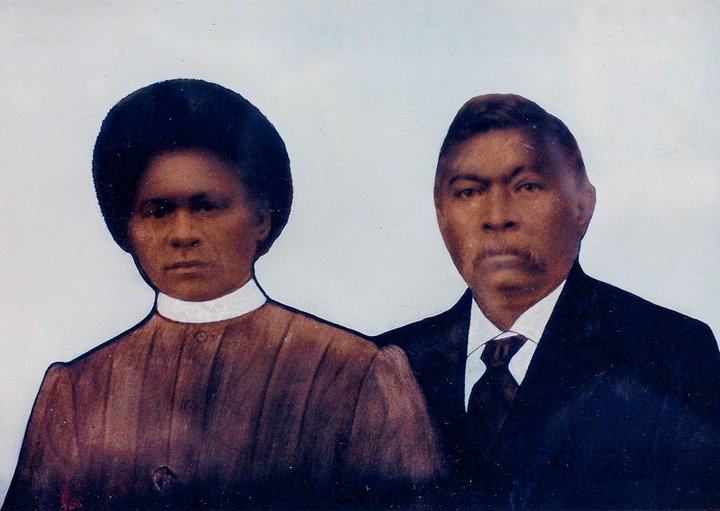
This is where things stood until a couple of years ago, when I ran across B.B., a descendant of Archie Barfield Grantham (1851-1915) and his first wife, Mary Adeline Raynor (1855-1897). In 1906, Arch married his third wife, B.B. told me — so Carrie, still childless, died within five years or so of their wedding. It was nice to be able to round out the thread of her life in that way, but there was more. For many years, a portrait hung on his grandparents’ wall, a hand-tinted, charcoal-enhanced photograph of Archie … and Carrie.

Carrie & Archie Grantham


Standard
Births Deaths Marriages, Enslaved People, Migration, Newspaper Articles, North Carolina, Paternal Kin

Mother Ward.

None of us knows the details of the arrangements, or the impact on their willing and unwilling participants, but it is clear that Napoleon Hagans had a messy personal life. His oldest child, William Coley, was born about 1860 to Winnie Coley, an enslaved woman who lived on the nearby farm of John Coley. Winnie had several additional children, fathered by Coley himself and by Napoleon’s brother-in-law Adam T. Artis. Around 1867 — no license has been found — Napoleon married Apsilla “Appie” Ward, born in 1849 to Sarah Ward, an enslaved woman, and her owner, David G. W. Ward, a wealthy physician living in northwest Greene County. Napoleon poured his ambition and wealth into his and Appie’s sons, Henry Edward (born 1868) and William Scarlett (born 1869). Both attended Howard University and settled into comfortable, distinguished livelihoods in farming, education and real estate.

Though Napoleon’s youngest was denied these advantages, he was arguably the most successful of all the sons.  Joseph Henry Ward was born 4 August 1870 in Wilson, North Carolina. (Or Wilson County, in any case.) His mother, Mittie Roena Ward, was Appie Ward Hagans’ twin. (Identical, it is said.) And Napoleon Hagans’ sister-in-law. I know nothing at all of her early years. In 1879, Mitty Finch (Finch? why?) married Virginia native Algernon Vaughn in Wilson. In 1880, the family’s household included Mittie’s mother, Sarah Darden; her husband Algie, a farm laborer; Mittie, a cook; and children Joseph, 8, Sarah, 6, and Macinda, 5 months.

By 1890, Joseph had struck out on his own and for reasons unknown landed in Indianapolis, Indiana. There, he went to work for a physician who would set him on his own path to a medical degree. Joseph’s half-sister Sarah married William Moody in Wilson in 1892 and, by the dawn of the new century, the Moodys and Mittie Vaughn were living in Washington DC. Soon after Mittie joined Joe Ward in Indianapolis, reverted to her maiden name (though keeping the title “Mrs.”), and began a peripatetic life that saw her in and out of the households of her children.

The Indianapolis Recorder, an African-American news weekly, kept close tabs on the mother of one of the city’s most illustrious residents:

Mrs. Mittie Ward, mother of Dr. J.H. Ward will leave today for Washington, D.C., to spend the winter with her daughter, Mrs. Sarah Moody. Her youngest daughter will remain in the city with her brother Dr. Ward.  [12 December 1903]

Ward-Artis.  On Wednesday June 22, at high noon the wedding of Miss Minerva Ward, the daughter of Mrs. Mittie Ward and sister of one of our prominent physicians Dr. Joseph H. Ward, and Mr. Dillard Artis, of Marion, will be celebrated in the presence of the immediate family and a few intimate friends. Rev. Morris Lewis assisted by Rev. T.A. Smythe will perform the ceremony. They will leave at 5 p.m. for Marion, where a wedding reception will be given from 8 to 11 p.m., at 920 S. Boot street, the home of the groom. The bride is well and favorably known in our city’s best circles and is a favorite in the younger social set. The groom is a prominent cement contractor of Marion and a highly respected citizen, owning a great deal of property, which he has accumulated by his industry and business tact. They will be at home at 920 S. Boot street, Marion.  [18 June 1910]

Mrs. Minerva Ward Artis of Marion, spent the holidays with her mother, Mrs. Mittie Ward, of the city.  [31 December 1910]

Mrs. Dillard Artis of Marion, was in the city a few days this week. Mrs. Artis is visiting her brother, Dr. J.H. Ward and her mother, Mrs. Mittie Ward.  [18 February 1911]

Dr. J. Ward of Indianapolis and Master Joseph were guests of his mother Mrs. Mittie Ward and sister Mrs. S.D. Artis of S. Boots street Wednesday.  [19 August 1911]

Mrs. Mittie Ward of Indianapolis, who has been the guest of her daughter for the past week Mrs. S.D. Artis returned home Saturday and on December 5, will leave for Washington, D.C. to spend the winter with her daughter.   [2 December 1911]

Dr. J.H. Ward of Indianapolis was called to this city [Marion, Indiana] the first part of this week to attend the bedside of his mother, Mrs. Mittie Ward, who is ill at the home of her daughter, Mrs. S.D. Artis, in South Boots street.  [25 November 1916]

Mittie Ward died of stroke in Washington, DC, in 1924. She was visiting her elder daughter Sarah Ward Moody and planning to travel to see the younger.

Image

Pittsburgh Courier, 19 April 1924.

Standard