Newspaper Articles, North Carolina, Paternal Kin, Vocation

The splendid side-wheeler Rough and Ready.

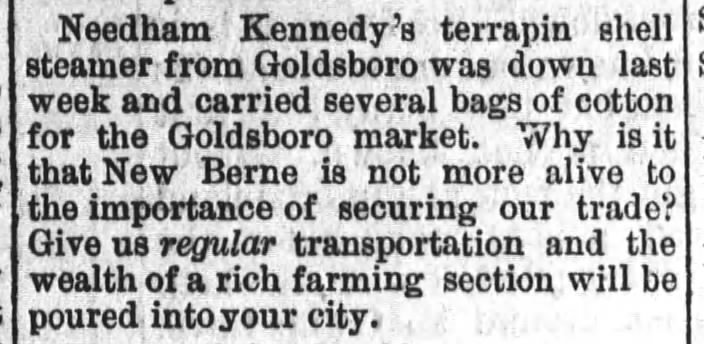
Needham KennedyMathew W. Aldridge‘s father-in-law — just gets more and more interesting.

Image

New Berne Weekly Journal, 17 January 1884.

and

Daily journal new bern 4 9 1884

New Bern Daily Journal, 9 April 1884.

How did this man, enslaved until 1865, own a steamer plying the Neuse River from Goldsboro down to New Bern??? And why has he left so little trace in the record? I’m on the hunt.

Here’s an article from a Raleigh newspaper announcing the Rough and Ready‘s arrival in North Carolina:

12 8 1847 NC Star Raleigh

Star, 8 December 1847.

Stay tuned.

Standard
Births Deaths Marriages, Free People of Color, North Carolina, Other Documents, Paternal Kin

Volte-face, no. 1; or 52 Ancestors: Daniel Artis.

[Though my format only infrequently focus on individuals, I’ve taken up the 52 Ancestors in 52 Weeks challenge. This is week 4, so I have some catching up to do. We’ll see.]

I had an inkling, didn’t I? Here’s what I wrote in my notes when I found Mariah Artis Swinson’s death certificate:

MARIAH SWINSON.  Died 6 Feb 1955, 500 Creech Street, Goldsboro NC, arteriosclerosis.  Born 14 Feb 1849 to Daniel Artis and unknown. Informant, Mrs. Mary Swinson.  Buried 9 Feb 1955, Elmwood cemetery, Goldsboro NC.  [Daniel Artis?  Is this an error or was Mariah Silvania’s niece rather than her daughter?  I conjectured that Daniel Artis was a brother of Silvania and Vicey Artis.]

Up to then, I had firmly believed that Mariah Artis Swinson, wife of Jesse Swinson, was the daughter of Guy Lane and Sylvania Artis, so I was thrown when her death certificate listed her father as Daniel. I had a Daniel Artis in my file with a question mark behind his name — was he Sylvania and Vicey Artis’ brother? He appears sparingly in records, and here’s all I knew about him:

On 20 Aug 1853, in Greene County NC, Silas Bryant sold Daniel Artis for $325 120 acres adjacent to the mouth of a lane at the dividing line between said Bryant and John Lane, the Bull Branch, and the mouth of Sellers Branch.  Henry Martin witnessed.  The deed was registered 7 Jun 1882.  [Silas Bryant apprenticed the children of Vicey Artis, who may have been Daniel’s sister.  John Lane apprenticed the children of Vicey’s sister Sylvania and probably owned her husband, Guy Lane.]  

and

In the 1860 census, Bull Head, Greene County NC, 40 year-old free man of color Dannel Artis, a ditcher, is listed next door to the household of white farmer John Lane, who reported $10000 personal property and $25000 real property, included Dannel, Mike, Penney, Dyner, Juley, and Washington Artis, who were Silvania’s children.

I have not found Daniel in earlier censuses. However, a few days ago, following up a request for assistance by a descendant of a Daniel Artis from Greene County, I examined the will and probate records of a Daniel Artis who died in early 1905.  The will, in black and white, stated that Mariah Swinson, wife of Jesse Swinson, was this Daniel Artis’ daughter, not Sylvania Artis’.

So, is Daniel Artis the will-maker the Daniel Artis that I believe to have been a brother of Vicey Artis Williams and Sylvania Artis Lane?

What does his will tell us?

There were two, in fact. The first, dated 15 January 1905, was recorded at the Greene County Courthouse in Will Book 1 at page 514; the second, dated two days later, at page 524.  The legatees are the same, but the gifts packaged differently, so I present both:

Item 1. Page 514 — to daughter Clary Edwards, wife of Henry Edwards, his interest valued at $172 in the tract of land on which Clary and Henry live. The tract was purchased from Debro Cobb with money advanced from Henry Artis. If $172 is more than the other’s children’s share, Clary is to make them even, and vice versa.  Page 524 — to daughter Clara Edwards, wife of Henry Edwards, his interest valued at $172 in the tract of land purchased from Debro Cobb. His agreement with Henry Edwards has not been recorded.

Item 2. Page 514 — to son Henry Artis, 1/4 interest in his real estate.  Page 524 — to son Henry Artis, 40 acres, including the house in which Daniel then lived.

Item 3. Page 514 — to the children of his son Lodrick Artis (Anna Randolph, Frank Artis, Lula Forbes, Madison Artis, Marcellus Artis, Ernest Artis, Dicey Batts and Hannah Artis) 1/4 of his estate.  Page 524 — to the children of Lodrick Artis and his wife Mandy, 40 acres (land Lodrick resided on at the time of his death) and all buildings thereon.

Item 4. Page 514 — to the children of his daughter Prior An Thompson (Isaac Sauls, C.D. Sauls, Maria Edwards and Clara Lane), 1/4 of his estate.  Page 524 — to Prior An Thompson’s children and their heirs, 40 acres that Willis Thompson lives on.

Item 5. Page 514 — $50 to daughter Mariah Swinson, wife of Jesse Swinson, to be paid from the shares of the others in the amount of $12.50 each.  Page 524 — A committee to be appointed to assess value of shares and make Clara Edwards’ share equal to the others, difference to be paid within seven years.

Item 6. Page 514 — none.  Page 524 — Each lot to be taxed $12.50 to pay daughter Mariah Swinson, wife of Jesse Swinson.

Grandson Isaac Sauls was appointed executor in both, Daniel Artis signed each with an X, and both were proved on 21 March 1905.

Whatever his intent at clarification, things did not go well with Daniel’s estate. A Notice of Sale ran four weeks from December 1923-January 1924 in the Greene County weekly The Standard-Laconic announcing the sale of “a certain tract or parcel of land devised to Henry Artis by Daniel Artis by his last will and testament, … containing 40 acres.” The sale was advertised pursuant to a judgment in Greene County Superior Court in the matter of Frances Hall; Bennett Hall; Bessie Woodard, infant; and Alice Woodard, infant, by their next friend Amos Woodard v. J. Settle Artis and Roumania Artis. Settle Artis, who was Henry Artis’ son, had purchased the parcel at a courthouse sale the previous July. Frances and Bennett Hall were Settle’s sister and brother-in-law, and Amos Woodard was another brother-in-law, widower of Settle’s sister Dillie.

I don’t know what Hall et al. v. Artis was about, but the allegations of the next suit over Daniel’s estate — filed in 1930 — are clear. The case caption alone is daunting: Isaac Sauls; Walter Sauls; Luby Sauls; Edward Sauls; Hattie Speight and her husband Walter Speight; Mariah Thompson; Lillie May Sauls, minor, George Sauls, minor, Sarah Sauls, minor, Lillie Lee Sauls, minor, Walter Sauls, minor, appearing by their next friend, Luby Sauls; and Nettie Sauls; Henry B. Lane; Lillie Maud Best and her husband Alex Best; John H. Lane and Carrie D. Lane, a minor, children and heirs at law of Clara Thompson; Penny Edwards, Silas Edwards, Prior Edwards and the Henry Pettaway children as follows: Hadie Pettaway, minor, Willie Harrison Pettaway, Georgia May Pettaway, minor, Minnie Clyde Pettaway, minor, grandchildren of Mariah Edwards, by their next friend Henry Pettaway  v. C.D. Sauls and Duffrey Edwards. In other words, a fight among the heirs of Daniel’s daughter Prior Ann Artis Sauls Thompson.  The crux of the matter is set out in paragraph 10:

10. That the plaintiffs, heirs at law of Isaac Sauls, Mariah Edwards and Clara Thompson are the owners of three fifths of the land devised by Daniel Artis in Item 4 of his will to the children of his daughter Prior Ann and are entitled to have the defendant Cain D. Sauls declared to have the same held in trust for them and are entitled to an accounting of the rents and profits of the same from the date of his purchase in 1908.

Instead, they alleged, C.D. Sauls had been keeping hundreds of dollars of rent for himself and, in 1928, had sold the parcel to Duffrey Edwards for $3000, with full knowledge by Edwards that Sauls was trustee for his relatives. C.D. denied all, of course. In 1937, his daughter and son-in-law, Willie Sauls Burgess and W.D. Burgess, were added as defendants after C.D. and his wife Ada allegedly tried to fraudulently transfer the disputed property to her.  In 1939, the clerk of court entered a non-suit judgment noting that the parties had reached an amicable settlement. No details were included. The matter was over.

So back to my original line of inquiry: who was this Daniel Artis?

Though he often managed to slip censustakers, the enumerator of the 1880 census found Daniel, his children Henry, Clara, Mariah, Prior Ann, and Lodrick, and their children living in a cluster in Bullhead district.  (There was a marker for “Artis Town” at a spot in the road in Greene County. I think it’s in this area.) At #260, Henry Artis, 30, wife Mary, 27, and children Frances, 16, Didida, 8, Missouri, 7, Settle, 3, and Henry, 2. At #261, Henry Edwards, 40, wife Clara, 45, and children Thomas, 19, Wright, 18, Scott, 15, Eliza, 13, George, 11, Henry, 9, Daniel, 7, and William, 5. #264, Jessee Swinson, 23, wife Maria, 20, and son Charles, 1.  #267, Willis Thompson, 28, wife Prior, 32, and his stepsons Isaac Sauls, 19, Cain Sauls, 18, and Richard Sauls, 15.  #268, Timothy Edwards, 22, wife Maria, 21, and children Mony, 2, and Lilly, 7 months, niece Alice Wood, 15, and grandmother Maria Sauls, 60. #269, Lodrick Artis, 35, wife Amanda, 30, and children Hannah, 12, Frank, 10, Lula, 8, Sarah, 4, Monsey, 2, Lodrick, 1 month, and Marcellus, 1. #270, Daniel Artis Sr., 65, wife Eliza, 60, and granddaughter Ida, 9.

This Daniel is roughly the right age to be the one listed in the 1860 census and certainly old enough to have purchased property in 1853.  [A future project: hunt for a plat or metes and bounds to compare that purchase with the land devides in 1905.]  Daniel Artis and Eliza Faircloth registered their two-year cohabitation just over the county line in Wayne County. If they were, in fact, married in 1864, she was not the mother of his children, who were born circa 1835-1860. Like Eliza, though, their mother — or mothers — probably  was enslaved, as were they. If Daniel was the brother of Silvania and Vicey, he followed in their footsteps by looking beyond the free colored community to find a spouse. (It is possible that the Daniel who married Eliza Faircloth was Daniel Artis, born in 1843 to Silvania Artis Lane. He and his wife Eliza appear in the 1880 census of Greene County with children Emma and James.)

It is time, I think, to adjust my files. Unlink Mariah Artis from Silvania and move her to Daniel, then enter all the new names I have for his descendants. The evidence is sparse and circumstantial, but sufficient to make a tentative determination that Daniel, Vicey and Silvania were siblings. They were born within about a ten-year span; they live in close proximity in Bull Head district, Greene County; they are the only Artises in the area (and among few in the county); they all had connections with Silas Bryant and/or John Lane; and there are some commonalities among the given names of their offspring (Silvania had a son Daniel; Silvania and Daniel had daughters named Mariah; and Vicey and Daniel had grandsons named Cain.)

Standard
Births Deaths Marriages, Free People of Color, North Carolina, Other Documents, Paternal Kin

Misinformation Monday, no. 6.

The sixth in a series of posts revealing the fallability of records, even “official” ones.

——

Again, from “The Adam Artis Family History”

Adam Artis had about five wives and 39 children. His first legal wife was Frances Hagens of Eureka. She was very fair and had beautiful long black silky hair. 

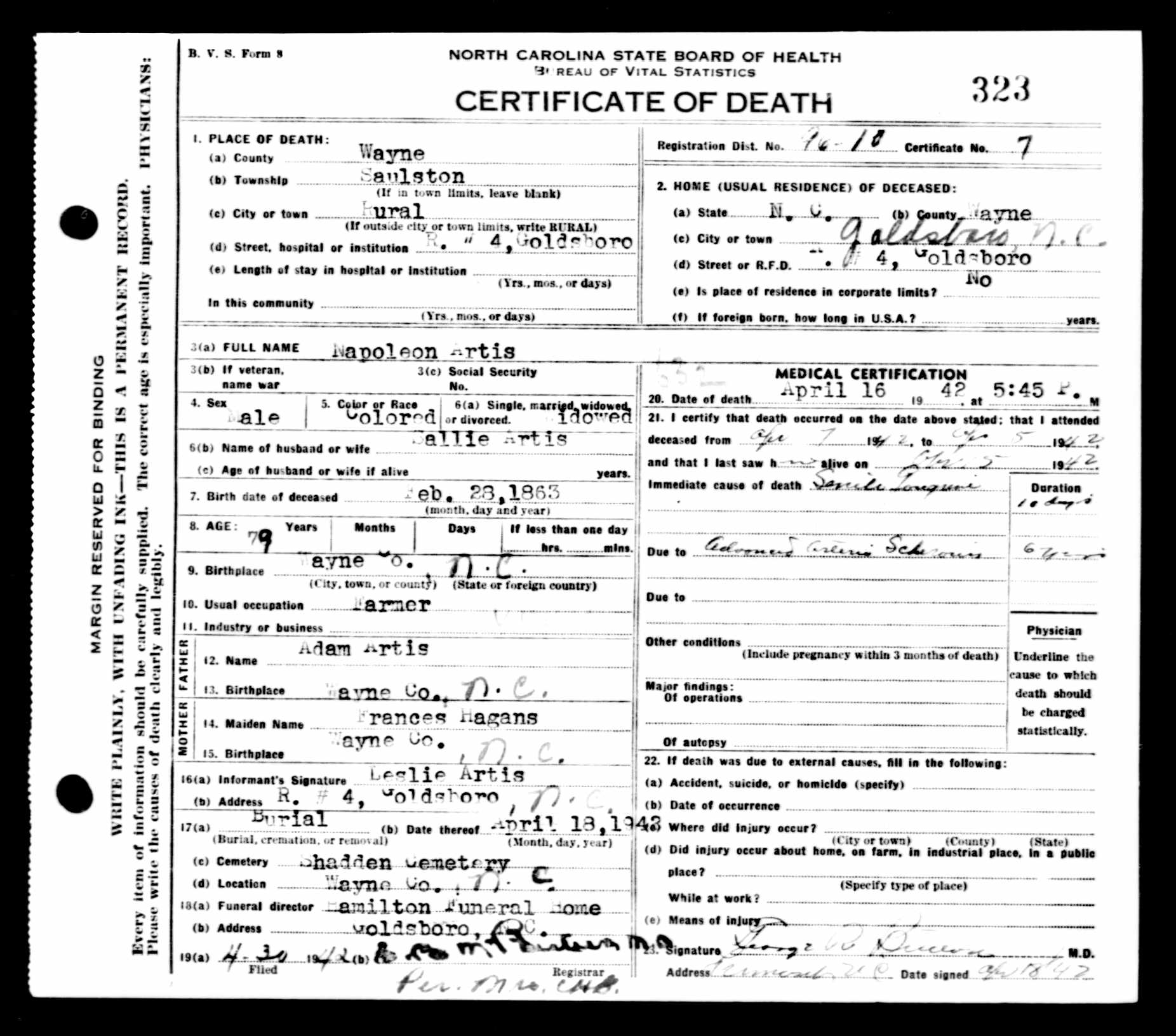
Frances Hagans. By the early 20th century, that this was Frances Artis’ maiden name was accepted wisdom. When four of her children — Vicey Artis Aldridge, Napoleon Artis, William M. Artis and Walter S. Artis — died, their informants replied “Frances Hagans” when asked the name of the mother of the deceased. Researchers find these records and dutifully set down her name this way in the innumerable family trees of her innumerable kin.

NorthCarolinaDeathCertificates1909-1975ForNapoleonArtis

But Frances Artis was not born a Hagans. She was a Seaberry, as her earliest records attest. She is Frances Seaberry, daughter of Aaron and Levisa Seaberry in both the 1850 and 1860 censuses. Most tellingly, it is the name Adam Artis gave the registrar when he applied for their marriage license in 1861.

ARTIS_--_Adam_Artis_Frances_Seberry_Marr_Lic

How, this mix-up? It is a case of transferral. Frances’ mother’s maiden name was Hagans and gave birth to a son, Napoleon Hagans, before she married Aaron Seaberry. Napoleon Hagans grew to become one of the wealthiest “colored” men in Wayne County, larger than life, feared and respected by black and white alike. Given the shadow that Frances’ brother (probably half-brother, in fact) cast, it is not surprising that 50+ years after her death, her descendants assumed that she was a Hagans, too.

Standard
Births Deaths Marriages, Maternal Kin, North Carolina, Photographs

Family cemeteries, no. 8: The Nicholsons.

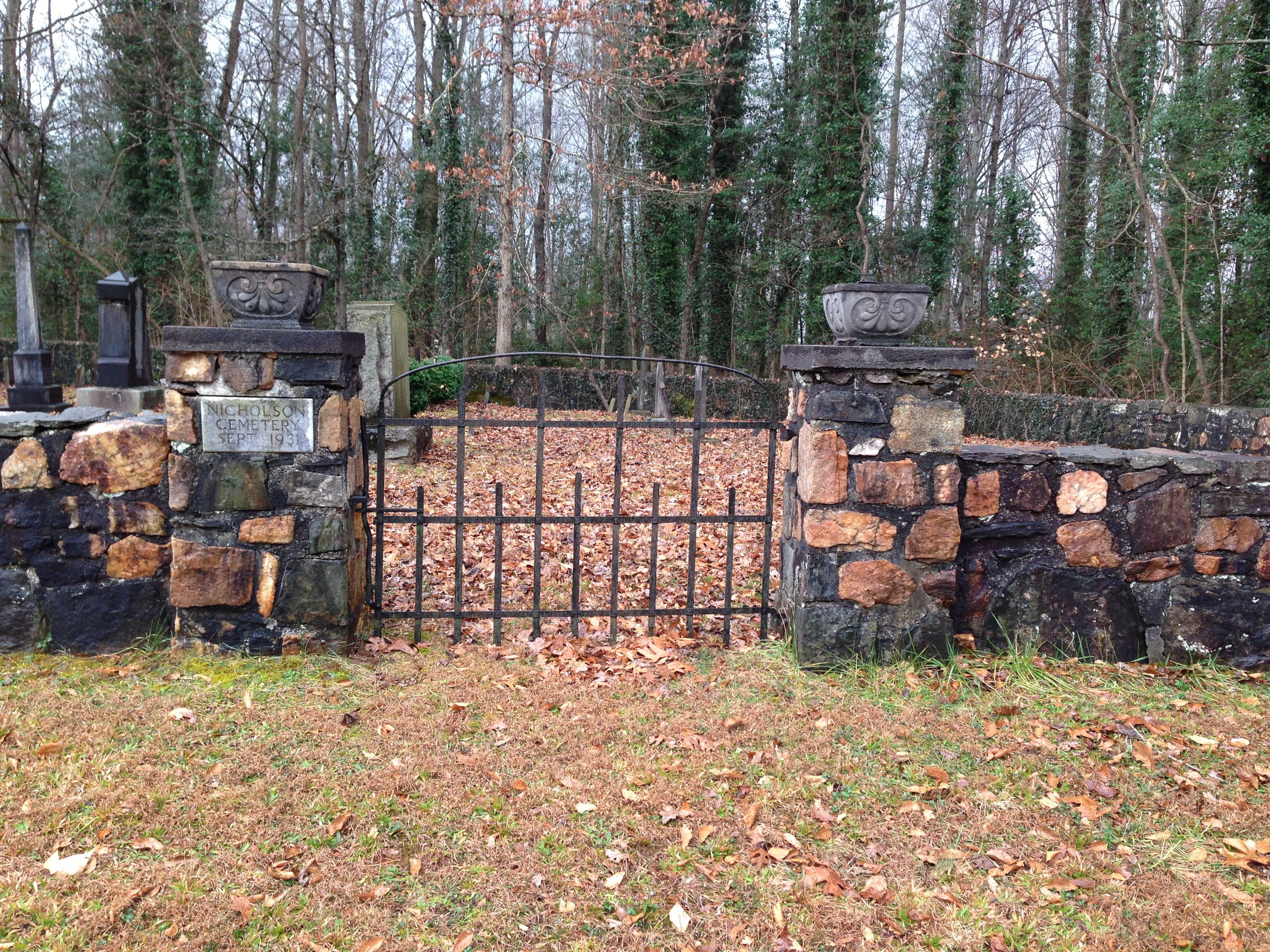
The map was not entirely clear, but the graveyard was definitely on Barnards Mill Road, which branched off Harmony Highway somewhere above Hunting Creek. Though morning, the sky was dark with impending rain. I kept an eye on the left side of the road. A bridge over the creek … an unmarked road … “Bridge Out.”  Wait, wasn’t the cemetery by a bridge?  I backtracked and turned off the highway. After a half-mile or so, the blocked bridge and a path, marked No Trespassing, leading into the woods. I am not a fool. I trotted up to the closest house and knocked. A middle-aged woman peered through a window, then motioned me around to the side door. “I’m looking for a cemetery near here. Welch-Nicholson.” She gestured behind me and smiled. Up the hill across the road, a low stacked-stone wall inset with a simple iron gate surrounded the remains of a hundred years of Nicholsons.

IMG_4594

My great-great-great-great-great-grandfather James Nicholson bought a mill on the creek in the late 1820s and probably established the graveyard. His father, Revolutionary War veteran John Stockton Nicholson, who was born 1757 in Princeton, New Jersey, and migrated to North Carolina circa 1800, is buried Muddy Creek Friends cemetery, Kernersville, North Carolina. He died in 1838.

IMG_4611

John was married twice, to Mary McComb, then Catherine Anne “Caty” Stevenson. Mary bore one son, the James Nicholson above. Caty bore ten, including John S. Nicholson Jr. Mary McComb Nicholson is buried near John Jr., whose stone is shown above. Caty is buried at Muddy Creek.

James Nicholson married Mary Allison in 1815; their children were Thomas Allison Nicholson and John McComb Nicholson. Thomas A. Nicholson married his first cousin Rebecca Clampett Nicholson, daughter of John S. Nicholson Jr. and Mary Fultz.

Thomas Nicholson’s broken gravestone is propped next to that of Rebecca.

IMG_4602

IMG_4605

Thomas and Rebecca’s oldest child James Lee Nicholson, my great-great-great-grandfather, is also buried here. He died a few weeks short of his 30th birthday in 1871.

Photos taken by Lisa Y. Henderson in December 2013.

Standard
Births Deaths Marriages, Free People of Color, Land, North Carolina, Other Documents, Paternal Kin, Photographs

A lot in Negro Town.

This convoluted case involves a dispute between two parties claiming title to a lot that once belonged to Needham Kennedy, Mathew W. Aldridge’s father-in-law. The ins and outs of the lawsuit are difficult to extract from the decision and, in any case, are not the most interesting aspects of the matter for me. Rather, my focus is on the evidence of relationships among Kennedy’s children (and their spouses) and the light shed on the affairs of a family that had quickly accumulated property post-slavery.

There is astoundingly little in conventional records about Needham Kennedy. I assume he was native to Wayne County, perhaps the former slave of one of several Kennedy families in the area. However, to my confusion and dismay, I have found neither him nor his family in any census records prior to 1900. Where were these landowners???

All the more important, then, is the personal information that can be gleaned from the North Carolina Supreme Court’s decision in Bradford v. Bank of Warsaw, 182 N.C. 225 (1921). The main opinion in the case gives some information, but the fullest, clearest details are set forth in a dissenting opinion. A distillation of it all:

Needham Kennedy bought a lot measuring 42 feet by 210 feet in “’Negro Town,’ a suburb of Goldsboro,” on 12 January 1870 and registered his deed six years later.  He also owned other property. Needham died intestate about 1898, leaving five children – Fannie Kennedy Aldridge, Ida Kennedy Darden, Bryant Kennedy, William Kennedy, and Levi Kennedy  – and a wife, the children’s stepmother, who died in 1908. (Their birth mother was named Patience, maiden name possibly Kennedy.)  After the stepmother’s death, the children arranged to divide the property so that William and Bryant, who lived in New Jersey, would receive cash and their sisters and Levi would divide the land. Ida was to get the contested lot (A); Fannie, lot B; and Levi, lot C.

In 1909 and 1910, William, Bryant and Levi conveyed their interest in A to Ida. The deeds from William and Bryant were not recorded until 1921, and Levi’s was lost and never recorded. On 21 March 1910, at lawyer A.C. Davis’ office, Fannie Aldridge and husband Mathew conveyed her interest in A to Ida and her interest in C to Levi.  Levi and wife and Ida Darden and her husband John conveyed their interest in B to Mathew Aldridge. These deeds were immediately probated, and Fannie, Ida and Levi took possession of their respective lots.  (Levi later sold his.)

To secure a sum of money that Ida owed Mathew, Ida gave him a mortgage on A dated 22 March 1910, which was recorded that day. Ida had received rents from A since her stepmother’s death and continued to do so until 20 May 1912. On that day, Mathew Aldridge sold the mortgaged property to Captain A.J. Brown, who recorded the deed on 11 June 1912.

Captain Brown, and later his heirs, received rents from A from the date of purchase until 27 March 1915. On that day, the heirs sold the lot to defendant Bank of Warsaw, which recorded its deed on 1 May 1916. The bank then began to receive rents.

In the meantime, on 14 July 1916, William, Bryant and Levi Kennedy conveyed their undivided 3/5 interest in lot A to J.J. Ham. The deeds were registered 24 August 1916. On 17 October 1917, Ham conveyed his interest in the lot to N.E. Bradford, who registered the deed 24 October 1917. Thus, both Bradford and the Bank claimed interests in the title to A on the basis of deeds executed by various heirs of Needham Kennedy.

My year of property law class is far behind me, and I won’t attempt to untangle the dense reasoning set forth in the majority opinion in this matter.  Suffice it to say, the Bank of Warsaw lost its appeal.

——

Fannie’s husband Mathew W. Aldridge, brother of my great-great-grandfather John, died in 1920. Seven months later, Fannie married W.D. Farmer.  (What’s the story there?) I have not found her death certificate.

Image

Eliza Balkcum Aldridge and her daughter-in-law, Fannie Kennedy Aldridge, circa 1920.

Levi Kennedy died 6 February 1940 in Goldsboro. His death certificate notes that he lived at 310 W. Pine Street, that he was a clothing merchant, and that he was married to Anna Kennedy.  He was born in 1875 in Goldsboro, and his parents were listed as Needham and Patience Kennedy. He is buried in Elmwood cemetery.

Ida Kennedy Darden Lamb died 18 December 1954 in Goldsboro. She was a widow and resided at 305 West Elm Street. She was born 18 March 1874 to “Needman” and Patience Kennedy.

I’ve been unable to trace William and Bryant Kennedy in New Jersey.

Standard
Free People of Color, Land, Newspaper Articles, North Carolina, Paternal Kin, Rights

A win for Uncle Mathew.

Image

Goldsboro Headlight, 5 March 1890.

I don’t know why Matthew W. Aldridge sued Calvin Foy, but I’ll try to find out next time I’m in Raleigh. “Little Washington” was a black neighborhood south of Pine Street and west of Virginia Street, just outside Goldsboro city limits. The community was largely lost to urban renewal projects.

Standard
Births Deaths Marriages, North Carolina, Oral History, Paternal Kin, Photographs

Remembering Mother Dear.

I had pneumonia twice.  The first day I went down to Graded School, that day it rained.  I come back – there was a hole in my shoe, and I slopped in all the water and got my feet wet.  That’s what Mama said, anyhow, and I taken with a fever.  

If I got wet – when I went to Graded School, it rained, and I slopped in all the water coming back from there.  Had a hole in my shoe.  Had pasteboard in there.  And then I’d go to sneezing and coughing.  And so Mama said, “You know you oughtn not to got wet!”  Well, how was I gon help from getting wet?  Had to come from school!  So that was the first year I went to school.  I remember that.  And I was sick that whole rest of the year.  I mean, wasn’t strong enough to go down to Graded School – she wouldn’t let me go down there.  So I stayed home, and Mama put all them old rags, that old flannel cloth, and she’d put it in red onions and hog lard.  And I had pneumonia.  And they was sitting up with me.  Said I hadn’t spoken in three days.  And so that old clock where Annie Bell took, it was up there on the mantel, it struck two o’clock.  Mama was sitting on one side of the stove, and Papa on the other.  So I said, when the clock struck, I said, “It’s two o’clock, ain’t it, Mama?”  And they thought I was dying.  So they had been sitting up with me.  So I think didn’t think nothing ‘bout it.  I went on back to sleep.  I didn’t know nothing ‘bout it.  Said I had double pneumonia.  So Mama got – honey, I had to wear a piece of cloth up here on my chest, one on the back, with Vick’s salve and hog grease or whatever that stuff was, mixed all up together and pinned it to my undershirt.  

And I thought about it, with Bessie dead — she died when I was eight months old.  And Mama Sarah took me as a baby and brought me to Wilson.  And I was the only child there.  Well, that’s how come, look like Papa, he felt sorry for me, I reckon.  Her husband did, and I called him the only Papa I knew.  So they all – I was always sickly and puny and: “Give her anything she wanted,” that’s what Dr. Williams – white doctor – so he said, “She can’t live nohow.”  And that’s when I had the pneumonia.  And so I didn’t want nothing but water.  So, “Well, give her all the water she want ‘cause she can’t live nohow.”  But I fooled ‘em!  Dr. Williams’ gone, Mama’s gone, all of ‘em, and I’m sitting right here!” 

IMG_2161

The mantel at 303 Elba Street, 2014.

And for most of my life, she was right there indeed. Every summer, when we drove up from North Carolina to spend a week with her in Philadelphia. Every winter, when she came down to spend the holidays with us and my aunt’s family and her sister. Later, when I was in law school and grad school, I spent my breaks with her, and I even lived with her a short bit when I moved to Philadelphia. I will regret till I’m gone that I did not visit her more often after I left, but when I did I had the good sense to record her stories. Her death was my first real loss, the one that broke the spell, and it pangs me almost as much now as it ever did. I miss this woman.

Image

Remembering Hattie Mae Henderson Ricks (6 June 1910-15 January 2001), my Mother Dear.

Standard
Births Deaths Marriages, Maternal Kin, Migration, North Carolina, Oral History, Photographs

Minnie Beulah McNeely Hargrove.

But there was Aunt Minnie, and then after Aunt Lethea died, Aunt Lethea told her to take care of me, and she just took me on, you know.  And she was always crazy about me.  The first percale sheets that I ever had Aunt Minnie sent them to me, and I never bought anything but percale sheets.  Boy, they were just so luxurious and so nice and everything.

Jay stayed with Aunt Min ‘cause Aunt Min reared him after Aunt Lethea died.  And he was at this same house with Aunt Minnie and Grandma.  Let’s see.  It was Aunt Min and Grandma and Uncle Luther and Jay and I.  We were all in the same house during the summer that I worked up there.

Ardeanur. And she had a brother named James.  And their mother died when they were little children, and Min reared them.  Reared the children.

——

Aunt Minnie, who had no children of her own, reared everyone’s. When her sister Addie McNeely Smith died in 1917, Minnie took responsibility for her children, Ardeanur and James. When sister Elethea McNeely Weaver died five years later, Minnie stepped in to care for her youngest boy, 11 year-old Irving “Jay” Weaver, and promised to keep an eye on Lethea’s favorite niece, my grandmother.

Aunt Min shared a home with her mother Martha Miller McNeely in Bayonne, New Jersey, and after her mother’s death, she and Ardeanur moved to Columbus, Ohio, to live near another sister, Janie McNeely Taylor. She was in her fifties when she defied her disapproving family and married John Hargrove. He did not live long to plague her, though, and in a reversal of roles, she spent her last years with Ardeanur.  Minnie Beulah McNeely Hargrove died 2 December 1982 in Columbus.  She was 93 years old.

Image

Above: Minnie hovering behind her flock. From left, a Murphy boy, Bertha Hart Murdock, Bertha’s cousin Alonzo Lord, Aunt Minnie, and Ardeanur Hart Smith, Statesville, circa 1920.

Image

Minnie in Bayonne, perhaps the late 1920s.

Image

Minnie in later years, Columbus, Ohio.

Image

Aunt Min marries John Hargrove, Columbus, early 1950s.

Image

Minnie McNeely Hargrove at the 1980 Colvert-McNeely family reunion, Newport News, Virginia. I was not there. At the time, I was too callow to know what I was missing. Today, I kick myself. I never met her.

Interview of Margaret C. Allen by Lisa Y. Henderson; all rights reserved.

Standard
Births Deaths Marriages, North Carolina, Paternal Kin, Photographs, Religion

Family cemeteries, no. 7: Turner Swamp Primitive Baptist Church.

Image

Rev. Jonah Williams once led the flock at Turner Swamp, and its cemetery is full of kin.

There’s Richard Artis (whose father Richard was Jonah’s — and my great-great-great-grandfather Adam Artis — brother) and his wife, Penny Coley Artis …

Image

… Richard’s brother John Henry Artis (1896-1963) and sister Emma Artis Reid (1877-1964) …

… and several of Richard and Penny’s children, including Alfonza Artis (1908-1948), C. Columbus Artis (1910-1985), Louis D. Artis (1916-1983), Jonah Artis (1918-1966) and Jesse L. Artis (1919-1960) …

… and Magnolia Artis Reid (1871-1939), daughter of Richard and Jonah’s sister Loumiza Artis Artis (wife of  Thomas Artis, no kin);

… and descendants of Adam, Richard, Jonah and Loumiza’s sister Zilpha Artis Wilson, wife of John Wilson, including her daughter Elizabeth Wilson Reid‘s children Milton C. Reid (1890-1961) and Iantha Reid Braswell (1893-1955) …

Nora Artis Reid (1894-1965), who was married to her cousin Milton Reid and was the daughter of Adam Artis’ son Noah Artis, and …

… even Wade Ashley Locus (1897-1945), a distant Seaberry relative of Adam’s wife Frances Seaberry Artis.

Photos taken by Lisa Y. Henderson, December 2013.

Standard