Agriculture, Births Deaths Marriages, Business, Education, Land, Migration, Newspaper Articles, North Carolina, Other Documents, Paternal Kin, Photographs, Politics

William Scarlett Hagans.

William Scarlett Hagans, born about 1869, was the second of Napoleon and Appie Ward Hagans‘ sons. He is first found as “Snowbee” in the 1870 census of Nahunta, Wayne County, North Carolina, in a household headed by “Poland Hagans” with wife Apcilla.  (Next door was Jonah Williams, brother of Adam Artis.  Artis married Napoleon’s half-sister Frances Seaberry; they were my great-great-great-grandparents.) Two years later the censustaker reported Napoleon’s stepfather, Aaron Seaberry, with the family.

William and older brother Henry E. Hagans attended primary  school in Goldsboro. William then departed for Howard University in Washington, DC, where he completed the preparatory division in 1889, the college department in 1893 (when he was one of six graduates), and the Law Department in 1898 (from whence he received a Bachelor of Arts degree.)

In a glimpse at young William’s social life, here’s a brief from the 20 October 1888 edition of the Washington Bee: “A company of young ladies and gentlemen, composed of Misses Mamie Jones, Ella Perry, Mary Dabney, Emma Ingrim, Louise Chapman, Mamie Dorster and Messrs. St. Clairlind, E. Williston, W.S. Hagans, Benjamin Henderson, J.W. Whiteman, James Usher, H.L. Hyman, L.A. Leftwich, spent an evening of pleasure at Miss E. Alley Thornton’s residence with her uncle, Rev. W.H. Howard, No. 77 Defrees street northwest.”

On 27 September 1894, the Goldsboro Daily Argus printed an article about the confused state of affairs among Wayne County’s Republicans, noting that “old-line leaders” like Napoleon Hagans, Rev. C. Dillard and E.E. Smith opposed “fusion” with Populists. The piece also noted that Will S. Hagans had been nominated to “legislature.”

The 1895-96 Report of the Superintendent of Public Instruction included a report from A.L. Sumner, principal of the State Normal School at Goldsboro, who noted that the school enrolled 172 students from 13 counties. “The Dorr Lyceum [a mandatory Friday evening lecture] was placed under the supervision of Prof. W.S. Hagans. In this association the students were taught to appreciate, write and speak the masterpieces of our literature, to write essays and debate, and were made acquainted with the meanderings of parliamentary usage.” The school’s catalogue for that year listed as faculty Sumner, Miss L.S. Dorr, and W.S. Hagans, who taught Classical Latin, Natural Philosophy, Theory and Practice of Teaching, Arithmetic, North Carolina History, etc. [Sumner was also editor of the Headlight, a Baptist-affiliated newspaper that published wherever Sumner moved for work.]

Per the 21 May 1896 issue of the Mecklenburg Times, at the state Republican convention, W.S. Hagans was elected alternate delegate to the national convention.

On 20 March 1897, the Raleigh Gazette, in an article about a reception in Goldsboro for African-American state senator W. Lee Person of Hickory, noted that Professor W.S. Hagans “spoke in high terms of commendation and praise of the Senator and his colleagues, and assured them that the colored people of Goldsboro were wedded to them, and would ever honor them for the record made for their race in the General Assembly of the State.”

On 5 June 1897, the Raleigh Gazette commented: “We certainly regret to hear that our friend, Prof. W.S. Hagans of Goldsboro, was not endorsed for the postmastership there. He certainly is worthy of the place. We hope to see him appointed to some good salaried place in Washington yet.”

On 27 June 1898, William S. Hagans, 27, married Lizzie E. Burnett, 23, in Nahunta, probably at the Hagans house. Presbyterian minister Clarence Dillard officiated and neighbor J.D. Reid, brother H.E. Hagans, and sister-in-law J.B. Hagans witnessed. Burnett was a member of the large and locally prominent Burnett family, but her parentage is not clear.

BURNETT -- Lizzie Burnett Hagans

Lizzie E. Burnett Hagans

Lizzie Burnett Hagans gave birth to a daughter Daisy in about 1898. She died in infancy.

The 19 January 1899 edition of the Washington Evening Star ran a breathless review of the season’s judicial reception at the Taft White House. The lengthy recitation of invited guests included Mr. W.S. Hagans.

On 21 March 1899, Henry Hagans and William S. Hagans received proceeds from the partition of about 476 acres in Nahunta township, Wayne County, belonging to the estate of the late Napoleon Hagans.

William and Lizzie Hagans welcomed a daughter, Susan A., in September 1899. The child was named for Lizzie’s mother. (And the A perhaps was for “Apsilla,” William’s mother.)

On 11 October 1899, William purchased from Minnie and Effie Morgan a lot on Oak Street in Goldsboro adjoining that of Lizzie E. Hagans.

On 28 October 1899, the Colored American noted that William S. Hagans “has returned from Goldsboro, where he attended the funeral of a relative. Mrs. Hagans accompanied her husband here, and apartments have been taken at No. 1524 O street northwest.” (Whose funeral?!?!)

On 9 December 1899, in a short article titled “Mr. White as Host,” The Colored American informed all that “Thanksgiving tide was made more joyous by the genial and whole-souled hospitality dispensed on Thursday evening of last week by Congressman George H. White at his handsome home, 1418 18th street northwest. … Those who sat at the festal board were Register [of U.S. Treasury] J.W. Lyons, Recorder H.P. Cheatham, Ex-Senator John P. Green, Major Charles R. Douglass, Messrs. John H. Hannon, Henry Y. Arnett [clerk to Cheatham], S.E. Lacy, W.S. Hagans, Lewis H. Douglass and R.W. Thompson.”

A month later, on 13 January 1900, the Colored American announced that “Mr. W.S. Hagans has returned from a holiday visit to his home at Goldsboro NC.  The great prominence of Congressman White and the voluminous mail occasioned by it, is keeping Mr. Secretary quite busy these days.”

On 24 February 1900, the Washington Bee ran “A Pen and Pencil Club: Washington’s Literati Form an Organization for Mutual Improvement and Promotion of Good Fellowship” a “brilliant coterie of journalists and writers” met at the Southern Hotel and organized the nucleus of  the Pen and Pencil Club. Editor T. Thomas Fortune was placed on the honorary roll, reserved for “prominent out-of-town scholars and penman.” Active members L.H. Douglass [Lewis Henry Douglass, son of Frederick Douglass and Civil War Union officer], J.W. Cromwell [John Welsey Cromwell, educator, lawyer, journalist], C.R. Douglass [Charles Remond Douglass, son of Frederick Douglass], C.A. Fleetwood [Christian A. Fleetwood, major, U.S. Colored Troops], E.L. Thornton, T.J. Calloway [Thomas J. Calloway, journalist], E.E. Cooper [Edward E. Cooper, editor, Colored American], W. Calvin Chase [William Calvin Chase, lawyer, editor of the Washington Bee], A.L. Manly, Paul H. Bray, S.E. Lacy, F.G. Manly, J.N. Goins [journalist], J.G. Clayton, J.H. Wills, W.L. Pollard, John T. Haskins, W.M. Wilson, W.O. Lee, A.O. Stafford [Alphonso O. Stafford, folklorist, teacher], W. Bruce Evans [physician and educator], W.L. Houston [William L. Houston, attorney], Lucien H. White [music critic, editor], H.P. Slaughter, Kelly Miller [mathematician, “The Bard of the Potomac”], C.W. Williams, J.H. Paynter [John H. Paynter, journalist/author], W.C. Payne [vice-presidential candidate, National Liberty Party, 1904], W.S. Hagans, R.H. Terrell [Robert Herberton Terrell, lawyer, teacher and later judge] and others.

In the 1900 census of Goldsboro, Wayne County, the censustaker recorded William B. Hagins (November 1872), wife Lizzie E. (April 1874), and daughter Susan (August 1898).  William is listed as white; his wife and daughter as black.

On 3 May 1900,  in an article titled “Hagan’s Win Out,” the Goldsboro Weekly Argus noted that Will S. Hagans had been elected to the Republican district executive committee and his brother Henry E. Hagans as a delegate to the national convention.

In 1902, W.S. Hagans, age 34, registered to vote in Wayne County under the state’s grandfather clause. He named “Dr. Ward” as his qualifying ancestor. David G.W. Ward, a physician in Wilson County, was William’s maternal grandfather. William could have named his father Napoleon (as did his brother Henry), and I am certain the choice was deliberate.

On 7 October 1902, the Winston-Salem Journal reported that “leading negroes have issued a call for a negro convention to be held on October 16 in Raleigh to put out a ticket against the Republicans. The call expresses indignation at the treatment negroes are receiving at the hands of Republicans and heaps abuse on Senator [Jeter C.] Pritchard, who, they declare, must be defeated at all hazards. The following negroes sign the call: Jas. E. O’Hara, Scotland Harris, H.P. Cheatham, W. Lee Pearson, R.W.H. Leak, W.S. Hagans, S.G. Newsom, W.F. Young.”

Daughter Eva Mae Hagans was born 1 January 1903 in Goldsboro.

On 31 January 1903, the Colored American shone a spotlight on Goldsboro, “a progressive little town of 8000 inhabitants. It is historic,” it claimed, “for the peaceful relations existing between the races. The chief occupation of its people is trucking. Yet we have negroes who are rapidly forging their way to the front along all industrial lines. Our people own thousands of acres of forming land, as well as excellent city property…. Prof. H.E. Hagans, the principal of our State Normal School and also a farmer, is worth $20,000. Mr. W.S. Hagans, who is one of the most successful agriculturalists, is worth $20,000. …”

On 9 May 1903, The Colored American reported “Mr. W.S. Hagans, who has made a host of friends among Washingtonians by his genial bearing and sterling qualities, will indulge in an extensive hunting expedition in and about his North Carolina home during the Xmas holidays.  He will have as his guests Congressman White and Recorder Cheatham.”

Wm S Hagans in Goldsboro with dogs

William S. Hagans, perhaps with hunting dogs, Goldsboro.

On 13 January 1904, William S. Hagans purchased 38 acres in Wayne County from J.D. Reed [sic] and wife. Reid grew up with William near Fremont, had been a witness at his wedding, and was principal of the Colored Graded School in the nearby town of Wilson.

On 20 January 1904, W.S. Hagans and wife Lizzie deeded 25 acres to J.W. Johnson. This land had been purchased by Napoleon Hagans in 1883 from J.W. Aycock and wife Emma, B.F. Aycock and wife Sallie, and O.L. Yelverton and wife Susan G. for $270. The property was located on the “public road leading from Sauls Crossroads to Bull Head.”

On 9 June 1904, West Virginia’s Charleston Advocate ran an editorial by R.H. Thompson titled “In the National Field/ The Lily-White Situation in The South as Viewed through Northern Glasses.” In it, he decried the state of the Republican Party.  “… The action of the North Carolina republican convention was a crime. The summary turning-down administered to such war-horses as John C. Dancy, Henry P. Cheatham, James E. Shepard, Samuel H. Vick, J.E. Taylor, Isaac Smith, W.S. Hagans and others has been an outrage that requires an emphatic prefix to fittingly characterize it. Not a solitary colored man of all of North Carolina’s able gallery of political lights was chosen as a delegate to the national convention. Time was when the race’s political sun set in the piney woods and moonshining camps in the Blue Ridge mountains, but the ill-fated ascendancy of Jeter C. Pritchard and his coterie of lily-whites has gradually dimmed the luster of the Tar Heel Negro constellation, now there are few so poor to do it reverence. George H. White was wise in moving his lares and penates to the hospitable shores of New Jersey, and it is a mercy that the tired frame of John Hannon went over to its lasting place ere his failing eyes witnessed the downfall of the house of cards he and his faithful allies had created as so ruinous a cost. …”

Daughter Flora Irene Hagans was born in 1904, and Rosalie Lorene Hagans in 1907.

On 16 May 1907, William S. Hagans contributed a lengthy column to the Washington Post entitled (and subtitled): “At Issue with Adams/ Goldsboro Man Reviews Politics in North Carolina/ Hopeless for Republicans/ ‘Lily White’ Faction Arraigned for Treatment of Colored Vote – Conventions Held on Trains to Trick the Negroes – Ingratitude Alleged – 20,000 Colored Votes Will Not Submit.” Which pretty much sums up the article, which is aimed at rebutting comments made in an interview with Judge Spencer B. Adams of North Carolina. “Where you find the negro voting at all, he is doing as he has always done — voting the Republican ticket or the ticket that goes by that name. He is just as much a Republican in this State to-day as every, but that he is not so enthusiastic cannot be denied. This can be easily explained. It has been the custom in this State ever since the enfranchisement of the negro for him to follow the lead of a few white men calling themselves Republicans. He expected and got this leadership before the adoption of the Constitutional amendment in 1900, which disfranchised a large majority of colored citizens. Those who happened to be spared from the operations of this new law still looked for this same leadership but found it not — a clear case of being left in outer darkness.”

At the heart of Wayne County Superior Court proceedings stemming from the suit in J.F. Coley v. Tom Artis (1908) was a dispute over 30 acres of land.  Thomas “Tom Pig” Artis began renting the property in 1881 from W.J. Exum.  In 1892, Exum’s widow Mary sold it to Napoleon “Pole” Hagans.  In 1896, after Napoleon’s death, the land passed to his sons Henry and William S. Hagans.  In 1899, Henry sold his interest to his brother.  In 1908, William S. Hagans sold the 30 acres to J.F. Coley.  Coley filed suit when Tom Artis laid claim to it, arguing that Napoleon had sold it to him.  Tom claimed the 800 lbs. of cotton he tendered to Napoleon (and later, son William S. Hagans) was interest on a mortgage, but William Hagans and other witnesses maintained the payment was rent.  William Hagans testified that his father was in feeble health in 1896 when he called his sons together “under the cart shelter” to tell them he would not live long and did not know to whom the land would fall.  William testified that Pole asked them to let “Pig” stay on as long as he paid rent, and they promised to do so.  The court found for Coley and against Artis.

On 4 February 1909, the Goldsboro Weekly Argus announced that Will S. Hagans, “one of our best-known and most reputable colored citizens and who owns one of the best farms in the county, has been invited by the inaugural authorities at Washington to officiate as a marshal at the inauguration of President-elect Taft.” The article noted that the selection was particularly significant as Hagans had been “squelched” the local Republican chairman who selected “lily-white” delegates to the convention.

On 17 April 1909, the Indianapolis Freeman printed a nice, but erroneous, article lauding well-educated negro farmers and citing as prime example William S. Hagans, a Harvard graduate. William, of course, was no such thing. He was a proud graduate of Howard University. [Might his half-brother, Indianapolis physician Joseph H. Ward, have commented upon this mistake?]

On 19 May 1909, the Charleston (West Virginia) Evening Chronicle announced that Prof. William S. Hagans of Goldsboro would address the exercises of the Agricultural Literary Society during the tenth annual commencement at North Carolina Agricultural & Mechanical College for colored youth in Greensboro May 23-27.

On 3 June 1909, the New York Age reported that W.S. Hagans of Goldsboro had delivered the principal address at the exercises of the Agricultural Literary Society. Hagans was “one of the most successful and prosperous farmers” in North Carolina.

In the 1910 census of Goldsboro, Wayne County: W.S. Higgins [sic], 38, wife Mrs. W.S., 36, and children Sussie A., 11, Eva, 9, Flora, 6, and Loraine, 3.  All are listed as white.

Son William Napoleon Hagans was born 16 May 1910.

On 14 December 1911, the Greensboro Daily News covered a meeting of 750 members of the Grand Lodge of F. & A. A.M. “Prominent negroes” attending included Archdeacon H.B. Delaney, Prof. W.S. Hagans, C.C. Spaulding and ex-Congressman H.P. Cheatham.

On 7 August 1912, Will S. Hagans was listed on page 9 of the “List of Coloed [sic] Pole Tax paid by May the first for Nahunta Township,” which is now found in Wayne County Voting Records at the North Carolina State Archives.

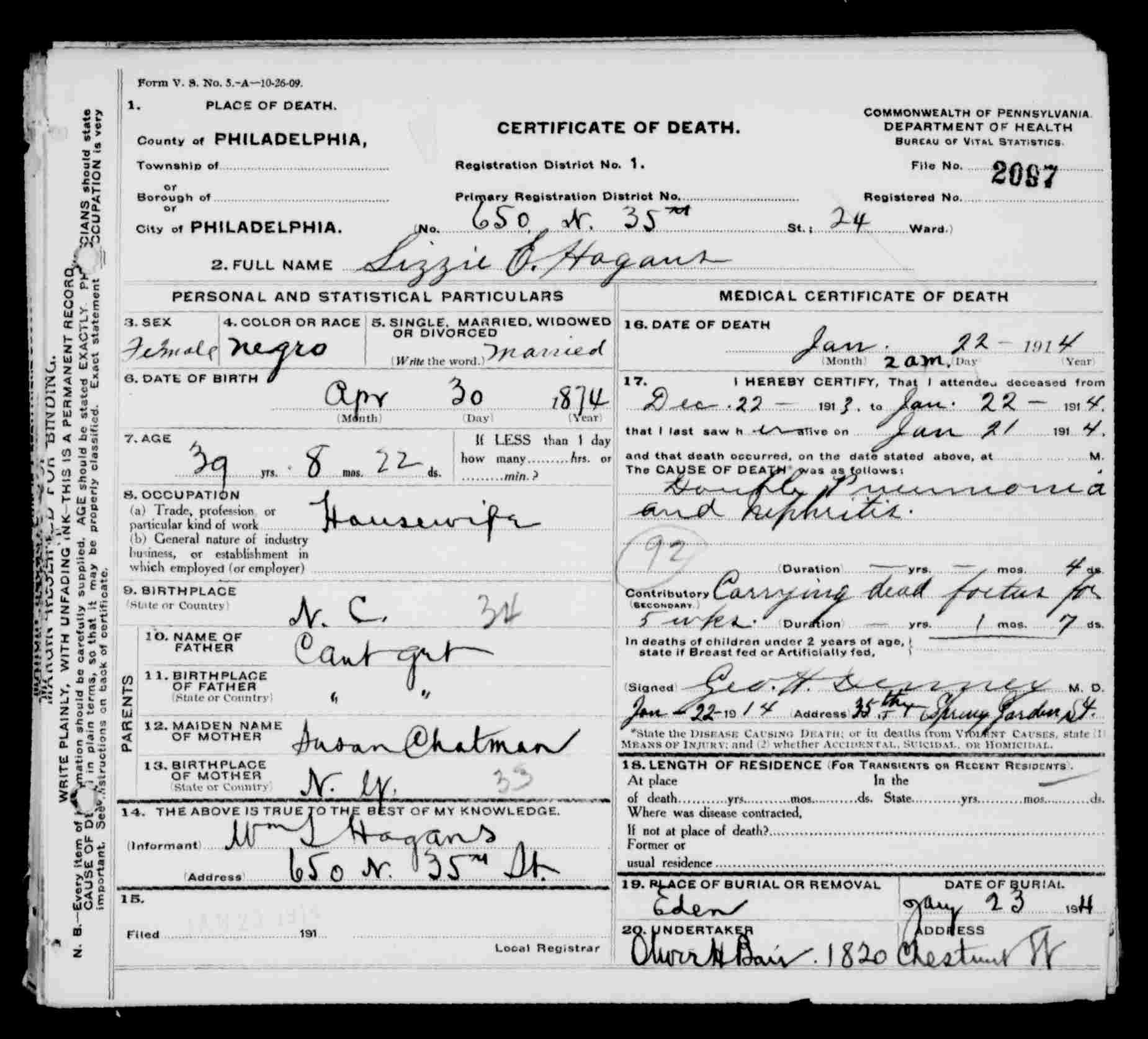
Sometime during 1913, William Hagans moved his family from Goldsboro to Philadelphia, Pennsylvania. They settled in a rowhouse at 650 North 35th Street, and William entered the real estate business. Lizzie was probably already pregnant with their seventh child, but neither she nor the boy would live to know their new city. On January 11, 1914, Lizzie gave birth to a stillborn son, whom she and William named Henry Edward, after William’s brother. Eleven days later, Lizzie died of double pneumonia and nephritis, conditions brought on or exacerbated by her having carried a dead fetus for five weeks. She and little Henry were buried in the same grave in Eden Cemetery, just outside Philadelphia.

On 25 November 1914, the Weekly Argus ran a lengthy letter to the editor from “one of Wayne County’s best known colored citizens and properous land owners, as was his father before him” — none other than Will S. Hagans. After a self-effacing reference to “looking after his little affairs,” William gave a number of flattering nods to prominent citizens and to “the magnificent new court house.” He proclaimed his fondness for Goldsboro and asserted that only a desire to give his children the “very best school advantages” had compelled his move North. (One suspects, however, that much more in the state’s tense political climate was at play.)

Gboro_Weekly_Argus_11_25_1914 WS Hagans Good Citizen

On 26 January 1916, William Hagans sold his first cousin William M. Artis and wife Hannah two tracts on Turner Swamp in Nahunta township totaling 68 acres.

In the 1920 census of Philadephia, Pennsylvania, at 643 North 34th [sic, should read 33rd] Street, 49 year-old widowed real estate broker William S. Hagans and his children Eva M., 17, Flora I., 15, Rosalie L., 12, and William N., 9, all described as mulatto and born in NC.  Hagans owned this home, a three-story rowhouse in the Mantua neighborhood that is still standing.

William Hagans' children after 1913

William’s children Rosalie, Eva, Susan, Flora and William, Fairmount Park, Philadelphia, circa 1916.

The 10 November 1921 edition of the Philadelphia Inquirer reported that the Court of Common Pleas awarded $750 to Lillian Wolfersberger, who sued William S. Hagans for injuries received at 36th and Powelton. Wolfersberger, who was blind, was being led across the street when she was struck by Hagans’ vehicle.

In its 29 December 1925 issue, the Pittsburgh Courier announced that William S. Hagans was elected president of the Citizens’ Republican Club with no opposition. “Mr. Hagans is popular and competent and a banner year is anticipated by the Citizens.” He was reelected to the office several times.

On 16 March 1929, according to the Pittsburgh Courier, the Citizens’ Republican Club president William S. Hagans appointed a committee to discuss ways to form a “Big Brother movement” in Philadelphia. “The need for such an organization is apparent because the white society have no provision for handling Negro cases.”

In the 1930 census of Philadelphia, at 643 N. 33rd Street, widowed real estate broker William S. Hagans, 59, and children Flora I., 26, public school teacher; Lorena,23, real estate stenographer; and William N., 19, all described as white.  All born in NC, but children’s mother’s birthplace listed as NY.  The house was valued at $8000.  The Haganses were the only “white” family on the block.  All others were Negro.

On 18 January 1930, the Pittsburgh Courier ran an article lauding the Citizens’ Republican Club’s hosting a “fanfest and fed” for “varsity football players of color” from Philadelphia high schools. Dr. Charles Lewis, “father of the Howard-Lincoln classic … for the first time

In 1930, Alfred Gordon, M.D. published an essay titled “Frederick Douglass Memorial Hospital and Training School” in a slender volume called Philadelphia: World’s Medical Centre. After setting forth the history of the hospital, Gordon named W.S. Hagans as a member of its Board of Managers.

The Scranton Republican on 15 October 1931 reported that Governor Pinchot had announced the termination of 43 employees in an reorganization of the department of labor and industry. Among them: William S. Hagans, special investigator, Philadelphia, whose salary was $1000.

On 18 January 1932, the Delaware County Daily Times reported that a special committee of the Pennsylvania State Negro Council had presented to the state superintendent of public schools a resolution calling for the establishment of a vocational school in Philadelphia. William S. Hagans, president of the Citizens Republican Club was a committee member.

On 27 September 1932, the Harrisburg Telegraph reported that the Republican state chairman had appointed a Colored Voters Advisory Committee for the current campaign. Members included William S. Hagans of Philadelphia.

In 1933 in Philadelphia, William married Emma L. Titus. The Great Depression dealt the couple crippling blows, and William lost his home and other holdings. In the 1940 census of Philadelphia, at 650 – 57th Street, realtor William Hagans, 65, was renting an apartment for $40/week with wife Emma, 40, a public school teacher, and mother-in-law Ellen Titus, 70. (Assuming this address is North 57th, William’s final home was a flat in a three-story rowhouse just two blocks from the house my grandmother later owned at Wyalusing and North 56th.)

William Scarlett Hagans died in 1946 in Philadelphia.

Wm Scarlett Hagans portrait

William S. Hagans.

Personal photographs courtesy of W.E. Hagans and W.M. Moseley. Other sources as cited.
Standard
Births Deaths Marriages, Land, North Carolina, Other Documents, Paternal Kin

To my ….

Abstracts of wills filed in Wayne County Superior Court, Goldsboro, North Carolina:

Lizzie E. Hagans — (1) to my beloved husband Will S. Hagans and his heirs in fee simple my house and lot in the town of Goldsboro, situated on Oak Street between West Center and James Streets and known as 104 West Oak Street; (2) to my husband $5000 with all benefits from life insurance policy #190279, Phoenix Mutual Life Insurance Company; (3) Will S. Hagans appointed executor. Signed 5 August 1904 in the presence of H[enry] S. Reid and J.A. Dees.

On 2 May 1917, C[larence] Dillard and J. Peele swore that they were knew Lizzie Hagans for a number of years, were well-acquainted with her handwriting and verified her signature. Henry S. Reid also swore that he witnessed the will, which was recorded and filed on 3 May 1917.

HAGANS -- Lizzie Hagans Death Cert

She had inherited Oak Street house from her (probable) uncle, William Burnett. Lizzie Hagans died shortly after William S. Hagans moved his family from Goldsboro to Philadelphia. 

——

Adam T. Artis — (1) S.S. Strother appointed executor; (2) a decent burial suitable to the wishes of my family and friends; (3) to my wife Katie Artis, all of the Thompson tract on which I now live, about 18 acres, all household and kitchen furniture and personal property; (4) to son Pinkney Artis, $100; (5) to son June Scott Artis, $10; (6) to son Henry Artis, $10: (7) to son Columbus Artis, $10; (8) to son William Artis, $5; (9) to son Walter Artis, $5; (10) to daughter Josephine A. Sherard, $15; (11) to son Robert Artis, $5; (12) sell the balance of my land to pay out the above, then divide the remaining in equal shares among my children Vicey Aldridge, Liza Evert, Augustus K. Artis, Georgana Reid, Mary Jane Artis, Emma D. Locus, Ida Reid, Lillie Thompson, Napoleon Artis, Haywood Artis, Addie Artis, Annie Artis, Alberta Artis, and Jesse Artis, and, at Katie’s death, property to be divided among the twelve heirs above whose gifts are not limited. Signed with an X in the presence of W.F. Lewis, J.J. Coley and J.E. Exum. Codicil: (13) to son Noah Artis, $10.

Recorded and filed 1 May 1919.

Adam Artis’ will includes the names of 23 of his children. Emma’s name is crossed out because she died before the terms of the will could be carried out. Known children whose names do not appear include Cain Artis, who died in 1917; Caroline Artis Coley and Louetta Artis, who presumably died before the will was made; Adam Artis Jr., who seems to have been very much alive in Washington DC. (Was the omission of his name inadvertent, as with Noah?) Despite newspaper reports claiming that Adam  fathered 47 “legitimate” children, these 27 are all I have been able to identify. Though there were doubtless others who died in childhood, I doubt there were 20 of them, and I am fairly certain that no other children reached adulthood.

——

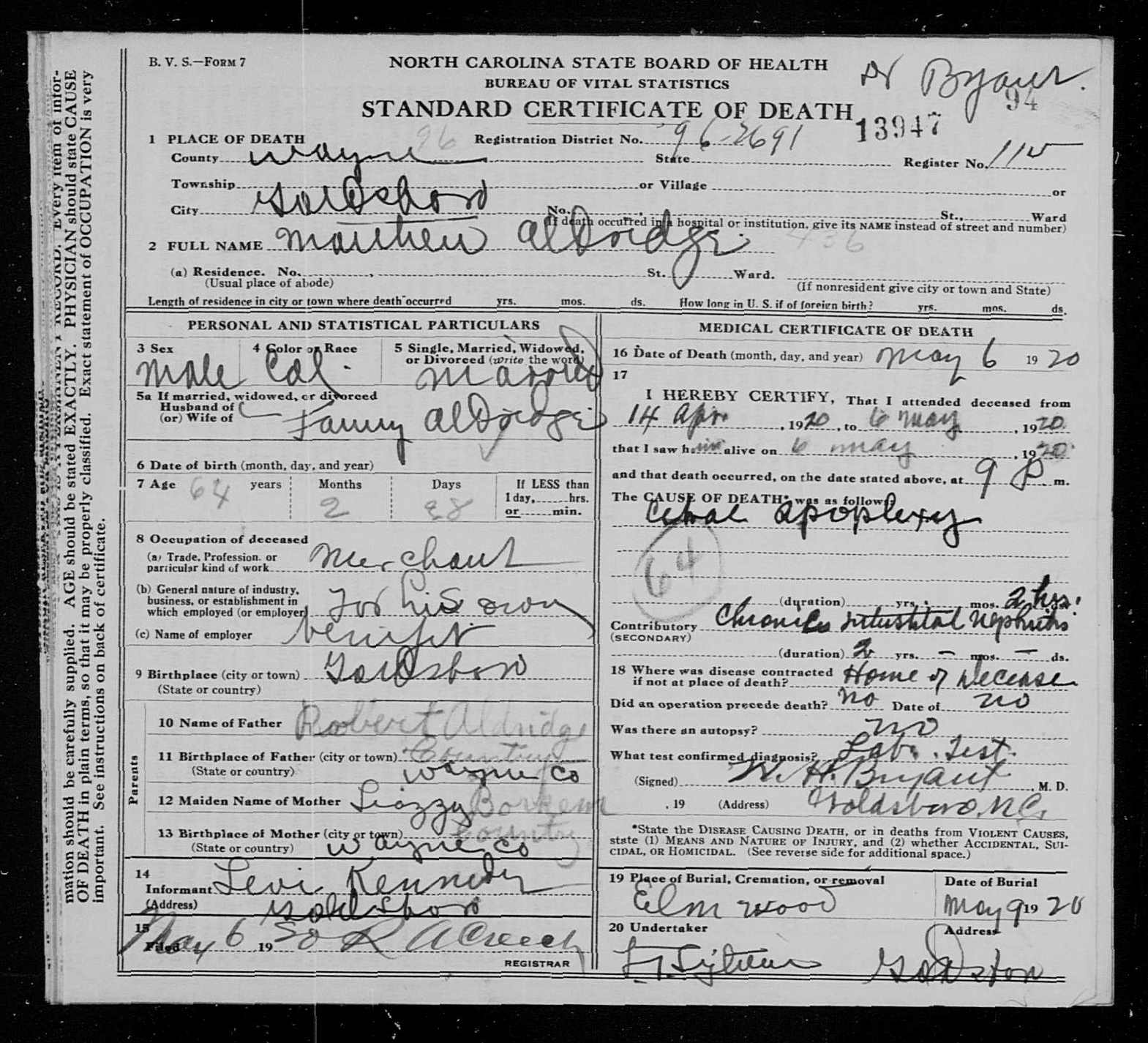
Mathew Aldridge — (1) to daughters Fannie B. Randolph and Mamie J. Aldridge, 1/2 undivided interest in my dwelling house and lot on Pine Street. Signed 27 August 1919 in the presence of N.D. White and Ida Darden.

Recorded and filed 18 May 1920. Fannie Aldridge was qualified as administratrix.

record-image-24 copy

Hmmm. Mathew Aldridge’s will provided for neither his wife, Fannie Kennedy Aldridge, nor his oldest daughter, Daisy Aldridge Williams. Perhaps he had settled property upon them prior to making his will.

——

Lucian Henderson — to John Wesley Carter, all my real estate known as my home place, 8 acres, provided that John W. Carter care for me and my wife Susan Henderson, otherwise null and void. My trusty friend John W. Carter appointed executor. Signed with an X in the presence of Everest Lewis and R.E. Simmons.

Lucian Henderson died 22 June 1934 and his will was recorded and filed 27 June 1934.

Lucian and Susan Henderson’s only child, Cora Q., died in 1907. For more re his friendship with John W. Carter, nephew of his sister Sarah’s husband Jesse A. Jacobs, see here.

——

Joseph Aldridge — (1) a decent burial; (2) to my wife Martha C. Aldridge, all my real and personal property during her lifetime or widowhood; (3) to my sons Allen Aldridge, Daniel Aldridge, William Aldridge and Milford Aldridge, $1 each, to my son Joseph Aldridge, my watch, to my son George Aldridge, my clock; (4) after Martha’s death, all my personal property to be divided between my sons Joseph and George and my daughters Mary Aldridge, Luella Aldridge and Lillie Mae Aldridge; as tenants i common, Mary, Luella and Lillie Mae to receive 12 acres to be laid out of the someplace on the east side of the old stagecoach road; to Joseph and George, all the remainder of the land between what I received from the estate of my father Robert and my brothers George and Dave. Signed 5 May 1934.

Recorded and filed 12 September 1934.

Martha Hawkins Henderson Aldridge remarried in 1940, triggering the terms of paragraph 4 of the will. As set forth here, she remained close to Joseph Aldridge’s children the remainder of her life. Also, a small clue I hadn’t noticed before: Joseph indicated that he received land from the estate of his brother Dave. As noted here, I had lost sight of David Sloan Aldridge after 1904, but now know that he died before 1934.


Standard
Land, Migration, North Carolina, Other Documents, Paternal Kin

Artis in Arkansas, follow-up.

Shortly after posting on the migration to Arkansas of Gus Artis and Eliza Artis Everett, I contacted the Lonoke County Museum.  After a brief and helpful phone conversation with a staff member named Sheryll, I sent a letter (and a donation) requesting any information about my Artises.  (Put your money where your mouth is with these little grassroots organizations, folks.)

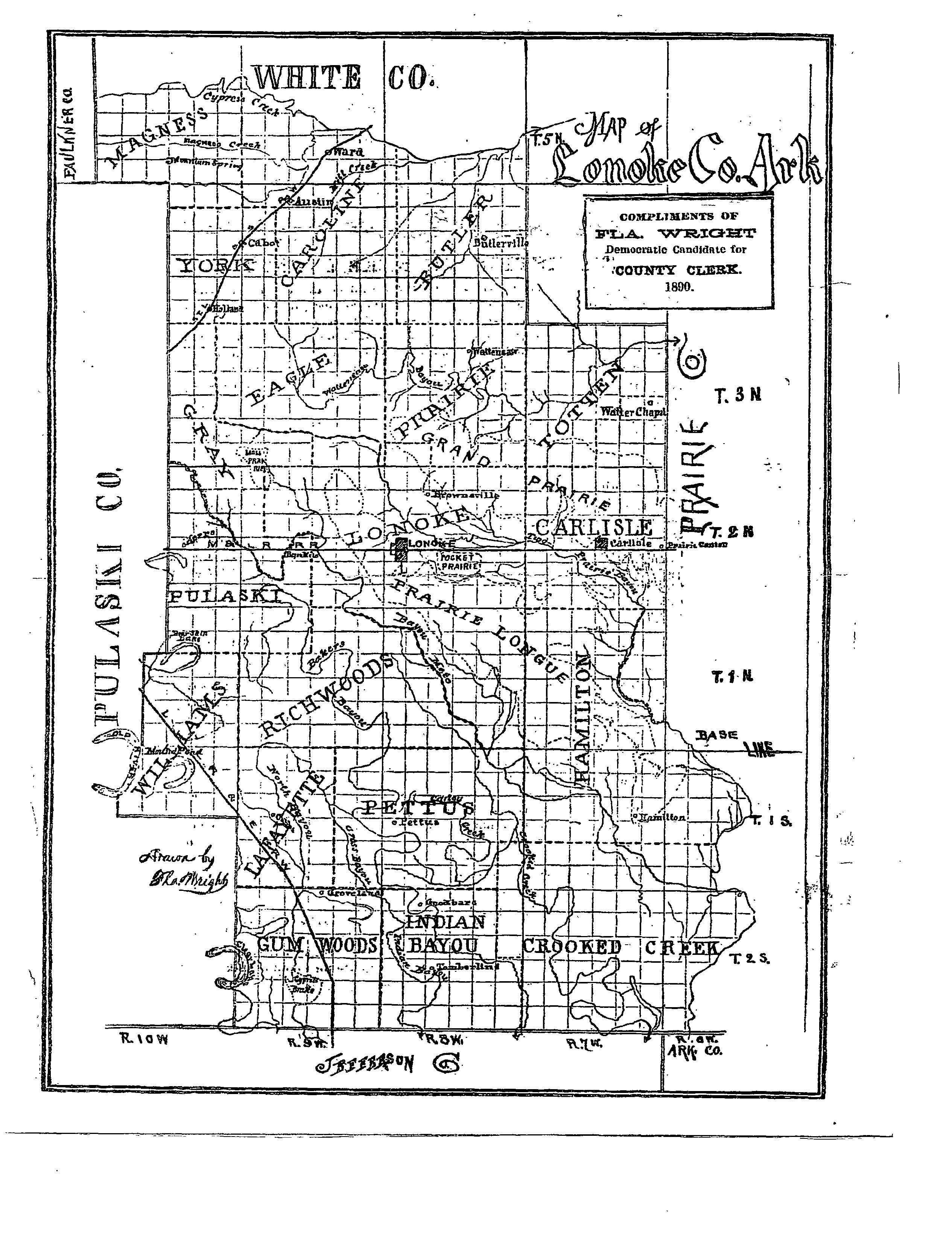
Yesterday, I received a slim packet in the mail, postmarked “Central Ar.” Inside, the fruits of Sheryll’s diligent search for my long-lost relations. Much of the information I already had, but two pieces were particularly helpful. First, an 1890 county map showing all the county’s townships. Williams, where Eliza and Haywood Everett lived, is a little bulge on the lower western flank of the county, sliced through by the now-defunct Little Rock & Eastern Railway. (U.S. 165 now tracks the line.) This corner of the county, pocked by horseshoe bends, lies within the rich alluvial plains of the Arkansas River.

Lonoke County Map

The second revelation came in a transcription of Lonoke County personal property tax registers. In my first blogpost, I wondered if Gus Artis had migrated to and settled temporarily in Lonoke County with the Everetts. The answer appears to be yes. Gus paid taxes on property in Williams township in 1890 and 1891. Haywood (Hayard, Hawood) Everett paid taxes in Williams in 1890 and 1891 and thereafter, as did his father Thomas Everett. With this information, my next step is to hunt down particulars of the land the Artises and Everetts were owned. 

Standard
Births Deaths Marriages, Maternal Kin, Migration, Other Documents

Funeral Program Friday: Matilda Whirley.

Not exactly a funeral program, but close enough:

Morning Star Baptist Church of Christ/In Remembrance.

MATILDA WHIRLEY.  December 7, 1910-March 5, 1992.  Matilda “Tillie” Whirley, one of Stephen and Emma Whirley’s eight children, was born on December 7, 1910 in Charles County, Virginia. She was educated in the public schools of Charles County until moving to Baltimore, Maryland. There she completed her education by attending evening classes.  For nineteen years, Miss Whirley worked as a housekeeper in the Ashburton section of Baltimore. She subsequently obtained employment at the University of Maryland, School of Dentistry from which she retired after working there for seventeen years.  At an early age Tillie received Christ as her personal Savior and became an active member of the New Vine Baptist Church in Charles County, Virginia. She was guided in the work of the church by her God-fearing parents. Her mother instructed her in baking the bread for the Lord’s Supper each month and Tillie, believing this was her sacred duty, continued baking the bread until she left Charles County.  After relocating to Baltimore, Maryland, Miss Whirley became affiliated with the Morning Star Baptist Church, under the pastorate of the late Reverend George Jacob Garnett. Because of her strong background as a servant of God, she became a great servant of mankind. At Morning Star, Miss Whirley was a member of the Senior Usher Board, Missionary Society, Samuel Ray Revival Choir, Church School, Building Fund, Lottie Henry Nurses’ Unit, Flower Circle, Women’s Ministry and Board of Christian Education. She was also a member, and later president, of the Pastor’s Aid and a loyal supporter of the Girl Scouts, Fuel Fund, Elevator Fund and any other fund or organization which would benefit her church or community.  Miss Whirley was a devoted, loving, effectual, caring Christian woman and was a friend to all who needed her. She freely gave wise and timely counsel, based on her life experiences, as she sought to make life go a bit smoother for her family, friends, church members, neighbors and co-workers. Miss Whirley was counted upon to be an integral part of church and community activities and participated and served wherever she could. Her dedication and love of God was evident in all she did. Miss Whirley was a good example of one of God’s servants; because of that, we take time to remember her this month.

Source: http://www.msbcoc.org/star/remember/matilda-whirley.asp

Standard
North Carolina, Other Documents, Paternal Kin

A reckoning. And recommendation.

I know I have a romantic view of old East Wilson (old, as in before it was ravaged by the crack trade), and though I know that’s attributable to my very safe and happy childhood there, I am reminded of just how shallow my rosy recollection is. One of my cousins, 20 years older than I, has just published a memoir. The early pages of Sherrod Village are set on streets I walked and peopled by folks I knew in East Wilson. Barbara Williams Lewis’ grandmother was my great-great-grandmother’s sister; they were two of the “innumerable” children of Adam T. Artis. (Her mother, in fact, is who described them to me that way.) I thought I would recognize so much in Barbara’s book. But I didn’t.
Children are shielded from so much ugliness (if they’re lucky) and understand so little of what they see. The ragged pasts of sweet old people are not always apparent in their mild presents. Nonetheless, I had believed that my truth was true. I had, perhaps, counted on it. I’d thought that I’d viewed East Wilson as a palimpsest. Instead, though my family’s story there involved poverty and insecurity and pain, I processed little beyond the surface of my own memories of crepe myrtles, corner stores and swimming lessons at Reid Street Center. I knew the history of the place, but not the lives of its people. Fifteen pages into Sherrod Village, I wrote to Barbara that I was “staggered.” I finished the book in the same state of astonishment. I HAD NO IDEA, I told her. No idea. And I thanked her.
Standard
Births Deaths Marriages, Business, Land, Maternal Kin, Other Documents

How the matter stands about the mill property.

From the Nicholson family file in the local history room at the Iredell County Public Library in Statesville, this letter:

Nicholson’s Mills N.C.

March 4th 1886

Wesley J. Smith & Mary J. Smith

Dear Children we received Your letter of the 4 of Feb and was much rejoiced to hear that You had another fine son and all was doing well, but alas the last mail brough us another letter that give us the painful news that you had met with the sad misfortune to loss the child well my dear children greav not for the child it is gone to a far better state of existance and altho You can not call it back You can go to it where parting will be no more for ever in the sweet groves of bliss.  You wished to know how the matter stands about the mill property I can only say that Anderson Obtained Judgement against me at the last Court at Statesville and it will not be sold in a Short time but I do not know when as he has not Advertised Yet but it will not be long if I do not raise the money and there does not seem to be any Chance to do that.  James A. Barnard has been trying to sell his property ever since las fall so that he could buy mine but he has not met with the chance to do it Yet and I fear he will not find any one to buy his and if he dose not mine will have to go and it will go for nearly nothing.  but I can not help it unless some one would come to my help.  Watsons & family are all well except bad colds Barnard & family are in tolerble health only the baba it is not well nor has not been since xhrismast Wesley’s folks were well when he heard last but that is a month ago.  Sandford Reeces children have the hoopen cough very bad and they have lost little Mattie she died last Sunday morning was a week and they buried her ar Flatrock on monday following Cynthia May had been sick about four months and she died the first of Feb.  Old Miles was sick about two weeks and died the last day of January Jacks wife died the day before christmast.  I am no better off with my rhumatisam but get more and more helpless all the time.  Mama is very poorly at this time with cold but the most of the time she is tolerbly stout for one of her age we can not tell when we can go to see you we are feeble and the weather & the roads are bad,  You must come and see us when You can.

Your Affectionat father & mother     T.A. Nicholson  R.C. Nicholson

——
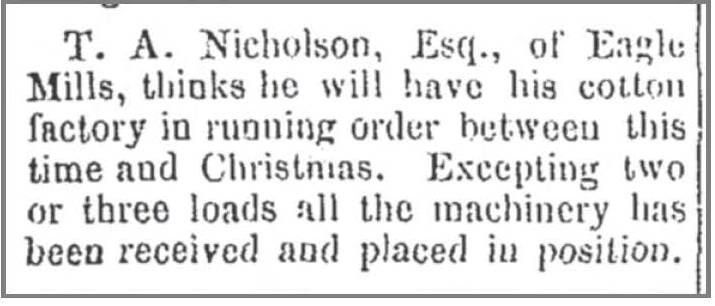
Two months later, Thomas Allison Nicholson was dead. The “mill property” — a cotton factory he had announced so confidently in newspapers —
Rec__amp__Landmark_11_25_1881_cotton_factory
Statesville Record & Landmark, 25 November 1881.
— had been in foreclosure for years.
Nicholson had tried to sell other property to raise cash:
Rec__amp__Lndmark_1_15_1884_Nich_Mill_land_sale
Statesville Record & Landmark, 15 January 1884.
And his creditors had tried repeatedly to unload the factory:
Rec_and_Landmark_4_17_1885_Nicholson_sale
Statesville Record & Landmark, 17 April 1885.
But nothing worked. Thomas Nicholson died with this burden, and soon after, his son’s father-in-law, William I. Colvert, administrator of the estate, announced the liquidation of the cotton factory’s machinery.
WS_Western_Sentinel_12_9_1886_T_Nicholson_sale
Winston-Salem Western Sentinel, 9 December 1886.
The loss of the mill property by no means impoverished the Nicholsons, despite the plaintive tone of Thomas’ letter. When his widow died in 1903, her estate included three large parcels of land on Hunting Creek.
Record_and_Landmark_11_17_1903_RC_Nicholson_sale
Statesville Record & Landmark, 17 November 1903.
Standard
Births Deaths Marriages, Civil War, Enslaved People, Other Documents, Photographs, Virginia

Has the old fuss died out yet?

Here’s another account of Joseph Holmes‘ murder, presented as a pivot point in the romanticized life of the author’s father:

When Jim Wilkes rode into Raft River Valley in 1870, he had two pasts behind him though he was barely twenty-one. His real name was Griffin Seth Marshall. He had called himself Jim Wilkes only since a spring evening in 1867 when an incident in a Virginia village had sent him into exile as a fugitive from the law.

I heard the story from Mother — I am the daughter of Kate Parke and Griffin Marshall. Father wouldn’t have considered it suitable for a little girl, but Mother had no such qualms. Mother had a strong sense of drama, and for her the story was the thing.

“Your father changed his name,” she told us, “because he got in trouble back home and had to leave the country. He never done anything. No indictment was ever found” — Mother was careful to insert the formal, exonerating phrase — “but he was in a crowd one night with his brother John and this colored man was killed. He’d been a slave of your grandfather’s before the war, so when he was shot they thought the Marshall boys had something to do with it. There were soldiers there, northern soldiers, but your father and his brother got away. They left the country that same night — without even saying goodbye to their mother. That was when they changed their name. That’s History,” Mother would add, as she usually did when she told us a story about the early days. “Do what you will with it.”

The time came when I visited the Virginia village. And I discovered not only that every word of Mother’s account was true, but that the full story was adorned with details and a couple of postscripts that would have delighted her.

THE NAME of the village is Charlotte Court House and it is the seat of Charlotte County. It’s the courthouse, built in 1823, is a handsome building of red brick, with a white portico and four white columns overarched by venerable trees. Before the courthouse on an evening is the spring of 1867 a crowd had gathered to listen to a speech. The speaker was a Negro, who was able to make a speech only because Federal troops were camped in a grove of trees across the street. His name was Jo Holmes. He had been a slave, the butler of Judge Hunter Marshall whose plantation Roxabel was five miles from the village. Now Jo Holmes was not only a free man but also a member of the Virginia legislature. Jo Holmes’ podium was the slave block that still stands at the point where the walk from the courthouse joins the street. According to the local story, he was advocating mixed marriages. He didn’t get very far with his speech. A shot was fired and Jo Holmes fell dead. The bullet, I was told is buried in the front wall of the courthouse.

In the crowd were my father and his older brother John who were home on vacation from Clifton Academy in Fauquier County. John had been in the Confederate cavalry. (Their oldest brother Hunter had been killed in the Civil War — four days after Appomattox.) Griffin, who was only seventeen, had been too young to go to war. With them was cousin David Morton, actually a second or third cousin, and a friend named Fred Beal.

The shot that killed Jo Holmes came from the part of the crows where the four young men were standing. One of the four did fire the shot — then slipped the gun into the hand of a friend who threw it into the creek that runs through the hollow beside the courthouse. The Federals came running, but before they could get to the scene the four boys had made their escape with the help of relatives and friends. They were hidden for several hours in a house in the village. Before dawn they were driven to Pamplin, the nearest station on the Norfolk and Western Railway, and put on a train headed west.

The four fugitives soon parted. A letter from Griffin to his older sister Mary dated May 29,1867 — I got it from the daughter of Father’s sister — shows that he and John had been commended to the care of people named Taylor in country that might be Texas. There is no mention of the other two boys. The letter is written on a piece of stationery embossed in the upper left-hand corner with the head of an Indian and, beneath it, the legend “N.P. Co.”; but there is no place name on the letter and the envelope is missing. It reads as follows:

May 29, 1867

My Dear Sister: You must really excuse me for not writing to you sooner but I have been sick nearly ever since I have been here and the other part of the part of the time I didn’t feel like writing. I haven’t had anything to do at all- we have been waiting for Mr. Taylor’s son to come down here- but he has been sick and is now worse and probably never will be able to come. The old man said that he (his son) could get better situations than anyone else and advised us to wait for him and of course as we are under his care we took his advice and are now waiting to see what is going to turn up. Mr. T. Sr. went up to see about his son yesterday and we are expecting him back every day. Morgan is well and in pretty good spirits, but I am not in good spirits. I am getting tired of doing nothing and paying board.

This is the hardest country I ever saw; there isn’t a tree of any consequence in two hundred miles of this place. One day it is hot as five hundred (this was a simile my father often used) and the next day you can’t wrap up and keep comfortable-now today it is very hot. I wrote to Ma some two or three days ago; tell her to write to me and that often. Has the old fuss died out yet or not? I am very anxious to know the effect that thing produced. I haven’t got anything to write about and I am going to stop. Give my love to Bee Jim and all at Roxobel and regards to all of my friends and write soon to your affectionate Brother

The handwriting is the same that appears in two letters Griffin had written to his mother a few months before from Clifton Academy, but the writer signs himself not “G. S. M.” or “G. S. Marshall” as in the earlier letters but “J.T. Wilkes.” The “Morgan” he refers to can only be his brother John. “I never understood,” said my cousin Sarah when she handed me the worn sheet, “what a letter with that strange signature was doing in Mother’s papers.”

I once asked my father who killed Jo Holmes. He replied only it was not he.

— An American Memoir, Margaret Marshall, originally published in The Hudson Review, volume 24, number 2 (1971).

—–

Gawd.

I could pick at the details of this account — starting with the date of the letter, a full two years before Joseph Holmes was actually killed — but what’s the point? It is so obviously unconcerned with Joe Holmes — “delightful postscripts”? — or his life that accuracy is too much to ask.

This photo is found among literary editor Margaret Marshall’s papers in the Yale Collection of American Literature, Beinecke Rare Book and Manuscript Library, Yale University:

Roxabel Margaret Marshall papers

It is labeled “Roxabel.”  This is either a photograph of the back of the house, which has been much modified if it is, or is mislabled. It certainly does not match Marshall’s white portico-and-columns description. (That’s a shed roof porch with posts.) Further, Roxabel is still standing, and I’ve been there. It’s used primarily as the background for tasteless plantation-themed weddings these days, but was mercifully still when I drove up with Kathy Liston, a Charlotte County archeologist-cum-genealogical researcher who opened many a door, literal and figurative, for me in my quest for Jasper and Joseph’s roots. With a wing added long after the Marshalls left, here is Roxabel today:

IMG_9982

If Joseph R. Holmes was enslaved here, was his brother Jasper as well? Or had they been separated early, Jasper perhaps sold locally as excess or to settle a debt. I don’t know. But I do know that, emancipated in 1865 and at least free to build a relationship on their terms, the brothers’ bond was sundered forever by a rash pistol shot.

Standard
Births Deaths Marriages, Free People of Color, North Carolina, Other Documents, Paternal Kin

A Seaberry clue.

Back in December, I went on a hunt for Artis cemeteries in the Eureka area. One that I found, just south of the others, holds the remains of William M. Artis and his family. Today, while I was sorting old documents, I ran across William’s death certificate. His place of birth, which I’ve surely read a hundred times, seized my eye:

Wm_Artis_Death_Cert-1

“Family (Seabury)”? Was this graveyard originally the resting place of William’s maternal great-grandfather, Aaron Seaberry, who died just after 1910? Are there other Seaberrys here, including William’s mother Frances Seaberry Artis? (Who was erroneously referred to as Frances Hagans above. “Hagans” was her mother’s maiden name and the surname of her half-brother Napoleon Hagans. William’s age is off, too. He was 70 when he died.)

Standard
Civil War, Free People of Color, Land, North Carolina, Other Documents, Paternal Kin

Map, in color.

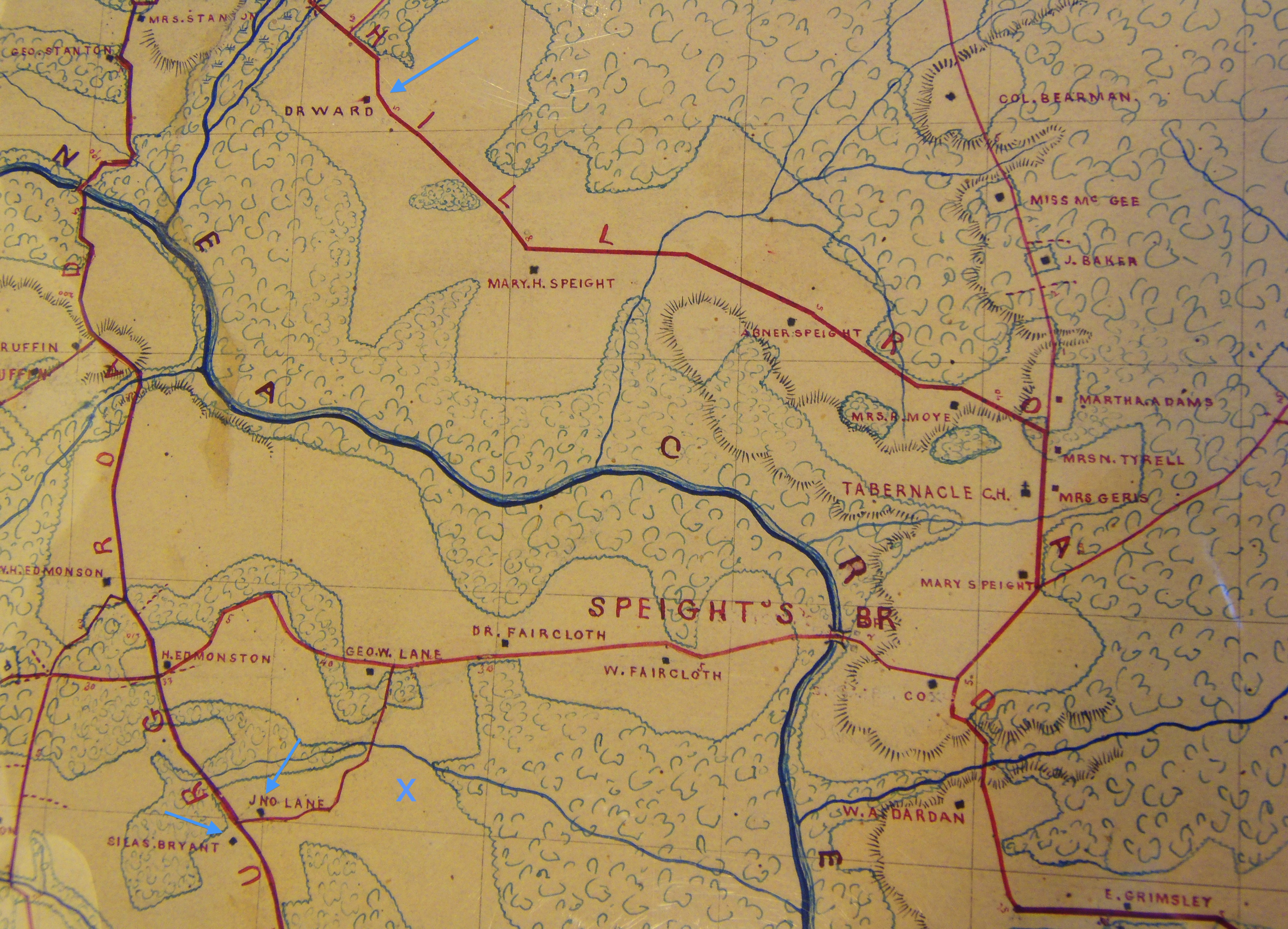
Last time I was at the North Carolina State Archives, I went looking for the original of this Confederate field map. I didn’t find it, but Trisha Blount Hewitt did.

OLYMPUS DIGITAL CAMERA

Dr. David G.W. Ward’s plantation is just below Stantonsburg at the top, and Silas Bryant and John Lane’s farms — where the Artises were apprenticed — are bottom left. X marks the approximate spot of the Artis Town cemetery.

More thanks to Trisha.

Standard
Enslaved People, North Carolina, Other Documents, Paternal Kin

Where did they go?, no. 4: Taylor.

Kinchen Taylor’s death in 1853 sent shockwaves through the community of enslaved men and women who labored on his plantation. In addition to more than 100 slaves, Taylor owned more several thousand acres of land in northern Nash County. Half of Taylor’s children were minors, and his slaves had to have known that the division and distribution of his property would wrench apart their community.

Taylor’s executors filed at least two inventories of his property, listing his slaves in no apparent order, but grouping mothers with their youngest children. My great-great-grandfather Green, about 38 years old in the 1856 inventory and valued at $750, is #30, while his wife Fereby and their oldest children Dallas, Peter and Henrietta are #88-91. Though some of Kinchen Taylor’s slaves were apportioned to Taylor’s adult children, most, including Green and his family, were placed in a pool to be later divided among the minors. Or sold for their benefit. (In the meantime, adults and older children were likely leased to nearby farmers who needed labor.) Inevitably, this estate division sundered families, and none could have known that freedom — and the chance to regather their kin — was just a decade away.

Who were the men and women that Kinchen Taylor enslaved? What became of them?  Using names culled from the estate papers, I present them here, in alphabetical order, with notes recording what I know.

——

Albert.  Valued at $1110.

Allen Sr. Valued at $1110.

  • “Allen Black” in list of slaves distributed to Kinchen Taylor’s son Benjamin Taylor. (This could be either Allen Sr. or Jr.)

Allen Jr.  Valued at $800.

Amanuel.  Valued at $870.

Amy and child Patience.  Valued at $510.

  • Amy and Patience included in lot of slaves distributed to Kinchen Taylor’s daughter Elizabeth Taylor.
  • In the 1870 census of Liberty, Nash County: at #334, Simon Taylor, 60, and wife Amy.
  • In the 1880 census of Whitakers, Nash County: Ned Taylor, 39, wife Silva, 35, and children Myra, 16, William Ann, 17, James, 12, Eddie, 5, Aron, 3, and Ernest, 1 month; plus Simon Taylor, 75, “father,” and Amy Taylor, 80, “mother.”

Ann/Anna.  Valued at $621.

  • Anna included in lot of slaves distributed to Kinchen Taylor’s son Benjamin Taylor.

Arnold.  Valued at $870.

  • In 1866 in Nash County, Arnold Taylor and Matilda Harrison registered a 20-year cohabitation, legalizing their marriage.
  • In the 1870 census of Liberty, Nash County: at #351, Arnold Taylor, 45, wife Matilda, 40, and children Virgil, 17, Alice, 16, Ida, 14, Temperance, 12, Cora, 10, General, 8, Sherman, 6, William, 2, and John, 1 month.
  • In the 1880 census of Whitaker, Nash County: at #550, Kinchen Taylor, 87, and wife Anicha, 65. At #551, Arnold Taylor, 54, wife Matilda, 47, and children Tempie, 18, Cora, 17, General, 18, Sherman, 15, William H., 12, Jefferson, 10, and Ann M., 3. At #552, Virgil Taylor, 25, wife Secie, 19, and “baby boy,” 4 months.

Berry.

  • Kinchen Taylor’s 1851 will bequeathed Sam, Cassa, Harriett, Rosetta, Berry and Daniel to daughter Winifred Taylor Rosser.

Betsey.  Valued at $200.

Bill. Valued at $1310.

Bob.  Valued at $935.

  • Bob included in lot of slaves distributed to Kinchen Taylor’s son, John A. Taylor.

Cain.  Valued at $695.

  • Cain included in lot of slaves distributed to Kinchen Taylor’s son Henry A. Taylor.

Carter.  Valued at $1230.

Cato.  Valued at $1080.

  • In the 1870 census of Liberty, Nash County: at #332, Cato Taylor, 30, and wife Sarah, 22.
  • In the 1880 census of Whitaker, Nash County: Cator Taylor, 43, wife Sarah, 28, and children George, 10, Lee, 8, Peggie Ann, 6, Lucinda, 4, Cicero, 2, and Nero, 4. [Next door: Sip, 55, and Harriet Taylor, 50. There’s no Sip or Scipio listed among Kinchen Taylor’s slaves, but was he related to Cato? The family shows a penchant for classical Roman names.]
  • In the 1900 census of North Whitaker, Nash County: Cato Taylor, born March 1837; wife Sarah, born Jan 1849; and children Lee, 32, Cicero, 23, Blanche, 20, Mary, 15, Pink, 13, Indiana, 8, and grandsons Arthur, 8, and Clifton, 5. Sarah reported 8 of 11 children living.
  • In the 1910 census of North Whitakers, Nash County: Kato Taylor, 70, wife Sarah, 60, children Blanche, 26, Mary, 21, and India 17, and grandchildren Lizzie, 13, Vinnie, 12, and Arthur, 19. Next door: Lee Taylor, 41, wife Mattie, 24, and children Roy, 5, Brisco, 2, and Dan, 3 months. Cato reported having been married twice; Sarah, once, and 10 of her 11 children were living.
  • Mary Taylor Hilliard died 22 February 1914 in Nash County. Age 24. She was born in Nash County to Cato Taylor and Sarah Taylor. Informant, J.H. Cutchin. 
  • Lee Taylor died 11 March 1918 in North Whitakers, nash Ciunty. He was about 50 years old, born in Nash County to Cater Taylor and Sahrah [last name unknown]. Informant, Lumilia Hill. Buried Edgecombe County.
  • In the 1920 census of North Whitakers, Nash County: Nick Wright, 40, wife Endie, 23, and daughter Jennie, 4, with mother-in-law Sarah Taylor, 56, and father-in-law Cator Taylor, 58. Next door: Arch Wright, 39, wife Blanche 33, and children Bertha, 11, and Marion, 4.
  • Kater Taylor died 11 February 1922 in North Whitakers township, Nash County. Married to Sarah Taylor. Born 1830 to unknown parents. Informant, Nick Wright.
  • Sarah Taylor died 21 January 1924 in North Whitakers. Widow of Kater Taylor. Born 1834 to Nathan and Sindie Ricks. Informant, Nick Right.
  • Essix Taylor died 10 November 1931 in Whitakers, Nash County. He was born 15 November 1854 in Nash County to Kater Taylor and an unknown mother. Informant, Lumilia Hill. Buried Edgecombe County.

Ceasar.  Valued at $1080.

  • Kinchen Taylor’s 1851 will bequeathed Jane, Caesar, Harriett, Rosetta, Berry and Daniel to daughter Winifred Taylor Rosser.
  • Caesar included in lot of slaves distributed to Kinchen Taylor’s son Benjamin Taylor.
  • In the 1870 census of Liberty, Nash County: at #334, Simon Taylor, 60, and wife Amy; #335, Caesar Taylor, 34, wife Ann, 22, and daughter Amy, 3; #336, Edward Taylor, 32, wife Sylva, 23, and children Almira, 4, and James, 2.

Chaney.  Valued at $150.

  • Chaney included in lot of slaves distributed to Kinchen Taylor’s son Henry A. Taylor.

Chapman.  Valued at $900.

  • Chapman included in lot of slaves distributed to Kinchen Taylor’s son Henry A. Taylor.

Clara.  Valued at $300.

  • Kinchen Taylor’s 1851 will bequeathed Big Tom, Little Tom and Clary to wife Mary Blount Taylor.
  • Clara included in lot of slaves distributed to Kinchen Taylor’s widow, Mary Blount Taylor.
  • In the 1870 census of Liberty, Nash County: at #352, Clara Taylor, 72, in the household of Mariah Wheless.

Daniel.

  • Kinchen Taylor’s 1851 will bequeathed Sam, Cassa, Harriett, Rosetta, Berry and Daniel to daughter Winifred Taylor Rosser.

Dawson.  Valued at $195.

  • Dawson included in lot of slaves distributed to Kinchen Taylor’s daughter Caroline Taylor Knight, wife of William H. Knight.

Doctor.  Valued at $1020.

  • Doctor included in lot of slaves distributed to Kinchen Taylor’s son Henry A. Taylor.

Old Dred.  Valued $370.

  • Dred included in lot of slaves distributed to Kinchen Taylor’s son John A. Taylor.

Edmon.  Valued at $780.

  • Edmond included in lot of slaves distributed to Kinchen Taylor’s daughter Lucy H. Taylor Harvey, wife of John H. Harvey.

Eliza.  Valued at $640.

Elizabeth.  Valued at $70.

  • Elizabeth included in lot of slaves distributed to Kinchen Taylor’s son Henry A. Taylor.

Ella.  Valued at $535.

  • Ella included in lot of slaves distributed to Kinchen Taylor’s daughter, Lucy H. Taylor Harvey, wife of John H. Harvey.

Ellick.  Valued at $846.

  • Kinchen Taylor’s 1851 will bequeathed Isham, “Fany’s child Sandy,” and Simon “now in his possession” to son Kinchen C. Taylor. (Sandy and Ellick are nicknames for “Alexander.”)
  • Ellick included in lot of slaves distributed to Kinchen Taylor’s daughter Elizabeth Taylor.

Elvira and children Joe, Faulcon and Ann.  Valued at $1100.

Emily.  Valued at $720.

Eveline and children Willie/Wiley, Caroline and Isham.  Valued at $1100.

Eveline and children included in lot of slaves distributed to Kinchen Taylor’s daughter Elizabeth Taylor.

Fanny and children Margarett, Lucy, Leah and Jolly.  Valued at $1490.

  • Fanny and children included in lot of slaves distributed to Kinchen Taylor’s son Henry A. Taylor.

Feriby and children Dallas, Peter and Henrietta.  Valued at $1230.

  • In the 1870 census, Lower Town Creek, Edgecombe County: Green Taylor, 52, wife Phebe, and children Dallas, 19, Christiana, 14, McKenzie, 13, Mike, 9, and Sally, 1.  
  • In the 1880 census, Lower Town Creek, Edgecombe County, Green Taylor, 64; wife Phoebe; daughters Christiana, Kinsey, and Sarah; four granddaughters, Nannie, 5; Carrie, 1; Lizzie, 8; and Louisa, 5; and one grandson, Isaiah, 2.
  • Mike Taylor died 8 Jan 1927 in Wilson NC.  About 68 years old.  Widower of Rachel Taylor.  Born Wilson County NC to Green and Faraby Taylor.  Buried 9 Jan 1927, Wilson NC.  Informant, Roddrick Taylor.

Frances and children Della, Carter and George.  Valued at $1250.

  • Frances and children included in lot of slaves distributed to Kinchen Taylor’s daughter Caroline Taylor Knight, wife of William H. Knight.

Green.  Valued at $750.

  • In the 1870 census, Lower Town Creek, Edgecombe County, Green Taylor, 52, wife Phebe, and children Dallas, 19, Christiana, 14, McKenzie, 13, Mike, 9, and Sally, 1.
  • In the 1880 census, Lower Town Creek, Edgecombe County, Green Taylor, 64; wife Phoebe; daughters Christiana, Kinsey, and Sarah; four granddaughters, Nannie, 5; Carrie, 1; Lizzie, 8; and Louisa, 5; and one grandson, Isaiah, 2.
  • Mike Taylor died 8 Jan 1927 in Wilson NC.  About 68 years old.  Widower of Rachel Taylor.  Born Wilson County NC to Green and Faraby Taylor.  Buried 9 Jan 1927, Wilson NC.  Informant, Roddrick Taylor.

Haley/Hilly and children Hasty, Amy and Glasgo.  Valued at $1310.

  • Kinchen Taylor’s 1851 will bequeathed Haley, Hasty, Amy, Glasgow, Alfred and Susan to daughter Caroline Taylor Knight.

Handy.  Valued at $780.

  • Handy included in lot of slaves distributed to Kinchen Taylor’s son John A. Taylor.

Hanna.  Valued at $625.

  • Hanna included in lot of slaves distributed to Kinchen Taylor’s son John A. Taylor.

Cooper Henry.  Valued at $340.

  • Cooper Henry included in lot of slaves distributed to Kinchen Taylor’s son John A. Taylor.

Long Henry.  Valued at $60.

  • Long Henry included in lot of slaves distributed to Kinchen Taylor’s daughter Lucy H. Taylor Harvey, wife of John H. Harvey.

Yellow Henry.  Valued at $780.

  • Yellow Henry included in lot of slaves distributed to Kinchen Taylor’s daughter Elizabeth Taylor.

Ida.  Valued at $740.

  • Ida included in lot of slaves distributed to Kinchen Taylor’s son John A. Taylor.

Isaac.

  • Isaac included in lot of slaves distributed to Kinchen Taylor’s daughter Lucy H. Taylor Harvey, wife of John H. Harvey.

Isabella and children Henrietta, Lucy and Joe.  Valued at $930.

  • Isabella included in lot of slaves distributed to Kinchen Taylor’s son John A. Taylor.

Jack.  Valued at $450.

  • Jack in lot of slaves distributed to Kinchen Taylor’s son Benjamin Taylor.

Jane.  Valued at $640.

  • Kinchen Taylor’s 1851 will bequeathed Jane, Caesar, Harriett, Rosetta, Berry and Daniel to daughter Winifred Taylor Rosser.
  • Jane included in lot of slaves distributed to Kinchen Taylor’s widow, Mary Blount Taylor.
  • In 1866 in Nash County, Jane Taylor and Jack Earl registered their 4-year cohabitation, legalizing their marriage.
  • In the 1870 census of  Liberty, Nash County: at #327, John Earl, 25, Jane, 22, and children John H., 5, and Conner, 1.

Jefferson/Jeffrey.  Valued at $770.

Jim Sr.  Valued at $333.

  • Jim included in lot of slaves distributed to Kinchen Taylor’s son Caroline Taylor Knight, wife of William H. Knight. (This may be Jim Sr. or Jr.)
  • In the 1870 census of Liberty, Nash County: at #329, James Taylor, 60, and wife Chaney, 65.

Jim Jr.  Valued at $580.

Joe.

  • Joe included in lot of slaves distributed to Kinchen Taylor’s son John A. Taylor or to son Benjamin Taylor.

John Sr. Valued at $1025.

  • John included in lot of slaves distributed to Kinchen Taylor’s daughter Lucy H. Taylor Harvey, wife of John H. Harvey.

John Jr.  Valued at $670.

  • A second John included in lot of slaves distributed to Kinchen Taylor’s daughter Lucy H. Taylor Harvey, wife of John H. Harvey.

Julia/July Ann.  Valued at $200.

Old Kinchen.  Valued at $360.

  • “Old Kinchen” included in lot of slaves distributed to Kinchen Taylor’s widow, Mary Blount Taylor.
  • In the 1870 census of Liberty, Nash County: at #360, Kinchen Taylor, 70, and wife Bettie, 70, in the household of Kinchen Burtin, 32.
  • In the 1880 census of Whitaker, Nash County: at #550, Kinchen Taylor, 87, and wife Anicha, 65. At #551, Arnold Taylor, 54, wife Matilda, 47, and children Tempie, 18, Cora, 17, General, 18, Sherman, 15, William H., 12, Jefferson, 10, and Ann M., 3. At #552, Virgil Taylor, 25, wife Secie, 19, and “baby boy,” 4 months.

Levinia and children Thadious and Frank.  Valued at $1000.

  • Levinia and children included in lot of slaves distributed to Kinchen Taylor’s daughter Elizabeth Taylor.

Big Lewis.  Valued at $40.

Lucinda and children Ella, Olive and Angeline.  Valued at $1240.

  • Kinchen Taylor’s 1851 will bequeathed Lucinda, Jane, Washington and Ellin to wife Mary Blount Taylor.
  • Lucinda and children included in lot of slaves distributed to Kinchen Taylor’s widow, Mary Blount Taylor.
  • In 1866 in Nash County, Thomas Taylor and Lucinda Taylor registered their 35-year cohabitation, legalizing their marriage.

Lucy Sr. and child Turner.  Valued at $640.

  • Lucy and Turner included in lot of slaves distributed to Kinchen Taylor’s son Henry A. Taylor.
  • Perhaps, in the 1870 census, Liberty, Nash County: at #359, William Taylor, 24, and Lucy Taylor, 52.

Lucy.

  • Lucy included in lot of slaves distributed to Kinchen Taylor’s son John A. Taylor.

Margarett.  Valued at $790.

  • Margaret included in lot of slaves distributed to Kinchen Taylor’s daughter Elizabeth Taylor.

Mariah.  Valued at $770.

  • Mariah included in lot of slaves distributed to Kinchen Taylor’s daughter Caroline Taylor Knight, wife of William H. Knight.

Matilda and child Calvin.  Valued at $405.

  • Matilda and children Calvin, Lucy and Violet included in lot of slaves distributed to Kinchen Taylor’s son Benjamin Taylor.

Moll and child Martha.  Valued at $640.

  • Molly and Martha included in lot of slaves distributed to Kinchen Taylor’s daughter, Lucy H. Taylor Harvey, wife of John H. Harvey.

Mourning.  Valued at $290.

  • Mourning included in lot of slaves distributed to Kinchen Taylor’s widow, Mary Blount Taylor.
  • In 1866 in Nash County, Mourning Taylor and Jacob Ing registered their 20-year cohabitation, legalizing their marriage.
  • In the 1870 census of Formosa, Halifax County NC: Jacob Ing, 70, and wife Mourning, 65.

Ned.  Valued at $990.

  • In the 1870 census of Liberty, Nash County: at #334, Simon Taylor, 60, and wife Amy; #335, Caesar Taylor, 34, wife Ann, 22, and daughter Amy, 3; #336, Edward Taylor, 32, wife Sylva, 23, and children Almira, 4, and James, 2.
  • In the 1880 census of Whitakers, Nash County: Ned Taylor, 39, wife Silva, 35, and children Myra, 16, William Ann, 17, James, 12, Eddie, 5, Aron, 3, and Ernest, 1 month; plus Simon Taylor, 75, “father,” and Amy Taylor, 80, “mother.”
  • Miry Gunter died 16 April 1919 in Whitakers, Nash County. Widow. Born about 1865 in Edgecombe County to Ned Taylor of Nash County and Sylvia Bridges of Edgecombe County. Informant, Ed Taylor. Buried Whitakers.
  • Frank Taylor died 31 March 1923 in North Whitakers, Nash County. Married to Pearlie Taylor. Born 16 August 1881 in Nash County to Ned Taylor of Nash County and Sylvia Bridget of Edgecombe County. Informant C.W. Williams. Buried Edgecombe County.
  • Annie Parker died 23 April 1951 in Rocky Mount, Edgecombe County. Born 8 December 1871 in Nash County to Ned Taylor and Sylvester Williams. Informant, W.E. Parker.
  • Mary Ella Hunter died 12 October 1959 in Whitakers, Nash County. Born 1 May 1889 in Nash County to Ned Taylor and Sylvia Taylor.

Nick.  Valued at $795.

  • Nick included in lot of slaves distributed to Kinchen Taylor’s son Henry A. Taylor.

Penny and children Carter Jr., Mary and George.  Valued at $1300.

  • Penny and children included in lot of slaves distributed to Kinchen Taylor’s daughter, Lucy H. Taylor Harvey, wife of John H. Harvey.

Pink.  Valued at $830.

  • Pink included in lot of slaves distributed to Kinchen Taylor’s widow, Mary Blount Taylor.
  • In 1866 in Nash County, Pink Taylor and Abel Earl registered their 4-year cohabitation, legalizing their marriage.

Rosetta.

  • Kinchen Taylor’s 1851 will bequeathed Sam, Cassa, Harriett, Rosetta, Berry and Daniel to daughter Winifred Taylor Rosser.

Sam.

  • Kinchen Taylor’s 1851 will bequeathed Sam, Cassa, Harriett, Rosetta, Berry and Daniel to daughter Winifred Taylor Rosser.
  • Sam included in lot of slaves distributed to Kinchen Taylor’s daughter Elizabeth Taylor.

Simon.  Valued at $465.

  • Kinchen Taylor’s 1851 will bequeathed Isham, “Tany’s child Sandy,” and Simon “now in his possession” to son Kinchen C. Taylor.
  • Simon included in lot of slaves distributed to Kinchen Taylor’s daughter Elizabeth Taylor.
  • In the 1870 census of Liberty, Nash County: at #334, Simon Taylor, 60, and wife Amy; #335, Caesar Taylor, 34, wife Ann, 22, and daughter Amy, 3; #336, Edward Taylor, 32, wife Sylva, 23, and children Almira, 4, and James, 2.
  • In the 1880 census of Whitakers, Nash County: Ned Taylor, 39, wife Silva, 35, and children Myra, 16, William Ann, 17, James, 12, Eddie, 5, Aron, 3, and Ernest, 1 month; plus Simon Taylor, 75, “father,” and Amy Taylor, 80, “mother.”

Susan.  Valued at $800.

  • Kinchen Taylor’s 1851 will bequeathed Haley, Hasty, Amy, Glasgow, Alfred and Susan to daughter Caroline Taylor Knight.

Tom.  Valued at $570.

  • Kinchen Taylor’s 1851 will bequeathed Big Tom, Little Tom and Clary to wife Mary Blount Taylor.
  • “Big Tom” included in lot of slaves distributed to Kinchen Taylor’s widow, Mary Blount Taylor.
  • In 1866 in Nash County, Thomas Taylor and Lucinda Taylor registered their 35-year cohabitation, legalizing their marriage.
  • In the 1870 census of Liberty, Nash County: at #323, Thomas Taylor, 62, wife Lucinda, 50, and children Vinah, 20, Augustine, 18, and Jackson, 8. (Kinchen Taylor’s son Kinchen C. Taylor and family lived at #328, in this house.)

Tom Jr.  Valued at $820.

  • Kinchen Taylor’s 1851 will bequeathed Big Tom, Little Tom and Clary to wife Mary Blount Taylor.
  • “Little Tom” included in lot of slaves distributed to Kinchen Taylor’s widow, Mary Blount Taylor.
  • In the 1870 census of Liberty, Nash County: at #323, Thomas Taylor Jr., 35, wife Caroline, 25, and children George, 2, and John, 6 months. 
  • In the 1880 census of Whitaker, Nash County: Thomas Taylor, 36, wife Caroline, 30, and children George, 13, Mack, 11, Rosella, 6, Eddie, 5, Cindy, 3, and Fannie, 4 months.
  • Lucinda Arrington died 26 February 1933 in Rocky Mount, Nash County. Married to W.E. Arrington. Age 40. Born in Nash County to Thomas Taylor and Carolin Taylor. Informant, W.E. Arrington.
  • Lena Taylor died 19 July 1946 in South Whitakers, Nash County. Married to John Taylor. Born 31 December 1883 to Thomas Taylor and Carolina [last name unknown.] Buried Jerusalem cemetery.
  • Rose Ella Williams died 26 November 1960 in Nashville, Nash County. Resided Whitakers. Married to Robert Williams. Born in Nash County to Tom Taylor and Carolyn [last name unknown.] Informant, Thomas W. Williams. Buried “Jewrusalem,” Edgecombe County.

Toney.  Valued at $980.

Virgil.  Valued at $750.

  • Virgil in lot of slaves distributed to Kinchen Taylor’s son Benjamin Taylor.

Washington.  Valued at $990.

  • Kinchen Taylor’s 1851 will bequeathed Lucinda, Jane, Washington and Ellin to wife Mary Blount Taylor.
  • Washington included in lot of slaves distributed to Kinchen Taylor’s widow, Mary Blount Taylor.

William Henry.  Valued at $750.

  • William Henry included in lot of slaves distributed to Kinchen Taylor’s son John A. Taylor.
  • Perhaps, in the 1870 census of Liberty, Nash County: at #339, William Taylor, 21, wife Hannah, 23, and son Cato, 5; or, at #359, William Taylor, 24, and Lucy Taylor, 52.

——

Some preliminary thoughts: there were several unrelated white Taylor extended families in antebellum Nash County, North Carolina (not to mention bordering counties) and, while Kinchen may have been the largest among them, many owned slaves. Some of men and women listed died before freedom came or were sold away. Even taking these fates into account, surprisingly few African-Americans Taylors registered cohabitations in 1866 or were enumerated in the county in 1870. No doubt, many freedmen elected some other surname or moved a few miles away into adjoining counties. Women and small children may have adopted the surname of a husband (alive, dead or otherwise absent) or father (ditto). Moreover, as older children were not grouped with their mothers in the inventories, the relationships among members of the community are obscured. Naming patterns and living arrangements disclosed in censuses hint at such connections. Tracing Kinchen Taylor’s slaves has been frustratingly difficult, but I don’t quit.

Sources: the file of Kinchen Taylor (1853), Nash County, North Carolina Estate Files 1663-1979, https://familysearch.org, original, North Carolina State Archives; Nash County Cohabitation Records, North Carolina State Archives; federal censuses.


Standard