Births Deaths Marriages, North Carolina, Other Documents, Paternal Kin

North Carolina death certificates: HENDERSON.

North Carolina did not require death certificates until 1914. The following abstracts relate to the first two generations of Hendersons whose deaths were recorded by law.

Spouse and children of Lewis Henderson (1836-1912), son of James Henderson and (Sallie?) Skipp:

Marguriet Henderson.  Died 17 July 1915, Brogden, Wayne County of unknown causes. Black. Age 82. Born Sampson County to an unknown father and Margaret Bowkin.  Informant, Lucian Henderson.

Lution Hinderson.  Died 22 June 1934, Brogden, Wayne County, of cerebral hemorrhage. Colored. Married to Susan Hinderson. Age 75 years, 3 months. Farmer. Born Wayne County to Louis Hinderson of Wayne County and Maggie Hill of Sampson County.  Informant, Jonnie Carter, Dudley. Buried in Dudley.

Sarah Jacobs Silver.  Died 8 Jan 1938, Selma, Johnston County NC, of probable heart disease (“dead when seen.”)  Age about 55 years old [actually, 62.]  Born Wayne County NC to Lewis Henderson and Margaret Carter, both of Wayne County.  Informant, Hattie Jacobs, 303 Elba Street, Wilson NC.   C.E. Artis, undertaker.  Buried in Wayne County NC on 12 Jan 1938.

Spouse and children of James Henry Henderson (1838-1920), son of James Henderson and (Sallie?) Skipp:

Amelia Brazzell.  Died 26 Mar 1914, Goldsboro NC, uremic convulsions (contributing: operation for ryosalprism[?]).  Age 37.  Married.  Born Wayne County NC to Jim Henderson (born Greene County) and Francis Henderson (born Greene County).  Informant, E.L. Henderson, Goldsboro NC.  Buried 27 Mar 1914, Jason NC.

James Henderson.  Died 21 Jun 1920, Faison, Duplin County NC, 12:15 a.m., acute gastro-enteric colitis.  Wife, Laura Henderson.  Carpenter.  Age 80.  Born Onslow County NC to James Henderson and Sallie Henderson, both of NC.  Buried 22 Jun 1920.

Lewis Henderson.  Died 20 June 1932, cerebral tumor (non-malignant), Mount Olive, Wayne County NC.  Colored.  Married to Hattie Henderson.  Age 46 “as near as known.”  Born in NC to Jim Henderson and Francis Henderson, both of Wayne County.  Buried 20 Jun 1932, Saint Luke.  Informant, Hattie Henderson.

Ira Henderson.  Died 22 Oct 1946, E. Hillsboro, Mount Olive NC, of bronchopneumonia (due to broncho asthma.)  Colored.  Married to Johnie Henderson.  Carpenter.  Born 3 Aug 1881, Wayne County NC to Jim Henderson and Francis Henderson, both of Wayne County NC.  Informant, Mrs. Johnnie Henderson, Box 243, E. Hillsboro St., Mount Olive.  Buried 25 Oct 1946, Mount Olive NC.

Elias Henderson.  Died 14 Nov 1953, Wayne Memorial Hospital, Goldsboro NC, of uremia.  Resided Miller’s Chapel section, Goldsboro NC.  Negro.  Married.  Born 24 May 1888, Wayne County NC to Jim Henderson and Laura (last name unknown).  Farmer.  Informant, Jazelle Henderson, Goldsboro NC.  Buried 17 Nov 1953, Lane’s, Wayne County NC.

Georgetta Elliott.  Died 8 Sep 1972, LaGrange, Lenoir County NC, coronary occlusion.  Negro.  Widowed.  Born 12 Aug 1894 to Jim Henry Henderson and Frances Sauls.  Informant, Mackie B. Williams, 406 Forbes Street, LaGrange NC.  Buried 10 Sep 1972, LaGrange cemetery, LaGrange NC.

Spouse and children of Alexander Henderson (1860-1916), son of James Henderson and Louisa Armwood Henderson:

Alexr Henderson.  Died 13 June 1916, Goldsboro, Wayne County, of phthis pulmonalis. Colored. Married. Age 56. Born Wayne County to Stephen Henderson and unknown mother. Buried Elmwood cemetery.  Informant, Mary Henderson.

Mary J. Henderson. Died 7 September 1926, Goldsboro, Wayne County, of strangulated umbilical hernia. Widow. Age 60. Born Simpson [sic] County to unknown parents. Buried Elmwood cemetery by James Guess. Informant, Will Henderson.

Theodore Henderson.  Died 15 November 1936, Goldsboro, Wayne County, “from knife wounds.” Married to Bettie Henderson. Age 45. Common laborer. Born Duplin County to Elix Henderson and Mary Odom, both of Wayne County. Buried Elmwood cemetery by James Guess. Informant, Willie Henderson.

Will Henderson.  Died 6 Dec 1959, 712 N. John Street, Goldsboro NC, of cerebral apoplexy.  Negro.  Married.  Minister.  Born 1 Dec 1878, to Alaxander Henderson and Mary Odom.  Married to Susie B. Henderson.  Informant, Margaret Brown, 826 N. Center, Goldsboro NC.  Buried 9 Dec 1959, Lightner cemetery, Wayne County NC.

Spouse and children of John Henry Henderson (1861-1924), son of James Henderson and Louisa Armwood Henderson:

John Henderson.  Died 8 August 1924, Goldsboro, Wayne County, of pulmonary tuberculosis.  Colored.  Married.  Age 63. Farmer. Born Sampson County to James Henderson of Onslow County and [blank] Armwood of Sampson County.  Buried Dudley NC. Informant, Sarrah Henderson.

Sarah Henderson.  Died 12 June 1930, Dudley, Wayne County, “cause not known — sudden supposed to be acute indigestion.” Widowed. Colored. Age 62. Daughter of Bryant and Bettie Simmons. Buried in Dudley by James Guess. Informant, Henry Henderson.

Henry Henderson.  Died 19 Oct 1942, en route to hospital in Goldsboro NC, “found dead in car, supposed heart attack.”  Born 23 May 1901, Dudley NC, to John Henderson and Sarah Simmons.  Laborer.  Informant, Lenora Henderson.  Buried Congregational Church cemetery, Wayne County NC.

Spouse and children of Nancy Henderson Smith Diggs (1865-1944), daughter of James Henderson and Louisa Armwood Henderson:

Willie Smith.  Died 29 Jul 1912, nephritis, Goldsboro NC.  Born 9 Aug 1900, Goldsboro NC, to I.R. Smith and Nancy Henderson, both born in Mount Olive NC.  Informant, C[?].M. Smith, 100 Smith Street, Goldsboro NC.  Buried 3 Jul 1912, Elmwood cemetery, Goldsboro NC.

Isham Smith.  Died 12 May 1914, 10:20 p.m., State Hospital, Fork township, Wayne County NC, of cerebral hemorrhage.  Age 56.  Undertaker.  Educational attainments: “Read & write.”  Parents unknown.  Married.  Buried in Goldsboro, NC. Informant, W.W. Faison, M.D., Goldsboro NC.

Ernest Smith.  Died 5 Oct 1918, 7:00 p.m., Goldsboro NC, of lobar pneumonia (influenza).  Colored.  Married.  Barber.  Born 11 July 1888 to Isham Smith and Nancy Henerson [sic].  Informant, Nancy Smith, 100 Smith Street.  Buried 8 Oct 1918, Elwood cemetery, Goldsboro NC, by James Guess, undertaker.

Nancy Smith.  Died 11 Dec 1944, 4:30 a.m., fracture of pelvis (“fell off bed”), 309 Smith Street, Goldsboro NC.  Born 7 Feb 1890, Mount Olive NC to Jim and Eliza Henderson. Widowed. Informant, Mrs. E. Hall, 309 Smith Street, Goldsboro NC.  Buried 17 Dec 1944, Elmwood cemetery, Goldsboro NC, by James Guess [her son-in-law.]

Annie Guess.  Died 8 Aug 1953, Goldsboro NC, of coronary insufficiency and aortic insufficiency.  Colored.  Married.  Born 11 Sep 1890, Goldsboro NC, to Issam Smith and Nancy Henderson.  Informant, James Guess Sr., Goldsboro NC.  Buried 11 Aug 1953, Elmwood cemetery, Goldsboro NC, by James Guess, undertaker.


Standard
Births Deaths Marriages, Free People of Color, North Carolina, Other Documents, Paternal Kin

Chears and bee gums.

Per the “Account of the Sale of the property of Matthew Aldridg Deceased sold by Joseph Hollowell Adm. on a credit of six months, Nov 20th 1868,” his widow, Catherine Boseman (or Simmons) Aldridge, purchased five “chears”, cart wheels and an axle, two tables (one small), two beds and furniture, “one cubbard & contents,” a clock, a gun, “3 Bee Gumes & work bench,” a tub dipper, kitchen furniture, a blind mare and two beehives. Green Simmons, George Simmons and David Winn purchased tools, and “Robbert Aldridg,” who likely was Matthew Aldridge’s brother, bought the fourth and fifth beehive choices.  A note on William Carter for a $27.50 debt, due 1 January 1869, was described as doubtful.  The Application for Letters of Administration in the file notes that Aldridge’s heirs were John Henry AldridgeWm. AldridgeFrances Aldridge, Della AldridgeMary Ann AldridgeJoanna Aldridge, and James Thomas Aldridge.

William Aldridge was one of the founders of the First Congregational Church of Dudley, and Frances Aldridge Wynn and Mary Ann Aldridge Baker’s descendants were prominent members of the church for several generations. John H. Aldridge had a daughter, Nina Frances Faison Hardy, who played an important role in my grandmother’s young life. More about Aunt Nina later.

Standard
Maternal Kin, Other Documents, Paternal Kin

Early going.

Image

My best guess is that I drafted this little chart in the late 1980s, the era in which I was seeking refuge from law school studies in dim microfilm reader rooms.  I am struck by several things. Most depressingly: I have identified exactly THREE additional ancestors since I laid this chart aside in favor of genealogy software sometime in the early ‘90s. (And have lost two — both of my grandmothers – which is the most genuinely distressing observation.) The other: the mistakes and missing info.

On the green side:

(1) Lewis Henderson’s mother was Patsey Henderson;

(2) Lewis’ wife was Margaret Balkcum and my current thinking on her mother’s name is Nancy Balkcum;

(3) Frances Seaberry was indeed a Seaberry, and her mother was Levisa Hagans;

(4) Mary Eliza Balkcum’s mother’s name was Nancy Balkcum;

(5) Bessie Henderson’s father was not William D. Martin, but his brother Joseph Buckner “Buck” Martin; and

(6) Robert Aldridge died circa 1899;

(7) Mike Taylor’s name was Henry Michael (or Michael Henry) Taylor;

(8) Mike Taylor’s mother was named Fereby Taylor.

On the red:

(1) Mary Brown’s parents were James Brown and Catherine Booker;

(2) Jasper Holmes died around 1898;

(3) Walker Colvert died in 1905;

(4) James Lee Nicholson’s mother was Rebecca Clampett Nicholson Nicholson – she married her first cousin;

(5) Harriet Nicholson’s mother was Lucinda Cowles; and

(6) Henry McNeely died in 1906 and his wife Martha Miller McNeely in 1934.

Standard
Births Deaths Marriages, North Carolina, Other Documents

Aunt Jane and the alligator.

While perusing the November 2001 issue of Trees, the publication of the Wilson County Genealogical Society, I ran across a previously unnoticed article about Jane Sauls and her daughters and their encounter with an alligator on their farm near Stantonsburg.  (“Unnoticed” in that I’d read it years ago, but not appreciated what I was reading.) Jane was a first cousin to my great-great-great-grandfather, Adam T. Artis (1831-1919).

Pages from November 2001

Jane Lane Sauls was born circa 1842 in Greene County NC. She died on 16 Dec 1928 in Stantonsburg township, Wilson County, North Carolina.  She was one of several children of Sylvania Artis, a free woman of color, and her husband Guy Lane, an enslaved man, but is not found in the 1850 or 1860 censuses.

In the 1870 census of Nahunta township, Wayne County, farm laborer John Sauls, 35, wife Jane, 27, and children Mary, 3, and Silvany, 1, are listed with Trecinda Barnes, 20, Jane Barnes, 7, and Edwin Barnes, 1. No marriage record for Jane and John has been located, and their relationship to the Barneses is unknown.

The 1880 census of Nahunta township, Wayne County, shows farmer John Sauls, 45, wife Jane, 36, daughters Mary, 12, Silvany, 9, Anner, 7, and Lucy, 6, plus Jane’s sister Fanny Lane, 14.  (Sister? Really? I’d bet niece.)

On 30 Nov 1894, J.W. Coley applied for a marriage license for Morrison Artis of Wayne County, 50, colored, son of Guy Coley and Sylvania Coley, both dead, and Jane Farrior of Wayne County, 35, colored, of unnamed parents, both dead. (This is the only instance of Coley as a surname for Guy.) The ceremony was performed by D.F. Ormond, Justice of the Peace, on 6 Dec 1894 at John Sauls’ house.in Nahunta township, before B.W. Best, John Sauls, and J. Reid.  Morrison Artis was Jane Lane Sauls’ brother.  Some of the siblings adopted their mother’s surname, Artis; others used their father’s, Lane.

The 1900 census of Nahunta township, Wayne County, shows John Sauls, wife Jane, daughters Mary and Sylvania Sauls, and “grandchildren” Louvenia (Apr 1883), Henry (Oct 1885) and John Lane (Oct 1886). In fact, these children were probably the children of Jane’s brother Alford Lane.

The 1910 census of Nahunta township, Wayne County, shows John Sauls, 76, wife Jane, 56, Mary, 38, Sylvany, 36, Anna, 33, and Snobe, 10, plus niece Louvenia Lane, 23, and boarder Freeman Swinson,14. Anna reported that she was divorced; Snobe was her son.  John B. Sauls, alias Snow B. Nobles, died in 1925. His father was Columbus Nobles.  Freeman Swinson was the son of Jane’s sister Mariah Artis Swinson.

The 1920 census of Nahunta township, Wayne County NC shows Anna Sauls, 45, widowed, sharing a household with her sisters Sylvania, 46, and Mary, 49, widowed mother Jane, 76, and cousin Levenia Sauls, 28.

Jane Lane Sauls died 16 Dec 1928 in Stantonsburg township, Wilson County, of paralysis due to hypertension and cerebral hemorrhage.  Her death certificate reported that she was born in 1842 in Greene County NC to Guy Lane and Sylvania Artis, both of Greene County, and she was the widow of John Sauls. She was buried 17 Dec 1928, Union Grove cemetery, Wayne County, by C.E. Artis, Wilson NC.  (C.E., son of Adam Artis, was her cousin.)  The informant was Anna Sauls, Rt. 6 Box 94, Stantonsburg.

Anna Sauls died 20 Dec 1950 in Stantonsburg township, Wayne County, of cerebral hemorrhage. Her death certificate reports that she was a widow and was born 1 Jan 1878 in Wayne County to John Sauls and Jane Lane. She was buried 23 Dec 1950, Union Grove cemetery, Wayne County NC. The informant was Louvenia Sauls, R#2 Box 300, Stantonsburg NC.

Sylvania Sauls died 23 Oct 1957 in Stantonsburg township, Wilson County, of cerebral hemorrhage.  Her death certificate reports that she was about 87 years old and was born in Wayne County NC to John Sauls and Jane Lane. She was buried 28 Oct 1957 in Union Grove cemetery.  The informant was Louvenia Sauls.

Mary Sauls died 29 Dec 1960 in Fremont township, Wayne County, of cerebral hemorrhage. [Did all these women really die of strokes, or was that a default diagnosis?] Her death certificate reports that she was born 3 Sep 1861 in Wayne County to Johnnie Sauls and Jane Lane. Mary was buried 3 Jan 1961, Union Grove cemetery, Wayne County.  The informant was Anna Ray, Rt. 2 Box 143, Fremont NC.

Standard
Births Deaths Marriages, Enslaved People, Maternal Kin, North Carolina, Oral History, Other Documents

Lucinda Cowles, also known as Lucinda Nicholson.

I give and bequeath to my beloved son Thomas A. the following Negroes to wit Carlos Nelson Lucinda and Joe.

——

On 19 Nov 1850, James Nicholson wrote out his last will and testament. Two days later, before he could sign it, he slipped into death.  The document was registered 19 Jun 1852 in Will Book 4, page 666 at the Iredell County Register of Deeds Office. Nicholson’s only heirs were his widow Mary Allison Nicholson and sons Thomas A. and John M. Nicholson.  James left Thomas 185 acres and John 242 acres and gave them a 75-acre mill tract in common.  Mary Nicholson received slaves Milas, Dinah, Jack, Liza and Peter; John received slaves Elix, Paris and Daniel; and Thomas received the four named above.  In addition, James bequeathed Thomas and John slaves Manoe, Armstrong, Manless, Calvin and Soffie jointly.

Thomas A. Nicholson put Lucinda to work in his home preparing meals and otherwise caring for his family. As Thomas’ son James Lee Nicholson grew to adulthood, he took increasing notice of the woman who cooked his suppers, laundered his shirts and emptied his slops. In 1861, she gave birth to his first child, a daughter that she named Harriet Nicholson. Lucinda and Harriet remained in Thomas Nicholson’s household till Emancipation, when they were provided with a small house and other support.

As the story goes, Harriet did not learn her father’s identity until her mother Lucinda revealed it on her deathbed. Lee Nicholson passed away when Harriet was 10 years old, leaving a widow and two small boys. Lucinda may have died even earlier, as she has not been found in the 1870 census. She had one other child, a son named William H. Nicholson, whose father was Burwell Carson. Based on information supplied by Harriet, William’s death certificate lists Lucinda’s maiden name as Cowles. We know nothing else about her life.

Standard
Agriculture, Free People of Color, Land, North Carolina, Other Documents, Paternal Kin, Politics, Rights, Vocation

I worked for it.

TESTIMONY OF NAPOLEON HIGGINS.

NAPOLEON HIGGINS, colored, sworn and examined.

By Senator VANCE:

Question. Where do you reside?  Answer. Near Goldsborough. I don’t stay in Goldsborough, but it is my county seat. I live fifteen miles from town.

Q. What is your occupation?  A. I am farming.

Q. Do you farm your own land?  A. Yes, sir.

Q. How much do you own?  A. Four hundred and eighty-five acres.

Q. How did you get it?  A. I worked for it.

Q. Were you formerly a slave?  A. No, sir; I was a free man before the war.

Q. You say you worked for it?  A. Yes, sir; I worked for it, and got it since the war.

Q. What is it worth per acre?  A. I don’t know, sir, what it is worth now. I know what I paid for it.

Q. What did you pay for it?  A. I believe I paid $5,500, and then I have got a little town lot there that I don’t count, but I think it is worth about $500.

Q. Then you have made all that since the war?  A. Yes, sir.

Q. How much cotton do you raise?  A. I don’t raise as much as I ought to. I only raised fifty-eight bales last year.

Q. What is that worth?  A. I think I got $55 a bale.

Q. How many hands do you work yourself?  A. I generally rent my land. I only worked four last year, and paid the best hand, who fed the mules and tended around the house, ten dollars; and the others I paid ten, and eight and seven.

Q. That was last year?  A. Yes, sir.

Q. What did you give them besides their pay?  A. I gave them rations; and to a man with a family I gave a garden patch and a house, and a place to raise potatoes.

Q. What about the rate of wages in your section of the country; does that represent them?  A. Yes, sir; of course a no account hand don’t get much, and a smart one gets good wages.

Q. Have you made any contracts for this year?  A. Yes, sir; but I am only hiring two hands this year.

Q. What do your tenants pay you for the use of your land?  A. Some of the tenants give me a third of the corn and a third of the cotton. Then I have got some more land that I rent out to white men, and they give me a fourth of the cotton, and another gives me a thousand pounds of lint cotton for twenty acres.

Q. Does anybody interfere with your right to vote down there?  A. No, sir.

Q. Or with any of the rights of your race?  A. No, sir; we vote freely down there. Of course, if one man can persuade you to vote with him, that is all right. But you can vote as you please.

Q. What are your politics? A. I am a republican, and that is the way my township generally votes.

Q. You say there is no interference with the rights of your race there?  A. Not that I know of.

Q. There has been something said here about the landlord and tenant act. Do you think that does anybody any harm? A. I think it is a good law.

Q. The object of it is to give you a lien on everything your tenant has until your rent is paid?  A. Yes, sir; and I think I am entitled to that.

Q. These white tenants can’t run off any of your cotton until you are paid?  A. No, sir; I am five or six miles from them, and they can’t run it off. They might do it and I not see them if I did not have the law to back me; and they are just as apt to run it off as not when they start.

Q. Then you think it is a good protection to you in your rights?  A. Yes, sir; I do.

Q. Do you have any schools down there?  A. Yes, sir.

Q. How is the money raised for them? Most of it is by a property tax, is it not?  A. Yes, sir.

Q. And the poll tax all goes to education except twenty-five cents on the dollar?  A. Yes, sir.

Q. Do you know how much land your race has acquired in that county?  A. I reckon they have got fifteen hundred acres in our township; but I could not tell how much in the county.

Q. Is there any distinction made between the whites and the blacks down there in the renting of lands?  A. None that I know of.

Q. Both are paid the same wages?  A. Yes, sir; unless a man wants to hire some man to lock his doors and look after and keep his keys; then they pay him more. And if it is a colored man that he has confidence in, they pay him the same.

Q. Is there any distinction there to take all white men as tenants?  A. No, sir; in our township they take them without regard to color. If a man is a smart man, he gets in just the same as a white man. Colored men rent from white men, and white men from colored men.

Q. Did you ever have any talk with any of those people who went to Indiana?  A. No, sir; I never saw one who went.

Q. Did you ever hear any of the speeches of any of these men who were stirring up these men?  A. No, sir.

Q. Did you see any of their circulars?  A. No, sir.

Q. Nor hear of any inducements offered to them? A. No, sir.

Q. Did you get any letters from any of them who went out there?  A. No, sir; I wasn’t acquainted with any who went. I learned more of it at Goldsborough last Monday night, when I was coming on here, than I ever knew before.

Q. Are there any complaints among your people to discriminations in the courts, between the whites and blacks?  A. Yes, sir; I have heard them say that the same evidence that will convict a colored man for stealing won’t convict a white man.

Q. When they are convicted, are they punished alike? Yes, sir; in the same cases. I have spoke to them and told them, lots of times, that of course they would be convicted many times where a white man would get out, and the only way to avoid that was to quit stealing. I told them, a white man has got more sense and more money to pay lawyers and knows better how to hid his rascality, and the best way for the colored man to keep out of the penitentiary was to quit stealing.

By Senator WINDOM:

Q. Is it the general impression among colored people down there that they don’t get justice?  A. Yes, sir; when two or three colored men get convicted they think so. But there are more black men convicted because there are more of them tried.

Q. You say they have not got sense enough to get out of it when they get in; they have attorneys, do they not? A. Yes, sir; but very often they have not got the money to feed up an attorney; and, you know, they more you pay a lawyer the more he sticks with you.

Q. Is there not discrimination there in the employment of mechanics? A. No, sir; I never heard of it.

By Senator VOORHEES:

Q. Do you know of any of these people, white and black, who have been convicted that you thought were convicted wrongfully?  A. No, sir.

Q. You thought they were rightfully convicted?  A. Yes, sir.

Q. You have been on juries yourself; did you ever make any difference between them?  A. No, sir; I have sat on juries there many times, and sat on a case of a white man who was tried for his life.

Q. Was there any other colored man on that jury? A. No, sir; I was the only one on that one; but I have been on others.

Q. You have sat on juries when white men’s cases were being tried, both on the criminal and on the civil sides of the court?  A. Yes, sir.

Q. Did any white man object to you sitting on them?  A. No, sir.

Q.Then most of this talk about discrimination and injustice is by men who have been disappointed in the results of their suits?  A. Yes, sir.

Q. You see no cause for it yourself?  A. No, sir.

Q. You have heard white men complain just as bitterly?  A. Yes, sir; of course. I suppose they are like I am.  I always try to beat the case.

By Senator WINDOM:

Q. You say you think this land and tenant act a good thing; do you think the renter is in favor of it?  A. I don’t know; they never say anything to me about it. I am on the other side of that question.

Q. Does not the fact that you own 285 [sic] acres of land give you a little better standing in the community than most of your colored friends?  A. Of course; I suppose it does.

Q. How did you start it?  A. I rented a farm and started on two government horses. I went to the tightest man I know and got him to help me. I rented from Mr. Exum out there.

Q. Are there others who have succeeded as well as you?  A. Yes, sir; there are. One or two men who have succeeded better than me. There are several of them in good circumstances there in our township. I think, altogether, they own 1,500 acres there.

Q. How many colored people own this?  A. I reckon 150.

Q. The 1,500 acres is divided up among 150 people?  A. No, sir; a good many of them have got none.

Q. This is what I asked you: How many own this 1,500 acres, all put together?  A. I reckon a dozen. It might not be more than eight. It is from eight to a dozen, anyhow. But there are a number who own some little lots of land of four or five acres that I have not mentioned.

This, of course, was Napoleon Hagans (not Higgins)’ testimony before a Senate Select Committee investigating the migration of hundreds of African-Americans from the South to Kansas Indiana in the late 1870s, allegedly because of “denial or abridgment of their personal and political rights and privileges.”  Hagans’ testimony about the source of his relative wealth, as well his opinions about the political and judicial climate for colored men in his part of North Carolina, were well-received by the committee, which concluded that all was well in Dixie. Nonetheless, it is perhaps possible — if one suppresses natural feeling and attempts to stand in Napoleon’s shoes — to detect a very subtle undercurrent of resistance here and there in the essential conservatism of his words.

Transcript in Senate Report 693, 2nd Session, 46th Congress: Proceedings of the Select Committee of the United States Senate to Investigate the Causes of the Removal of the Negroes from the Southern States to the Northern States, Washington DC, beginning Tuesday, 9 March 1880.

Standard
Births Deaths Marriages, Education, Free People of Color, North Carolina, Other Documents, Paternal Kin

John William Aldridge.

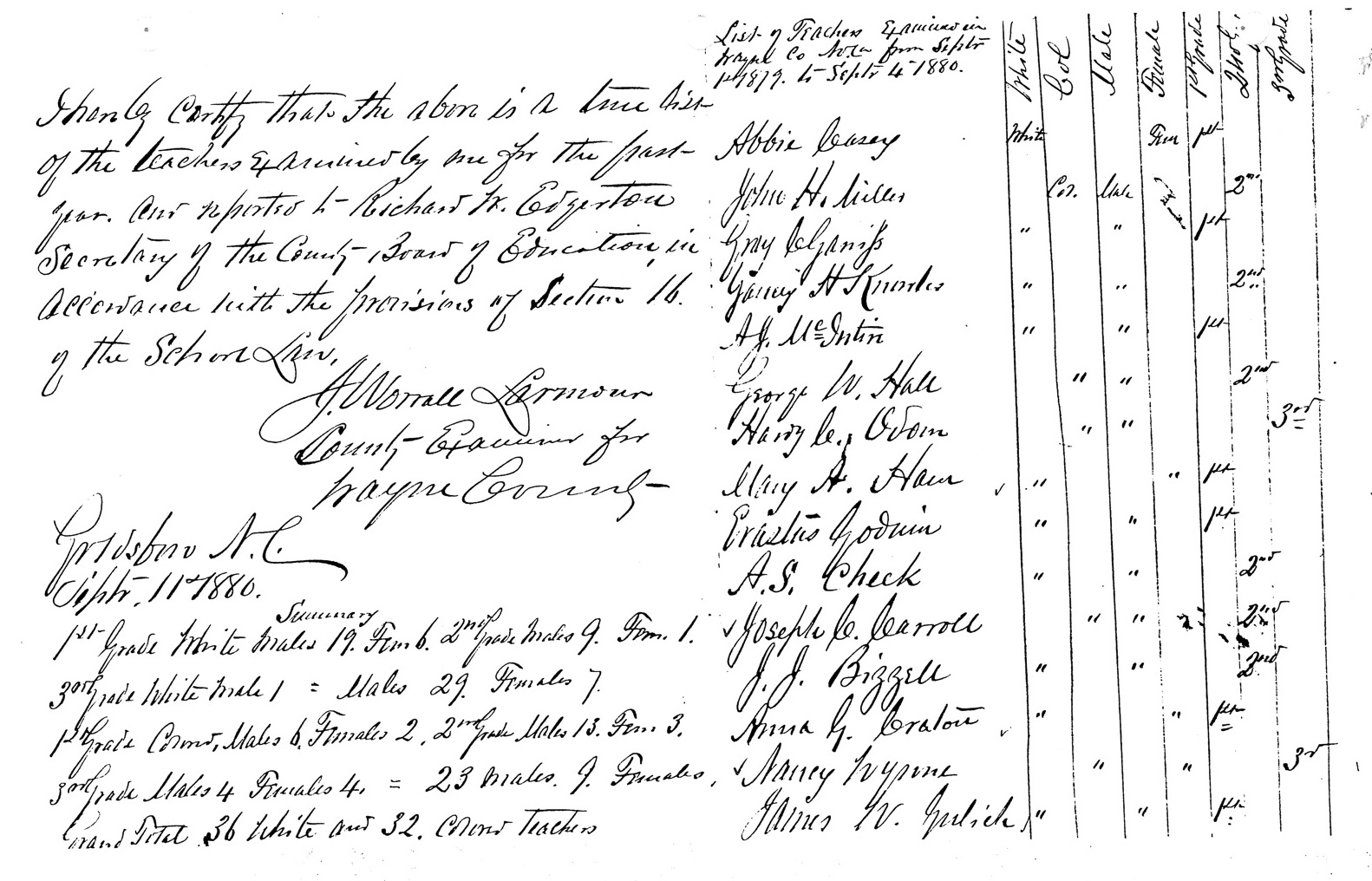
John Aldridge and his brothers George and Matthew Aldridge were hired to teach in Wayne County in the late 1870s. For reasons unknown, they were assigned to schools in the far north of the county, some 15 miles north of Dudley:


ALDRIDGE -- Aldridge_School Records

ALDRIDGE -- Aldridge_School Records 2 

From the same unsigned family history:

John Aldridge met Luvicie Artis at the school where he taught; she was one of his students. He built a 7 room house for her when they got married. John was a stout man with a reddish brown complexion and wavy black hair. He stopped teaching when he married Luvicie and started to farm and run a general store. The store was burned down in 1911. He sent his children to a private school. He died in 1910 of a congested chill. He was 58 years old when he died, and was worth about $30,000 at that time.

ALDRIDGE_--_John_Aldridge_Vicey_Artis_Marriage_License

If John was worth $30,000 when he died, it was all in realty. His personal estate was paltry:
JW Aldridge Estate Doc
Standard
Births Deaths Marriages, North Carolina, Other Documents, Paternal Kin

Adam Artis’ children, part 3: Frances Seaberry.

From an unsigned narrative (“The Adam Artis Family History”) written, I think, by one of Adam Artis’ great-grandchildren:

“Adam Artis had about five wives and 39 children. His first legal wife was Frances Hagens of Eureka. She was very fair and had beautiful long black silky hair. Adam was very tall and slender. He owned a large farm in Eureka and was a first class carpenter. They lived in a nice two story house. Frances’ brother, Napoleon Hagens, owned a very large plantation near Eureka. He had several tenants and/or slaves there. He was very mean to his wife and tenants.  He would sit on the fence in the shade and watch the tenants plow. If they didn’t plow the way he wanted them to, he would crack them with a whip. One day a tenant grabbed the whip and beat Napoleon’s shirt off.”

This is a nice starting point, if not entirely accurate. Frances Seaberry was Adam’s second legal wife. If he had 39 children, not even his last surviving daughter could name them. Her half-brother Napoleon Hagans never owned slaves, though he had many tenants, and he cast a shadow large enough that his sister’s descendants thought his last name was hers.

Also, “Frances and Adam Artis had 9 children (Hayward, William, Walter, Addie, Jesse, Doc, Georgianna, Luvicie and Ida.) Luvicie and Ida were twins. Frances died when the twins were only 13 years old.”

In fact, they had 11:

Ida Artis was born about 1861.  (And was not Louvicey’s twin.) She married Isaac Reid (1853-??), son of Zion and Lucy Reid, about 1876 .Their children were Frances Reid (1877-??) and Lorenzo Eli Reid (1879-1952). Ida Artis Reid died 1880-1900.

Napoleon Artis, known as “Doc,” was born 28 February 1863. He married Sallie Taylor; their sons were Humphrey, Leslie and Odell. Doc died 16 October 1942. His descendants still live on land along Route 222 between Stantonsburg and Eureka once owned by Adam Artis.

“When Luvicie Artis was 13 years old, she married John Aldridge of Dudley. John was the son of Robert and Eliza Aldridge. … Luvicie had very high cheek bones. Luvicie was a mid-wife and nurse. She died at the age of 64. She only wanted to eat peas and sweet potatoes. She wouldn’t eat much meat or green vegetables, and would drink hardly any water.”

Louvicey Artis was born in 1865 and married John Aldridge in 1879. Their 11 surviving children were Zebedee Aldridge, Lula Aldridge, Frances Aldridge Cooper, John J. Aldridge, James Thomas Aldridge, Amanda Aldridge Newsome, Beulah Aldridge Carter, Correna Aldridge Newsome, Catherine Aldridge Davis and Christine Lenora Aldridge Henderson. Vicey Artis Aldridge died 13 February 1927.

Louvicey’s twin, Eliza Artis, married Haywood Everett. Before 1900, the couple migrated to Arkansas and settled in Lonoke County. They had no children, and Eliza died 10 October 1936.

Georgeanna Artis was born 1867. She married Henry Reid (1859-1930), son of John and Mozana Hall Reid (and first cousin to Isaac Reid, above) on 29 Nov 1883. Their children: Alice Reid Williamson, Cora Reid, William H. Reid, Brodie Reid, Lenny Reid, Nita Reid, Henry N. Reid, Linda B. Reid, and Georgia Reid. She died 18 August 1923 in Goldsboro NC.

Adam Toussaint Artis Jr. was born in 1868. He married Rena G. Wynn in 1893 in Wayne County and had one son, Lafayette. He migrated to Washington DC, and married Agnes West in 1904. Their son was Harry L. Artis.

Haywood Artis was born in 1870. He migrated to Norfolk, Virginia, in the 1890s, and married Harriet Hawthorne. Their children included Bertha Artis, Jesse Artis, Hattie Artis Johnson, Mae Willie Artis, Haywood Artis Jr., and Charles Artis.

Emma Artis, born 1872, married Robert H. Locust and died within months of the wedding.  [A tidbit: Robert H. Locust’s second wife, Fannie Aldridge, was the sister of John Aldridge (Louvicey Artis’ husband) and Amanda Aldridge Artis (Adam Artis’ third wife.]

Walter Scott Artis was born 2 October 1874. He married Hannah E. Forte. Their children: Napoleon Artis, Beatrice Artis, Estelle Artis, Adam Toussaint Artis III, and Elmer H. Artis.  Walter Artis died 25 June 1951.

William Marshall Artis was born 28 August 1875 and married Etta Diggs.  Their children: Margaret Artis, William M. Artis Jr., Frances Artis, Irene Artis Carter, Adam H. Artis, Fletcher Artis, Doris V. Artis, Haywood Thomas Artis and Beulah M. Artis Exum. William died 28 September 1945.

Jesse Artis was born in 1878, presumably not long before his mother’s death.

Standard
Births Deaths Marriages, Maternal Kin, Newspaper Articles, North Carolina, Oral History, Other Documents, Vocation

Irving Houser gets a McNeely Girl.

Me:  Okay, and Emma, she was up in Bayonne.

My grandmother:  This man went up there in his young years. I think he had an eye on her. People used to say that the men —  all of Mama and her sisters were supposed to have been catches, you know. They were good-looking women and everything, and they just said the men said it didn’t matter which one it was so long as they got one of them.

Me:  One of the McNeely girls?

My grandmother: McNeelys. Mm-hmm.

Me:  So he came back and married Aunt Emma and carried her to New Jersey. To Bayonne — oh! Irving Houser, Sr.

——

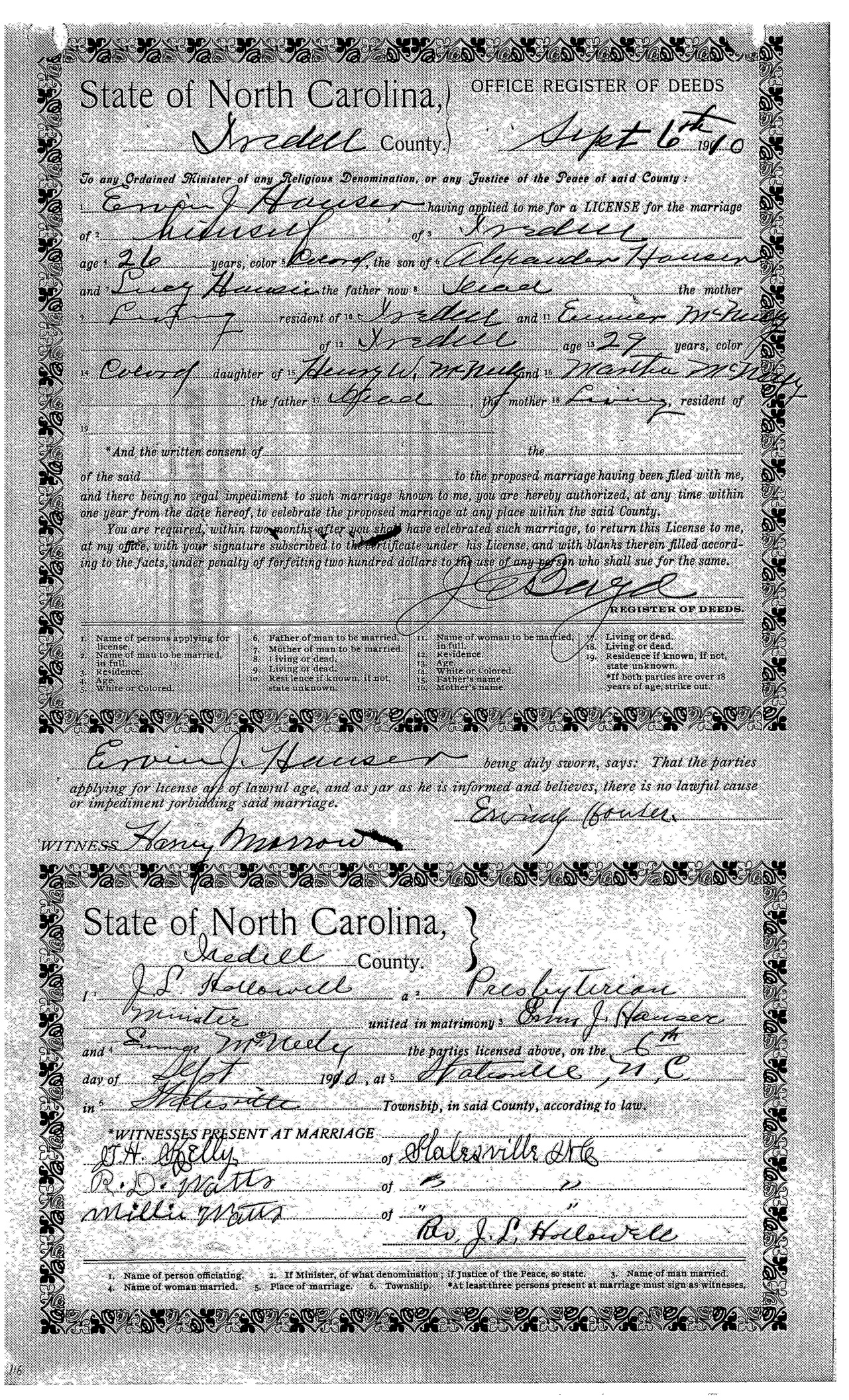
Irving L. Houser was born in 1885 in Iredell County to Alexander “Dan” and Lucy Houser. He and Emma McNeely were married 6 September 1910 in Statesville. The couple migrated to Bayonne, New Jersey, and settled on Andrew Street.

McNEELY -- Ervin Hauser & Emmer McNeely Marr Lic

Six years later, in a span of three days, Irving appeared twice in New York City newspapers. First:

OLD JOBS OFFERED BAYONNE STRIKERS

Standard Oil Co. Tells Them They May Come Back, But Without Increase of Wages.

MRS. CRAM PLANS NEW VISIT.

Says She Will Consult a Lawyer and Won’t Be Barred — Federal Conciliators at Work.

The Standard Oil Company refused yesterday to grant the wage increases demanded by employees whose strike has tied up practically every big Plant in the Constable Hook section of Bayonne, N.J. for more than a week, but offered to take the strikers back at the old wage scale whenever the men wanted to resume work.  The Committee of Ten, which learned these terms from George B. Hennessey, General Superintendent of the Bayonne plant, endeavored to report to the body of strikers.  The police prevented them because no police permit to hold a mass meeting had been requested, but one was issued for a meeting this morning, at which the strikers will decide whether to accept or decline the terms.

     …

Pending today’s meeting, the strikers were quiet yesterday.  Early in the morning there had been some disorder at Avenue E and Twenty-fourth Street, bringing a squad of policemen, who fired as many more.  They caught Irving Houser of 92 Andrew Street, an employee of the Edible Products Company, which plant is near the Tidewater Oil Company, and locked him when they found a revolver in his pocket.

New York Times, 18 Oct 1916.

Then,

Bayonne, N.J.

Miss Viola Houser, of Orange, N.J., visited her brother and sister, Mr. and Mrs. Irving Houser, Andrew Street, on Sunday, October 10.

New York Age, 21 Oct 1916.

Amid social unrest and social calls, Irving and Emma had three children: Mildred Wardenur (1913), Henry A. (1915) and Irving L. Houser Jr.  (1920).  For many years, Irving worked in various jobs in an oil refinery, but by time he registered for the “Old Man’s Draft” of 1942, he was employed at Bayonne City Hall.  By then, he had purchased a house at 421 Avenue C, a site now occupied by Bayonne Giant Laundromat.  Irving Houser Sr. died in 1962.

Standard
Births Deaths Marriages, North Carolina, Oral History, Other Documents, Paternal Kin, Photographs, Religion

When your pilgrimage is over.

… Self life that might hender and draw you to earthly thing it inpels you on in to Godlines Paul sed I die dailey to the things of this world yeal your life dailey and hold your life in submision to the will of God and live by his word that you may grow unto the fulles measure of the staturs of Chris the one that lives wright is the ones who will a bide bide with him the day of his coming and stand when he a …

… Come by your God like impression God will take care of you no matter where you are cax aside all fear and put your trust in God and you are save.  Then when your pulgrimage is over and you are call from labor to reward you will be greeted with that holy welcome that is delivered to all true missionaries come in the blessed of my father …

My grandmother had a large, dusty black Bible that had belonged to her “mama,” Sarah Henderson Jacobs Silver.  (The Bible’s original owner was Carolina Vick, a midwife in east Wilson — her family’s birth and death dates are inscribed in its leaves.)  When I first thumbed through the Book in the early 1990s, I found two scraps of paper stuck deep in its chapters. Pencilled in a square, unsophisticated hand were these bits of Sarah’s sermons. She had left the Congregationalism of her upbringing and joined the Holiness movement sweeping the country in the early 1900s.  My grandmother was not impressed:

I was just thinking ‘bout that today, ‘bout how we used to do.  Mama’d make us go to Holiness Church and stay down there and run a revival two weeks.  And we’d go down there every night and lay back down there on the bench and go to sleep.  Then they’d get us up, and then we didn’t have sense enough to do nothing but go to sleep and get up. 

Mama’d go every night.  And they’d be shouting, holy and sanctified, jumping and shouting.  I don’t know, that put me out with the Holiness church.  And sanctified people.  I know Mama wont doing right.

Evangelist Sarah spent night after night jumping and shouting, leaving my adolescent grandmother to wash and iron the endless loads of laundry they took in from white customers. Sarah apparently met her second husband, Rev. Joseph Silver, founder of one of the earliest Holiness churches in eastern North Carolina, on the revival circuit. They married in 1933 and divided the five years before her death between Wilson and his home in Halifax County.

Evangelist

Sarah H. Jacobs and her Bible, with my uncle Lucian J. Henderson in the background, taken in Wilson NC circa 1930. (I have the Bible, but some time between when I first saw — and transcribed — the sermon scraps and when I took possession after my grandmother’s death in 2001, the pieces of paper were lost.)

Photo of Sarah Henderson Jacobs Silver in the collection of Lisa Y. Henderson. Interview of Hattie Henderson Ricks by Lisa Y. Henderson; all rights reserved.

Standard