Births Deaths Marriages, Free People of Color, North Carolina, Other Documents, Paternal Kin, Rights

Her freedom has never been disputed.

State of North Carolina Onslow County

To all persons whom it may concern we the under Signed being called on to State what we Know concernning the Freedom of Nancy Dove formerly Nancy Henderson do certify that Nancy Ann Henderson the Mother of the said Nancy Dove was a Free born white Woman and that the Freedom of the said Nancy Dove never has been disputed given under our hands this 3rd March 1860  /s/ John Mills {seal} Nancy Parker {seal}

Test J.W. Thompson X

——

I believe that Nancy Henderson alias Dove and my great-great-great-great-great-grandmother Patsey Henderson were sisters. More on that later.

Standard
Births Deaths Marriages, Enslaved People, Free People of Color, North Carolina, Other Documents, Paternal Kin

Up from slavery.

artis-solomon-williams-estate-records-dragged

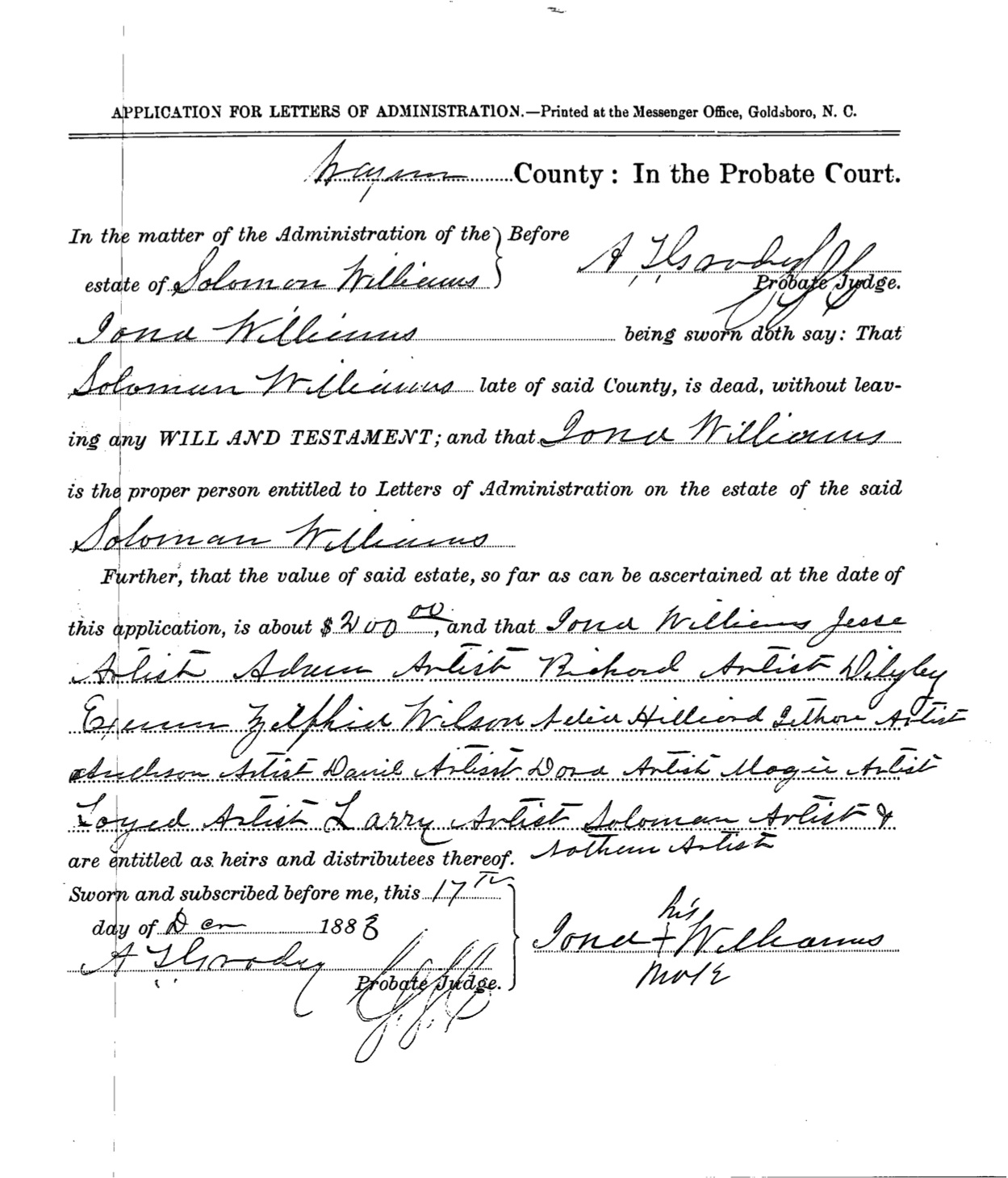
Vicey Artis, a free woman of color, and Solomon Williams, a slave, had eleven children together – Zilpha Artis Wilson, Adam Toussaint Artis, Jane Artis Artis, Loumiza Artis Artis, Charity Artis, Lewis Artis, Jonah Williams, Jethro Artis, Jesse Artis, Richard Artis and Delilah Williams Exum — before they were able to marry legally.  On 31 August 1866, they registered their 35-year cohabitation in Wayne County.  Vicey died soon after, but Solomon lived until 1883.  The document above, listing his and Vicey’s six surviving children and heirs of their deceased children, is found among his estate papers.

Standard
Births Deaths Marriages, Free People of Color, North Carolina, Oral History, Other Documents, Paternal Kin

He was gon make something off the crop.

And Papa was sick, and somebody had to watch him.  He wasn’t down in the bed, but his mind was kind of off.  Now he’d listen to you, you’d talk to him, and anything he wanted, had to tell you about it.  “Naw, you can’t go there.  I got to go home.  I got to go home.”  Said he had to go home.  I said, “We are home.”  Said, “Naw, we’re not.”  That’s the way his mind worked.  Like that. 

So after Mamie got married in Greensboro, I come on back to Wilson, and then, after I come back, I hated I’d come back ‘cause I had to – Papa’s mind was bad, and I had to stay home.  To keep him.  He’d go ‘way from the house and couldn’t find his way back. And he was ruptured from the time I can remember. And so at that time Mama was working in the factory, and school wasn’t open, but when school opened, I had to stay home and look out for him.  And then, so finally, when he died.  He was supposed to have an operation.  He was ruptured, and Carrie, she claimed she didn’t know it.  And I said, now, I was the youngest child was there, and I knowed that all that stuff that was down ‘tween his legs was something wrong with him.  He went up to Mercy Hospital for something, probably his rupture – I know he had to go to the hospital for treatments or something.  Anyway, the last time, Carrie came down and she was fussing about if she’d known Papa had to have an operation, she’d have come down and he’d have had it.  Instead of waiting until it was too late.  Now the last week they wasn’t expecting him to live.  But, no bigger than I was, I knew he had it.  And she was grown, old enough for my mother, and then she talking ‘bout she didn’t know he was ruptured?  Well, all his tubes was, ah –  And he always had to wear a truss to hold hisself up.  And when he’d be down, I’d be down there sweeping at the school, and he’d be out there plowing a field he rented out there, and he’d come up, lay down on the floor and take a chair and he’d put his legs up over the chair like that, and I’d wet the cloths from the bowl where was in the hall, some of the old dust cloths, and hand them to him, and he’d put them down on his side, and you could hear it ‘bluckup’ and that thing would go back there.  But see it had got, his intestines, that tissue between there had bursted, and the doctor told him he needed an operation.  So he was gon get it, but he didn’t have money enough to get it.  Didn’t save up money enough to have the operation.  So none of the children – all of them know, as large as his – but leastways he couldn’t hide himself, ‘cause even from a little child, I could see that for years, and I wondered what it was.  ‘Cause I know everybody didn’t have it, at least didn’t have all that in their britches ….  And Carrie come down there, and she fuss Mama out about him not having the operation and this kind of stuff.  And she said, “Well, we never had the money to get the operation.”  We tried to go and get it, and we’d pay on it by time.  But, naw, he wanted, he was gon make something off the crop, and he’d pay.  Pay it and have it then.  But he never got the chance.  So when they put him in the hospital and operated on him, say when they cut him, he had over a quart of pus in him.  I think it was on a Thursday, and he lived ‘til that Tuesday.

NorthCarolinaDeathCertificates1909-1975ForJessieAdamJacobs——

Oh, this breaks my heart. (And she was absolutely right. July 6, 1926, was a Tuesday.)

Excerpts from interviews of Hattie Henderson Ricks by Lisa Y. Henderson; all rights reserved.

Standard
Births Deaths Marriages, Land, Maternal Kin, North Carolina, Other Documents

Jule McNeely leaves a toehold.

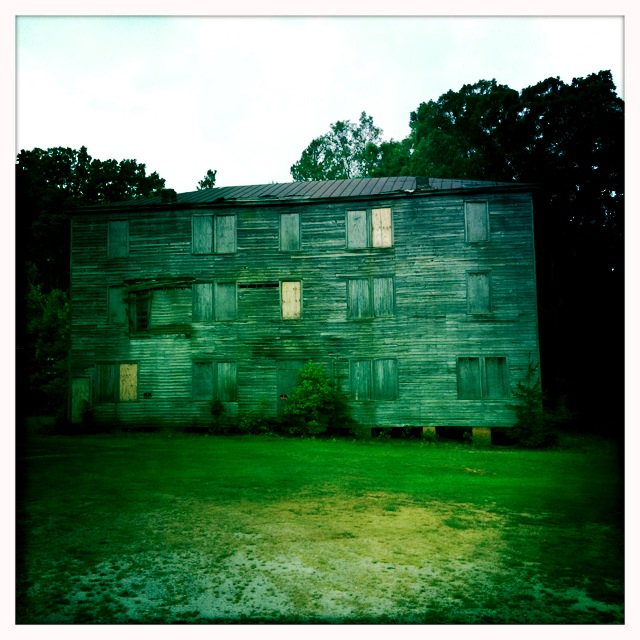
I did not doubt that Henry and Julius McNeely were brothers, but here is proof-positive: Julius died widowed, childless and intestate, and his sole heirs were Henry’s children.Image“Jule” McNeely’s thin estate file, opened in 1913 in Rowan County Superior Court, is devoted to the distribution of his tiny plot of farmland to John, Luther, Emma, Addie, Carrie, Ed, Litha, Janie, Lizzie and Minnie McNeely as tenants in common. When Addie died in the middle of matters, a guardian was appointed for her children, “Ardenia” [actually, Ardeanur], 14, and James Smith, 9. At issue: “Beginning at a stone on D.S. Cowan’s line, and runs S. two degrees W 7.10 chains to a stone thence; N. 85 degrees W. 3.50 chains to a stone, thence; N. 2 degrees E. 6.50 chains to a stone on Cowan’s line, thence; E. to the beginning, containing two and a half acres more or less.” “The above land is the old Jule McNeely place, lying just east of Mount Ulla in Rowan County, and” — despite its tininess — “is a very desirable lot.” The heirs’ attorney petitioned for the sale of the lot, noting that it was too small to be advantageously divided or to justify continued possession by so many heirs, all of whom lived in Iredell County except Emma and her husband Ervin Houser of Bayonne, New Jersey. The petition was granted, and at auction on April 21, 1917, Carrie’s husband Lon W. Colvert placed the highest bid at $80.

[Sidenote: Before I found this file, I did not know that (1) Lizzie McNeely was first married to Watt Kilpatrick; (2) when Addie McNeely Smith died; or (3) Lon Colvert owned property in Rowan County, much less property that had belonged to his wife’s late uncle.]

Standard
Civil War, Maternal Kin, North Carolina, Other Documents

I will henceforth faithfully support, protect and defend.

The war is over. The Union has won. There is nothing to do but accept it and move on. Two months after the Surrender, his enslaved son now free, John W. McNeely swore his allegiance to the United States.ImageHalf-way across the country, in Iron County, Missouri, William B. McNeely had not waited for the war to end and beat his brother to the punch by nine months.Image

[Sidenote: Compare the W, M and N in John and William’s signatures. They clearly learned to write from the same instructor.]

Oath of Allegiance. Union Provost Marshals’ File of Papers Relating to Individual Claims, National Archives and Records Administration.

Standard
Education, Letters, Maternal Kin, Other Documents, Photographs, Virginia

The Keysville school.

Acts of the General Assembly of the Commonwealth of Virginia.  Chap. 91.  An Act to Incorporate the Keysville Bluestone mission industrial school.  Approved January 17, 1900.

Be it enacted by the General Assembly of Virginia, that Reverend Nelson Jordan, R.C. Yancey, George D. Wharton, P.E. Anderson, F.L. Hall, Jesse H. Wilson, Jordan Moseley, Whitfield Clark, L.N. Wilson, A.J. Goode, S.L. Johnson, N.C. Ragby and Miss Mary E. Wilson [are appointed] board of trustees [of an institution] by the name and style of the Keysville Bluestone mission industrial school for the purpose of keeping and conducting at Keysville, Charlotte County, Virginia, a boarding and day school of the above name, and of giving instruction to such colored persons, male and female, as may be committed to their care as pupils of said school. …

Image

——

Rev. Whitfield Clark’s sister Mary married my great-great-great-great-uncle Joseph R. Holmes, who was murdered on the steps of Charlotte County courthouse in 1869. As shown below, Joseph Holmes had been instrumental in securing support for the precursor to this school:

record-image-2

Joseph homes letter

Photograph of Keysville Industrial School, Keysville, Virginia, by Lisa Y. Henderson, July 2012. Images of letters from Virginia Freedmen’s Bureau Letters of Correspondence 1865, 1872, www.familysearch.org (originals in Records of the Field Offices for the State of Virginia, Bureau of Refugees, Freedmen and Abandoned Lands 1865-1872, National Archives and Records Administration.)

Standard
Civil War, Maternal Kin, North Carolina, Other Documents, Rights

The first registration.

voter reg

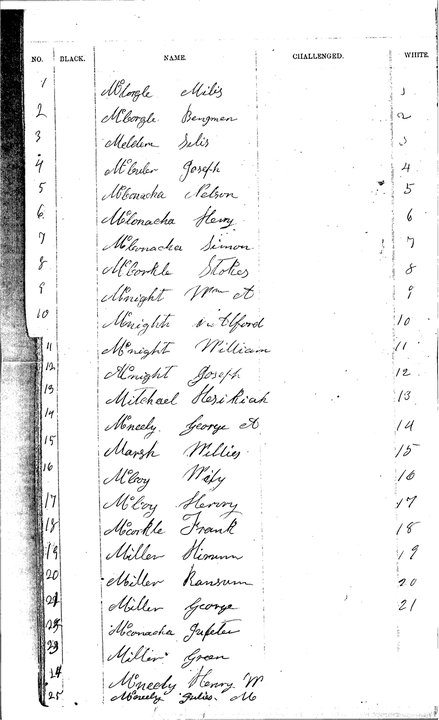
Rowan County, North Carolina, 1866. The war is over. The 14th and 15th Amendments have not yet passed, but the county’s hopeful freedmen have come out en masse to register to vote, perhaps under the auspices of the Freedmen’s Bureau. Among them, my great-great-grandfather Henry W. McNeely, his half-brother Julius McNeely, and his future in-laws Ransom, George and Green Miller. Henry’s father John W. McNeely, Confederate allegiance renounced and U.S. citizenship restored, was also there — his world upside down.

Standard
Births Deaths Marriages, Enslaved People, Maternal Kin, North Carolina, Other Documents

Cohabitation as man and wife.

COLVERT -- Walker Colvert Rebecca Parks CohabitationIn March 1866, in order to ratify marriages and legitimate children, the North Carolina General Assembly passed an Act directing Justices of the Peace to collect and record in the County Clerk’s office the cohabitations of former slaves. Freedmen who did not record their marriages by September, 1866, faced misdemeanor charges. Stragglers rushed the courthouse that August, and on the 25th Walker Colvert and Rebecca Parks traveled the 12 miles or so from Eagle Mills to stand in line. They declared that they had been together for 13 years and named three children, John, Elvira and Lovenia. (There should also have been a son Lewis, the youngest — and who in the world is Lovenia? I have found no trace of her.)

Walker, fifty-ish at the time, was my great-great-great-grandfather. He was born in Culpeper County, Virginia, then passed, like a bedframe or milk cow, from one Colvert to another and into Iredell County, North Carolina. Rebecca was not his first wife, and his age suggests earlier children, names and fates unknown. My grandmother, who died in 2010 at age 101, knew and remembered Rebecca. And, like that, a link across five generations.

Standard
Births Deaths Marriages, Maternal Kin, Newspaper Articles, North Carolina, Other Documents

A colored man of rare powers of mind.

Harriet pursued him, my grandmother said. Relentlessly. Followed him to Ohio to make her case for marriage. Certainly, that she, a widow in her early 40s, found (or allowed herself to become) pregnant suggests an impetus for her plans. Still, Thomas Alonzo “T.L.” Hart was not easily swayed. Their only child Bertha Mae was born in 1902 and not until December 1904 did he apply for a marriage license at the Iredell County Courthouse.

Alonzo was born about 1866 to Ephraim and Caroline Hart. Little is known about the years before he married Harriet Nicholson Tomlin. My grandmother asserted that he was a non-practicing lawyer, but no record has been found of his education or training.  In the late 1890s, he moved briefly to Ohio; a visit home was nearly disastrous:

——

Alonzo Hart, colored, who formerly lived here but has recently been in residence in Toledo, Ohio, was arrested yesterday on a warrant sworn out by Mr. O.P. Sowers, the latter charging him with having his purse and $90 in cash which he lost on Monday, December 26th.  Hart deposited $100 in cash with Justice White for his appearance at the trial which is set for to-morrow.  The defendant is represented by Mr. H.P. Owen and the plaintiff by Mr. L.C. Caldwell.  Mr. Sowers is positive that he lost his purse on the sidewalk in front of the Cooper block on Center Street.  It is said that Hart was present at the time and as he has been pretty flush with cash since then he is suspected of having picked it up.  — Statesville Landmark, 6 Jan 1899.

——

But:

At Alonzo Hart’s trial for theft, the witness testified that Hart was not the man, “and as there was no other evidence against him, [Hart] was discharged, Mr. Sowers paying the costs.” — Statesville Landmark, 11 Jan 1899.

Despite his ignominious arrest, Hart remained in Iredell County, farming in Shiloh township while his sister Etta kept house. A couple of years after marrying Harriet, he again made the local newspaper:

Alonzo Hart, colored, was severely injured Sunday night by Will Stevenson, colored, in a fight in the Poplar Branch neighborhood.  Hart received several severe cuts about the body and one on the neck.  The cause of the trouble is unknown.  A warrant for Stevenson is in the hands of the police. — Statesville Landmark, 18 Sep 1906.

——

Fifteen years later, Hart helped prevent a lynching by negotiating the surrender of a black man wanted for killing a white man:

BOB BENSON SURRENDERS.

“Slayer of Robert Dishman Surrenders to Alonzo Hart, Colored, and Sends for the Sheriff — Others Capture Benson Before the Sheriff Arrives on the Scene and Take Him to Lincolnton — Now in the Mecklenburg Jail”

Working on clues set forth by Alonzo Hart, colored, Bob Benson was captured late yesterday evening by Messrs George Ayers, Fred Claywell, Pam Morrow, Vance Jenkins and Everett Wilkinson.

Lacking only a few hours of being a fugitive from justice a week, Bob Benson, who assaulted and killed Robert Dishman is today resting behind bars in the Mecklenburg county jail, where was taken to escape possible violence.  Thus ended one of the most thrilling searches for a criminal in the history of the county.

Friday during the search on Third creek, near Morrison’s store, Alonzo Hart came to Sheriff Alexander and asked the sheriff if he should find Benson and turn him over to the sheriff would there be any violence.  Upon receiving the sheriff’s promise that he would keep Benson from violence and see that he received justice, Hart said he would do all in his power to get in touch with Benson and have him give him up to the sheriff.

Early Sunday morning between 6 and 7 o’clock Benson came to the home of Hart, which is south of Hoyt Morrison’s store, wearing only a shirt and an old sack tied around his loins, and begged Hart for something to eat and a chance to rest.  According to Hart, Benson said he had been lying in a thicket near Third creek during the search Friday night and Saturday, and had more than one time heard searching parties passing near him so close that he could plainly understand their conversation.

Throughout the day, Sunday, Hart persuaded Benson that it was best for him to give up to the officers, which Benson agreed to do provided he was turned over to the officers, who would take care of him.  About 5 o’clock yesterday afternoon Hart came to town after the sheriff and was seen by some of the party who captured Benson, who surmised Hart was in town on business concerning Benson, and went immediately to Hart’s home, where they captured Benson in one of the rooms of the house.

Benson was carried by his captors to the Lincoln county jail last night.  Early this morning Sheriff Alexander had Benson moved to the Mecklenburg County jail at Charlotte, so as to be doubly sure of his safety.

It was just one week ago yesterday evening, about 8 o’clock, on the Chipley Ford road, six miles north of Statesville, that Bob Benson, a negro, dealt Robert Dishman, white, a blow, or blows, on his head with a stick or other weapon, that resulted in Dishman’s death about 30 hours later at the Carpenter-Davis hospital.  It was a week ago today that the searchers for Benson assumed the proportion of a posse.  A few officers and others had begun the search soon after the killing.

Probably the search for a criminal in no other case in Iredell county has attracted more interest than has been evidenced in the Benson case.  Reports which came to the officers and the posse kept this interest alive.

After the crime he is alleged to have committed Benson lost himself in the neighborhood of his home and in the neighborhood of his victim for the first night of his get-away.  The earlier hours of the day following the crime brought some reports of his having been seen.  Late the same afternoon came the report that up to that time had had the semblance of assurance — someone had seen him making his way from woods to woods in the country around the pump station.  It was then that the crowd assumed the proportion of a posse and it was on this clue that the bloodhounds were introduced and initiated.  They struck a trail and followed it to the right house but the wrong person.  The search continued that night, dissipating other reports of Benson’s whereabouts.  The same program was gone over day after day and night after night.

The all night man hunt was without reward Thursday.  Benson had not been seen since he was shot at about 4:30 o’clock that afternoon, near the home of Mr. D.L. Raymer.

The bloodhounds were brought from Salisbury about 7 o’clock that night and were placed where Benson was last seen, but did not hit a trail durng the night.  — Statesville Landmark, 26 Sep 1921.

——

THE BOB BENSON REWARD.

Attorney Z.V. Long Will Share Burden of a Decision in This Matter to Iredell Superior Court.

No decision yet has been reached in paying the reward of $300 [illegible] by the County and $200 by the [illegible] for the apprehension of Bob Benson, colored, who killed Robert Dishman and who has been convicted and sentenced to electrocution.

Two claims are offered for the reward, one by Alonzo Hart, colored, whose home Benson went and [illegible] until a number of white men went and got him and took him to the Lincolnton jail, while Hart was in town looking for Sheriff Alexander to report Benson’s presence at his house.

The matter of determining proper disposition of the reward was left to County Attorney Z.V. Long.  Since it has become apparent that an amicable settlement can not be made this way, the matter will be left to Iredell Superior court to say how and to whom the reward shall be paid.  — Statesville Landmark, 5 December 1921.

——

Harriet Nicholson Tomlin Hart died in 1924. When Alonzo Hart’s sister died four years later, the Landmark breathlessly reported every detail of the disposition of her sizeable estate, worth about $81,000 in 2013 dollars.

Margaret Richardson Leaves Will Disposing of $6,000 Estate

The will of the late Margaret Richardson, colored, which has been filed with the Clerk of Superior Court John L. Milholland for probate, provides for the distribution of the estate, estimated to have a value of $6,000, as follows:

The farm, one mile north of Statesville, is given to a sister, Lula Loyd; two acres laid off the northern end of the farm, adjoining the lands of J.C. Duke, and the city pump station, to Gilmer Walker; all the rest of the land and personal property to be sold and the cash distributed as follows: $10 to Mollie Alexander of Wilkes County; $10 each to Florence Camp and Minnie Brawley, both of Toledo, Ohio; $100 to Alonzo Hart of Iredell county; $25 to Zion Methodist church, colored, on South Center street; $25 to Broad Street Presbyterian church, colored; $25 to John Adkins, of Winston-Salem; $300 to Lula Loyd; $100 to Preston Smith of Virginia; $200 to Alonzo Loyd and the rest of the property to be divided equally among Lula Loyd, Bertha May Hart, Mollie Alexander, Florence Camp, Minnie Brawley, Earl Smith, and Rebecca Bailey.  Mr. John A. Scott, Jr., is designated as executor of the will. — Statesville Landmark, 19 Mar 1928.

——

At the end of the following year, Thomas Alonzo Hart succumbed to tuberculosis at a Hoke County sanatorium. His final appearance in the Landmark was a respectful and laudatory one:

FUNERAL SERVICE FOR ALONZO HART.

Will Be Held Sunday Afternoon from Centre Presbyterian Church — Was Respected Colored Citizen

Funeral services for Alonzo Hart, 63, well known colored man, whose death occurred Tuesday at State Sanatorium, where he had been a patient for a short time, will be held from Center presbyterian church Sunday, December 22, at 2:30 o’clock in the afternoon.  Interment will follow in the cemetery there.  The surviving members of the family are one daughter, two step-sons and four sisters.

Alonzo Hart, by his extraordinary habits of frugality and industry, had accumulated a considerable estate.  Although living in an age of speedy travel, he held on to an older and slower method of transportation, his regular visits to town having been made in his buggy, drawn by his faithful, dependable mule.  He was a colored man of rare powers of mind, having a valuable library and keeping fully informed on the events of the day by reading newspapers and periodicals.  A unique Iredell citizen has passed to his reward. — Statesville Landmark, 19 Dec 1929.

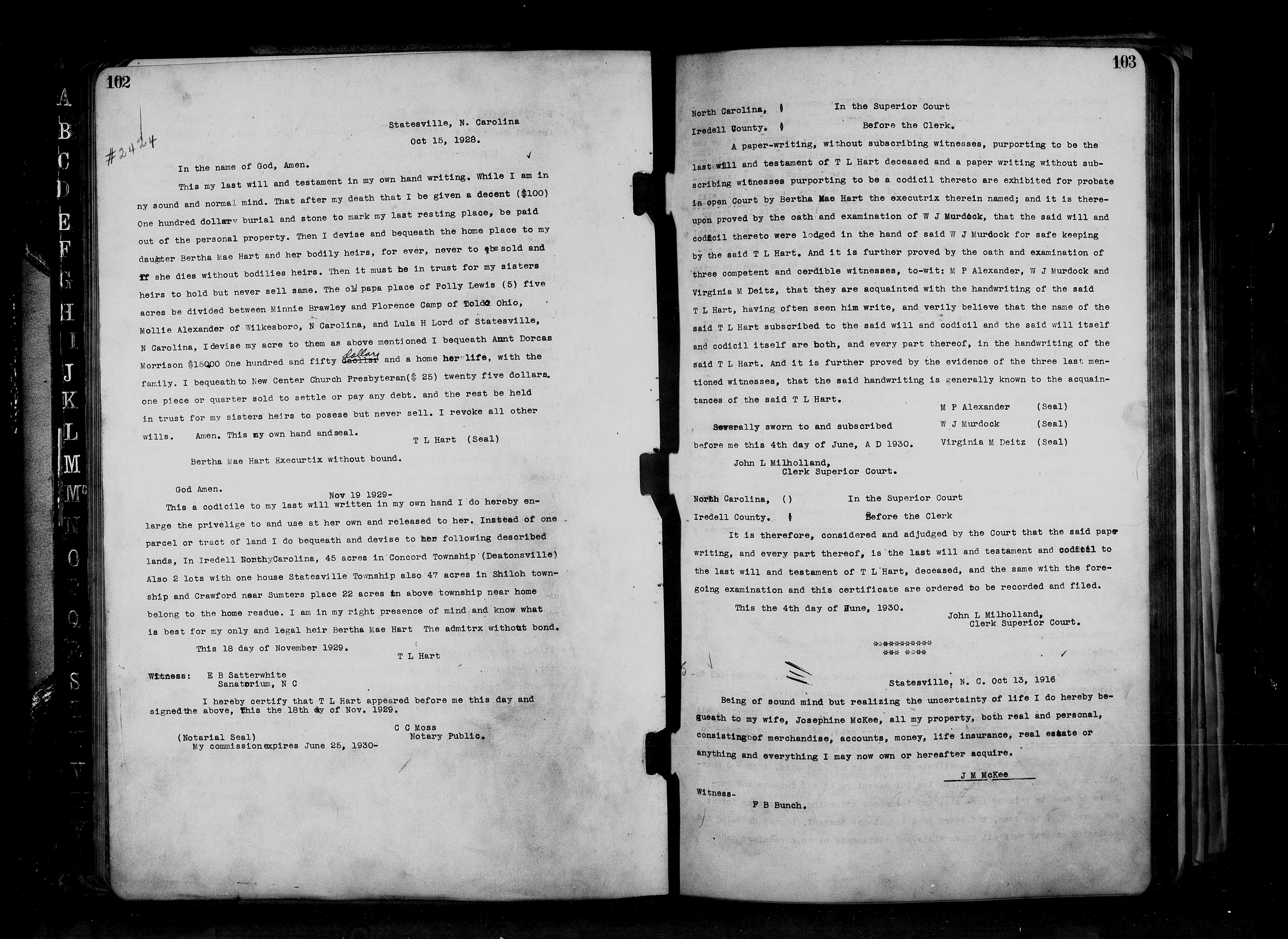
His will confirms Hart’s prosperity and reveals as well his deep ties to his family:
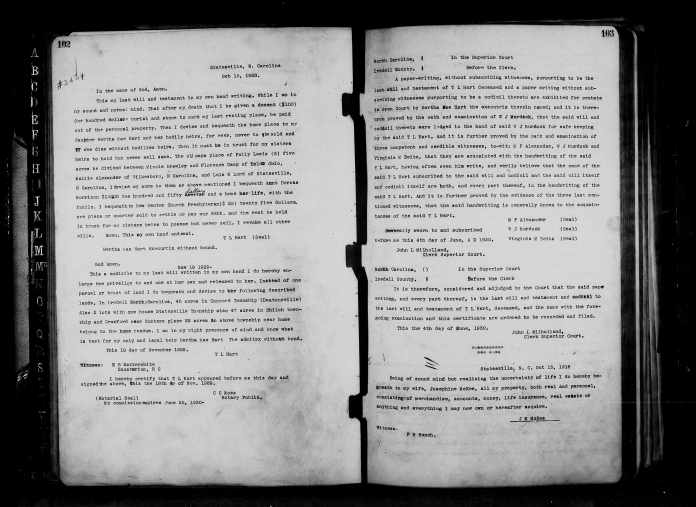
TL Hart Will

Standard
Births Deaths Marriages, Maternal Kin, Other Documents, Photographs, Virginia

Mary Brown Allen.

There’s a Mary Brown, age 20, listed in the 1870 census of Amelia County, Virginia. She worked as a laborer and shared her home with a 24 year-old man named Grief Bratcher. This is probably my great-great-grandmother.

Mary Brown Allen

Six years later, Mary Brown was in Charles City County, perhaps with a young daughter Nannie, and certainly pregnant. By a white man. A rape? A convenience? Love? We may never know. We do know, however, that just a few months into the pregnancy she married Graham Allen, a 24 year-old laborer from the other side of the James River in Prince George County. When she bore a son on Christmas, 1876, he was named John Christopher Allen. Over the next 40 years, Mary reared four children to adulthood (another four or five died), as well as some grandsons, while Graham farmed the small parcels of land he painstakingly accumulated and led a flock at New Vine Baptist Church. She never learned to read or write and left scant trace in the public record. Mary Brown Allen died April 1, 1916.

ImagePhotograph from the collection of Lisa Y. Henderson.

[UPDATE, 27 July 2015: As detailed here and here, DNA testing has led to the discovery of the father of Mary’s oldest son, John C. Allen, Sr. He was Edward C. Harrison of Charles City County.]

Standard