Births Deaths Marriages, North Carolina, Other Documents, Paternal Kin, Religion

Memorial page.

In 1915, forty-five years after her husband Lewis Henderson helped found Dudley’s Congregational Church, Margaret Balkcum Henderson was buried in its graveyard. She was the last member of my direct Henderson line on the church rolls. To this day, however, my kin can be found in Congregational on Sunday mornings, worshipping, singing, ushering, fellowshipping.

In 1970, the church published a photo-filled anniversary booklet commemorating its centennial. A Memorial Page lists more than 150 members who had gone on to their reward before the church marked its hundredth birthday. At least a third of those memorialized are my direct or collateral kin.

Memorial Page

  1. The Aldridges were my grandmother’s father James Thomas Aldridge‘s family. Frances Aldridge [Newsome] (1883-1961) was Tom’s elder sister. John J. Aldridge (1885-1964) and Ora Bell Mozingo Aldridge were his brother and sister-in-law, and Fitzgerald Aldridge (1917-1962) was their son. John W. Aldridge (1853-1910) and Louvicey Artis Aldridge (1865-1927) were Tom’s parents (and my great-great-grandparents), and Lula Aldridge (1882-1917) another sister.
  2. Joshua Brewington married John W. Aldridge’s sister Amelia Aldridge Brewington (1855-1895).
  3. Richard Boseman married Lillie Aldridge (1871-1944), daughter of William Aldridge and Cornelia Simmons. William’s father was John Matthew Aldridge (ca. 1810-ca. 1868), brother of my great-great-great-grandfather Robert Aldridge (1819-1899.) Estelle and James were Richard and Lillie’s children. Arlander Boseman, their cousin, married Flora E. Manuel, daughter of Shafter and Mamie Cobb Manuel, below.
  4. I’ve written of the Carters here. Marshall Carter married Frances Jacobs, sister of “Papa” Jesse A. Jacobs Jr. Ammie, Willoughby, Freddie, Granger, Johnnie, and Littman Carter were Marshall and Frances’ sons. Hersey Carter was a grandson. And Florence Carter Camp was their only daughter. Florence’s son William Homer Camp married Onra Henderson, daughter of Henry L. Henderson and Nora Aldridge Henderson. Ammie Carter is listed as Nora Aldridge Henderson’s cousin on her delated birth certificate. Johnnie Carter was my great-great-great-uncle James Lucian Henderson‘s caretaker and sole heir. And their brother Milford E. Carter married my great-grandfather Tom’s sister, Beulah M. Aldridge (1893-1986).
  5. Mack D. Coley, grandson of Winnie Coley, married Hattie Wynn (1873-??), daughter of Charles Wynn and Frances Aldridge Wynn (1853-??). Frances was a daughter of J. Matthew Aldridge and Catherine Boseman Aldridge. Roosevelt Coley (1905-1977) was Mack and Hattie’s youngest child.
  6. Mittie Boseman Flanagan (1896-??) was another daughter of Richard and Lillie Aldridge Boseman.
  7. Archie Barfield Grantham’s father, also named Archie Barfield Grantham, married Carrie Henderson Boseman, sister of my great-great-grandmother Loudie Henderson (1874-1893), in 1899. Carrie died within the next five years.
  8. John H. Henderson (1861-1924) was half-brother of my great-great-great-grandfather Lewis Henderson (1836-1912), father of Carrie and Loudie and others. John married Sarah Simmons. Their son Henry L. Henderson (1901-1942) married Nora Aldridge (1902-1961), another daughter of John and Vicey Aldridge. Aaron “Jabbo” Henderson (1922-1944) was John and Vicey’s son, and Katie Lee Henderson, wife of Horace B. Henderson, was their daughter-in-law. (My Henderson line: Lewis and Mag Henderson’s daughters Ann Elizabeth, Carrie, Loudie, Mary Susan and Sarah Henderson were members of Congregational Church.  And probably sons Lucian and Caswell, too, in their youth. Ann Elizabeth and Loudie’s children were baptized in the church in the 1890s. By 1910, however, only, Lewis and Mag remained. He died in 1912, and she, in 1915.)
  9. Elizabeth Syrona Simmons Hill (1925-1965) was the daughter of George Gideon Simmons and Luella Solice. George G. Simmons (1895-1962) was the son of Samuel M. Simmons and Elizabeth Wynn Simmons (1876-1930), whose parents were Edward J. and Susan Henderson Wynn. Susan (1854-1907) was the sister of John and Lewis Henderson.
  10. Solomon Jacobs was the brother of “Papa” Jesse A. Jacobs Jr.
  11. William Shafter Manuel (1898-1966) was the son of Alonzo Manuel and Sallie Wynn Manuel (1877-1967). His mother’s parents were Edward and Susan Henderson Wynn.
  12. Blonnie Coley Flowers Matthews (1898-1948) was the daughter of Mack and Hattie Wynn Coley.
  13. Yancy Musgrave (1892-1961), son of Alfred and Polly Ann King Musgrave, married Annie C. “Dolly” Simmons (1898-1934), daughter of Hillary B. Simmons and Ann Elizabeth Henderson Simmons (1862-1900). Ann Elizabeth was the sister of my great-great-grandmother Loudie Henderson.
  14. Amanda Aldridge Newsome (1892-1919) was a daughter of John and Vicey Artis Aldridge.
  15. Hillary B. Simmons (1855-1941), son of George W. and Axie Jane Manuel Simmons, married Ann E. Henderson in 1879.
  16. Frances Aldridge Speight was possibly the daughter of William and Cornelia Simmons Aldridge.
  17. Charles Sykes (1920-2004) was the son of William O. and Gertrude Wynn Sykes (1885-1954). Gertrude’s parents were Charles and Frances Aldridge Wynn. [Why was Charles included in a memorial in 1970? Was there another Charles Sykes?]
  18. Blanche Coley Williams (1900-??) was another daughter of Mack and Hattie Wynn Coley.
  19. Charles Wynn married Frances Aldridge, daughter of Matthew and Catherine Boseman Aldridge.
  20. Eddie Wynn (1886-1965), son of Edward J. and Susan Henderson Wynn, married Fronnie Greenfield.
  21. Israel H. Wynn (1892-1967) was the son of W. Frank and Hepsey Henderson Wynn (1856-circa 1894) (who were the brother and sister, respectively of Edward and Susan Henderson Wynn). Israel married his first cousin Frances “Frankie” Henderson (1891-1985), daughter of John and Sarah S. Henderson.
  22. Levi Wynn … well, there were lots of Levi Wynns in Dudley. (Levi was one of the “five Wynn brothers” who headed a large and prosperous free family of color in southern Wayne County and northern Duplin County in the antebellum era. I use quotation marks because (1) there were more than five male Wynn heads of household in the period; (2) there is evidence that, though surely very closely related, they were not all brothers; (3) there were women who appear to have been Wynn sisters heading families.) This may have been the Levi Wynn (1883-??) who was a son of Charles and Frances Aldridge Wynn.
Standard
Births Deaths Marriages, Migration, North Carolina, Other Documents, Paternal Kin

The baby boy, found. (Sort of.)

When you’re not looking for something, there it is.

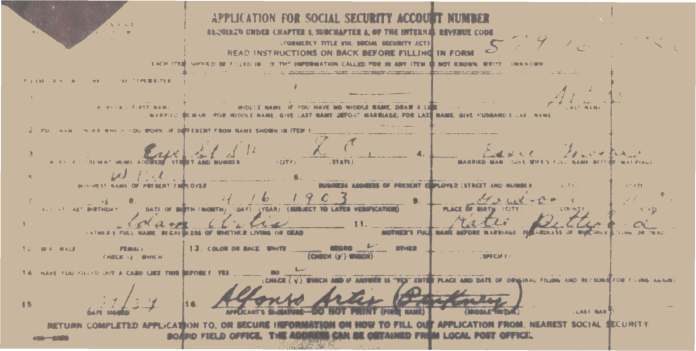
The story I’d heard was that Adam T. Artis‘ youngest child, Pinkney Alphonso Artis, had run away to Baltimore as a young man (or maybe even teenager) and refused to return. I believed it; I certainly had not been able to find much trace of him. He was listed as a child with his parents in the 1910 census, then disappeared from that set of records. I found his Social Security application, filed in Washington DC on 29 May 1939, which told me that “Alfonso Artis” lived at 70 Eye Street, SW; was married to Essie Moore; was employed by WPA; and had been born 16 Apr 1903, Goldsboro, North Carolina, to Adam Artis and Katie Pettiford.

AP Artis SSN App

Just over a year later, in June 1940, his mother died, and “Pinkney Artis” of Washington DC was listed as the informant on her death certificate. And that was it. That was all I knew about Pinkney.

Until the other day, when I stumbled upon this, hidden in plain sight:

Screen Shot 2015-08-09 at 10.05.31 PM

The 1940 census, Nahunta township, Wayne County: Adam’s notorious last wife, the remarried Katie A. “Cain” (her death certificate says “King”), son “Pinkny” A. Artis and daughter-in-law Ester Artis. Pinkney reported that he had been living in the same place five years earlier. (His wife had been in DC in 1935. What a transition that must have been.) They were surrounded on all sides by Artises. At #28, Richard Baker, his wife Odessa (daughter of Pinkney’s half-brother Henry J.B. Artis) and their daughter Daisy; at #29, Simon Exum (son of Simon Exum and Pinkney’s aunt Delilah Williams Exum) and his family; and at #31, J.B. Artis himself with wife Laurina and two children.

So, then, not only have I found no trace of Pinkney in Baltimore in his early years, but there is evidence that he was in Wayne County during at least the mid-1930s. He did come home. But where was he all that time?

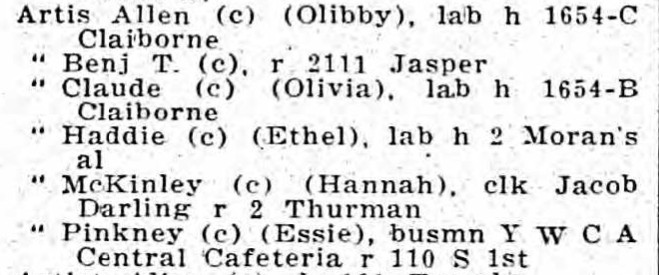
I still have not found Pinkney in the 1920 or 1920 censuses, but here he is in the 1932 city directory of Richmond, Virginia:

Screen Shot 2015-08-14 at 11.09.42 AM

Did he and Essie marry in Richmond? In DC? I don’t know. How long did they live there? I don’t know that either. But these finds add some texture and definition to Pinkney’s life, and I’ll continue to search.

Standard
Education, Migration, Oral History, Paternal Kin, Photographs

Back to school.

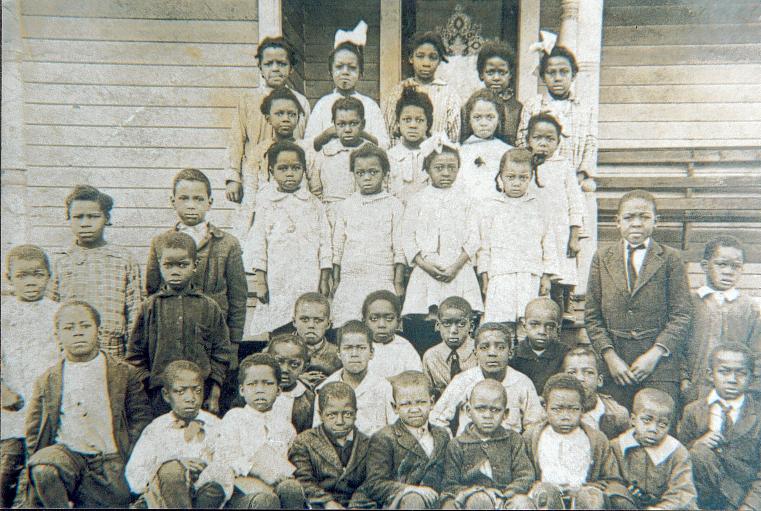
Atlanta has begun its new school year, and my Facebook timeline feed is dotted with pictures of beaming children. Just about a hundred years ago, my grandmothers started school for the first time. I have no photos of my father’s mother at that age, but she spoke to me of her anxious first days at an elementary school in New York City. She’d gone there with her great-aunt and adoptive mother, Sarah Henderson Jacobs, who occasionally traveled North for short stints of domestic work:

The first day I ever went to school, Frances [Aldridge Newsome, her paternal aunt] took me and her son Edward to school. And the building – I don’t remember what the building looked like inside – but I know we went in, and they had little benches, at least it was built around in the room. And you could stand there by it and mark on your paper if you wanted to or whatever. I didn’t see no seats in there. You sit on the same thing you were writing on.   It’s in that, it seem like, from what I remember, it was down in the basement. You had to go down there, and the benches was all the way ‘round the room. And the teacher’s desk — and she had a desk in there. And the children sat on the desk, or you stand there by it, or kneel down if you want to mark on it. First grade, you ain’t know nothing ‘bout no writing no how. And I went in, and I just looked. I just, I didn’t do nothing. I just sit there on top of the desk. And I was crying. I went back to Frances’ house, and then after they come picked us up, I said, well, “Frances, I want to go home.” Go where Mama was. So Frances said, “We’ll go tomorrow.” I said, “How come we can’t go today?”   She said, “Well, it’s too far to go now.” I said, “Well, can you call her?” And she said, “I don’t know the phone number, and I don’t know the name it’s in.” And so that kind of threw me; I finally went on to bed. But anyway before long they all took me back over to Brooklyn.

My mother’s mother also spoke of her early school days:

I never shall forget, we went to Golar’s school when there was a flu epidemic at home, and the schools were closed for months, you know. I don’t know how or why they closed them like that, but anyway, they were closed. And the county schools were open. And Papa used to take us down there to [her sister] Golar’s school. She had a school down there below Belmont. It wasn’t called Belmont. What’s the other one called? She had a little school in Williams Grove. And taught me so much more than them city schools. Girl, I’m telling you, I was in second grade, I never shall forget, she taught me how to crochet. She taught me how to crochet. She taught me how to do divisions. She taught me how to do fractions.

Morningside School 2

Margaret Colvert Allen, seated far right, third row. Circa 1915, Statesville.

Morningside School 3

Margaret C. Allen, second from right, second row from top. Her sister Launie Mae Colvert Jones, at left, first row of middle section. Circa 1916, Statesville.

Interviews of Hattie Henderson Ricks and Margaret Colvert Allen by Lisa Y. Henderson; all rights reserved.

Standard
Education, North Carolina, Other Documents, Paternal Kin

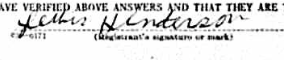
Signature Saturday, no. 6: James Henry’s Hendersons.

For decades, men (and the rare women) who apprenticed free children of color in North Carolina were required to teach them to read and do basic math. However, in the crackdown on free colored people that followed the Nat Turner Rebellion, this mandate was first ignored and then done away with altogether. It is not a surprise then that census records generally report that my great-great-great-great-uncle James Henry Henderson was illiterate.

JasHHenderson

James H. Henderson (1838-1920).

What of his children though? Was he able to send them to school long enough to gain at least the rudiments of literacy? His first five children were daughters. I have not found Mary Ella, Elizabeth or Nancy Henderson in census records as adults, but Amelia Henderson Braswell‘s entries indicate that she could neither read nor write. The evidence is mixed for James’ “outside” daughter Carrie M. Faison Solice, whose mother was Keziah “Kizzie” Faison. The 1900 and 1930 censuses say no, she could not; the 1910 and 1920 say yes, she could. As for James’ sons and youngest daughter and some of their offspring, here’s what I’ve found:

Elias Lewis Henderson (1880-1953) was James and Frances Sauls Henderson’s oldest son. He was a farmer and founder of Saint Mark Church of Christ, near Fremont, Wayne County. I am fairly certain that he could read, but have found no sample of his handwriting.

Elias L Henderson Text

David John Henderson (1901-1960) was E.L. and Ella Moore Henderson’s oldest son.

Screen Shot 2015-08-04 at 7.26.35 PM

Their second son was James Henry Henderson (1906-1947).

James Henry Henderson Sig

And Ira Junior Henderson (1911-1984) was their third.

Screen Shot 2015-08-08 at 1.52.25 PM

Jazell Westly Henderson (1924-2004) was Elias’ son with his second wife, Sarah Edmundson Henderson.

Jazell W Henderson Sig

James Ira Henderson (1881-1946) was James and Frances Henderson’s second son. He signed his World War I draft card with an X.

Screen Shot 2015-08-06 at 9.03.47 PM

Here’s the signature of Ira’s son, William Henry Henderson (1902-1974).

Screen Shot 2015-08-06 at 8.56.56 PM

James’ son Lewis Henderson (1885-1932) was named after his uncle, my great-great-great-grandfather Lewis Henderson (1836-1912).

Lewis Henderson Sig

Lewis had ten daughters and one son, James Ivory Henderson (1922-1986).

Screen Shot 2015-08-06 at 8.58.55 PM

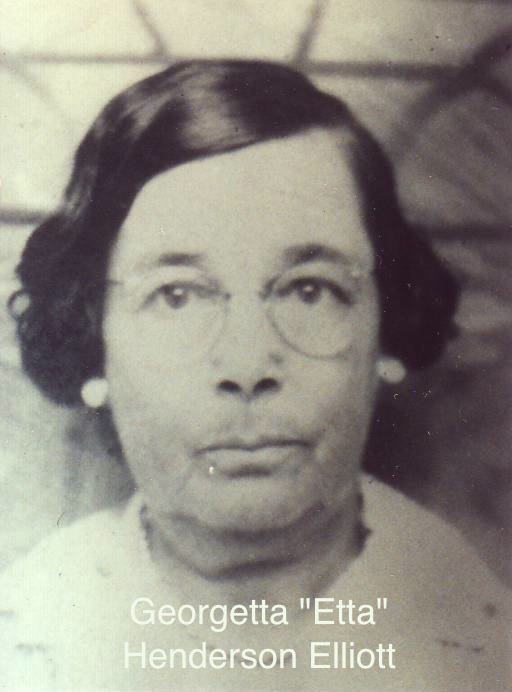
Georgetta Henderson Elliot (1889-1972), called Etta, was James and Frances Henderson’s youngest daughter. This signature appears on her daughter Mackie Bee‘s marriage license, but there is a possibility that it was inscribed by the officiating minister, rather than Etta herself.

Screen Shot 2015-08-02 at 4.06.41 PM

Georgetta Henderson 001 Text

Standard
Births Deaths Marriages, North Carolina, Paternal Kin, Photographs

The brothers.

Yesterday would have been Cousin Snook’s 92nd birthday. My grandmother spoke of him and his oldest brothers in tandem — “Snook, Dink and Jabbo.” They were her double cousins, the sons of her second cousin once removed Henry Lee Henderson and her aunt Nora Aldridge Henderson. Jabbo died early, without children, but my relationships with Dink and Snook’s descendants, as well as with their surviving youngest brother, are deeply cherished.

Dink and Snook

Johnnie D. “Dink” Henderson (1925-1992) and Horace B. “Snook” Henderson (1923-1984).

Aaron Henderson

Aaron H. “Jabbo” Henderson (1922-1944).

Standard
North Carolina, Paternal Kin, Photographs

Bessie, in color.

I’ve talked about Bessie Henderson‘s portrait before. It is perhaps the most cherished of the original photographs I hold, likely the only picture taken in her short life.

I recently asked my cousin J.G., great-grandson of Bessie’s first cousin Daniel Simmons, if he would take a shot at colorizing Bessie’s photograph. She died at 19 in early 1911, and no one now living ever saw her alive. (In fact, I’ve known only five people — my grandmother, her sister Mamie, Beulah Aldridge CarterFannie Aldridge Randolph, Jessie Mae Jacobs — who did. The last of them passed in 2001.) So I just wanted to see her as she might have looked. See her in something other than sepia tone.

And here she is.

Bessie Henderson 001 - before after side by side-2

I was struck on two fronts. First, there is Bessie’s beauty anew. And then … the detail. The lacy ruffles of her blouse, the tiny collar pin bar, the pleats of her skirt. And the background? It was years before I saw the white bird swooping past Bessie’s wrist. But trees? A pool of water? Ducks? Who knew?

Here’s a little video of Bessie’s progression. Thank you again, J.G.!

Standard
Births Deaths Marriages, North Carolina, Other Documents, Paternal Kin

Amelia Henderson Braswell.

A long time ago, like, maybe, in the late 1990s, I took a ride with my cousin L.H. over to LaGrange, Lenoir County, to visit Mackie Bee Elliott Williams. The daughter of Roland and Georgetta “Etta” Henderson Elliott, Cousin Mackie Bee was then a little more than 80 years old. Today, as I began writing this piece, I discovered that she passed away just this past March at the age of 97.

mbw

Cousin Mackie Bee as a young woman, early 1930s.

In that era before phone cameras and portable scanners, I’d arrived at Cousin Mackie Bee’s armed with my trusty old Canon AE-1 and several micro-filters. Fortune rewards the prepared. Cousin Mackie, whose grandfather was James Henry Henderson, had lined the walls of home with photographic portraits of her mother Etta and, to my astonishment, two of her aunts, Mary Ella and Amelia Henderson.

Of Mary Ella Henderson, I have found only one reference — the 1880 census of Brogden, Wayne County, which lists mulatto farmer James Henderson, his wife Frank, and children Mary, 12, Nancy, 10, and Lizzie, 6. Amelia was born in 1880, but too late to be counted by the census taker. I have been able to fill out some details of her short life, however.

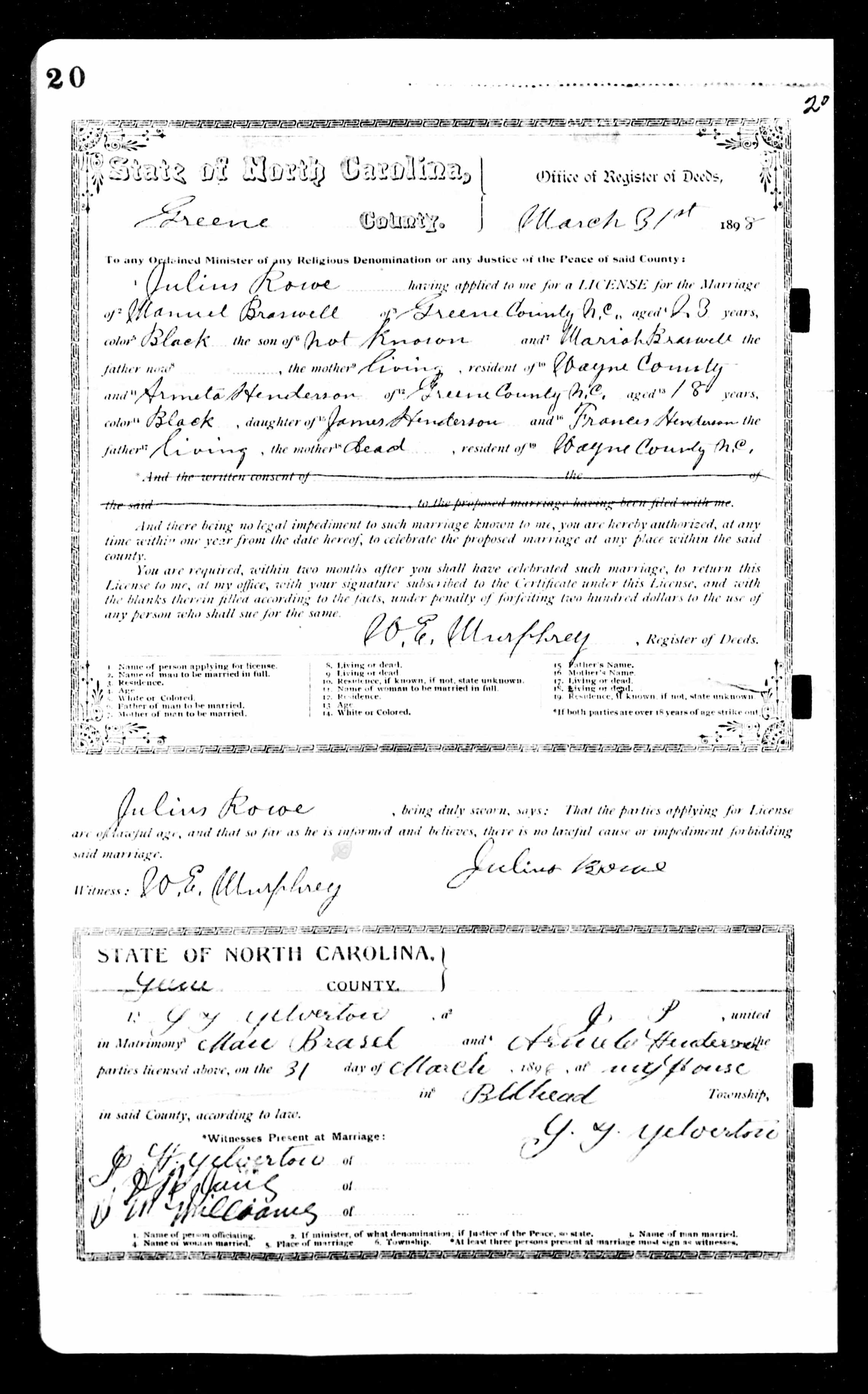
On 31 1898, 18 year-old Amelia Henderson married Manuel Braswell in Bullhead township, Greene County, North Carolina. Their license noted that she was a Wayne County resident, and, assuming she was still living in her father’s household in the far south of the county, I’m not sure how she would have met Braswell.

42091_342520-01232

By the time of the 1900 census, “Man” and Amelia Braswell were living in Nahunta, Wayne County, which bordered Greene County.  Man worked as a farm laborer; the couple had no children. Ten years later, they remained in the same area, still with no children.

Four years after that, Amelia Henderson Braswell was dead.

The death certificate for Amelia “Brazzell” records her death on 26 March 1914 in Goldsboro of uremic convulsions following an operation for pyosalpinx.  It was a slow and agonizing demise. Uremic convulsions are involuntary muscle spasms or seizures resulting from the toxic effects of kidney failure. Pyosalpinx is pus-filled infection of a fallopian tube. Amelia was 37.  Her brother Elias L. Henderson provided the information for her death certificate, and the family buried her in Jason, Greene County, the day after she died.

Amelia Henderson 001

Amelia Henderson Braswell (1880-1917)

Standard
Free People of Color, North Carolina, Paternal Kin, Rights

No damages.

More times than I might have imagined, see here and here and here and here and here, members of my extended family have figured in litigation that made its way to the North Carolina Supreme Court. Here’s another such case:

William Hooks v. William T. Perkins, 44 NC 21 (1852).

In 1845, the Wayne County Court of Pleas and Quarter Sessions bound brothers Rufus Artis and Thomas Artis to William Hooks to serve as apprentices until age 21. At the time of their indentures, Rufus’ age was reported as 7 and Thomas’ as 18. In 1849, after the court determined that Thomas was, in fact, only 15 when apprenticed, a judge ordered his indenture amended to correct his true age. Hooks, apparently, never got around to it.  Meanwhile, William Perkins hired Thomas. Deprived of the young man’s labor, Hooks attempted to enforce the court order, and Perkins took up Thomas’ cause.  Arguing that Thomas was bound to serve him until his true age of 21 — regardless of the age listed on his indenture — Hooks sued Perkins for damages for the period from November 1848 to February 1849 during which Perkins would not turn Thomas over.  The state Supreme Court held that Hooks should have amended Thomas’ indenture to reflect his actual age at the time it expired, per the court order.  Having failed to do so, Hooks was not Thomas’ master when Perkins hired him and was not entitled to damages.

Notwithstanding the court’s findings, Rufus, 11, and Thomas Artis, 20, were listed in the household of farmer William Hooks, along with another apprentice, W.H. Hagins, 15, in the 1850 census of North Side of the Neuse, Wayne County. (William Perkins does not appear in the county’s census at all.)  Worse, by 1860, Rufus Artis had lost ground, as the census of Nahunta, Wayne County, lists him as a 17 year-old — rather than the 21 or 22 year-old he actually was — in Hooks’ household, along with Polly Hagans, 15, and Ezekiel Hagans, 13.  In other words, what Hooks could not get out of Thomas Artis, he appears to have extracted from his younger brother.

Rufus Artis eluded the census taker in 1870, but he was around. On Christmas Eve 1874, he married Harriet Farmer in Wayne County. The family appears in the 1880 census of Nahunta, Wayne County: Rufus Artis, 46, wife Harriet, 30, and daughters Hannah, 13, and Pennina, 9. The family lived very near a cluster of three other sets of extended Artis families descended from Vicey Artis, Celia Artis, and Vincent Artis, none of whom were not known to have been related. (Or, at least, not closely so.) In the 1900 census of Nahunta, Rufus and Harriet, their children grown and gone, shared their home with Harriet’s mother, 73 year-old Chanie Farmer. Daughter Pennina had married Curry Thompson, son of Edie Thompson, on 11 October 1893 in Wayne County. They had two daughters, Harriet (1895) and Appie (1896). On 10 January 1917, Harriet Thompson married John Henry Artis, born 1896 to Richard Artis and Susannah Yelverton Artis. Richard, of course, was the son of Solomon Williams and Vicey Artis, and the brother of my great-great-great-grandfather Adam T. Artis.

Standard
North Carolina, Other Documents, Paternal Kin

Signature Saturday, no. 5: Napoleon Hagans and family.

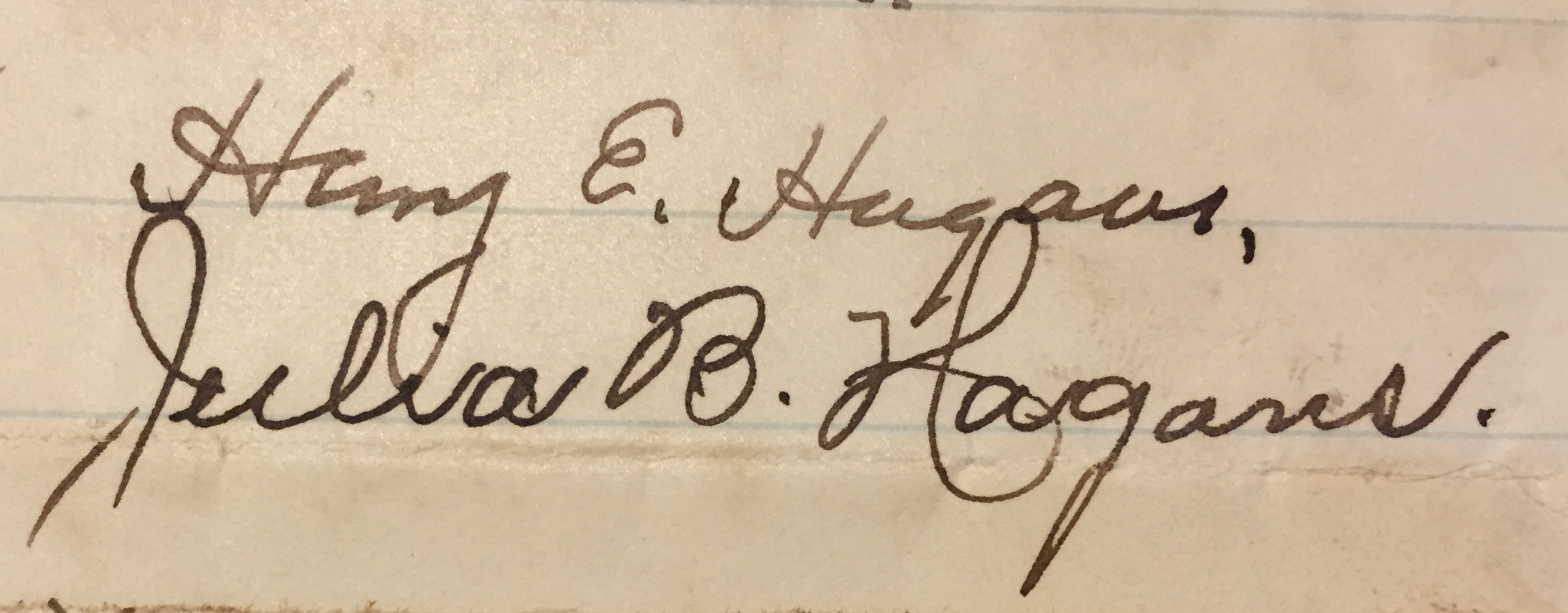
Napoleon Hagans, self-made man, could neither read nor write. His wife, Appie Ward Hagans, born into slavery, picked up the rudiments of an education at some point in her life and was able to scratch out a shaky signature, as shown in this 1888 deed. By time his sons were born, Napoleon had begun his ascent into Wayne County’s African-American elite, recognized by both blacks and whites as a savvy and successful cotton farmer. Thanks to his wealth, the children he reared, Henry and William Hagans, would lead lives very different from their father’s, starting with their educations at local schools and then Howard and Shaw Universities.Napoleon Hagans X Appie Hagans SigHenry E. Hagans spent much of his life as a teacher and principal, and his small, firm hand reflects his pedagogical life. He likely met his wife, Julia B. Morton of Danville, Virginia, at Howard. This sample of their signatures is on a deed dated 1899.
HE Hagans & Julia Hagans SigWilliam Hagans’ signature was bolder and more architectural than his brother’s, as shown on the 1916 deed below. Though not a teacher, his early career as secretary (read: assistant or even chief of staff, if there was additional staff) to United States Congressman George H. White and as businessman/farmer provided ample opportunity for him to display his conjoined signature. (William M. Artis, son of Adam T. and Frances Seaberry Artis, was William Hagans’ first cousin, and Hannah E. Forte Artis was the wife of William Artis’ brother, Walter S. Artis. William likely did not attend school beyond eighth grade, but his penmanship is lovely. Hannah, too, clearly benefitted from several years of schooling. I wish I knew more about late 19th century rural African-American schools in Wayne County.)
WS Hagans WM Artis Hannah Artis Sig

Standard
Births Deaths Marriages, North Carolina, Other Documents, Paternal Kin

Jonah’s Jonah.

This caught me a bit by surprise.                                    42091_343647-01367

Jonah Reid’s first wife was Magnolia “Maggie” Artis, daughter of Thomas Artis and Loumiza Artis ArtisPatrick Exum and J.D. Reid witnessed their marriage on 30 August 1892 in Wayne County.  Patrick’s mother, Delilah Williams Exum, was Maggie’s late mother’s sister.  (Judge James Daniel “J.D.” Reid was Jonah’s maternal uncle.  He would later become a prominent school principal, bank promoter and hospital administrator in Wilson, North Carolina.  Jonah and Maggie named their son Judge Daniel Reid in his honor.) Magnolia Artis Reid died of apoplexy on 1 June 1939 in Township No. 13 [Cokey], Edgecombe County. She was 68 years old.

Three months later, as shown above, Jonah Reid remarried. That’s a little surprising. So soon. At his age. But what’s really surprising is whom he named as his father. Jonah Williams?

Elder Jonah Williams?

Jonah Reid appears in the 1880 census of Nahunta, Wayne County, in the household of his widowed grandfather Wash Reid (spelled “Reed.”) Washington Reid was one of several related Reids, born free in the early 19th century, who built successful farms in the area of Turner Swamp. Several members of this family intermarried with Artises, including Isaac Reid, who married Adam T. Artis‘ daughter Ida in 1877; William Reid, who married Zilpha Artis Wilson‘s daughter Bettie in 1882; Henry Reid who married Adam Artis’ daughter Georgianna in 1883; John Gray Reid, who married Richard Artis‘ daughter Emma in 1907; and Milton C. Reid, grandson of William and Bettie, who married his cousin Nora M. Artis, granddaughter of Adam Artis, via son Noah, in 1916. Wash and Penninah Reid’s daughter Louisa gave birth to Jonah Reid about 1874. (She later married Perry Barnes.) That same year, Jonah Williams’ wife Pleasant had a daughter, named Vicey after his mother.

Jonah Reid’s first marriage license does not list his parents. (If in fact his father was the Jonah Williams, Reid was marrying his first cousin, which was not uncommon during the time.) In his second, he openly claimed Jonah Williams as his birth father.  His marriage license is not proof of paternity, but does suggest a starting point for researchers in his line.

Standard