Agriculture, Land, North Carolina, Other Documents, Paternal Kin

A home for his lifetime.

The seventh in an occasional series excerpting testimony from the transcript of the trial in J.F. Coley v. Tom Artis, Wayne County Superior Court, November 1908.

Defendant introduces JESSE ARTIS who being duly sworn, testified:

I had a conversation with Tom Artis and Hagans about this land. I was working there for Hagans (Plaintiff objects) as carpenter. Tom Artis was working with me. The Old man Hagans was talking to Tom about claim which Mrs. Exum had on his land, and was telling him that he had some money at that time, and was would take it up if he wanted to, and give him a home for his lifetime. He left us, and Tom talked to me. I told him he did not know whether he would have a home all his life or not. I advised Tom to let Hagans take up the papers, and Tom did so. Hagans told me next day that if Tom should pay him 800 lb. of cotton he should stay there his life time. When he paid him his money back, the place was his. I don’t know that Tom and I are any kin. Just by marriage. We are not a member of the same Church.

CROSS EXAMINED.

When I was a carpenter ‘Pole told me all about this on his place. He took me into his confidence. I don’t know whether he told me all. He told me a good deal.

——

Jesse Artis (circa 1847-circa 1910) was a brother of my great-great-great-grandfather Adam Artis and his brother Jonah Williams, the latter of whom also testified in this trial.

Standard
Education, Land, North Carolina, Other Documents, Paternal Kin

The question of a half-acre in Fremont.

North Carolina, Wayne County    }         In the Superior Court Before A.T. Grady C.S.C.

A.A. Williams & R.J. Barnes          }

vs                                                               }         Complaint

John W. Moore & Isaiah Barnes   }

The plaintiffs allege

1. That the plaintiffs and the defendants are tenants in common of a lot of land situate in the town of Fremont in said State and County adjoining the lands of W.R. Ballance & others bounded as follows:

Beginning at a stake in the centre of Sycamore Street below J.P. Hopewell’s lot and running the centre of said street 47 yards; then at right angles with said street nearly East to R.E. Cox and W.R. Ballance line; then nearly North with said line 47 yards to a stake thence nearly west to the beginning containing one half acre.

2. That the plaintiffs and the defendants are seized and possessed in fee simple of said lands as tenants in common in the following proportions to wit   1. A.A. Williams to one third part thereof 2. R.J. Barnes to one third part thereof 3. Isaiah Barnes to one sixth part thereof 4. John W. Moore to one sixth part thereof

3. That the defendants Isaiah Barnes and John W. Moore refuse to [illegible] with the plaintiffs in a petition for the sale of said lands for division.

4. That the plaintiffs desire to have partition of said land made amongst the plaintiffs and the defendants according to their respective rights and interests therein so that each party may hold his interest in severalty, but the number of the parties interested it is impossible that actual partition thereof can be made without serious injury to the parties interested

Wherefore the plaintiffs demand judgment

1. That the plaintiffs and the defendants be declared tenants in common in said lands

2. That an order issue for the sale of said lands on such terms as this Court shall deem reasonable and that the proceeds of such sale may be divided among the plaintiffs and the defendants according to their respective shares and interests in the said lands.

   W.S.O’B.Robinson, Atty for plaintiffs

——

North Carolina, Wayne County    }   Superior Court Before the Clerk

A.A. Williams & R.J. Barnes

vs

Jno. W. Moore et als

The defendants Jno. W. Moore, Isaiah Barnes and R.J. Barnes, answering the petition herein say:

I. That paragraph I thereof is not true.

II. That paragraph II thereof is not true.

III. That paragraph III thereof is not true.

IV. That paragraph IV thereof is not true.

For a further defense defendants allege:

I. That on the [blank] day of 1888, the plaintiffs and defendants, together with Geo. Aldridge and Wm. Durden for the purpose of obtaining a school site for a free school in District No. 6 Colored, in Wayne County, which district had been in July 1888 created at the request of the said persons above-named, paid for the lot of land described in the petition and procured a conveyance thereof from R.E. Cox to themselves, it being the intent and purpose of all the parties thereto that the parties in said deed should hold the lot therein conveyed as trustees for the said district for use as a free school in the same, and that the said deed should be executed to them as said trustees.

2. That by the eventual mistake of the parties to said deed the same was executed by the said R.E. Cox to the parties individually and not as trustees.

Wherefore defendants pray that they be hence dismissed and that they receive their costs of plaintiff A.A. Williams and for such other and further relief is they may be entitled to.

                                   Aycock & Daniels, Attys for Deft.

——

These undated pleadings do not exactly speak for themselves, but I hesitate to read into them something that’s not there. I don’t know how the suit turned out, but if the answer is credited, something like this happened: my great-great-grandfather John Aldridge‘s brother George and five others purchased a half-acre from R.E. Cox to be used for the erection of a school for Fremont’s African-American children. (That’s how it worked then — communities had to donate the land for schools to be built upon.) Through mistake and oversight, Cox made out the deed to the six men individually, rather than as trustees. Subsequently, Williams and R.J. Barnes, seeking to take advantage of the tenancy in common, sought to force a sale of the land — which was too small to divide — so that each owner could cash out his share.

Who were these folks?

  • A.A. Williams was a teacher and principal of the Colored Graded School in Goldsboro.
  • John W. Moore appears in the 1880 census of Nahunta, Wayne County, as a 57 year-old farmer. He is named in Goldsboro newspaper as active in colored school affairs.
  • Isaiah Barnes appears in the 1880 census of Fremont, Wayne County, as a 30 year-old farm laborer.  By 1894, he is named in Goldsboro newspapers as a poll holder for Fremont voting district.
  • R.J. Barnes cannot be identified.
  • William E. Durden is most likely the “William Darden” who appears in the 1880 census of Nahunta, Wayne County, as a 29 year-old farmer.
  • R.E. Cox was a physician and Fremont town commissioner. Goldsboro newspaper show that he also owned a drugstore and was active in other business ventures. He was white; the other men were African-American.

Document found in School Records, Miscellaneous Records, Wayne County Records, North Carolina State Archives. 

Standard
North Carolina, Oral History, Paternal Kin, Photographs

A Kerchief of Sense.

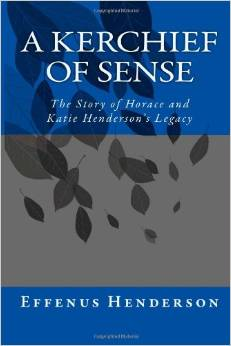
Timed to coincide with the anniversaries of his father’s birth in 1923 and his mother’s death in 1963, Effenus Henderson‘s recent memoir, A Kerchief of Sense, is available at Amazon.com. It is a simultaneously heart-breaking and heart-warming story of family and faith.

kerchief

So much of what Effenus has written of occurred during the period that our branches of both the Henderson and Aldridge families had lost contact. I found my way back to them through my grandmother and father, who often mentioned that we had a cousin called Snook — Horace Henderson — still down in Dudley. My grandmother only knew bits and pieces of the story told here, but her recollections led to our reconnection with his children and our larger family. Tribulation was no stranger to either of our lines, but we survived and now thrive. Thank you, Effenus, for capturing this aspect of our common legacy.

snook 12 2

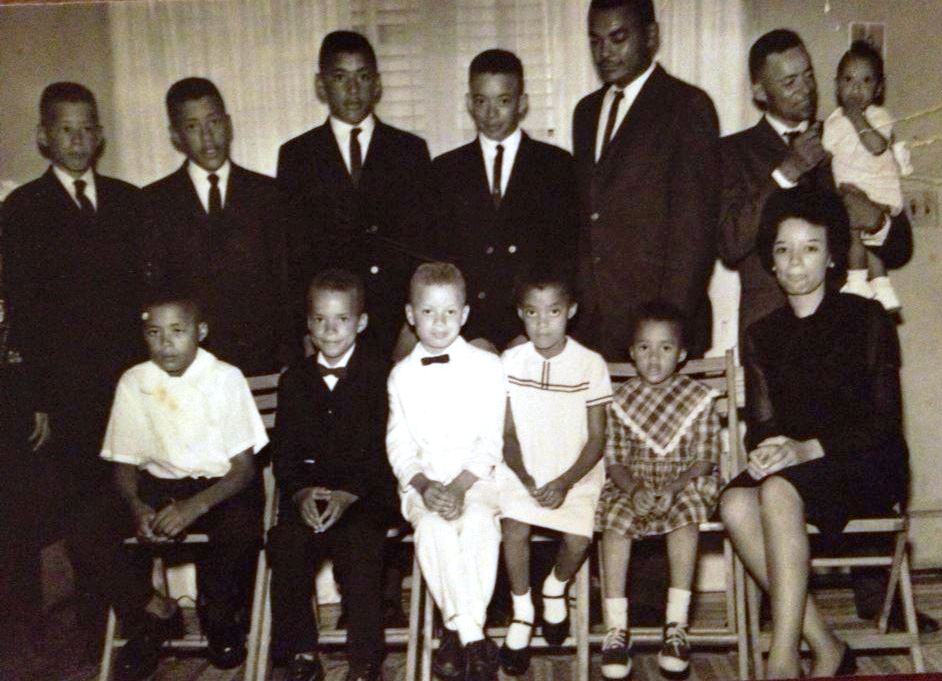
Horace Henderson Sr. and his twelve children, 1963.

Standard
North Carolina, Paternal Kin

Reunions.

Thanksgiving break of my senior year in college. My first visit to Dudley on my own. I’d cold-called my cousin L., just based on my father telling me every time we passed down Highway 117 — “we have a cousin Snook that lives there.” My grandmother had talked about Snook, too. And his brothers Dink and Jabbo. So I called, and I introduced myself, and got a warm and immediate invitation to visit. I took my first cousin T. down the next spring,

dudley 86

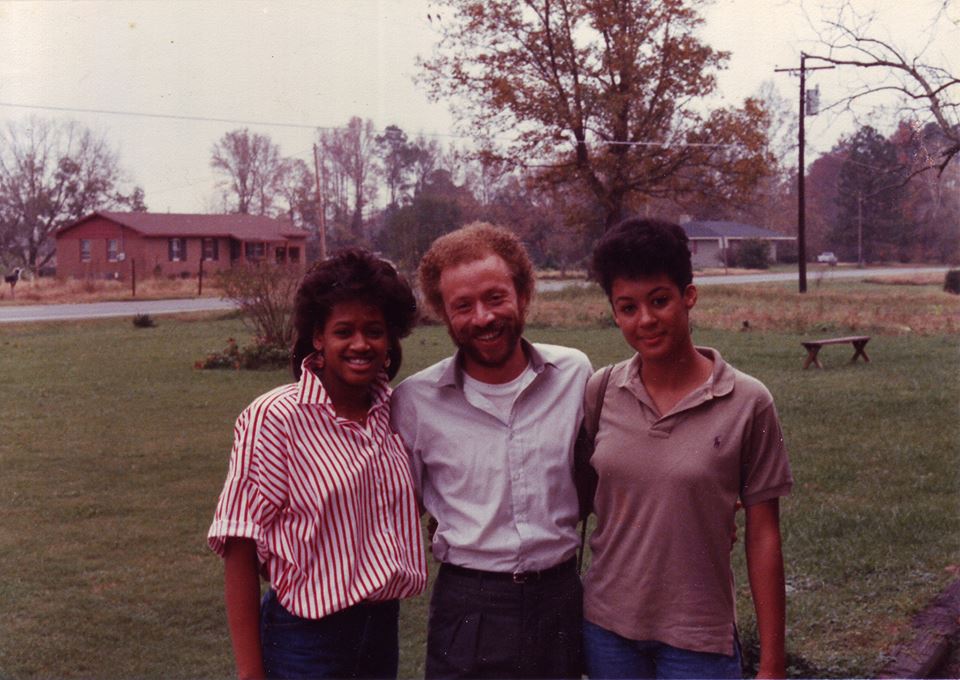
T.L., L.H. and me in Dudley, Spring 1986.

and the following summer, at a serendipitous family reunion, my grandmother was reunited with Hendersons and Aldridges that she hadn’t seen in decades. Aaron “Jabbo” Henderson had long ago gone on, and Horace “Snook” Henderson Sr. had passed just a few years before, but there were Johnnie “Dink” Henderson and brother K.H. and sisters O.H.D., F.H.T. and M.H.S., my grandmother’s first cousins in one direction and second in another.

cousins

My grandmother and me with cousins O.D. and F.T., Henderson Family Reunion, early 1990s.

As L. recently wrote about the first photo above, “I remember that day so vividly. I believe this was the day we were introduced as cousins. Such a beautiful and blessed moment which has caused for many good times and good memories. Praise God for bringing us and our families together. Long lost cousins!”

It’s been a blessing indeed. Over the intervening years, I’ve become closer to many of these cousins than to some I’ve known all my life. The links we’ve forged have been a testament to the meaning of family and the insolubility of its bonds. Today I got a call from one of Snook’s grandsons, inviting me to help create a video project about our family’s history. For real? “Of course!,” I nearly shouted. The blessings keep flowing.


Standard
Agriculture, Land, Newspaper Articles, North Carolina, Paternal Kin

No need for exodusting.

Napoleon Haganstestimony before a Senate committee was not his last word on the migration of African-American farmers out of North Carolina. Nine months later, he — or someone for him, in any case, as he was unlettered — penned a letter to the editor of the local newspaper, recounting his agricultural success and exhorting his “race” to cast down their buckets where they were. His sentiments were echoed by Jonah Williams, his friend, neighbor, pastor and brother-in-law’s brother. (Jonah, too, was illiterate. Both men, however, were strong believers in the value of education and saw that their children received the best they could afford. See here, here and here.)

Goldsboro_Messenger_12_30_1880_exodusting

Goldsboro Messenger, 30 December 1880.

Standard
Births Deaths Marriages, Migration, Newspaper Articles, North Carolina, Paternal Kin, Photographs, Virginia

Adam’s diaspora: Haywood Artis.

I’ve written here and here about the migration of Adam T. Artis‘ children Gus K. and Eliza to Arkansas. Though most of his 30 or so children remained in North Carolina, a few went in North. Or, at least, a little further north. One was Haywood Artis, born about 1870 to Adam and his wife Frances Seaberry Artis. He was my great-great-grandmother Vicey‘s full brother.
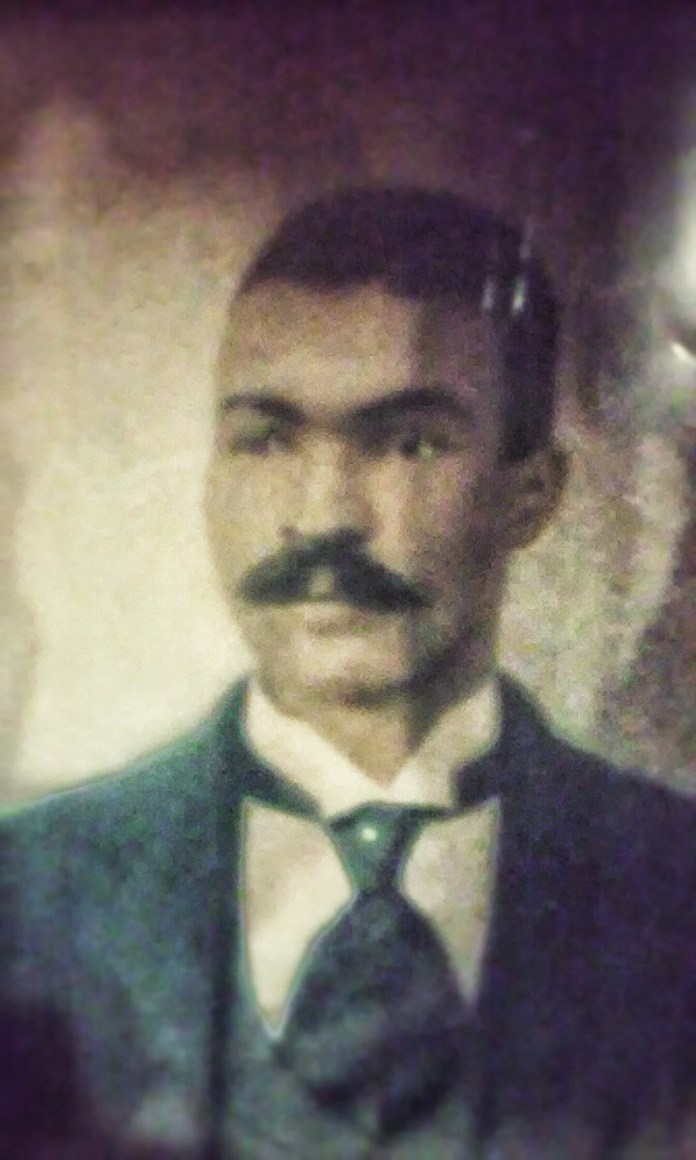
20150204_170518~2

                          Haywood Artis

In the 1880 census of Nahunta, township, Wayne County, North Carolina, Adam Artis, widowed mulatto farmer, is listed with children Eliza, Dock, George Anner, Adam, Hayward, Emma, Walter, William, and Jesse, and four month-old grandson Frank Artis.  (I’ve never been able to determine whose child Frank is.]

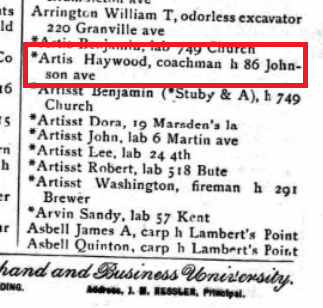
Haywood’s whereabouts over the next 15 years are unrecorded, though he was likely still living in his father’s home most of that time. However, at some point he joined the tide of migrants flowing into Tidewater Virginia, and, on 13 January 1897, in Norfolk, Virginia, Hayward Artis, age 26, born in North Carolina to A. and F. Artis, married Hattie E. Hawthorn, 23, born in Virginia to J. and E. Hawthorn. As early as 1897, Haywood began appearing in city directories for Norfolk, Virginia. Here, for example, is Hill’s City Directory for 1898:

Hartis

Haywood and Hattie and their children Bertha E., 3, and Jessie, 11 months, appeared in the 1900 census of Tanners Creek township, Norfolk County, Virginia. The family resided on Johnston Street, and Haywood worked as a porter at a jewelry store. Ten years later, they were in the same area. Haywood was working as a farm laborer, and Hattie reported four or her seven children living — Bertha, 12, Jessie, 11, Hattie, 8, and M. Willie, 2.

In the 1920 census of Monroe Ward, Norfolk, Haywood and Harriet Artis appear with children Elnora, 22, Jessie, 20, Hattie, 18, Willie Mae, 12, Haywood Jr., 8, and Charlie, 5.  Haywood was a farm operator on a truck farm, daughters Elnora and Hattie were stemmers at a tobacco factory, and son Jesse was a laborer for house builders.

By 1930, the Artises were renting a house at Calvert Street.  Heywood Artis headed an extended household that included wife Harriett, Haywood jr. (laborer at odd jobs), Charles, son-in-law Daniel Johnson (machinist for U.S. government) and his wife Hattie (bag maker at factory), cousins Henry Sample, Raymond G. Mickle, and Lois Sample, and granddaughters Mabel Johnson, 2, Olivia Washington, 15, and Lucille, 13, Bertha, 9, and Lois Brown, 6.

On 19 March 1955, Haywood Artis’ obituary appeared in the Norfolk Journal and Guide:

Haywood Artis, who has made his home in Norfolk for some 65 years, was buried following impressive funeral rites held at Hale’s funeral home March 7 with the Rev. W. H. Evans officiating.

Mr. Artis died March 4 at the home of his daughter, Mrs. Willie Mae Yancey, 2734 Beechmont avenue, after a long illness.

Mr. Artis, who was born in Goldsboro, NC, is survived by three daughters, Mesdames Elnora Brown, Hattie Johnson and Willie Mae Yancey, all of Norfolk, and a son, Hayward Jr., of New Jersey.

There are also 34 grandchildren, 33 great-grandchildren and other relatives and friends.

Interment was in Calvary Cemetery.

Thanks to B.G. for the copy of his great-great-grandfather Haywood Artis’ photograph.

Standard
Births Deaths Marriages, North Carolina, Paternal Kin, Photographs

52 Ancestors in 52 Weeks: 7. Love.

My parents celebrate 54 years of marriage in May, God willing. They have always been my model of deep and enduring love, and I have celebrated them here. For this week’s Ancestor Challenge, I’ve chosen to highlight a different kind of love.

My grandmother, Hattie Mae Henderson Ricks, and her sister, Mamie Lee Henderson Holt, were born into difficult circumstances. Their mother Bessie Lee Henderson, teenaged and unmarried, had been orphaned as a toddler. When Bessie died months after Hattie’s birth, the family gathered to decide who would rear the girls. Mamie remained in Dudley with their aged great-grandparents, Lewis and Margaret Henderson, and Hattie went to Wilson to live with their grandmother’s sister, Sarah Henderson Jacobs. They were not reunited until Grandma Mag’s death, when Mamie was 8 and Hattie, 5. They separated again just 7 years later, when Mamie married a young man she met while visiting relatives in Greensboro. Nonetheless, despite the short time they lived together in childhood, my grandmother and her sister were devoted to one another. Their fierce sisterly bond defied the uncertainty of their earliest years and the emotional neglect of their years with Mama Sarah. It knit their children and grandchildren in a web that continues to hold. Even my grandmother’s move to Philadelphia in 1958 did not shake it. Every Christmas, she visited us and my aunt’s family in Wilson, then my father drove her to Greensboro to bring in the New Year with the Holts. Eventually, Alzheimer’s began to claim Aunt Mamie’s mind and memories, and travel became too difficult for my grandmother, but her attachment did not waver. Only when Aunt Mamie passed did my grandmother begin to let go. Nine months later, almost to the day, she was gone.

After my grandmother passed in 2001, I found a note she wrote about her early life: Heart Broken Mother – Bessie Died age Nineteen Leaving two out of wedlock Girls arounds 3 years and 8 months old. … My sister and I always felt very close to each other as we had no real parents It had been a hard life for both of us

This is the love I celebrate in this week’s challenge. The first love that comes with family. The love that, if we are fortunate, endures the entire arc of life.

Mamie&hattie 001

Mamie and Hattie Mae Henderson, circa 1920.

Mamie&Margaret 002

The sisters, probably in Greensboro, 1940s.

Willow Road

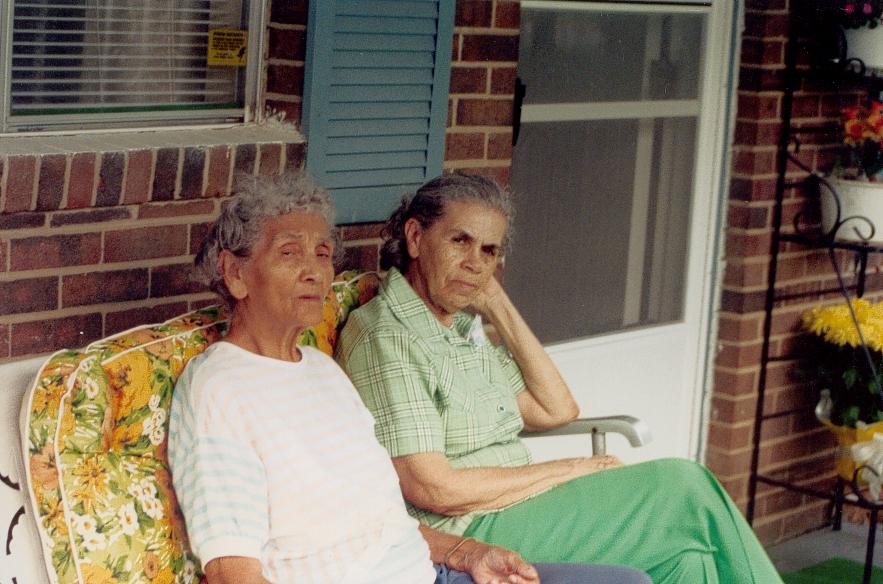
The sisters on Aunt Mamie’s porch in Greensboro, probably late 1980s.

Standard
Enslaved People, Maternal Kin, North Carolina, Paternal Kin, Photographs, Virginia

Freedom’s faces.

Yesterday was the 150th anniversary of Congress’ passage of the Thirteenth Amendment, which abolished slavery in the United States. On Facebook, several friends posted links to sites featuring “never-before-seen” photographs of formerly enslaved Americans, most taken in the 1930s. As I clicked through these images, struck by the strength and endurance embodied, I had a sudden thought — I’ve got a few photos of former slaves, too. And they’re my own people.

——

McNEELY -- Martha M McNeely in blue dress

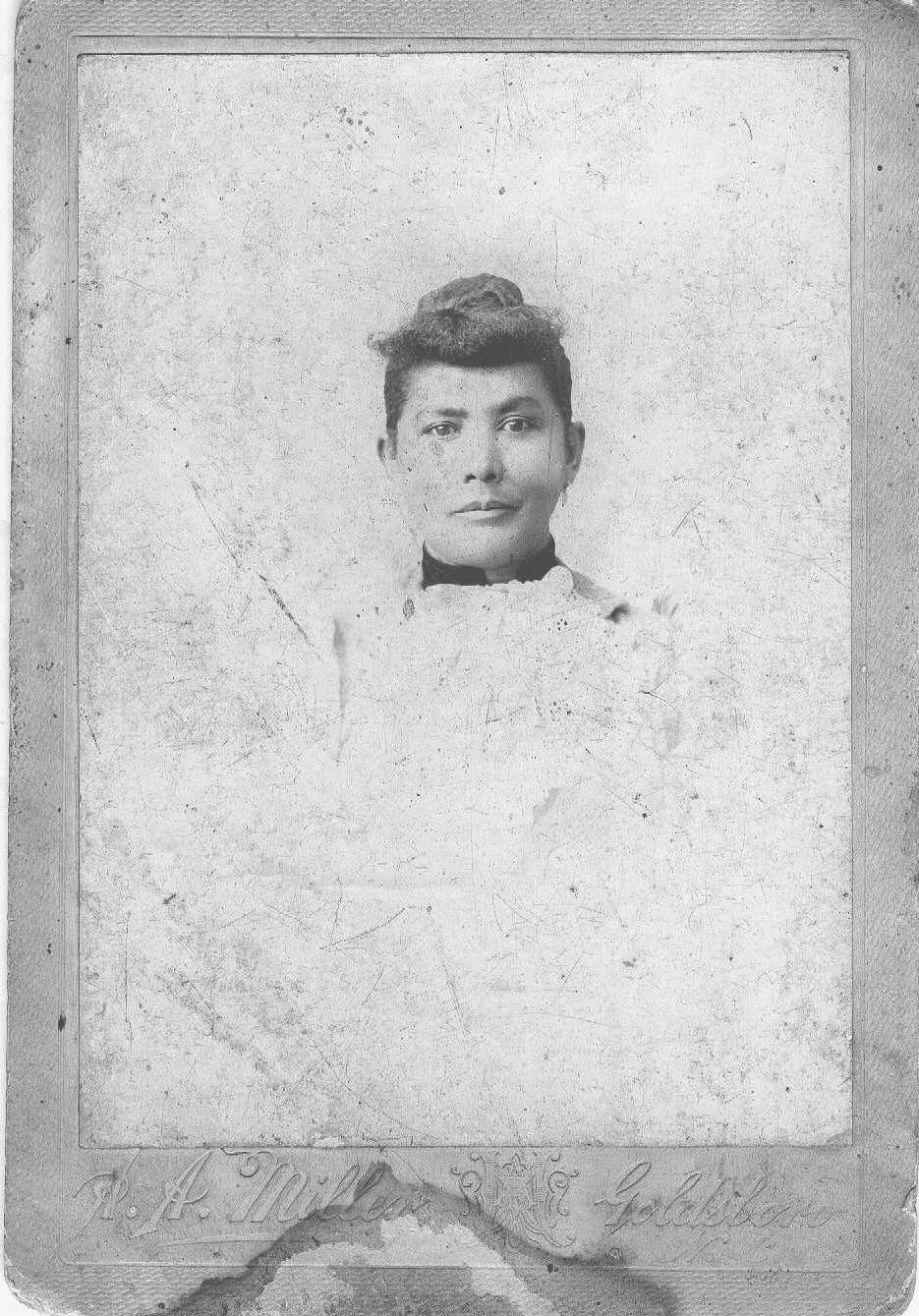
Martha Margaret Miller McNeely. Born about 1855 in Rowan County, North Carolina, to Margaret McConnaughey and Edward Miller. Enslaved by John M. McConnaughey. My matrilineal great-great-grandmother.

 NICHOLSON -- Harriet Nicholson 2

Harriet Nicholson Tomlin Hart. Born in 1861 in Iredell County, North Carolina, to Lucinda Cowles and James Lee Nicholson. Enslaved by Thomas A. Nicholson, her grandfather. My maternal great-great-grandmother.

Mary Brown Allen

Mary Brown Allen. Born about 1849 in Amelia County, Virginia, to Catherine Booker and James Brown. Owner unknown. Maternal great-great-grandmother.

Aspilla Ward Hagans

Apsilla “Appie” Ward Hagans. Born 1849 in Greene County, North Carolina, to Sarah Ward and Dr. David G.W. Ward, her owner. Wife of my great-great-great-great-uncle Napoleon Hagans.

Mittie_Ward

Mittie Ward Vaughn. Born 1849 in Greene County, North Carolina, to Sarah Ward and Dr. David G.W. Ward, her owner. Twin of Appie, above. Mother of son of my great-great-great-great uncle Napoleon Hagans.

——

In tribute to these and countless others, known and unknown, who walked through this country’s darkest days.

Standard