Other Documents, Photographs

52 Ancestors in 52 Weeks: 6. So far away.

I thought first about this week’s challenge in a spatial sense. Who was so far away? My grandmother in Philadelphia, to whose home we voyaged every summer from North Carolina? My New York relatives? My Chicago cousins? And then I remembered this, an “autobiography” I wrote as a class assignment in fifth grade. Forty years ago. So far away indeed.

——

THE AUTOBIOGRAPHY OF LISA HENDERSON

by Lisa Henderson 

This Autobiography is dedicated to: my parents for providing me with memories

Table of Contents:

Preface i Autobiography 1 Time Line 7 Family Tree 8 Book List 9

Preface

This autobiography was written by me as a project. I hope it will be a success to me.

The Autobiography of Lisa Henderson

I guess I have a good sense of timing. June 26 in the late [meaning ‘upper,’ as in temperature] 90’s was when I was born. Just in time for a tan. I was born at 4:50 P.M. at Mercy Hospital. I weighed 7 pounds 10 ounces and was 22 inches long. When I was about six months old, I came down with bronchitis. It was one of my few very serious childhood diseases. I moved from 706 Ward Boulevard to 1401 Carolina St., at about 8½ months. I lived on Carolina St. until a little more than a year ago when I moved again. At 14 months I started walking. I was at my Uncle J____’s house. I took my first steps at home though. From ages 1½ to 3 years I stayed with Mrs. Speight while my parents worked. I played with my cousin M____. We had wood blocks to play with. Sometimes we went on walks with A____ and B____ her two [grand]sons. Once, going to her house I fell in the street and busted my knee. I know I had a fit. We went to the Philadelphia and I went to the Philadelphia Zoo for the first time when I was about two. When I was three my sister was born. Mama and Daddy named her K____. She got meningitis when she was about 6 months old and stayed in the hospital 21 days. At age four I entered nursery school at Kiddie Kollege of Knowledge. Most of my immediate friends and cousins in Wilson who were of age were there, too. My teachers were Mrs. H___ and Mrs. P___. At 4½ I broke my fingernail in half in a 2-inch door. I was taken to the emergency room at the clinic. I got it all plastered up. T____ and I used to slide off the cast and look at my black, blue, purple and green finger. When I was five I entered kindergarten at Kiddie Kollege of Knowledge. All my friends and cousins except four people were gone to the first grade. Kindergarten wasn’t very exciting. I guess the most exciting thing was graduation. At graduation I got a Timex Cinderella watch. During the summer between kindergarten and first grade I got my [smallpox] vaccination. I got it on my back because in order to please complainers they were putting it back there instead of on your arm. In that same summer I got cellulitis. A mosquito bit me and I scratched it and scratched it and scratched it, until it got infected and ate my first layer of cells. I came back to Wilson from Virginia and went to the doctor. He said I had to go to the hospital. I stayed there 6 days. I went to B.O. Barnes School when I was in first grade. My teacher’s name was Mrs. B____. It was in the first grade that I met V___ and J____. She came from Mrs. H____’s room. In the second grade I met another good friend J____ and B____. I was in Mrs. M____s room. In January we had Mrs. F___ because Mrs. M____ had to go to the hospital. I got my first dog when I was in the second grade. His name was Tiger. When he got run over I had a fit. Also, when I was in the second grade my father had an accident. He was playing volleyball when a boy threw the ball and hit his finger. The ball flew with such force that the finger was broken. He said he could see the bone and flesh when it happened. Were it healed is still a big knot. Upon entering third grade I realized something. Of all my three years in elementary school I had been in the same homeroom as B____ and M____. I was named secretary of the class by my teacher, Mrs. P____. In fourth grade I went to Vinson-Bynum from B.O. Barnes. My teacher was Mrs. E____. In fourth grade I rode a bus to school for the first time. It was Bus 73. In the later part of fourth grade I moved to 2___ Bel Air Avenue. I rode Bus 70 when I moved to Bel-Air. I met W____ in the 4th grade.

——

And, yes, that’s The End. I don’t know what else to say about this pithy summary of my first 10 years, except I seemed to have lots of fits and had a very narrow notion of what aspects of life and people in it warranted memorialization.  I got an A, though. And that family tree in the table of contents? It marks the first time I ever asked questions about my ancestors.

Lisa 5th grade

1974-75.

Standard
Maternal Kin, Photographs, Religion

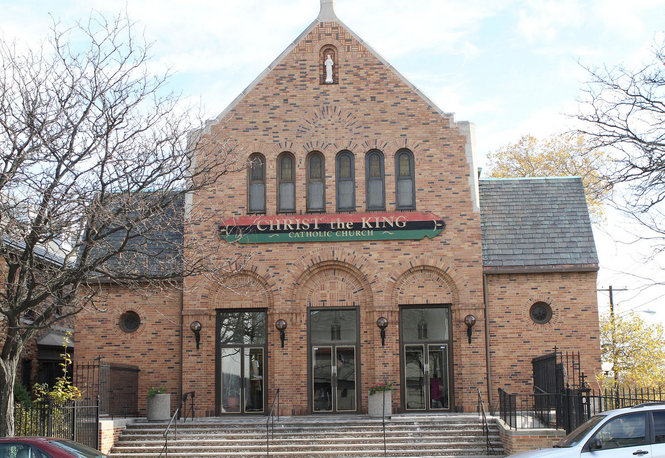
Church home, no. 9: Christ the King Catholic Church, Jersey City, New Jersey.

After my recent 52 Challenges post, I started wondering about the church my great-grandmother and cousins are standing in front of. My grandmother and her sisters were reared Episcopalian (and AME Zion), so I assumed that it was an Episcopal church. To my surprise, my cousin G.W., son of the oldest daughter of my great-aunt Launie Mae Jones Colvert, identified it as Christ the King Catholic Church.

Catholic??? Aunt Launie Mae was Catholic?

Another cousin, K.J., chimed in. She’d talked to her mother, who said that in Aunt Launie Mae “had told her she converted to Catholicism after my grandfather was sick (with TB), and the Catholic church was there for her.” (Aunt Launie Mae’s husband was Isaiah James Jones (1912-1984), a native of Georgia.) This would have been in the early 1940s. The things you learn when you least expect.

11898265-standard

(I wonder what happened to those beautiful wooden doors?)

Standard
Enslaved People, Maternal Kin, North Carolina, Paternal Kin, Photographs, Virginia

Freedom’s faces.

Yesterday was the 150th anniversary of Congress’ passage of the Thirteenth Amendment, which abolished slavery in the United States. On Facebook, several friends posted links to sites featuring “never-before-seen” photographs of formerly enslaved Americans, most taken in the 1930s. As I clicked through these images, struck by the strength and endurance embodied, I had a sudden thought — I’ve got a few photos of former slaves, too. And they’re my own people.

——

McNEELY -- Martha M McNeely in blue dress

Martha Margaret Miller McNeely. Born about 1855 in Rowan County, North Carolina, to Margaret McConnaughey and Edward Miller. Enslaved by John M. McConnaughey. My matrilineal great-great-grandmother.

 NICHOLSON -- Harriet Nicholson 2

Harriet Nicholson Tomlin Hart. Born in 1861 in Iredell County, North Carolina, to Lucinda Cowles and James Lee Nicholson. Enslaved by Thomas A. Nicholson, her grandfather. My maternal great-great-grandmother.

Mary Brown Allen

Mary Brown Allen. Born about 1849 in Amelia County, Virginia, to Catherine Booker and James Brown. Owner unknown. Maternal great-great-grandmother.

Aspilla Ward Hagans

Apsilla “Appie” Ward Hagans. Born 1849 in Greene County, North Carolina, to Sarah Ward and Dr. David G.W. Ward, her owner. Wife of my great-great-great-great-uncle Napoleon Hagans.

Mittie_Ward

Mittie Ward Vaughn. Born 1849 in Greene County, North Carolina, to Sarah Ward and Dr. David G.W. Ward, her owner. Twin of Appie, above. Mother of son of my great-great-great-great uncle Napoleon Hagans.

——

In tribute to these and countless others, known and unknown, who walked through this country’s darkest days.

Standard
Paternal Kin, Photographs

More good folks of Greene County.

Last week I joined a Facebook group called Greene County Family Researchers. It’s been just about the best thing since sliced bread. Trisha Blount-Hewitt introduced me to the group. She’s the researcher who alerted me to Bailham Speight’s Confederate pension application. Tammi L., who told me the story of Daniel Artis’ service to Christopher Lane during the Civil War, is a member of the group, as are other Lane researchers. Mike E. pointed me to a photo of Cain Sauls’ hotel, and several other group members have provided invaluable leads and resources.

Perhaps the most amazing is a photograph from the William L. Murphy Collection (#746) at Joyner Library, East Carolina University, shared by Mike E. He believes the house to have been that of Jesse B. and Henrietta Baker Murphy family. Notes with the photo date it to about 1900 and identify the African-Americans at left and right as residents of Artis Town. I can’t wait to show it to my Sauls cousins.

Murphy House Greene County

Standard
DNA, North Carolina, Paternal Kin, Photographs

DNAnigma, no. 16: Neighbors.

A plus of growing up in the vicinity of the places your ancestors lived: every once in a while, you’ll discover that your childhood friends (or enemies, ha!) are actually your kinfolk. Just today, I noticed a match with a woman whose name sounded vaguely familiar. I checked her family tree, saw her grandfather’s name, and — bingo! — she’s the first cousin of R., one of my closest childhood friends. R.’s family lived up the street from mine, and I remember my match and her sister, who grew up in Virginia, visiting them. I zapped a message to R.’s sister on Facebook — “We’re COUSINS!” — and she is as stunned as I. I have NO IDEA what our connection is, but I’m about to put my back in this.

IMG_0385

Me, R. and J., 1966. Cousins!

Standard
Maternal Kin, Photographs, Virginia

Remembering Julia Allen Maclin.

I found this photo on the Newport News Public Library’s website. Posted in material related to the Virginiana Collection, the picture is captioned: “Junior Class of 1923 stands before the renovated Huntington High School on 18th Street.”

africanAmerican_1

I am fairly certain that the woman I encircled is my great-aunt Julia Allen Maclin, who was born 109 years ago today. I know that this terribly grainy side shot is her:

IMG_4954

Happy birthday, Aunt Julia.

Standard
Maternal Kin, North Carolina, Oral History, Photographs

Remembering Launie Mae Colvert Jones.

My maternal grandmother’s youngest sister, Launie Mae, would have turned 104 today.

Here she is, not long, I think, after she moved to Bayonne, New Jersey, around 1930. She met Georgia-born Isaiah James Jones, married, and reared seven children in Jersey City.

Launie Colvert 002

And here, a photo taken at the first Colvert-McNeely family reunion in 1978. Sweet and funny, this is how I best remember her.

Launie Colvert 001

Launie Colvert Jones (20 December 1910-2 August 1997)

Standard
Photographs

Willie Brown’s sisters and me.

A recent post in a Facebook genealogy group about a portrait offered on eBay sent members speculating and lamenting and made me think of something I wrote years ago:

Urban Provisions is the first and only little home decor and furnishings shop in my gentrifying town on the edge of Atlanta. An older black woman stopped in one day and asked Ben if this was where you could get help with your ‘lectric and gas. He said, “No, ma’am.” “Well, it say Urban,” she huffed, and stepped back out.

As Ben was telling me the story some hours later, the same woman poked her head in the door and beckoned us outside. She and her husband began pulling old family portraits out of their backseat. They were for sale. One was a framed commemorative newspaper (50th anniversary of the Emancipation Proclamation) depicting Abraham Lincoln, Booker T. Washington, and Frederick Douglass. It was in bad shape. The best of the lot was a large, well-preserved, beautifully framed photographic portrait of two women. The husband said they were his great-grandfather’s sisters and insisted they were Siamese twins. (After some grime-wiping and hard squinting, I could see that, unless split zygotes cling shoulder blade to clavicle, this was not the case. They didn’t even look much alike.) The great-granddaddy was named Willie Brown, and he lived near Edison and Morgan in Calhoun County, Georgia.

I asked the husband what he wanted for the portrait, and he told me to name a price. After some hard internal dialectic, I named $100. He said I ought to at least give him $125. I said, “Wai’ min’te, now,” and he caved. “I got to pay bills,” he explained, and I rode my bike up to the bank to get his money. I told Willie Brown’s great-grandson if he ever wanted to get his people back to stop by the store and let Ben know. The wife said, with finality, “We ain’t gon wont ’em.” She had other pictures to hang now that these were out of the way.

I collect photographic portraits of black people. The older, the better; I go for those in original frames with original glass. I have paid a lot for some and a little for others. I know the provenance of a few, but most have entered posterity in forlorn anonymity. One hundred years after the photographers bulb burst in their stoic faces, these stiff brides and babies and black-suited gentlemen regard me in tight-mouthed silence. Had they already bitterly foreseen their eternity in a stranger’s dining room? I am guiltily aware of my lack of kinship with these ghosts.

How does this happen? How do such prizes manage to break loose and drift away from their moorings in some proud, hardworking, veil-lifted family? I do know, of course, for I’m the one hoarding my family’s remaining sepia-toned snapshots — none as grand as the Brown twins — protecting them from indifference or disdain or desperation. For some, family exists only three-dimensionally, in the here and now. Sentimentality may be unaffordable. Maybe I tether these unknowns, give them a nice, black, ancestor-worshiping home, to make it up to my own, whose frames warped irremediably on back porches, their fragile, charcoaled images rotting in country sheds or shredded in the buck teeth of cellar rats. Are any of my people hanging dusty in the dimness of some junk dealer’s lair, pawned for baby’s shoes?

IMG_2122

The “Siamese twins.”

Standard