Births Deaths Marriages, Free People of Color, North Carolina, Paternal Kin, Photographs

Edward & Susan Henderson Wynn.

Image

Image

Edward James Wynn (1838-1922) was the son of Gray Winn and Sarah “Sallie” Greenfield Winn.  His wife, Susan Henderson Wynn (1854-1907), was the daughter of James H. Henderson and Louisa Armwood Henderson. They are buried in a small family cemetery near Dudley in southern Wayne County.

Standard
Births Deaths Marriages, North Carolina, Paternal Kin, Photographs

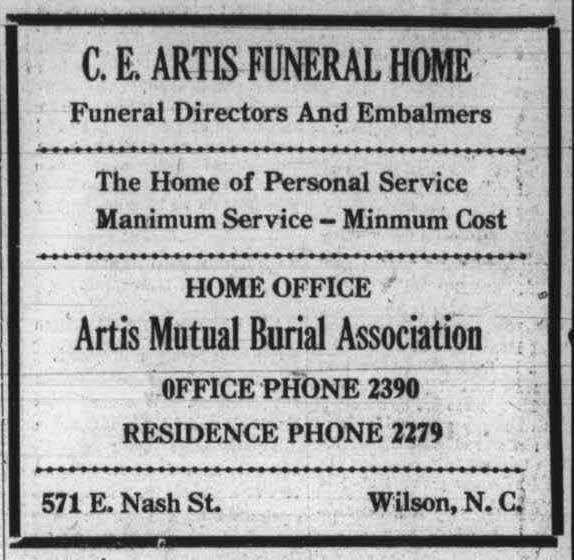
The Home of Personal Service.

Columbus Estell “C.E.” Artis was born in 1886 near Eureka, Wayne County NC to Adam T. Artis and his fourth wife, Amanda Aldridge Artis. Census records and city directories show that he tried his hand at a number of businesses, including grocery stores and “eating houses.” The 1915 directory of the town of Wilson NC described him as an undertaker, but it’s not clear for whom he worked or if he owned his own business at that time. He spent several years in Washington DC during and after World War I, but a 1922 newspaper article makes references to Batts Brothers and Artis as local undertakers, and the 1925 Wilson city directory carries this entry:

ARTIS & FLANAGAN (CE Artis, WE Flanagan) funeral directors 563 E Nash phone 1183

Here’s Artis’ business  described in 1979 in National Register of Historic Places Inventory — Nomination Form for  “East Wilson Business Area,” Wilson Central Business and Tobacco Warehouse Historic District:

One of only two black funeral directors in Wilson, Columbus Estelle Artis (1886- 1973) had this modest, one-story, three-storefront building [at 567-571 East Nash Street] erected in 1922. His funeral business occupied the 571 store until the mid 1950s when he retired and closed his business; the other two stores have always been used for rental purposes, except for a brief period from ca 1945 until ca 1951 when Artis expanded his funeral home into the 569 store. The stuccoed brick structure has narrow stores at 567 and 569 that contain a simple door and a large adjacent display window, both of which have transoms of clear glass. The store at 571 East Nash Street has a central door with flanking display windows, also with transoms. Unfortunately, all of the windows and three of the window transoms have been boarded up. The blind northwest elevation originally abutted the drug store occupied by Darcey D. Yancy during the 1940s and 1950s; this building was razed in the mid 1960s. The rear elevation of the Artis building has a one central door per store. The southeast elevation wall is adjacent to the Jackson Chapel First Missionary Baptist Church, which has maintained offices of the Artis building since 1980.

(Historic designation notwithstanding, Jackson Chapel tore down the buildings in the 1990s to make way for a church expansion and parking lot.)

C.E. Artis’ distinctive, wide-nibbed, angular cursive — r’s slashed diagonally — appears on hundreds of Wilson and Wayne County death certificates.  Like James Guess in Goldsboro, with whom he competed to some extent, C.E. Artis was often called upon to bury his kin, including several of his siblings. Among the funerals he conducted were:

Vicy Aldrich, 13 Feb 1927.  Buried Aldrich cemetery, Dudley NC.  Daughter of Adam and Frances Seaberry Artis, Vicey Artis Aldridge was C.E.’s half-sister.

+ Baby Jacobs, 22 Apr 1928.  Buried Rountree cemetery, Wilson. Unnamed stillborn son of Hattie Mae Jacobs, who was the granddaughter of Vicey A. Aldridge.

+Napoleon Artis, 9 Sep 1928.  Buried family cemetery, Wayne County.  Son of C.E.’s half-brother Walter S. Artis, who was son of Adam and Frances Seaberry Artis.

Jane Sauls, 16 Dec 1928. Buried Union Grove cemetery, Wayne County. Daughter of Sylvania Artis Lane, who was sister of C.E.’s grandmother Vicey Artis Williams.

+ Mable Barnes, 18 Apr 1929.  Buried family cemetery, Wayne or Wilson County. Daughter of C.E.’s brother Robert E. Artis.

+ Ivery Artis, 24 Jul 1930.  Buried Wayne County. Son of Morrison Artis, who was first cousin of C.E.’s father Adam T. Artis.  Also, Morrison’s first wife, Jane Artis, was Adam’s sister.

+ Alberta Artis, 9 Jun 1931.  Buried Wayne County.  Granddaughter of C.E. Artis’ paternal aunt Delilah Williams Exum.

+ Lucinda Artis, 23 Jun 1931.  Buried Wayne County.  Widow of C.E.’s uncle Jesse Artis.

+ Susiannah Artis, 11 Sept 1931.  Buried Wayne County.  Widow of C.E.’s uncle Richard Artis.

+ Leslie Exum, 4 Jul 1934.  Buried Wayne County.  Grandson of C.E.’s half-brother Jesse Artis, son of Adam and Frances Seaberry Artis. Leslie’s wife Beulah Artis Exum was daughter of C.E.’s half-brother, William M. Artis.

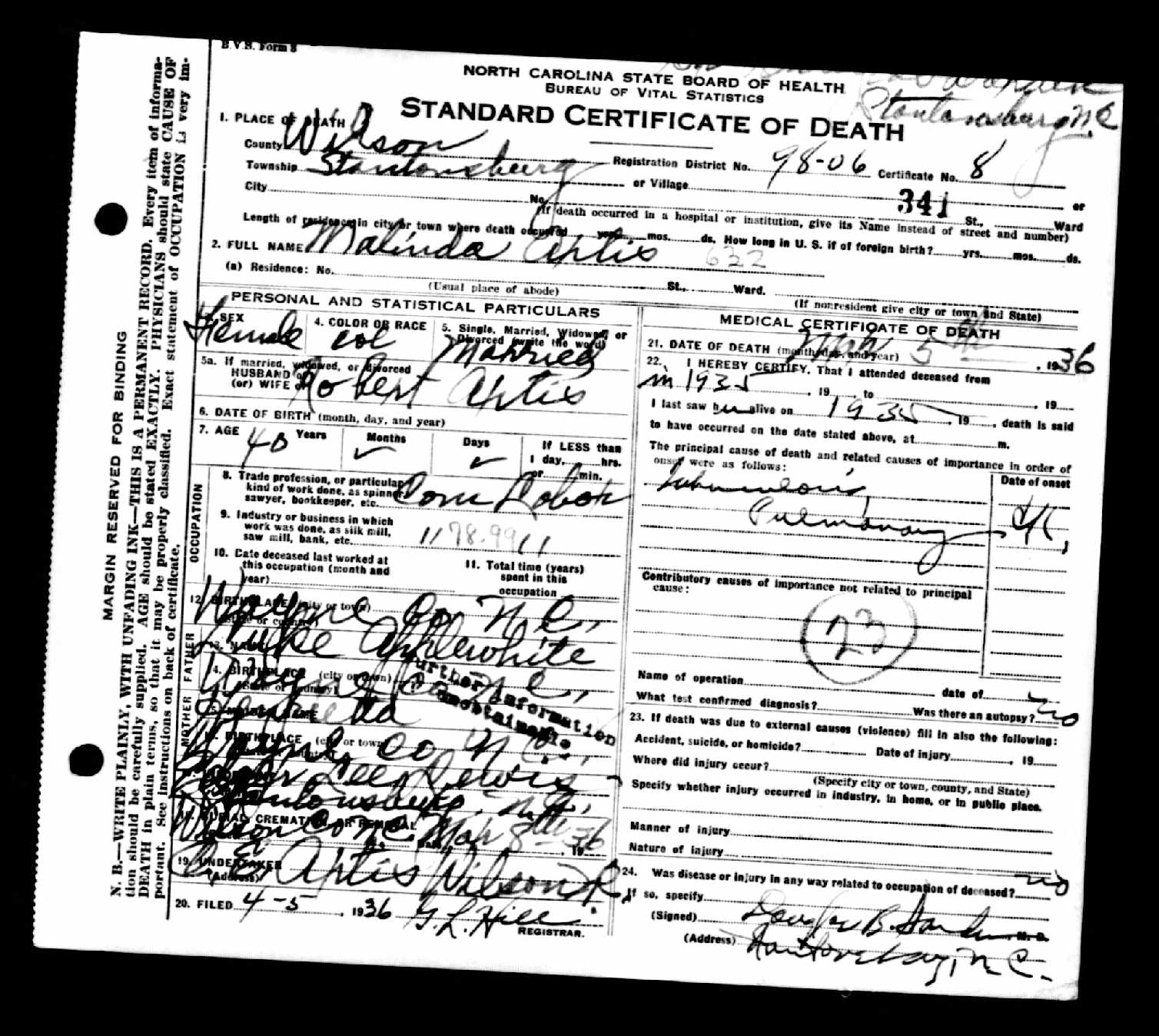
+ Malinda Artis, 5 Mar 1936.  Buried Wilson County.  Second wife of C.E.’s brother Robert Artis.
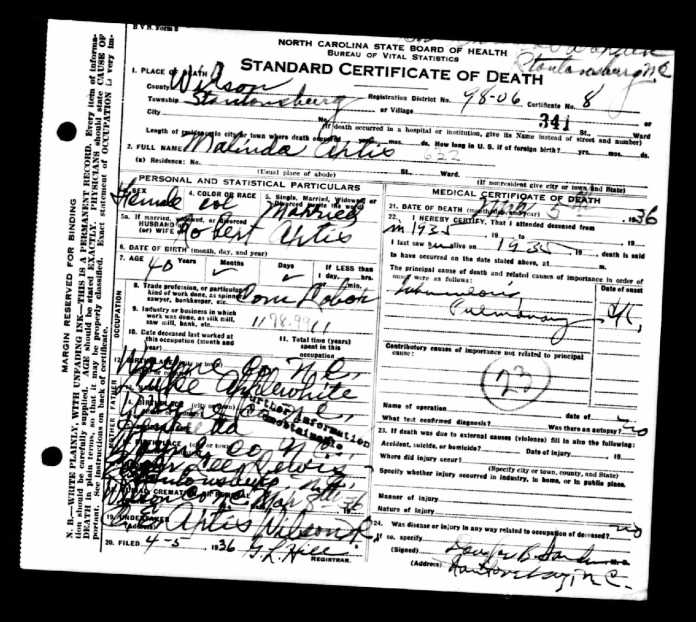
malinda artis

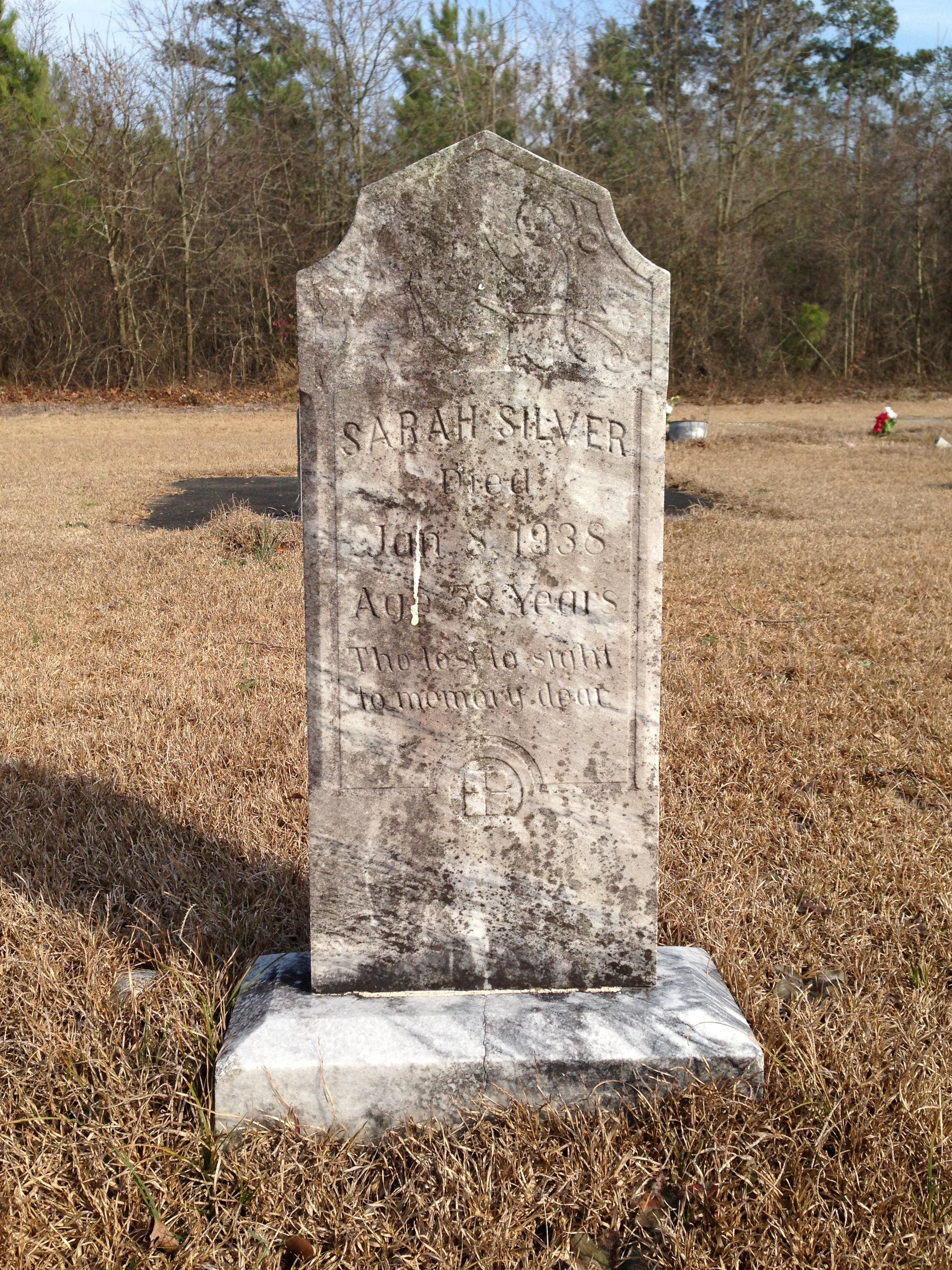
+ Sarah Jacobs Silver, 8 Jan 1938. Buried Wayne County [in fact, in the Congregational Church cemetery].  Silver’s great-niece Hattie Henderson (alias Jacobs) was the granddaughter of C.E.’s half-sister Louvicey Artis Aldridge.  Silver also lived on Elba Street in Wilson NC, around the corner from C.E.’s Green Street home.
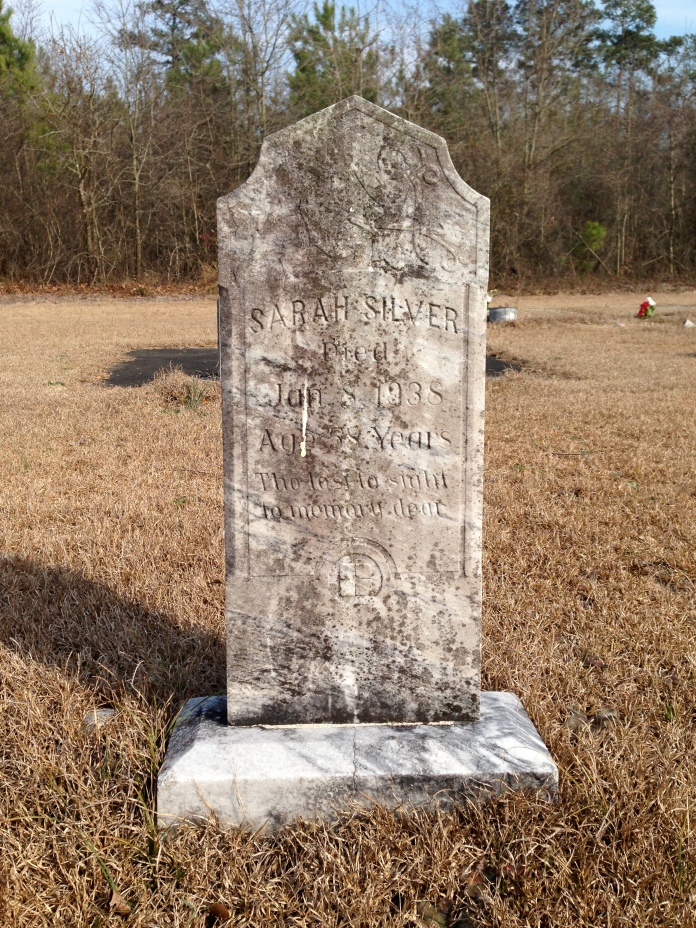
IMG_1651

+ Viola Artis, 1 Feb 1938.  Buried Wayne County.  Granddaughter of C.E.’s brother Henry J.B. Artis.

+ William Wilson, 5 Mar 1939.  Buried Wilson County. Grandson of C.E.’s aunt, Zilpha Artis Wilson.

+ Delilah Exum, 18 Jul 1939.  Buried Wayne County.  C.E.’s father’s sister.

+ Julius Artis Jr., 18 Dec 1939. Buried Wilson County.  Grandson of C.E.’s brother Henry J.B. Artis.

+ Katie Artis King, 22 June 1940.  Buried family cemetery, Wayne County.  C.E.’s stepmother, his father Adam’s last wife.

+ John G. Reid, 29 Dec 1941. Buried Turners Swamp cemetery, Wayne County.  Husband of C.E.’s first cousin, Emma Artis Reid, daughter of Richard Artis Sr.

+ Ada Dixon Sauls, 28 January 1945. Buried Baptist church cemetery, Snow Hill. Wife of C.E.’s cousin, Cain D. Sauls.

+ Liberty P. Artis, 10 Jul 1945.  Buried family cemetery, Wilson County.  Son of C.E.’s brother Robert.

+ William Artis, 28 Sep 1945.  Buried “family (Seabury)” cemetery, Wayne County.  C.E.’s half-brother, son of Adam T. Artis and Frances Seaberry Artis.

+ Scott Artis, 6 Apr 1947.  Buried Red Hill cemetery, Wayne County. Son of  Morrison Artis, son of Sylvania Artis Lane, who was C.E.’s grandmother’s sister.

+ Bettie Reid, 2 Dec 1947.  Buried family cemetery, Wayne County.  Elizabeth “Bettie” Wilson Reid was C.E.’s first cousin.  Her mother, Zilpha Artis Reid, was Adam Artis’ sister.

+ Solomon Shearard, 6 Feb 1948.  Buried Rest Haven cemetery, Wilson.  Husband of C.E.’s sister Josephine.  Name generally spelled “Sherrod.”

+ Annie Marie Cooper, 16 Oct 1948.  Buried Rest Haven cemetery, Wilson.  Daughter of C.E.’s youngest sister Alberta.

+ Annie C. Best, 4 Jan 1949.  Buried Rest Haven cemetery, Wilson. Daughter of C.E.’s half-brother Jesse.

+ Minnie Belle Artis, 4 Apr 1950.  Buried family cemetery, Wilson County.  Daughter of C.E.’s brother Robert.

+ Walter Scott Artis, 25 Jun 1951.  Buried Fort cemetery, Wayne County.  C.E.’s half-brother, son of Adam and Frances Seaberry Artis.

+ Noah Artis, 16 May 1952.  Buried family cemetery, Wilson County.  C.E.’s half-brother, son of Adam and Lucinda Jones Artis.
Pages from index

The Carolina Times, 19 September 1942.

Standard
Births Deaths Marriages, Maternal Kin, Newspaper Articles, Photographs, Virginia

Marion Allen Lomans.

She was the aunt for whom my aunt was named. She was a teacher. She married late and had no children. And she died when my mother was small. That was about all I knew about my grandfather’s oldest sister, Marion Ellen Allen Lomans.

My uncle let me copy a scarred and badly tinted photo:

Marion Lomans

She looked like an Allen sister, but I was no less mystified. (Frankly, other than Aunt Julia, they were all a bit mysterious — how did I never meet Aunt Edith?  Or Aunt Nita until I was an adult? Or even Uncle Buster, who lived right in Newport News?)

And then M., my mother’s first cousin, sent this picture, which charmed me to no end — Aunt Marion and her students at John Marshall School:

Marion Allen & class

And then I found her obituary:

MA_Lomans_Obit_Daily_Press_15_Apr_1942

Virginian Pilot, 15 November 1942.

And so I learned a few more things: that, despite her marriage to Mr. Lomans, a World War I veteran whom she had married “recently” and whose Christian names were actually Gillespie Garland, she was still living at home at the time of her death. That she was a member of the United Order of Tents (a secretive charitable organization founded by black women in the mid-19th century) and the Good Samaritans (another?). That she taught for only six years. That Aunt Tee — that’s Edith — was unmarried and living in New York City when Marion died.  That Marion died at Whittaker Memorial Hospital, an institution that her father served as a board member.  That she was buried from Zion Baptist,  the church that nurtured her father. Still, who was she?

Standard
Births Deaths Marriages, Maternal Kin, Migration, Newspaper Articles, North Carolina, Photographs

Sarah McNeely Green.

Image

There were three uncles, and some male cousins, but the McNeelys were basically a family of women.  My grandmother was the middle daughter of her mother’s three and grew up among six aunts who had many girls.

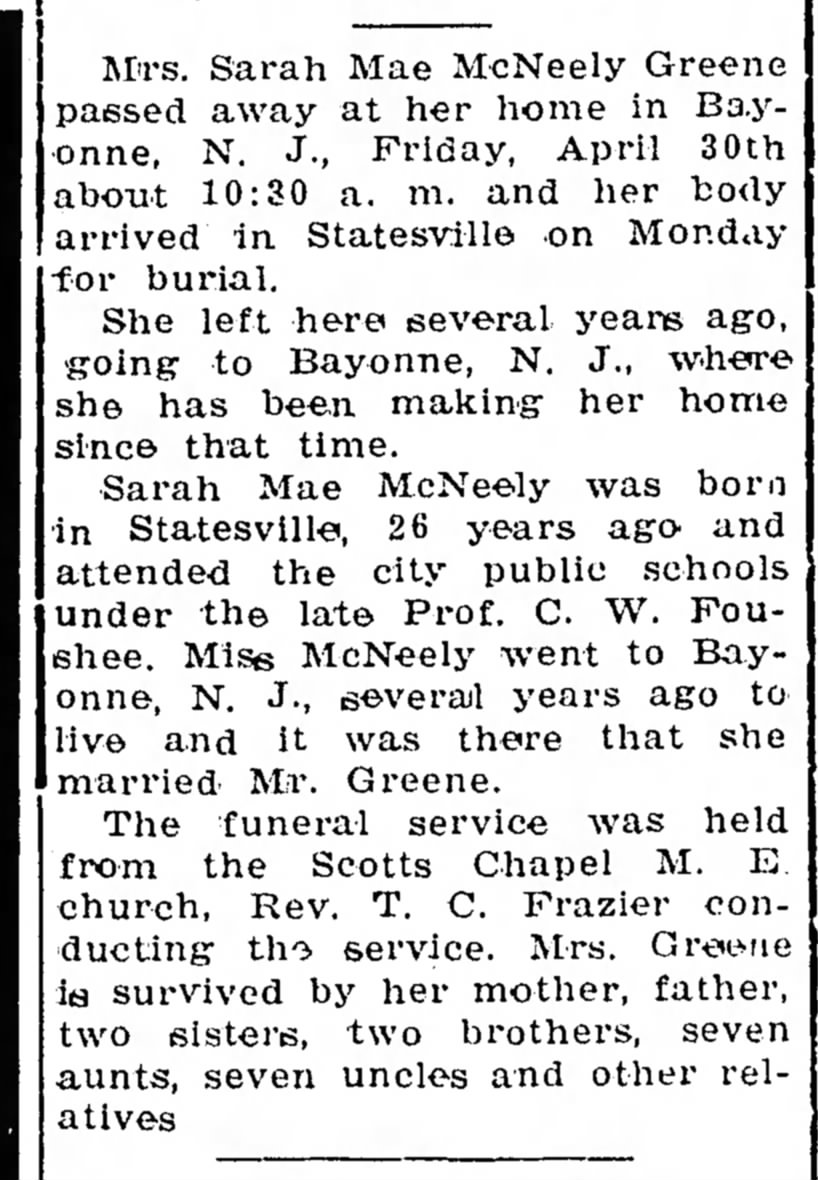
Janie McNeely, called “Dot,” was the youngest of Henry and Martha McNeely’s daughters.  Born in 1894, she worked as a laundress and reared her children in Statesville’s Rabbit Town section before migrating to Columbus, Ohio, in the 1940s.  Janie’s oldest child was Sarah Mae McNeely, born in 1911. She was followed by Frances V. McNeely (1913), Willa Louise McNeely (1918), Carl Graham Taylor (1923) and William Maurice McNeely (1925).

Sarah worked with her mother and sister at Statesville Laundry in the early 1930s. Soon after, she joined her grandmother, uncle John, aunt Emma and cousins in Bayonne, New Jersey, where she married a Mr. Green. (No one, including her obituary writer, seems to know his first name.)

Image

Statesville Landmark, 3 May 1937.

A few days later, in the Statesville Record‘s “News of Our Colored People”:

Image Statesville Record, 7 May 1937.

[Was Sarah survived by Mr. Green or not? Who was her father? And who were the extra aunt and all those uncles?]

Image

Photographs in the collection of Lisa Y. Henderson.

Standard
Births Deaths Marriages, Education, Maternal Kin, North Carolina, Oral History, Photographs

There she is.

Image

There she is.  That’s one of those dresses that Mama made for her to come to Hampton.  She came to Hampton a summer.  She stayed more than six weeks.  Must have stayed around eight or ten.  But anyway, she came here, and the things that she learned!  Oh, you would not believe.  All kind of things – artwork she could do.  Making baskets.  Oh, I don’t know what all.  That’s a blue taffeta dress with a white collar.  And you know we had a supervisor [Mary Charlton Holliday] who came to Statesville, and she particularly liked Golar, and she was a Hampton graduate, and she wanted Golar to go to Hampton so she could learn all this stuff.  All this artwork and everything.  And when she got ready, when Golar got ready to go, Mama had bought – this is a navy taffeta dress with a white collar.  And Mama had made all these dresses for her.  She had – this was a dressy dress.  And she had a pink dress, and she just, Mama just made her so many pretty things, you know.  And the, two or three nights before she was to go, to leave to go to Hampton, she broke down and cried.  Mama said, “What’s wrong?”  Said, “We’re gonna be, we’re gonna have your things ready.  You’re gonna be ready to go.”  And she said, “That’s not why I’m crying.”  She said, “I’m crying because Papa and Grandmama went to the bank and took out all of your money.”  Mama had paid into her Christmas savings account, and the bank just gave the money to Grandma and Papa, and that’s how they got her things together.  And she told Mama.  Ooooo

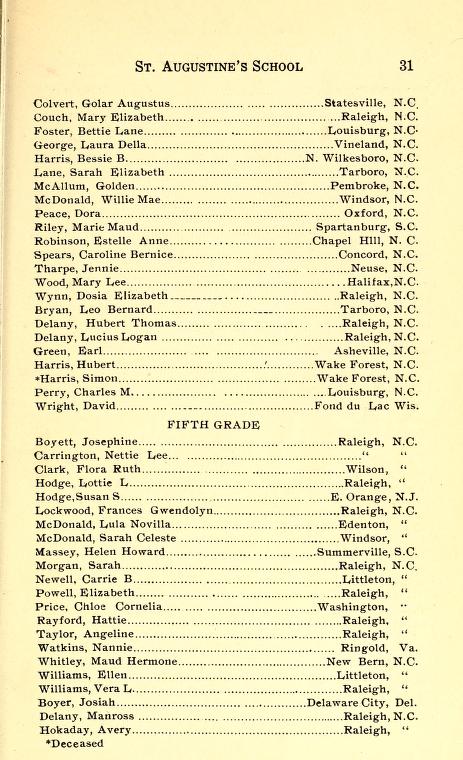
Golar Augusta Colvert was born in 1897 in Statesville, Iredell County, to Lon W. Colvert and his first wife, Josephine Dalton Colvert. She was about 9 years old when her widowed father married Carrie McNeely, and she grew close to her stepmother and adoring young half-siblings. When she was about 15, she enrolled at Saint Augustine’s College in Raleigh NC, where school catalogs show that she was a classmate of the Delany Sisters’ younger brothers.

annualcatalogueo18991914_0693

Annual Catalog of Saint Augustine’s School, 1913-1914.

In 1919, Golar married William Bradshaw, son of Guy and Josephine Bradshaw. Their son William Colvert Bradshaw was born in 1921 and daughter Frances Josephine in 1924. The little girl did not live to see two years. William worked in a furniture factory and Golar taught elementary school, and the family lived in a large frame house with a wrap-around porch on Washington Street in Statesville’s Wallacetown section.

In the summer of 1931, for reasons that are not at all clear, Golar traveled to Washington DC to undergo surgery.

Yeahhhh.  Went to Washington.  Had this operation and, ah, we got a letter from her.  Like, this afternoon, saying that she was all right, that they were gon take her stitches out, and she was coming home.  And she died that night.

GC Bradshaw 7 23 1931

Statesville Landmark, 23 July 1931.

Image

Statesville Landmark, 27 July 1931.

Interview of Margaret C. Allen by Lisa Y. Henderson; all rights reserved.

Standard
North Carolina, Oral History, Paternal Kin, Photographs

Going through the pea vines.

And David John, I don’t know what happened to him.  And his wife.  Well, now, David John come to Wilson and used to stay with us, and he worked in the factory.  So I don’t know whatever become of them folks down there.  And the girls that was all down there.  ‘Cause we went down there — me and Mamie went down there — and stayed with David John’s sister Estelle and worked in green tobacco.  And that’s where a mosquito bit me on my foot, and I scratched it, and, going through the pea vines, and the dew on ‘em, my foot swelled up so big I couldn’t walk on it.  And so Uncle ‘Lias, their daddy, brought me back home to Wilson.  Mamie stayed on down there, but I didn’t want to go back down there no more.

——

My grandmother’s reminiscences about Uncle ‘Lias (pronounced something like “LAH-iss”) were one of my early clues about the breadth of the Henderson family. I knew he was not her mother’s brother, or even her grandmother’s brother, and I was determined to find out exactly what the connection was. In fact, Elias Lewis Henderson was not an uncle at all, but a cousin. Born about 1880 in southern Wayne County, he was the oldest son of James Henry Henderson, who was the brother of my great-great-great-grandfather Lewis Henderson. (James Henry also named his youngest son Lewis Henderson after his brother.)Elias L Henderson

Elias married first Ella Moore. Their children were: David John (1901, married Amelia Artis), Mary Estelle (1903, married Theodore Rowe), twins Anna Bell (married Willie Johnson) and Mae Bell (1905), James Henry (1906, married Bessie Hagans), Myrtie Mae (1907), Olivia (1909, married James Raynor and [unknown] Whitaker), and Ira Junior (1911, married May Bell Bryant and Betty Ellis).  With his second wife, Sarah Edmundson, he had a son, Jazell Westly (1924, married Nancy).

Though my grandmother lost contact with David John and Mary Estelle, when she moved to Philadelphia in the late 1950s, she was reunited with their sister Anna Bell’s daughter Eunice Johnson Smith. Here, in the early ’60s, are Eunice’s daughter Wilma Smith, Eunice and my grandmother at a dinner at a Sheraton hotel in Philadelphia:

FB0068

Interview of Hattie H. Ricks by Lisa Y. Henderson, all rights reserved; photographs in the collection of Lisa Y. Henderson.

Standard
Land, North Carolina, Other Documents, Photographs

The death of Green Street.

As my father put it, all the “big dogs” lived on Green Street. The 600 block, which ran between Pender and Elba Streets, two blocks east of the railroad that cleaved town, was home to much of Wilson’s tiny African-American elite. There, real estate developers, clergymen, doctors, undertakers, educators, businessmen, craftsmen — and a veterinarian — built solid, two-story Queen Annes that loomed over the cottages and shotgun houses that otherwise lined East Wilson’s streets.  Booker T. Washington slept there.

Page_32

The north side of Green Street as depicted in a 1922 Sanborn map.

During my childhood, a half-century into its reign, Green Street was slipping, home to widowers and dowagers struggling to stay on top of the maintenance and expense imposed by multi-gabled roofs, ranks of single-paned windows, and wooden everything. Still, its historical distinction as black Wilson’s premier residential address held, and a drive down the block elicited a bit of pride and wonder.  In 1988, East Wilson, with Green Street its jewel, was nominated for inclusion in the National Register of Historic Places. Every house on the block depicted above was characterized as “contributing,” and the inventory list contained brief descriptions of the dwellings and their owners. #617, for example, was the Walter Hines house, a two-story “Queen Anne house with hip-roofed central block and projecting cross gables,” and Hines was described as “a prominent barber and property owner.”

Historic status, though, could not keep the wolves from the door. Even as the city’s Historic Properties Commission was wrapping up its work, East Wilson was emerging as an early victim of that defining scourge of the late 1980s — crack cocaine. As vulnerable old residents died off — or were whisked to safer quarters — crackheads and dealers sought refuge and concealment in the empty husks that remained. Squatters soiled their interiors and pried siding from the exteriors to feed fires for warmth. One caught ablaze, and then another, and repair and reclamation seemed fruitless undertakings.

This is the north side of Green Street now. The left edge of the frame is just west of #611. THERE IS NOT ANOTHER HOUSE UNTIL YOU GET TO #623. They are gone. Abandoned. Taken over. Burned down. Torn down. Gone.

IMG_4050

[Sidenote: 623 Green Street was built for Albert Gay, a porter at the Hotel Cherry downtown. Albert married Annie Bell Jacobs, daughter of Jesse A. Jacobs, Jr., and their descendants remain in the house. Charles Gay, next door, was Albert’s brother. And around the corner, in the small ell below Pilgrims Rest Primitive Baptist Church, 303 Elba.]

Photograph taken by Lisa Y. Henderson, October 2013.

Standard
Births Deaths Marriages, Maternal Kin, Oral History, Photographs, Virginia

Mary Agnes Holmes Allen.

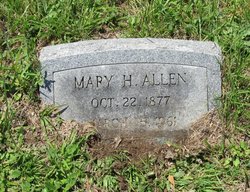
Her headstone is wrong. Mary Agnes Holmes was born October 15, 1877 — not October 22 — on the R.L. Adams’ plantation in Charles City County, Virginia. Her parents were tenant farmers there, and Agnes was one of a handful of Jasper and Matilda Holmes‘ children to survive to adulthood.

Agnes’ mother died when she was about 8 years old, and her father apparently did not remarry. Jasper Holmes was an ambitious man and managed to purchase several small plots of farmland upon which he supported his family in a degree of comfort. The Holmeses may have attended New Vine Baptist Church and, if so, that is likely where Agnes met John C. Allen.

There is an ugly story told about their marriage: John had quickly established himself as an eligible bachelor in Newport News’ East End, and his appeal was heightened — in the standards of the day — by his light skin and wavy hair. When he brought his new bride home shortly after Christmas 1900, his neighbors, peeking through curtains, were shocked to see a plain, broad-featured, brown-skinned woman step from the carriage. (Agnes herself was not immune to such prejudices, and her color-struck notions would reverberate among her offspring.)

Image

During the early years of her marriage, Agnes did “day’s work” as a housemaid. I did not know this. I had assumed that she was always a housewife, which is a reflection of my failure to understand just how my great-grandparents were able to achieve the middle-class respectability that marked their lives by the middle of the 20th century. (Not to mention how they maintained their dignity on the climb.)

Me:  Now, his mama didn’t ever work, did she?

My grandmother:  Who?  Indeed, she did work.

Me:  Like, outside the home?

My grandmother:  Yeah, during the late years, she didn’t, but she worked outside the home ‘cause she told me one time she walked across the bridge, ‘cross 25th Street bridge, and said it was snowing and ice, and the ice froze on the front of her coat.  And I never shall forget, she worked for a lady, and this lady had a small child.  And she asked her would she wash the child’s sweaters.  Sweaters that the baby had.  And she took and said, “Asking me to do all kinds of extra work like that,” and said, “You know what I did?”  Said, “I washed the sweater in hot water, and then I put it in cold water.  When I got through with it, it was ‘bout big as my fist.”  I said, “How can [whispering, inaudible.]”  And she knew it –

Cousin N: Was gon shrink up.

My grandmother:  And I said, “Oh, my God, that is awful!”  And it was.  Anyway, she told me that.  She said, “I washed it all right for her, and I put it in hot water, as hot as I could find, and then put it in cold water.  When I got through with it, couldn’t nothing wear it.”

By the time my mother and her siblings were children, Mary Agnes Allen had assumed the domestic role I’d always imagined her in — at home on Marshall Avenue, among Tiffany lamps and lace antimacassars, preparing roast beef to serve on Blue Willow china to a husband just home from this board meeting or that union affair. Her grandchildren speak of her ambivalently, aware of the casually cruel distinctions she drew among them, but unable to name any particular misdeed.

Me:  Well, was Mary Agnes mean to y’all or what?

My mother:  She was not to me, that I remember.  I don’t know what this was about.  Ahh … maybe it was that she was not friendly.  Maybe she wont like Grandma Carrie, joking and saying little funny stuff.  I don’t know.  I don’t know what it was.

Her grandchildren — at least, her son John’s offspring — felt that lack of warmth acutely. Though their 35th Street home was only a mile away from hers, Mary Agnes Allen does not feature much in the stories of their childhood. (Nor, frankly, does John Allen Sr.)  In her later years, she left Newport News to live with her daughter Edith Allen Anderson in Jetersville, Amelia County, Virginia. The photo below, I’m guessing, was taken shortly before her move. And seems to reveal a softer side.

Image

Mary Agnes Holmes Allen died March 15, 1961, just two months before my mother married in the sideyard at Marshall Avenue.  A brief obituary ran in the Daily Press on the 17th, noting that she was a member of Armenia Tent No. 104 and the Court of Calanthe. She was survived by three daughters, a son, a “foster son” (actually, her nephew), a sister, and, most curiously, “12 grandchildren and 10 great-grandchildren.” In fact, she had ten grands and no more than three great-grands.

Image

Interviews by Lisa Y. Henderson, all rights reserved.  Photographs in collection of Lisa Y. Henderson.

Standard
Land, Other Documents, Paternal Kin, Photographs

This deed.

Image

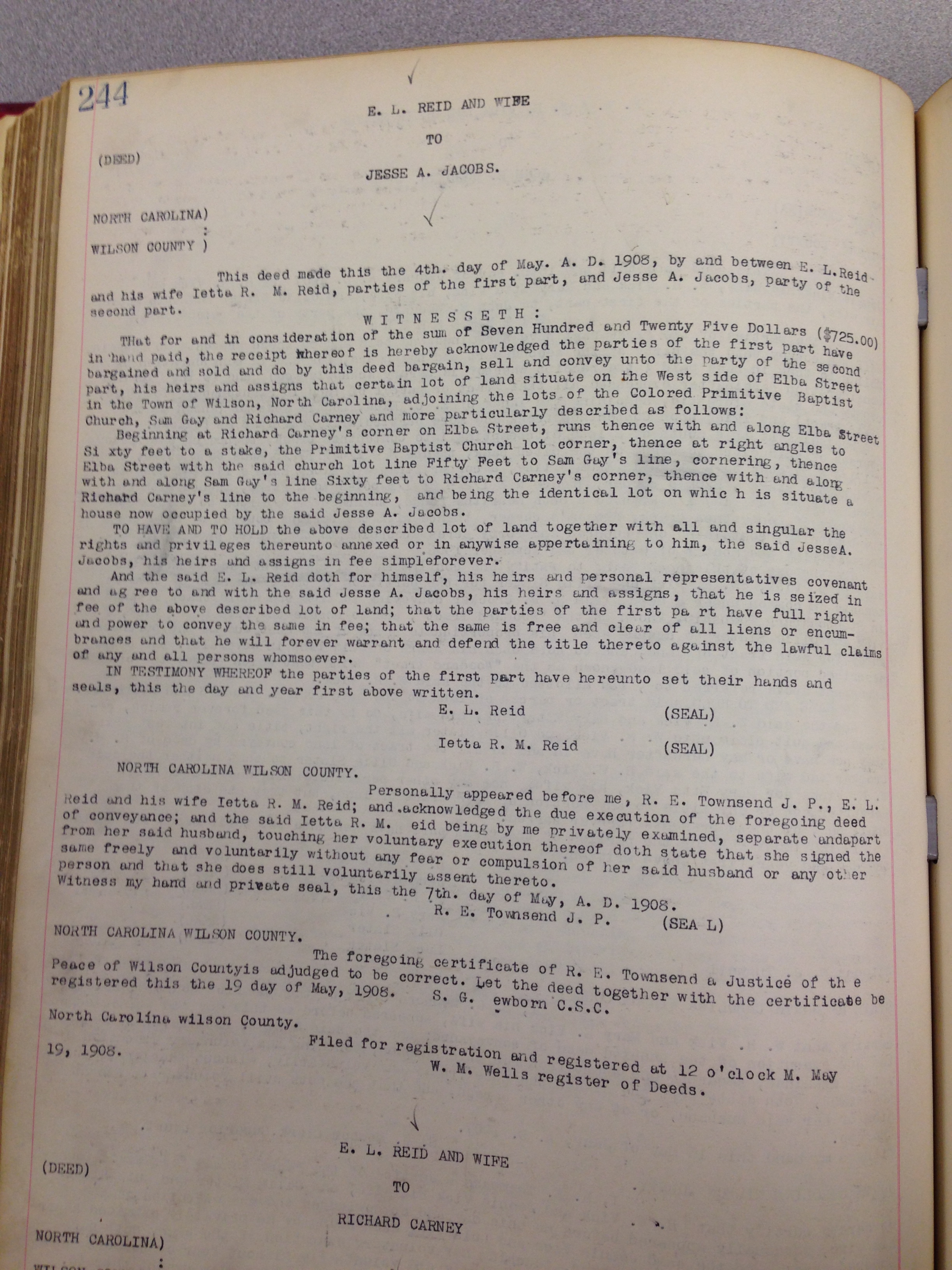
This is the deed for Jesse Jacobs‘ purchase of 303 Elba Street. He bought the house (in which he was already living) and lot for $725 from E.L. and Ietta R.M. Reid on 4 May 1908. (Elijah Reid, a veterinarian, was born into a free family of color from the opposite end of Wayne County than Jesse and Sarah Jacobs.) The same day, Jacobs gave George W. Connor, Trustee, a mortgage on the property, perhaps to secure a $400 loan he used to buy it.  Jacobs was to repay Connor at the rate of $2.50 per week. 

On 10 April 1917, the Jacobses arranged another mortgage on their Elba Street home, this time promising to repay W.A. Finch, Trustee, $395 at 6% interest. Circumstances intervened. By about 1922 or ’23, Jesse Jacobs was too ill to work. He died in 1926. Sarah and Hattie Jacobs, her great-niece (and my grandmother) paid what they could from their meager earnings as laundresses. When Sarah Jacobs died in early 1938, the house remained encumbered. Finch’s loan was not repaid until September of that year, most likely from the sale of the property.

Standard