Free People of Color, Newspaper Articles, North Carolina, Paternal Kin, Politics, Rights

Enlighten me; or how to obtain just dues.

In 1899, North Carolina passed a constitutional amendment that created new literacy and property restrictions on voting, but exempted those whose ancestors had the right to vote before the Civil War. The intent and impact of the amendment was to prevent generally poor and often illiterate African-Americans from voting, without disfranchising poor and illiterate whites:

Public Laws of North Carolina, 1899, chapter 218.

(Sec. 4.) Every person presenting himself for registration shall be able to read and write any section of the constitution in the English language and before he shall be entitled to vote he shall have paid on or before the first day of March of the year in which he proposes to vote his poll tax as prescribed by law for the previous year. Poll taxes shall be a lien only on assessed property and no process shall issue to enforce the collection of the same except against assessed property.

(Sec. 5.) No male person who was on January one, eighteen hundred and sixty-seven, or at any time prior thereto entitled to vote under the laws of any states in the United States wherein he then resided, and no lineal descendant of any such person, shall be denied the right to register and vote at any election in this state by reason of his failure to possess the educational qualification prescribed in section four of this article….

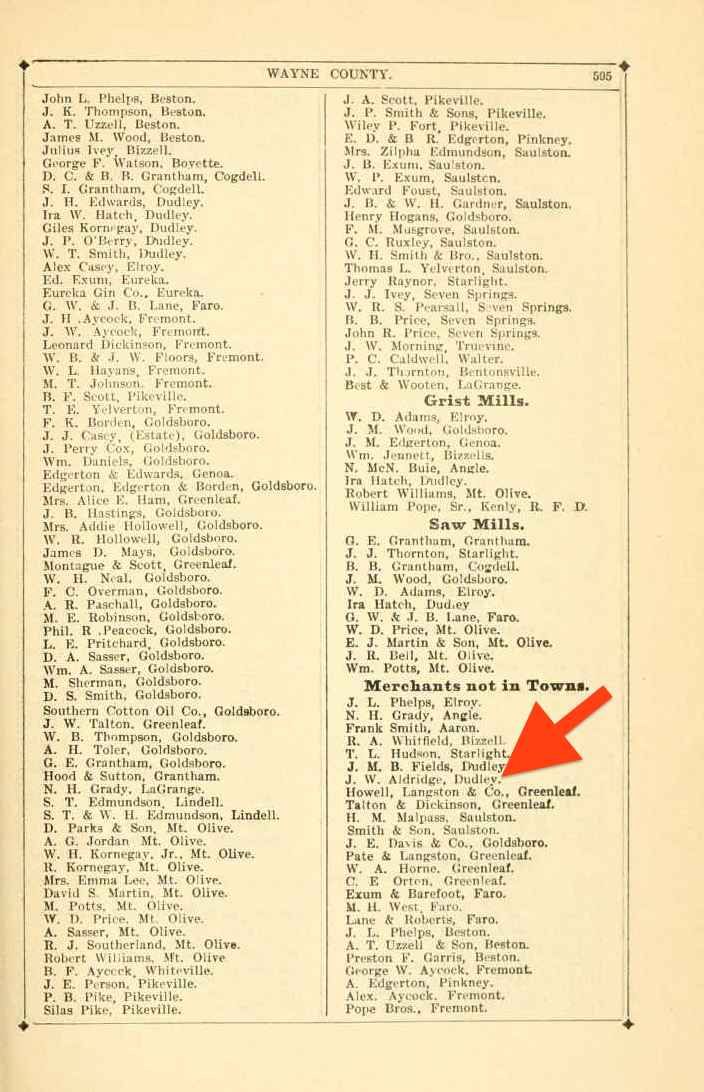
In 1902 — 112 years ago today — my great-great-grandfather John W. Aldridge, a steadfast if low-key supporter of local Republican politics, took pen in hand for a tight-jawed letter to the editor of a newspaper in the state capital:

Morning_Post_Raleigh_10_15_1902_JW_Aldridge_Voting_Rights

Raleigh Morning Post, 15 October 1902.

——

The following “colored” men were among those who registered to vote in Wayne County in 1902.  In accordance with Section 5, each was required to name the ancestor who “grandfathered” him in. Despite his very public protest, and his brothers’ successful registrations, John W. Aldridge’s name does not appear:

Joseph Aldridge, 36, Brogden, Robert Aldridge.

M.W. Aldridge, 45, Goldsboro, Robert Aldridge.

Robert Aldridge, 33, Brogden, Robert Aldridge.

Marshall Carter, 42, Brogden, Mike Carter. [Marshall Carter’s son Milford married John W. Aldridge’s daughter, Beulah.]

Williby Carter, 22, Brogden, Mike Carter. [Williby was Beulah Aldridge Carter‘s brother-in-law.]

H.E. Hagans, 34, Goldsboro, Napoleon Hagans. [Napoleon and Henry Hagans were the half-brother and nephew, respectively, of Frances Seaberry Artis, wife of Adam T. Artis.]

W.S. Hagans, 31, Nahunta, Dr. Ward. [William was another son of Napoleon. “Dr. Ward” was his white grandfather.]

John H. Jacob, 52, Brogden, Jesse Jacob.  [Jesse and John Jacobs were the father and brother of Jesse A. Jacobs Jr., who married Sarah Henderson.]

Wiley Mozingo, 76, Goldsboro, Christopher Mozingo. [Wiley Mozingo’s daughter Patience Mozingo married Noah Artis, son of Adam T. Artis. His granddaughter Ora B. Mozingo married John W. Aldridge’s son, John J. Aldridge.]
 

Standard
North Carolina, Paternal Kin, Photographs

A photo.

A nice surprise came in yesterday’s mail — a copy of another photo of Aint Nina Faison Kornegay Hardy, courtesy of J.M.B. A handwritten note on its back identifies the two boys leaning into her and the date, 18 September 1939 — 75 years ago today.

N_Aldridge_Hardy

Here you can clearly see her right leg and ankle swollen over the sides of her shoes, evidence of the chronic pain and debility she suffered. Lymphedema, perhaps. Or maybe chronic venous insufficiency. Conditions difficult to treat even now, and then impossible. Always, though, that sweet smile.

Standard
Education, Other Documents, Paternal Kin, Photographs

B.S. Civil Engineering.

Oscar Randall, son of George and Frances “Fannie” Aldridge Randall, appeared in The Crisis‘ annual round-up of recent college graduates.

Pages from The Crisis Volume 20 no 3 O Randall

“Civil Engineer, Oscar Randall, whose scholastic average is 87% for the 4 year term,” p. 140.

Allison, M.G., “The Year in Negro Education,” The Crisis, July 1920, volume 20, number 3.

Standard
Births Deaths Marriages, Land, North Carolina, Other Documents, Paternal Kin

To my ….

Abstracts of wills filed in Wayne County Superior Court, Goldsboro, North Carolina:

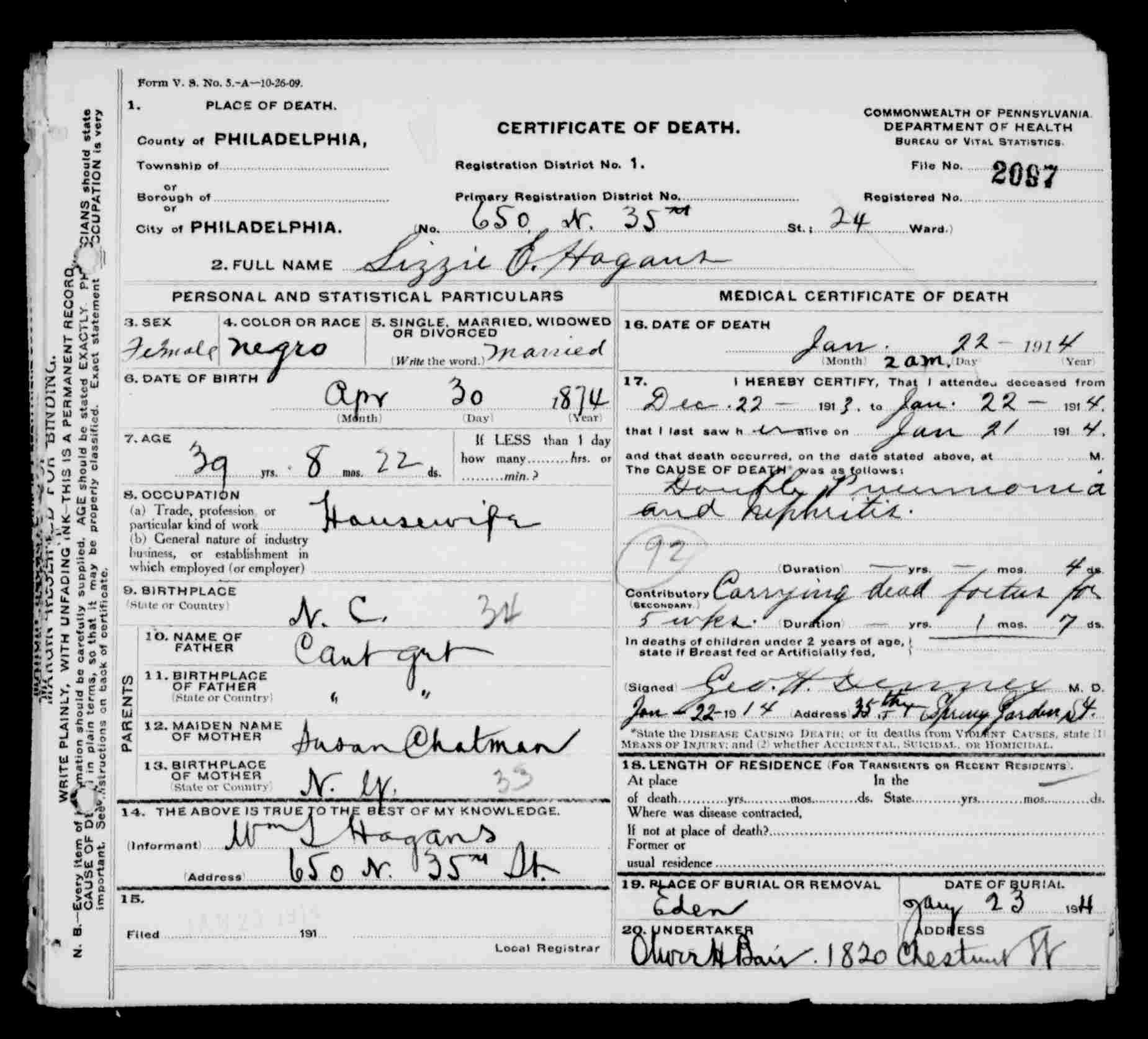
Lizzie E. Hagans — (1) to my beloved husband Will S. Hagans and his heirs in fee simple my house and lot in the town of Goldsboro, situated on Oak Street between West Center and James Streets and known as 104 West Oak Street; (2) to my husband $5000 with all benefits from life insurance policy #190279, Phoenix Mutual Life Insurance Company; (3) Will S. Hagans appointed executor. Signed 5 August 1904 in the presence of H[enry] S. Reid and J.A. Dees.

On 2 May 1917, C[larence] Dillard and J. Peele swore that they were knew Lizzie Hagans for a number of years, were well-acquainted with her handwriting and verified her signature. Henry S. Reid also swore that he witnessed the will, which was recorded and filed on 3 May 1917.

HAGANS -- Lizzie Hagans Death Cert

She had inherited Oak Street house from her (probable) uncle, William Burnett. Lizzie Hagans died shortly after William S. Hagans moved his family from Goldsboro to Philadelphia. 

——

Adam T. Artis — (1) S.S. Strother appointed executor; (2) a decent burial suitable to the wishes of my family and friends; (3) to my wife Katie Artis, all of the Thompson tract on which I now live, about 18 acres, all household and kitchen furniture and personal property; (4) to son Pinkney Artis, $100; (5) to son June Scott Artis, $10; (6) to son Henry Artis, $10: (7) to son Columbus Artis, $10; (8) to son William Artis, $5; (9) to son Walter Artis, $5; (10) to daughter Josephine A. Sherard, $15; (11) to son Robert Artis, $5; (12) sell the balance of my land to pay out the above, then divide the remaining in equal shares among my children Vicey Aldridge, Liza Evert, Augustus K. Artis, Georgana Reid, Mary Jane Artis, Emma D. Locus, Ida Reid, Lillie Thompson, Napoleon Artis, Haywood Artis, Addie Artis, Annie Artis, Alberta Artis, and Jesse Artis, and, at Katie’s death, property to be divided among the twelve heirs above whose gifts are not limited. Signed with an X in the presence of W.F. Lewis, J.J. Coley and J.E. Exum. Codicil: (13) to son Noah Artis, $10.

Recorded and filed 1 May 1919.

Adam Artis’ will includes the names of 23 of his children. Emma’s name is crossed out because she died before the terms of the will could be carried out. Known children whose names do not appear include Cain Artis, who died in 1917; Caroline Artis Coley and Louetta Artis, who presumably died before the will was made; Adam Artis Jr., who seems to have been very much alive in Washington DC. (Was the omission of his name inadvertent, as with Noah?) Despite newspaper reports claiming that Adam  fathered 47 “legitimate” children, these 27 are all I have been able to identify. Though there were doubtless others who died in childhood, I doubt there were 20 of them, and I am fairly certain that no other children reached adulthood.

——

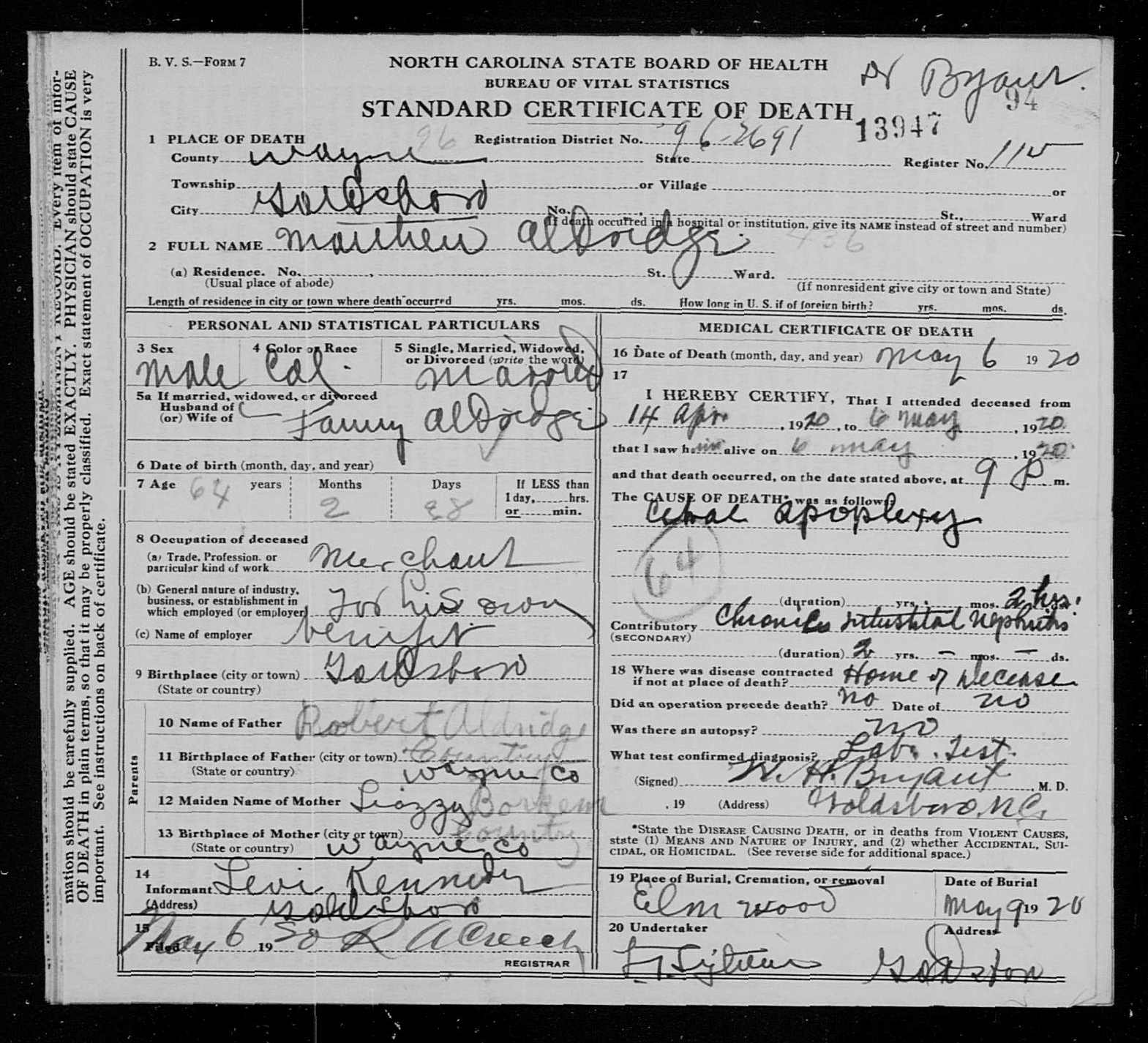
Mathew Aldridge — (1) to daughters Fannie B. Randolph and Mamie J. Aldridge, 1/2 undivided interest in my dwelling house and lot on Pine Street. Signed 27 August 1919 in the presence of N.D. White and Ida Darden.

Recorded and filed 18 May 1920. Fannie Aldridge was qualified as administratrix.

record-image-24 copy

Hmmm. Mathew Aldridge’s will provided for neither his wife, Fannie Kennedy Aldridge, nor his oldest daughter, Daisy Aldridge Williams. Perhaps he had settled property upon them prior to making his will.

——

Lucian Henderson — to John Wesley Carter, all my real estate known as my home place, 8 acres, provided that John W. Carter care for me and my wife Susan Henderson, otherwise null and void. My trusty friend John W. Carter appointed executor. Signed with an X in the presence of Everest Lewis and R.E. Simmons.

Lucian Henderson died 22 June 1934 and his will was recorded and filed 27 June 1934.

Lucian and Susan Henderson’s only child, Cora Q., died in 1907. For more re his friendship with John W. Carter, nephew of his sister Sarah’s husband Jesse A. Jacobs, see here.

——

Joseph Aldridge — (1) a decent burial; (2) to my wife Martha C. Aldridge, all my real and personal property during her lifetime or widowhood; (3) to my sons Allen Aldridge, Daniel Aldridge, William Aldridge and Milford Aldridge, $1 each, to my son Joseph Aldridge, my watch, to my son George Aldridge, my clock; (4) after Martha’s death, all my personal property to be divided between my sons Joseph and George and my daughters Mary Aldridge, Luella Aldridge and Lillie Mae Aldridge; as tenants i common, Mary, Luella and Lillie Mae to receive 12 acres to be laid out of the someplace on the east side of the old stagecoach road; to Joseph and George, all the remainder of the land between what I received from the estate of my father Robert and my brothers George and Dave. Signed 5 May 1934.

Recorded and filed 12 September 1934.

Martha Hawkins Henderson Aldridge remarried in 1940, triggering the terms of paragraph 4 of the will. As set forth here, she remained close to Joseph Aldridge’s children the remainder of her life. Also, a small clue I hadn’t noticed before: Joseph indicated that he received land from the estate of his brother Dave. As noted here, I had lost sight of David Sloan Aldridge after 1904, but now know that he died before 1934.


Standard
Agriculture, North Carolina, Paternal Kin

Crop liens & chattel mortgages.

The following abstracts are taken from agreements recorded at the Wayne County Register of Deeds office in Goldsboro, North Carolina:

Ira Henderson (1885-1946) was the son of James H. and Frances Sauls Henderson. On 11 March 1922, to secure payment of a $200 loan from B.W. Southerland Company of Duplin County, due 15 June 1922, Ira pledged: one bay mare about 8 years old known as the Parker mare; one mouse-colored mare mule about 8 years old; a one-horse Hackney wagon; one top-end spring buggy (red running gear); one set of harnesses; 9 red jersey shoats waighing about 50 pounds each; also, his entire interest in all his crops of cotton, corn, tobacco and all truck crops of every kind grown in 1922 on the lands of Nancy Winn near Mount Olive or any other land he cultivated. Signed with an X.

John J. Aldridge (1881-1964) was the son of John W. and Louvicey Artis Aldridge. On 29 January 1923, he conveyed an interest in all his crops to Seminole Phosphate Company to secure a $200.71 loan for fertilizer “used on my lands in Brogden township.” Terms required that he repay the loan with 6% interest on or before 1 October 1923.  Signed J.J. Aldridge

Standard
Births Deaths Marriages, Free People of Color, Land, North Carolina, Paternal Kin, Photographs

Family cemeteries, no. 15: Henderson-Aldridge.

There was another Aldridge cemetery, but its whereabouts are only vaguely remembered.  Not far off Highway 117.  A few miles north of Dudley. Robert Aldridge was buried there about 1899 and, presumably his wife Mary Eliza Balkcum Aldridge, too. There they remain, though others who died in that era were disinterred and moved to what is now known as the Henderson-Aldridge cemetery.

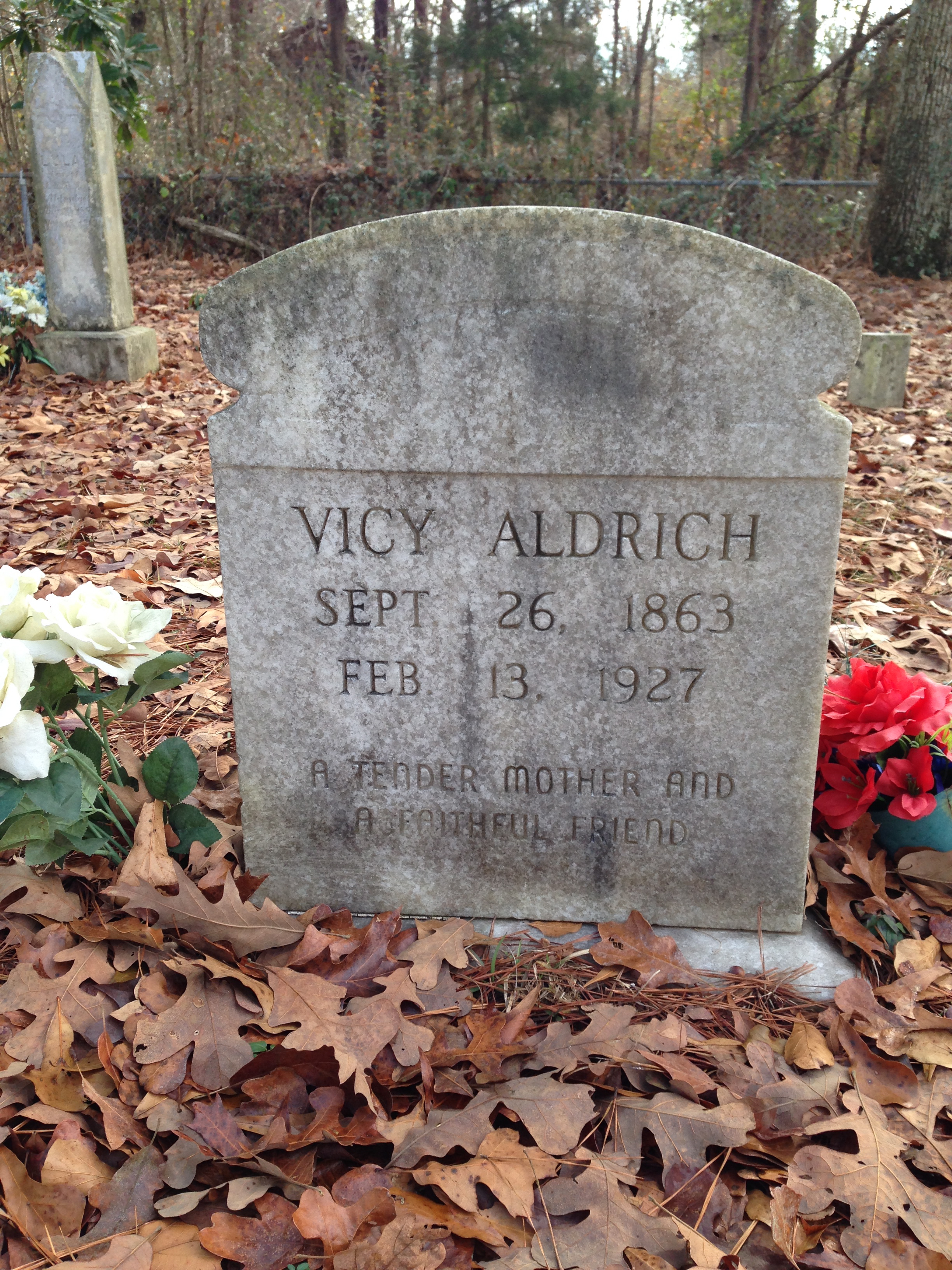
The oldest graves belong to Robert and Eliza’s son John W. Aldrich (1853-1910), his wife Vicey Artis Aldrich (1865-1927), and their daughters Lula Aldridge (1882-1918) and Amanda Aldridge Newsome. [“Aldrich” was the preferred spelling of son J. Thomas Aldrich, who erected the stones.] Most of the other graves belong to descendants of John and Vicey, or of John’s brother Robert Jr. and his offspring.

IMG_4665

IMG_4666

Burials include Catherine Aldridge Davis (1900-2009) and her son George E. Davis (1921-1964); Lenora Henderson (1902-1961) and husband Henry Lee Henderson (1901-1942); Aaron H. Henderson (1922-1943); Horace B. Henderson (1923-1984) and wife Katie Lee Henderson (1924-1963); Hoover Aldridge (1929-1970); Dr. James T. Aldrich (1890-1968) and wife Athalia F. Aldrich; Frances Newsome (1883-1961); Allen Aldridge (1908-1969); Milford Aldridge (1913-1985); Sarah Eliza Aldridge Powell (1918-1998); Paul Aldridge (1913-1947) and wife Lonie Mae Aldridge (1919-1940); Robert Aldridge (1865-1941); Lula Aldridge (1882-1919); Amanda A. Newsome (1892-1918); Bennie R. Aldridge Jr. (1940-2008); and, most recently, Isaiah Len Henderson (1998-2013) and Ross M. Sutton (1935-2013).

Photos by Lisa Y. Henderson, 2013.

Standard
Newspaper Articles, North Carolina, Paternal Kin

A warrant charging forgery.

Shortly after my grandmother’s birth in the summer of 1910, her father, J. Thomas Aldridgedecamped for Shaw University.  Dudley’s colored school went only through eighth grade, so Tom, already in his mid 20s, had to start in Shaw’s preparatory division. (He shaved ten years of his age the rest of his life.) The family’s pride and joy, Tom was the first to pursue higher education. Near the start of his second year, however, Tom was arrested for forgery.  Ever vigilant for stories that cast colored people in a negative light, the story was picked up by newspapers across eastern North Carolina, no doubt amplifying his humiliation.

Wilmington_Dispatch_11_8_1911_Forgery

Wilmington Dispatch, 8 November 1911.

Image

Clinton Caucasian, 9 November 1911. 

Wilson_Daily_Times_11_10_1911_Tom_Aldridge_forgery

Wilson Daily Times, 10 November 1911.

I don’t know the outcome of the prosecution. Presumably, Tom, at least, was not convicted. He is listed as an enrolled student at Shaw University each year from 1911 through 1917, as he worked his way through its preparatory and undergraduate divisions. (Early in his studies, Tom changed the spelling of his name from ‘Aldridge’ to ‘Aldrich.’ I don’t know why.) After Shaw, he went on to Meharry Medical School in Nashville, his brush with the law far behind him.

T Aldrich Register

Sahw Register

37th Annual Catalogue of the Officers and Student, Shaw University, 1911.

Standard
Agriculture, Free People of Color, Land, Newspaper Articles, North Carolina, Paternal Kin, Politics

Our colored friend has grown richer.

Image

ImageGoldsboro Messenger, 21 October 1880.

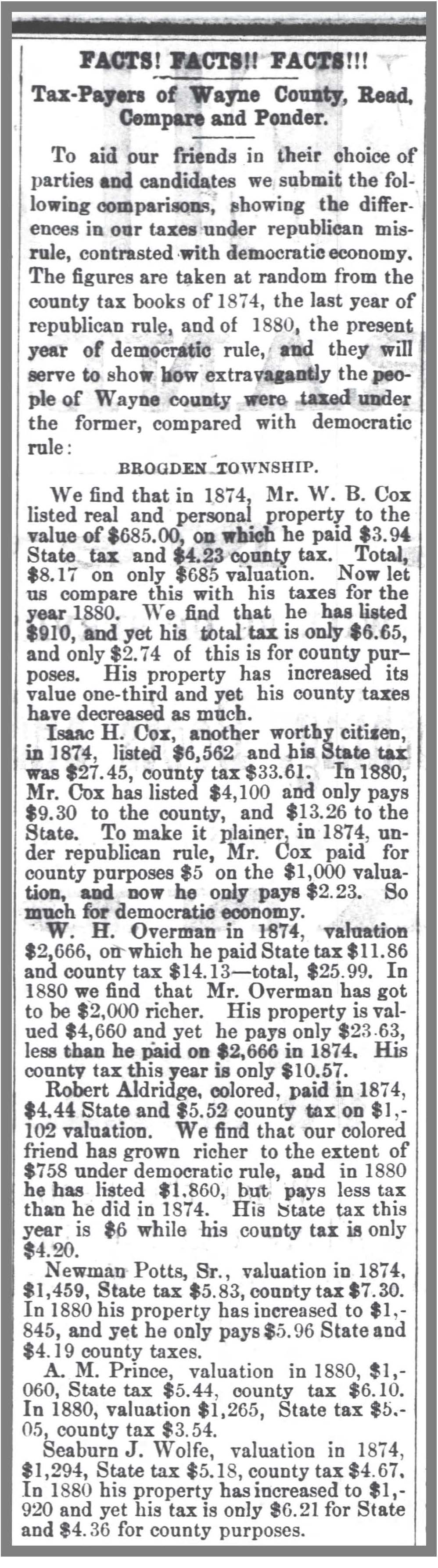
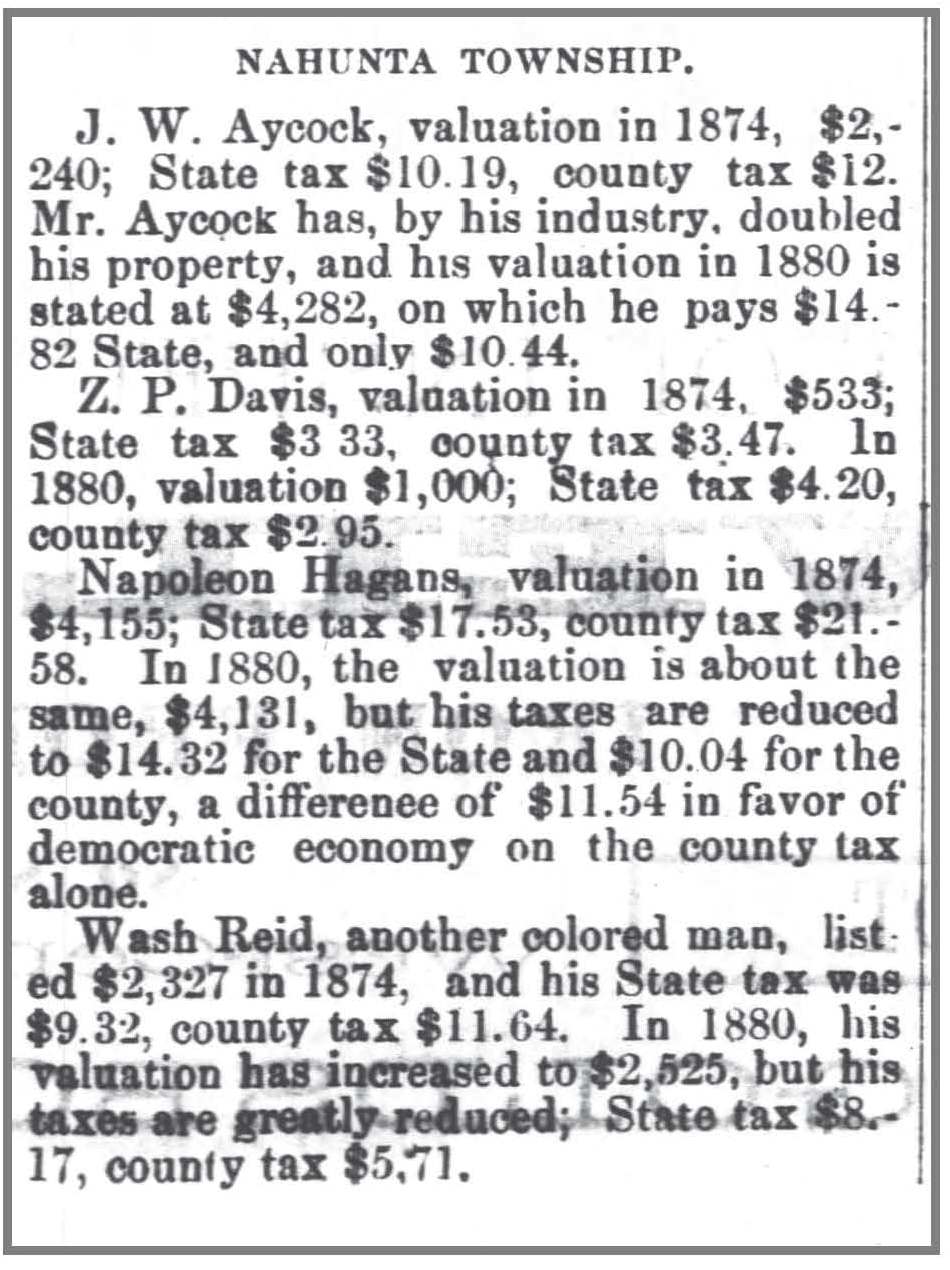
These propaganda pieces are part of a single article published to demonstrate that the rising tide of Democratic rule had floated all boats as land values increased while taxes fell. (In other words, the end of Republican rule meant more money in the pocket, as well as a foot on the neck of African-Americans.)

Two of the “colored friends” noted were my kin — my great-great-great-grandfather Robert Aldridge and Napoleon Hagans, the brother of my great-great-great-grandmother Frances Seaberry Artis. (And Washington Reid’s nephews William and Henry Reid, sons of John Reid, married Adam Artis’ niece Elizabeth Wilson and daughter Cora Artis, respectively.) Aldridge, Hagans and Reid (as well as Artis, Frances’ father Aaron Seaberry and Betty’s father John Wilson) were all prosperous free-born farmers.

Standard