Civil War, Free People of Color, Military, North Carolina, Paternal Kin, Photographs

Lane photographs.

My Daniel Artis/Christopher Lane posts have attracted even more fruitful attention. S.C. has researched the John Lane family for her half-brother, who is descended from one of Christopher Lane’s brothers, and has generously shared photos she has collected.

This photo, taken perhaps in the 1980s, depicts the ruins of John Lane’s house in Bullhead, Greene County. It was in and around this house, presumably, that Sylvania Artis‘ children worked during their involuntary apprenticeship to Lane. S.C. says the house has since been pulled down, though some its interior was salvaged. She also said the family’s cemetery is nearby.

LaneHouse

And then this rather leprous image shows Christopher C. Lane, the young soldier who took Daniel Artis with him as a valet when he entered Confederate service.

ChristopherCLane

Many thanks to S.C. for reaching out and for sharing these photographs.

Standard
Births Deaths Marriages, Free People of Color, North Carolina, Paternal Kin

She was named after …

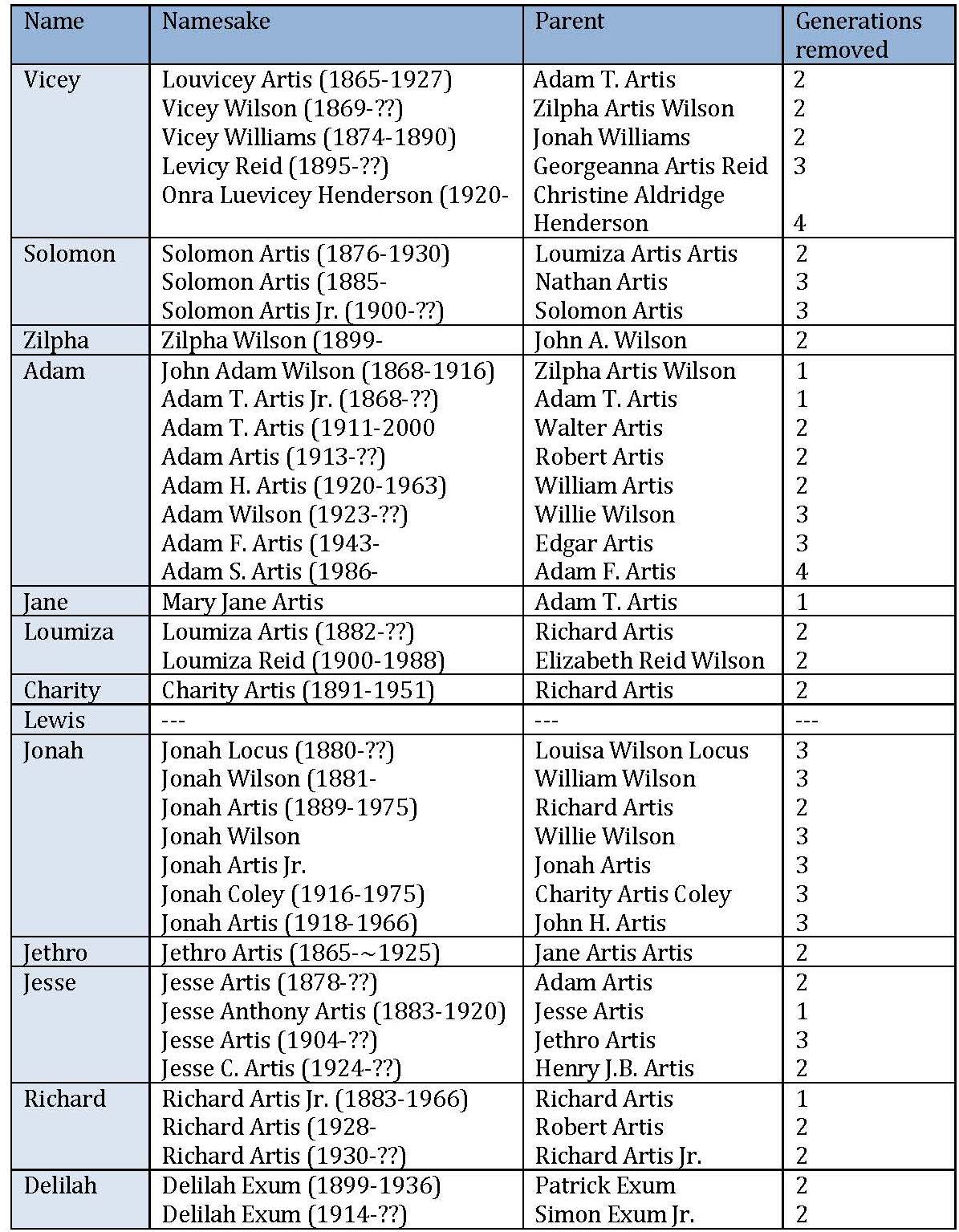
As in many early American families,  the descendants of Solomon and Vicey Artis Williams honored their forebears and living kin by naming children after them. The practice did not begin with them, and it is intriguing to speculate about which of the names that Vicey bestowed upon her offspring had been handed down from earlier generations.

The chart below sets forth all known namesakes of Solomon, Vicey or their children Zilpha, Adam, Jane, Loumiza, Charity, Lewis, Jonah, Jethro, Jesse, Richard and Delilah.

Match

Standard
Free People of Color, North Carolina, Paternal Kin

Adam’s daughters reconnect.

I spoke by phone almost two hours yesterday with D.J., who reached out to me via Scuffalong. I started this blog for several reasons, an important one being the hope that others interested in the families I’m researching would find useful information and would reach out to collaborate. In just over a year, I’ve connected to several such people and, in addition to sharing my research, have gained access to invaluable leads and angles that I’d never considered. I was particularly happy to “meet” D.J. though, because she is also a cousin. We are descended to the same degree from two of Adam T. Artis‘ daughters — Louvicey and Lillie Beatrice — making us fourth cousins.

Standard
Education, Newspaper Articles, North Carolina, Paternal Kin, Vocation

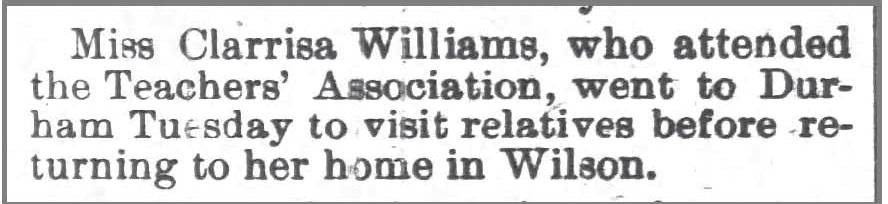
Bright lady teacher.

For the better part of a year, the doings of Jonah Williams‘ daughter Clarissa regularly made the society columns of the African-American Raleigh Gazette:

Ral_Gazette_1_30_1897_C_Wms

Raleigh Gazette, 30 January 1897.

Raleigh_Gazette_6_19_1897_C_Wms_teacher

Raleigh Gazette, 19 June 1897.

Raleigh_Gazette_6_26_1897_C_Wms

Raleigh Gazette, 26 June 1897.

Ral_Gazette_9_18_1897_C_Wms_bright_lady_teacher

Raleigh Gazette, 18 September 1897.

And then the paper folded.

More than 20 years passed before Clarissa next appeared in print. The “bright lady teacher” had fulfilled her promise and was elected principal of the Colored Graded School. Her tenure was not long, however. Clarissa Williams died of kidney disease on 26 October 1922, at the age of 51.

Wilson_Daily_Times_9_24_1918_C_Wms_Princ

Wilson Daily Times, 24 September 1918.


Standard
Births Deaths Marriages, Free People of Color, North Carolina, Other Documents, Paternal Kin, Religion

He was faithful in all his houses.

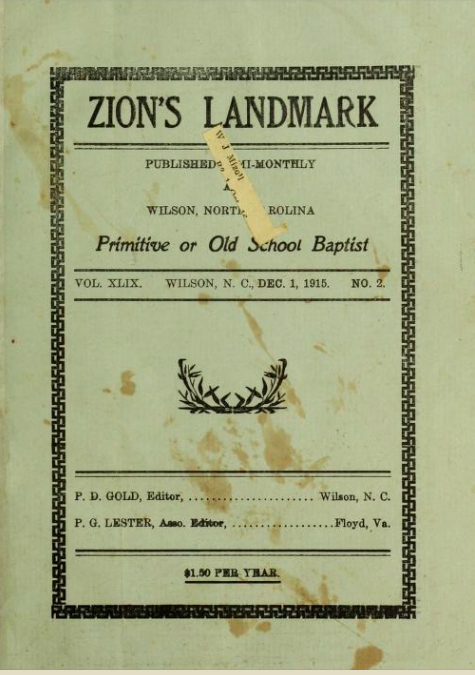
The Wilson Daily Times was an afternoon paper in my day. It was lying in the driveway when I arrived home from school, and I could read it first if I put it back like it was — pages squared and neatly folded. (Even today, I shudder at a sloppy newspaper, flipped inside out and pages sprawling.) The Daily Times‘ roots are in Zion’s Landmark, a semi-monthly newsletter begun in 1867 by Pleasant Daniel Gold. Elder Gold (1833-1920), pastor of Wilson Primitive Baptist Church, filled the periodical with sermons and homilies, ads for homeopathic remedies, testimonials, altar calls and, most enduringly, obituaries of Primitive Baptists throughout eastern North Carolina.

African-Americans did not often make it into the pages of the Landmark, but P.D. Gold held Jonah Williams in considerable esteem. Gold preached my great-great-great-great-uncle’s funeral and published in the Landmark a lengthy obituary by Brother Henry S. Reid, clerk at Turner Swamp Primitive Baptist Church:

Screen Shot 2014-10-12 at 10.41.54 PM

Screen Shot 2014-10-12 at 10.37.49 PM

Screen Shot 2014-10-13 at 7.34.42 AM

And what does this piece add to what I already know about Jonah Williams?

  • A marriage date for him and Pleasant Battle — 4 January 1867.
  • Some confusion about their children. I knew Pleasant had a slew of children from a previous marriage to Blount Battle. However, I had four children for Jonah and Pleasant — Clarissa (the surviving daughter referred to in the obit), Willie F. (1872-1895), Vicey (1874-1890), and J.W., whom I know only from a stone in the Williams’ cemetery plot. I’m thinking now that this is a foot marker, rather than a headstone, and I’ll revise my notes.
  • Jonah joined Aycock Primitive Baptist Church, part of the Black Creek Association, around 1875.
  • Around 1895, he and others were permitted to leave Aycock and form Turner Swamp Primitive Baptist Church, the first “organized colored” P.B. church in the area. The Black Creek Association ordained Jonah when he was called to serve at Turner Swamp.
  • Elder P.D. Gold preached Jonah Williams’ funeral.

Text found at https://archive.org/details/zionslandmarkse4919unse_0

Standard
Migration, Newspaper Articles, North Carolina, Paternal Kin

That glorious climate of Arkansas.

Perhaps this sheds some light on Gus Artis and his sister Eliza Artis Everett‘s migration to Arkansas from North Carolina well after the Exoduster era:

Goldsboro_Headlight_11_6_1889_Arkansas_migrantsGoldsboro Headlight, 6 November 1889.

On 27 November 1889, the Wilson Mirror reprinted a Goldsboro Argus piece that described Williams and Herring as “railroad hirelings and speculators.” “However much the desire should be divided among our people — and by this we mean the white people — for the negro to exodus this country or remain, the solid, stubborn truth shall not be kept from the poor, deluded, half-informed negro, that this is his home, the climate of his nature; that our people are the most tolerant and generous in the world; and his best friends, and that, therefore, he should stay right here where his associations date back through the centuries; where his faults, and there are many (but who of us is without faults?) are borne with from custom; where his privileges as a free citizen are unquestioned and untrammeled, and where his destinies are linked by law with the whites, who, under a Democratic administration, have for twenty years paid 90 per cent. of his government and education, while he has furnished 90 per cent. of the crime and ignorance of the State.”

Best friends, indeed.

The 20 December 1889 issue of the Wilmington Messenger chimed in the mockery, noting that “Peg leg Williams and Silas Herring have not dissolved copartnership. Peg leg is now in [Goldsboro], and he and Silas are as active as bees in inducing the “coons” of this section to leave their homes of peace and plenty here, to go the far off miasmatic lands of the West, there to die like cattle with the black tongue.”

Robert “Peg-Leg” Williams is memorialized in 100 Americans Making Constitutional History: A Biographical History, edited by Melvin I. Urofsky. Described as the most famous and successful of Southern “emigrant agents, Mississippi-born Williams, a Civil War veteran, assisted 16,000 African-Americans in leaving North Carolina in the wake of discriminatory labor laws passed in 1889.

*Kizzy Herring Herring, who applied for her husband’s Civil War pension from Lonoke County, Arkansas, was another who left Wayne County for the West. So, I suspect was Guy Lane, Jr., son of Guy and Sylvania Artis Lane, who decamped from Wayne County to Memphis, Tennessee, sometime between 1880 and 1900. Did he just not quite make it to Arkansas? Or did he double back to the city after deciding that Arkansas did not suit?

Standard
Civil War, Free People of Color, Military, North Carolina, Other Documents, Paternal Kin

Daniel Artis, Union soldier?

Daniel Artis’ pension file arrived today, and I was puzzled. Was this either of “my” Daniels?

As detailed here, Daniel Artis, allegedly went to war as a body servant for Confederate officer Christopher C. Lane. There are two Daniel Artises. One was born about 1820 and would have been well into middle age when he trudged off to battle. On the other hand, his nephew Daniel Artis, Sylvania’s son, was born about 1843, and was in his prime when the Civil War erupted.

What does the file tell us? It’s a slim one, as pension application files go. Daniel’s request for assistance was rejected summarily, so there was no need to interview his neighbors and kin to corroborate his claims. Still, it is useful.

On 2 December 1901, the Board of Review received an application from DANIEL ARTIES, G 14 USCHA, and assigned it claim number 1277226. Milo B. Stevens & Company of Washington, D.C., a firm of attorneys specializing in pension claims, represented the old soldier. Daniel gave his address as P.O. Box 5, Greenville, Pitt Co., NC, and stated that he had enrolled in the Army in an unknown date in 1865 and been discharged on 11 December of the same year. Despite the Pitt County address, Artis granted Stevens power of attorney on a form sworn to in Wayne County — specifically, Eureka — in the presence of W.M. Exum and Philip Forte. I’m not clear on Exum’s identity, but Forte was a prominent African-American in the neighbor and himself a Union veteran.  Further, Forte’s daughter Hannah married Daniel’s cousin Walter S. Artis, son of Adam and Frances Seaberry Artis. Simon S. Strother, the notary public who stamped Daniel’s application, was executor of Adam T. Artis’ estate.) At some point, a commissioner requested “personal description and name of owner” from Artis, but the response — which would have included an assertion of his freeborn status — is not found.

IMG_7141

Daniel’s supporting declaration for invalid pension stated that he was 68 years old, that he had been discharged at Fort Macon, and that he was unable to support himself by manual labor due to “rheumatism in back and hip and piles and affected in the breast.” Daniel signed the document with an X.

And then the downer: “Rejection on the ground that the soldiers name is not borne on the rolls of Co G, 14th U.S.Col.H.A., as alleged, as shown by the report from the War Department.”

IMG_7165

So, which Daniel is this? Several clues help eliminate Daniel the elder. First, he was born circa 1820, well before Daniel the applicant. Second, Daniel the elder owned significant property in Greene County and is not known to have lived in either Wayne or Pitt Counties. Last, and this applies to either, if Daniel served Christopher C. Lane during his time as an officer in Company A, 3rd North Carolina Artillery from about 1861 till his death in 1864, is it likely that he would have trudged home from Georgia, turned around, gone to New Bern, and enlisted in the Colored Troops in 1865?

My money is on Daniel, son of Sylvania Artis and Guy Lane. Here’s the little I know about him:

In the 1850 census of Greene County, next to white farmer John Lane, Silvany Artess is listed with her children Daniel, Mitchell, Meriah, Gui, and Penny Artess. Ten years later, John Lane’s household included Dannel, Mike, Penney, Dyner, Juley, and Washington Artis, who probably were his apprentices.  Next door was 40 year-old Dannel Artis, the children’s uncle.  On the other side, their mother Sylvania Artis.

Around 1861, Daniel went to war with John Lane’s son Christopher and returned home in 1864.  Surely it is he, and not his 45 year-old uncle Daniel, that enlisted in the Union Army in 1865. His service was short-lived, and he apparently returned to Greene County after.

Guy Lane and Sylvania Artis formalized their marriage a year after he was emancipated, and by 1870 the family had moved several miles west into Nahunta district, Wayne County. There, Guy Lane and wife Silvania are shown in the census with children Daniel, Mike [Mitchell], Mariah, Guy, Penny, Dinah, Julie, Washington, and Alford.

In the 1880 census in Bull Doze [Bull Head] township, Greene County, Daniel Artis appears with his wife Eliza and children Emma D. and James W. I cannot find him in any census thereafter. However, if he is the Daniel Artis who applied for a Civil War pension, he was living in Wayne or Pitt County from 1900 until at least 1904. The notice below also seems to indicate that he was alive as late as 1905, when Dunk Lane and “Miss Dickerson” used his house as a place of assignation. This is the last evidence I have of Daniel Artis’ life.

Gboro_Weekly_Argus_8_1_1907 D Artis

Goldsboro Weekly Argus, 1 August 1907.

Standard
Births Deaths Marriages, Land, North Carolina, Other Documents, Paternal Kin

To my ….

Abstracts of wills filed in Wayne County Superior Court, Goldsboro, North Carolina:

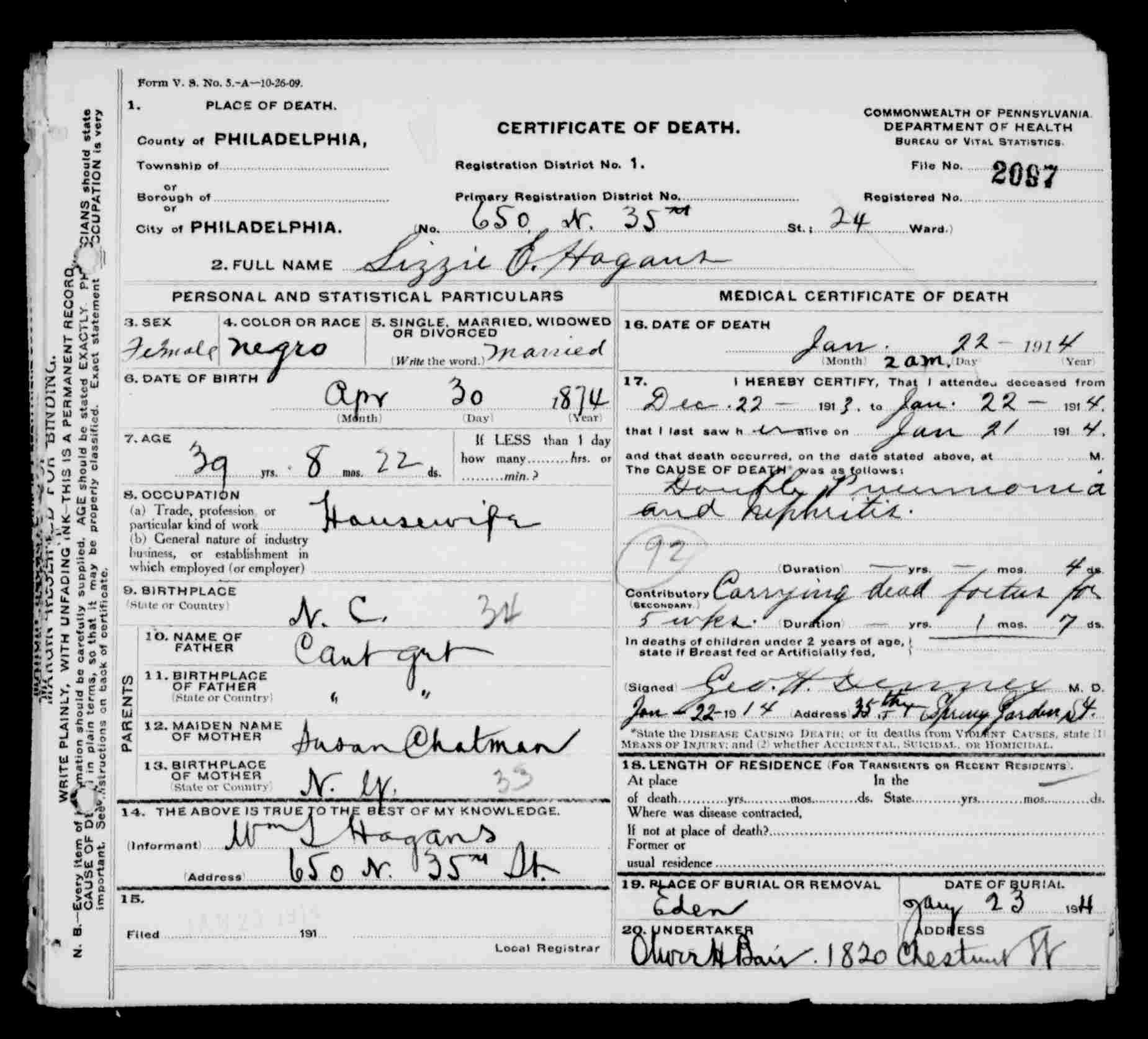
Lizzie E. Hagans — (1) to my beloved husband Will S. Hagans and his heirs in fee simple my house and lot in the town of Goldsboro, situated on Oak Street between West Center and James Streets and known as 104 West Oak Street; (2) to my husband $5000 with all benefits from life insurance policy #190279, Phoenix Mutual Life Insurance Company; (3) Will S. Hagans appointed executor. Signed 5 August 1904 in the presence of H[enry] S. Reid and J.A. Dees.

On 2 May 1917, C[larence] Dillard and J. Peele swore that they were knew Lizzie Hagans for a number of years, were well-acquainted with her handwriting and verified her signature. Henry S. Reid also swore that he witnessed the will, which was recorded and filed on 3 May 1917.

HAGANS -- Lizzie Hagans Death Cert

She had inherited Oak Street house from her (probable) uncle, William Burnett. Lizzie Hagans died shortly after William S. Hagans moved his family from Goldsboro to Philadelphia. 

——

Adam T. Artis — (1) S.S. Strother appointed executor; (2) a decent burial suitable to the wishes of my family and friends; (3) to my wife Katie Artis, all of the Thompson tract on which I now live, about 18 acres, all household and kitchen furniture and personal property; (4) to son Pinkney Artis, $100; (5) to son June Scott Artis, $10; (6) to son Henry Artis, $10: (7) to son Columbus Artis, $10; (8) to son William Artis, $5; (9) to son Walter Artis, $5; (10) to daughter Josephine A. Sherard, $15; (11) to son Robert Artis, $5; (12) sell the balance of my land to pay out the above, then divide the remaining in equal shares among my children Vicey Aldridge, Liza Evert, Augustus K. Artis, Georgana Reid, Mary Jane Artis, Emma D. Locus, Ida Reid, Lillie Thompson, Napoleon Artis, Haywood Artis, Addie Artis, Annie Artis, Alberta Artis, and Jesse Artis, and, at Katie’s death, property to be divided among the twelve heirs above whose gifts are not limited. Signed with an X in the presence of W.F. Lewis, J.J. Coley and J.E. Exum. Codicil: (13) to son Noah Artis, $10.

Recorded and filed 1 May 1919.

Adam Artis’ will includes the names of 23 of his children. Emma’s name is crossed out because she died before the terms of the will could be carried out. Known children whose names do not appear include Cain Artis, who died in 1917; Caroline Artis Coley and Louetta Artis, who presumably died before the will was made; Adam Artis Jr., who seems to have been very much alive in Washington DC. (Was the omission of his name inadvertent, as with Noah?) Despite newspaper reports claiming that Adam  fathered 47 “legitimate” children, these 27 are all I have been able to identify. Though there were doubtless others who died in childhood, I doubt there were 20 of them, and I am fairly certain that no other children reached adulthood.

——

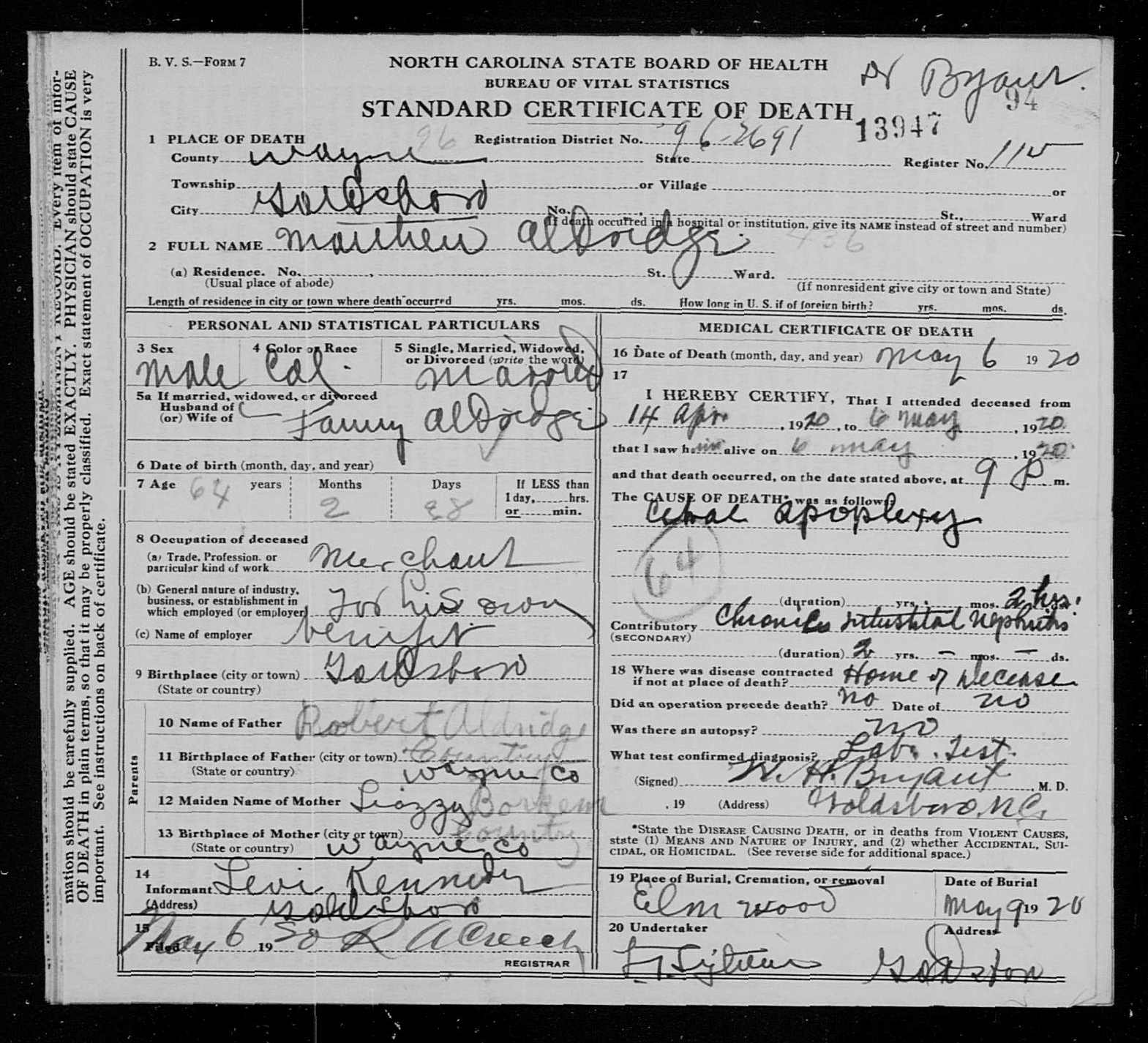
Mathew Aldridge — (1) to daughters Fannie B. Randolph and Mamie J. Aldridge, 1/2 undivided interest in my dwelling house and lot on Pine Street. Signed 27 August 1919 in the presence of N.D. White and Ida Darden.

Recorded and filed 18 May 1920. Fannie Aldridge was qualified as administratrix.

record-image-24 copy

Hmmm. Mathew Aldridge’s will provided for neither his wife, Fannie Kennedy Aldridge, nor his oldest daughter, Daisy Aldridge Williams. Perhaps he had settled property upon them prior to making his will.

——

Lucian Henderson — to John Wesley Carter, all my real estate known as my home place, 8 acres, provided that John W. Carter care for me and my wife Susan Henderson, otherwise null and void. My trusty friend John W. Carter appointed executor. Signed with an X in the presence of Everest Lewis and R.E. Simmons.

Lucian Henderson died 22 June 1934 and his will was recorded and filed 27 June 1934.

Lucian and Susan Henderson’s only child, Cora Q., died in 1907. For more re his friendship with John W. Carter, nephew of his sister Sarah’s husband Jesse A. Jacobs, see here.

——

Joseph Aldridge — (1) a decent burial; (2) to my wife Martha C. Aldridge, all my real and personal property during her lifetime or widowhood; (3) to my sons Allen Aldridge, Daniel Aldridge, William Aldridge and Milford Aldridge, $1 each, to my son Joseph Aldridge, my watch, to my son George Aldridge, my clock; (4) after Martha’s death, all my personal property to be divided between my sons Joseph and George and my daughters Mary Aldridge, Luella Aldridge and Lillie Mae Aldridge; as tenants i common, Mary, Luella and Lillie Mae to receive 12 acres to be laid out of the someplace on the east side of the old stagecoach road; to Joseph and George, all the remainder of the land between what I received from the estate of my father Robert and my brothers George and Dave. Signed 5 May 1934.

Recorded and filed 12 September 1934.

Martha Hawkins Henderson Aldridge remarried in 1940, triggering the terms of paragraph 4 of the will. As set forth here, she remained close to Joseph Aldridge’s children the remainder of her life. Also, a small clue I hadn’t noticed before: Joseph indicated that he received land from the estate of his brother Dave. As noted here, I had lost sight of David Sloan Aldridge after 1904, but now know that he died before 1934.


Standard
Land, Migration, North Carolina, Other Documents, Paternal Kin

Artis in Arkansas, follow-up.

Shortly after posting on the migration to Arkansas of Gus Artis and Eliza Artis Everett, I contacted the Lonoke County Museum.  After a brief and helpful phone conversation with a staff member named Sheryll, I sent a letter (and a donation) requesting any information about my Artises.  (Put your money where your mouth is with these little grassroots organizations, folks.)

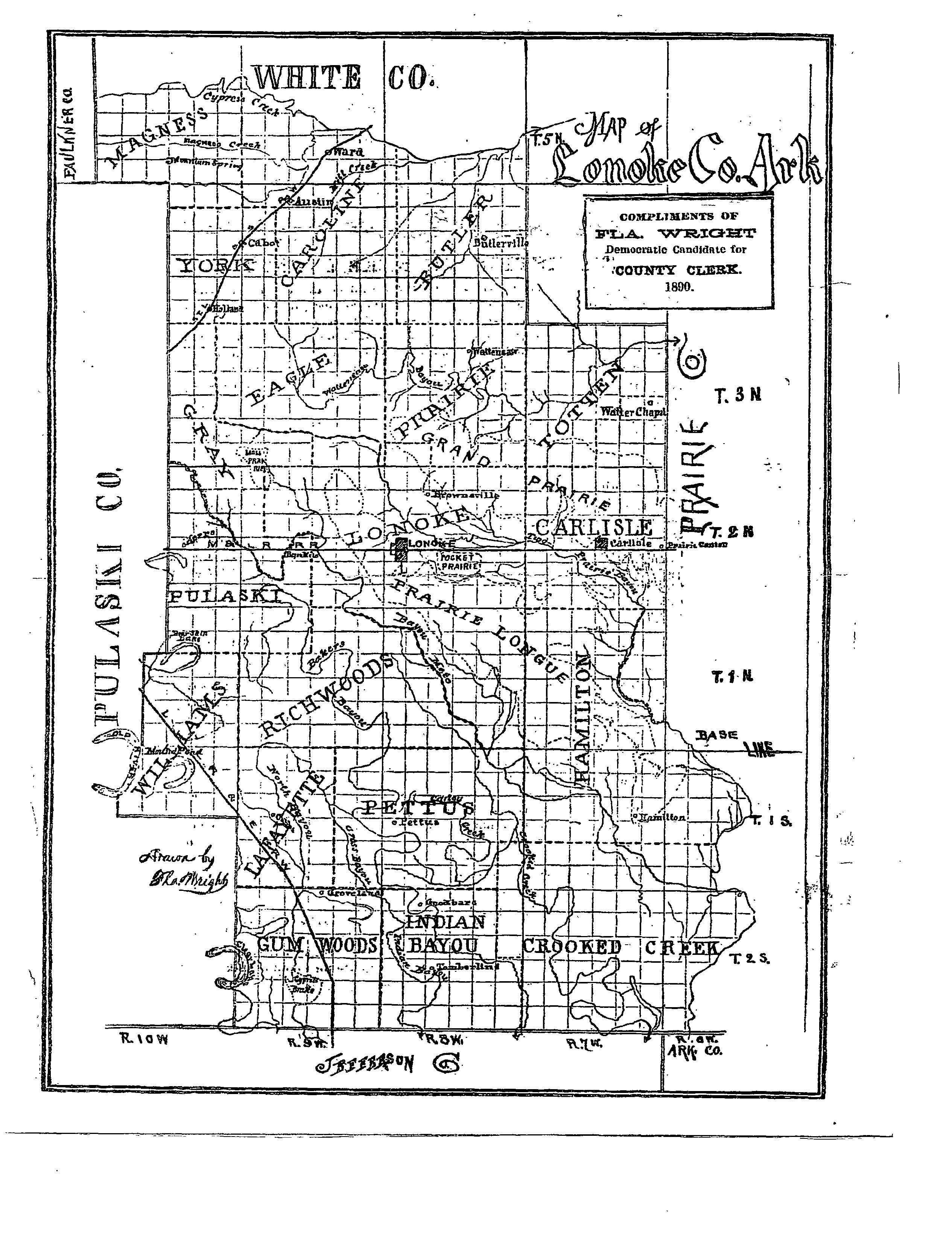
Yesterday, I received a slim packet in the mail, postmarked “Central Ar.” Inside, the fruits of Sheryll’s diligent search for my long-lost relations. Much of the information I already had, but two pieces were particularly helpful. First, an 1890 county map showing all the county’s townships. Williams, where Eliza and Haywood Everett lived, is a little bulge on the lower western flank of the county, sliced through by the now-defunct Little Rock & Eastern Railway. (U.S. 165 now tracks the line.) This corner of the county, pocked by horseshoe bends, lies within the rich alluvial plains of the Arkansas River.

Lonoke County Map

The second revelation came in a transcription of Lonoke County personal property tax registers. In my first blogpost, I wondered if Gus Artis had migrated to and settled temporarily in Lonoke County with the Everetts. The answer appears to be yes. Gus paid taxes on property in Williams township in 1890 and 1891. Haywood (Hayard, Hawood) Everett paid taxes in Williams in 1890 and 1891 and thereafter, as did his father Thomas Everett. With this information, my next step is to hunt down particulars of the land the Artises and Everetts were owned. 

Standard
North Carolina, Other Documents, Paternal Kin

A reckoning. And recommendation.

I know I have a romantic view of old East Wilson (old, as in before it was ravaged by the crack trade), and though I know that’s attributable to my very safe and happy childhood there, I am reminded of just how shallow my rosy recollection is. One of my cousins, 20 years older than I, has just published a memoir. The early pages of Sherrod Village are set on streets I walked and peopled by folks I knew in East Wilson. Barbara Williams Lewis’ grandmother was my great-great-grandmother’s sister; they were two of the “innumerable” children of Adam T. Artis. (Her mother, in fact, is who described them to me that way.) I thought I would recognize so much in Barbara’s book. But I didn’t.
Children are shielded from so much ugliness (if they’re lucky) and understand so little of what they see. The ragged pasts of sweet old people are not always apparent in their mild presents. Nonetheless, I had believed that my truth was true. I had, perhaps, counted on it. I’d thought that I’d viewed East Wilson as a palimpsest. Instead, though my family’s story there involved poverty and insecurity and pain, I processed little beyond the surface of my own memories of crepe myrtles, corner stores and swimming lessons at Reid Street Center. I knew the history of the place, but not the lives of its people. Fifteen pages into Sherrod Village, I wrote to Barbara that I was “staggered.” I finished the book in the same state of astonishment. I HAD NO IDEA, I told her. No idea. And I thanked her.
Standard