Maternal Kin, North Carolina, Photographs

The reunion.

Reunion 1978 01My grandmother and her children: the first reunion.

It was in July. I’m sure of that, but not the actual date. The first Colvert-McNeely family reunion. We gathered in Statesville, of course, where my grandmother Margaret and her sisters Louise and Launie Mae were born and grew up. The reunion called not only their descendants, but those of their older half-sisters, Mattie and Golar, and their maternal McNeely kin. I was 14 that summer and not much interested in anyone more than three or four years older than I. Nor had I been seized with the unquenchable genealogical fervor that would light me up a decade later . So I lounged around the hotel pool and wasted opportunities that year, and subsequent, to winnow every broad hint and slender clue from the ever-waning recollections of my elders. My great-aunt Louise, who lived in Statesville all her life and probably knew the most. My great-great-aunt Min, last of the McNeely siblings. The “other” Colverts, cousins and children of my great-grandfather’s half-sisters — were they even there? I’d been surprised to learn later that some were living in 1978. (They were not much spoken of. Was there a rift?) Who was in Statesville that summer? Whom did I miss?

CM Reunion 1978

The last day. Or maybe the first. My uncle John’s wife Gladys, my mother, my grandmother (in curlers — she would not approve of this post), my uncle John, an unknown man (a Colvert? a McNeely? who?), my mother’s first cousin Donald, my aunt Lynne, my father. Statesville, 1978.


Standard
Business, Civil War, Enslaved People, Land, Maternal Kin, Newspaper Articles, North Carolina, Photographs

Eagle Mills.

An abstract from Heritage of Iredell County, Vol. I (1980) —

In 1846, peddlar Andrew Baggerly bought the old Francis Barnard mill tract on Hunting Creek in north Iredell County.  In 1849, he placed an ad in Salisbury’s Carolina Watchman: “Capital Wanted And If Not Obtained Then Valuable Property For Sale.”  He described the property as “the most valuable water power in the Southern Country … situated on Hunting Creek in Iredell County, twenty-eight miles west of Salisbury … [on] a never-failing stream, … remarkable for its purity, … [and] adapted to the manufacture of paper, to calico printing, to bleaching etc.”  Baggerly noted that there was a dam in place, an active sawmill, a grist mill soon to open, and a factory building about half-finished.

On 2 Mar 1850, Baggerly, James E.S. Morrison, William T. Gaither, William R. Feimster, William I. Colvert, G. Gaither Sr. and Andrew Morrison filed a deed for a 318 1/4-acre tract called the Eagle Mills place.  By 1852, the factory was operating with William I. Colvert as its agent.  It had 700 spindles and 12 looms and employed an overseer and 22 workers, 20 of whom were women. By 1854 the adjacent former Inscore Mill had been added to the works, and Baggerly claimed the “intrinsic and speculative value” of the complex was $2,700,000.  

In 1855, Baggerly advertised in Charlotte’s North Carolina Whig and in the Carolina Watchman, calling the complex “Eagle City, the Great Point of Attraction, Destined to be the great center of manufacturing interests in Western North Carolina and perhaps the United States.”  He deeded the president and Congress of the United States a ten-acre block in Eagle City called Eagle Square, located on Market Street.  

After Baggerly was forced to liquidate his assets during the Panic of 1857, William Colvert became the owner of his interest in Eagle Mills.  “According to tradition there was a tobacco factory, hotel, oil mill, and general store at Eagle Mills in addition to the grist mill and cotton factory.  A number of homes stood in the horseshoe bend above the mills and a church was eventually constructed on the edge of the settlement.”

In the spring of 1865, Stoneman’s raiders came upon Eagle Mills unexpectedly and burned it to the ground.  The mills were rebuilt, but Eagle Mills never recovered its former prosperity.  The cotton factory and grist mill operated until destroyed by fire in April 1894.  At that time, William I. Colvert, Robert S. Colvert, and James E.S. Morrison were the owners.  

The only remains at the site are gravestones in the church cemetery, traces of the main road to the mill, the grist mill’s foundation stones, and, a short distance upstream, remains of the stone supports where a covered bridge crossed the creek.

——

Sville_Record_and_Landmark_4_19_1894_Eagle_Mills

Statesville Record & Landmark, 19 April 1894.

——

When William I. Colvert took charge of Eagle Mills in 1852, my great-grandfather Walker Colvert was in his early 30s and father of a one year-old boy, John Walker Colvert. I don’t know exactly what kind of work Walker did for W.I., but they had grown up together, and Walker was an entrusted slave. Even if his primary labors were not at the cotton factory complex, I am certain that he spent considerable time in and around his master’s largest investment. So, too, would John Walker, who remained with W.I. after Emancipation. He is listed in W.I.’s household in the 1870 and 1880 censuses, and I suspect he stayed at Eagle Mills until the final fire closed down the works.

On a rainy December morning I cruised the backroads of northern Iredell County, drinking in the landscape that was home to my Colverts and Nicholsons for much of the 19th century. I made a left onto Eagle Mills Road, headed north. A sharp bend in the road and there, a bridge over Hunting Creek. I pulled over and, ignoring a No Trespassing sign, clambered down to the sandy bank. The waterway is too shallow and rocky to have been paddled or poled, but I imagine that Walker and John Walker knew its course very well. Hunting Creek powered Eagle Mills and was a direct link between W.I. Colvert’s lands and those of Thomas A. Nicholson, whose son James Lee married W.I.’s daughter and whose granddaughter, Harriet Nicholson, gave birth to John Walker Colvert’s first child.

IMG_4618

Photograph by Lisa Y. Henderson, December 2013.

Standard
Business, Maternal Kin, Newspaper Articles, North Carolina

To look like new.

Mountain_Scout_Taylorsville_8_23_1916 Pressing Club

Mountain Scout (Taylorsville), 23 August 1916.

This ad appears several times in Taylorsville’s Mountain Scout in the latter half of 1916. Did Lon Colvert open a branch of his Statesville operation a few miles away in Alexander County?  Like barber shops, clothes cleaning and pressing businesses were frequently operated by African-Americans in the late 19th and early 20th-century South.

Standard
Maternal Kin, North Carolina, Photographs, Vocation

Saint Agnes Hospital.

20140503-223413.jpg

This only looks like a Civil War ruin. In reality, Saint Agnes Hospital closed in the early 1960’s, after Raleigh’s Wake Medical Center integrated. Saint Agnes trained generations of African-American nurses, including my great-great-aunt, Henrietta Colvert.

Screen shot 2014-05-05 at 7.29.28 AM

From the Annual Catalogue of St. Augustine’s School, Raleigh, N.C., A Normal School and Collegiate Institute For Colored Students of Both Sexes, Thirty-Third Session, 1911-12.

Standard
Births Deaths Marriages, Enslaved People, Land, Maternal Kin, North Carolina

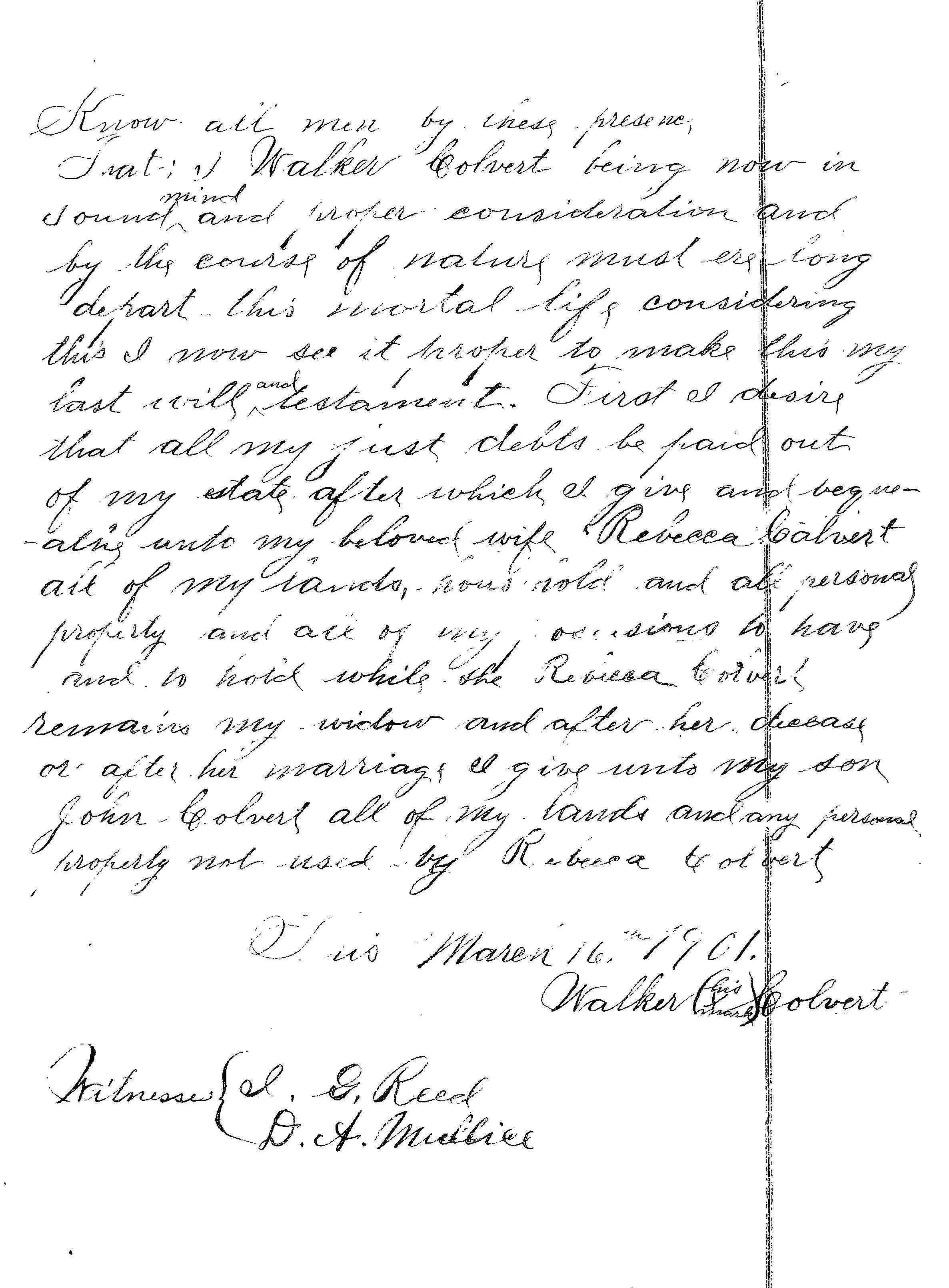
All of my possessions to have and to hold.

COLVERT -- W Colvert Will_Page_1

COLVERT -- W Colvert Will_Page_2

Born 40 years into American independence, and less than ten after the importation of African slaves was banned, Walker Colvert could have prayed for, but never foreseen, that he would gain his freedom just past the midpoint of his life and that he would die possessed of something to leave his wife and son.


Standard
Maternal Kin, North Carolina, Oral History, Photographs

Papa used to keep him just slick and pretty.

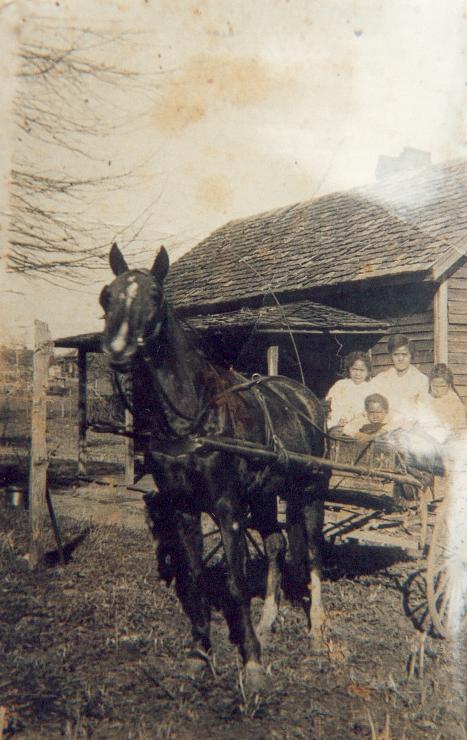
His name was Prince. And Papa sold Prince when he bought a car. But when he bought Prince, Prince had never been broken in. Nobody’d ever ridden him. And this man broke him in for Papa. But he was still high-spirited, because he was a race horse. And he had four white feet. That is what was so distinctive about him. He was chestnut. And we were so crazy about him that we would go in the – Papa had a big enclosed lot, like, that he could come out in. Other than the stable. And we would go in there with him, but he wouldn’t bother us. He would never bother us. And this old gentleman would be what was called currying. He would curry the horse and brush him and all, and he would hold me up and let me brush it. What was the man’s name? I can see him right now. He was an old man and real light. He was almost white. He had light hair, had white hair. And he loved Mama’s cooking. She used to bake something that was a pie. She called it a pie – but it was sweet potatoes. It was not mashed like you’d make up in a sweet potato pie ‘cause she would slice them and put them in the pie. Then she would make a sauce with nutmeg and lemon juice and thicken it with flour, you know. And then she would cook all of that in a big plate thing like that. And when Papa sold Prince, we went down where the man who had bought him had him, and he would look bad. His skin – you know Papa used to keep him just as slick and pretty. And that man would come to the house and wash him down with soap and water and everything and made him pretty. And he had pretty white feet. But Papa sold him to that man when he bought the car. And we went down there one day to see Prince, and he looked awful. He looked bony. He just looked awful. And we went down a little hill where he was in an enclosure. And we called him, and he came running over there where we were. We were so glad to see him. And we went home and told Papa that Prince said he wanted to come home. Yes, Lord. We wanted Prince moved.

COLVERT -- Colvert Girls & Bert

Possibly Prince (though he only has two white feet), circa 1913, with Louise Colvert, Launie Mae Colvert, Bertha Hart and Margaret Colvert.

—–

Interview with Margaret Colvert Allen by Lisa Y. Henderson; all rights reserved.

Standard
Births Deaths Marriages, Maternal Kin, North Carolina

Family cemeteries, no. 10: Green Street.

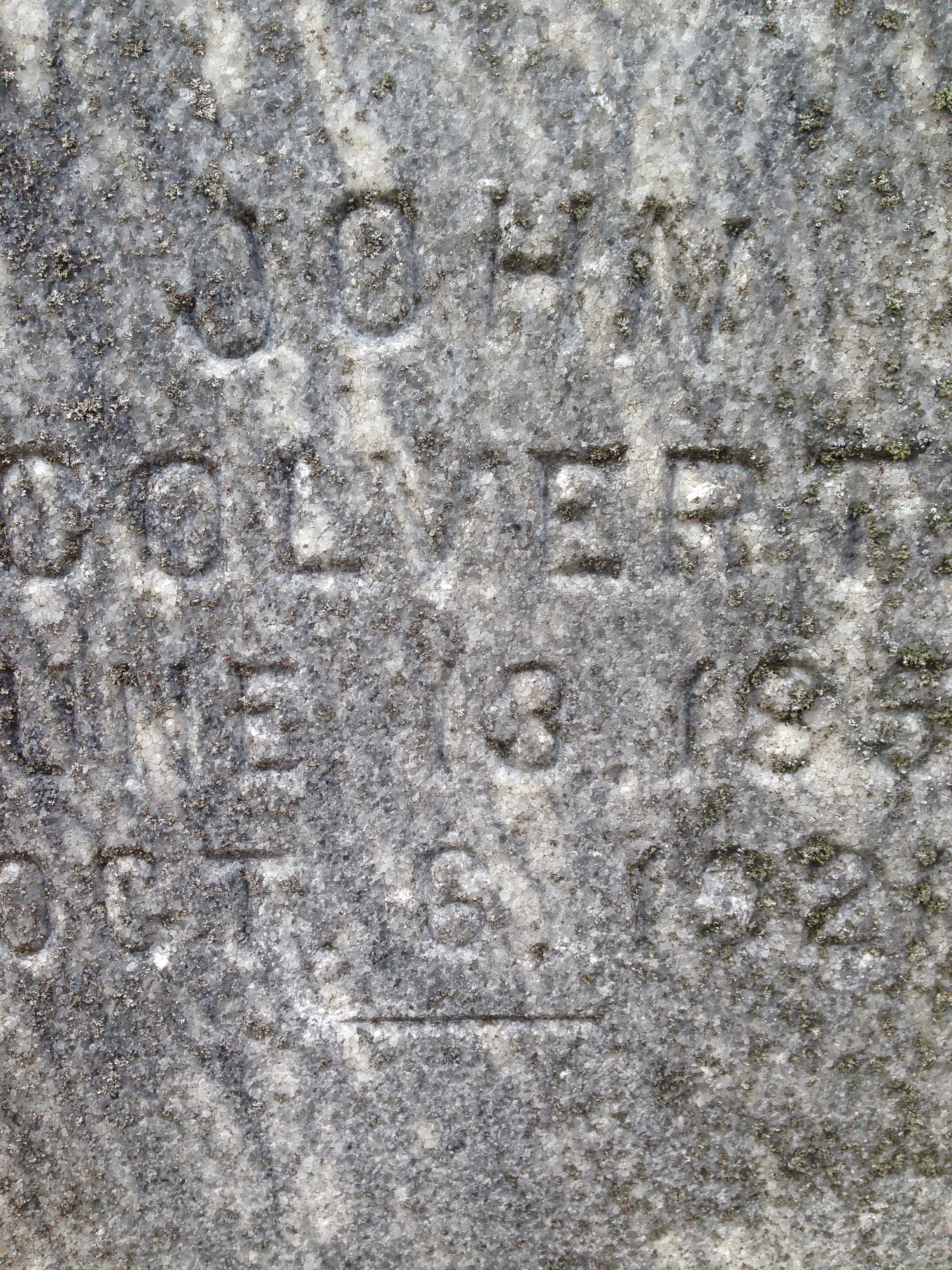
Green Street cemetery is a three-acre square smack in the middle of Statesville’s African-American southside. My great-aunt’s house faced the graveyard, but I don’t recall anyone ever talking about family members being buried there. Nonetheless, several years ago, I found three: my great-great-grandfather John W. Colvert, his wife Adaline Hampton Colvert (the double stone below) and their daughter Selma Eugenia Colvert, who is buried nearby. I suspect that others rest there, including John Colvert’s parents, his son Lon W. Colvert, Lon’s first wife Josephine Dalton Colvert, and his children Walker Colvert and Golar C. Bradshaw.

IMG_4585

IMG_4588

Standard
Maternal Kin, North Carolina, Oral History, Photographs

A bird’s eye view.

The bird’s-eye view map of Statesville, North Carolina, drawn in 1907, reveals a number of features in Lon W. Colvert‘s landscape (click for a closer look):

statesville_1872_annotated

At #1: near the intersection of Centre Street, 109 East Broad Street, early site of Colvert’s barbershop. At #2: Center Street AME Zion Church. At #3: Southern Railway station, built in 1906. Colvert had an earlier shop in the Depot Hill area near the depot.  At #4: the railroad.  The Colverts’ house was adjacent to the railroad in Wallacetown, southeast of the station, as was that of his in-laws, Henry and Martha McNeely.

Below, the current tenant at 109 East Broad:

Image

Photo by Lisa Y. Henderson, December 2013.

Standard
Births Deaths Marriages, Maternal Kin, North Carolina, Oral History, Photographs, Virginia

Remembering Margaret Colvert Allen.

She gripped a balled handkerchief, or a tissue, in that hand almost always. You’d only notice that little finger, crooked up above the rest, when she made certain gestures, like smoothing her dress across her lap. It was a source of endless fascination when I was a child, and she would obliging turn her hand this way and that so we could get a closer look. Her pinkie finger, it was, curled permanently into a C-shape.

Here’s how it happened:

My grandmother:  Ooo, I had a lot of friends.  We had a lot of friends.  We could not visit people all in the neighborhood.  We could not go, the children came to our house.  You know, to play and all that kind of – to play ball.  We’d play ball in the evening, and they’d put me in the field because I couldn’t catch no ball on account of my finger.  [Laughs.]  I always had to go in the field.  Louise and Launie Mae were whizzes.  Louise was a terrible bad ball —  I mean, she could play some ball.  But Launie Mae was good, too.  But, honey, they’d put me out there way out there in the field where didn’t no – just as soon as I’d reach up to catch that ball that thing would knock it out.

Me:  Right. How did you hurt your finger?

My grandmother:  Ah, you know, they had windows that you’d put a stick under.

Me:  To prop them up?

My mother’s cousin: Didn’t have a sash.

My grandmother:  Yeah.  And I was in there playing and took that stick out there, and it broke something.  But anyway, Mama said she had gone to town.  That’s what they say when they went into Statesville.  And she said when she came back, Golar came out meeting her with me in her arms, and said she had on a little dress, and said she turned the dress up and blood was coming through the dress off me, you know, my finger and everything.  It scared her to death.  So they carried, she carried me to the doctor’s, and they put splints on to get it – it was broken, you know.  He put splints on.  But, see, I would pick ‘em off.

Me:  Just take it right off.

My grandmother:  Take ‘em off.  And take ‘em off.  And hold my hand like that.  [Balling her hand into a fist.]

Me:  Okay.  So that’s how it healed.  It healed closed.  How old were you then?  Real little?

My grandmother:  I guess I was little.  I don’t know how old I was.  Two, three.  I don’t know whether Launie Mae was there or not.  I know Louise was, but I don’t know ‘bout all of ‘em.  But, anyway, I was just big enough to crawl up to the window and pull the stick out.

I have many favored photos of my grandmother, and this is one of the last:

MCA

At home, in her easy chair, just back from church, with that little finger.

Remembering Margaret Colvert Allen (2 August 1908-11 February 2010).

Standard