Free People of Color, Land, North Carolina, Paternal Kin, Photographs

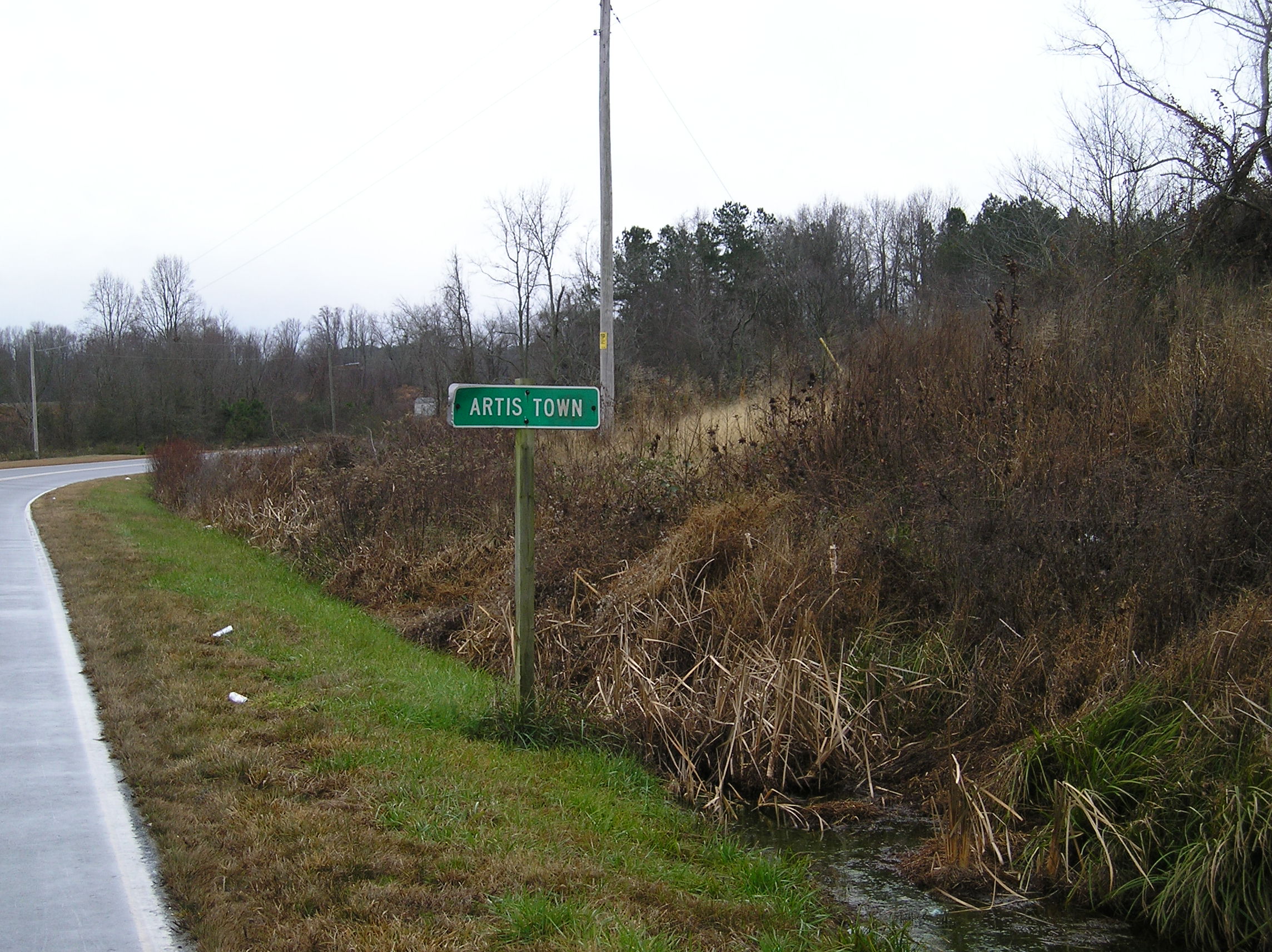
Artis Town, at last.

I checked first at the Court House. I had a hazy memory of a dusty, yellowed pull-down map hanging on a wall in the Register of Deeds office depicting Greene County townships in, perhaps, the 1950s. Most county roads were then unpaved, and the map bore witness to many now-abandoned crossroads and hamlets, including “Artis Town.” But the map was gone, cast aside in a reshuffling of office space that relegated Register of Deeds to the basement. The two ladies on duty — blue-permed and powder-fresh — interrupted their gossip (“He’s good as gold, but when he’s mad, he’ll … he’ll CATCH”) to help, gamely pulling two or three crumbling maps from storage, but none was what I sought. “Try EMS!,” one finally suggested, “They know all the roads.”

In the dim front office of a low brick building on the northern edge of Snow Hill, I explained myself: “I’m looking for a place in the road called Artis Town. There used to be a sign. Like, a green one with white letters. And it was somewhere off Speights Bridge Road, or maybe Lane Road, but I hunted up and down this morning and couldn’t find it.” The good old boys were puzzled. “Artis Town … Artis Town …” “Well, naw, I never heard of … Mike! You know where Artis Town is?” “Artis Town. Artis Town ….” An older man walked through the door and was put to the test. “Well, I think … hmmm. Hey. Call Donald. If he don’t know, don’t nobody.” … “Hey, Pam, is Donald — wait, you’re from out that way. Do you know where Artis Town is? … Okay … okay … okay. Donald? Yeah, Artis Town. … Okay … mm-hmm … that’s what Pam said. Okay, thankee.” And sure enough, it was in a bend of Lane Road, off Speights Bridge, and there had been a sign, and it was gone.

But I asked my mother about it, too, because she taught in Greene County for two years when she first came to North Carolina, and I thought maybe she’d heard of it. Her school had been in Walstonburg and probably drew students from Speights Bridge, and … “Let me look at my gazetteer.” She has the old version from the 1980s, which, of course, I pitched once I bought the shiny new one. And I’m regretting that surely, for Artis Town is marked quite clearly on her map, and I could have saved myself some gas and tire rubber had I consulted it. (Though I would have missed out on the helpful hospitality of the fine people of Snow Hill.)

I dug my old laptop out of storage today. It took a bit of searching, but finally: photos I took in December 2004 when I was wandering the roads of Greene County with no real purpose other than a penchant for what Least Heat-Moon calls “blue highways.” Almost ten years would pass before I’d connect Artis Town with my own Artises. The ancestors, though, are patient.

Image

Image

Photographs by Lisa Y. Henderson, 23 December 2004.

Standard
Enslaved People, Free People of Color, Land, Newspaper Articles, North Carolina, Paternal Kin, Vocation

Black carpenter makes name for himself.

I’ve been pulling together a descendant chart for Daniel Artis. In part, I want to keep the names straight and, in part, I’m trying to see if I’m related to any of the other Edwardses, Saulses or Artises I grew up with. Tonight I Googled some random names from this family and up popped this, published just three days ago in Kinston.com, the on-line version of the Kinston Free Press. Andrew Sauls’ father was Isaac Sauls, son of Isaac Sauls, son of Prior Ann Artis Sauls Thompson, daughter of Daniel Artis, brother of my great-great-great-great-grandmother Vicey Artis Williams.

[Update, 7 March 2014: I emailed the Free Press journalist and two days later — yesterday — got a call from Andrew Sauls himself! He lives on land his grandfather bought in 1920 (plus 400 more); confirmed that the Artis Town sign is gone; knew M.’s grandfather, “Cousin Booker T.,” well; and promised to show me around Sauls-Edwards-Artis territory next time I’m home!  — LYH]

Standard
North Carolina, Paternal Kin

Long-lost cousins.

M. had the same first name — an unusual one in that time and place — and last initial as my first cousin. We met when I, a year too young, tagged along to my cousin’s Brownie Scout meetings. M. and I discovered that we lived down the street from one another and from then until my family moved away three years later, we were inseparable.

Several years ago, I did some basic genealogical research on M.’s mother’s family. Her grandfather was a Greene County Edwards, and I was able to trace his ancestry back to slavery. I gratified by the achievement, but nothing in what I found resonated on a personal level.

Fast forward to last week. While hunting for Artis Town, I revisited an Edwards cemetery that I first encountered five or ten years ago while driving Greene County back roads. As I noted here, this time I realized that these Edwardses were also Artises, descendants of Daniel, the brother of my great-great-great-great-grandmother Vicey Artis Williams. Standing there, mulling this over, I started thinking about M.’s family, her Edwardses, and wondering …

When I got back to my parents’ house, I hopped onto the internet. Twenty minutes, and a lot of scribbling and charting later, there it was. M.’s grandfather was the grandson of Mariah Sauls Edwards, who was the daughter of Prior Ann Artis Sauls Thompson, who was the daughter of Daniel Artis. In other words, M. is my cousin, too!

P.S. I figured all this out the day before M.’s birthday. A little present for us both.

P.P.S. An iron-clad childhood rule: “Don’t get in anybody’s car unless we have given you permission.” I broke it twice before the lesson took. The second and last time, I was about seven. I was playing down at M.’s house when her grandparents announced that they were about to ride down Greene County. I ran home to see if I could go with them. Nobody was home. I decided for myself and hopped in the car. I don’t remember much about the short visit — a white farmhouse on brick pillars standing on a slight hill, maybe? — but now I wonder. Was I visiting my own kin?

Standard
Births Deaths Marriages, Enslaved People, Free People of Color, North Carolina, Paternal Kin, Photographs

Family cemeteries, no. 9: Daniel Artis’ Edwardses.

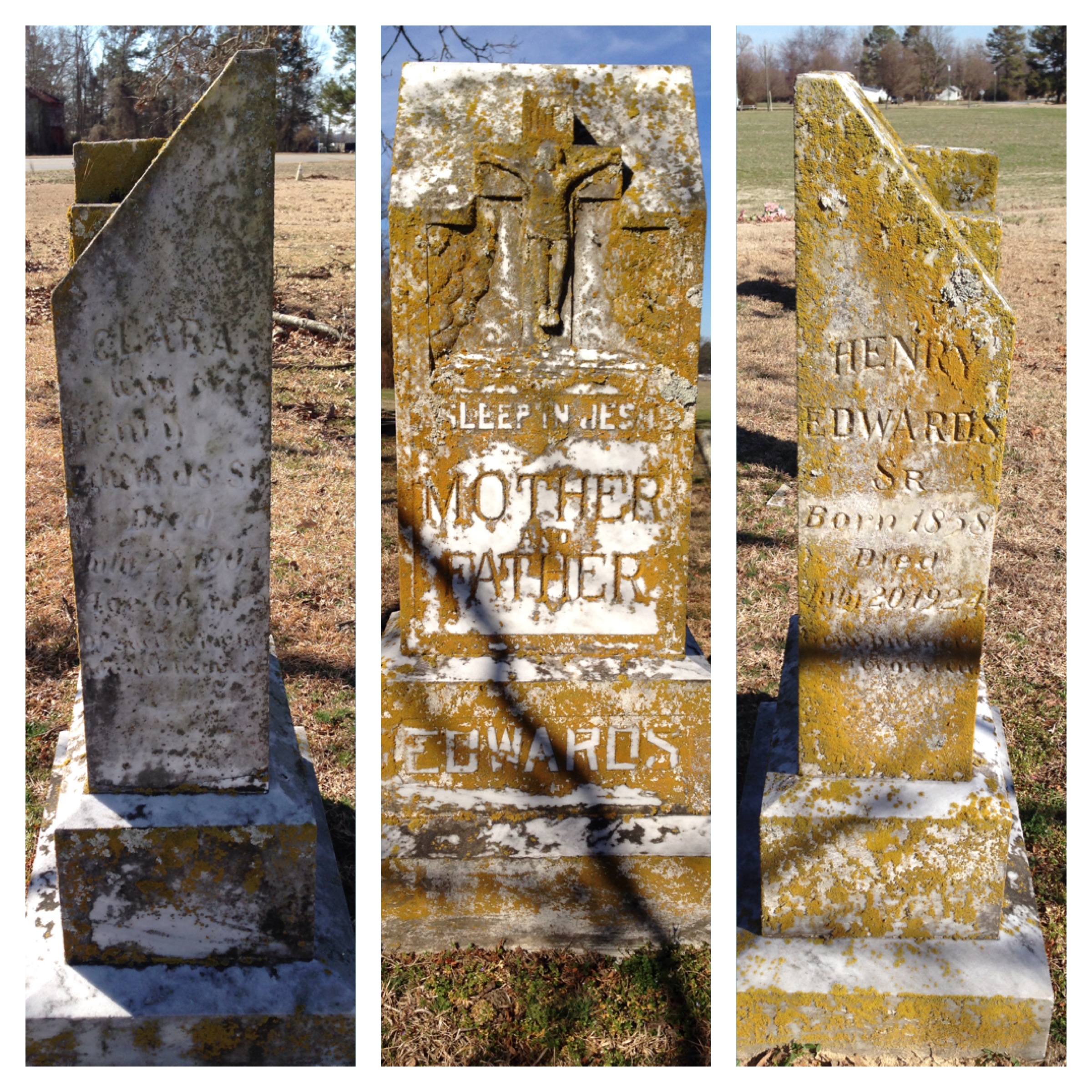
A right turn out of my parents’ neighborhood puts me onto Highway 58. Head southeast, cross the edge of Stantonsburg, over Contentnea Creek and the Greene County line, and, 13 miles from home, you reach Lane Road. Turn left, round the curve, and there, neatly marked and kept, is the Edwards cemetery. Here are buried Daniel Artis‘ daughter Clara, her husband Henry Edwards, and their descendants.

Image

Photo taken today, Lisa Y. Henderson.

Standard
Births Deaths Marriages, Enslaved People, North Carolina, Paternal Kin

Finding the Wards.

This is what we knew:  Joseph Henry Ward, born circa 1870 in or near Wilson, North Carolina, was the son of Napoleon Hagans and a sister of Napoleon’s wife, Apsilla Ward Hagans.  I couldn’t find him in the 1870 or 1880 censuses, but by 1900 he was listed in Indianapolis, Indiana, working as a physician.

The hunt for Joe Ward’s people thus began.

In the 1910 census of Indianapolis, a nephew, Augustus Moody, born about 1893, is listed in the Ward household. I searched for Augustus in 1900 and found him in Washington DC in this household: William Moody (born 1872), wife Sarah S. (1876) and children Augustus (June 1894) and Crist (1896), plus sister-in-law Minerva Vaughn (1890), mother-in-law Mittie Vaughn (1854), and mother Fannie Harris (1854) — all born in North Carolina.  Soooo …  Augustus’ mother was Sarah S. Moody, and Sarah’s mother was Mittie Vaughn.  Okay, and how was Joe Ward related to these folks?

I went back to the 1880 census of Wilson County and found: Sarah Darden (57, mother), Algia Vaughn (23, son-in-law), Mittie (22, daughter), Joseph (8), Sarah (6), and Macinda (5 mos.), the last three Sarah’s grandchildren.  From this I deduced that Mittie Vaughn, daughter of Sarah Darden, had at least two children, Joseph and Sarah, before 1880.  I then located young Sarah’s marriage license to William Moody, which listed her maiden name as Ward.  So Joseph and Sarah were listed in the 1880 census in their stepfather’s name, not their mother’s, and “Joseph Vaughn,” son of Mittie Vaughn, is in fact the Joseph Ward I was looking for.

How did I know Algernon was a stepfather? He was only 22 years old when he married Mitty Finch,  27, in Wilson on May 6, 1879.  (Finch?!?!?! That’s an as-yet unexplained anomaly.) I also found a cohabitation registration for grandmother Sarah Ward and Sam Darden, dated 12 July 1866. This registration, which formalized the marriages of ex-slaves, noted that they had been married five years, well after the births of Sarah’s children Mittie and Appie. If Sam was not their father, who was?

The first clue: in 1902, when William S. Hagans (son of Napoleon and Appie Ward Hagans) registered to vote in Wayne County, North Carolina, under the state’s grandfather clause, he named “Dr. Ward” as his qualifying ancestor. I didn’t know what to make of that — I couldn’t find a Dr. Ward in Wayne County — so I laid it to the side for a bit.

Then I found a reference to Appie and Mittie’s previously unknown brother. On 16 June 1870, Henry Ward, son of D.G.W. Ward and Sarah Darden, married Sarah Forbes in Wilson, North Carolina.  If we assume that Henry, Appie and Mittie had the same father, who is this D.G.W. Ward? Was he the “Dr. Ward” that William claimed as his qualifying ancestor under the grandfather clause?

In the 1860 census, D.G.W. Ward (45) and wife Adline (19) appear in Speights district, Greene County, which borders Wilson County to the southeast. Ward reported owning $26,500 in real property and a whopping $112,000 in personal property! (As the 1860 slave census shows, this wealth largely consisted of 54 slaves.) He was one of the, if not the, wealthiest men in the county. And he was a physician. Here, indeed, was Dr. Ward.

David George Washington Ward was married twice — perhaps circa 1840 to Mariah H. Vines, who died after having one child; then to Emily Adeline Moye in 1859. Between those marriages, he fathered at least three children with Sarah, an enslaved woman.

Standard
Enslaved People, Free People of Color, Land, North Carolina, Other Documents, Paternal Kin

Confederate map tells all.

Years ago — 10? 15? — I ordered copies of two Confederate field maps from the fine folks at Wilson County Genealogical Society. (The originals are held at North Carolina State Archives.) The maps feature not only geographic markers, such as creeks and towns, but the names of landowners throughout the region. I remember intently scanning the area around modern-day Eureka, hunting for signs of my Artises and finding none. (Celia Artis is on one of the maps, but she’s not “mine.”) Disappointed, I folded them away in a box.

A couple of days ago, I stumbled across the maps while reorganizing some files. I let my eyes drift a little further afield and

SILAS BRYANT! JOHN LANE! DR. WARD!

jumped off the page.

Just like that, the locations of the farms on which Vicey Artis‘ children, including Adam, were apprenticed; Sylvania Artischildren were apprenticed; and Mittie Ward and Apsilla Ward Hagans were enslaved (by their father.) Not only that — with a little extrapolation from the 1860 census, I can determine approximately where my people were living during the War.

Here’s the first map (with my annotations in unfortunate grayscale, click to enlarge):

Confederate_Field_Map_2 annotated

The left edge of the map is defined by the Wilmington & Weldon Railroad. (2) Nahunta, bottom left and now the town of Fremont, is exactly halfway between Wilson, seat of Wilson County, and Goldsboro, seat of Wayne County. Follow the road east out of Nahunta on what is now NC 222, and you’ll see (3) Martinsville, now Eureka. Angle southeast from Eureka on what is now Faro Road, then veer right at the fork onto what is now Lindell Road. (See “B. Mooring”? Frances Seaberry and her family are listed near his household in the 1860 census.) After crossing a north-south road, pre-Lindell takes a sharp turn north. Drag your finger straight across from the bend and you’ll touch two squared names — Silas Bryant and John Lane.

Here is Bryant’s household in the 1850 census of Greene County:

silas bryant 1850

And on the next page:

john lane 1860

As reflected on the map, Silas Bryant and John Lane lived in close proximity, and, on their land, sisters Sylvania and Vicey Artis, who owned no property. My great-great-great-grandfather Adam Artis and his sisters Charity and Jane are listed in Bryant’s household, which suggests that they served him as involuntary apprentices under North Carolina’s laws governing the labor of the children of unmarried free women of color. (Both Sylvania and Vicey were married, of course, but to enslaved men — relationships that were not recognized under the law.) The 1860 census suggests that John Lane also had apprentices, Sylvania’s younger children. Lane may also have owned their father, Guy, who adopted the surname Lane after emancipation.

[And remember this?: “On 20 Aug 1853, in Greene County NC, Silas Bryant sold Daniel Artis for $325 120 acres adjacent to the mouth of a lane at the dividing line between said Bryant and John Lane, the Bull Branch, and the mouth of Sellers Branch.” I think Daniel was Vicey and Sylvania’s brother.]

Where is this now? Just inside the Greene County line, dotted at left, Highway 58 crosses over Speights Bridge Road. The second road on the left is the same one shown on the field map and is still called Lane Road. (9) marks the approximate location of Silas Bryant’s home and (10), John Lane’s.

Screen shot 2014-02-12 at 10.56.56 AM

Due north of Lane and Bryant, across Contentnea Creek is another boxed name, Dr. Ward. This was David George Washington Ward, physician, wealthy planter, and owner of twin daughters, Mittie and Appie, whose mother was an enslaved woman named Sarah. (More about the Wards elsewhere.)

Just inside the Greene County line, a few miles southeast of Stantonsburg in Wilson County, (11) marks the approximate location of Dr. Ward’s house today. [Update: Actually, it’s the approximate location of Dr. Ward’s name on the map. His house was, and is, in Wilson County close to Stantonsburg.]

Screen shot 2014-02-12 at 10.55.30 AM

Back on pre-NC 222, about a third of the way between Martinsville/Eureka and Stantonsburg, a road leads off to the east toward Watery Branch Church. (It still does — and is called Watery Branch Road.) Barely legible is the name of one of the few free people of color marked on the map: Celia Artis. Though not related by blood, at least in any immediate way, Adam Artis and his family are listed next to her in the 1860 census, and their descendants intermarried. (And share a cemetery that lies next to the road about where the C is in Celia.) Here, then, is the approximate location of Adam Artis’ earliest farmland. He later accumulated property all along the highway.

Other landmarks on the field map: (4) Toisnot Swamp (marked Creek here), a tributary of the Contentnea that flows down from Wilson County; (5) Contentnea Creek itself; (6) Black Creek, another Wilson County tributary; (7) Aycock Swamp, another tributary, upon whose banks Adam Artis’ brother-in-law and Appie Ward’s husband Napoleon Hagans built his house; and (8) Turner Swamp.

Standard
Births Deaths Marriages, Enslaved People, Migration, Newspaper Articles, North Carolina, Paternal Kin

Mother Ward.

None of us knows the details of the arrangements, or the impact on their willing and unwilling participants, but it is clear that Napoleon Hagans had a messy personal life. His oldest child, William Coley, was born about 1860 to Winnie Coley, an enslaved woman who lived on the nearby farm of John Coley. Winnie had several additional children, fathered by Coley himself and by Napoleon’s brother-in-law Adam T. Artis. Around 1867 — no license has been found — Napoleon married Apsilla “Appie” Ward, born in 1849 to Sarah Ward, an enslaved woman, and her owner, David G. W. Ward, a wealthy physician living in northwest Greene County. Napoleon poured his ambition and wealth into his and Appie’s sons, Henry Edward (born 1868) and William Scarlett (born 1869). Both attended Howard University and settled into comfortable, distinguished livelihoods in farming, education and real estate.

Though Napoleon’s youngest was denied these advantages, he was arguably the most successful of all the sons.  Joseph Henry Ward was born 4 August 1870 in Wilson, North Carolina. (Or Wilson County, in any case.) His mother, Mittie Roena Ward, was Appie Ward Hagans’ twin. (Identical, it is said.) And Napoleon Hagans’ sister-in-law. I know nothing at all of her early years. In 1879, Mitty Finch (Finch? why?) married Virginia native Algernon Vaughn in Wilson. In 1880, the family’s household included Mittie’s mother, Sarah Darden; her husband Algie, a farm laborer; Mittie, a cook; and children Joseph, 8, Sarah, 6, and Macinda, 5 months.

By 1890, Joseph had struck out on his own and for reasons unknown landed in Indianapolis, Indiana. There, he went to work for a physician who would set him on his own path to a medical degree. Joseph’s half-sister Sarah married William Moody in Wilson in 1892 and, by the dawn of the new century, the Moodys and Mittie Vaughn were living in Washington DC. Soon after Mittie joined Joe Ward in Indianapolis, reverted to her maiden name (though keeping the title “Mrs.”), and began a peripatetic life that saw her in and out of the households of her children.

The Indianapolis Recorder, an African-American news weekly, kept close tabs on the mother of one of the city’s most illustrious residents:

Mrs. Mittie Ward, mother of Dr. J.H. Ward will leave today for Washington, D.C., to spend the winter with her daughter, Mrs. Sarah Moody. Her youngest daughter will remain in the city with her brother Dr. Ward.  [12 December 1903]

Ward-Artis.  On Wednesday June 22, at high noon the wedding of Miss Minerva Ward, the daughter of Mrs. Mittie Ward and sister of one of our prominent physicians Dr. Joseph H. Ward, and Mr. Dillard Artis, of Marion, will be celebrated in the presence of the immediate family and a few intimate friends. Rev. Morris Lewis assisted by Rev. T.A. Smythe will perform the ceremony. They will leave at 5 p.m. for Marion, where a wedding reception will be given from 8 to 11 p.m., at 920 S. Boot street, the home of the groom. The bride is well and favorably known in our city’s best circles and is a favorite in the younger social set. The groom is a prominent cement contractor of Marion and a highly respected citizen, owning a great deal of property, which he has accumulated by his industry and business tact. They will be at home at 920 S. Boot street, Marion.  [18 June 1910]

Mrs. Minerva Ward Artis of Marion, spent the holidays with her mother, Mrs. Mittie Ward, of the city.  [31 December 1910]

Mrs. Dillard Artis of Marion, was in the city a few days this week. Mrs. Artis is visiting her brother, Dr. J.H. Ward and her mother, Mrs. Mittie Ward.  [18 February 1911]

Dr. J. Ward of Indianapolis and Master Joseph were guests of his mother Mrs. Mittie Ward and sister Mrs. S.D. Artis of S. Boots street Wednesday.  [19 August 1911]

Mrs. Mittie Ward of Indianapolis, who has been the guest of her daughter for the past week Mrs. S.D. Artis returned home Saturday and on December 5, will leave for Washington, D.C. to spend the winter with her daughter.   [2 December 1911]

Dr. J.H. Ward of Indianapolis was called to this city [Marion, Indiana] the first part of this week to attend the bedside of his mother, Mrs. Mittie Ward, who is ill at the home of her daughter, Mrs. S.D. Artis, in South Boots street.  [25 November 1916]

Mittie Ward died of stroke in Washington, DC, in 1924. She was visiting her elder daughter Sarah Ward Moody and planning to travel to see the younger.

Image

Pittsburgh Courier, 19 April 1924.

Standard
Births Deaths Marriages, Free People of Color, North Carolina, Other Documents, Paternal Kin

Volte-face, no. 1; or 52 Ancestors: Daniel Artis.

[Though my format only infrequently focus on individuals, I’ve taken up the 52 Ancestors in 52 Weeks challenge. This is week 4, so I have some catching up to do. We’ll see.]

I had an inkling, didn’t I? Here’s what I wrote in my notes when I found Mariah Artis Swinson’s death certificate:

MARIAH SWINSON.  Died 6 Feb 1955, 500 Creech Street, Goldsboro NC, arteriosclerosis.  Born 14 Feb 1849 to Daniel Artis and unknown. Informant, Mrs. Mary Swinson.  Buried 9 Feb 1955, Elmwood cemetery, Goldsboro NC.  [Daniel Artis?  Is this an error or was Mariah Silvania’s niece rather than her daughter?  I conjectured that Daniel Artis was a brother of Silvania and Vicey Artis.]

Up to then, I had firmly believed that Mariah Artis Swinson, wife of Jesse Swinson, was the daughter of Guy Lane and Sylvania Artis, so I was thrown when her death certificate listed her father as Daniel. I had a Daniel Artis in my file with a question mark behind his name — was he Sylvania and Vicey Artis’ brother? He appears sparingly in records, and here’s all I knew about him:

On 20 Aug 1853, in Greene County NC, Silas Bryant sold Daniel Artis for $325 120 acres adjacent to the mouth of a lane at the dividing line between said Bryant and John Lane, the Bull Branch, and the mouth of Sellers Branch.  Henry Martin witnessed.  The deed was registered 7 Jun 1882.  [Silas Bryant apprenticed the children of Vicey Artis, who may have been Daniel’s sister.  John Lane apprenticed the children of Vicey’s sister Sylvania and probably owned her husband, Guy Lane.]  

and

In the 1860 census, Bull Head, Greene County NC, 40 year-old free man of color Dannel Artis, a ditcher, is listed next door to the household of white farmer John Lane, who reported $10000 personal property and $25000 real property, included Dannel, Mike, Penney, Dyner, Juley, and Washington Artis, who were Silvania’s children.

I have not found Daniel in earlier censuses. However, a few days ago, following up a request for assistance by a descendant of a Daniel Artis from Greene County, I examined the will and probate records of a Daniel Artis who died in early 1905.  The will, in black and white, stated that Mariah Swinson, wife of Jesse Swinson, was this Daniel Artis’ daughter, not Sylvania Artis’.

So, is Daniel Artis the will-maker the Daniel Artis that I believe to have been a brother of Vicey Artis Williams and Sylvania Artis Lane?

What does his will tell us?

There were two, in fact. The first, dated 15 January 1905, was recorded at the Greene County Courthouse in Will Book 1 at page 514; the second, dated two days later, at page 524.  The legatees are the same, but the gifts packaged differently, so I present both:

Item 1. Page 514 — to daughter Clary Edwards, wife of Henry Edwards, his interest valued at $172 in the tract of land on which Clary and Henry live. The tract was purchased from Debro Cobb with money advanced from Henry Artis. If $172 is more than the other’s children’s share, Clary is to make them even, and vice versa.  Page 524 — to daughter Clara Edwards, wife of Henry Edwards, his interest valued at $172 in the tract of land purchased from Debro Cobb. His agreement with Henry Edwards has not been recorded.

Item 2. Page 514 — to son Henry Artis, 1/4 interest in his real estate.  Page 524 — to son Henry Artis, 40 acres, including the house in which Daniel then lived.

Item 3. Page 514 — to the children of his son Lodrick Artis (Anna Randolph, Frank Artis, Lula Forbes, Madison Artis, Marcellus Artis, Ernest Artis, Dicey Batts and Hannah Artis) 1/4 of his estate.  Page 524 — to the children of Lodrick Artis and his wife Mandy, 40 acres (land Lodrick resided on at the time of his death) and all buildings thereon.

Item 4. Page 514 — to the children of his daughter Prior An Thompson (Isaac Sauls, C.D. Sauls, Maria Edwards and Clara Lane), 1/4 of his estate.  Page 524 — to Prior An Thompson’s children and their heirs, 40 acres that Willis Thompson lives on.

Item 5. Page 514 — $50 to daughter Mariah Swinson, wife of Jesse Swinson, to be paid from the shares of the others in the amount of $12.50 each.  Page 524 — A committee to be appointed to assess value of shares and make Clara Edwards’ share equal to the others, difference to be paid within seven years.

Item 6. Page 514 — none.  Page 524 — Each lot to be taxed $12.50 to pay daughter Mariah Swinson, wife of Jesse Swinson.

Grandson Isaac Sauls was appointed executor in both, Daniel Artis signed each with an X, and both were proved on 21 March 1905.

Whatever his intent at clarification, things did not go well with Daniel’s estate. A Notice of Sale ran four weeks from December 1923-January 1924 in the Greene County weekly The Standard-Laconic announcing the sale of “a certain tract or parcel of land devised to Henry Artis by Daniel Artis by his last will and testament, … containing 40 acres.” The sale was advertised pursuant to a judgment in Greene County Superior Court in the matter of Frances Hall; Bennett Hall; Bessie Woodard, infant; and Alice Woodard, infant, by their next friend Amos Woodard v. J. Settle Artis and Roumania Artis. Settle Artis, who was Henry Artis’ son, had purchased the parcel at a courthouse sale the previous July. Frances and Bennett Hall were Settle’s sister and brother-in-law, and Amos Woodard was another brother-in-law, widower of Settle’s sister Dillie.

I don’t know what Hall et al. v. Artis was about, but the allegations of the next suit over Daniel’s estate — filed in 1930 — are clear. The case caption alone is daunting: Isaac Sauls; Walter Sauls; Luby Sauls; Edward Sauls; Hattie Speight and her husband Walter Speight; Mariah Thompson; Lillie May Sauls, minor, George Sauls, minor, Sarah Sauls, minor, Lillie Lee Sauls, minor, Walter Sauls, minor, appearing by their next friend, Luby Sauls; and Nettie Sauls; Henry B. Lane; Lillie Maud Best and her husband Alex Best; John H. Lane and Carrie D. Lane, a minor, children and heirs at law of Clara Thompson; Penny Edwards, Silas Edwards, Prior Edwards and the Henry Pettaway children as follows: Hadie Pettaway, minor, Willie Harrison Pettaway, Georgia May Pettaway, minor, Minnie Clyde Pettaway, minor, grandchildren of Mariah Edwards, by their next friend Henry Pettaway  v. C.D. Sauls and Duffrey Edwards. In other words, a fight among the heirs of Daniel’s daughter Prior Ann Artis Sauls Thompson.  The crux of the matter is set out in paragraph 10:

10. That the plaintiffs, heirs at law of Isaac Sauls, Mariah Edwards and Clara Thompson are the owners of three fifths of the land devised by Daniel Artis in Item 4 of his will to the children of his daughter Prior Ann and are entitled to have the defendant Cain D. Sauls declared to have the same held in trust for them and are entitled to an accounting of the rents and profits of the same from the date of his purchase in 1908.

Instead, they alleged, C.D. Sauls had been keeping hundreds of dollars of rent for himself and, in 1928, had sold the parcel to Duffrey Edwards for $3000, with full knowledge by Edwards that Sauls was trustee for his relatives. C.D. denied all, of course. In 1937, his daughter and son-in-law, Willie Sauls Burgess and W.D. Burgess, were added as defendants after C.D. and his wife Ada allegedly tried to fraudulently transfer the disputed property to her.  In 1939, the clerk of court entered a non-suit judgment noting that the parties had reached an amicable settlement. No details were included. The matter was over.

So back to my original line of inquiry: who was this Daniel Artis?

Though he often managed to slip censustakers, the enumerator of the 1880 census found Daniel, his children Henry, Clara, Mariah, Prior Ann, and Lodrick, and their children living in a cluster in Bullhead district.  (There was a marker for “Artis Town” at a spot in the road in Greene County. I think it’s in this area.) At #260, Henry Artis, 30, wife Mary, 27, and children Frances, 16, Didida, 8, Missouri, 7, Settle, 3, and Henry, 2. At #261, Henry Edwards, 40, wife Clara, 45, and children Thomas, 19, Wright, 18, Scott, 15, Eliza, 13, George, 11, Henry, 9, Daniel, 7, and William, 5. #264, Jessee Swinson, 23, wife Maria, 20, and son Charles, 1.  #267, Willis Thompson, 28, wife Prior, 32, and his stepsons Isaac Sauls, 19, Cain Sauls, 18, and Richard Sauls, 15.  #268, Timothy Edwards, 22, wife Maria, 21, and children Mony, 2, and Lilly, 7 months, niece Alice Wood, 15, and grandmother Maria Sauls, 60. #269, Lodrick Artis, 35, wife Amanda, 30, and children Hannah, 12, Frank, 10, Lula, 8, Sarah, 4, Monsey, 2, Lodrick, 1 month, and Marcellus, 1. #270, Daniel Artis Sr., 65, wife Eliza, 60, and granddaughter Ida, 9.

This Daniel is roughly the right age to be the one listed in the 1860 census and certainly old enough to have purchased property in 1853.  [A future project: hunt for a plat or metes and bounds to compare that purchase with the land devides in 1905.]  Daniel Artis and Eliza Faircloth registered their two-year cohabitation just over the county line in Wayne County. If they were, in fact, married in 1864, she was not the mother of his children, who were born circa 1835-1860. Like Eliza, though, their mother — or mothers — probably  was enslaved, as were they. If Daniel was the brother of Silvania and Vicey, he followed in their footsteps by looking beyond the free colored community to find a spouse. (It is possible that the Daniel who married Eliza Faircloth was Daniel Artis, born in 1843 to Silvania Artis Lane. He and his wife Eliza appear in the 1880 census of Greene County with children Emma and James.)

It is time, I think, to adjust my files. Unlink Mariah Artis from Silvania and move her to Daniel, then enter all the new names I have for his descendants. The evidence is sparse and circumstantial, but sufficient to make a tentative determination that Daniel, Vicey and Silvania were siblings. They were born within about a ten-year span; they live in close proximity in Bull Head district, Greene County; they are the only Artises in the area (and among few in the county); they all had connections with Silas Bryant and/or John Lane; and there are some commonalities among the given names of their offspring (Silvania had a son Daniel; Silvania and Daniel had daughters named Mariah; and Vicey and Daniel had grandsons named Cain.)

Standard
Births Deaths Marriages, Free People of Color, Migration, Other Documents, Paternal Kin

Age 121?!?

ImageOn March 30, 1932, in Lucy, Tennessee, just north of today’s Memphis International Raceway, an old man closed his eyes a final time. His doctor described his death in an unusually detailed, almost poetic, passage: “causes due to advanced age weakening of heart muscles beats slowing down until stopping quietly but regular.” He was, according to the death certificate, 121 years old, and his name was Guy Lane.

Guy Lane?!?!

I scanned the rest of the form: farmer … living in Shelby County … born in North Carolina … son of Guy Lane … an informant named Lillie ….

My great-great-great-great-grandmother, Vicey Artis, born free in or near Wayne County around 1810, had a sister named Sylvania. Both women married enslaved men. (And their brother Daniel married an enslaved woman.) On 31 August 1866, Vicey Artis and Solomon Williams and Sylvania Artis and Guy Lane registered their decades-old cohabitations in Wayne County and thereby legalized their marriages. Old Man Guy died before 1880, but ….

Sylvania and Guy Lane’s twelve children, who used both parents’ last names, were born over the course of more than twenty years.  Morrison Artis, born 1837, was first, followed by Mary Artis (1839), Jane Lane Sauls (1842), Daniel Artis (1843), Mitchell Lane (1845), Mariah Artis (1846), Guy Lane Jr., Penny Lane (1850), Dinah Lane (1851), Julie Lane Sutton (1853), Washington Lane (1855) and Alford Lane (1859).

In 1869, Guy Lane Jr. married Dinah Dew in Wayne County. They appear together in the 1870 and 1880 censuses and had at least six children: Ora, Moses, Lizzie, William, Mary S., Milton F. Lane, and a girl. By 1900, though, Guy and his family are nowhere to be found in North Carolina. Instead, they surface 800 miles due west, just outside Memphis. (Had they been Exodusters sidetracked on the way to Arkansas?)  Guy had a new wife, of four years — Eliza, born in Tennessee — but his youngest two children, Milton and Guy Jr. (actually III), both born in NC, were with him. In 1910, on the Memphis & Shakerag Road, 60 year-old Guy and Eliza Lane are listed with eight year-old daughter Lilly. Both reported that they had been married twice, and Eliza reported that only one of her nine children was living. In the 1920 census, the couple are living with Lillie and her husband Robert Burnett. Guy continued to work as a farmer, and his age is reported as 78. Ten years later, in 1930, Guy and Liza are living alone again, and his age has leapt inexplicably to 114. By time he died in 1932, Guy had gained another seven years.

The credible evidence suggests that cousin Guy Lane, in fact, was born about 1848, making him a more reasonable 84 years old when his heart slowed down until stopping quietly. He is not forgotten.

Standard