North Carolina, Paternal Kin

Tonight.

April 1998. I’d been a member of Wilson County Genealogical Society perhaps six months. The group’s Colonial Roads Tour felt like something I couldn’t miss, so I made a special trip home to board a bus that would introduce us to Wilson County’s earliest past. The late, great Henry Powell narrated, identifying and illuminating obscure landmark after obscure landmark as Wilson County’s backroads unspooled beneath the bus’ wheels. For the first time, I began to understand Wilson as a palimpsest created not just by time, but by race and class. There were whole layers of culture and memory and history accessible only to those who had inherited the right keys. The keys I had unlocked none of these doors. But they did grant access to the Society.

From the beginning, I was welcomed into the group — encouraged, consulted and listened to. WCGS’ efforts to be inclusive have been organic and sincere, and I have appreciated the opportunity to be a resource for others in and out of the group. Living in Atlanta means that I’ve only attended a handful of the Society’s Tuesday night meetings, but over the years I’ve been able to contribute dozens of articles to its excellent newsletter.

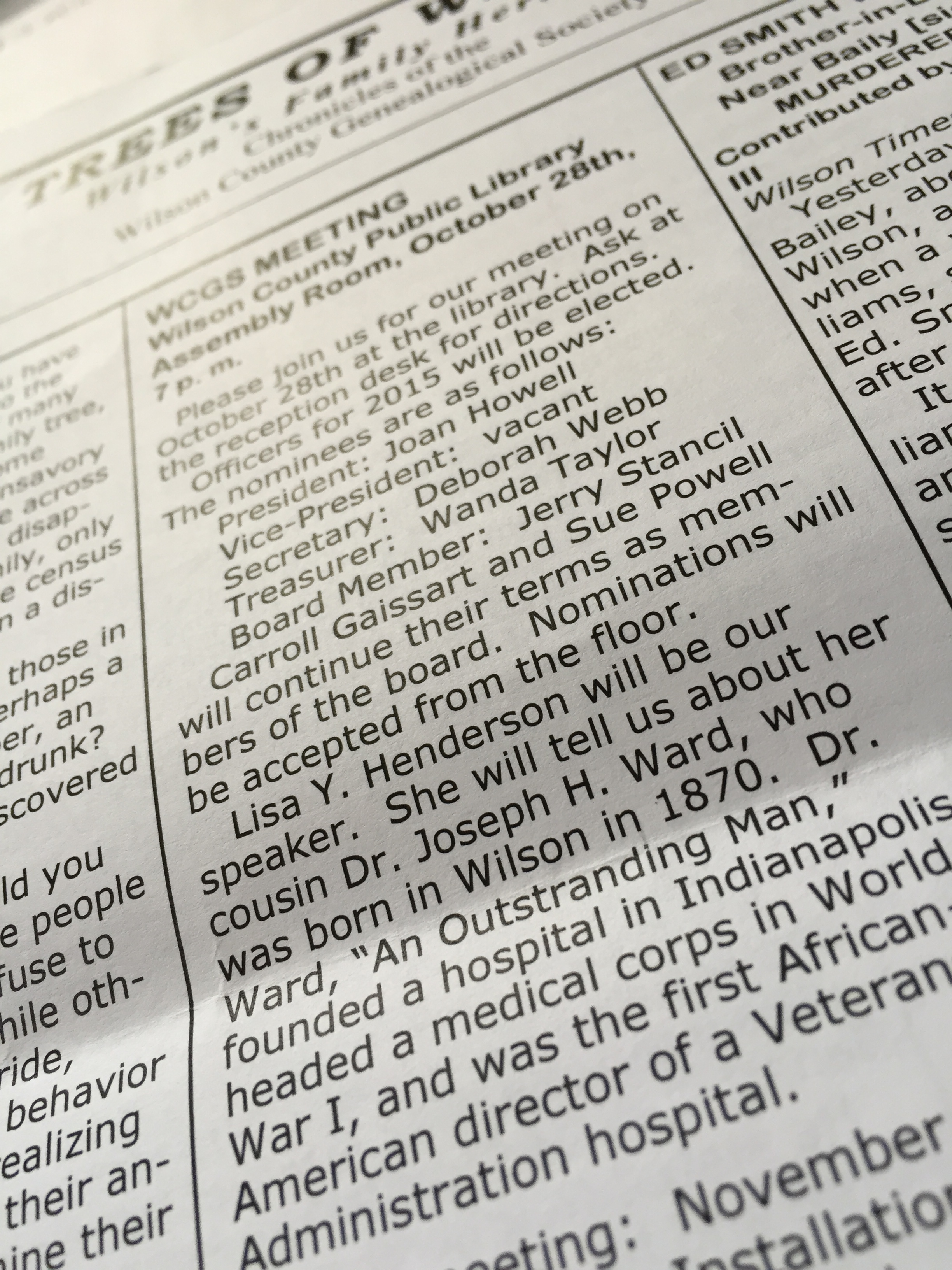
This week I again came home just for a WCGS event. Tonight, at the Society’s invitation, I used my keys to open a door to Wilson County to which few society members have access. My presentation touched on slaves and free people of color and segregation, but was focused on the awesome life of one of Wilson’s “lost” sons, my cousin Dr. Joseph H. Ward. After I set my nerves aside, my talk went well, eliciting thoughtful questions and positive comments at its conclusion.

IMG_5157

I thank Wilson County Genealogical Society for the opportunity to give back to a community that has encouraged and supported my research for 17 years. And I thank the little fan club that came out to support me — my parents; Mrs. L and Mr. and Mrs. M, who have been surrogate parents all my long life; and a couple of staunch childhood friends. After the program, I spoke by phone with Cousin Joseph’s great-granddaughter, who is named after his beloved wife. One of the joys of my recent research has been being able to fill in the blanks in her ancestor’s early life, and she and her mother hope to visit his birthplace soon.

Standard
Births Deaths Marriages, Education, Migration, Newspaper Articles, North Carolina, Other Documents, Paternal Kin

The rise of the Grand Chancellor; or “There was something unusual in that green looking country boy.”

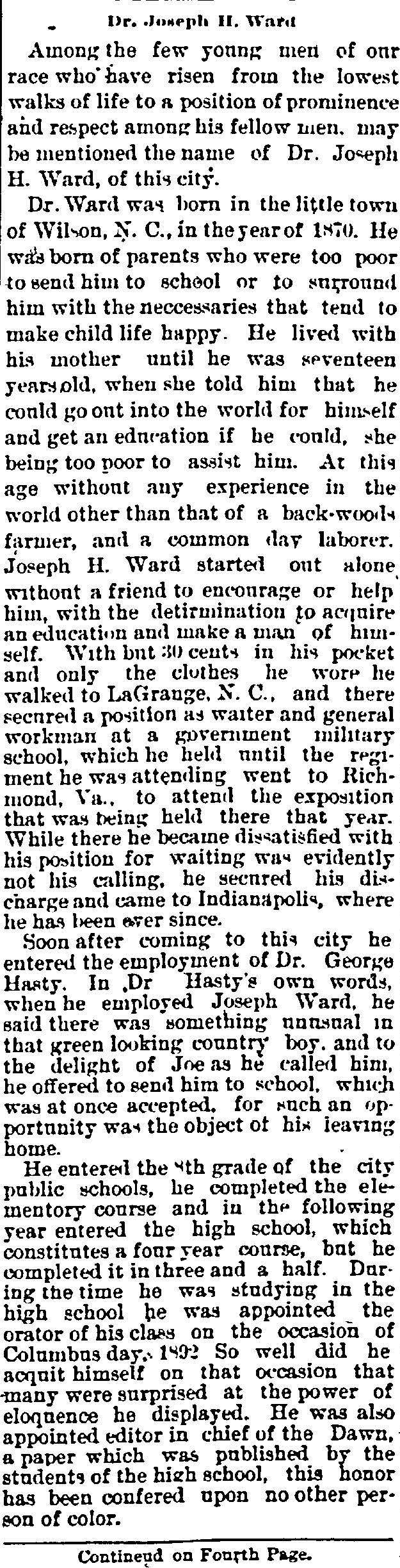
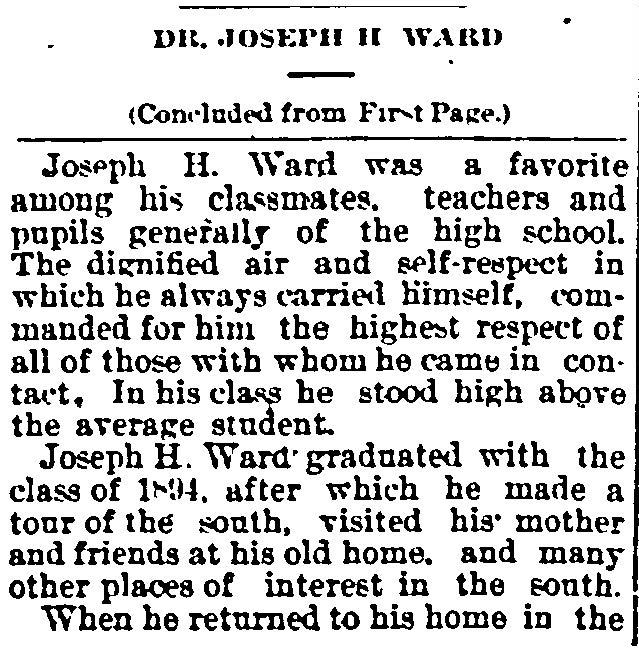
In which the Indianapolis Freeman enlightens us regarding Joseph H. Ward‘s journey from Wilson, North Carolina, to Naptown:

Joseph H Ward Grand Chancellor Ind Freeman 7 22 1899

Joseph Ward early years 7 22 1899 Ind Freeman_Page_1

Joseph Ward early years 7 22 1899 Ind Freeman_Page_2

Joseph Ward early years 7 22 1899 Ind Freeman_Page_3

Indianapolis Freeman, 22 July 1899.

A few notes:

  • Joseph Ward’s mother might have been too poor to send him to school, but his father Napoleon Hagans, had he chosen to acknowledge him, certainly could have, as he sent his “legitimate” sons to Howard University.
  • The school in LaGrange at which he worked was most likely Davis Military Academy:  “By 1880 a second school for boys … Davis Military Academy, was founded by Colonel Adam C. Davis. “School Town” became La Grange’s nickname as the military school would eventually have an enrollment of 300 students from every state and even some foreign countries. The school also had a band, the only cadet orchestra in the country during that time. The school prospered, but an outbreak of meningitis closed it in 1889.”
  • Dr. George Hasty was a founder of the Physio-Medical College of Indianapolis, which Joseph Ward later attended.
  • Joseph graduated from High School No. 1, later known as Shortridge, an integrated institution.
  • A “tour of the south”? Really?
  • Do student records exist from the Physio-Medical College? The school closed in 1909.
  • Joseph’s first wife was Mamie I. Brown, an Indiana-born teacher. The 20 October 1900 issue of the Indianapolis Recorder reported: “Mrs. Mamie Ward, through her attorney O.V. Royal, was granted a divorce from her husband, Dr. J.H. Ward, in the Superior Court no. 1, and her maiden name was restored. Both parties are well known in society circles.” Four years later, Joseph married Zella Locklear.
Standard
Agriculture, Births Deaths Marriages, Business, Education, Land, Migration, Newspaper Articles, North Carolina, Other Documents, Paternal Kin, Photographs, Politics

William Scarlett Hagans.

William Scarlett Hagans, born about 1869, was the second of Napoleon and Appie Ward Hagans‘ sons. He is first found as “Snowbee” in the 1870 census of Nahunta, Wayne County, North Carolina, in a household headed by “Poland Hagans” with wife Apcilla.  (Next door was Jonah Williams, brother of Adam Artis.  Artis married Napoleon’s half-sister Frances Seaberry; they were my great-great-great-grandparents.) Two years later the censustaker reported Napoleon’s stepfather, Aaron Seaberry, with the family.

William and older brother Henry E. Hagans attended primary  school in Goldsboro. William then departed for Howard University in Washington, DC, where he completed the preparatory division in 1889, the college department in 1893 (when he was one of six graduates), and the Law Department in 1898 (from whence he received a Bachelor of Arts degree.)

In a glimpse at young William’s social life, here’s a brief from the 20 October 1888 edition of the Washington Bee: “A company of young ladies and gentlemen, composed of Misses Mamie Jones, Ella Perry, Mary Dabney, Emma Ingrim, Louise Chapman, Mamie Dorster and Messrs. St. Clairlind, E. Williston, W.S. Hagans, Benjamin Henderson, J.W. Whiteman, James Usher, H.L. Hyman, L.A. Leftwich, spent an evening of pleasure at Miss E. Alley Thornton’s residence with her uncle, Rev. W.H. Howard, No. 77 Defrees street northwest.”

On 27 September 1894, the Goldsboro Daily Argus printed an article about the confused state of affairs among Wayne County’s Republicans, noting that “old-line leaders” like Napoleon Hagans, Rev. C. Dillard and E.E. Smith opposed “fusion” with Populists. The piece also noted that Will S. Hagans had been nominated to “legislature.”

The 1895-96 Report of the Superintendent of Public Instruction included a report from A.L. Sumner, principal of the State Normal School at Goldsboro, who noted that the school enrolled 172 students from 13 counties. “The Dorr Lyceum [a mandatory Friday evening lecture] was placed under the supervision of Prof. W.S. Hagans. In this association the students were taught to appreciate, write and speak the masterpieces of our literature, to write essays and debate, and were made acquainted with the meanderings of parliamentary usage.” The school’s catalogue for that year listed as faculty Sumner, Miss L.S. Dorr, and W.S. Hagans, who taught Classical Latin, Natural Philosophy, Theory and Practice of Teaching, Arithmetic, North Carolina History, etc. [Sumner was also editor of the Headlight, a Baptist-affiliated newspaper that published wherever Sumner moved for work.]

Per the 21 May 1896 issue of the Mecklenburg Times, at the state Republican convention, W.S. Hagans was elected alternate delegate to the national convention.

On 20 March 1897, the Raleigh Gazette, in an article about a reception in Goldsboro for African-American state senator W. Lee Person of Hickory, noted that Professor W.S. Hagans “spoke in high terms of commendation and praise of the Senator and his colleagues, and assured them that the colored people of Goldsboro were wedded to them, and would ever honor them for the record made for their race in the General Assembly of the State.”

On 5 June 1897, the Raleigh Gazette commented: “We certainly regret to hear that our friend, Prof. W.S. Hagans of Goldsboro, was not endorsed for the postmastership there. He certainly is worthy of the place. We hope to see him appointed to some good salaried place in Washington yet.”

On 27 June 1898, William S. Hagans, 27, married Lizzie E. Burnett, 23, in Nahunta, probably at the Hagans house. Presbyterian minister Clarence Dillard officiated and neighbor J.D. Reid, brother H.E. Hagans, and sister-in-law J.B. Hagans witnessed. Burnett was a member of the large and locally prominent Burnett family, but her parentage is not clear.

BURNETT -- Lizzie Burnett Hagans

Lizzie E. Burnett Hagans

Lizzie Burnett Hagans gave birth to a daughter Daisy in about 1898. She died in infancy.

The 19 January 1899 edition of the Washington Evening Star ran a breathless review of the season’s judicial reception at the Taft White House. The lengthy recitation of invited guests included Mr. W.S. Hagans.

On 21 March 1899, Henry Hagans and William S. Hagans received proceeds from the partition of about 476 acres in Nahunta township, Wayne County, belonging to the estate of the late Napoleon Hagans.

William and Lizzie Hagans welcomed a daughter, Susan A., in September 1899. The child was named for Lizzie’s mother. (And the A perhaps was for “Apsilla,” William’s mother.)

On 11 October 1899, William purchased from Minnie and Effie Morgan a lot on Oak Street in Goldsboro adjoining that of Lizzie E. Hagans.

On 28 October 1899, the Colored American noted that William S. Hagans “has returned from Goldsboro, where he attended the funeral of a relative. Mrs. Hagans accompanied her husband here, and apartments have been taken at No. 1524 O street northwest.” (Whose funeral?!?!)

On 9 December 1899, in a short article titled “Mr. White as Host,” The Colored American informed all that “Thanksgiving tide was made more joyous by the genial and whole-souled hospitality dispensed on Thursday evening of last week by Congressman George H. White at his handsome home, 1418 18th street northwest. … Those who sat at the festal board were Register [of U.S. Treasury] J.W. Lyons, Recorder H.P. Cheatham, Ex-Senator John P. Green, Major Charles R. Douglass, Messrs. John H. Hannon, Henry Y. Arnett [clerk to Cheatham], S.E. Lacy, W.S. Hagans, Lewis H. Douglass and R.W. Thompson.”

A month later, on 13 January 1900, the Colored American announced that “Mr. W.S. Hagans has returned from a holiday visit to his home at Goldsboro NC.  The great prominence of Congressman White and the voluminous mail occasioned by it, is keeping Mr. Secretary quite busy these days.”

On 24 February 1900, the Washington Bee ran “A Pen and Pencil Club: Washington’s Literati Form an Organization for Mutual Improvement and Promotion of Good Fellowship” a “brilliant coterie of journalists and writers” met at the Southern Hotel and organized the nucleus of  the Pen and Pencil Club. Editor T. Thomas Fortune was placed on the honorary roll, reserved for “prominent out-of-town scholars and penman.” Active members L.H. Douglass [Lewis Henry Douglass, son of Frederick Douglass and Civil War Union officer], J.W. Cromwell [John Welsey Cromwell, educator, lawyer, journalist], C.R. Douglass [Charles Remond Douglass, son of Frederick Douglass], C.A. Fleetwood [Christian A. Fleetwood, major, U.S. Colored Troops], E.L. Thornton, T.J. Calloway [Thomas J. Calloway, journalist], E.E. Cooper [Edward E. Cooper, editor, Colored American], W. Calvin Chase [William Calvin Chase, lawyer, editor of the Washington Bee], A.L. Manly, Paul H. Bray, S.E. Lacy, F.G. Manly, J.N. Goins [journalist], J.G. Clayton, J.H. Wills, W.L. Pollard, John T. Haskins, W.M. Wilson, W.O. Lee, A.O. Stafford [Alphonso O. Stafford, folklorist, teacher], W. Bruce Evans [physician and educator], W.L. Houston [William L. Houston, attorney], Lucien H. White [music critic, editor], H.P. Slaughter, Kelly Miller [mathematician, “The Bard of the Potomac”], C.W. Williams, J.H. Paynter [John H. Paynter, journalist/author], W.C. Payne [vice-presidential candidate, National Liberty Party, 1904], W.S. Hagans, R.H. Terrell [Robert Herberton Terrell, lawyer, teacher and later judge] and others.

In the 1900 census of Goldsboro, Wayne County, the censustaker recorded William B. Hagins (November 1872), wife Lizzie E. (April 1874), and daughter Susan (August 1898).  William is listed as white; his wife and daughter as black.

On 3 May 1900,  in an article titled “Hagan’s Win Out,” the Goldsboro Weekly Argus noted that Will S. Hagans had been elected to the Republican district executive committee and his brother Henry E. Hagans as a delegate to the national convention.

In 1902, W.S. Hagans, age 34, registered to vote in Wayne County under the state’s grandfather clause. He named “Dr. Ward” as his qualifying ancestor. David G.W. Ward, a physician in Wilson County, was William’s maternal grandfather. William could have named his father Napoleon (as did his brother Henry), and I am certain the choice was deliberate.

On 7 October 1902, the Winston-Salem Journal reported that “leading negroes have issued a call for a negro convention to be held on October 16 in Raleigh to put out a ticket against the Republicans. The call expresses indignation at the treatment negroes are receiving at the hands of Republicans and heaps abuse on Senator [Jeter C.] Pritchard, who, they declare, must be defeated at all hazards. The following negroes sign the call: Jas. E. O’Hara, Scotland Harris, H.P. Cheatham, W. Lee Pearson, R.W.H. Leak, W.S. Hagans, S.G. Newsom, W.F. Young.”

Daughter Eva Mae Hagans was born 1 January 1903 in Goldsboro.

On 31 January 1903, the Colored American shone a spotlight on Goldsboro, “a progressive little town of 8000 inhabitants. It is historic,” it claimed, “for the peaceful relations existing between the races. The chief occupation of its people is trucking. Yet we have negroes who are rapidly forging their way to the front along all industrial lines. Our people own thousands of acres of forming land, as well as excellent city property…. Prof. H.E. Hagans, the principal of our State Normal School and also a farmer, is worth $20,000. Mr. W.S. Hagans, who is one of the most successful agriculturalists, is worth $20,000. …”

On 9 May 1903, The Colored American reported “Mr. W.S. Hagans, who has made a host of friends among Washingtonians by his genial bearing and sterling qualities, will indulge in an extensive hunting expedition in and about his North Carolina home during the Xmas holidays.  He will have as his guests Congressman White and Recorder Cheatham.”

Wm S Hagans in Goldsboro with dogs

William S. Hagans, perhaps with hunting dogs, Goldsboro.

On 13 January 1904, William S. Hagans purchased 38 acres in Wayne County from J.D. Reed [sic] and wife. Reid grew up with William near Fremont, had been a witness at his wedding, and was principal of the Colored Graded School in the nearby town of Wilson.

On 20 January 1904, W.S. Hagans and wife Lizzie deeded 25 acres to J.W. Johnson. This land had been purchased by Napoleon Hagans in 1883 from J.W. Aycock and wife Emma, B.F. Aycock and wife Sallie, and O.L. Yelverton and wife Susan G. for $270. The property was located on the “public road leading from Sauls Crossroads to Bull Head.”

On 9 June 1904, West Virginia’s Charleston Advocate ran an editorial by R.H. Thompson titled “In the National Field/ The Lily-White Situation in The South as Viewed through Northern Glasses.” In it, he decried the state of the Republican Party.  “… The action of the North Carolina republican convention was a crime. The summary turning-down administered to such war-horses as John C. Dancy, Henry P. Cheatham, James E. Shepard, Samuel H. Vick, J.E. Taylor, Isaac Smith, W.S. Hagans and others has been an outrage that requires an emphatic prefix to fittingly characterize it. Not a solitary colored man of all of North Carolina’s able gallery of political lights was chosen as a delegate to the national convention. Time was when the race’s political sun set in the piney woods and moonshining camps in the Blue Ridge mountains, but the ill-fated ascendancy of Jeter C. Pritchard and his coterie of lily-whites has gradually dimmed the luster of the Tar Heel Negro constellation, now there are few so poor to do it reverence. George H. White was wise in moving his lares and penates to the hospitable shores of New Jersey, and it is a mercy that the tired frame of John Hannon went over to its lasting place ere his failing eyes witnessed the downfall of the house of cards he and his faithful allies had created as so ruinous a cost. …”

Daughter Flora Irene Hagans was born in 1904, and Rosalie Lorene Hagans in 1907.

On 16 May 1907, William S. Hagans contributed a lengthy column to the Washington Post entitled (and subtitled): “At Issue with Adams/ Goldsboro Man Reviews Politics in North Carolina/ Hopeless for Republicans/ ‘Lily White’ Faction Arraigned for Treatment of Colored Vote – Conventions Held on Trains to Trick the Negroes – Ingratitude Alleged – 20,000 Colored Votes Will Not Submit.” Which pretty much sums up the article, which is aimed at rebutting comments made in an interview with Judge Spencer B. Adams of North Carolina. “Where you find the negro voting at all, he is doing as he has always done — voting the Republican ticket or the ticket that goes by that name. He is just as much a Republican in this State to-day as every, but that he is not so enthusiastic cannot be denied. This can be easily explained. It has been the custom in this State ever since the enfranchisement of the negro for him to follow the lead of a few white men calling themselves Republicans. He expected and got this leadership before the adoption of the Constitutional amendment in 1900, which disfranchised a large majority of colored citizens. Those who happened to be spared from the operations of this new law still looked for this same leadership but found it not — a clear case of being left in outer darkness.”

At the heart of Wayne County Superior Court proceedings stemming from the suit in J.F. Coley v. Tom Artis (1908) was a dispute over 30 acres of land.  Thomas “Tom Pig” Artis began renting the property in 1881 from W.J. Exum.  In 1892, Exum’s widow Mary sold it to Napoleon “Pole” Hagans.  In 1896, after Napoleon’s death, the land passed to his sons Henry and William S. Hagans.  In 1899, Henry sold his interest to his brother.  In 1908, William S. Hagans sold the 30 acres to J.F. Coley.  Coley filed suit when Tom Artis laid claim to it, arguing that Napoleon had sold it to him.  Tom claimed the 800 lbs. of cotton he tendered to Napoleon (and later, son William S. Hagans) was interest on a mortgage, but William Hagans and other witnesses maintained the payment was rent.  William Hagans testified that his father was in feeble health in 1896 when he called his sons together “under the cart shelter” to tell them he would not live long and did not know to whom the land would fall.  William testified that Pole asked them to let “Pig” stay on as long as he paid rent, and they promised to do so.  The court found for Coley and against Artis.

On 4 February 1909, the Goldsboro Weekly Argus announced that Will S. Hagans, “one of our best-known and most reputable colored citizens and who owns one of the best farms in the county, has been invited by the inaugural authorities at Washington to officiate as a marshal at the inauguration of President-elect Taft.” The article noted that the selection was particularly significant as Hagans had been “squelched” the local Republican chairman who selected “lily-white” delegates to the convention.

On 17 April 1909, the Indianapolis Freeman printed a nice, but erroneous, article lauding well-educated negro farmers and citing as prime example William S. Hagans, a Harvard graduate. William, of course, was no such thing. He was a proud graduate of Howard University. [Might his half-brother, Indianapolis physician Joseph H. Ward, have commented upon this mistake?]

On 19 May 1909, the Charleston (West Virginia) Evening Chronicle announced that Prof. William S. Hagans of Goldsboro would address the exercises of the Agricultural Literary Society during the tenth annual commencement at North Carolina Agricultural & Mechanical College for colored youth in Greensboro May 23-27.

On 3 June 1909, the New York Age reported that W.S. Hagans of Goldsboro had delivered the principal address at the exercises of the Agricultural Literary Society. Hagans was “one of the most successful and prosperous farmers” in North Carolina.

In the 1910 census of Goldsboro, Wayne County: W.S. Higgins [sic], 38, wife Mrs. W.S., 36, and children Sussie A., 11, Eva, 9, Flora, 6, and Loraine, 3.  All are listed as white.

Son William Napoleon Hagans was born 16 May 1910.

On 14 December 1911, the Greensboro Daily News covered a meeting of 750 members of the Grand Lodge of F. & A. A.M. “Prominent negroes” attending included Archdeacon H.B. Delaney, Prof. W.S. Hagans, C.C. Spaulding and ex-Congressman H.P. Cheatham.

On 7 August 1912, Will S. Hagans was listed on page 9 of the “List of Coloed [sic] Pole Tax paid by May the first for Nahunta Township,” which is now found in Wayne County Voting Records at the North Carolina State Archives.

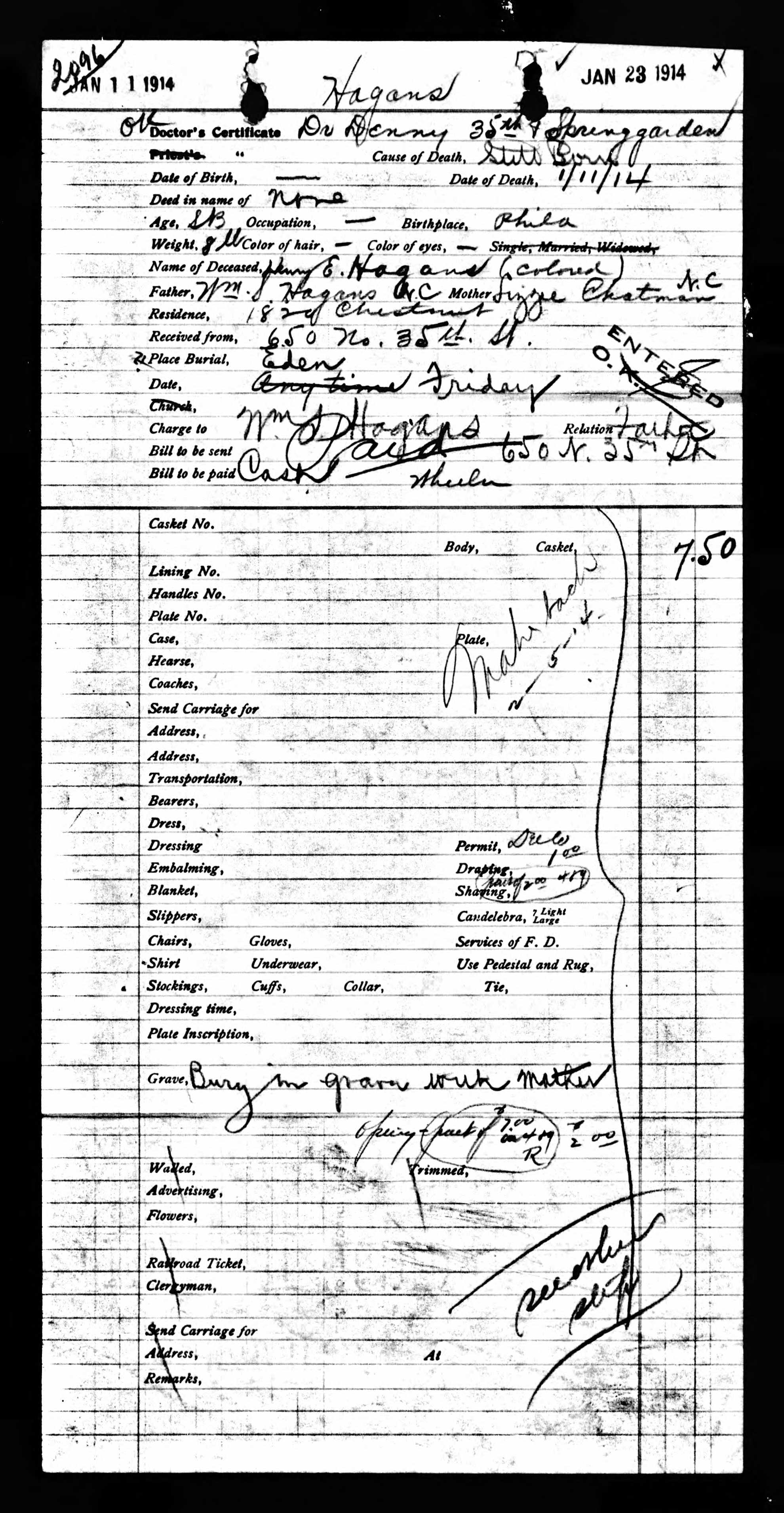
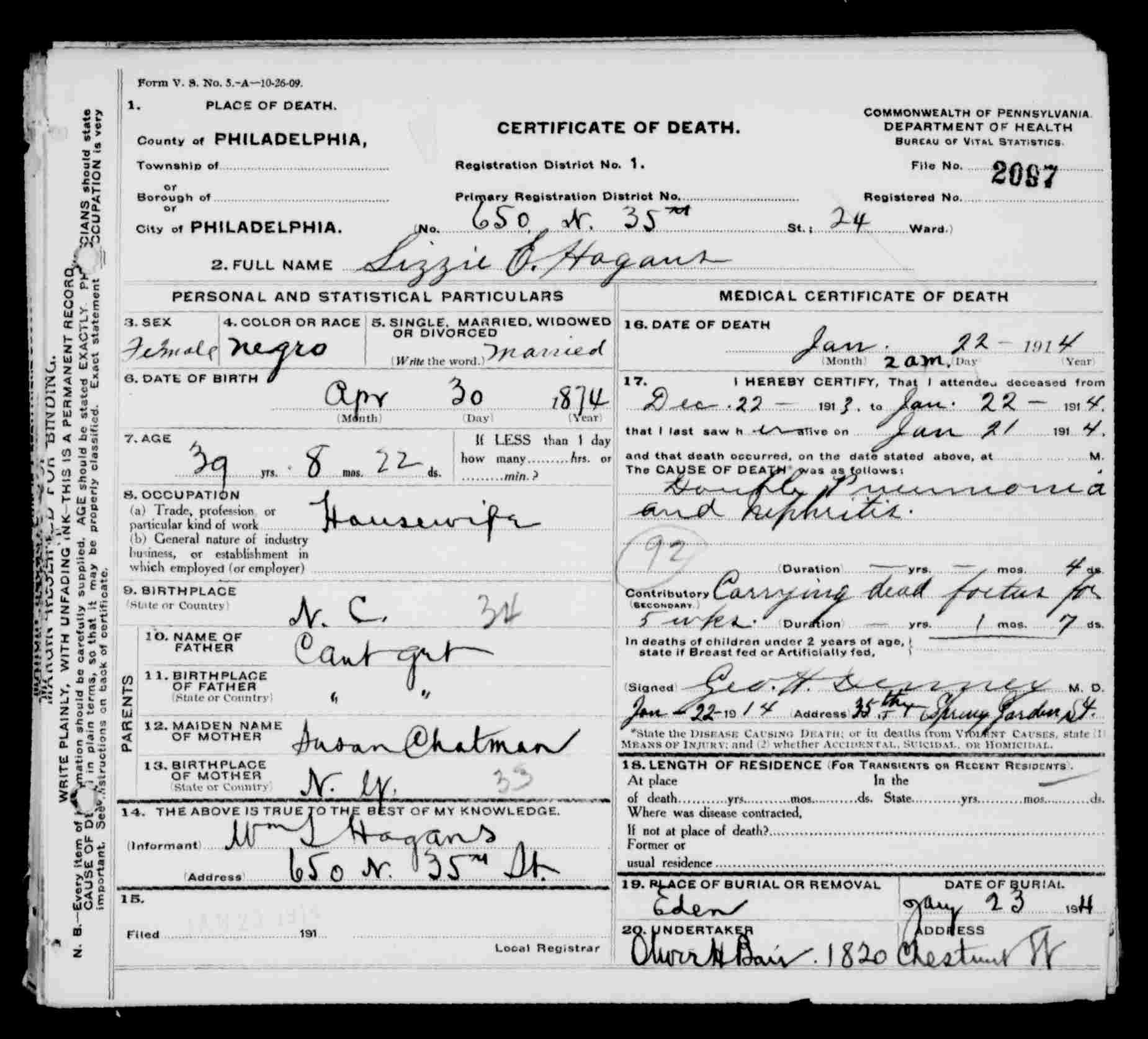
Sometime during 1913, William Hagans moved his family from Goldsboro to Philadelphia, Pennsylvania. They settled in a rowhouse at 650 North 35th Street, and William entered the real estate business. Lizzie was probably already pregnant with their seventh child, but neither she nor the boy would live to know their new city. On January 11, 1914, Lizzie gave birth to a stillborn son, whom she and William named Henry Edward, after William’s brother. Eleven days later, Lizzie died of double pneumonia and nephritis, conditions brought on or exacerbated by her having carried a dead fetus for five weeks. She and little Henry were buried in the same grave in Eden Cemetery, just outside Philadelphia.

On 25 November 1914, the Weekly Argus ran a lengthy letter to the editor from “one of Wayne County’s best known colored citizens and properous land owners, as was his father before him” — none other than Will S. Hagans. After a self-effacing reference to “looking after his little affairs,” William gave a number of flattering nods to prominent citizens and to “the magnificent new court house.” He proclaimed his fondness for Goldsboro and asserted that only a desire to give his children the “very best school advantages” had compelled his move North. (One suspects, however, that much more in the state’s tense political climate was at play.)

Gboro_Weekly_Argus_11_25_1914 WS Hagans Good Citizen

On 26 January 1916, William Hagans sold his first cousin William M. Artis and wife Hannah two tracts on Turner Swamp in Nahunta township totaling 68 acres.

In the 1920 census of Philadephia, Pennsylvania, at 643 North 34th [sic, should read 33rd] Street, 49 year-old widowed real estate broker William S. Hagans and his children Eva M., 17, Flora I., 15, Rosalie L., 12, and William N., 9, all described as mulatto and born in NC.  Hagans owned this home, a three-story rowhouse in the Mantua neighborhood that is still standing.

William Hagans' children after 1913

William’s children Rosalie, Eva, Susan, Flora and William, Fairmount Park, Philadelphia, circa 1916.

The 10 November 1921 edition of the Philadelphia Inquirer reported that the Court of Common Pleas awarded $750 to Lillian Wolfersberger, who sued William S. Hagans for injuries received at 36th and Powelton. Wolfersberger, who was blind, was being led across the street when she was struck by Hagans’ vehicle.

In its 29 December 1925 issue, the Pittsburgh Courier announced that William S. Hagans was elected president of the Citizens’ Republican Club with no opposition. “Mr. Hagans is popular and competent and a banner year is anticipated by the Citizens.” He was reelected to the office several times.

On 16 March 1929, according to the Pittsburgh Courier, the Citizens’ Republican Club president William S. Hagans appointed a committee to discuss ways to form a “Big Brother movement” in Philadelphia. “The need for such an organization is apparent because the white society have no provision for handling Negro cases.”

In the 1930 census of Philadelphia, at 643 N. 33rd Street, widowed real estate broker William S. Hagans, 59, and children Flora I., 26, public school teacher; Lorena,23, real estate stenographer; and William N., 19, all described as white.  All born in NC, but children’s mother’s birthplace listed as NY.  The house was valued at $8000.  The Haganses were the only “white” family on the block.  All others were Negro.

On 18 January 1930, the Pittsburgh Courier ran an article lauding the Citizens’ Republican Club’s hosting a “fanfest and fed” for “varsity football players of color” from Philadelphia high schools. Dr. Charles Lewis, “father of the Howard-Lincoln classic … for the first time

In 1930, Alfred Gordon, M.D. published an essay titled “Frederick Douglass Memorial Hospital and Training School” in a slender volume called Philadelphia: World’s Medical Centre. After setting forth the history of the hospital, Gordon named W.S. Hagans as a member of its Board of Managers.

The Scranton Republican on 15 October 1931 reported that Governor Pinchot had announced the termination of 43 employees in an reorganization of the department of labor and industry. Among them: William S. Hagans, special investigator, Philadelphia, whose salary was $1000.

On 18 January 1932, the Delaware County Daily Times reported that a special committee of the Pennsylvania State Negro Council had presented to the state superintendent of public schools a resolution calling for the establishment of a vocational school in Philadelphia. William S. Hagans, president of the Citizens Republican Club was a committee member.

On 27 September 1932, the Harrisburg Telegraph reported that the Republican state chairman had appointed a Colored Voters Advisory Committee for the current campaign. Members included William S. Hagans of Philadelphia.

In 1933 in Philadelphia, William married Emma L. Titus. The Great Depression dealt the couple crippling blows, and William lost his home and other holdings. In the 1940 census of Philadelphia, at 650 – 57th Street, realtor William Hagans, 65, was renting an apartment for $40/week with wife Emma, 40, a public school teacher, and mother-in-law Ellen Titus, 70. (Assuming this address is North 57th, William’s final home was a flat in a three-story rowhouse just two blocks from the house my grandmother later owned at Wyalusing and North 56th.)

William Scarlett Hagans died in 1946 in Philadelphia.

Wm Scarlett Hagans portrait

William S. Hagans.

Personal photographs courtesy of W.E. Hagans and W.M. Moseley. Other sources as cited.

Standard
Births Deaths Marriages, Land, North Carolina, Other Documents, Paternal Kin

To my ….

Abstracts of wills filed in Wayne County Superior Court, Goldsboro, North Carolina:

Lizzie E. Hagans — (1) to my beloved husband Will S. Hagans and his heirs in fee simple my house and lot in the town of Goldsboro, situated on Oak Street between West Center and James Streets and known as 104 West Oak Street; (2) to my husband $5000 with all benefits from life insurance policy #190279, Phoenix Mutual Life Insurance Company; (3) Will S. Hagans appointed executor. Signed 5 August 1904 in the presence of H[enry] S. Reid and J.A. Dees.

On 2 May 1917, C[larence] Dillard and J. Peele swore that they were knew Lizzie Hagans for a number of years, were well-acquainted with her handwriting and verified her signature. Henry S. Reid also swore that he witnessed the will, which was recorded and filed on 3 May 1917.

HAGANS -- Lizzie Hagans Death Cert

She had inherited Oak Street house from her (probable) uncle, William Burnett. Lizzie Hagans died shortly after William S. Hagans moved his family from Goldsboro to Philadelphia. 

——

Adam T. Artis — (1) S.S. Strother appointed executor; (2) a decent burial suitable to the wishes of my family and friends; (3) to my wife Katie Artis, all of the Thompson tract on which I now live, about 18 acres, all household and kitchen furniture and personal property; (4) to son Pinkney Artis, $100; (5) to son June Scott Artis, $10; (6) to son Henry Artis, $10: (7) to son Columbus Artis, $10; (8) to son William Artis, $5; (9) to son Walter Artis, $5; (10) to daughter Josephine A. Sherard, $15; (11) to son Robert Artis, $5; (12) sell the balance of my land to pay out the above, then divide the remaining in equal shares among my children Vicey Aldridge, Liza Evert, Augustus K. Artis, Georgana Reid, Mary Jane Artis, Emma D. Locus, Ida Reid, Lillie Thompson, Napoleon Artis, Haywood Artis, Addie Artis, Annie Artis, Alberta Artis, and Jesse Artis, and, at Katie’s death, property to be divided among the twelve heirs above whose gifts are not limited. Signed with an X in the presence of W.F. Lewis, J.J. Coley and J.E. Exum. Codicil: (13) to son Noah Artis, $10.

Recorded and filed 1 May 1919.

Adam Artis’ will includes the names of 23 of his children. Emma’s name is crossed out because she died before the terms of the will could be carried out. Known children whose names do not appear include Cain Artis, who died in 1917; Caroline Artis Coley and Louetta Artis, who presumably died before the will was made; Adam Artis Jr., who seems to have been very much alive in Washington DC. (Was the omission of his name inadvertent, as with Noah?) Despite newspaper reports claiming that Adam  fathered 47 “legitimate” children, these 27 are all I have been able to identify. Though there were doubtless others who died in childhood, I doubt there were 20 of them, and I am fairly certain that no other children reached adulthood.

——

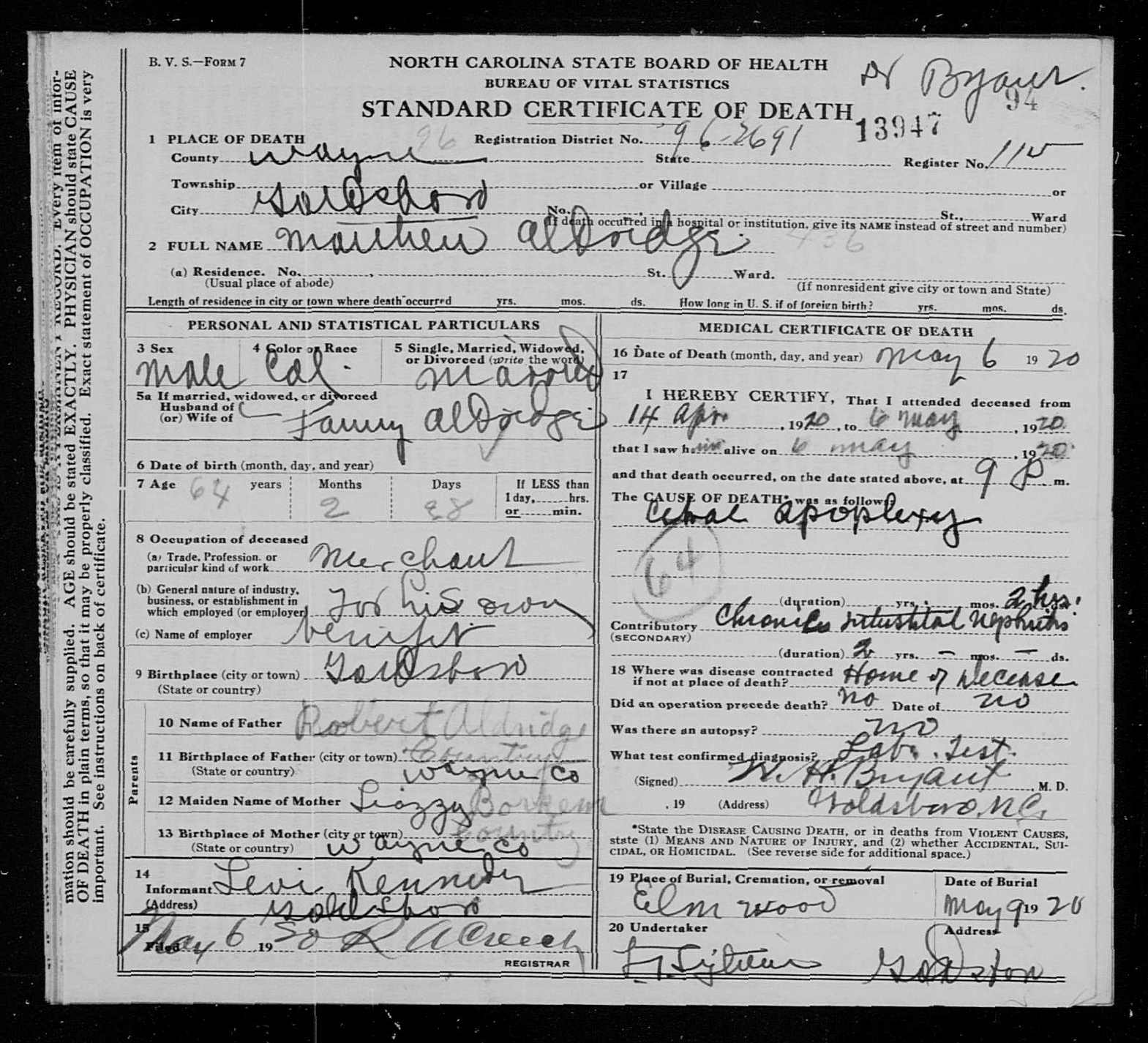
Mathew Aldridge — (1) to daughters Fannie B. Randolph and Mamie J. Aldridge, 1/2 undivided interest in my dwelling house and lot on Pine Street. Signed 27 August 1919 in the presence of N.D. White and Ida Darden.

Recorded and filed 18 May 1920. Fannie Aldridge was qualified as administratrix.

record-image-24 copy

Hmmm. Mathew Aldridge’s will provided for neither his wife, Fannie Kennedy Aldridge, nor his oldest daughter, Daisy Aldridge Williams. Perhaps he had settled property upon them prior to making his will.

——

Lucian Henderson — to John Wesley Carter, all my real estate known as my home place, 8 acres, provided that John W. Carter care for me and my wife Susan Henderson, otherwise null and void. My trusty friend John W. Carter appointed executor. Signed with an X in the presence of Everest Lewis and R.E. Simmons.

Lucian Henderson died 22 June 1934 and his will was recorded and filed 27 June 1934.

Lucian and Susan Henderson’s only child, Cora Q., died in 1907. For more re his friendship with John W. Carter, nephew of his sister Sarah’s husband Jesse A. Jacobs, see here.

——

Joseph Aldridge — (1) a decent burial; (2) to my wife Martha C. Aldridge, all my real and personal property during her lifetime or widowhood; (3) to my sons Allen Aldridge, Daniel Aldridge, William Aldridge and Milford Aldridge, $1 each, to my son Joseph Aldridge, my watch, to my son George Aldridge, my clock; (4) after Martha’s death, all my personal property to be divided between my sons Joseph and George and my daughters Mary Aldridge, Luella Aldridge and Lillie Mae Aldridge; as tenants i common, Mary, Luella and Lillie Mae to receive 12 acres to be laid out of the someplace on the east side of the old stagecoach road; to Joseph and George, all the remainder of the land between what I received from the estate of my father Robert and my brothers George and Dave. Signed 5 May 1934.

Recorded and filed 12 September 1934.

Martha Hawkins Henderson Aldridge remarried in 1940, triggering the terms of paragraph 4 of the will. As set forth here, she remained close to Joseph Aldridge’s children the remainder of her life. Also, a small clue I hadn’t noticed before: Joseph indicated that he received land from the estate of his brother Dave. As noted here, I had lost sight of David Sloan Aldridge after 1904, but now know that he died before 1934.


Standard
Births Deaths Marriages, Newspaper Articles, North Carolina, Paternal Kin, Photographs, Politics, Religion, Virginia

Henry Edward Hagans.

The second oldest of Napoleon Haganssons, Henry Edward Hagans was born in 1868 near Fremont, Wayne County. (Napoleon was the half-brother of my great-great-great-grandmother, Frances Seaberry Artis.) His mother was Apsilla “Appie” Ward Hagans. He and his brother William S. Hagans (then called “Snowbee”) appear with their parents in the 1870 and 1880 censuses. Little is known about their childhood, but it would have been one of relative and increasing comfort as their father’s landholdings expanded. Henry and William attended local elementary schools, then left home to enter the preparatory division of Howard University in Washington, DC. Henry returned to North Carolina to attend college at Shaw University in Raleigh, graduating in 1890.

HAGANS -- Henry Hagans Photo

Henry in his teens, probably as a young collegian at Shaw.

Most of what we know about Henry’s life is gleaned from numerous mentions in newspaper articles resulting from his social, professional, civic and political career. To call him an active man is an understatement. While still in college, he hit the ground running and slowed only in the last few years of his life, when ill health may have dampened his passions. What follows is a narrative built largely from his public life. The portrait is incomplete, but reveals a remarkable man nonetheless.

On 11 November 1885, the Raleigh News & Observer carried a glowing review of the “Colored Fair,” an annual exhibition convened by the North Carolina Industrial Association. The fair opened with a procession of the Association’s marshals, followed by their assistants, including H.E. Hagans of Fremont, who was only about 17 years old. NCIA, founded in 1879, was an organization of African-American civic leaders, founded “to encourage and promote the development of the industrial and educational resources of the colored people of North Carolina.” Governor Starks “spoke of his great surprise at the extent and merit of this the first colored fair he ever attended. He was really amazed to see what progress the colored people had made in twenty years. In that time he said they had really become a race ….”

On 6 November 1888, the New Bern Daily Journal announced that stockholders of the Eastern North Carolina Stock and Industrial Association had elected officers, including H.E. Hagans — then 20 — as chief marshal.

On 10 May 1890, the Washington Bee, an African-American newspaper in the nation’s capitol, noted in a “Personals” column that “Mr. H.E. Hagans of Tremont [sic], N.C. is in the city on a visit.” (The two entries preceding Henry’s notice detailed the travels of former U.S. senator Blanche Kelso Bruce and Congressman John Mercer Langston.)

In about 1892, Henry married Julia B. Morton, daughter of Andrew and Mary Morton of Danville, Virginia. Andrew Morton was a prosperous barber and entrepreneur. The nomination form for historic place registration for Danville’s Mechanicsville district notes: “Another freedman, Andrew Morton, built 543 Monroe Street ca. 1882. Morton became a successful barber and prominent member of the black community, helping to establish Calvary Baptist Church in 1892.” Images of America: Danville Revisited, a photographic history of this southwest Virginia city, includes photographs and brief bios of Andrew and Mary Morton. Henry and Julia may have met through connections at Howard — she graduated from the school’s Normal Department in 1888. Henry’s listing as a teacher in North Danville in the Virginia State Superintendent’s Report for School Years 1891-2 and 1892-3 reveals that the couple lived briefly in Danville before settling permanently in Fremont, then Goldsboro.

HAGANS -- Julia Hagans

Julia B. Morton Hagans.

On 15 September 1892, the Goldsboro Weekly Argus trumpeted big news: “The State Colored Normal School opened in this city yesterday, of which Prof. H.E. Hagans, son of Napoleon Hagans, one of the most respected and prosperous colored men in the State, from the Fremont section, has recently been elected principal.  The ARGUS is glad to note his election.  He merited the preferment, and we wish the school all success under his administration.” According to an article in the Colored American, see below, Henry left this position to become Chair of English at A&M College in Greensboro (now North Carolina A&T State University).

On 31 July 1893, Julia Hagans gave birth to Henry’s only child, son Earle Morton Hagans, in Danville.

Henry’s mother Appie died in 1895, and his father almost exactly one year later. Under the terms of Napoleon Hagans’ will, Henry and his brother William divided the estate equally.

On 26 June 1897, the Raleigh Gazette noted that “Prof. H.E. Hagans of Fremont” was an attendee at the North Carolina State Teachers Association’s 16th annual session at Shaw University.

On 23 October 1897, the Raleigh Gazette reported on the closing exercises of the city school of Eureka, whose “able corps of teachers” included Prof. George W. Reid, Mrs. H.E. Hagans and Miss Elnora S. Ferrell. After devotional exercises, students were examined — revealing “an amount of familiarity with the subjects taught very seldom witnessed in the average school of this kind” — then a “sumptuous repast” was served. (In fact, “the best dinner ever given in Eureka.”)

On 20 November 1897, the short-lived Wilson (NC) Blade noted in “Fremont Items,” that “Professor Henry E. Hagans made a flying trip to Goldsboro last Saturday and returned last Sunday.  While here he visited the Sunday school and delivered an elegant address.” After closing exercises were over, several distinguished persons spoke, including “Prof. H.E. Hagans, formerly an instructor in the A.&M. College, Greensboro.”

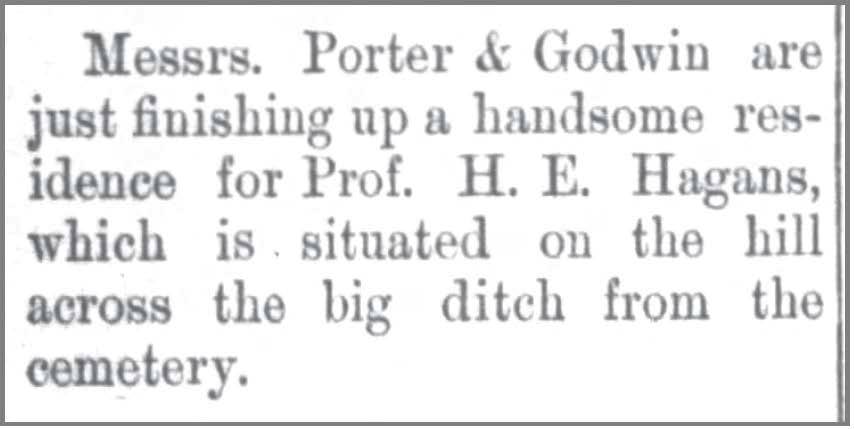
On 30 May 1898, the Goldsboro Daily Argus announced:

Gboro_Daily_Argus_5_30_1898_HE_Hagans_hours

This was surely 501 East Elm Street, a corner address just across the street and slightly northeast of Willow Dale, the cemetery for Goldsboro’s white residents. (The “big ditch” is still there.) There is a house on the lot today, but it dates from no earlier than the mid-20th century. Sanborn maps from the era show a large two-story dwelling.

On 25 June 1898, the Colored American, a Washington, DC, newspaper, noted that: “Mr. H.E. Hagans of Goldsboro, N.C., and a brother of Mr. W.S. Hagans, secretary to Hon. George H. White, was in the city for a few days last week. He is a splendid specimen of the superior young men of the race in North Carolina.” Henry previously had been White’s secretary.

On 27 June 1898, Henry and his wife “J.B.” were official witnesses at the marriage of his 27 year-old brother William Hagans and Lizzie E. Burnett, 23. The ceremony, conducted by Rev. Clarence Dillard, took place in the Nahunta district of Wayne County, probably at William’s home. Neighbor J.D. Reid was an additional witness.

By his late 20s, Henry was thick in the middle of local Republican politics. Coverage of African-American politicians in Goldsboro newspapers was snarky at best and crudely racist the rest of the time. A 20 September 1898 Weekly Argus article was typical, snidely mocking the elocution of black speakers and jabbing at their decorum. The point of the coverage — an agreement between black and white factions of the party concerning the nomination of a county ticket — arrives late in the piece, and there we learn that Professor Henry E. Hagans gained the chairmanship of Wayne County’s Republican executive committee.

On 9 Nov 1898, Daniel Vick and wife Fannie of Wilson NC executed to Henry E. Hagans of Goldsboro a promissory note for $400 with interest after maturity at 6% and payable 9 Feb 1899.  If Vick defaulted, Hagans would sell at public auction two lots on Church Street and Barefoot Road in Wilson.  The deed was registered and filed in Wilson County on 16 Apr 1903 in deed book 66, page 236.  A handwritten note on the entry: “The within papers transferred to S.H. Vick this the 6th day of May AD 1899 /s/ H.E. Hagans”  Another note: “This mortgage is satisfied in full by taking taking a new mortgage and is hereby cancelled 4 Dec 1903 /s/ S.H. Vick”  Samuel H. Vick, Daniel’s son, was turn-of-the-nineteenth-century black Wilson’s most prominent citizen and was active with George H. White and Henry Hagans in Republican politics.

On 21 March 1899, the nearly 476 acres comprising the bulk of Napoleon Hagans’ estate was divided between his sons. Parcels included two tracts in Nahunta township containing 173 and 48 acres; a tract containing 3 acres; two tracts containing 75 ¾ and 6 acres; three tracts containing 39 ¼, 30 and 8 1/3 acres; a tract containing 4 1/8 acres; a tract containing 25 acres; a tract containing 9 ¼ acres; a tract containing 24 acres; and a tract containing 30 acres.

On 21 July 1899, the Fayetteville Observer reported that “[t]he Summer School of Methods, which opened in this city on the 10th inst., for the benefit of colored teachers, closed its labors last night with an interesting programme.” The article noted that 183 teachers from 17 counties attended the school, and faculty included “Prof. E.E. Smith, the efficient conductor, Prof. Edward Evans, Prof. Emma J. Council, Profs. J.W. Byrd and G.W. Herring, Dr. R.S. Rives, Rev. W.M. Jackson, Supt. J.I. Foust, and Profs. H.E. Hagans and J.W. Woody.”

The following month, the Goldsboro Headlight reported that Henry Hagans had been selected for jury duty at the September term of court.

The Raleigh Morning Post carried pleasant coverage of commencement exercises at Goldsboro’s Colored State Normal School and credited Henry Hagans and his assistants, Ed. Williams and C.A. Whitehead, for an “excellent system of training.”

On 5 April 1900, the Goldsboro Weekly Argus cheerfully chronicled the “sorry plight” of the county’s Republican party, a mostly white faction of which was in open revolt against chairman Hagans. The white Republicans were “sick and sore” of Hagans and refused to attend a committee meeting he called. In their absence, delegates to the state and Congressional conventions were selected, with African-Americans gained the primo latter. Dark hints were thrown that “Czar Hagans” must have taken money for his brazen actions as, whatever the law, “public sentiment was opposed to negroes filling offices over white people.” The problem, railed a white Republican, was “educated negroes,” who wanted only to teach school, preach or engage in politics.

The same day, the Raleigh Morning Post published a letter from H.E. Hagans, coldly furious in his defense of his actions and honor:

Raleigh_Morning_Post_4_5_1900_Let_Hagans_SPeak

Exactly one month later, the Colored American‘s “Political Horoscope” column ignored the kerfuffle to record Henry’s rise in party leadership: “At the convention of the second district of North Carolina held at Tarboro April 26, Congressman George H. White and H.E. Hagans were chosen to the Philadelphia convention.”

In the 1900 census of Goldsboro, Wayne County, in Ward 2, Henry E. Hagans, born September 1867, is listed with wife Julia A., born July 1869, and son Earl, born September 1892.  Henry owned his home; no occupation listed. Earl is also listed 135 miles away in Danville, living with his Morton grandparents. This is, perhaps, the first clue that the boy was not following in his father’s footsteps.

Henry’s own steps were a little shaky in 1900. At the September term of Superior Court, judge W.S. Robinson entered a judgment against him in the matter of The Bank of Wayne vs. H.E Hagans: “It appearing to the County  that the Summons herein was duly served on the defendant the 10 days before the beginning of this term, and that a verified complaint was duly filed herein on the 4th day of Sept 1900 and  that the defendant has failed to appear and answer or demur to the complaints; It is thereupon on motion of Aycock & Daniels, attorneys for plaintiff considered and adjudged by the court, that the plaintiff, The Bank of Wayne, recover of the defendant H.E. Hagans, the sum of Three Hundred and Eighteen and 45/100 ($318.45) dollars of which Three Hundred ($300) dollars is principal and Eighteen and 45/100 ($18.45) dollars is interest, together with the costs of this action to be taxed by the clerk.”

On 19 March 1901, the Wilmington Messenger ran a story about an 18 year-old Goldsboro mulatto man arrested for stealing mail. Andrew C. Alexander, “an attache of the postoffice,” turned to Henry Hagans to stand surety for Alexander’s $200 bond.

On 19 April 1901, per the Raleigh News & Observer, Henry addressed the annual meeting of the alumni association during commencement week at Shaw University.

In 1902, H.E. Hagans, age 34, registered to vote in Wayne County under the state’s grandfather clause. He named Napoleon Hagans as his qualifying ancestor. (His brother William named their maternal grandfather, a white physician named David G.W. Ward.)

On 3 April 1902, the Charlotte Observer printed the following letter:

Charlotte_News_3_3_1902_Are_you_coming

The News & Observer covered the “negro mass meeting,” attended by about 150 men from 18 counties, on 16 April. The purpose of the gathering, headed by elected president Henry Hagans was “to discuss the status of the negro as an officeholder in the Republican party and to devise plans to make his power felt by the white Republicans his votes had elevated to power.” Senator J.C. Pritchard came in for especially harsh criticism. An appointed committee, which included Henry’s brother William, devised an address to the colored people of North Carolina that encouraged sober respectability, self-respect, home ownership, support of “race enterprises,” payment of poll taxes, country living, loyalty and thrift, while pointedly remarking upon pressing issues such as jury discrimination, Jim Crow laws, and the need for accountability from elected officials.

On 31 January 1903, the Colored American shone a spotlight on Goldsboro, “a progressive little town of 8000 inhabitants. It is historic,” it claimed, “for the peaceful relations existing between the races. The chief occupation of its people is trucking. Yet we have negroes who are rapidly forging their way to the front along all industrial lines. Our people own thousands of acres of forming land, as well as excellent city property….  Prof. H.E. Hagans, the principal of our State Normal School and also a farmer, is worth $20,000. Mr. W.S. Hagans, who is one of the most successful agriculturalists, is worth $20,000. …”

On 9 May 1903, the Colored American, “Mr. H.E. Hagans, formerly an attaché of the office of the Recorder of Deeds, and later private secretary to Congressman George H. White, is now principal of the Colored State Normal School of Goldsboro NC.  This office is in receipt of a unique invitation to attend the Commencement Exercises of this school Friday, the eighth, instant.” This is the only mention I have found of Henry’s service under Tarboro’s John C. Dancy, see below.

On 19 September 1903, the Colored American, “Prof. H.E. Hagans, of Goldsboro NC, who is principal of the public schools of that city and an extensive farmer and real estate owner, spent a few hours in the city last week, the guest of Hon. John C. Dancey [sic], recorder of deeds.  Mr. Hagans is a prominent Pythian and attended the conclave held in Baltimore last week.  He is one of the coming men of his State.”

On 24 September 1904, as Henry’s political career perhaps reached its crest, the Colored American paid him homage with a full front-page feature:

HE_Hagans_Colored_American_9_24_1904 (1)

“Educator, orator and scholar.”

On 10 July 1907, the Charlotte Observer‘s coverage of recent state legislative activity noted that the body approved a charter for the Southern Fidelity Life Insurance Company “to do also a health industrial and sick benefit business” and named J.E. Shepard, John C. Dancy and H.E. Hagans among the shareholders. Three days later, Greensboro’s Daily Industrial News announced the close of the Negro State Inter-Denominational Sunday School Convention. Henry E. Hagans had been elected secretary of the organization.

Henry played no direct role in the Wayne County Superior Court proceedings in J.F. Coley v. Tom Artis (1908), a dispute over 30 acres of land.  Thomas “Tom Pig” Artis began renting the property in 1881 from W.J. Exum.  In 1892, Exum’s widow Mary sold it to Napoleon Hagans.  In 1896, after his death, the land passed to Napoleon’s sons Henry and William.  William S. Hagans gained the 30 acres in partition and, in 1908, sold it to J.F. Coley.  Coley filed suit when Tom Artis laid claim to it, arguing that Napoleon had sold it to him.  At trial, William testified that his father was in feeble health in 1896 when he called him and his brother Henry together “under the cart shelter” to tell them he would not live long and did not know to whom the land would fall.  William testified that Pole asked them to let “Pig” stay on as long as he paid rent, and they promised to do so.

In the fall of 1908, the Haganses attempted a new tack with Earle, sending him to Indianapolis to live with his uncle/cousin Dr. Joseph H. Ward. The Indianapolis Freeman informed all that Earl was to  attend school in the city and that he was “the son of Prof. H.E. Hagans of Goldsboro, N.C., who is the head of one of the oldest and most substantial families in North Carolina. The Hagans [sic] are relatives of Dr. J.H. Ward …” [Italics added; mythmaking at work….]

The 1910 census of Goldsboro lists Henry L. Higgins [sic], 38, public school teacher, wife Julie, 34, and son Earl, 14.  (The ages of everyone in the household were off by about 4 years.)  Henry and Julia had been married 18 years, and she reported one of two children living. Earl left home within a few years of this census. When he registered for the World War I draft in June 1917, he was living in Norfolk, Virginia, working as a hotel waiter and had a wife and child. He was described as a chauffeur in the 1920 census and was dead by 1930. His wife Sarah and son Earle Jr. survived him.

On 21 July 1910, the Greensboro Daily News reported that the negro Knights of Pythias had met in Wilmington and among “those prominent in public affairs attending the grand lodge” was Professor H.E. Hagans of Goldsboro.

The 1911-1912 Goldsboro City Directory lists “Hagans Henry E tchr h 501 Elm e” and “Hagans Julia B mgr Beneficial Millinery Co h 501 Elm e.” I have not been able to find any additional information on the millinery company.

On 18 July 1913, the New Berne Weekly Journal reported on the annual session of the North Carolina Grand Lodge of Colored Knights of Pythians at which H.E. Hagans was elected Grand Lecturer.

On 21 May 1915, the Williamston (NC) Enterprise reported on commencement exercises at the Higgs Roanoke Institute at Parmele. The several-day event included a speech by Henry E. Hagans to the Invincible Literary Society.

In July and August 1916, large advertisements ran in the Washington Bee recruiting members to the Royal Knights of King David, Old North State Fraternal Insurance Organization, touting its “unblemished record of 33 years” and warning that “the usual life of a negro organization is 20 years, and usually it is 20 years of internal strife and mismanagement — then the inevitable failure.” Not so with R.K.K.D., whose financial policy was “safe, sound and sane.” A week or so before the ads, a small article announced the arrival of  H.E. Hagans and R.E. Owens, staying at the home of the “well-known” Mr. and Mrs. John Doster of 1205 Tea Street northwest. As for Hagans and Owens, “these two well known representatives of North Carolina are not only well known to the editor of The Bee, but they are known to every North Carolinian as being men of the highest business integrity.”

Henry was not the only one to move about. The 15 June 1918 New York Age reported that Mrs. Henry E. Hagans had stopped in D.C. a few days after visiting her sister, Mrs. M.A. Galloway, and niece, Mrs. William Solomon, in New York City and her youngest sister, Mrs. Charles Reid, in Danville.

It’s not clear whether Earle Hagans served in the war. However, on 6 July 1918, the Washington Bee trumpeted the establishment by the Colored Auxiliary of the War Community Service Commission of the District of a “finely equipped recreation center” for colored soldiers, “filling a long-felt want.” “Temporarily the club room is in the charge of Mr. Henry E. Hagans.” The 13 July edition of the New York Age provided additional details about the center’s “dedicatory services.”

In the 1920 census of Goldsboro, still living in the Elm Street house: H.E. Hagans and wife J.B., both teachers.

On 2 August 1920, Henry contributed to the Bee a long feature article entitled “James E. Shepard, President of National Training School, A Great Benefactor/ Manual Training Center / My Visit to the Summer School of the National Training School, Durham, N.C., and Some of My Observations.” In the typically ornate language of the day, Henry penned a paean to “that indomitable leader Dr. Jas. E. Shepard.” “To tell the story of the rapid growth of this institution would be too long; it is full of romance, and its development has, indeed, been so wonderful that it is almost beyond mental conception.” Nonetheless, despite this challenge, Henry managed to wring out several dozen column inches of praise for this institution and its founder, “the most constructive genius of the Negro race today.” The National Training School is today North Carolina Central University.

——

This is the only photograph I have seen of Henry in late maturity. He is probably not many years away from death here, but the boy that was is still visible in his thick eyebrows and the abundance of curly black hair swept back from his brow. Henry wears his prosperity in the fullness of his smooth-shaved face and his pinstriped suit; my best guess is that the picture was taken in Goldsboro.

Henry Hagans Brother of Wm S Hagans

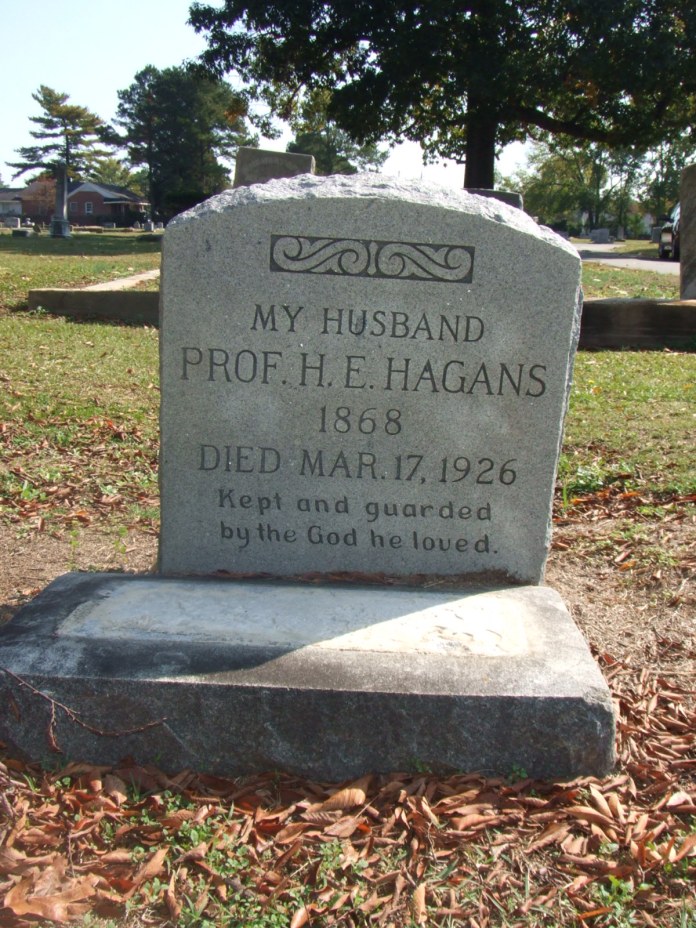
Henry Edward Hagans died 17 Mar 1926 in Goldsboro of myocarditis and an enlarged liver.  He was 58 years old. He was buried 19 March 1926 at Elmwood cemetery. Before she returned to Danville to live out her years, his wife erected this headstone in his memory:

HAGANS -- HE Hagans headstone

Family photos courtesy of W.E. Hagans and W.M. Moseley; photo of grave marker by Lisa Y. Henderson, 2013.

Sources: Federal census records; deeds, birth, marriage and death records, Wayne County Register of Deeds office; deeds, Wilson County Register of Deeds office; North Carolina State Archives; others as cited.

Standard
Births Deaths Marriages, Free People of Color, Newspaper Articles, North Carolina, Paternal Kin

Nothing could swerve him.

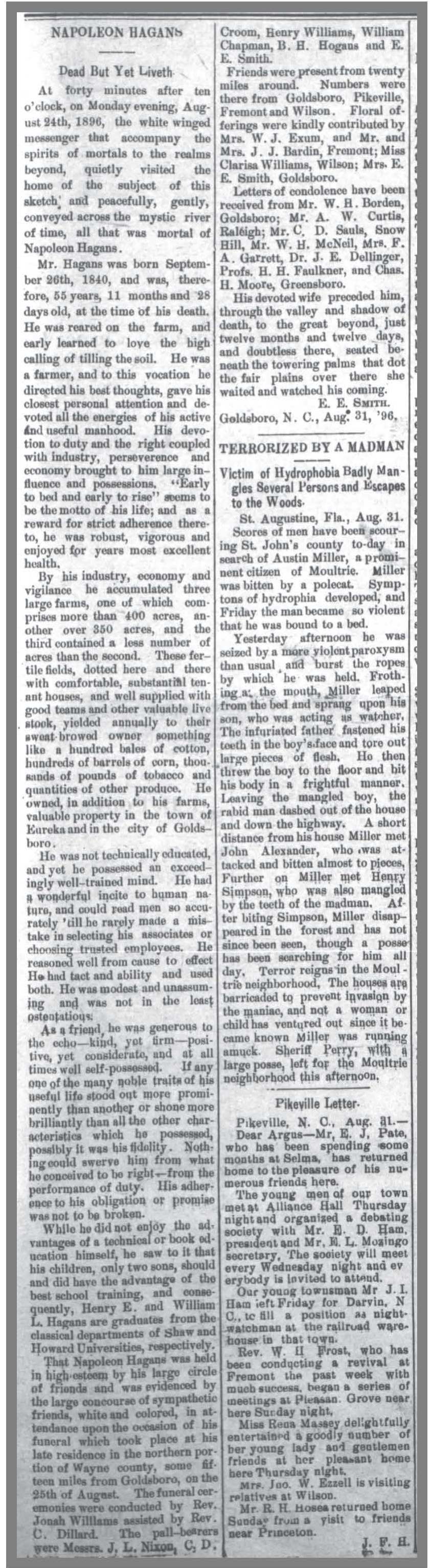
I felt sure that Napoleon Hagans‘ death had merited more than the brief mention I’d seen in the Goldsboro Headlight, and last night I found it:

Goldsboro_Daily_Argus__9_1_1896_N_Hagans_Obit

Goldsboro Daily Argus, 1 September 1896.

This shining eulogy was penned by Ezekiel Ezra “E.E.” Smith (1852-1933), college president, recent United States Ambassador to Liberia, and arguably the most accomplished of Wayne County’s 19th-century African American citizens. (Smith was born free in Duplin County, just to the south, but moved to Goldsboro as a young man, married a cousin of Napoleon’s daughter-in-law Lizzie Burnett Hagans, and was principal for a time of Goldsboro’s colored school.)  Side-stepping the indelicate issue of Napoleon’s parentage, E.E. painted a glowing portrait of his friend’s virtues — his hard work, his astuteness, his self-built wealth, his determination to give his children what he lacked. Napoleon’s business acumen and successes won relationships across color lines and among North Carolina’s colored elite, and E.E. listed those who took part in the funeral or had taken the time to reach out to pay respects:

  • Rev. Jonah Williams, Eureka. Jonah Williams was the elder of a Baptist church a few miles from Napoleon’s home (and a central figure in the establishment of Primitive Baptist congregations in the area) and had, like Napoleon, been involved in Republican politics. Jonah’s brother, Adam T. Artis, married Napoleon’s half-sister, Frances Seaberry.
  • Rev. Clarence Dillard, Goldsboro. Clarence Dillard, Howard University Theology ’83, came to Goldsboro as a Presbyterian minister and was principal of the colored graded school at Napoleon’s death. (It is said that he traded a teaching position at Agricultural & Mechanical College for the Colored Race [now North Carolina Agricultural & Technical State University] to Napoleon’s son Henry E. Hagans for this job.) Dillard was active in Republican politics and was co-editor of a short-lived African-American newspaper in Goldsboro, The Voice.
  • J.L. Nixon, Goldsboro. John Louis Nixon (1855-1919) was co-editor and manager of The Voice and, later, secretary of the Goldsboro-based United Church Benevolent Society and a mail clerk for the United States Postal Service. He was a native of Wilmington.
  • C.D. Crooms, Goldsboro. Charles D. Crooms was a teacher and merchant.
  • Henry Williams.
  • William Chapman, Goldsboro. William Chapman (or Chatman) married Susan Burnett, mother-in-law of Napoleon’s son William S. Hagans.
  • B.H. Hogans, Goldsboro. Benjamin Harrison Hogans (1865-1926) was a teacher, a trustee of Saint James AME Zion Church and, later, a mail carrier. He was born in Orange County and came to Goldsboro as a child with his parents Haywood and Zilpha Latta Hogans.
  • E.E. Smith.
  • Mrs. W.J. Exum, Fremont. Mary Burt Alston Exum, white, was the widow of William J. Exum (1825-1885), a prominent farmer and former slaveowner in northern Wayne County. Napoleon bought land from William (and Mary, after William’s death).
  • Mr. and Mrs. J.J. Bardin, Fremont. John J. Bardin, white, was a druggist in Fremont.
  • Miss Clarisa Williams, Wilson. Clarissa Williams, Jonah Williams’ daughter, was a teacher in Wilson.
  • Mrs. E.E. Smith, Goldsboro. Willie Ann Burnett Smith, daughter of Dolly Burnett, was a cousin of Napoleon’s son William’s wife Lizzie E. Burnett. William Chapman was Willie Burnett Smith’s step-father.
  • W.H. Borden, Goldsboro. William H. Borden (1841-1905), white, was president of Goldsboro Furniture Company.
  • A.W. Curtis, Raleigh. Rev. A.W. Curtis, white, lead the Congregational Church mission in Raleigh.
  • C.D. Sauls, Snow Hill. Cain D. Sauls (1864-1938) of Greene County wore many hats — farmer, merchant, newspaper columnist, banker, justice of the peace, and all-around businessman. He was the grandson of Daniel Artis, who was a first cousin of Adam T. Artis.
  • W.H. McNeil, Greensboro. William H. McNeill was president of Suburban Investment Company of Greensboro and Piedmont Mutual Life Insurance Company. (The 18 July 1903 edition of Washington DC’s The Colored American reported that Mrs. W.H. McNeill had visited Mrs. F. Douglass at 1720 Fourteenth Street, NW.)
  • Mrs. F.A. Garrett, Greensboro.
  • J.E. Dellinger, Greensboro. J. Elmer Dellinger (1862-1920) was active in Republican politics and the development of Baptist Sunday Schools, was a physician, and taught chemistry at Agricultural & Mechanical College in Greensboro. He was also a manager of Suburban Investment Company. He was born in Lincoln County, North Carolina.
  • H.H. Faulkner, Greensboro. Henry H. Faulkner was a school principal in Greensboro.
  • Charles H. Moore, Greensboro. Moore was principal of the first graded school for African-American children in Greensboro.
Standard
Agriculture, Free People of Color, Land, Newspaper Articles, North Carolina, Paternal Kin, Politics

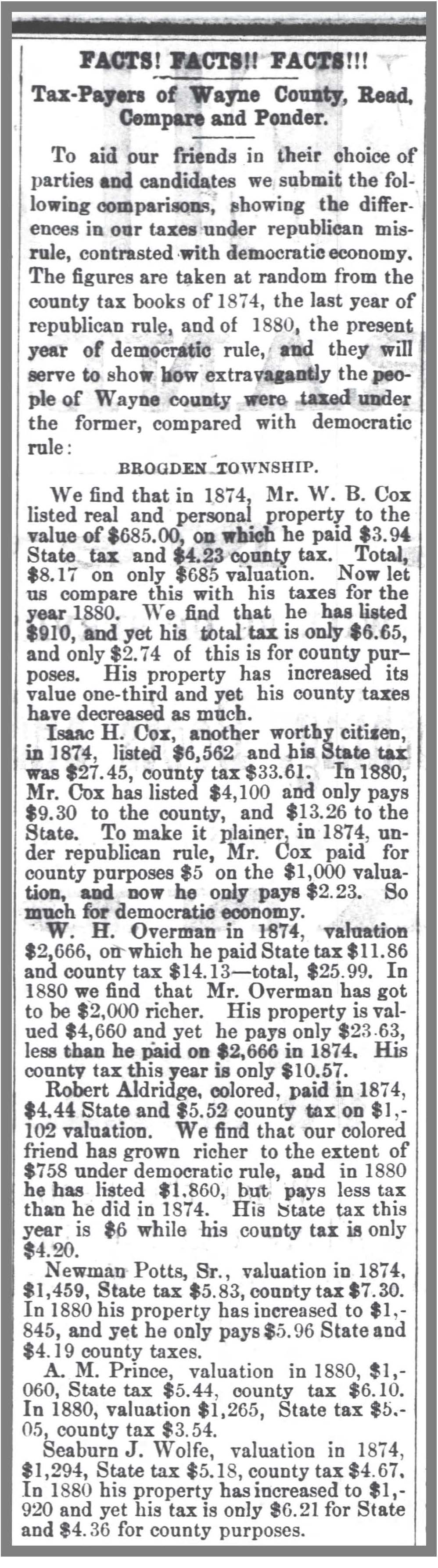
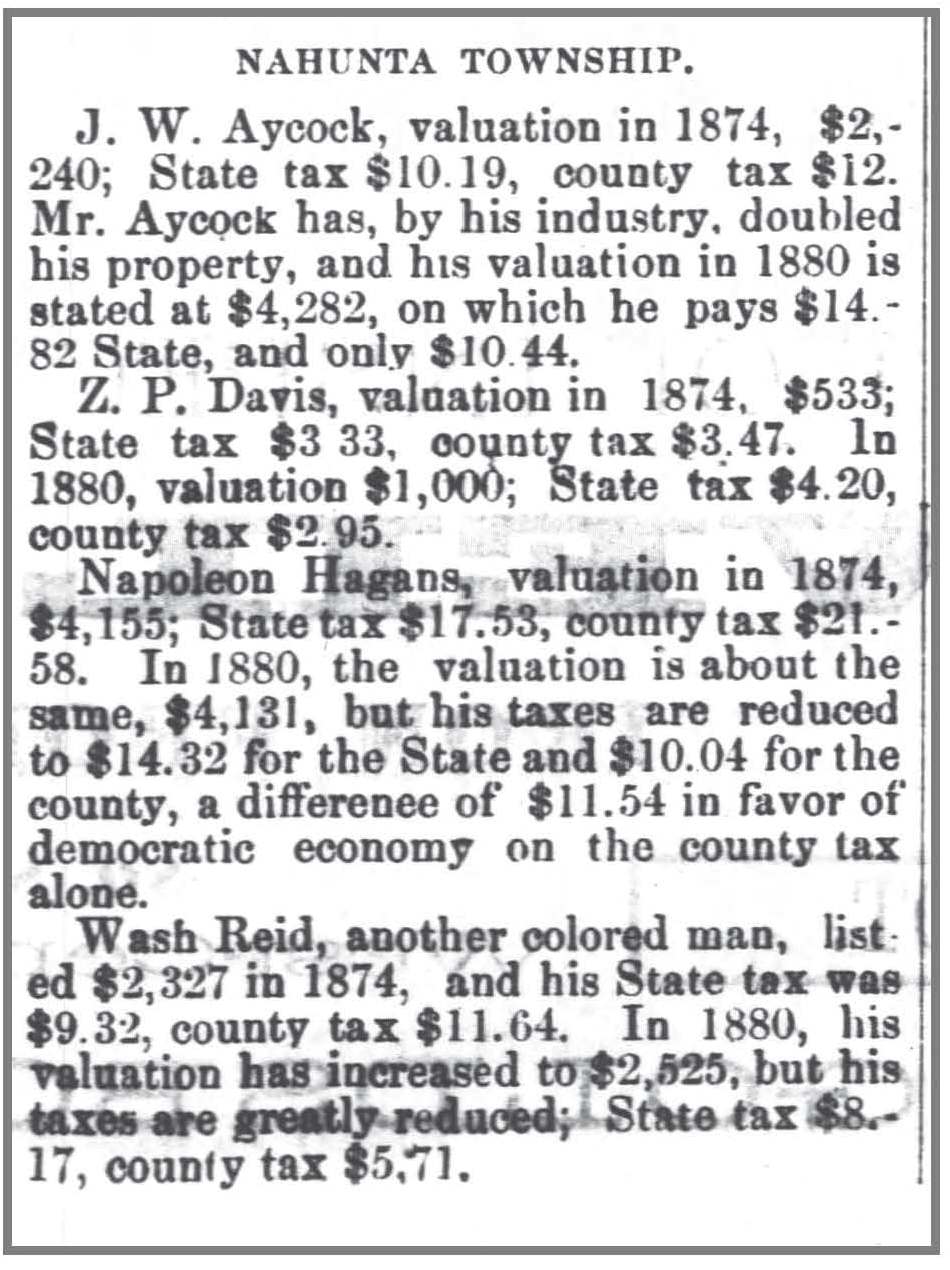
Our colored friend has grown richer.

Image

ImageGoldsboro Messenger, 21 October 1880.

These propaganda pieces are part of a single article published to demonstrate that the rising tide of Democratic rule had floated all boats as land values increased while taxes fell. (In other words, the end of Republican rule meant more money in the pocket, as well as a foot on the neck of African-Americans.)

Two of the “colored friends” noted were my kin — my great-great-great-grandfather Robert Aldridge and Napoleon Hagans, the brother of my great-great-great-grandmother Frances Seaberry Artis. (And Washington Reid’s nephews William and Henry Reid, sons of John Reid, married Adam Artis’ niece Elizabeth Wilson and daughter Cora Artis, respectively.) Aldridge, Hagans and Reid (as well as Artis, Frances’ father Aaron Seaberry and Betty’s father John Wilson) were all prosperous free-born farmers.

Standard
Agriculture, Business, Newspaper Articles, North Carolina, Paternal Kin

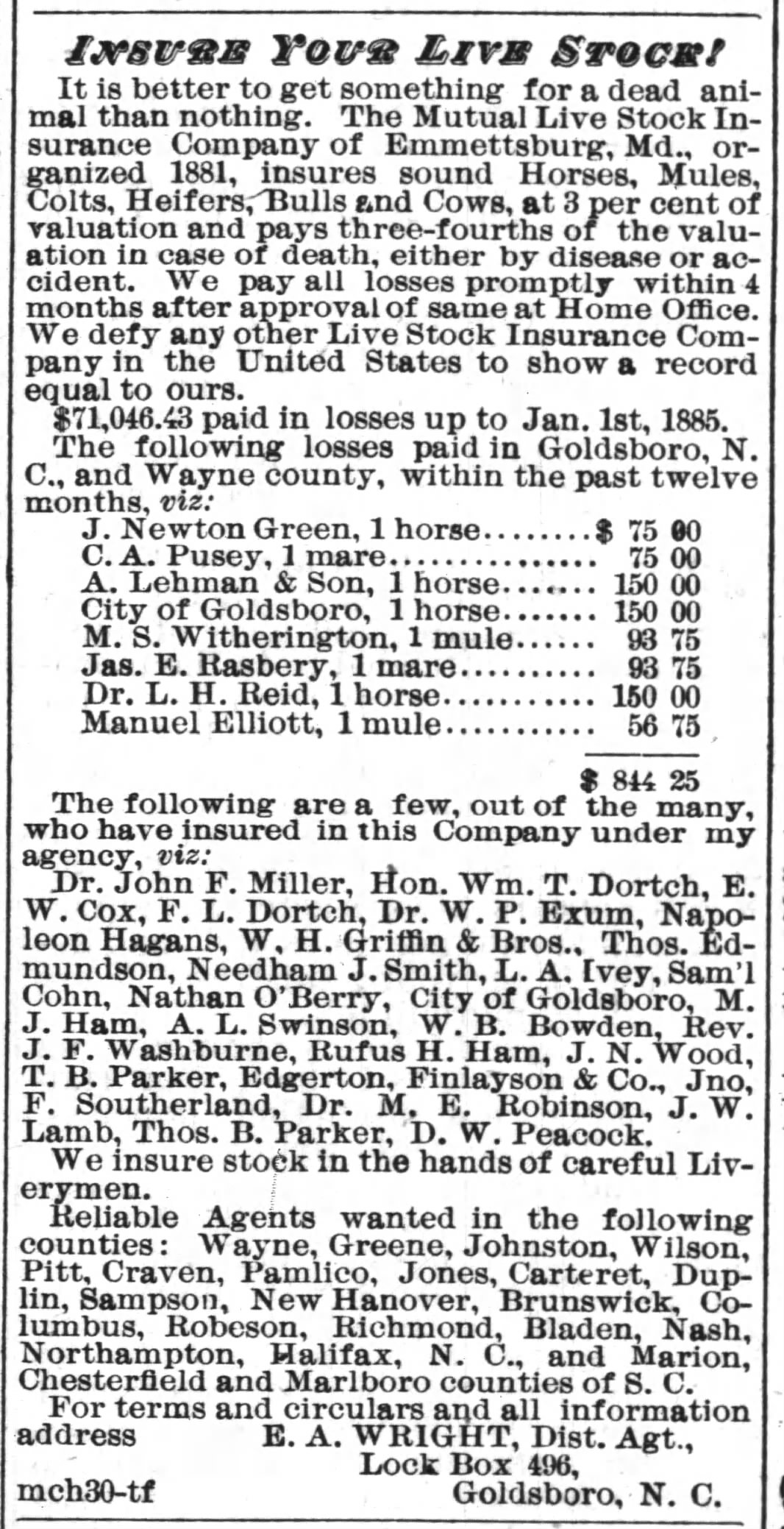
It is better to get something than nothing.


Image

Goldsboro Messenger, 30 March 1885.

Apparently, Napoleon Hagans was a big believer in insurance. The Insurance Press compiled life insurance claims paid out on a weekly basis, state by state. In the 9 September 1896 issue, the sole listing for North Carolina was: Fremont, Napoleon Hagans, $5000 — the payment he received after his wife Appie Ward Hagans’ death.

Standard