Births Deaths Marriages, North Carolina, Paternal Kin

James Henderson’s children, part 2: Eliza Armwood.

Around 1851, as his oldest set of children moved into their mid-teens, James Henderson married Eliza (sometimes noted as “Louisa”) Armwood, daughter of John and Susan Armwood. They reared their ten children in the tri-county area formed by the meeting of Sampson, Duplin and Wayne Counties:

Anna Jane Henderson, born in 1852, married Montreville Simmons, son of Calvin and Hepsey Whitley Simmons in 1871 in Duplin County. The Simmons family had migrated to Ontario, Canada, in the 1850s, and after the death of his young first wife, Montreville journeyed home to find a second. The family is found in the 1881 census of Chatham, Kent, Ontario: Montreville Simmons, 40, farmer; wife Annie, 29; and children Elizabeth, 8, Doctor T., 7, Susan M., 4, and Montreville, 2. All were born in the US except the two youngest children, and the family was Baptist. They returned to the US in the 1890s, and in 1900 are found in the census of Eel, Cass County, Indiana. Annie Simmons died 16 June 1906 in Cass County.

Susan and Hepsie Henderson, born 1854 and 1856, married brothers Edward J. and Washington F. “Frank” Wynn and raised their families near Dudley.  Susan H. Wynn’s children were Elizabeth Wynn Simmons, Sallie Wynn Manuel, Fannie Wynn Price, William H. Wynn, Arthur Wynn, Eddie Wynn, Minnie Wynn Greenfield, Cora Wynn Bennett, Jessie Wynn and Danzie Wynn. She died 6 January 1907 and is buried in a family cemetery near Dudley. Hepsie’s children were Alice Wynn, George Wynn, William Wynn, Sallie Wynn, James Wynn, Richard G. Wynn, Dock Wynn, Georgeanna Wynn and Israel Henderson Wynn. Hepsie died circa 1895.

Alexander Henderson, born 1860, was the only one of James’ sons to leave farming.  In 1900, he, his wife Mary Odom Henderson and children were living near Mount Olive, but by 1910, Alex had moved his family to James Street in Goldsboro.  Alex and Mary Odom Henderson’s children were William Henderson, Mary Jane Henderson Wooten, Theodore Henderson and Connie Geneva Henderson Smith. He died 13 June 1919 and is buried in Elmwood Cemetery, Goldsboro. Inexplicably, his death certificate lists his father as “Stephen Henderson.”

John Henry Henderson, born 1861, married Sarah E. Simmons, daughter of Bryant and Elizabeth Wynn Simmons, in 1886 at the Congregational Church in Dudley.  John and Sarah’s three surviving children were Charles Henry Henderson, Frances Henderson Wynn and Henry Lee Henderson.  At John’s death on 8 August 1924, he was the last of James Henderson’s sons.  John’s son Charles Henderson moved away to Virginia, but “Frankie” and Henry remained in Dudley and are the forebears of a great many of our present-day Hendersons, some of whom still live on ancestral land.

Nancy Henderson, born 1865, married Isham Smith, son of Milly Smith.They lived in Goldsboro, where Isham worked as a wagon driver.  Their children were Annie Smith Guess, Oscar Smith, Furney Smith, Ernest Smith, Elouise Marie Smith, Johnnie Smith, Mary E. Smith Southerland, James Smith, Willie Smith, Effie May Smith, and Bessie Lee Smith. Nancy’s second husband was Patrick Diggs. She died 11 December 1944.

Betty Henderson and Edward Henderson, born 1867 and 1874, appear in one census record each, and nothing further is known of them.

Julia Henderson, born 1872, known as “Mollie,” married Alex Hall in Wayne County in 1889. They had two daughters, Lula and Sadie. In 1902, Mollie married Walter Holt, son of George W. and Martha Holt, in Randolph County. (How — and why — did she get from Wayne County to Randolph?) By 1910, they were living in Greensboro NC.  She died circa 1929.

Louella Henderson, born 1876, married first a man whose last name was King, then one named Wilson. (According to my grandmother.) She may have died in Bessemer NC.

Standard
Newspaper Articles, Paternal Kin, Politics, Rights

Uncle Caswell makes a fine point. … And then ….

Image

Colored American, Washington DC, 20 June 1903.

——

(1) Who knew Caswell C. Henderson was “one of the best known Republicans in the County of New York”?

(2) Uncle Caswell worked at the United States Custom House, where positions were highly sought-after. In other words, they were patronage jobs. Now I understand the path the farmer’s son from North Carolina took to get one.

(3) It appears that Caswell wasn’t a white man at work after all. He was merely one when below the Mason-Dixon line.

Standard
Births Deaths Marriages, Free People of Color, North Carolina, Other Documents, Paternal Kin, Rights

Her freedom has never been disputed.

State of North Carolina Onslow County

To all persons whom it may concern we the under Signed being called on to State what we Know concernning the Freedom of Nancy Dove formerly Nancy Henderson do certify that Nancy Ann Henderson the Mother of the said Nancy Dove was a Free born white Woman and that the Freedom of the said Nancy Dove never has been disputed given under our hands this 3rd March 1860  /s/ John Mills {seal} Nancy Parker {seal}

Test J.W. Thompson X

——

I believe that Nancy Henderson alias Dove and my great-great-great-great-great-grandmother Patsey Henderson were sisters. More on that later.

Standard
North Carolina, Oral History, Paternal Kin, Photographs

She raised 13.

My father’s mother said:

Every day she needed, had to eat some fish.  ‘Cause she couldn’t eat pork.  Good as she loved ham and stuff, and Papa always raised a pig every year.  She had a bad heart.  And so she wasn’t supposed to eat no pork.  And so that’s what she had, fish.  Fish and beef.  Fish and beef. … Well, she raised chickens.  But she got to put the chicken in a coop.  Even if it was running ‘round out there in a bigger pen.  She put it one of them little coop places where was built up like that, and let it stay a week, cleaning it out.  That’s what she said to do.  I reckon you let ‘em run ‘round in the yard eating dirt, so she was gon clean ‘em out. She would get her about five or six biddies out the bunch, and she just put them in that coop, and by them being out there in the back yard fenced in that part, picking up all the gravel and everything else they want … Put ‘em in that coop, let ‘em stay a week, clean ‘em out.  So, I said to Mama, “Why you got to take ‘em out the yard and put ‘em in a pen?  And then feed ‘em nothing but corn in there?”  She said that cleans ‘em out.  At the time, when she was telling me, I didn’t know what cleaning ‘em out was.  Wonder, “Why she talking ‘bout cleaning ‘em out?”  I wanted to ask her again, but she would scold at you.  She done called herself telling you what to do.  But she didn’t tell you the whole thing.  So I’d just hush.  And then go and try to get it out of somebody else.

She weighed 200 pounds.  She was fat.  But she wore dresses longer than what they’re wearing now.  Just like, that one up there, that skirt she had on, she made that.  And she, it was blue silk.  And then she made a ruffle, that ruffle that was ‘round that skirt, she took and sewed all ‘round it…. Her hair was shoulder-length, but she always rolled it, always turned it up and pinned it back there and had this part that come around.  She didn’t never cut it real short.  And it didn’t, I don’t never remember seeing it when it was real long.  But she was always tucking it in and trying to make a ball back there.

Image

She didn’t have but one child.  But she raised 13.  Papa’s children, and then my mama Bessie and Jack, and me and Mamie.  Her own child was named Hattie Mae, too.

Sarah Daisy Henderson Jacobs Silver was my great-great-grandmother’s sister.

——

Photo of Sarah Henderson Jacobs Silver in the collection of Lisa Y. Henderson. Interview of Hattie Henderson Ricks by Lisa Y. Henderson; all rights reserved.

Standard
Letters, North Carolina, Paternal Kin

I pray for the whole family.

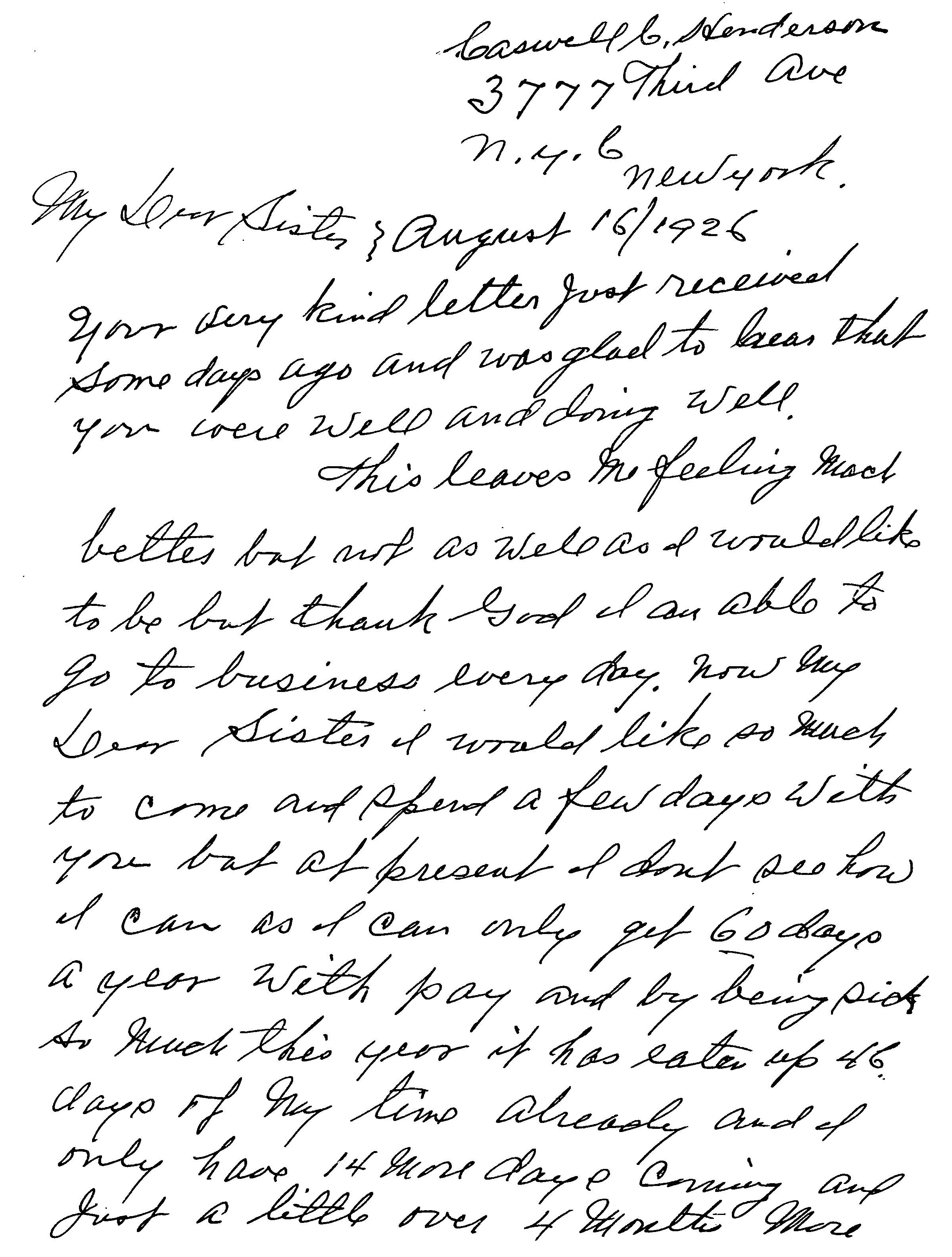
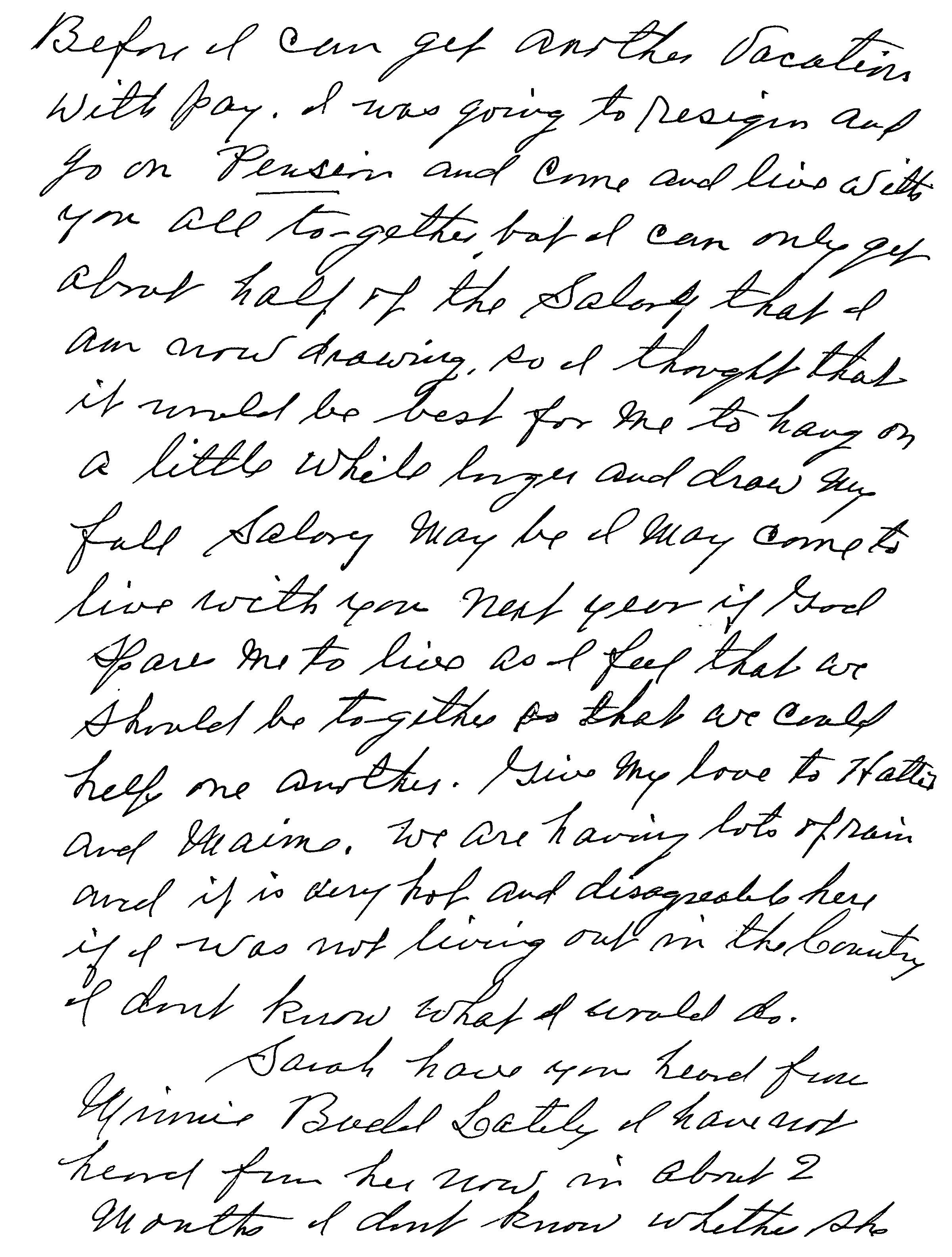
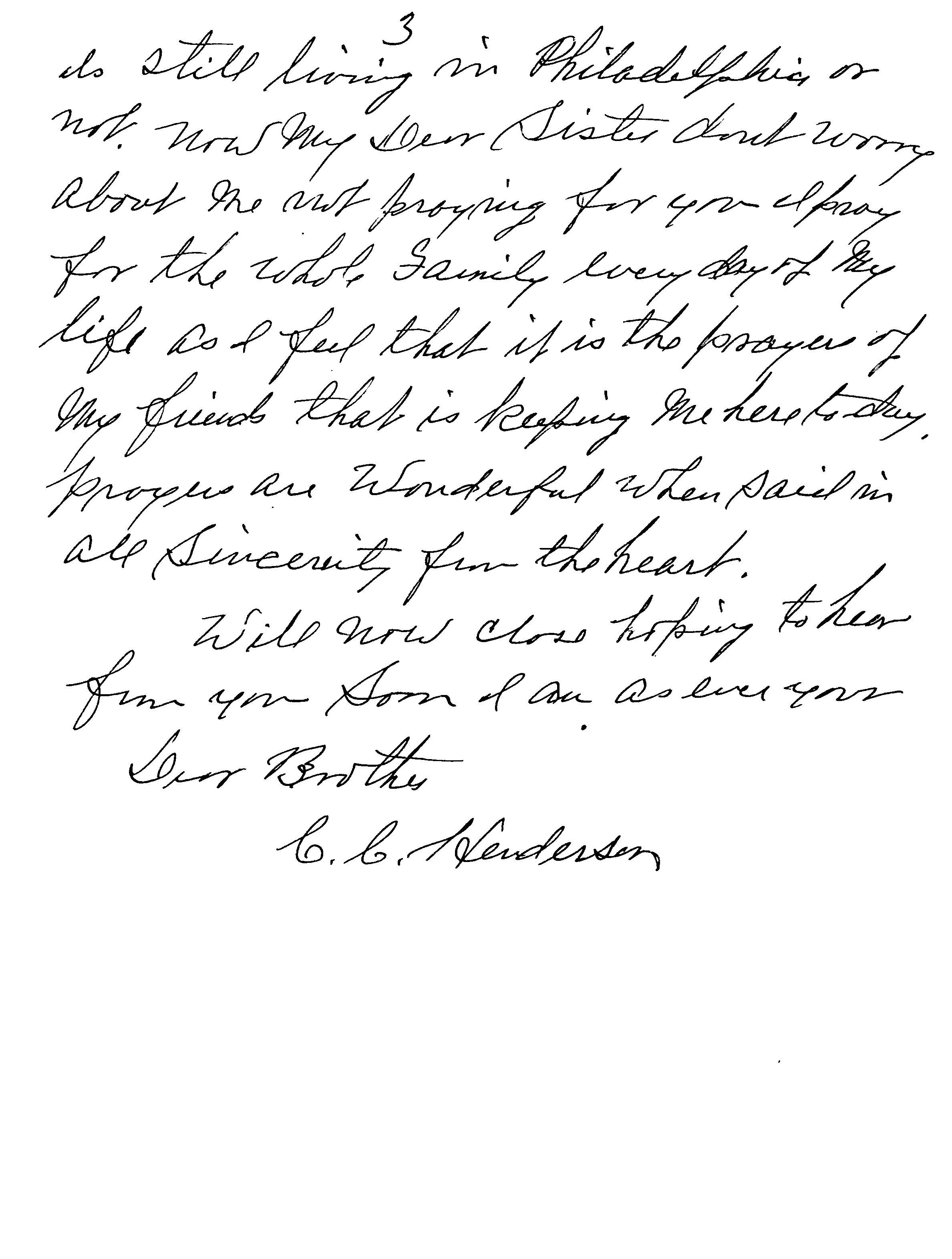
A few months after my grandmother passed away in January 2001, my father, mother, sister and I converged on her little rowhouse at 5549 Wyalusing Avenue, Philadelphia, to clean it out. In a drawer of a large steel desk in the basement, I found a packet of papers. In them, a letter I’d never known existed, from my great-great-grandmother Loudie‘s brother Caswell C. Henderson to their sister, Sarah H. Jacobs Silver, who reared my grandmother. ImageImageImage

Though he does not say so directly, Caswell seems to have been responding to the news of the death of Sarah’s husband in early July. She has asked him to come home, for a visit or perhaps permanently, but he cannot, pleading health and finances. He is hopeful, though, that soon they will be together to “help one another.” He expresses the importance of his family (if not his wife, who garners no mention) by sending greetings to his great-nieces and inquiring after Minnie Simmons Budd, daughter of his and Sarah’s deceased sister Ann Elizabeth Henderson Simmons. Of course, while “prayers are wonderful when said in all sincerity from the heart,” the prayers of his friends could not keep Caswell forever, and he died 16 January 1927.

Standard
Births Deaths Marriages, Oral History, Paternal Kin

When Grandma Mag died.

My grandmother was 5 years old when her great-grandmother Margaret B. Henderson died in 1915. This is what she recalled:

I remember when Grandma Mag died.  I don’t remember ‘em burying her.  But I was up to Nora’s house.  That’s how come I remember it.  Grandma Mag was living, well, she was in bed, she was sick.  I don’t remember her being up. Grandma Mag stayed down in Dudley. When she died, I was down there, and we went to Nora’s house.  And I used to ask myself, ‘Why is she in the bed all the time?’  

During Grandma Mag’s funeral, I stayed with Aunt Vicey and Nora and Beulah, the one that had the wen under her neck.  We called her A’nt Vicey, but she was my grandmama. I stayed up there with them, and I was scared to sleep in the bed by myself. So Nora told me, “Well, if you get in the back and I’ll get in the front.”  So she said, “Well, I’ll be in here right with you,” so I went on to sleep.  That’s who I slept with. 

So, I stayed up there in that house when Grandma Mag died.  I stayed up there.  And I slept in her room.  I remember that.  But I don’t remember … they didn’t let me go to the funeral, I don’t think. 

“Aunt Vicey” was Louvicey Artis Aldridge (1865-1927), her father’s mother. “Nora” and “Beulah” were Vicey’s daughters Lenora Aldridge Henderson (1902-1961) and Beulah Aldridge Carter (1893-1986).

Standard
Births Deaths Marriages, Free People of Color, North Carolina, Paternal Kin, Photographs

James Henderson’s children, part 1: the Skipps.

James Henderson had two sets of children. His first set bore the surname Skipp in childhood, when they were apprentices, and these facts suggest that James and their mother were not married. Son James Henry’s death certificate gives his mother’s name as Sallie Henderson. Was she instead Sallie Skipp?  Skipp is rare name in Onslow County, but a free man of color named William Skipp headed a household in 1820. Her father, perhaps?

The children of James Henderson and “Sallie Skipp”:

Lewis Henderson married Margaret Balkcum, a free woman of color from Sampson or Duplin County.  The family settled near Dudley, in southern Wayne County, and in 1870 Lewis and Mag became founding members of the Congregational Church.  By 1880, Lewis was growing corn, wheat and cotton on about 150 acres.  He and Mag had nine children, but descendants of only two, Ann Elizabeth and Loudie, remain today. Lewis died 12 July 1912.

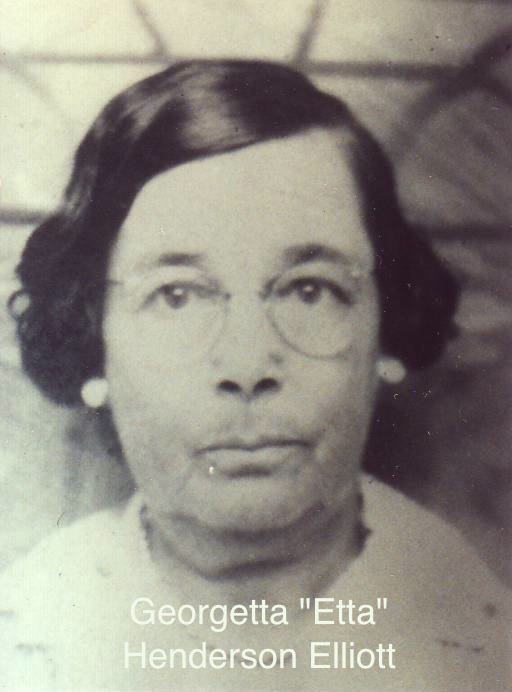
James Henry Henderson’s first child, Carrie Faison, was born about 1869 to Keziah Faison.  Soon after, James married Frances Sauls and settled in Wayne County as tenant farmers.  James and Frances’ children were Mary Ella Henderson (1867-??), Elizabeth Henderson (1869-??), Nancy Henderson (1873-??), Amelia Henderson Braswell (1877-1914), Elias L. Henderson (1880-1953), James Ira Henderson (1881-1946), Lewis Henderson (1885-1932), and Georgetta Henderson Elliott (1889-1972).  In 1900, James married Laura Roberts. Though James’ modern heirs descend from only a few of his children, Lewis, Georgetta “Etta,” and Elias, they comprise the largest sub-branch of the family. James died 21 June 1920 in Duplin County.

Mary E Henderson Text

Amelia Henderson 001 Text

Elias L Henderson Text

Georgetta Henderson 001 Text

Mary Henderson seems to have died in childhood.

Eliza Henderson moved to Sampson County with her rest of her family, but has not been found after the 1860 census.

Standard
Free People of Color, North Carolina, Paternal Kin, Religion

Church home, no. 1: First Congregational, Dudley NC.

“History of the First Congregational Church of Dudley, North Carolina, Given by Mr. General Washington Simmons, born December 22, 1856.”

In 1867, after Emancipation, came the first school for Dudley, taught four months by a white confederate soldier, John P. Casey, who was paid by the community families. The only textbook was the “blue-back speller.”

George Washington Simmons, father of General W. Simmons, corresponded with Mr. James O’Hara in Wilmington, Delaware, though whom the services of another white friend, Miss Jane Allen of Delaware, were secured for another two months’ session. She, too was paid by families.

From Oberlin College in 1868, came D.C. Granison, 23 or 24 years of age, the first Negro teacher, who remained for two years, residing in the home of George Washington Simmons. … His correspondence with the A.M.A. brought visitors in 1870, among whom were many to be remembered, especially Rev. D.D. Dodge, at that time pastor of the First Congregational Church in Wilmington, North Carolina. With his guidance our first Sunday School was organized. After several visits, he sent Rev. John Scott of Naugatuck, Connecticut, who began work in 1870. …

Just after Rev. Scott’s ordination, the First Congregational Church of Dudley was organized in what is known as the old “mission home.” … Charter members of the church were George Washington Simmons, James KingLevi Winn Sr., Levi Winn Jr., Henry Winn, George Winn, and members of their families. The first converts were Charity Faison and Sylvania Simmons. They were baptized in the “Yellow Marsh Pond” just north of the cemetery. …

Volume II [of the church records] summarizes the history from March 9, 1870. … The list of members, dating from 1870, is divided by male and female. It includes the names of Frank Cobb, William AldridgeBryant Simmons (Sr. and Jr.), John AldridgeLewis Henderson, Levi Wynn, Richard Brunt, Amos Bowden, Charles Boseman, M.A. Manuel, Solomon Jacobs, George Washington Simmons, …

From the souvenir bulletin of the 100th Anniversary, First Congregational Church United Church of Christ, 1870-1880.  Copy of bulletin in possession of Lisa Y. Henderson.

Standard
Free People of Color, North Carolina, Paternal Kin

The case for the Skipps as James Henderson’s children.

1. In the 1840 census of Onslow County, James Henderson is listed twice.  First, his household includes 1 male 24-26 [James]; 1 female 10-24 [Sallie Skipp?]; 2 males under 10 [Lewis and James]; and 1 female under 10 [Mary], all colored, and is listed between Bryant Koonce and William Mills.  Second, the household composition is the same, but is listed between William Boyett and Jesse King.

2. In the 1850 census of Upper Richlands township, Onslow County:  at household #32, Jim Henderson, 35, mulatto, mechanic, in the household of B.S. Koonce, farmer; at #34, Eliza Skipp, 7, mulatto, in the household of Jesse Alphin, farmer; at #60, Jim Dove, 14, and Mary Skipp, 10, mulatto, in the household of John Humphrey, farmer; at #65, Lewis Skipp, 16, laborer, and James Skipp, 10, both mulatto, in the household of Stephen Humphrey.

3. Neither James “Jim” Henderson nor the Skipp children appear in any Onslow County census thereafter.

4. In the 1860 census of Westbrooks township, Sampson County (about – miles from Upper Richlands): at #1033, Lewis Henderson, 25, turpentine laborer, with wife Margaret, 26, and children Lewis T., 4, James L., 3, and Isabella J., 4 months; at #1038, James Henderson, 52, carpenter, wife Eliza, 25, and children Anna J., 8, Susan, 6, Hepsie, 4, and Alex, 1; at #1039, Eliza Henderson, 18, in the household of John B. Sutton; at #1113, James Henderson, 22, farm laborer, in the household of Louis C. King. (Mary Skipp/Henderson has not been accounted for.) They are the only Hendersons in Westbrooks and were not in Sampson County in 1850.

5. In the 1870 census of Faisons, Duplin County: James Henderson “senior” is listed with his wife and children, including 27 year-old James. In Brogden, Wayne County: Lewis Henderson with his wife and children.

6. In the 1880 census of Brogden, Wayne County, James is listed with his wife and daughters. Lewis and his family were also in Brogden township. James senior remained in Faison.

7. Lewis Henderson had sons Lewis and James and a daughter Mary. James H. Henderson had sons Lewis and Elias Lewis and a daughter Mary.

8. James Henderson died in Faison, Duplin County, on 21 June 1920, aged about 80. His death certificate listed his birthplace as Onslow County and his parents as James Henderson and Sallie Henderson.

9. My grandmother, a great-granddaughter of Lewis, recognized Elias L. Henderson as a cousin. She recognized as aunts the daughters of James Henderson by his second wife. (They were actually her grandmother’s aunts, though they were contemporaries.) She also recognized as cousins the son and daughter of James’ son John Henderson.

——

In other words: in 1850, four children of ages to be siblings appeared in Onslow in proximity to a man believed to be their father. One of the children, Lewis, was born approximately the same year as Lewis Henderson. Ten years later, three of the four children, now bearing their father’s surname, appeared in proximity to him in Sampson County. (Surname shifts, especially among the children of unmarried parents, were not uncommon in free families of color.) The sons, Lewis and James, named sons after one another and settled sequentially in Brogden township, Wayne County.  Most of their half-siblings also migrated to Brogden, and their descendants maintained close family ties into the early 20th century. When James “junior” died, his death certificate acknowledged his birth in Onslow County and named James Henderson as his father.

Standard
Free People of Color, North Carolina, Oral History, Paternal Kin

Lewis & Mag’s children, part 1: sons.

Lewis and Margaret Balkcum Henderson had nine or so children in Sampson County before shifting a few miles north into Wayne County, where they settled with other free-issue families near a tiny crossroads town called Dudley.  Before the Civil War, Margaret bore Lewis T. (1856), James Lucian (1858), Isabella J. (1860), Ann Elizabeth (1862), and Caswell C. (1864), and after, Mary Susan (1868), Carrie (1870), Sarah Daisy (1872), and Loudie (1874).

Of Lewis T., Isabella and Mary Susan, there is not enough known to talk about; they died as children.  But Lucian was my grandmother’s favorite great-uncle; the only one of Lewis and Mag’s children to stay in Dudley and farm.  He and his wife Susie (born a McCullin) had only one child, a daughter Cora Q., who died early and is remembered only by her headstone in the cemetery of the Congregational Church.  (I am endlessly fascinated by the Q.  What could it possibly have stood for?) Lucian so impressed my grandmother that she named her firstborn son after him. He is gone, but my cousins Lucian Jr., the III and the IV, remain.

My grandmother said:

Uncle Lucian, now he look more like an Indian to me than anybody.  Didn’t have too much hair, but what he had was straight and was that brownish color like it was fair.  We’d come down there and stay with them.  Get off the train and run all the way down there to their house.  That wont nothing.  And they had two beds in that front room.  One on one side and one on the other’n, and they slept on that one side, and me and Mamie slept in the other’n.  In the same room.  ‘Cause it wasn’t no door to it, and the fireplace was in the front room.  I don’t think they ever had a lamp or no light.  We’d go to bed with the chickens and get up with the chickens.  ‘Cause time it’s day, Uncle Lucian was up.  A’nt Susie couldn’t cook.  Because she couldn’t be over the stove, she’d fall out if she was over the stove.  She never left the house that I know of.  ‘Cause she had this thing, that, her head shook all the time.  I said to Mama Sarah, I said, “That thing’s gon shake her head off.”  I told Mama, “She’s gon shake her head off.”  She said, “It was a palsy, that’s how come.”  So Uncle Lucian always got up and cooked breakfast.  And, Lord, I used to love to go down there.  We would get up early mornings, and Uncle Lucian would cook breakfast and, honey, that old ham where he cooked you could smell a mile!  Honey, you could smell that ham before you even got there.  It was on the highway, and we didn’t go all the way ‘round the bend and come up the road.  We’d come down over the fence and come down the cornrow and come up to the house.  And he’d make rice, and it would be that ham gravy.  And the biscuits, they looked like they’s hamburg muffins, the biscuits was so big.  And you talking ‘bout good.   Ooo, you’d be ‘bout to have a fit, it smelled so good. Cooking ham and rice, and had to have ham gravy, just pour water in there from frying.  Great big old milk biscuits.  You eat one of them — you couldn’t even eat a whole one, ’cause they was so big.  And cooked on a little old bitty tin stove, a four-cap stove — the burner wont no more than bigger than that — where you had to put two, three pieces of wood in the stove, and the pipe run right straight up in the house.  Yeah, I thought that was some good days and some good food.  Look like to me, I thought it was the best.  We had good food at home, but seem like down there, it just taste better.  We didn’t have no ham everyday like they had down there, and by him having and curing it, the way they cured ham, his was different from what we had.  Like with that pepper and salt and stuff and seasoning outdoors.  And every one they’d kill, he’d get the hog and cook ‘em and hang ‘em in his packhouse. 

But every great-uncle was not as favored as Lucian.  There was also Caswell, from whom my father gained his middle name, but about whom my grandmother was ambivalent.  Caswell was in New York City by 1890, where he was a white man on his job with the Customs House, but moved among colored folks at home in the Tenderloin and later in Harlem and the Bronx:

Uncle Caswell come to Wilson visiting Mama Sarah.  He didn’t never bring his wife down there ‘cause he was passing for white, and she was kind of brown-complexioned.  But he’d leave our house, and he would go and get a paper every morning down there to Cherry Hotel.  Walk down there for the exercise and get that paper.  He’d go in the hotel there and ask for a paper and talk to the people, and they all said, “Who is this white man?”  And then he’d come all the way back a different way, then walk back down Green Street and come on home, so they wouldn’t know he was crossing the tracks.   And so he wanted Mamie, he didn’t want me, he wanted Mamie to come stay with him and his wife.  And he was gon send her to school and take care of her.  He’d buy all her clothes and everything.  But me, he ain’t said nothing ‘bout me.  But Mama said, “Naw, you can’t. I don’t want her to go to New York.  ‘Cause she don’t know nothing ‘bout New York, and, too, that would leave Hattie down here by herself.”  She said, “They’s gon stay, she gon stay with me ‘cause I promised Bessie that I’d take care of them as long as I lived.  I promised Bessie I’d keep ‘em together.  But if you want to give her something, or help me out with her, buy ‘em clothes or something like that, you can.”  So I didn’t like that. He ain’t said nothing ‘bout me.  But then they said I liked to read, and so he saved the papers where he was taking, and he would send ‘em in the mail to me.  But he sent Mamie candy.  And I told him I wont no goat!  Uncle Caswell didn’t like me.  And I started to tell him he was down there trying to be cute, playing, wanting folks to think he was white.  Passing for white.  Well, he could pass for white.  Least that’s what he was doing up in New York.  ‘Cause he was working at the roundhouse, had a good job.

——

Interview of Hattie H. Ricks by Lisa Y. Henderson; all rights reserved.

Standard