Maternal Kin, Newspaper Articles, North Carolina

Nicholson reunion.

These were Harriet Nicholson Hart‘s people, though I can guarantee you she was not there:

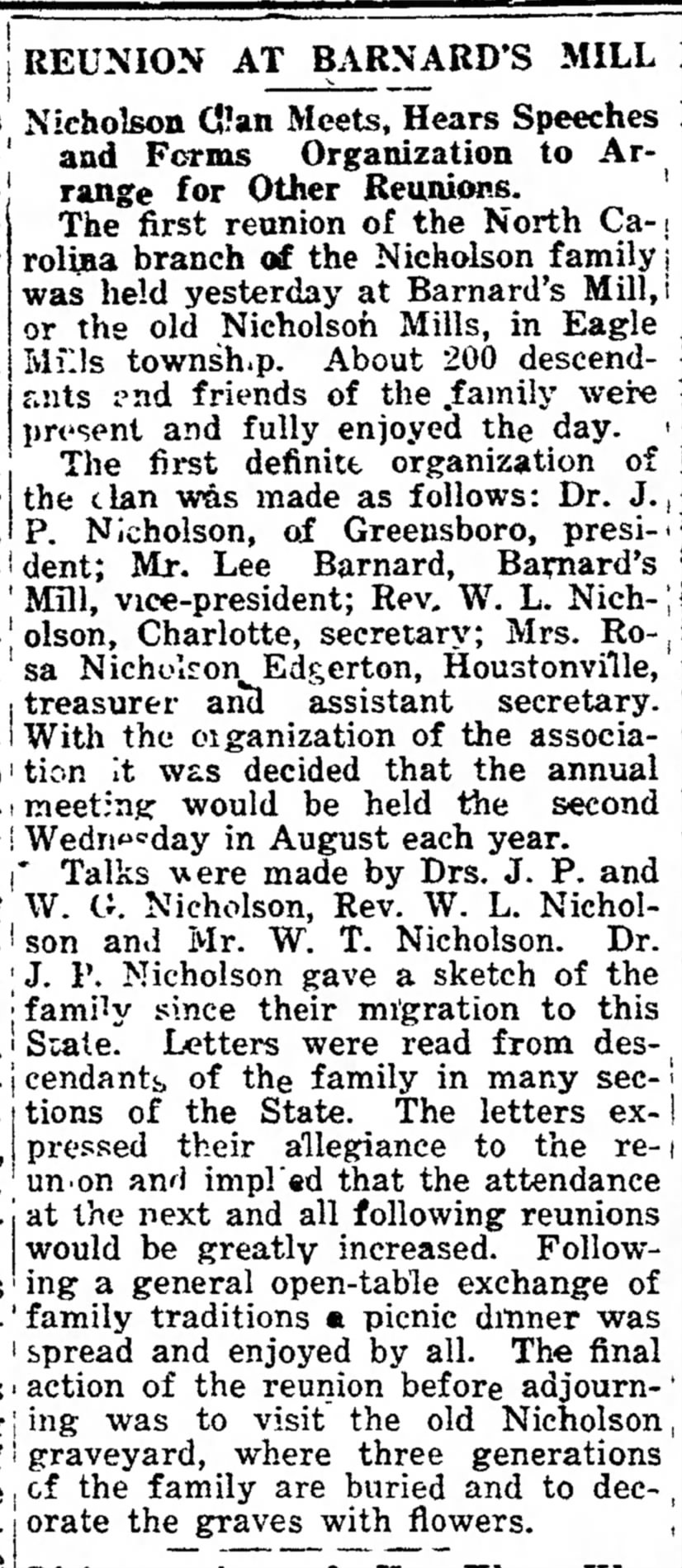
Nich Reunion 1 8 17 22

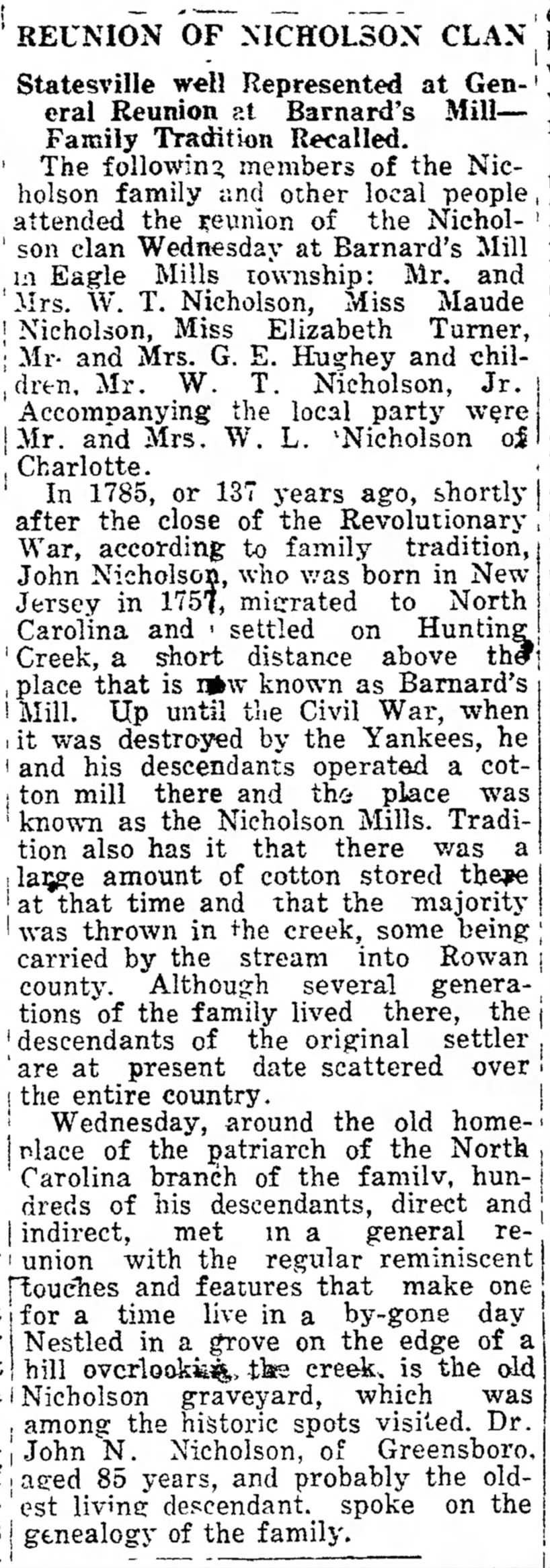
nich reunion 2 8 17 22

Statesville Landmark, 17 August 1922.

Nich Reunion 8 9 1923

Statesville Landmark, 9 August 1923.

Nich Reunion 8 12 1926

Statesville Landmark, 12 August 1926.

The North Carolina branch of the Nicholson Family descended from Revolutionary War veteran John Stockton Nicholson, born 1757 in Princeton, New Jersey, and his wives, Mary McComb Nicholson (1760- 1783) and Catherine Anne “Caty” Stevenson Nicholson (1766-1843).  The Nicholsons and Stevensons arrived in America from England in the mid-17th century.  The McCombs were perhaps Irish.  John and Mary had one child, James Nicholson (1783-1850). John and Caty had a passel: John Stockton Nicholson Jr. (1787-1868), Mary Nicholson Walker (1788-??), Elizabeth Nicholson Beeson (1790-??), Rebecca Nicholson Clampett (1793-1880), George Nicholson (1796-1802), Moses Pinckney Nicholson (1799-1844), Anderson Nicholson (1801-1879), Catherine Nicholson Clampitt (1804-1841), Phoebe Nicholson Barron (1806-1882), and Hannah Nicholson Idol (1811-1877).

Harriet was descended from both of John S. Nicholson’s wives. Mary’s son James married Mary Allison (1792-1857), daughter of Theophilus and Elizabeth Knox Allison, in 1815. They had two children, Thomas Allison Nicholson (1816-1886) and John McComb Nicholson (1820-??). Thomas married his first cousin, Rebecca Clampett Nicholson (1817-1903), daughter of Caty’s son John S. Nicholson Jr. and Mary Fultz.  Thomas and Rebecca’s children were: James Lee Nicholson (1841-1871), John Wesley Nicholson (1843-1913), Mary Jane Nicholson Smith (1846-1922), George Watson Nicholson (1848-1913) and Rebecca Ann (or Annie Rebecca) Nicholson Barnard (1860-1925). As detailed here, J. Lee Nicholson was Harriet’s father.

Nearly all of the reunion attendees mentioned by namein these articles were descended from Thomas A. Nicholson’s children Lee, George and Annie. Rev. W.L. and W.T. Nicholson, for example, were Lee’s sons, and the Barnards were Annie’s children and grandchildren. Dr. J.P. Nicholson, however, was Rebecca C. Nicholson Nicholson’s brother and Dr. W.G. Nicholson, her nephew. I’m not sure who the octogenarian John N. Nicholson was.

Standard
Enslaved People, Maternal Kin, North Carolina

Where did they go?, no. 1: Nicholson.

In 1850, James Nicholson of northern Iredell County dictated a will that distributed 17 enslaved people – Milas, Dinah, Jack, Liza, Peter, Elix, Paris, Daniel, Carlos, Nelson, Lucinda, Joe, Manoe, Armstrong, Manless, Calvin and Sophie — among his heirs. I am descended from one, Lucinda, whose daughter Harriet was conceived after she joined Thomas A. Nicholson’s household. As I wrote here, Lucinda is found post-slavery only on death certificates of two of her children.  What of the other 16? Are they any easier to trace?

In a word – no.

Mary Allison Nicholson received five slaves from her husband’s estate.  Son Thomas received three outright and a share in five others. Son John McCombs Nicholson received four and a share in the same five. (It is not at all clear whether the groupings of these 17 people respected family units or were simply combinations devised with an eye for equal value.) Mary died in 1857 and, presumably, her property passed to her sons. However, in the 1860 slave schedule of Iredell County, only two Nicholson slaveholders appear: Thomas, who owned 13, and Martin T. Nicholson, who owned three. (Martin was Thomas’ brother-in-law and first cousin.)  In the population schedule, Thomas reported owning $11,000 worth of personal property, a figure that would have included the value of his slaves. His brother John reported only $565. Had he sold his?

And the bigger question, where did Thomas’ slaves go after Emancipation?  Freedmen did not always adopt the surnames of their immediate masters, of course, but in the 1870 census of Iredell County, only four black residents claimed the surname Nicholson. Eliza Nicholson, age 25, lived in the household of Thomas Nicholson’s son Wes. She presumably is the Liza of James’ estate.  Manless Nicholson, 22, his wife (?) Maggie Nicholson, 24, and daughter Annie, 5, lived in Thomas’ household and worked for him. Manless had been jointly owned by Thomas and his brother. In Yadkin, the adjoining county, 35 year-old Alaxander Nicholson (probably the “Elix” above) is listed in the household of Isabel Cartwright. But that is it.  No more.

Obviously, some people were simply inadvertently omitted from the 1870 schedule, such as Lucinda and her daughter Harriet, who were clearly living in Iredell then, and Milas Nicholson, who appears ten years later in Turnersburg township, Iredell County, as a 33 year-old with a wife and child. Also, the 1880 census of Deep Creek, Yadkin County, shows an 80 year-old Sophia Nicholson who may have been “Soffie.” (And was probably Manlius “Manless” Nicholson’s mother, as a Yadkin County marriage license and his death certificate indicate.)  Of Dinah, Daniel, Nelson, Armstrong and the others, however, there is no trace, either in surrounding counties or under a different surname.

Standard
Maternal Kin, North Carolina, Oral History

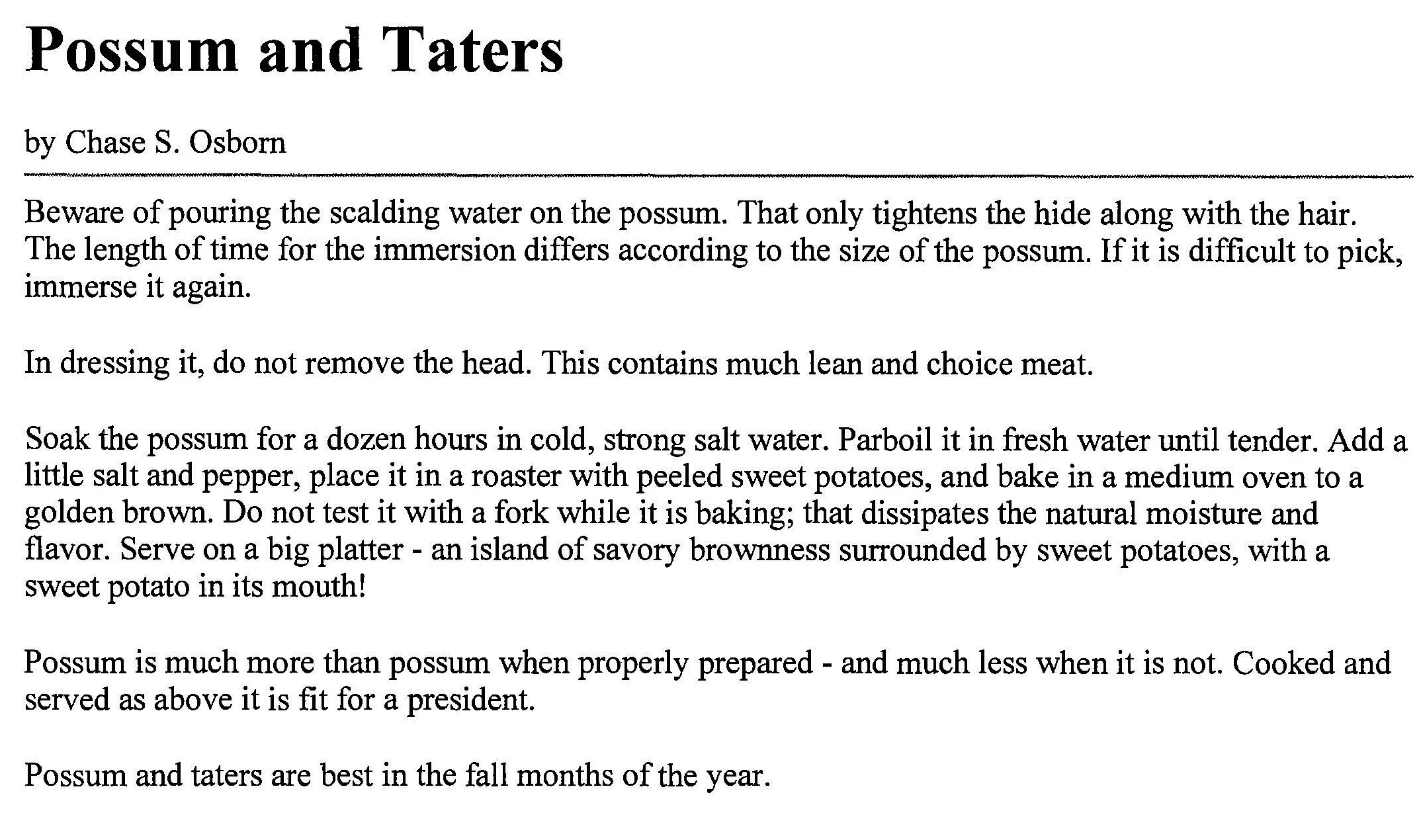
Possums and sweet potatoes.

My grandmother:  His mother used to cook possum. 

Me:  Used to cook possum?

My grandmother:  Oh, possum, honey.  They would cook those dern things.

Me:  Well, possum stew.  I guess I have heard of that.

My grandmother:  Naw.  They didn’t have no possum stew.  They’d bake this thing.

Me:  Awwww!

My grandmother:  And, look, wait a minute.  You know they’ve got big mouths.  Long mouths.  A possum.  And he’d put a sweet potato in the possum’s mouth.  [I laugh, hard.]  I don’t remember cooking one, but my grandmother sure used to cook ‘em.  And Papa cooked ‘em.  But I refused to cook ‘em.  Not me.  And you know these people when I came here ate muskrats?!

Possum_and_taters-1

It was Harriet Nicholson Hart who fixed such special dishes for her favorite son.

Interview of Margaret C. Allen by Lisa Y. Henderson; all rights reserved.

Standard
Maternal Kin, North Carolina

The Lost Ones, no. 1.

  • Lena Tomlin and siblings. Harriet Nicholson reported to the census taker in 1910 that only three of her nine children were living. Those three were Lon W. Colvert, H. Golar Tomlin and Bertha Hart. The six deceased children were most likely all Tomlins (though it is possible that Harriet gave birth to another Colvert child in 1874.) Census records reveal the name of one, Milas Tomlin, who was born circa 1877. Newspaper articles from 1896 disclose a daughter, Lena Tomlin. And that’s it. My grandmother’s sister Launie Mae told me that several of Harriet and Abner Tomlin’s children drowned. It is good an explanation as any.
  • Lovenia Colvert and Elvira Colvert Morgan. Walker Colvert and Rebecca Parks’ cohabitation registration listed three children – John, Elvira and Lovenia. I have never found another reference to Lovenia Colvert. (Was she a relative who went west?) Her sister Elvira, however, left a slight record.  Though she does not appear in her parents’ household in the 1870 census, in 1874, when she was about 14, Elvira married Richard Morgan, son of Richard Madison and Hilda Morgan. In the 1880 census, Richard and Viree Morgan are listed in Eagle Mills, Iredell County, sharing a household with 20 year-old Squire Gray. By 1900, the Morgans (and Squire Gray, separately) were living in Asheville at 281 S. Main Street. Richard worked as a saloon servant, and Elvira reported that she’d had no children. This is the last record I have found for her.
Standard
Maternal Kin, North Carolina, Oral History

She would always bring him something.

My grandmother: My grandmother used to always bring him something down, she’d come down sometimes Sunday afternoon or Saturday night.

My aunt: Grandma Allen?

My grandmother: No, no, no, no, no. My daddy.

Me: Harriet.

My grandmother: She would always bring him something. In the springtime, when there’d be strawberries and rhubarb, she used to make strawberry pie with rhubarb in ’em. And she would make three or four and stack ’em like that. And cut all the way down. And she would always bring that to Papa.

Margaret C. Allen on this family’s stack pie legacy.

——

Interview of Margaret C. Allen by Lisa Y. Henderson; all rights reserved.

Standard
Births Deaths Marriages, Enslaved People, Maternal Kin, North Carolina, Oral History, Other Documents

Lucinda Cowles, also known as Lucinda Nicholson.

I give and bequeath to my beloved son Thomas A. the following Negroes to wit Carlos Nelson Lucinda and Joe.

——

On 19 Nov 1850, James Nicholson wrote out his last will and testament. Two days later, before he could sign it, he slipped into death.  The document was registered 19 Jun 1852 in Will Book 4, page 666 at the Iredell County Register of Deeds Office. Nicholson’s only heirs were his widow Mary Allison Nicholson and sons Thomas A. and John M. Nicholson.  James left Thomas 185 acres and John 242 acres and gave them a 75-acre mill tract in common.  Mary Nicholson received slaves Milas, Dinah, Jack, Liza and Peter; John received slaves Elix, Paris and Daniel; and Thomas received the four named above.  In addition, James bequeathed Thomas and John slaves Manoe, Armstrong, Manless, Calvin and Soffie jointly.

Thomas A. Nicholson put Lucinda to work in his home preparing meals and otherwise caring for his family. As Thomas’ son James Lee Nicholson grew to adulthood, he took increasing notice of the woman who cooked his suppers, laundered his shirts and emptied his slops. In 1861, she gave birth to his first child, a daughter that she named Harriet Nicholson. Lucinda and Harriet remained in Thomas Nicholson’s household till Emancipation, when they were provided with a small house and other support.

As the story goes, Harriet did not learn her father’s identity until her mother Lucinda revealed it on her deathbed. Lee Nicholson passed away when Harriet was 10 years old, leaving a widow and two small boys. Lucinda may have died even earlier, as she has not been found in the 1870 census. She had one other child, a son named William H. Nicholson, whose father was Burwell Carson. Based on information supplied by Harriet, William’s death certificate lists Lucinda’s maiden name as Cowles. We know nothing else about her life.

Standard
Births Deaths Marriages, Maternal Kin, North Carolina, Oral History

William. And William.

Me: There was something I was going to ask you …. Now, I knew — I found out that she had a brother. Named William.

My grandmother: Who?

Me: Nicholson. Ommm, Harriet.

My grandmother: He was a white man, honey.

Me: Her real brother.

Grandmother: It was her half-brother. He was a white man that owned the undertaking business.

——

Harriet Nicholson Tomlin Hart had two brothers named William. One black, one white.

The first, with whom she shared a mother, was William H. Nicholson, born Christmas Day 1842. After her husband Abner’s death, Harriet and her youngest son Golar went to live with him in Charlotte, North Carolina, about 35 miles south of Statesville. In 1900, the censustaker recorded the family at 611 E. Stonewall. William worked as a plasterer, and Harriet is designated as his sister. She acted as informant on his death certificate, filed a few days after he died 17 December 1909, naming his parents as Burwell Carson and Lucinda Cowles. I have found no other references to his life.

The other brother, with whom she shared a father, was William Thomas Leonadas Nicholson, one of two sons of James Lee Nicholson and Martha “Mattie” Colvert Nicholson. (The other was John Walter Lee Nicholson.) William was a boy of 7 when Lee Nicholson died in 1871, and he was reared with his mother’s family in northern Iredell County. (She was the daughter of William I. Colvert, former owner of Walker and John W. Colvert. The latter fathered Harriet Nicholson’s oldest child.) In 1878, the Nicholson family “began to make and sell caskets at the general store they operated [in] northern Iredell County. As was common in the late 1800s, many undertakers were also furniture makers, and the Nicholsons continued to sell caskets and conduct funerals in their furniture store when they moved to Statesville. At the time, a casket’s price was based on the wood used and its size—probably between $25 and $35 for an adult casket. W.T. Nicholson moved the funeral home into its current location in 1920, and he remained its owner until his death in 1951.” William T. Nicholson handled preparations for his sister’s burial — whether he acknowledged her or not — as well as John W. Colvert. Nicholson Funeral Home, at 135 East Front Street, Statesville, remains in operation.

Standard
Births Deaths Marriages, Maternal Kin, Newspaper Articles, North Carolina, Other Documents

A colored man of rare powers of mind.

Harriet pursued him, my grandmother said. Relentlessly. Followed him to Ohio to make her case for marriage. Certainly, that she, a widow in her early 40s, found (or allowed herself to become) pregnant suggests an impetus for her plans. Still, Thomas Alonzo “T.L.” Hart was not easily swayed. Their only child Bertha Mae was born in 1902 and not until December 1904 did he apply for a marriage license at the Iredell County Courthouse.

Alonzo was born about 1866 to Ephraim and Caroline Hart. Little is known about the years before he married Harriet Nicholson Tomlin. My grandmother asserted that he was a non-practicing lawyer, but no record has been found of his education or training.  In the late 1890s, he moved briefly to Ohio; a visit home was nearly disastrous:

——

Alonzo Hart, colored, who formerly lived here but has recently been in residence in Toledo, Ohio, was arrested yesterday on a warrant sworn out by Mr. O.P. Sowers, the latter charging him with having his purse and $90 in cash which he lost on Monday, December 26th.  Hart deposited $100 in cash with Justice White for his appearance at the trial which is set for to-morrow.  The defendant is represented by Mr. H.P. Owen and the plaintiff by Mr. L.C. Caldwell.  Mr. Sowers is positive that he lost his purse on the sidewalk in front of the Cooper block on Center Street.  It is said that Hart was present at the time and as he has been pretty flush with cash since then he is suspected of having picked it up.  — Statesville Landmark, 6 Jan 1899.

——

But:

At Alonzo Hart’s trial for theft, the witness testified that Hart was not the man, “and as there was no other evidence against him, [Hart] was discharged, Mr. Sowers paying the costs.” — Statesville Landmark, 11 Jan 1899.

Despite his ignominious arrest, Hart remained in Iredell County, farming in Shiloh township while his sister Etta kept house. A couple of years after marrying Harriet, he again made the local newspaper:

Alonzo Hart, colored, was severely injured Sunday night by Will Stevenson, colored, in a fight in the Poplar Branch neighborhood.  Hart received several severe cuts about the body and one on the neck.  The cause of the trouble is unknown.  A warrant for Stevenson is in the hands of the police. — Statesville Landmark, 18 Sep 1906.

——

Fifteen years later, Hart helped prevent a lynching by negotiating the surrender of a black man wanted for killing a white man:

BOB BENSON SURRENDERS.

“Slayer of Robert Dishman Surrenders to Alonzo Hart, Colored, and Sends for the Sheriff — Others Capture Benson Before the Sheriff Arrives on the Scene and Take Him to Lincolnton — Now in the Mecklenburg Jail”

Working on clues set forth by Alonzo Hart, colored, Bob Benson was captured late yesterday evening by Messrs George Ayers, Fred Claywell, Pam Morrow, Vance Jenkins and Everett Wilkinson.

Lacking only a few hours of being a fugitive from justice a week, Bob Benson, who assaulted and killed Robert Dishman is today resting behind bars in the Mecklenburg county jail, where was taken to escape possible violence.  Thus ended one of the most thrilling searches for a criminal in the history of the county.

Friday during the search on Third creek, near Morrison’s store, Alonzo Hart came to Sheriff Alexander and asked the sheriff if he should find Benson and turn him over to the sheriff would there be any violence.  Upon receiving the sheriff’s promise that he would keep Benson from violence and see that he received justice, Hart said he would do all in his power to get in touch with Benson and have him give him up to the sheriff.

Early Sunday morning between 6 and 7 o’clock Benson came to the home of Hart, which is south of Hoyt Morrison’s store, wearing only a shirt and an old sack tied around his loins, and begged Hart for something to eat and a chance to rest.  According to Hart, Benson said he had been lying in a thicket near Third creek during the search Friday night and Saturday, and had more than one time heard searching parties passing near him so close that he could plainly understand their conversation.

Throughout the day, Sunday, Hart persuaded Benson that it was best for him to give up to the officers, which Benson agreed to do provided he was turned over to the officers, who would take care of him.  About 5 o’clock yesterday afternoon Hart came to town after the sheriff and was seen by some of the party who captured Benson, who surmised Hart was in town on business concerning Benson, and went immediately to Hart’s home, where they captured Benson in one of the rooms of the house.

Benson was carried by his captors to the Lincoln county jail last night.  Early this morning Sheriff Alexander had Benson moved to the Mecklenburg County jail at Charlotte, so as to be doubly sure of his safety.

It was just one week ago yesterday evening, about 8 o’clock, on the Chipley Ford road, six miles north of Statesville, that Bob Benson, a negro, dealt Robert Dishman, white, a blow, or blows, on his head with a stick or other weapon, that resulted in Dishman’s death about 30 hours later at the Carpenter-Davis hospital.  It was a week ago today that the searchers for Benson assumed the proportion of a posse.  A few officers and others had begun the search soon after the killing.

Probably the search for a criminal in no other case in Iredell county has attracted more interest than has been evidenced in the Benson case.  Reports which came to the officers and the posse kept this interest alive.

After the crime he is alleged to have committed Benson lost himself in the neighborhood of his home and in the neighborhood of his victim for the first night of his get-away.  The earlier hours of the day following the crime brought some reports of his having been seen.  Late the same afternoon came the report that up to that time had had the semblance of assurance — someone had seen him making his way from woods to woods in the country around the pump station.  It was then that the crowd assumed the proportion of a posse and it was on this clue that the bloodhounds were introduced and initiated.  They struck a trail and followed it to the right house but the wrong person.  The search continued that night, dissipating other reports of Benson’s whereabouts.  The same program was gone over day after day and night after night.

The all night man hunt was without reward Thursday.  Benson had not been seen since he was shot at about 4:30 o’clock that afternoon, near the home of Mr. D.L. Raymer.

The bloodhounds were brought from Salisbury about 7 o’clock that night and were placed where Benson was last seen, but did not hit a trail durng the night.  — Statesville Landmark, 26 Sep 1921.

——

THE BOB BENSON REWARD.

Attorney Z.V. Long Will Share Burden of a Decision in This Matter to Iredell Superior Court.

No decision yet has been reached in paying the reward of $300 [illegible] by the County and $200 by the [illegible] for the apprehension of Bob Benson, colored, who killed Robert Dishman and who has been convicted and sentenced to electrocution.

Two claims are offered for the reward, one by Alonzo Hart, colored, whose home Benson went and [illegible] until a number of white men went and got him and took him to the Lincolnton jail, while Hart was in town looking for Sheriff Alexander to report Benson’s presence at his house.

The matter of determining proper disposition of the reward was left to County Attorney Z.V. Long.  Since it has become apparent that an amicable settlement can not be made this way, the matter will be left to Iredell Superior court to say how and to whom the reward shall be paid.  — Statesville Landmark, 5 December 1921.

——

Harriet Nicholson Tomlin Hart died in 1924. When Alonzo Hart’s sister died four years later, the Landmark breathlessly reported every detail of the disposition of her sizeable estate, worth about $81,000 in 2013 dollars.

Margaret Richardson Leaves Will Disposing of $6,000 Estate

The will of the late Margaret Richardson, colored, which has been filed with the Clerk of Superior Court John L. Milholland for probate, provides for the distribution of the estate, estimated to have a value of $6,000, as follows:

The farm, one mile north of Statesville, is given to a sister, Lula Loyd; two acres laid off the northern end of the farm, adjoining the lands of J.C. Duke, and the city pump station, to Gilmer Walker; all the rest of the land and personal property to be sold and the cash distributed as follows: $10 to Mollie Alexander of Wilkes County; $10 each to Florence Camp and Minnie Brawley, both of Toledo, Ohio; $100 to Alonzo Hart of Iredell county; $25 to Zion Methodist church, colored, on South Center street; $25 to Broad Street Presbyterian church, colored; $25 to John Adkins, of Winston-Salem; $300 to Lula Loyd; $100 to Preston Smith of Virginia; $200 to Alonzo Loyd and the rest of the property to be divided equally among Lula Loyd, Bertha May Hart, Mollie Alexander, Florence Camp, Minnie Brawley, Earl Smith, and Rebecca Bailey.  Mr. John A. Scott, Jr., is designated as executor of the will. — Statesville Landmark, 19 Mar 1928.

——

At the end of the following year, Thomas Alonzo Hart succumbed to tuberculosis at a Hoke County sanatorium. His final appearance in the Landmark was a respectful and laudatory one:

FUNERAL SERVICE FOR ALONZO HART.

Will Be Held Sunday Afternoon from Centre Presbyterian Church — Was Respected Colored Citizen

Funeral services for Alonzo Hart, 63, well known colored man, whose death occurred Tuesday at State Sanatorium, where he had been a patient for a short time, will be held from Center presbyterian church Sunday, December 22, at 2:30 o’clock in the afternoon.  Interment will follow in the cemetery there.  The surviving members of the family are one daughter, two step-sons and four sisters.

Alonzo Hart, by his extraordinary habits of frugality and industry, had accumulated a considerable estate.  Although living in an age of speedy travel, he held on to an older and slower method of transportation, his regular visits to town having been made in his buggy, drawn by his faithful, dependable mule.  He was a colored man of rare powers of mind, having a valuable library and keeping fully informed on the events of the day by reading newspapers and periodicals.  A unique Iredell citizen has passed to his reward. — Statesville Landmark, 19 Dec 1929.

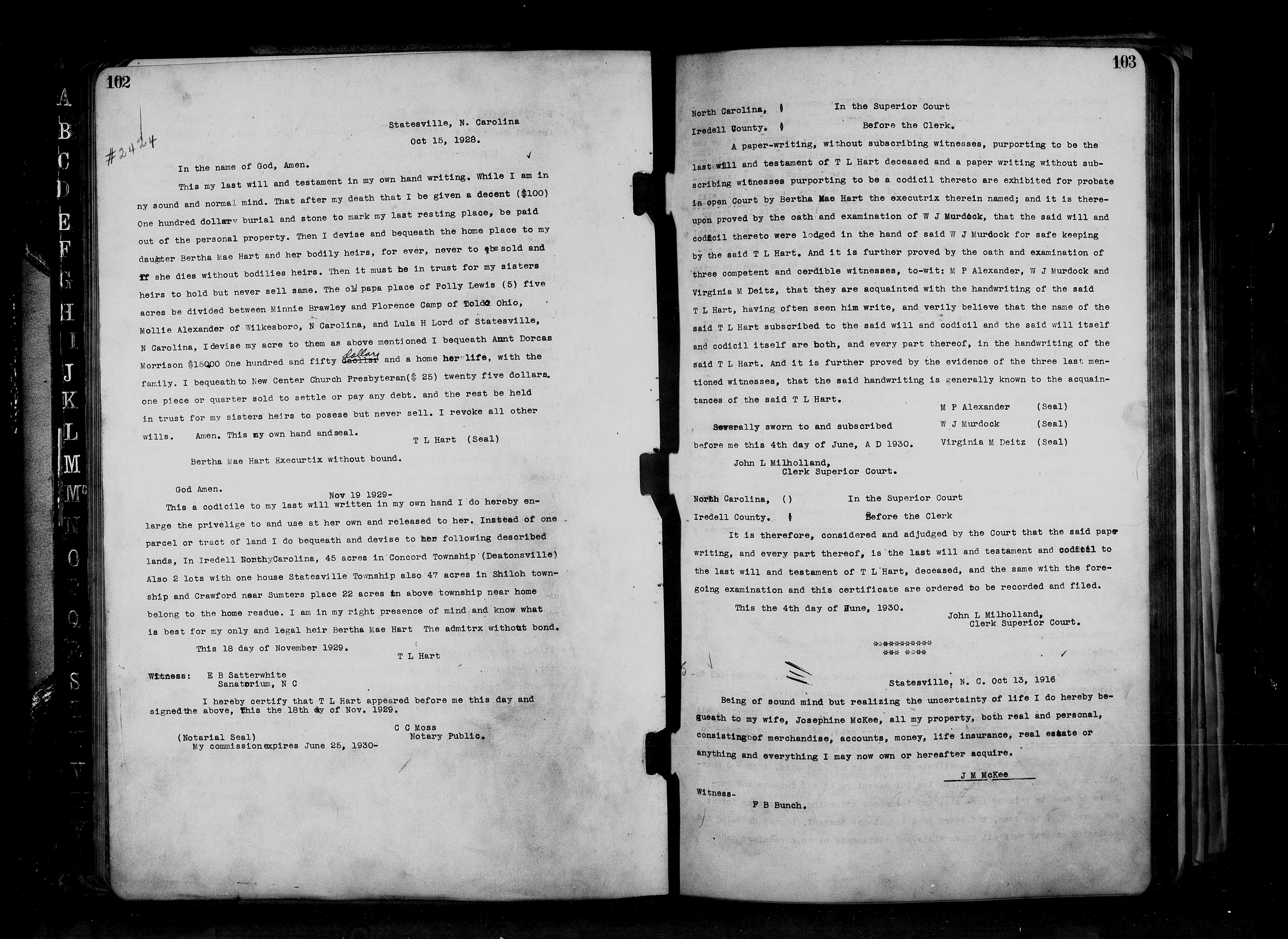
His will confirms Hart’s prosperity and reveals as well his deep ties to his family:
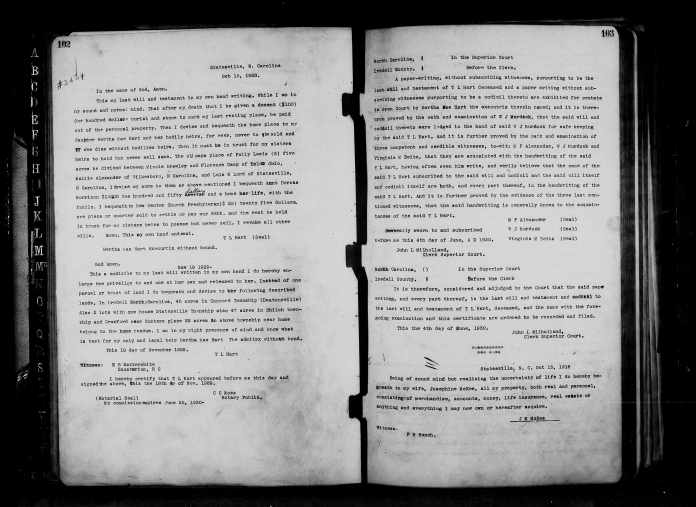
TL Hart Will

Standard
Births Deaths Marriages, Maternal Kin, Newspaper Articles, North Carolina

Witnesses to a homicide.

Harriet Nicholson, then about 16, married Abner Tomlin on November 20, 1877, in Iredell County. Their marriage license lists “L. Nicholson” as Harriet’s mother and leaves blank the space for a father’s name. Harriet’s son Lon Colvert was two years old and remained with his father’s grandparents.

The couple settled in Olin township, likely near Abner’s family. Harriet may have been pregnant when she married; their son Milas (named after Ab’s father) was born about 1877. In subsequent census records, Harriet reported having given birth to as many as nine children by Abner, but my grandmother knew only one, Harvey Golar Tomlin, born about 1891. However, at least one other child, Lena, lived to young adulthood, as the newspaper article below attests:

——

HOMICIDE FRIDAY NIGHT.  Jess Shaw, Colored, Shot and Killed in Wallacetown — Bob Owens Charged With Murder — Conflicting Testimony

Jess Shaw, a colored man probably about 19 years old, was shot and killed between 10 and 11 o’clock Friday night in Wallacetown, a colored suburb on the A., T. & O. Railroad, just south of the Statesville depot.  Bob Owens, a young colored man is charged with the killing and was held by the coroner’s jury.

The shooting took place near the house of Emma Rhinehardt.  According to the testimony Shaw had borrowed a guitar from Grace Belk, colored.  She told him he could pick it but not carry it away.  He did carry it away and when the woman saw him, shortly before the killing, she cursed him about the guitar and advanced on him with a knife.  Jess stooped down to pick up a rock, or did pick up one, and just then he was shot.  Three shots were fired, but only one took effect.  It is known that Bob Owens, Grace Belk, Maggie Morrison, Dovey Gray and Emma Rhinehardt were present when the shooting occurred.  Jess ran up the railroad when shot, a distance of 100 or 150 yards, and calling to Ab. Tomlin’s wife told her he had been shot and that Bob Owens had shot him.  Tomlin and his daughter Lena went to him and carried him to their house.  He died in about 15 minutes but before dying told them again that Bob Owens had shot him.

… Dr. Long, who made the post mortem examination, assisted by Dr. Carlton, found that one ball had entered the abdominal wall of Shaw’s body, passed through a large intestine in two places, completely severed a large artery and buried itself in the muscular tissue of the pelvis, from which it was removed by the surgeons.  Death was due to internal hemorrhage produced by the shot.

The testimony as to the shooting is conflicting.  Ab Tomlin and his daughter testified to Shaw’s telling them that Owens shot him. …

Owens is a small black negro and bears a fair reputation among white people, but his reputation is said to be bad among those of his own race.

The locality where the shooting occurred is a colored settlement that is noted for rowdyism. 

— Statesville Semi-Weekly Landmark, 4 October 1898.

——

Ab Tomlin apparently died soon after this incident, as his wife Harriet is listed as a widow in the 1900 census. Of their son Harvey Golar, known as “Doc,” more later.

Standard
Maternal Kin, Newspaper Articles, North Carolina, Oral History

Aunt Bert shot a white man.

Damage Suit Asks $25,000

Suit for $25,000 personal damages has been filed by James L. Warren against Odessa Waddell Williams, executrix of the estate of the late Bertha Mae Murdock, in Iredell Superior Court.

Warren contends in his company that he suffered the damages when Bertha Mae Murdock allegedly shot him in a restaurant near here March 28, 1944, prior to her death.

According to Warren’s complaint, she allegedly shot him while he was visiting at Bill Bailey’s Barbecue Stand four miles west of here. He claims she was a co-partner in that firm at the time.

Warren says that, as result of the alleged shooting, his leg had to be amputated.

Statesville Record & Landmark, 16 December 1955.

—–

OLYMPUS DIGITAL CAMERA

I’ve been looking for an article like this for years, and I don’t know how I missed this one. Still, I’m hoping to find something from 1944, the year Bertha Mae Hart Murdock, daughter of Harriet Nicholson Hart, shot James Warren.

Here’s the version of events my family tells: Aunt Bert married a scandalous man who ran a roadhouse out in the country catering to white folks looking for a little liquor with their barbecue. A patron said something to her one day, and maybe got fresh, and she pulled a pistol and shot him. (There was no “allegedly” about it.) She was convicted and sent to the state women’s prison in Raleigh, where she served as cook for the governor before her release.

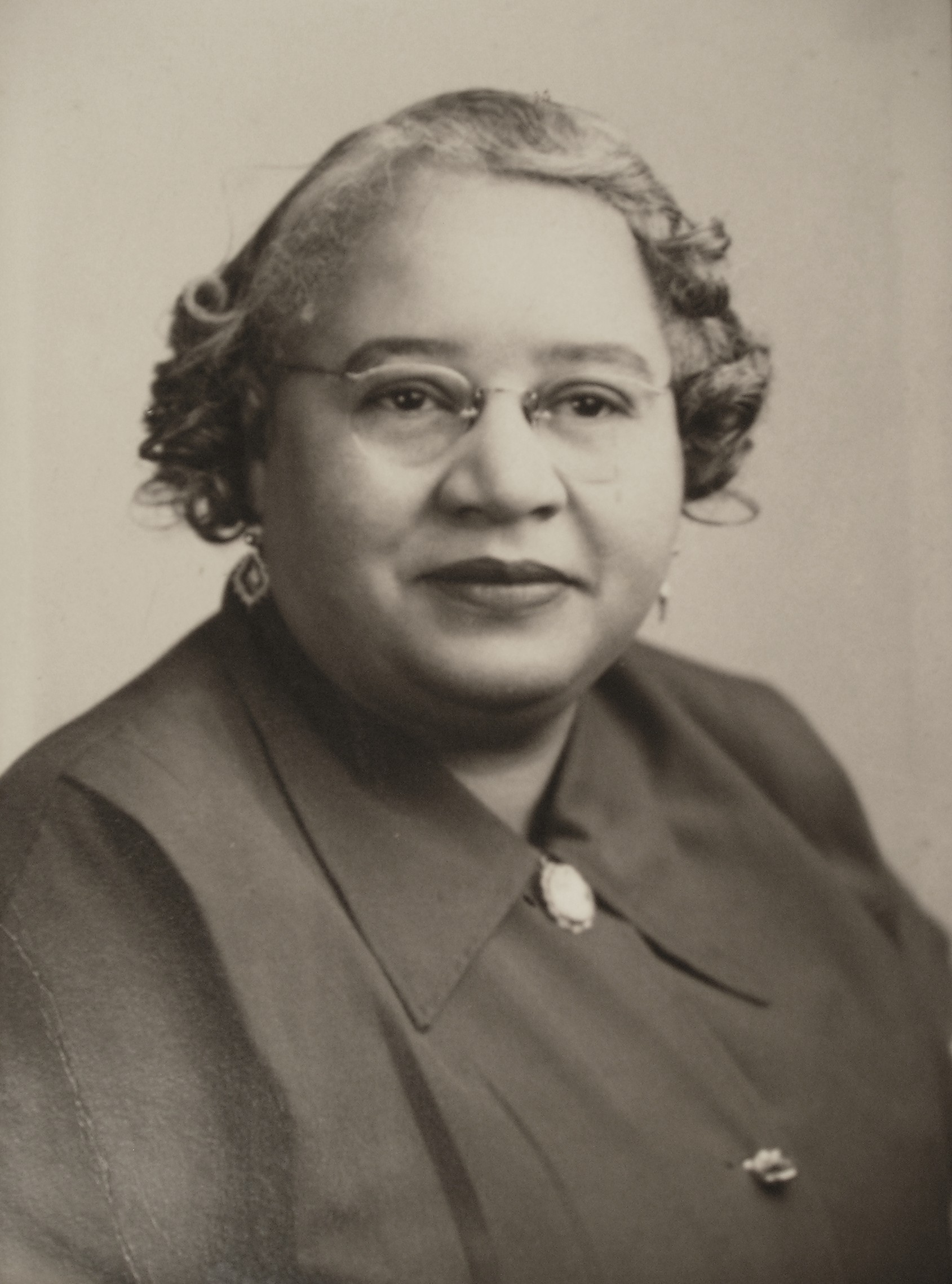
Photo of Bertha M. Murdock in collection of Lisa Y. Henderson.

Standard