Maternal Kin, North Carolina, Oral History, Photographs

A bird’s eye view.

The bird’s-eye view map of Statesville, North Carolina, drawn in 1907, reveals a number of features in Lon W. Colvert‘s landscape (click for a closer look):

statesville_1872_annotated

At #1: near the intersection of Centre Street, 109 East Broad Street, early site of Colvert’s barbershop. At #2: Center Street AME Zion Church. At #3: Southern Railway station, built in 1906. Colvert had an earlier shop in the Depot Hill area near the depot.  At #4: the railroad.  The Colverts’ house was adjacent to the railroad in Wallacetown, southeast of the station, as was that of his in-laws, Henry and Martha McNeely.

Below, the current tenant at 109 East Broad:

Image

Photo by Lisa Y. Henderson, December 2013.

Standard
Births Deaths Marriages, Maternal Kin, Migration, North Carolina, Oral History, Photographs

Minnie Beulah McNeely Hargrove.

But there was Aunt Minnie, and then after Aunt Lethea died, Aunt Lethea told her to take care of me, and she just took me on, you know.  And she was always crazy about me.  The first percale sheets that I ever had Aunt Minnie sent them to me, and I never bought anything but percale sheets.  Boy, they were just so luxurious and so nice and everything.

Jay stayed with Aunt Min ‘cause Aunt Min reared him after Aunt Lethea died.  And he was at this same house with Aunt Minnie and Grandma.  Let’s see.  It was Aunt Min and Grandma and Uncle Luther and Jay and I.  We were all in the same house during the summer that I worked up there.

Ardeanur. And she had a brother named James.  And their mother died when they were little children, and Min reared them.  Reared the children.

——

Aunt Minnie, who had no children of her own, reared everyone’s. When her sister Addie McNeely Smith died in 1917, Minnie took responsibility for her children, Ardeanur and James. When sister Elethea McNeely Weaver died five years later, Minnie stepped in to care for her youngest boy, 11 year-old Irving “Jay” Weaver, and promised to keep an eye on Lethea’s favorite niece, my grandmother.

Aunt Min shared a home with her mother Martha Miller McNeely in Bayonne, New Jersey, and after her mother’s death, she and Ardeanur moved to Columbus, Ohio, to live near another sister, Janie McNeely Taylor. She was in her fifties when she defied her disapproving family and married John Hargrove. He did not live long to plague her, though, and in a reversal of roles, she spent her last years with Ardeanur.  Minnie Beulah McNeely Hargrove died 2 December 1982 in Columbus.  She was 93 years old.

Image

Above: Minnie hovering behind her flock. From left, a Murphy boy, Bertha Hart Murdock, Bertha’s cousin Alonzo Lord, Aunt Minnie, and Ardeanur Hart Smith, Statesville, circa 1920.

Image

Minnie in Bayonne, perhaps the late 1920s.

Image

Minnie in later years, Columbus, Ohio.

Image

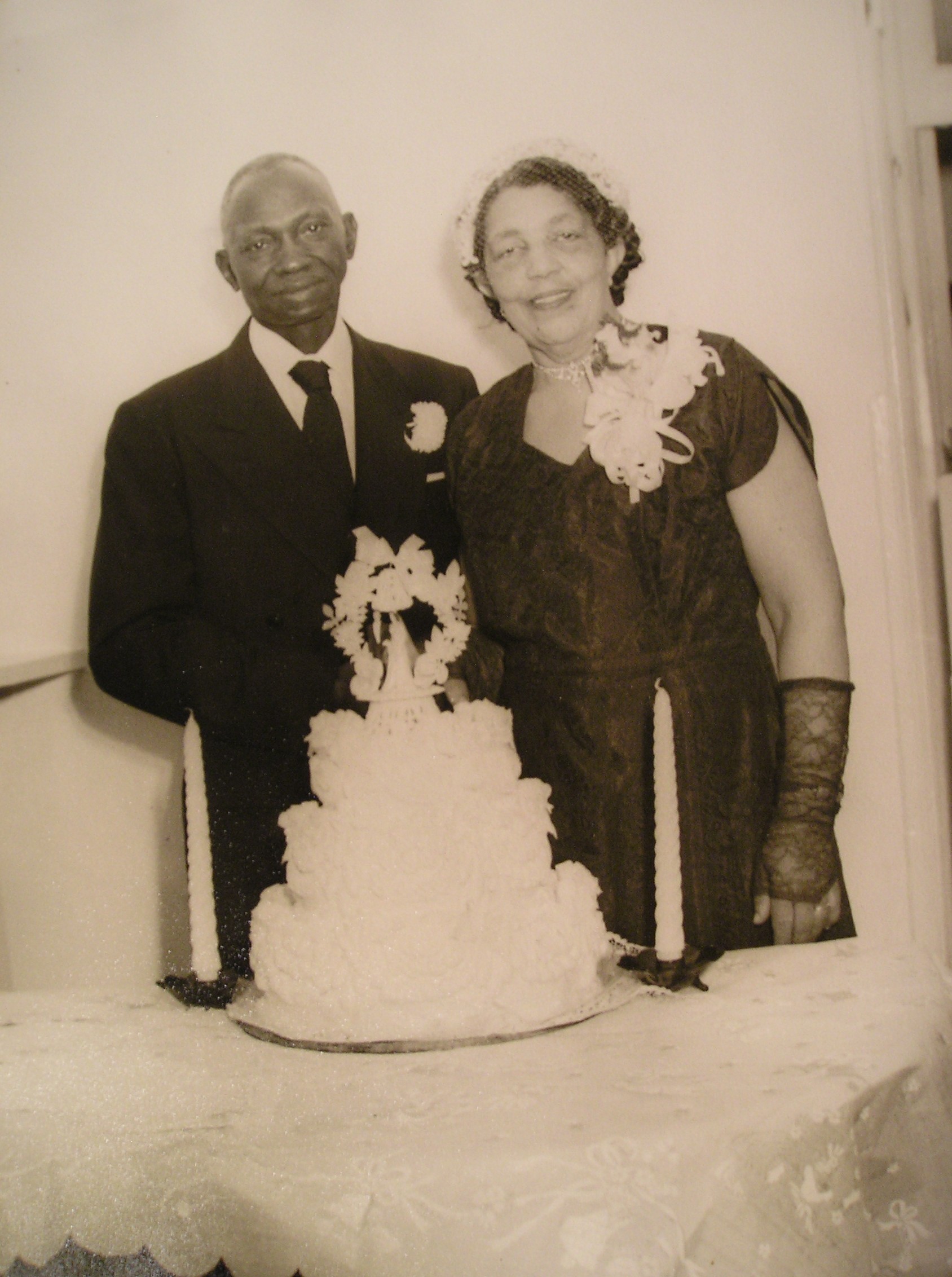
Aunt Min marries John Hargrove, Columbus, early 1950s.

Image

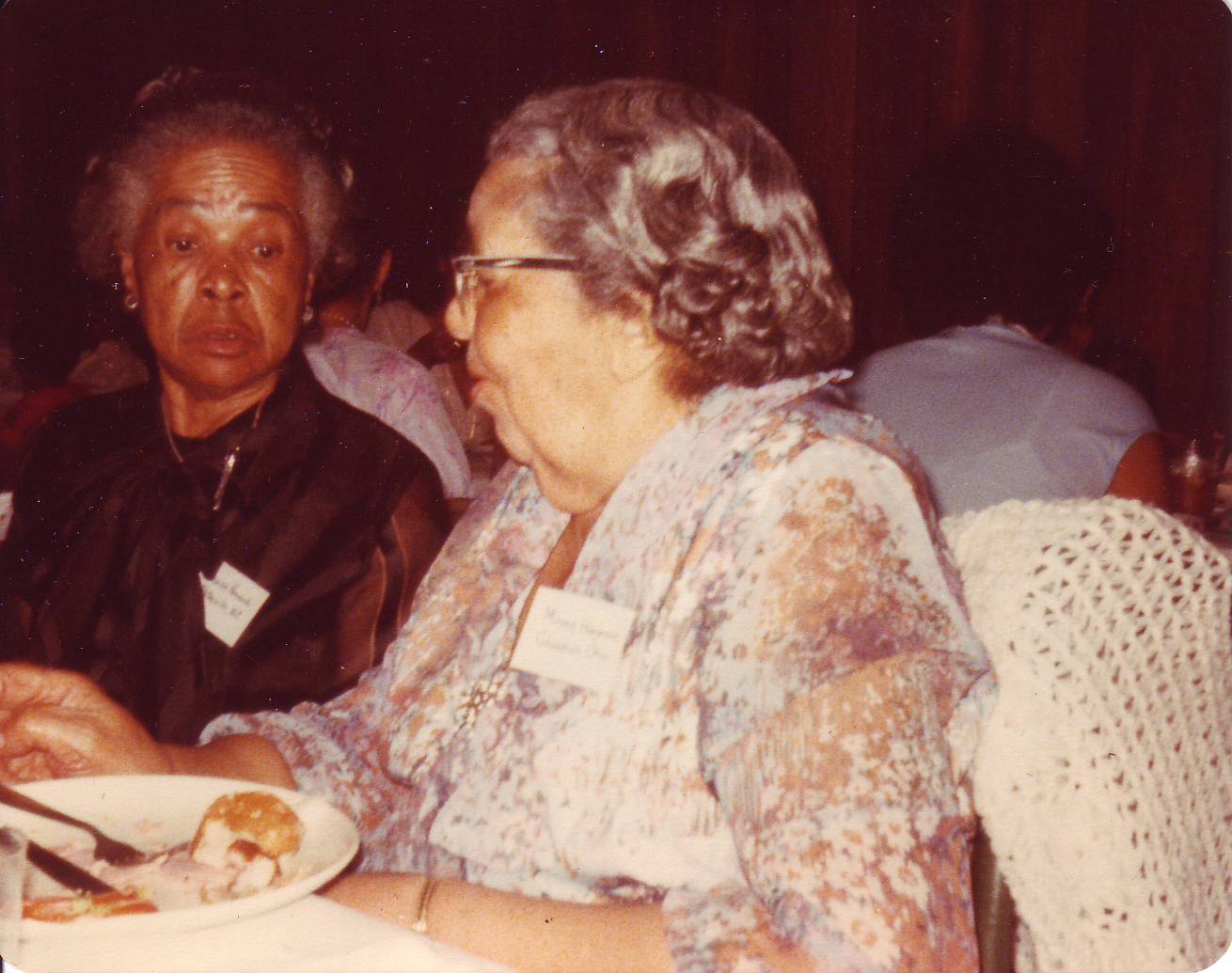
Minnie McNeely Hargrove at the 1980 Colvert-McNeely family reunion, Newport News, Virginia. I was not there. At the time, I was too callow to know what I was missing. Today, I kick myself. I never met her.

Interview of Margaret C. Allen by Lisa Y. Henderson; all rights reserved.

Standard
Maternal Kin, North Carolina, Photographs, Religion

Church home, no. 7: Center Street African Methodist Episcopal Zion Church, Statesville NC.

My grandmother:  She was a great Methodist. And she would come down occasionally to go to church, you know.  Have on all them taffeta skirts, and they were shirtwaisted skirts, you know.  And she was pretty, honey.  Have you ever seen any of her pictures?

And another time:

Where did they have that funeral?  They must have brought her down and had her in, at the Methodist Church in Statesville.  She belonged there.  She would come Saturday, get up Sunday morning, honey, and put on those taffeta skirts with those pretty blouses and lace all down the front and ‘round there. 

——

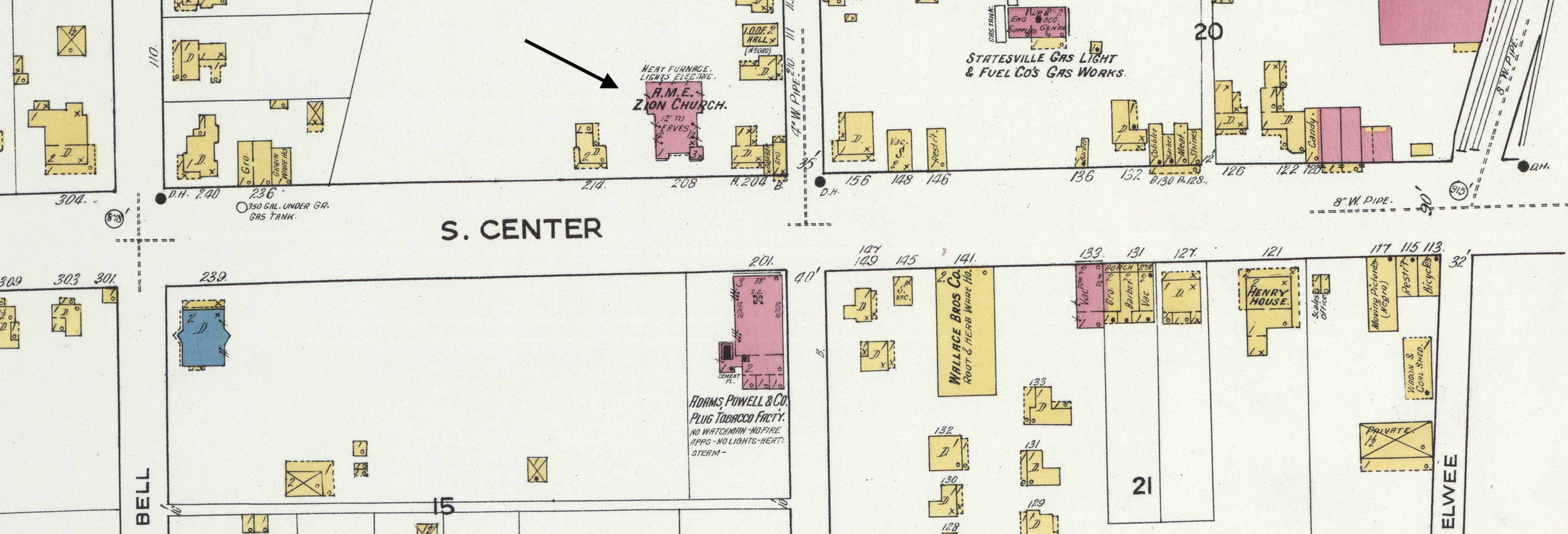
I had not planned to go to Sunday School. I was on my way home for Christmas and stopped in Statesville just to look for Harriet Nicholson Hart‘s church. I suspected that Center Street AME Zion Church was the same as Mount Pleasant AMEZ, which still meets, but my internet search was inconclusive.

The morning was dreary and chilly when I pulled into a space across from the church. I had snapped a couple of shots with my phone when I saw a woman step from an SUV in the parking lot. “Excuse me,” I called. “I’m looking for Center Street AMEZ.” She tilted her head toward the church behind me. “This is it,” she said. “It’s called Mount Pleasant now.” I explained that my family had been members of the church a hundred years before and my great-great-grandmother had been funeralized there in 1924. We chatted for a couple of minutes, and after asking if I might peek inside, I followed her through a side door — straight into Sunday School.

A junior pastor was addressing a small gathering of adults, and I — acutely conscious of my jeans and hoodie — took a seat just inside the door. As he spoke on the necessity to reach out to youth, I discreetly glanced around. In the nave, dully gleaming brass organ pipes stretched nearly wall-to-wall. At the back of the sanctuary, a large arched tripartite stained glass window brightened the pews. At an opportune time, I introduced myself and expressed my joy at joining in a service at a church that had been so important to my family at one time. “What were their names?” “Nicholson and Colvert and Hart,” I said, “and other family lived in the neighborhood. My great-aunt was Louise Colvert Renwick.” There were nods of familiarity and expressions of welcome.

I slipped out before too long and paused again as I reached my car to gaze back at the building. A woman hurried around the side of the church, calling out for me to wait. She was the pastor’s wife and she had a small gift — a card and a CD of hymns. “Thank you for visiting,” she said. “We’re so glad you found us.”

IMG_4582

IMG_4579Mount Pleasant AMEZ Church today, corner of South Center and Garfield Streets.

Page_13

Center Street AMEZ Church, Sanborn map of Statesville, 1918.

——

Interviews of Margaret C. Allen by Lisa Y. Henderson; all rights reserved.

Standard
Land, Maternal Kin, North Carolina, Other Documents

Where we lived: colored settlements.


Me:  And where was the area that was called Wallacetown?

My grandmother:  Mm-hmm. That was just out near where we lived. We lived out there.  And then there was like a stream or a branch or something where you crossed that thing, that was called Rabbittown.

Me: Okay.

Grandma: We lived in Wallacetown.

——

From the 1916 city directory of Statesville, North Carolina:

Popular Branch — a colored settlement southeast of Wallacetown [actually, it was “Poplar” Branch]

Rabbittown — a colored settlement southeast of Wallacetown

Wallacetown — a colored settlement southeast of the railway station

Rankinsville — a colored settlement to the right of the north end of Centre Street

Screen shot 2013-12-18 at 10.18.27 PM

Standard
Births Deaths Marriages, Maternal Kin, Newspaper Articles, North Carolina, Oral History, Photographs

Remembering Grandma Carrie.

McNEELY -- Carrie M Colvert with corsage

Me: In her pictures she always looked stern.

My mother: Grandma? 

Me: Carrie.

Ma: Grandma Carrie?  I know it.  But she was funny.  She was funny to me.  She could say some of the, she could say some funny stuff.  I know that’s where Mama gets it from.  The little sayings. 

Image

Statesville Landmark, 20 December 1957.

My grandmother didn’t think much of Charles V. Taylor:

Course she met this guy and married him that she had known him when she was a child.  Taylor.  And went to New Jersey.  She came back home, and Mama had high blood pressure, you know.  But she kept, her doctors kept it in check.  But he hadn’t let her go to the doctor for two times, and she had a stroke and died.  Oooo.  I could have killed that man.  I was so mad with that man I didn’t know what to do.  And when we went down there, Mama just got worse and worse.  She went to the hospital, and they did everything they could at the hospital, and then they let her come home.  And I went down there to see her one time, while she was at home, you know, and she couldn’t talk.  She couldn’t talk, I mean.  And she would try her best to tell me something.  And I just cried and cried and cried and cried and cried. And I didn’t know what she was trying to tell me.  So my sister lived not far from her.  And she was a cafeteria manager, but she would come to see Mama between the meals.  You know, in the morning breakfast and lunch, and then after dinner she’d come.  She really did take care of Mama when she was living with that Thing.  And she went to the hospital and stayed awhile, and he wouldn’t pay the hospital bill.  And I took a note out at the bank, and Louise paid her doctor’s bill and everything, and when she died, he tried to make us pay all the burial expenses.  And his brother came over there and told us, said, “Don’t you pay a penny.  ‘Cause he’s got money, and he’s supposed to use it for that.”  And said, “Don’t you do it.  Don’t you give it to him.”  And that man and the undertaker got together and planned all that stuff against us, you know.  The three of us.  It was terrible.  And Mama had a lot of beautiful clothes, you know, because this man bought her things.  And they were all in there looking at them.  I said, “I don’t want a thing.  I don’t want not one thing.”  I think I got a coat.  It was just like a spring coat.  It was lined.  And I think Louise insisted that I take it, but that was the only thing that I took.

——

McNEELY -- Carrie Colvert thoughtful

Remembering Caroline Martha Mary Fisher Valentine McNeely Colvert Taylor, who died 56 years ago today.

——

Interviews of my mother and Margaret C. Allen by Lisa Y. Henderson; all rights reserved.

Standard
Births Deaths Marriages, Maternal Kin, Newspaper Articles, North Carolina, Oral History, Photographs, Vocation

Lon Colvert: straight and shady.

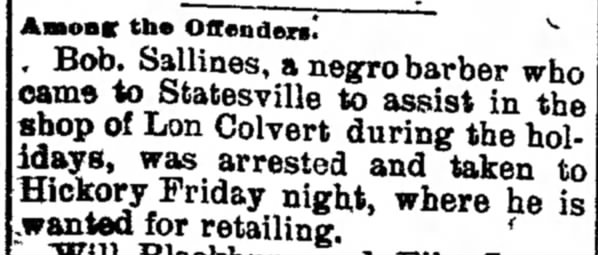
If reports are to be believed, Lon Colvert had a bit of a shaky start. “Otho Turner”?
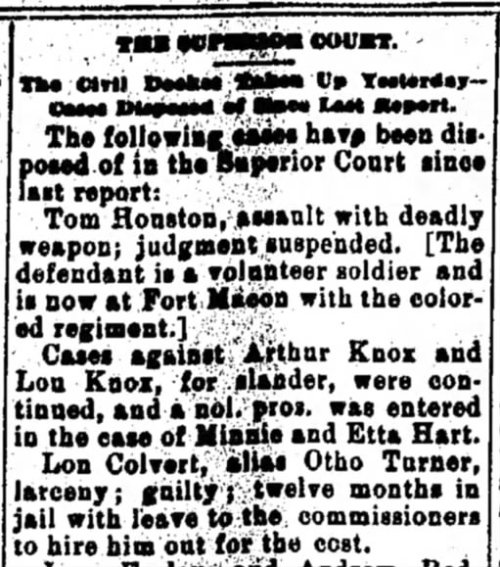
Image

Statesville Landmark, 18 August 1898.
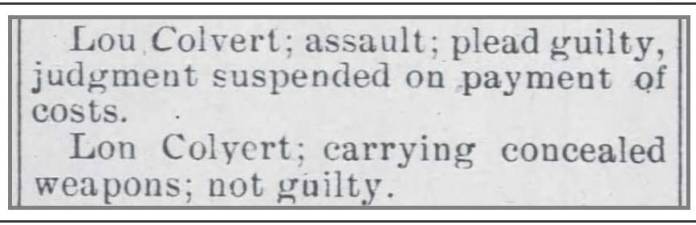
Carolina_Mascot_Sville_2_8_1900

Statesville Carolina Mascot, 8 February 1900.

Lou Colvert was Lon’s uncle. No details on Lon packing. But he switched gears a bit.  To retailing, which specifically meant selling liquor — unauthorized.

Iredell County Superior Court —

Lon Colvert, retailing; guilty.  

— Statesville Landmark, 5 Nov 1901.

Another poor outcome.

“Cases Disposed of Since Monday — Some Recruits for the Chain Gang — A City Ordinance Held Invalid”

The following cases have been disposed of in the Superior Court since Monday:    …

Lon Colvert, convicted of retailing, was discharged on payment of the costs. 

— Statesville Landmark, 8 Nov 1901.

But somewhere along in here, he began to right his ship.

Notices of New Advertisements.

L.W. Colvert has moved his barber shop from Depot Hill to 109 east Broad street.

— Statesville Landmark, 23 Aug 1904.

It’s not clear when Lon first opened his barber shop, or how he got into the business, but it was a good move. Depot Hill was a few blocks south of downtown; the 100 block of East Broad was right at the heart of the business district. He had arrived.

Still, there were setbacks. (I read “liquor” in this “little pilgrimage,” but I could be wrong.)

“Played His Bondsman False and Will Spend his Holidays in Jail.”

Thursday afternoon a colored barber, Lon Colvert by name, braced Mr. J.P. Cathey for a horse and buggy with which to make a little pilgrimage that night, and Mr. Cathey refused.  Lon was just obliged to make that little run, so later he stated the case to Jo. Thomas.  Jo. is the colored individual who worked for Mr. Cathey then and who is now being boarded by the county.  Jo. slipped out with a horse and buggy.  Lon made his trip, came back, paid Jo. one plank, which he shoved down in his jeans, and then Jo. slept the sleep of the consciousless offender.

But the snow that fell during the interval between the exit and return of that buggy caused Jo’s little house of cards to tumble.  Next morning Mr. Cathey saw the tracks, asked Jo. who had got a buggy the night before, and Jo straightaway told the thing that was not.  So Mr. Cathey got off of Jo’s bond, which he had signed not long since, and now Jo. is behind bars.

— Statesville Landmark, 20 Dec 1904.

He pressed on.

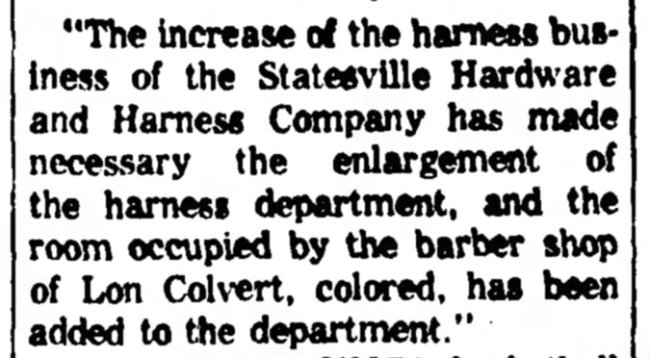
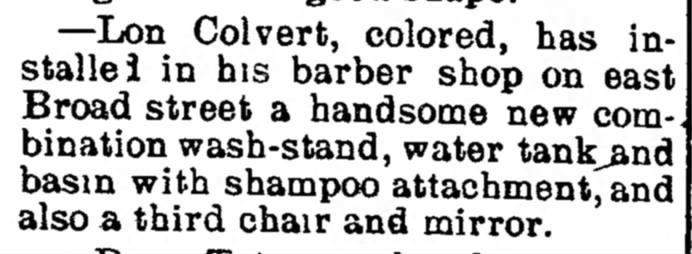
Lon Colvert, colored, has recently equipped his barber shop on east Broad street with a handsome two-chair dressing case and has made other improvements in the shop.

— Statesville Landmark, 1 Jan 1907.

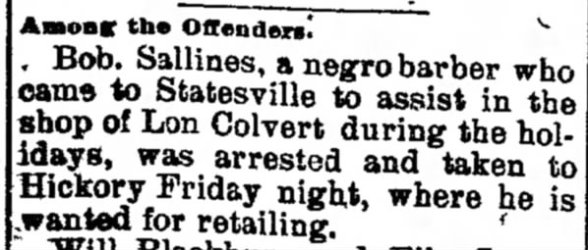
Occasionally, his friends let him down.
Image

Statesville Landmark, 1 January 1907.

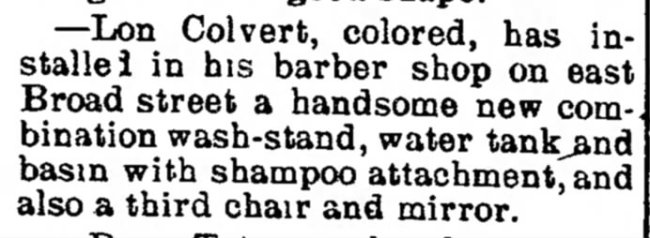
But he had a new wife and a new baby to add to his first three, and the straight and narrow was starting to win.
Image

Statesville Landmark, 7 May 1907.

Image

Statesville Landmark, 7 January 1910.

A momentary setback, no more. Lon moved his business back down Center Street toward the train depot and entered the golden age of his entrepreneurship, the period of my grandmother’s childhood.

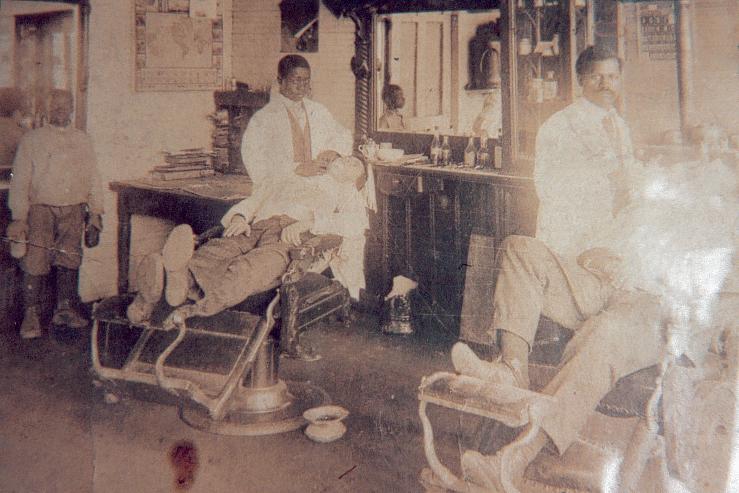
Papa had a barber shop.  Well, of course, Papa did white customers. And, see, the trains came through Statesville going west to Kentucky and Tennessee and Asheville and all through there.  They came through, and they had, they would stop in Statesville to coal up and water up, you know.  There were people there to fill up that thing in the back where the coal was.  And there was another — it had great, big round things that they’d put in water.  And when those trains would stop for refueling, they would, there were a couple of men who would come. I can see Walker and my uncle and Papa standing, waiting for these men who were on the train to give them a shave and get back on the train in time.  And there wasn’t any need of anybody else coming in at that time ‘cause they couldn’t be waited on.  They were waiting for these conductors and maybe mailmen, but I know there would be at least three at a time.  And Papa would shave them.  And he made a lot of money.

Papa had a taxi, too. Walker drove it most of the time.  And then he would hire somebody to drive it other times.  And then when people had to go to Wilkesboro, Papa would take them.  Because Wilkesboro was a town north of Statesville. And there was no transportation out there.  No buses, no trains, or anything.  So when people would come on the train that were, what they call them, drummers, the salesmen, when they would come through, Papa would carry them up there. 

And he had this clean-and-press in the back of the barbershop. And, look, had on the window, on the store, ‘Press Your Clothes While You Wait.’  I can see those letters on there right now.  ‘Press Your Clothes While You Wait.’  And people would go in there, get their clothes pressed, you know.  And I know ‘barber shop’ was on the door….  ‘L.W. Colvert Barber Shop.’  ‘L.W.’ was on the side of this door, and ‘Colvert’ was on this side of the door.  They had a double door.

There were, of course, risks to doing business. Though I’m casting a side-eye at the carnie. (“H.G.” was Lon’s 21 year-old half-brother Golar, and I never knew he was a partner in the business.)

Damages for Scorching Suit — Court Cases.

Lon Colvert and H.G. Tomlin, doing a pressing club business under the name of Colvert & Tomlin, were before Justice Sloan Saturday in a case in which Chas. Moore, white, a member of the carnival, was asking $18 damage for them.  They pressed a suit for Moore and it was scorched, for which Moore asked damage.  The case was finally compromised by Colvert & Tomlin paying Moore $5 and $1.20 cost. 

— Statesville Landmark, 27 March 1917.

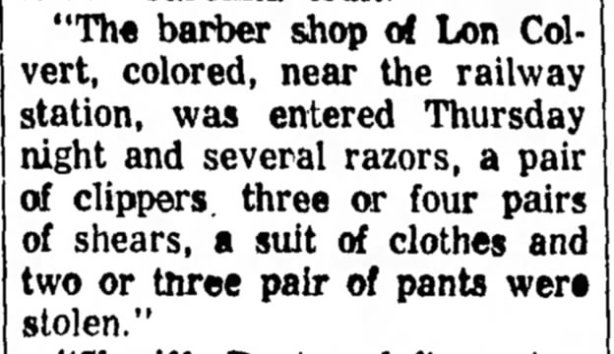
And there was the little matter of a charge of carrying a concealed weapon in 1919; a jury returned a not guilty verdict.  Still, a burglary at the shop was an omen. The good years were coming to an end. Lon was struck with encephalitis in the 1920s and was largely unable to work in his final years.
Image

Statesville Landmark, 25 September 1925.

By this time, Golda had embarked upon a peripatetic life in the Ohio Valley, and  Walker was left to keep his father’s businesses running.  He exercised his best judgment.

Walker Colvert, driver of the Wilkesboro jitney Steve Herman, driver of the Charlotte jitney, and Henry Metlock, driver of the Taylorsville jitney were charged with delivering passengers to the depot rather than the jitney station.  It appearing that all the violations were emergency calls, the defendants were discharged.

Statesville Landmark, 1 Mar 1926.

Lon Colvert died 23 October 1930.  “He was an old resident of Statesville,” his obituary noted, “and for a number of years had a barbershop on South Center street, near the Southern station.”
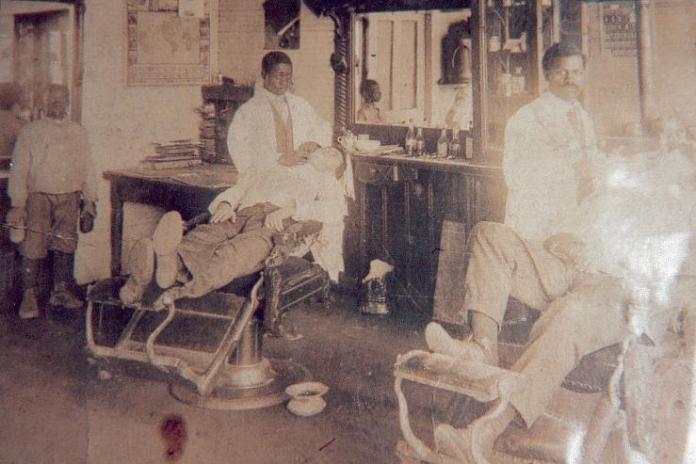
COLVERT -- Barbershop 2 The barbershop, 1918, when it was at 101 South Center Street. Walker Colvert, center, and L.W. Colvert, right.

——

Interview of Margaret C. Allen by Lisa Y. Henderson; all rights reserved. Copy of photograph in possession of Lisa Y. Henderson.

Standard
Births Deaths Marriages, Maternal Kin, Newspaper Articles, North Carolina, Oral History, Vocation

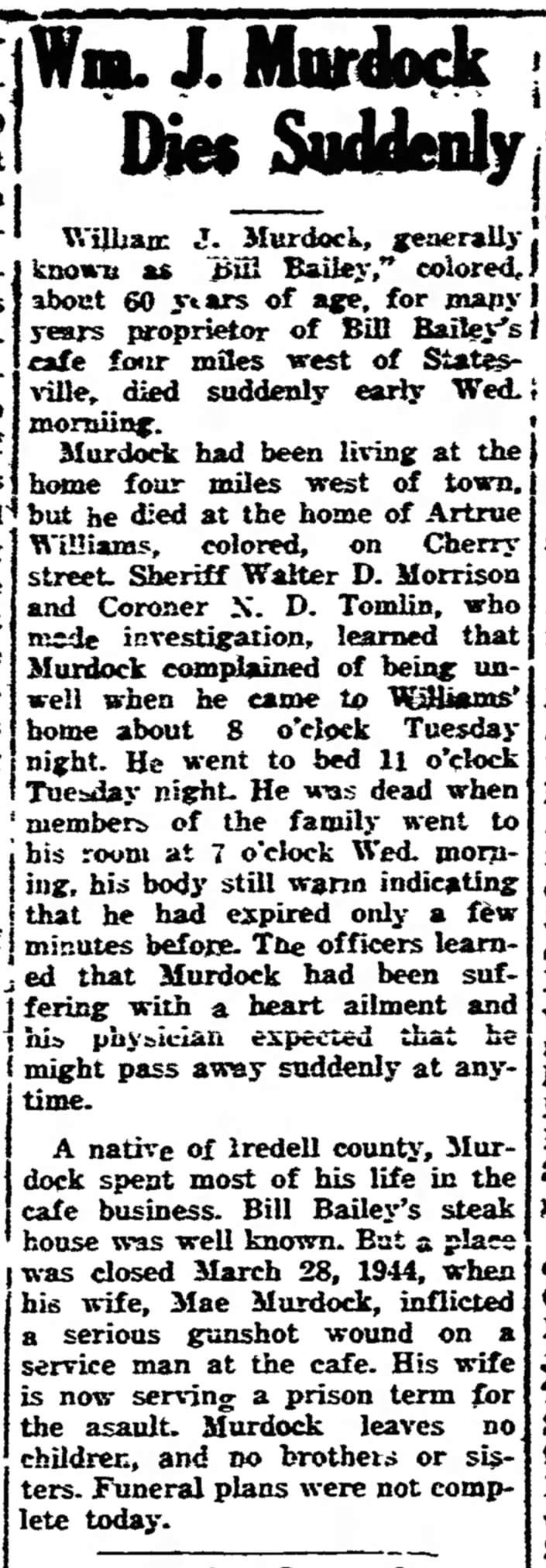
Bill Bailey’s life and times.

My grandmother did not mince words when it came to her aunt’s husband. William James “Bill Bailey” Murdock was “trashy.” “We couldn’t stand him,” she said. “He did everything illegal and got away with it.” I laughed, and thought, “Oh, Grandma. Really?”

Well, yes.

Consider this:

bill bailey youth 7 14 03 Statesville Landmark, 14 July 1903.

He was born William Bailey in Iredell County, the son of Lela Bailey, black, and John T. Murdock, white, both teenagers. His stepfather was Floyd Murdock, and he eventually adopted the surname, but he was known as “Bill Bailey” all his infamous life. His mother was a cook, and it is likely that he gained his culinary skills at her side. In 1920, he lived on Washington Street in Statesville’s Rabbit Town section with Lela and his first wife Hattie, biding his time as a flour mill laborer.

Two years later, Bill and his roadhouse merited their first in a long line of write-ups in the local newspaper:

11 27 1922 Roadhouse

Statesville Landmark, 27 November 1922.

Three months later, in March 1923, Ethel Wallace was arrested for shooting her husband — and the husband of her husband’s girlfriend — at Bill Bailey’s Emporium. Before this matter was even tried, Bill himself was arraigned on a charge of assault with a deadly weapon against Howard Houston. It didn’t stick. In February 1924, however, Bill plead guilty to bootlegging, was fined $50 and given two years’ probation. In January 1926, he was arrested for bootlegging again.

In December 1927, Bill was acquitted of assault with a deadly weapon in the shooting of “a colored girl” named Veola Knox and of transporting and possessing liquor, but fined $50 for assaulting Jim Moore. Two years later, on the day after Christmas, someone “severely carved up” Alfred Hough, slashed his jugular, outside Bill Bailey’s.

In July 1931, Bill was charged with manufacturing and possessing “home brew” — a barrel and 18 cases worth — on his premises just beyond the southern Statesville city limits. In November 1932, Crawford Scott was shot in the shoulder just passing by the place.  In 1934, three men were arrested for liquor possession at Bill Bailey’s, and 1936 brought this:

10 1 36 Liquor

Statesville Landmark, 1 October 1936. 

Nothing stuck.  As the Depression wound down and the War picked up, Bill Bailey’s reputation shifted from gutbucket to speakeasy to wholesome purveyor of steaks and libations to Statesville’s white middle class. Shootings and cuttings disappeared from the pages of the Landmark to be replaced by jovial accounts of “delightful fried chicken suppers” at Bill’s “popular resort,” enjoyed by society ladies, sportsmen, company men, and civic boosters alike.

The bonhomie slammed to a halt on the night of March 28, 1944, when Bertha Hart “Aunt Bert” Murdock shot James Warren, a white serviceman out to celebrate leave with a juicy steak.  My mother’s cousin N. asserts that Bill and Bert thought that their clientele, not to mention his father’s relatives — who’d kept Bill out of prison during Prohibition and rewarded his good cooking with steady patronage — would stand by them. It did not happen.  The place shut down, and just over a year after wife’s conviction, Bill Bailey was dead.

Murdock died 12 6 1945 LandmarkStatesville Landmark, 6 December 1945.

Standard
Births Deaths Marriages, Education, Maternal Kin, North Carolina, Oral History, Photographs

There she is.

Image

There she is.  That’s one of those dresses that Mama made for her to come to Hampton.  She came to Hampton a summer.  She stayed more than six weeks.  Must have stayed around eight or ten.  But anyway, she came here, and the things that she learned!  Oh, you would not believe.  All kind of things – artwork she could do.  Making baskets.  Oh, I don’t know what all.  That’s a blue taffeta dress with a white collar.  And you know we had a supervisor [Mary Charlton Holliday] who came to Statesville, and she particularly liked Golar, and she was a Hampton graduate, and she wanted Golar to go to Hampton so she could learn all this stuff.  All this artwork and everything.  And when she got ready, when Golar got ready to go, Mama had bought – this is a navy taffeta dress with a white collar.  And Mama had made all these dresses for her.  She had – this was a dressy dress.  And she had a pink dress, and she just, Mama just made her so many pretty things, you know.  And the, two or three nights before she was to go, to leave to go to Hampton, she broke down and cried.  Mama said, “What’s wrong?”  Said, “We’re gonna be, we’re gonna have your things ready.  You’re gonna be ready to go.”  And she said, “That’s not why I’m crying.”  She said, “I’m crying because Papa and Grandmama went to the bank and took out all of your money.”  Mama had paid into her Christmas savings account, and the bank just gave the money to Grandma and Papa, and that’s how they got her things together.  And she told Mama.  Ooooo

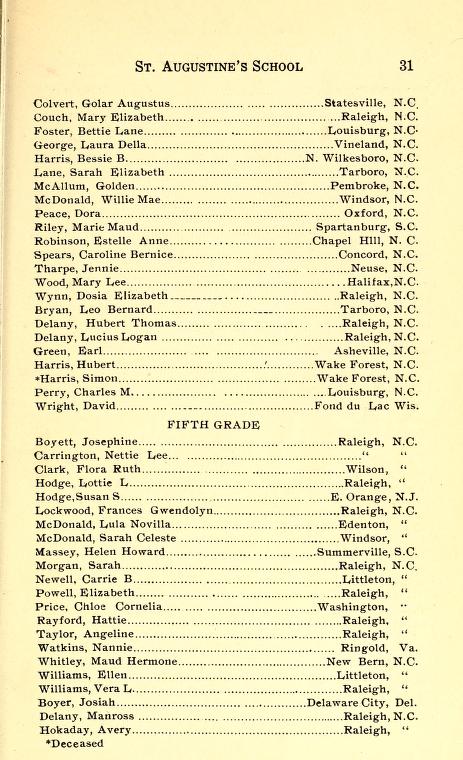
Golar Augusta Colvert was born in 1897 in Statesville, Iredell County, to Lon W. Colvert and his first wife, Josephine Dalton Colvert. She was about 9 years old when her widowed father married Carrie McNeely, and she grew close to her stepmother and adoring young half-siblings. When she was about 15, she enrolled at Saint Augustine’s College in Raleigh NC, where school catalogs show that she was a classmate of the Delany Sisters’ younger brothers.

annualcatalogueo18991914_0693

Annual Catalog of Saint Augustine’s School, 1913-1914.

In 1919, Golar married William Bradshaw, son of Guy and Josephine Bradshaw. Their son William Colvert Bradshaw was born in 1921 and daughter Frances Josephine in 1924. The little girl did not live to see two years. William worked in a furniture factory and Golar taught elementary school, and the family lived in a large frame house with a wrap-around porch on Washington Street in Statesville’s Wallacetown section.

In the summer of 1931, for reasons that are not at all clear, Golar traveled to Washington DC to undergo surgery.

Yeahhhh.  Went to Washington.  Had this operation and, ah, we got a letter from her.  Like, this afternoon, saying that she was all right, that they were gon take her stitches out, and she was coming home.  And she died that night.

GC Bradshaw 7 23 1931

Statesville Landmark, 23 July 1931.

Image

Statesville Landmark, 27 July 1931.

Interview of Margaret C. Allen by Lisa Y. Henderson; all rights reserved.

Standard
Births Deaths Marriages, Maternal Kin, Newspaper Articles, North Carolina

Lon W. Colvert.

Image

Lon W. Colvert was born 10 June 1875 to Harriet Nicholson and John W. Colvert. He possibly was their second child and certainly was the only one to reach adulthood. My grandmother emphatically stated that his middle name was Walter, but her sister Launie Mae thought “Walker” – after his grandfather – and that’s the name that appears on certain records. Lon’s paternal grandparents reared him, but he was extremely close to his mother as an adult.

Lon was probably in his late teens when he arrived in Statesville from his family’s farm in the northern reaches of Iredell County. He was an ambitious young man with an eye on the main chance and a penchant for the shady that followed him even into his respectable years. By time he was 30, he was well-established downtown as a first-class barber, and the local paper obliged him with recognition:

Image Statesville Landmark, 7 May 1907

Lon and his first wife, Josephine Dalton, had three children, Mattie (1895), Golar Augusta (1897) and John Walker II (1898). Soon after Josephine’s death, he married Caroline M.M.F.V. McNeely and fathered three more daughters, Mary Louise (1906), Margaret Beulah (1908) and Launie Mae (1910).

In the mid-1920s, Lon’s business successes were short-circuited when his health began to fail. He passed away 23 October 1930, 83 years ago today.

Lon Walker Colvert Dies in Wallacetown.

Lon Walker Colvert, colored, 55 years old, died this morning at 1 o’clock at the home of his daughter, Gola Bradshaw, in Wallacetown.  He was an old resident of Statesville, and for a number of years had a barbershop on South Center street, near the Southern station.

The funeral service will be Friday at 2:30, at Center Street A.M.E. Zion church, with interment in the local cemetery.

Surviving are his wife and six children; also one brother and one sister.

— Statesville Landmark, 23 Oct 1930.

Standard