Births Deaths Marriages, Enslaved People, North Carolina

Collateral kin: Winnie Coley.

I’ve talked about her here and here, but now I’m a little uncertain. Were there actually two Winnie Coleys? Were the mothers of Cain and Caroline Artis and William M. Coley and Patrick, Philip and John Revis Coley different women? Here’s what I know — and conjecture — about her:

  • In 1863, North Carolina’s Confederate government levied a tax on slaveholders across the state. Tax lists survive for only a few counties. (Most deliciously for me, Rowan is one.) I have not been able to find Wayne County’s anywhere, but fortuitously — and a little suspiciously — they were abstracted in Martha Ellis Will’s Wayne County North Carolina Court House Records Four Books 1780-1896. The 1863 tax list of Davis District, shows John Coley, Administrator of Estate of W.W. Lewis, with five taxable slaves. It’s the first record of Winnie and her children:  Winey, age 29; Cane, age 9; Caroline, age 7; Pat, 4; and Nathan, 2. [Who was W.W. Lewis? Coley himself is not listed with slaves, but the 1860 slave schedule tells a different story. There he reported owning 114 men, women and children. And where were Winnie’s other children?]
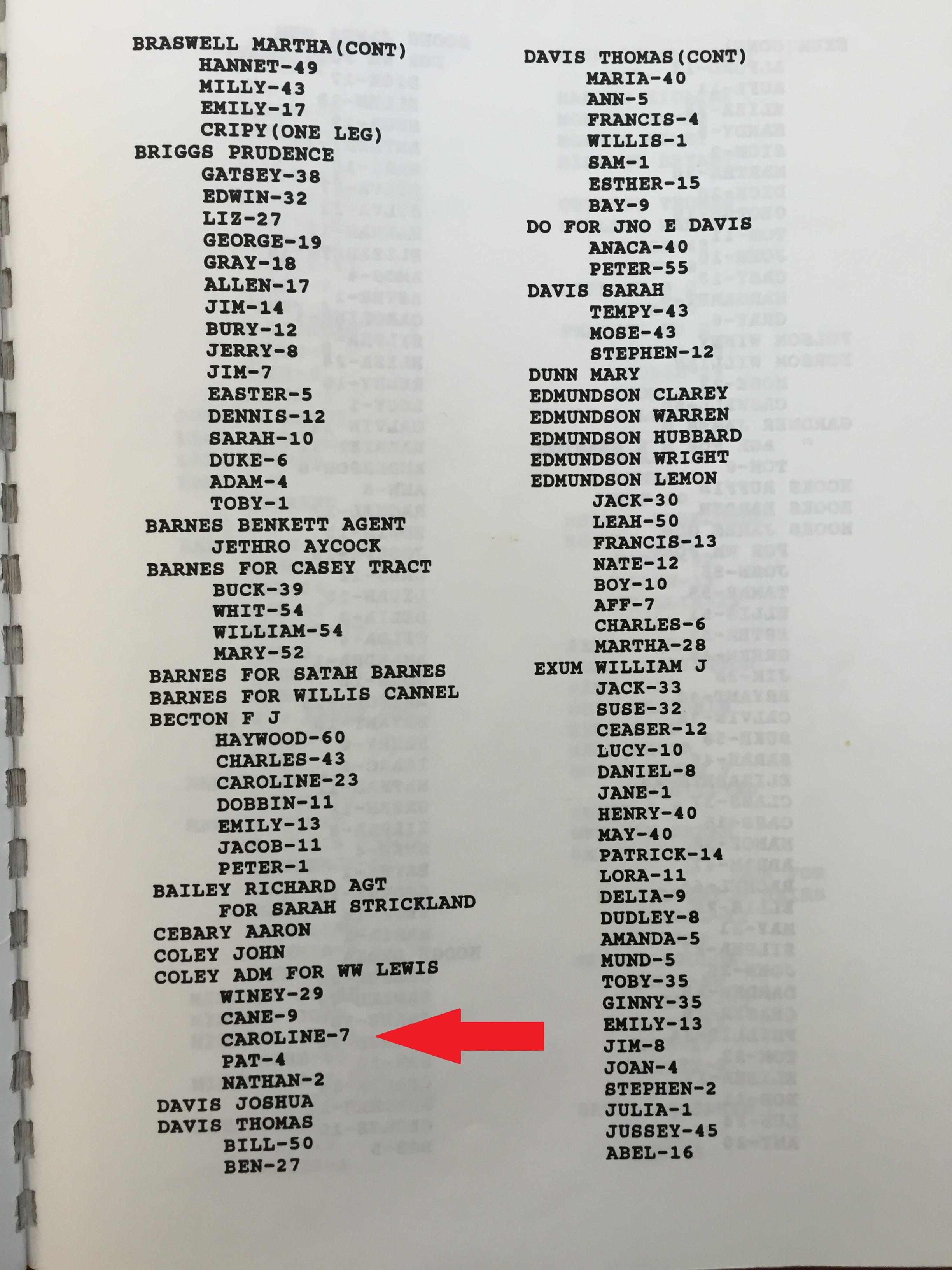
 John_Coley_Adm

  • At #272 of the 1870 census of Pikeville, Wayne County, the unmarried 55 year-old John Coley heads a household of possibly related white folks. In every direction, there is evidence of his toppled fiefdom — African-Americans bearing the surname Coley. Were they related to him? To each other? How? (And the non-Coleys in the neighborhood — who among them were also John’s former slaves, men and women who’d disdained his name?) For now, a few. At #270, Trecendia Coley, 36, with Peter, 5, and Dallas Coley, 5. At #273, Winney Coley, 41, with John R., 17, Phillipp, 11, and Mack Coley, 5. At #276, Peter Coley, 50, Harret, 44, Devrah, 16, Delliah E., 15, Napolian, 14, Nicholas, 12, and Thomas V. Coley, 7. At #281, Thomas Coley, 35, Charlotte, 27, Branton, 8, Bealie, 6, Trecendia, 4, Harriett, 1.
  • On 5 May 1872, Patrick Coley, son of Peter Coley “sen.” and Winney Coley, married Debby Coley, daughter of Peter Coley and Hannah Coley in Greene County. [The 1870 mortality schedule of Wayne County records the death of 52 year-old black farmer Peter Coley of Pikeville. Was he Peter Sr.? Also, though no ages are listed on the marriage license, the 1880 and 1900 censuses show Patrick’s birth year as 1849, which is not consitent with the “Pat” listed in the 1863 tax list.]
  • On 2 Oct 1878, Richard Baker applied for a marriage license from the Wayne County Register of Deeds for Madison Artis of Wayne County, 22, colored, son of Calvin and Serena Artis, father living, mother dead, and Caroline Coley of Wayne County, age 24, colored, daughter of Adam Morris [sic, Artis] and Winny Coley, both living.  The ceremony was performed by Fred G. Becton, Justice of the Peace, on 3 Oct 1878 at Winnie Coley’s in Nahunta, before E.L. Becton, Thomas Artis, and Jonah Williams.  [Thomas Artis, son of Celia Artis, was Madison Artis’ uncle. Jonah Williams was Caroline’s uncle, Adam Artis’ brother.]
  • In the 1880 census of Pikeville, Wayne County, Winnea Coley, 71, is listed with sons Jack R., 26, Phillip, 20, and grandson Dallas Coley, 15. [71?!?! This is the same Winnie Coley listed in 1870, but her age is inexplicably 20 years off.]
  • On 5 November 1881, in Wilson County, Winnie Coley, 50, married Alex Barron, 57. The ceremony took place at minister Jessie Baker’s house in the presence of Mary Ellis, Peter Coley and Red Barnes. [Is this our Winnie? If so, she never appears elsewhere with this husband. Which Peter Coley was this?]
  • On 16 February 1882, Phillip R. Coley, 22, son of Peter Coley (dead) and Winnie Coley (living), married Ann Exum, 18, in Pikeville, Wayne County, in the presence of witnesses Christopher Coley, Gard Coley and Olin Coley. [“Grad” Coley appears in the 1870 census in household #279 as the son of Howell and Amy Coley. In 1886, Gard married Ollin Coley [Sr.]’s daughter Miranda. Their witnesses were Philip R. Coley, Dennis Coley and Christopher Coley. Christopher appears in the 1870 census of Pikeville, Wayne County, as the son of Lafayette and Julia Coley. Philip R. Coley witnessed Christopher’s 1885 marriage to Sarah Powell. Ollin Coley Jr. married Christopher’s sister Imogen in the presence of Philip R., Dennis and Christopher Coley in 1885.]
  • On 11 Apr 1888, Charles Battle applied for a marriage license for Cain Artis of Wayne County, age 35, black, son of Adam Artis and Winny Artis, both living, and Margaret Barnes of Wilson County NC, age 38, black, daughter of Sherard Edmundson, dead.  P.D. Gold, minister of the gospel, performed the ceremony on the same day at Margaret Barnes’ home in Wilson before H.G. Phillips, Henrietta Clark and Mary J. Davis.
  • On 26 February 1891, William Coley, 22, son of Napolion Hagans and Winney Hagans, of Gardner’s Township, Wilson County, married Minnie Woodard, daughter of Alfred and Sarah Woodard of Taylor’s township, Wilson. Cain Artis applied for the license and stood as a witness.
  • In the 1900 census of Wilson, Wilson County: Willie Coley, 30, wife Minnie, 30, children Effie M., 8, and James M., 6, mother Winnie Coley, 65, and sister Zilley Coley, 38. [Where was Zilley in previous censuses? Or was she, in fact, Minnie’s sister?]
  • On 21 July 1909, in Wilson, Wilson County, William Coley, 42, son of Pole Hagans and Winnie Coley, married Mary Mercer, 34, daughter of Sam and Julia Mercer. Jonah Williams, Primitive Baptist Minister, performed the ceremony at the home of W.M. Coley in Wilson.
  • Winnie is not found in the 1910 census or beyond and presumably died between 1900 and 1910.
  • On 23 March 1917, farmer Cain Artis died in Wilson County of pulmonary tuberculosis.  His death certificate reports that he was born March 1851 to Adam T. Artis and Winnie Coley, both of Wayne County NC.  Informant for the certificate was W.M. Coley of Wilson NC.
  • On 15 December 1920, Phil R. Coley died in Nahunta, Wayne County, of stomach cancer. His death certificate reports that he was born around 1861 to Peter Coley and Winnie [no last name], both of Wayne County. J.A. Coley was informant.
  • On 26 January 1928, William Coley died in Wilson County of pulmonary tuberculosis. His death certificate reports that he was born about 1867 to Pole Hagans and Winnie Coley, both of Wayne County.  Informant for the certificate was Mary Coley of Wilson NC.
  • On 3 September 1934, Jack Revis Coley died in Nahunta, Wayne County, of bladder and prostate cancer. His death certificate reports that he was born about 1850 to Peter Coley and Winnie Coley, both of Wayne County.  Informant for the certificate was Philip E. Coley of Fremont NC.
  • In summary, Winnie Coley was born about 1830 and died 1900-1910. Her children included Cain Artis (circa 1851-1917); Caroline Coley, born about 1854; John Revis “Jack” Coley (born in the early 1850s-1934); Philip R. Coley (circa 1860-1920); Patrick Coley (??-??); and William M. Coley (circa 1867-1928); and possibly Nathan Coley (circa 1861-??) and Lafayette Coley (circa 1842-1913).
  • Fun facts: Philip R. Coley’s son Philip Elmer Coley married Genetta Thompson, daughter of Celebus and Lillie Beatrice Artis Thompson. Lillie was a daughter of Adam T. Artis and a half-sister of Cain Artis. Genetta, then, married her half-uncle Cain’s half-brother’s son.
  • Fun facts, 2: William Coley’s father Napoleon was the half-brother of Frances Seaberry, who married Adam Artis. Thus, William’s half-brother Cain was also his first cousin by marriage.
Standard
Agriculture, Business, North Carolina, Paternal Kin

“They call me Tom Pig.”

The eighth in an occasional series excerpting testimony from the transcript of the trial in J.F. Coley v. Tom Artis, Wayne County Superior Court, November 1908.

Defendant introduces TOM ARTIS, who being duly sworn, testifies:

My name is Tom Artis. They call me Tom Pig. I own some land, 30 acres. (Plaintiff objects.) I have been living on the 30 acre tract of land 25 years, except one year. I mortgaged this land to Mr. Exum. (Plaintiff objects.) I don’t know about how long it was. About 25 or 30 years. (Plaintiff objects.) I don’t know what became of that mortgage. I got Hagans to take it up. (Plaintiff objects.) I don’t know who was present when I got Hagans to take it up. When Hagans agreed to take it up, Mrs. Exum, Hagans and myself were present. I own the 30 acre tract and lived on the the tract adjoining. After Hagans took up the papers, he told me that I could build on that place, or on the 24 acre piece. He said he thought it best for me to build on mine, he might die sometime, and there might be some trouble about me holding the house. I did so. He furnished the lumber, and I did the work. I decided to build on his side. After I built there I had been paying the 800 lb. of lint cotton year in and year out. (Plaintiff objects to each and every statement of the foregoing evidence.) The 800 lb. of cotton was to keep up the taxes and the interest of the money. (Plaintiff objects.) I have been paying this 800 lb. of cotton all the time. (Plaintiff objects.) I left that place one year. I left because my house got in such a bad fix, and I couldn’t stay there, and run my business like I wanted to, and I went over to Mr. Jones’. I rented the land. I rented it to Simon Exum. He gave me 950 lb. for the 30 acre place. I rented the Calv Place and the Adam Artis place. I moved back after one year at Mr. Jones’ place. I built on the Hagans place. Since then I built the piaza and shed room, to my own expense. Borrowed money from Hagans. I paid him back. He didn’t pay for the repairing of it. He furnished some shingles. Got 1/4 covered. I never asked W.S. Hagans to sell the 30 acre tract of land. I never said to Hagans in the presence of Reid or anybody else that I wanted im to sell it. I never asked anybody to buy the 30 acre tract of Hagans. Not the 30 acre tract. I had a conversation with Mr. Coley with reference to buying that land. I was talking about the Calv place. My land wasn’t brought in. The Calv place is the place I rented and lived on. That’s the land I spoke to Mr. Coley about buying from Hagans. He said if Mr. Cook and Hagans didn’t trade to send him a note. I told Hagans, he said tell him Coley, if his hands were not tied. I remember going over to Mr. Coley’s mill with Hagans. I didn’t hear any conversation bwteen Hagans and Coley with reference to buying this tract of land. They were off from me. I didn’t know what they were talking about. I heard them say when they came back to the buggy, Hagans said that he would see him again shortly. I don’t know if he said what day. Next I heard after that was that Hagans had sold it all to Mr. Coley, mine and all. I never rented the 30 acre tract of land. I know Jno. Rountree. I never asked him to go to Will Hagans and ask him to give me an opportunity of buying the 30 acre piece of land. I never said to Will Hgans, Jno. Rountree or Henry Reid, or anybody that I wanted Hagans to give me the opportunity of seeing my boys in Norfolk, so I could buy the 30 acrea piece. I asked Hagans what he would take for the acre back of my huose, of the Calv place. I told him I would buy that. His answer was, “Can you find a buyer for the other part of the Calv place.” I told him I didn’t know. He walked about his buggy house door. He said, “Uncle Tom” I can’t take what that mortgage calls for for your land, land is so much more valuable now than it was when yours was given. It passed off at that. Next I heard he had sold it to Coley.

To be continued.

——

N.B. Calvin “Calv Pig” Artis was Tom Pig Artis’ brother. He sold the Calv Pig place to Napoleon Hagans in 1879. (Tom and Calvin apparently derived their nicknames from their father Simon Pig Artis, who had been an enslaved man.)

Standard
Births Deaths Marriages, Free People of Color, North Carolina, Paternal Kin

The case for Vicey, Sylvania and Daniel Artis as siblings.

I thought I’d posted this earlier, but apparently not. Here is my case for Vicey Artis Williams, Sylvania Artis Lane and Daniel Artis as siblings.

  • Vicey Artis was born circa 1810; Sylvania Artis, circa 1820; and Daniel Artis, circa 1820.
  • None were listed in census records prior to 1850.
  • In the 1850 census, Vicey and her younger children were listed in a household between Silas Bryant and John Lane in Bull Head, Greene County.
  • In 1850, Sylvania and her younger children were listed in a household on the other side of John Lane in Bull Head.
  • In 1850, Daniel was not listed.
  • In 1853, Daniel Artis bought 125 acres of land from Silas Bryant adjacent to Bryant and John Lane.
  • In 1860, Vicey and Sylvania were listed next door to one another in Davis district, Wayne County. Six of Sylvania’s children were listed in the household of John Lane in Bull Head, Greene County, less than five miles away.
  • In 1860, Daniel was listed in the household of John Lane in Bull Head.
  • On 28 August 1866, Vicey Artis and Solomon Williams, Sylvania Artis and Guy Lane, and Daniel Artis and Eliza Faircloth registered their cohabitations before justice of the peace Henry J. Sauls, probably near present-day Eureka (then Sauls Crossroads.)
  • Vicey’s children include a daughter Jane.
  • Sylvania’s children include Jane, Daniel, and Mariah.
  • Daniel’s children include a daughter Mariah.
  • Sylvania’s oldest son Morrison Artis, born about 1837, married Vicey’s daughter Jane Artis, born about 1833, on 27 November 1862. Their children included a son Daniel.
Standard
Births Deaths Marriages, North Carolina, Other Documents, Paternal Kin

28 August 1866.

I’ve seen these cohabitation registrations many times, but I just noticed today that Vicey Artis, Sylvania Artis and Daniel Artis, whom I believe to be siblings, and their spouses all registered their marriages on the same day before the same justice of the peace, Henry J. Sauls.

williams cohab

lane cohab

dartis cohab

Did the six travel to Sauls’ home together, walking or, perhaps, in a wagon? August 28 was a Tuesday during the relative lull before fall harvesting began. Did the families celebrate?

Standard
Births Deaths Marriages, North Carolina, Other Documents, Paternal Kin

North Carolina Marriage Records.

Ancestry.com recently launched North Carolina County Marriage Records, a date collection that includes images of marriage bonds, licenses, certificates and registers from 87 counties. (Including all of mine!) I’ve already stumbled across two previously unseen records for distant cousins, aunts or uncles, and I anticipate filling in gaps with many more that I managed to overlook over the years.

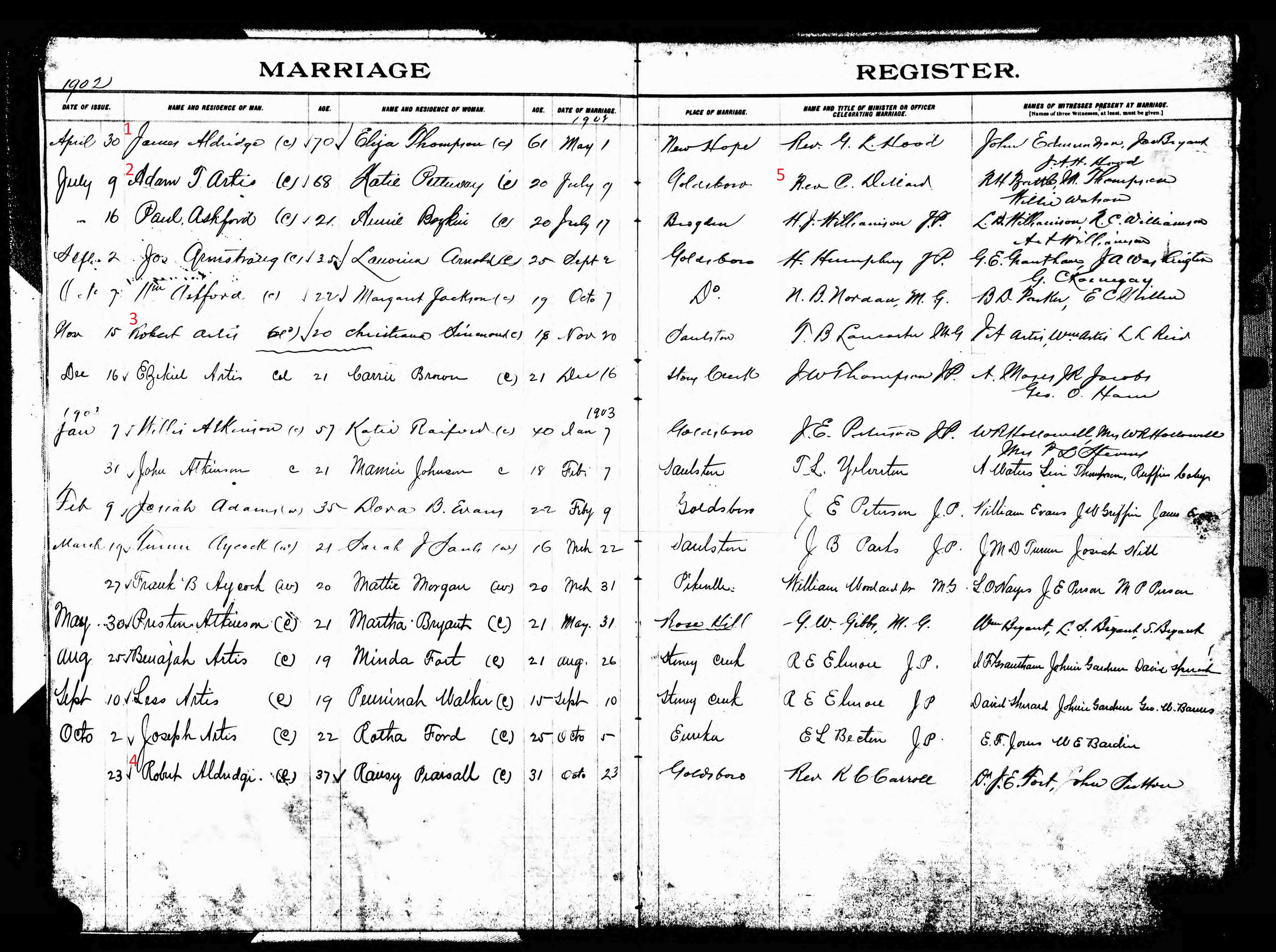
As a sample of the value of these records, here’s a single page from one Wayne County marriage register:

Wayne Marriage

1. James Aldridge, 70, married Eliza Thompson. Just about every “colored” Aldridge in 19th century Wayne County is a member of my extended family, but this one doesn’t seem to be one of mine. I can’t place a James born circa 1832. Perhaps this man came into the county from Lenoir or Duplin, which had slave-holding Aldridge families.

2. Adam T. Artis, 68, to Katie Pettiway, 20. This was my great-great-great-grandfather’s last marriage. He was actually 71, rather than 68, so Katie was more than 50 years his junior. (And her maiden name was actually Pettiford.) I’ve written about their family here. (By the way, more about their officiant, Rev. Clarence Dillard (5) here.

3. Robert Artis, 20, to Christiana Simmons, 18. Robert Artis was a son of Adam and Amanda Aldridge Artis. His witnesses may have been his cousin Jesse Anthony Artis, son of Jesse Artis, and uncle William Artis.

4. Robert Aldridge, 37, to Rancy Pearsall, 31. My great-great-grandfather John W. Aldridge‘s second youngest brother Robert finally married in 1903. He and Rancy (or Rannie) adopted a son, Bennie, born in 1908, and she died before 1916, when Robert remarried.

——

They’re not exactly brick walls, but this one data collection has revealed this and this and this and this… 

Standard
Agriculture, North Carolina, Other Documents, Paternal Kin

Gravy.

Sometimes you’ll run across a little extra information in an unexpected place. 005152197_04657 I’m not related to Robert E. Simmons. But I’m connected to him a couple of ways. As the son of George R. and Mary McCullin Simmons, he was (1) the nephew of my great-great-uncle Lucian Henderson‘s wife Susie McCullin Henderson and (2) the nephew of my great-great-aunt Ann Elizabeth Henderson Simmons‘ husband Hillary B. Simmons. While researching for Robert’s great-niece, I found his World War I draft registration card and in it a little glimpse at my great-great-grandmother Vicey Artis Aldridges life after her husband John’s death in 1910. Per the correction on the back of the card (at right), Robert Simmons was a tenant farmer on Vicey’s land. Under this arrangement, Robert would worked in exchange for rent in the form of cash or a fixed portion of the crop he raised. The arrangement may also have included housing for Robert and his family and a small wage if he had additional responsibilities. Typically, though, a tenant farmer provided his own equipment and animals. (Farm laborers, on the other hand, were hired hands working for wages.)

Standard
Births Deaths Marriages, North Carolina, Oral History, Paternal Kin

Collateral kin: McCullin.

In October 1998, I received an email from P.M., who was seeking information about her Simmons forebears. During the antebellum era, the Simmonses were a large free family of color in Duplin and Wayne Counties. Though I am not one, I’ve researched them both in my free people of color work and because several Simmonses have intermarried into my lines. I quickly identified P.M.’s great-grandfather, George Robert Simmons, as the son of George W. and Axey (or Flaxy) Jane Manuel Simmons and, accordingly, brother of Ann Elizabeth Henderson Simmons‘ husband Hillary B. Simmons. I was also able to provide information about her Artis line, but came up blank when she mentioned her great-grandmother, Mary McCullin Simmons. Then: “Mary’s sister Susie married a Lucien Henderson,” P.M. wrote. “I think they lived in Dudley. My mother remembers visiting her when she was a little girl. Does his name ring a bell?”

It did indeed. James Lucian Henderson, whom I’ve written about several times, including here and here, was my grandmother’s beloved great-uncle. In the hours I recorded her talking about her people, my grandmother mentioned Aunt Susie several times:

And A’nt Susie was real light, and her hair was all white, and she’d plait it in little plaits, and then tuck ’em up. It didn’t grow that much, ’cause it wasn’t long. And she had a rag on her head all the time. Only time she’d comb it was — when she’d be combing her head, you’d see it. And it was just about like this. [Indicates the length of two finger joints.] Shorter than this. I don’t know whether she cut it off or not. But it didn’t grow, and it was white, and she’d put that rag back around her head. After she’d comb her hair. And it was doing like that all the time. Shaking. Her head was shaking, and I asked Mama, “What’s wrong with her?” How come her head was shaking all the time? And she said, “Well, it’s a sickness.” She said, “I don’t remember what they call it.” So I didn’t say nothing else about that. I used to go down there.  She couldn’t cook. Like over the stove, like cook dinner, after twelve o’clock. Had to cook it before twelve o’clock before it got too hot. Because she couldn’t be over the stove, she’d fall out, if she was over the stove. So Uncle Lucian always got up and cooked breakfast.

So we come up there and stay, and Aunt Susie, she’d be out there in the yard to the pump or something. I never did see her with her hair. She’d always have a pocket handkerchief, look like, tied to the corner and out it up on her head and tuck it up under her hair. And it was white like cotton. And so, I don’t think she ever left the house. See Uncle Lucian always went to church right up there from the house. I don’t know what the name of Uncle Lucian’s church was.   It had a funny name, but I don’t know whether it was Methodist or Baptist, but she didn’t go to church. She never left the house that I know of. I told Mama, “She’s gon shake her head off.” She said, “It was a palsy, that’s how come.” I said to Mama, I said, “That thing’s gon shake her head off.” And I said, ‘Hmm, why she have a rag on her head all the time and her head just shaking like that?’ It be a white rag up there. I wanted to ask her so bad. But I didn’t. Didn’t never ask her.

I recently heard from P.M. again and pulled out our old correspondence. Here’s what I now know about the McCullins:

Rose (or Rosa) McCullin was an enslaved woman born perhaps 1825. She is believed to have been enslaved by Calvin J. McCullin or his brother Benjamin F. “Frank” McCullin in Buck Swamp township, Wayne County, and to have been the mother of at least four daughters – Jane, Mary, Susan and Virginia – by Frank McCullin. Rose McCullin appears in no census records and seems to have died before 1870. The only known references to her are on the marriage and death records of her children, as detailed below.

Jane McCullin

  • was born about 1850.
  • In the 1860 slave schedule of Buck Swamp township,Wayne County, B.F. McCullum is listed with five slaves, all female, aged 35, 12, 8, 7, and 4. The woman is described as black; the girls as mulatto. Are these Rose and her children? [Benjamin McCullin’s mother, Amy Ann “McCullum,” wife of C.J. McCullin, is listed with 12 slaves. C.J. McCullin is not listed.]
  • Jane McCullin married Irvin Manly on 20 January 1870 in Wayne County.
  • In the 1870 census of Brogden, Wayne County: Irvin Manly, 26, Jane, 20, Rachel, 54, and Hosea Manley, 6. The family lived within a cluster of households headed by white farmer Allen Manly, 60, Henry Manly, 32, and William Manly, 28.
  • In the 1880 census of Brogden, Wayne County: Irvin Manley, 40, Jane, 30, Fannie, 8, Joe, 7, Mary, 5, Nancy, 3, and Jesse Manley, 10 months, and sister-in-law Susan McCullen, 22.
  • In the 1900 census of Grantham Wayne County: Irvin Manly, 57, Jane, 58, and children Mary, 24, Jesse, 20, Nathan, 17, and Arthur, 16. Jane reported 5 of 7 children living.
  • In the 1910 census of Grantham, Wayne County: Irvin Manley, 65, and wife Jane, 64, with daughter Mary Flowers, 30, and her son Marshal C. Flowers.
  • In the 1920 census of Grantham, Wayne County, 75 year-old Jane Manley appears to have lived alone, but next to her son Arthur Manley and family. On the other side of Arthur was Irvin Manley, 75.
  • In the 1930 census of Grantham, Wayne County: Irvan Manley, 85, and Jane Manley, 88, were listed as in-laws in the household of Marshall and Mary Flowers on Grantham and Faison Road.
  • Jane Manley died 19 July 1931 in Brogden township, Wayne County. Her death certificate reports that she was colored and married to Irvin Manley and that she was born 14 July 1839 to an unknown father and Rose McCullen. She was buried the next day at an unnamed location in Wayne County.

Mary Ann McCullin

  • was born about 1853.
  • In a 1863 tax assessment of property and slaves in Wayne County, C.J. McCullen reported owning Hardy, 62; Dinah, 54; Fereby, 40; Toney, 26; Phillis, 20; Jimmy, 17; Henrietta, 15; Grace, 14; Ballard, 17; Liza, 38; Creasy, 2; Susy, 4; T[illegible], 12; Ollin, 14; Henry, 9; Isabell, 8; Mary, 6; Clarisy, 3; Rose, 3; Isaac, 50; and Fountin, 10. [The sex and age of several men and women correlate roughly with those listed with Amy Ann McCullin in the 1860 slave schedule. Does this  list show Mary McCullin? Susan McCullin? If so, where are Rose,  Jane and Virginia? Also, there is no entry for B.F. McCullen, though he reported five slaves in the 1860 census.]
  • In the 1870 census of Grantham, Wayne County: B.F. McCullin, 51, Penny, 28, Theophilus A., 9, Martha A., 6, Susan C, 5, Ordelia J., 3, Sarah B., 5/12, Mary, 17, and Susan, 15. Mary and Susan were described as black; the rest as white.
  • On 28 December 1871, Geo. R. Simmons and Mary A. McCullin were married by John Scott, M.G. Her mother was listed as Rosa McCullin; her father, unknown.
  • In the 1880 census of Brogden, Wayne county: Robt. Simmons, 33, Mary, 24, and children Nettie, 8, Stephen A., 6, and E. Robt. [Robert Elder], 2. [Mary’s last child, Bertha, was born in 1883.]
  • Mary McCullin Simmons seems to have died before 1900.

Susan McCullin

  • was born about 1855.
  • Per above, “Susy, age 4” is listed among C.J. McCullin’s slaves in an 1863 tax assessment.
  • In 1870, she and her sister Mary were listed in B.F. McCullin’s household in Grantham, Wayne County.
  • In the 1880 census of Brogden, Wayne County, she was listed in the household of Irvin and Jane Manley, her sister and brother-in-law.
  • On 4 April 1883, in Wayne County, Susan McCullin, 20, married Lucias [sic] Henderson, 24, son of Lewis and Margaret Henderson. She is listed as the daughter of F. McCullin and R. McCullin.
  • Susie and Lucian’s daughter Cora Q. Henderson was born 2 February 1887.
  • In the 1900 census of Dudley, Brogden, Wayne County: Lucious Henderson, wife Susan, and daughter Cora.
  • Susan’s daughter Cora died 20 March 1907. She is buried in the cemetery of First Congregational Church, Dudley, Wayne County.
  • In the 1910 census of Brogden, Wayne County, farmer Lucious Henderson, 52, and wife Susie, 50. Susie reported having had one child, but none living.
  • In the 1920 census of Brogden, Wayne County, farmer Luchon Henderson, 62, wife Susan, 61, with Mary Budd, 56, her son James, 28, and grandson Vernell, 11 mos.
  • In the 1930 census of Brogden, Wayne County, Luchion Henderson, 70, farmer, and wife Susie, 70.
  • Susan’s husband Lucian Henderson died 22 June 1934. His death certificate lists her as Susie Manly Henderson. The informant, Johnnie Carter, was the beneficiary of Lucian’s estate: “to John Wesley Carter, … my home place, 8 acres, provided that John W. Carter care for me and my wife Susan Henderson …”
  • An entry in my grandmother Hattie Henderson Ricks’ Bible states that Susie Henderson died 15 March, 1940. She lived briefly with my grandmother in Wilson before her death, but I assume that she died in Wayne County, but have not found her death certificate.

42091_343598-01165

Marriage license of Lucian Henderson and Susan McCullin, Wayne County Register of Deeds.

Virginia McCullin

  • Virginia was born about 1857.
  • On 3 January 1877, Virginia McCullen, 20, married Isaac Raynor, 21, in Wayne County.
  • In the 1900 census of Mount Olive, Wayne County: Isaac Rayner, 48, Virgina, 36, and children Mary, 20, Zekiel, 19, Florence, 16, and Grainger Rayner, 14; boarder Fountain Futrell, 20; and Sweena Rayner, 70, Isaac’s mother. The couple reported being married 21 years, and Virginia reported 4 of 4 children living.
  • In the 1910 census of Fork, Wayne County: washwoman Virginia Raynor, 43, widow, with daughters Mary, 28, and Florence, 24, and grandchildren Lillie M., 5, and William D., 4.
  • Virginia Bradley died 3 December 1914 in Fork township, Wayne County. Her death certificate lists her parents as Frank McCullen and Rosa (last name unknown.) [When did Virginia marry a Bradley?]
  • Ezekiel Raynor died 8 February 1940 in Mount Olive, Wayne County. He was born 1884 to Isaac Raynor of Duplin County and Virginia McCullin of Wayne County.
  • Daughter Florence Moore died 21 June 1945 in Goldsboro, Wayne County, aged 56. She was a widow and was born 30 March 1889 to Isaac Raynor and Virginia McCullens.
  • Daughter Mary Lane died 23 April 1960 in Goldsboro, Wayne County, aged 76. She was a widow and was born 9 September 1883 to Isaac Raynor and Virginia (last name unknown.)
  • Son Granger Raynor died 18 November 1964 in Goldsboro, Wayne County. He was born in August 1886 to Isaac Raynor and Virginia Manley.

Interview of Hattie Henderson Ricks by Lisa Y. Henderson, all rights reserved.

Standard
Agriculture, Land, North Carolina, Other Documents, Paternal Kin

A home for his lifetime.

The seventh in an occasional series excerpting testimony from the transcript of the trial in J.F. Coley v. Tom Artis, Wayne County Superior Court, November 1908.

Defendant introduces JESSE ARTIS who being duly sworn, testified:

I had a conversation with Tom Artis and Hagans about this land. I was working there for Hagans (Plaintiff objects) as carpenter. Tom Artis was working with me. The Old man Hagans was talking to Tom about claim which Mrs. Exum had on his land, and was telling him that he had some money at that time, and was would take it up if he wanted to, and give him a home for his lifetime. He left us, and Tom talked to me. I told him he did not know whether he would have a home all his life or not. I advised Tom to let Hagans take up the papers, and Tom did so. Hagans told me next day that if Tom should pay him 800 lb. of cotton he should stay there his life time. When he paid him his money back, the place was his. I don’t know that Tom and I are any kin. Just by marriage. We are not a member of the same Church.

CROSS EXAMINED.

When I was a carpenter ‘Pole told me all about this on his place. He took me into his confidence. I don’t know whether he told me all. He told me a good deal.

——

Jesse Artis (circa 1847-circa 1910) was a brother of my great-great-great-grandfather Adam Artis and his brother Jonah Williams, the latter of whom also testified in this trial.

Standard
Agriculture, Land, Newspaper Articles, North Carolina, Paternal Kin

No need for exodusting.

Napoleon Haganstestimony before a Senate committee was not his last word on the migration of African-American farmers out of North Carolina. Nine months later, he — or someone for him, in any case, as he was unlettered — penned a letter to the editor of the local newspaper, recounting his agricultural success and exhorting his “race” to cast down their buckets where they were. His sentiments were echoed by Jonah Williams, his friend, neighbor, pastor and brother-in-law’s brother. (Jonah, too, was illiterate. Both men, however, were strong believers in the value of education and saw that their children received the best they could afford. See here, here and here.)

Goldsboro_Messenger_12_30_1880_exodusting

Goldsboro Messenger, 30 December 1880.

Standard
Agriculture, Land, Newspaper Articles, North Carolina

An educated colored man comments.

clipping_1703338

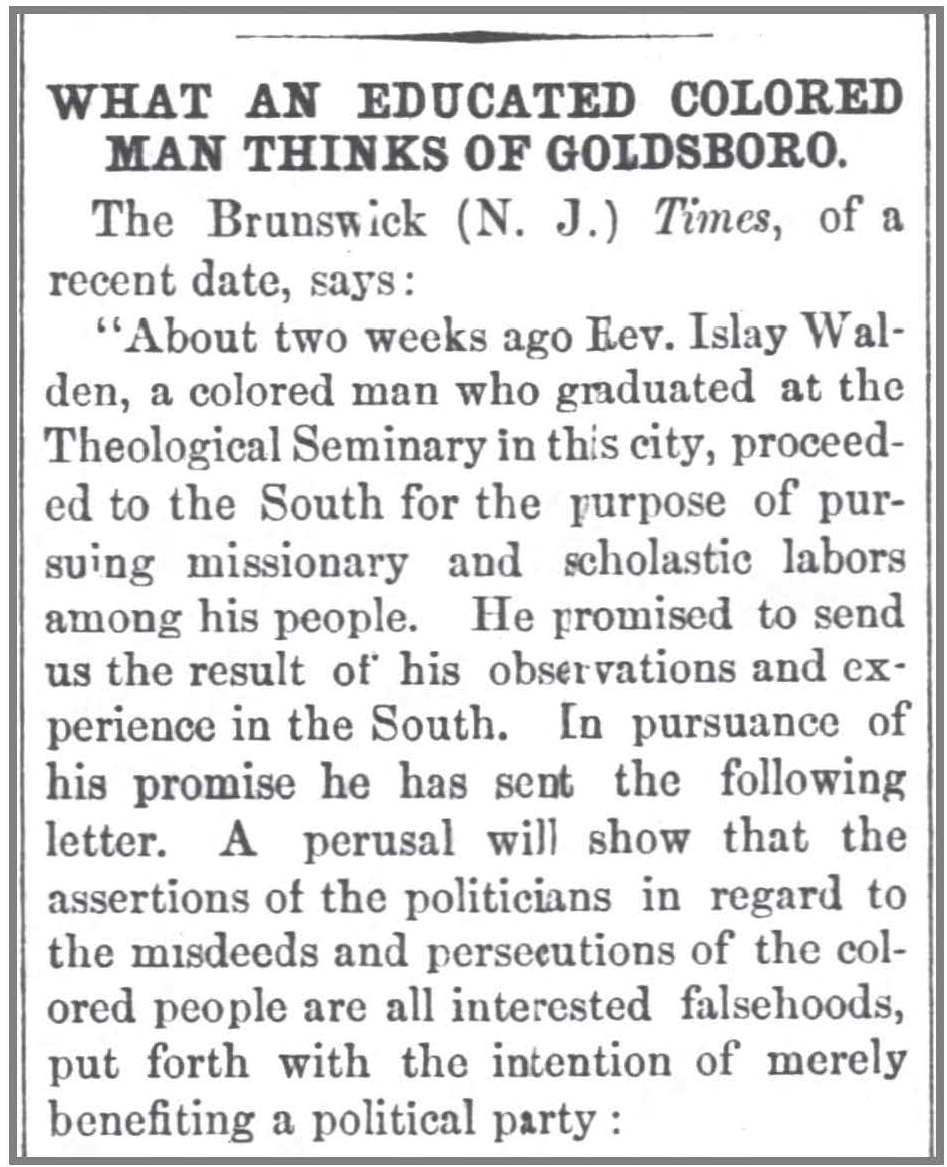
After a few observations about colored dockworkers in Norfolk and the spirit of brotherly love that enveloped black and white railroad workers, Alfred Islay Walden arrived in Wayne County. At Mount Olive, he asserted confidently that “nearly all the families own their homes and farms” and marveled at the reported wealth of “some men.” The former is not true, but the latter could have been a reference to the members of the Simmons and Wynn families, whose relative wealth dated back to their status as free skilled craftsmen and landowners in the antebellum era.

The week in Dudley is particularly interesting, as all of my paternal grandmother’s Henderson and Aldridge ancestors and relatives lived in this community in 1879, when Walden was perambulating. The “excellent school carried on by the American Missionary Society” was probably the school conducted at First Congregational Church, which my forebears founded and attended. The many who taught first and second grades in public schools included my great-great-grandfather John W. Aldridge and his brothers Matthew W. and George W. Aldridge. I’m not sure who owned the saw and shingle mills, but the landowners included the Aldridge brothers and their father Robert Aldridge, Lewis Henderson and his father James Henderson, Hillary B. Simmons’ father George W. Simmons, and other extended kin.

Gboro_Messenger_28_Aug_1879_Islay_Walden_letter

Goldsboro Messenger, 28 August 1879.

Standard