Births Deaths Marriages, Migration, Paternal Kin, Photographs

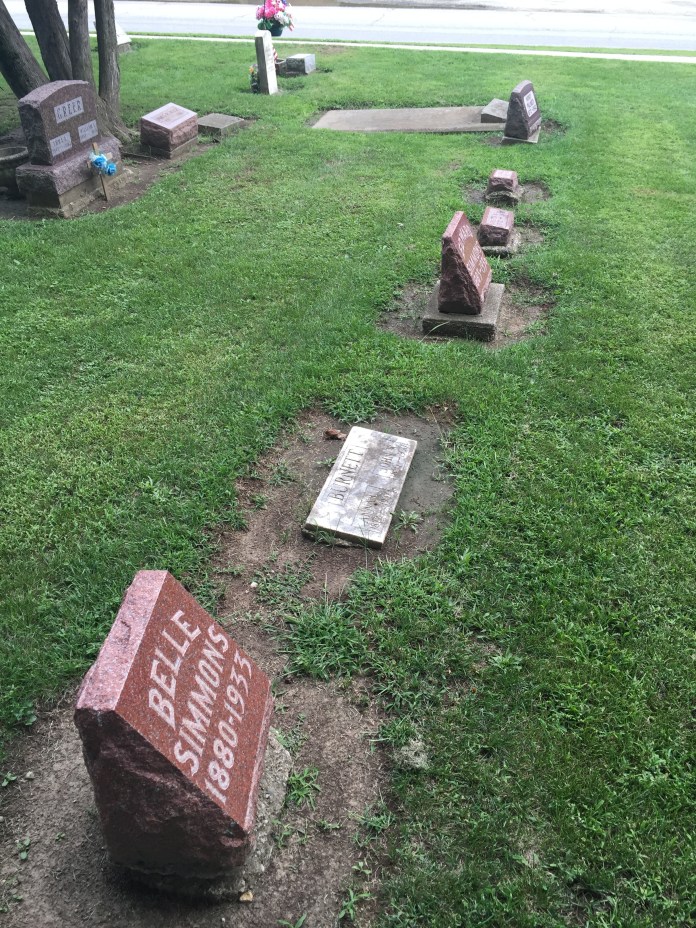
Family cemeteries, no. 19: Mount Hope cemetery, Logansport, Indiana.

IMG_9558

LPT 11 3 1951 F simmons

Logansport Pharos-Tribune, 3 November 1951.

Screen Shot 2016-09-02 at 9.12.37 PM

Logansport Press, 11 November 1951.

Fifty years after they married, Dock Simmons buried his beloved wife Fannie at Mount Hope cemetery at the northern edge of Logansport. The week after her death, her sisters joined him in publishing thanks to all who had expressed condolences for their loss. The notice is my last glimpse of Dock.

My first thought when I found the headstone above was: “How sad. There was no one left — no siblings, no children — to etch in Dock’s death date.” My second: “Wait. Is Dock even buried here?”

Curiously, I have not been able to find Dock’s death certificate. He does not appear to have died in Indiana, whose death certificates are available online through 2011. Where, then? Did he spend his last years with one of Fannie’s sisters? (The Simmonses had sheltered Fannie’s mother and brother.) Perhaps with her nieces or nephews? (He had only one, Harold.)

I sent an inquiry to Mount Hope and received an immediate response from its sexton: “I am sorry to say that there is no indication that Doc Simmons is here.”

Standard
Newspaper Articles, Paternal Kin

Montraville’s mayhem.

I generally view with skepticism lurid newspaper accounts of Negro malfeasance, but it’s hard to ignore the cumulative record of Montraville Simmons’ outrageousness. He beat his wife and children, he seduced his neighbors’ women, he piled up lawsuits.

Here’s a smattering of not even ten years’ worth of Montraville’s mayhem:

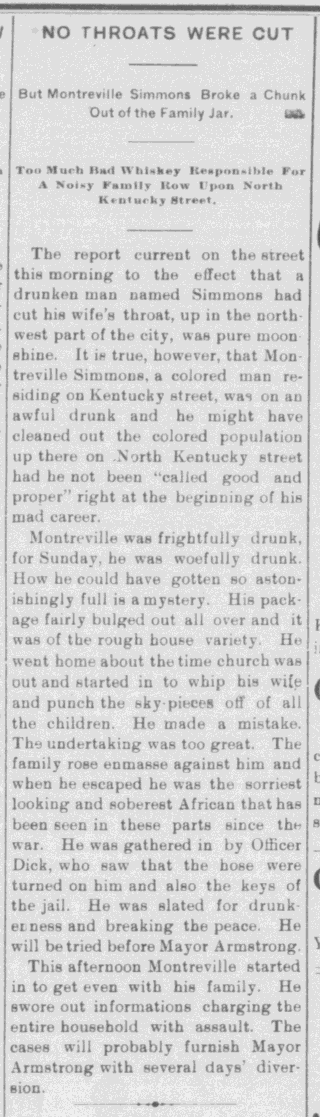
  • In which a drunken Montraville whipped his wife Anna Henderson Simmons (but did not slit her throat) and punched his children, and they rose en masse to beat him back. After his arrest, Montraville pressed charges against his whole family for assault.

KDT 11 13 1899

Kokomo Daily Tribune, 13 November 1899.

  • In 1901, remember, he hit son Dock Simmons in the head with a rock.
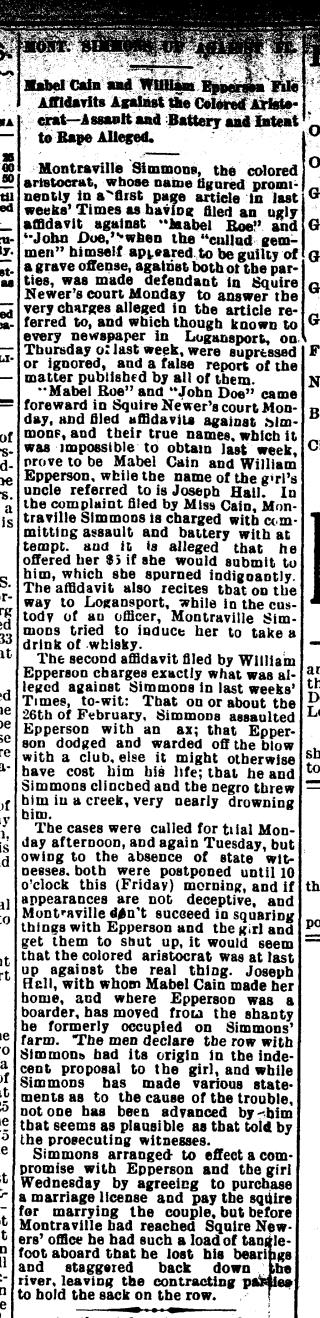
  • In which, long story short: Joseph Hall was a tenant living on Simmons’ farm. Mabel Cain was his niece, and William Epperson was her boyfriend. Montraville allegedly offered Cain $5 for sex. (This, apparently, is the assault and battery with attempt to rape.) Epperson was outraged; he and Montraville fought with ax and club; and Montraville threw Epperson into a creek, nearly drowning him. On the way to court, while in custody, Montraville tried to get Cain to drink some whisky. Later, he offered to squash the matter by paying for a marriage license for Cain and Epperson. He got drunk, however, forgot his promise, and went home.

L Times 3 7 1902

Logansport Times, 7 March 1902.

  • (First, there’s the mention that Montraville was recently a “prominent figure in the colored circles of Ervin Township,” suggesting that he did live in the Bassett settlement during his time in Howard County.) Charles Baker worked for Montraville, and he and his wife Ollie Perkins Baker shared the Simmons’ home. Having noticed that his wife was on extra friendly terms with Montraville and his sons, Charles decided to move back to Logansport. Ollie initially refused, then relented and “kissed the Simmons boys” (who were men in their twenties) as they left. The next day, Ollie insisted on returning to the farm, and Charles finally agreed. He and Montraville began drinking, and the inevitable argument broke out. Ollie took Montraville’s side, grabbed Charles’ gun, and hid it under a mattress. Montraville threatened Charles with a length of wagon wheel, and Charles grabbed his gun and smashed the butt into Montraville’s head. Ollie was screaming to Montraville, “Kill him!,” and Charles ran out of the house when a Simmons son snatched the gun from him. Ollie refused to leave with him. Montraville’s version of events was more laconic: he was in bed, Charles started beating Ollie, Montraville protested, and Charles knocked him in the head.

KDT 1 9 1903

Kokomo Daily Tribune, 9 January 1903.

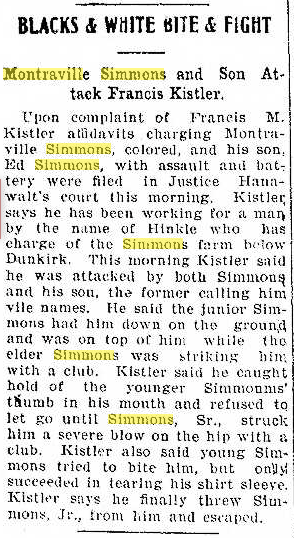
  • In which a white laborer named Francis Kinstler filed assault and battery charges alleging that Montraville and Ed Simmons called him vile names and attacked him. Kistler bit Ed’s thumb, and Montraville clubbed him in the hip. After tearing Ed’s shirt with his teeth, Kinstler escaped.

LPT 7 24 1907

Logansport Pharos-Tribune, 24 July 1907. 

  • Montraville and Edward were acquitted.

LPT 7 27 1907

Logansport Pharos-Tribune, 27 July 1907.

  • As mentioned here, in 1908 Montraville’s second (or third) wife Emily charged him with beating her for breaking a beer-filled mug.
  • And then there was white-collar crime. Montraville mortgaged fifty acres of growing corn for $250. Except he didn’t have any corn growing. This article recounts the tale of Montraville’s tumble from rumored wealth to a “rocky” life.

KDT 5 19 1908

Kokomo Daily Tribune, 19 May 1908.

  • Later that summer, a Logansport paper elaborated on Montraville’s downfall to homelessness, wifelessness and penury.

LDT 8 23 1908

Logansport Daily Tribune, 23 August 1908.


Standard
Land, Newspaper Articles, Paternal Kin, Photographs

Indiana Chronicles, no. 3: Dock Simmons’ Logansport.

As discussed here, in 1900, Doctor T. “Dock” Simmons went in with his father Montraville to purchase 138 acres in Noble township, Cass County.

Things did not go well.

On 9 June 1901, the Logansport Pharos-Tribune reported “Trouble on Watts Farm: Father and Son Cannot Agree on Conducting Affairs.” Dock and Montraville argued as Dock was preparing to take his “best girl” to church. A few days later, Dock proposed to “go and leave the farm forever, giving his father his interest, if he would allow him to take his team [of three horses] away.” “To this the father objected, but the son, tired as he says of the unpleasant conditions that have prevailed on the farm for some time, was determined to leave, and in spite of his father’s threats, hitched up a team and drove to town.” Montraville jumped on a horse, passed Dock on the way into Logansport, and went to the police station. As Dock passed, a police officer ordered him to come in. He and his father then agreed to drop the matter and went back to the farm. Barely two hours later, Dock re-appeared at the station “with a bleeding head and a lump on his cheek” and accused his father of hitting him with a rock. He did not to press charges, however, and the police advised him to go home and “patch up the matter as best he could.” “It is likely that young Simmons will sue for the division of the property which consists of 140 acres.” He apparently did not.  A 9 June 1905 Pharos-Tribune article reported that the Watts farm owned and operated by Montraville, Dock and Montraville Simmons Jr. had been sold at sheriff’s auction to satisfy a $3000 judgment against “the Simmons people.” Somehow, though, they got the land back.

On 26 August 1901, Dock Simmons and Fannie Gibson were married by a Justice of the Peace in Logansport.

PT 8 26 1901

Logansport Pharos-Tribune, 26 August 1901.

The couple made their home in town, away from Dock’s bullying father, as on 26 September the Logansport Daily Report briefly mentioned that Fannie was very sick at their Park Avenue home.  Two months later, on 15 August, Dock was horribly scalded by steam from a blown-out traction engine while working at the farm with his brother (probably Edward). A newspaper article mentioned that Dock, who lived on Helm Street, was confined to his father’s home with terrible burns. A different paper, the Logansport Daily Report, said he lived on “Lockwood street, West Side,” a statement that lines up with the 1905 Logansport city directory: w[est] s[ide] Lockwood 1 [block] s[outh] Melbourne av.”

1905 Dock

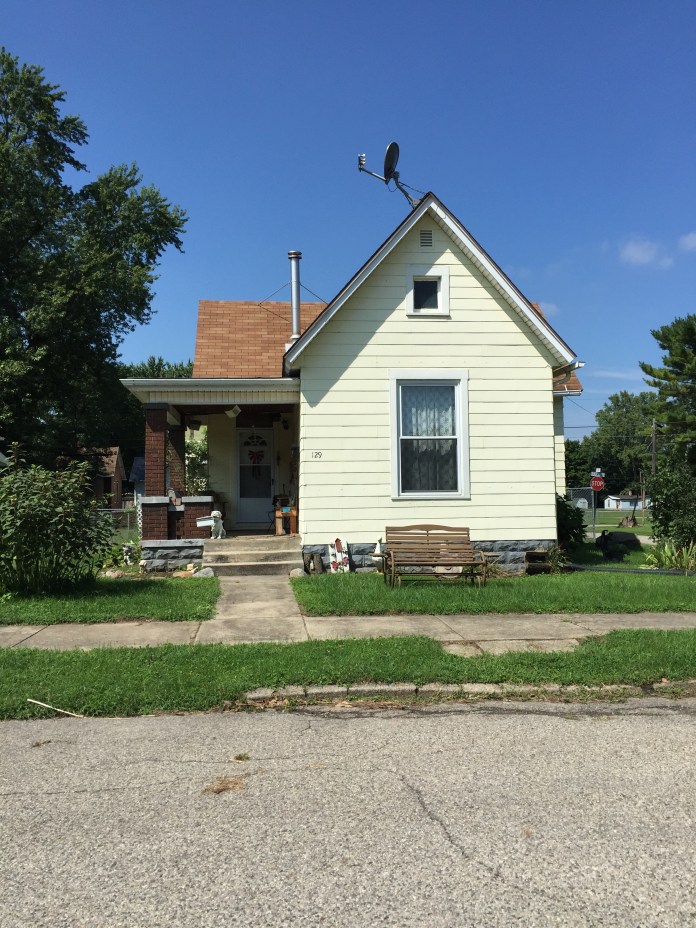
In the 1910 census, Dock and Fannie appear at yet another address: 57 Seybold Street. However, on 6 January of that year, the Pharos-Tribune reported that Fannie had broken her arm in a fall in her yard “two miles west of the city on the Wabash river road.” And on 28 May, when Dock was robbed by a female highwayman, the Daily Tribune described him as a Dunkirk resident. Then on 7 February 1911, in describing an accident in which Dock was knocked from his wagon by a streetcar, the Pharos-Tribuine gave his address as Park Street. It is not until about 1920 that the Simmonses’ address achieves regularity at 129 Seybold Street.

What is going on here??? Were Fannie and Dock really bouncing around Logansport every few months? No, and a modern map of Logansport helps explain. The oldest section of town, shown here underlying the city’s name, formed at the junction of the Eel and Wabash Rivers. The area across the Eel from the city’s point was known as its West Side.  This neighborhood, at A, is informally bounded by the old Vandalia railroad tracks. Market Street is the major thoroughfare shown snaking across the city. It becomes West Market as it crosses west over the Eel. (The spot marked B is approximately where Dock was robbed by the Lady Bandit.) Dunkirk, shown here at C, is an unincorporated community just west of the city. (The Simmons’ farm was a few miles beyond Dunkirk.)

IMG_9555

Here’s a closer look at the west side of the West Side. All the streets named as habitats for Dock and Fannie Simmons — Helm Street, Lockwood Street, Park Avenue, Seybold Street, and Wabash River Road (now West Wabash Avenue) — form a two-block rectangle. It’s possible that they occupied several houses in these blocks before finally settling at 129 Seybold, but it’s more likely that the inconsistencies were the result of the use of a street name to designate an area, rather than a precise address, and they were in the same house the whole time.

IMG_9554

Dock and Fannie seem to have lived at 129 Seybold until the end of their days, and the house, built about 1900, remains home to a Logansport family.

IMG_9466.jpg

Photograph by Lisa Y. Henderson, August 2016.


Standard
Births Deaths Marriages, Newspaper Articles, Other Documents, Paternal Kin

The devoted son.

Edward, the youngest of Montraville and Anna Henderson Simmons‘ children, died 11 April 1936, another victim of tuberculosis.

Koko Trib 4 13 1936 Ed SImmons obit

Kokomo Tribune, 13 April 1936.

A few observations:

  • Edward Simmons was born about 1883. His obituary states that he had “lived in Kokomo since seven years of age.” This was not literally true. He was listed in the 191o census of Eel township, Cass County, as a 20 year-old living with his father Montraville, 63. I take this actually to mean then that he and his family arrived in Kokomo (or Howard County) from Canada when he was 7, i.e. about 1890.
  • Second Baptist Church is a successor to Free Union Baptist Church in the Bassett settlement. From Second Baptist’s website: “In the year of 1887 the Freewill Baptist Church, meeting in the Bassett Settlement, under the leadership of Rev. Richard Bassett disbanded. Its members met with Rev. W. A. Stewart and members of the First Baptist Church of Kokomo. They organized the Second Missionary Baptist Church as we know it today. Services were held in the third ward school on the corner of North Lafountain and Richmond Streets. By the end of November of that year the Second Baptist Church, known as a Missionary Church, had been constitutionally established. The First Missionary Baptist Church made contributions to foreign missions on behalf of Second Baptist. Rev. Richard Bassett served as pastor of Second Baptist Church a short time and he was known throughout the state as an organizer of churches.  He was elected to the State Legislature in 1892, being only the third black to be elected to his position.”
  • Edward’s body lay for viewing in his home for almost a day before his burial at Crown Point cemetery. I assume that his headstone and plot were pre-purchased as his plot is nearly beside previous wife Belle’s grave and their stones are of identical make and engraving style.
  • Speaking of wives, this: “Mr. Simmons was devoted to his mother and father, and remained unmarried until both of them died.” … And then he married and married and married some more.
  • First wife: On 25 February 1915, Edward Simmons married Mary E. Jones in Kokomo. On 21 January 1919, Mary Simmons died of influenza in Kokomo. Her death certificate reports that she was born 2 August 1875 in North Carolina to George Taylor and an unknown mother and was married to Edward Simmons.
  • Second wife: On 28 July 1919, Edward Simmons married Cora White in Kokomo. In the 1920 census of Kokomo, Howard County, at 721 Waugh Street, Edward Simmons, 38, laborer at Globe Range Company; wife Cora, 40; and lodger Roger Jones, 17. On 18 February 1923, Martha Cora Simmons died of myocarditis in Kokomo. Her death certificate reports that she was born 26 April 1878 in Kentucky to Jacob Bushaw and Martha Heardin and buried in Jeffersonville, Indiana.
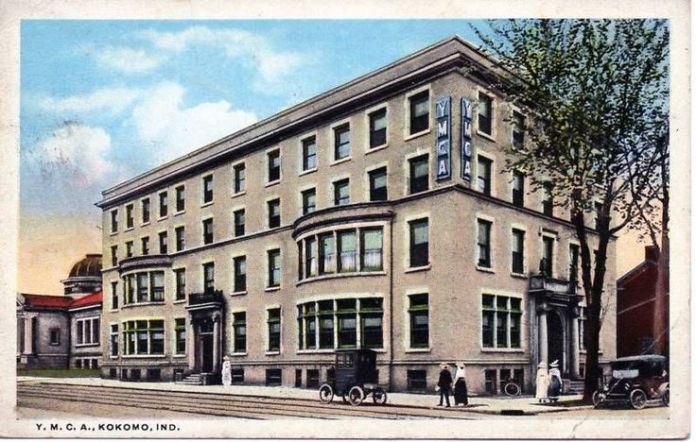
  • Third wife: In the 1930 census of Kokomo, at 800 E. Dixon Drive (owned and valued at $1150) were Edward Simmons, 42, janitor at Y.M.C.A., and wife Belle, 45. [Not to be mistaken in records for bank president Edward Simmons (1859-1945) and wife, Belle George Simmons, who were white.] Bell Simmons died 17 July 1933 at Sipe Theatre in Kokomo of chronic myocarditis. Her death certificate reports that she lived at the Y.M.C.A. at 200 E. Walnut and was born in Ohio to unknown parents. She was buried at Crown Point.

Koko Trib 7 18 1933

Kokomo Tribune, 18 July 1933.

ab9286eb777ccb85c0c15c48cdd022ef

  • Fourth wife: I don’t know exactly when Edward married Cecilia Gilbreath, but it happened during the narrow window between Belle’s and Edward’s deaths in 1933 and 1936. She and Edward had no children. Per Celie’s son Joe L. Gilbreath’s death certificate, filed in Kokomo in 1979, her maiden name was Silvers. Joe was born in Texas, but I know nothing of his mother’s early years..

Koko Trib 4 10 1937 Ed Simmons memorial

Kokomo Tribune, 10 April 1937.

  • “Tenie” was the nickname of Susan Simmons Bassett.
  • How many ways was the other sister’s name spelled? Monsie, Moncy, Muncie, Muncey?
Standard
Births Deaths Marriages, Paternal Kin

Family cemeteries, no. 18: Bassett cemetery, near Kokomo, Indiana.

BASSETT CEMETERY sometimes known as “Bassett Colored Baptist” or “Lower* Settlement Cemetery” is at south edge of SECTION 9 of T. 24-2-E and is in north central ERVIN TOWNSHIP of northwestern HOWARD COUNTY of northcentral Indiana. About midway between hamlets of Poplar Grove and Kappa, it is on north side of road formerly popularly known as “Nigger Pike” and in a farming-area formerly inhabited by numerous Negro families and then able to boast of having a colored Baptist Church and a school for colored children, as well as a blacksmith shop, store, etc. Like the Rush, or Upper Settlement farther east, this settlement is understood to have formed here before the Civil War, and under the sympathetic encouragement of the many Quakers who had settled nearby.

*The term [Lower] alludes to west-flowing Deer Creek’s south fork, which passes more than a mile to the north of cemetery.

This record of genealogically and historically important tombstone-information and a supplement thereto, were prepared for INDIANA HISTORICAL SOCIETY and the STATE LIBRARY by the Pioneer Cemetery Committee of the L’Anguille Valley Historical & Memorial Association, Logansport, Indiana, which is in the adjoining county of Cass, of which committee Mrs. Audna M. Johnson of Logansport is chairman, Fieldwork (18 miles from that city) was done MARCH 29, 1948, the day after Easter Sunday, by committee-members Robert B. Whitsett, 500 Front St., Logansport, and Wm. R. Coder, also of Logansport. Work was done in honor and memory of these early settlers of African descent (who lie buried here in marked graves) and of their many contemporaries who likewise lie buried here but in unmarked graves, and to their numerous descendants and citizens of Logansport, Kokomo, and other communities. Information in Supplement was largely derived from Mr. Ernest Griggs (colored), aged 71, of 1208 West Wabash Avenue, Logansport, but partly from Mrs. Dock Simmons (col.) and Mr. George A. Harness (white) and Mrs. Harriet Shideler (white) and sister, all of Logansport.

SUPPLEMENT: Miscellaneous bits of hearsay information:

“Among person buried in the doubtless dozens of unmarked graves in the Bassett cemetery are Ernest W. Griggs [of Logansport’s] late nonagenarian father [the settlement’s widely known blacksmith] Reuben Griggs, from Tennessee, a former slave, who died about 1917, and who had maintained that he was 94 years of age; and Reuben’s wife Sarah Griggs (Ernest’s mother) who was a daughter of Thomas Artis and who died in about 1887 when Ernest [now — 1948 — 71] was about 10 or 11 years of age, and when she was only about 29; and Dock Simmons [of Logansport]’s late parents: Montraville Simmons, a Negro farmer from North Carolina; and wife Anna [or Annie] Simmons and one son of theirs [Dock’s brother] Montraville Simmons Jr.” … “Daniel Bassett married Dock Simmon’s sister Muncie Simmons.” …

——

The original founders of the Bassett settlement were free families of color from eastern North Carolina by way of Parke County, Indiana. The family who gave its name to the community was headed by Britton Bassett, who was born about 1784, probably in Greene County, North Carolina. (He appears there in the 1830 census.) The plat map below, drawn in 1877, shows the locations of Bassett community school and church and parcels owned by the African-American Bassett, Artis, Ellis, Griggs and Jones families.

Bassett cem

Montraville and Anna Simmons and their children immigrated to Howard County from Canada in the late 1880s. (I don’t know why, of all likely locations, they chose this one.) The Bassett community church had just closed, but they likely joined its successor, Second Baptist, led by Rev. Richard Bassett in Kokomo. Two of their daughters married Bassett brothers.

In 1900, Montraville, Anna and their unmarried children moved twenty or so miles north to Cass County. When Anna died near Logansport in 1906, Kroeger & Strain (still in business as Kroeger Funeral Home) handled her burial. The top half of Kroeger’s “particulars” sheet contains much of the same personal misinformation as Anna’s death certificate and is filled out in the same hand. It’s the rest that’s interesting. Anna was buried at 11:00 on a Tuesday morning at Free Union Baptist Church cemetery. (That name is largely forgotten, but it was the Bassett community congregation.) Her body was transported to Howard County by a team of horses, and the family reserved a carriage. According to the super-helpful lady at Kroeger, “blk. cl. oct. casket” indicated a black octagonal casket. (The “cl.” is a mystery.) The family provided Anna’s clothing, but purchased slippers for her feet. All in all, it seems no expense was spared.
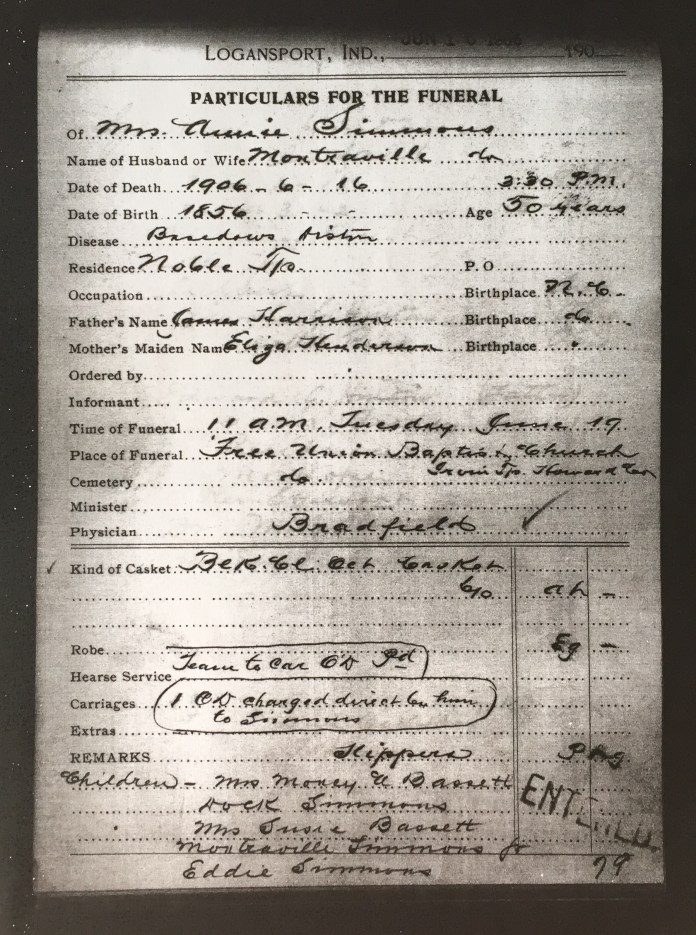
A Simmons Kroeger

Bassett cemetery today contains less than two dozen marked graves. Small swales between stones, however, reveal many more. The Mrs. Dock Simmons who contributed to the L’Anguille Valley Historical & Memorial Association’s cemetery survey, above, was Fannie Gibson Simmons, who’d been married just five years when her mother-in-law Anna died. Ernest Griggs was the stepfather of Anna’s grandson Harold Simmons, son of Montraville Simmons Jr.
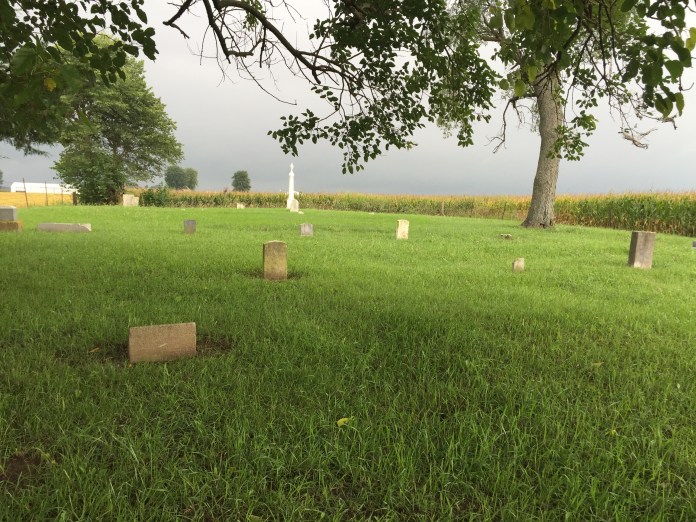
IMG_9568

Bassett cemetery today.

[Sidenote: Indiana county plat books, updated every year, are a genealogist’s dream. Land ownership can be identified at a glance, and every parcel is a nice subset of a square. Here’s the 2015 map of Ervin township, Howard County, showing roughly the same section as above, including the location of Bassett cemetery.]

IMG_9576 (1)

[Another sidenote, on “Nigger Pike”: There were two 19th-century African-American settlements in Kokomo. The road now known as West 400 North would take you to both of them. The Bassett Cemetery report, written in 1948, refers to the formerly popular name of the pike, indicating that general usage had died out by then. (But not otherwise commenting.) The United States has a long history of offensive or derogatory place names.]

Copies of L’Anguille Valley Historical & Memorial Association’s Bassett Cemetery report, Bassett-Ellis plat map, and 2015 plat map courtesy of the well-stocked and -staffed Genealogy & Local History Department, Kokomo-Howard County Public Library; copy of funeral receipt courtesy of Kroeger Funeral Home, Logansport; photograph of Bassett cemetery by Lisa Y. Henderson, August 2016.

Standard
Births Deaths Marriages, Free People of Color, Migration, Paternal Kin

Indiana Chronicles, no. 2: To pay respects.

Ten A.M. After some nervous indecision, I’d parked in the driveway of a nearby farmhouse and was hustling up the road toward a tiny cemetery. The odor of cow dung was large. The crack of thunder at the horizon was larger. I arrived in Kokomo three days after catastrophic F3 tornadoes had ripped through, and I was not anxious to get caught out in the new storms racing across central Indiana. But I’d come 600 miles for this, and I wasn’t leaving before I got what I came for.

With his wife dead and nothing to hold them in Onslow County, North Carolina, James Henderson gathered up his children and pushed 60 miles northwest to Sampson County. There, James married Eliza Armwood and, about 1852, their first child was born. It does not take a great leap of imagination to picture my great-great-great-grandfather Lewis, oldest of James’ first bunch, cradling his baby sister Anna Jane in his arms or hoisting her to his shoulders in the years before his own children were born. Nor is it hard to conjecture his sense of loss when Anna left with her new husband Montraville Simmons to join his family in impossibly faraway Canada. She was the only one of James’ children to leave North Carolina, and she did so in a big way. The Simmonses eventually quit Ontario for Indiana, but, practically speaking, the Midwest was no closer to home. It’s not clear when Anna last saw any of her people, but it’s a sure bet that none ever visited Cass County, and not a one has ever visited her grave.

Thus, I found myself navigating the grid of backroads between Logansport and Kokomo, one eye on the western sky as bands of rain lashed my windshield. Properly speaking, I was not headed to Anna’s actual grave, for it is unmarked. But to stand in Bassett cemetery would be close enough.


Standard
Free People of Color, North Carolina, Paternal Kin

Friend or family?

I was reminded of this cohabitation:

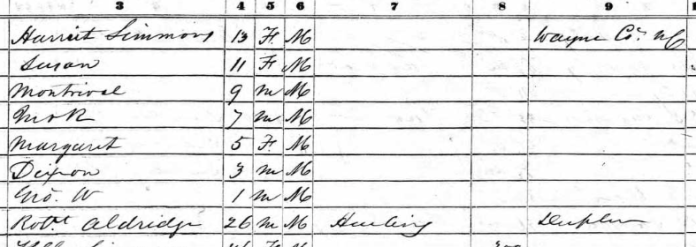
Screen Shot 2016-08-28 at 12.27.30 PM

In the 1850 census of South Side of Neuse, Wayne County, North Carolina: farmer Calvin Simmons, 42, wife Hepsey, 46, and children Harriet, 13, Susan, 11, Montrival, 9, Jno. R., 7, Margaret, 5, Dixon, 3, and Geo. W., 1, plus Robt. Aldridge, 26, who worked as a hireling.  Calvin was born in Sampson County, Robert in Duplin; the others in Wayne.

This, of course, is the family of Montraville Simmons, recorded in the last census before they emigrated to Kent County, Ontario. Who was my great-great-great-grandfather Robert Aldridge to John Calvin Simmons and his wife Hepsie Dixon Simmons? A farmhand? A boarder? A poor relative? At this point, I know nothing of Robert’s parents, so I am intrigued.

Standard
Births Deaths Marriages, Paternal Kin, Photographs

Family cemeteries, no. 17: Crown Point cemetery, Kokomo, Indiana.

Three of Montraville and Anna Henderson Simmons‘ children are buried in Crown Point, though only two have stones:

Plus, one of Edward’s wives, Belle Simmons:

Susie Simmons Bassett, who died in 1937, lies beside her sister in an unmarked grave. The graves lie in a broken line in section 221 of the cemetery.

IMG_9551

Photos taken by Lisa Y. Henderson, August 2016.
Standard
Free People of Color, Land, Migration, Paternal Kin

Indiana Chronicles, no. 1: East half and Northwest quarter of Section 29, Township 27 North, Range 1 East.

On 10 April 1900, Montraville Simmons and Dock Simmons of Howard County, Indiana, paid $6000 to the heirs of Israel Watts for this real estate:

Beginning at the North-west corner of said Section; thence West Twenty-eight -28- chains and Eighty-two -82- links to a stone; thence South Twenty-eight -28- chains and Seventy-one -71-links to a stone on the North Bank of the Wabash and Erie Canal; thence Westwardly along the North line of the Wabash and Erie Canal Eighteen -18- chains and Sixty-three -63- links to the East line of the Public Highway; thence South eastwardly along the East line of the Public Highway to the North Bank of the Wabash River; thence Eastwardly along the North line or meanderings of said Wabash River to the East line of said Section Twenty-nine -29-; thence North along the East line of said Section to the place of beginning, containing in said tract One Hundred and thirty-eight -138- acres, more or less.

Excepting from the Warranty the Wabash and Erie Canal and the P.C.C. and St.L.R.R. Co. right-of-way.

The decade that the family held the “Old Watts Farm” was a non-stop circus of squabbling with neighbors, domestic abuse and ruinous mortgages. (More on all that later.) In the middle of it all, Anna Henderson Simmons lay her burden down. After a few years tied up in Anna’s probate, and the deaths of Montraville Sr. and Jr., the property passed out of the Simmonses’ hands.

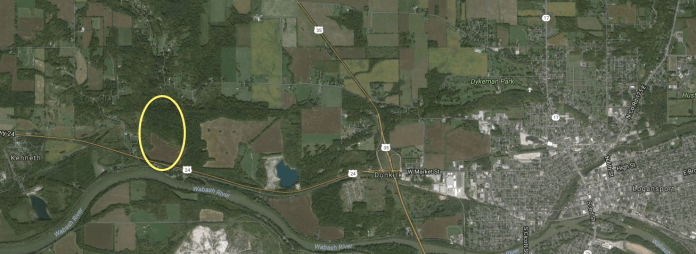
Astonishingly, though, the parcel is largely intact. Here it is in an undated (but perhaps mid 1930s) Cass County, Indiana Plat Book and Atlas, found at the Cass County Public Library:

IMG_9503

And a 1951 map of Cass County prepared by Charles D. Murphy, Cass County surveyor (also found at the library):

IMG_9499

And an up-to-date county plat map hanging in the Cass County Recorder’s Office:

IMG_9457

And in a screen-capture from Google Maps:

Screen Shot 2016-08-26 at 7.27.31 PM

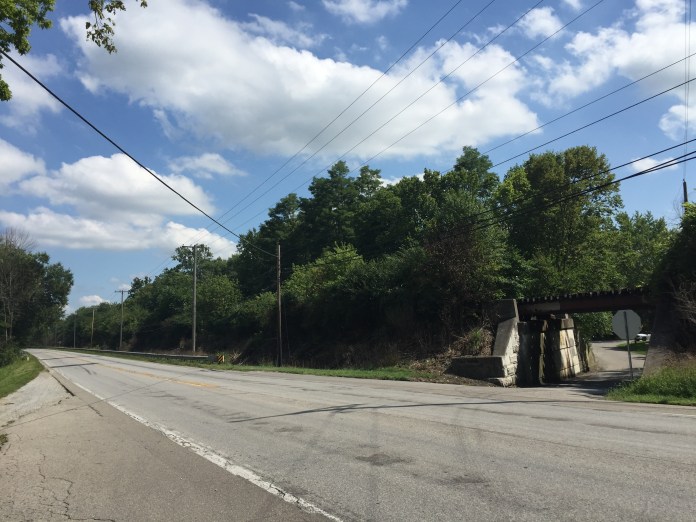
Highway 24 cuts across the bottom of the property running alongside the railroad (formerly owned by Pittsburgh, Cincinnati, Chicago & Saint Louis Railroad.) It’s difficult to tell where the canal once ran. Presently, there’s no road off 24 leading into the Simmons farm. However, if, headed west, you hang a sharp left onto Georgetown Road, you’ll pass under the railroad trestle and, on the left as the road curves to follow the Wabash River, you’ll see a private driveway that leads into what was Montreville’s riverfront. (Now occupied by Morels on the Wabash, offering cabins and campsites.)

IMG_9508

Looking across Highway 24 to the trestle over Georgetown Road. The land stretching away to the left (east) was Montreville Simmons’.

IMG_9490.JPG

The Wabash River looking west.

Metes and bounds set forth in deed (that I copied, but neglected to write down the book and page numbers for), Cass County Recorder’s Office; photographs by Lisa Y. Henderson, August 2016.
Standard
Births Deaths Marriages, Free People of Color, Migration, Newspaper Articles, Paternal Kin

The last will and testament of Anna Henderson Simmons.

STATE OF INDIANA, CASS COUNTY, SS:

BE IT REMEMBERED, That on the 10th day of July, 1906, the following proceedings were had in the Cass Circuit of Indiana, in the matter of the Estate of Anna Simmons, deceased, as entered of record in Probate Order Book No. 31, page 589, which proceedings are in the words and figures as Follows, to-wit:

IN THE MATTER OF THE ESTATE OF ANNA SIMMONS, DECEASED         PROBATE OF WILL, July 10, 1906.

Comes now on this 10th day of July 1906, John W. Markley, one of the subscribing witnesses and presents to the Clerk of the Cass Circuit Court, for probate the will of Anna Simmons, deceased, dated May 14th of May [sic] 1906, and shows by the affidavit of John W. Markley one of the subscribing witnesses to said will in proof thereof, that at the time of execution of said will the said Anna Simmons was a person over twenty one years of age, of sound disposing Mind and Memory and not under any coercion or restraint, and that said decedent departed this life testate in Cass County in the State of Indiana, on the 16th day of June, 1906. And thereupon said will is admitted to probate by the Clerk of the Cass Circuit Court as the last will and testament of Anna Simmons, deceased, And said will and the affidavit of John W. Markley in proof thereof are now spread of record by the Clerk of the Cass Circuit Court, in the Will records of Cass County Indiana, as the last will and testament of Anna Simmons, deceased, which will and affidavit in proof thereof are in these words

In the name of the benevolent Father of all

I Anna Simmons wife of Montraville Simmons being of sound and disposing mind and memory do hereby make and publish this as my last Will and Testament, hereby revoking and making void any and all wills by me at any time heretofore made.

First: I direct that all my just debts be paid out of the first moneys coming to the hands of my executor hereinafter named.

Second. I will devise and bequeath to my children, Moncy A. Bassett, Doctor T. Simmons, Susan Bassett, Montraville Simmons Jr. and Edward Simmons, a certain mortgage and debt secured thereby, which mortgage is executed by Montraville Simmons March 23rd 1903, to me to secure money advanced to said Montraville Simmons by me of funds received from my father, as a portion of my interest in his estate. Said mortgage is recorded in the Recorders office in Cass County Indiana in mortgage record No. 49 page 314, but the devisees aforesaid are not to compel a collection of said debt as long as the interest on said debt is paid by the said Montraville Simmons.

In the event that said Montraville Simmons becomes incapacitated for work and has no income so he is able to pay any interest on said mortgage & it becomes necessary to foreclose said mortgage to preserve the property and debt, it is my desire that the children above named look after the comfort of their father and to such end that they use such p[art of the prcoeeds said mortgage as is necessary to provide for his subsistence and comfort.

I hereby appoint Doctor T. Simmons my son to act as Executor of this my last will.

In testimony whereof I have hereunto set my hand this 14 day of May 1906.  Anna (X) Simmons

Witness Benjamin D. Bradfield

Subscribed by the testator in our presence as his last will and testament and at her request, subscribed by us in her presence and in the presence and in the presence of such other as witnesses to said last will.     John W. Markley, Benjamin D. Bradfield

——

Beyond the gobsmackedness of finding that Anna Henderson Simmons had a will at all, there is this:

  • The will is dated just a month before Anna died on 16 June 1906. Her mind was sound, but she knew her body was failing.
  • All she left to her children was the mortgage she held on her husband Montraville Simmons’ property. She had secured the mortgage to ensure that Montraville repaid a loan she made him.
  • Incredibly, she cites as the source of the money lent “funds received from my father, as a portion of my interest in his estate.” Funds received from her father’s estate???? Anna’s father, James Henderson — my great-great-great-great-grandfather — died about 1890 in Wayne County, North Carolina. I have found no probate records for him there or anywhere.
  • Montraville executed the mortgage on 23 March 1903. According to a lawsuit Anna filed in December 1905 — which had the effect of stalling claims by Montraville’s many and exasperated creditors — Montraville was in debt to her for $3500. While some small portion of that may have been inherited from her father, it is hard to believe that James Henderson’s estate totaled $3500, much less that his estate remitted that amount to the one child (of his dozen or so then living children) that he had not seen in 30 years.
  • Even if their father defaulted on the mortgage — and despite his abuse of his family, about which more later — Anna wanted her children to care for him. She could not have known, of course, that her compassion would be wasted, as he would remarry within the year and set off a new wave of scandal.
  • To wit, from the 9 April 1907 Logansport Pharos-Tribune: “Married [to Emily Langford] March 11 and separated March 16, and in the meantime to have another darky come along and love his wife right in his presence is the ‘terrible’  experience which Montraville Simmons was ‘his’ during this short but eventful honeymoon.” Montraville (described as a “darky of large proportions”) claimed that Emily allowed William Wilson to “hug, kiss, caress and fondle” her in his presence and, when he protested tried to kill him with a flatiron. Montraville filed for divorce, but on 9 July 1907, the Pharos-Tribune reported that the Monticello, Indiana, paper had reported that Montraville “is gathering up the ragged remains of his matrimonial venture in our local colored colony” and had dropped the divorce action. This dysfunction roiled on into 1908, when the Logansport Daily Reporter alerted Cass County that Montraville had beaten Emily badly for breaking a mug and spilling his beer.
  • Witness Benjamin D. Bradfield was an Irish-born doctor who practiced for decades in Cass County. John W. Markley owned a title company.
  • Dock Simmons did not prove to be a worthy steward of his mother’s estate. (To be fair, the “more notoriety” label was probably more applicable to his father than to him.) From the 9 February 1909 edition of the Logansport Times:

Screen Shot 2016-08-25 at 9.29.06 PM

  • Anna’s legacy disappeared under a flurry of lawsuits. Later newspaper reports show that by 1909 Montraville and the children were under siege by various creditors holding judgments totaling hundreds of dollars. Montraville Jr. died in 1910 at the tender age of 28; his father followed two years later.
Standard