Agriculture, Business, Land, North Carolina

“I told anybody that it was my land”; or, “Why don’t you stir it while it’s hot?”

The ninth in an occasional series excerpting testimony from the transcript of the trial in J.F. Coley v. Tom Artis, Wayne County Superior Court, November 1908.

(Tom Pig Artis’ testimony continued from here.)

CROSS EXAMINED.

I have been claiming this land all the time. I have not been listing it for taxes. Before the mortgage was given I was listing it. I have not listed it ever since 1892, ’till this last year. I listed my other property, but don’t know that listed this land. I have been mortgaging the crops on this land. I mortgaged it one year in 1893. I guess I did. To Mr. Minshew. I don’t know that I described the land in the Minshew mortgage as the land belonging to Napoleon Hagans. I don’t say I didn’t. I can’t tell the date, but I have rented some land from Hagans. Two or three years. That mortgage to Minshew was intended to cover the crops to be made on the 30 acre piece. (Defendant objects to all about mortgage.) I don’t know that I made another crop lien on that same land in 1895. I don’t remember that I made one then. I made a mortgage to Mr. Peacock in Fremont on the same land. I described the land as mine. I don’t know that I said it was known as the Hagans land. I made a crop lien to Peele & Copeland in 1906. That was to cover crops on the 30 acre piece I guess. I described it as the land known as Will Hagans land. I guess, I don’t know. I might have described it as mine. I made Peele & Copeland another crop lien in 1907 on the same land. I described it as the land known as the Will Hagans land, if its there, I expect I did. I didn’t say in that mortgage that it was my land. On April 16th 1908 I made Peele & Copeland another crop lien. I don’t know that I gave them a mortgage this year. I may have. I guess I did. If it shows it, I did. I described it as my own land. First time that I ever put a statement in a paper or that made reference to crop on this 30 acre piece, that they would be grown on my own land. On March 23rd 1908, I made a real estate mortgage on this land to Peele & Copeland for $420.00. This crop lien I made this year, and also this mortgage on this land was made after the action was made to recover the land. I rented some other land from Hagans beside the 30 acre piece. I didn’t have any of the Hagans land under rent beside the 30 acre tract last year in 1907. I had land rented off, but not the Hagans land. (This action was brought March 18th 1908.) The real estate mortgage to Peele & Copeland was given Mar. 23rd, 1908. Was served Mar. 27th 1908, and the crop lien Apr. 16th 1908.) Last year I didn’t have any of W.S. Hagans’ land rented. I cultivated only the 30 acre tract, and lived in the house on the other side. (Summons introduced by Plaintiff.) At the time Mr. Cook was negotiating about buying this land from Hagans I was cultivating the 30 acre tract, and was living across the line on the 24 acre piece. I knew that Cook was trying to buy the Calv place. I didn’t know that he was trying to buy both places then. Not until I heard from other people that he was trying to buy both places. I heard that a few days before he came up here to get the papers fixed. When I heard this news, I didn’t go see Mr. Coley. I happened to see him. I was just passing and saw him. He spoke to me first about it. He said he understood Mr. Cook was about to buy all the land about there, and mine too. He said why didn’t I let him know. He said if he had known it he would have bought some. I told him I understood they were going to fix the papers the next day. I said if he is, I am going to Goldsboro, and he said if you go, and he and Cook don’t trade, tell Hagans to send me a note. I went the next day, and I told him exactly what he told me. I carried it to him. The rumor was that he Cook was buying both places. I told Coley that if anybody got it I would rather him get it, for I didn’t think that I could get along with Mr. Cook. I didn’t have any reference to my place. I didn’t tell Coley that I didn’t mean the 30 acre piece. I told him myself. I told him I understood Mr. Cook was trying to but all the land down there, trying to buy the 30 acre piece and the 24 acre piece. I told him I was coming to Goldsboro, he asked me to speak to Hagans. I told him if anybody had to have it, I had rather for him to have it than Cook. I came and saw Hagans. I didn’t ask Hagans not to sell it to Cook. I didn’t ask him to let Coley have it. I didn’t tell him I would get along better with Coley than Cook. I didn’t say that. I don’t remember that I told Hagans I could get along better with Coley than Cook. I don’t swear, but I never told him that. I told Coley. I told Hagans what Coley said, if he and Mr. Cook didn’t trade to send him a note. Hagans and Coley did trade. They went to my place. I got in the buggy with him. Rode over to Mr. Coleys. They were talking but I don’t know what they were talking about. They were around the house. I didn’t hear a word except that Hagans would see him later, maybe some other things were said, I don’t remember. I didn’t hear how much Coley was to give him for it, not until he had bought it. Mr. Coley came, but I don’t know if he came to see me. He just passed by. He didn’t say anything about renting it. He said he never knew where these lines were, and he said he wanted me to go around and show them to him. I don’t know whether he had any deed for it or not. I went all around and showed him the lines between his and mine too. There was a fence off the line a little. He told me to take the fence and put it around the pasture. He didn’t say he wanted me to. I didn’t move the rails of the fence, because Mr. Cook saw me with my cart. He said that fence was on the line of the 30 acre place, and told me not to move it. I didn’t because Cook said it was on the line. I went to move it. This fence was on the line between the 30 acre place and Cook’s line, not between the 30 and 24 acre pieces. Mr. Coley came back at another time, and talked about renting the land. Never reached any agreement. He said Uncle Tom aren’t you going to rent it. I said “No, I never rented my land.” I told him all the time it was my land, when I was showing him the corners etc. He was Now was the time to stir while it was hot. I told him I didn’t have to rent my own land. I told anybody that it was my land. I don’t know when I told Coley first it was my land. He knew I suppose that it was my land. I told him before I went to see Hagans that it was mine. I offered to buy from Hagans an acre along the 24 acre piece. He asked me if I couldn’t get somebody else to buy the rest of it. I told him I didn’t know. I never offered to buy the 30 acre piece, in presence of Reid or anybody else, nor offered to pay any on the mortgage, but I told him I could take up the mortgage. I told him that this year, and told him so last year. This last winter. I made a mortgage to H.J. Harrell in 1895. It was intended to cover crop on the 30 acre tract. I described it as the Hagans & Ward land. I tended some land on the Ward place, the other was on the 30 acre piece. That was on the 11th of May, 1908. (Book 18, Page 180) Reason I didn’t move the fence was because Cook stopped me. I didn’t go to see Coley and tell him what Cook said. I told him about about it. I don’t remember where I told him, but I told him. I said Mr. Coley Mr. Cook said you gave him these rails, and he said no he didn’t. Cook had done moved the rails. I was aiming to have the line run. I went to have the lines turned out. I knew the fence was off the line for maybe 25 years. I never have had it run. I didn’t advise Mr. Coley to have it run. I showed Mr. Coley lines and corners, because he asked me to go around with him. I told him at the time it was my land. I didn’t tell Coley he would get Cook’s tobacco barn. I told him the line would strike the tobacco barn. It was on my side. There had been a division since then. He had alreday told me that Hagans had sold him the land, he wanted to know the land between me and him. He said, “Let’s go all around and we went with two more men. I told him it was my land. He asked me why didn’t I stir it while it was hot. He said not to let it get cold, do it now. I gave Peele & Copeland a lien on this land for $420. for supplies etc. I owed for supplies last year and for now. I have a statement of how much I owed him. He had crop lien as security last year. I paid him some. I owed him about $300 together with the mule claim and cow, they amounted to about $200 or $300. I gave him a note for $420. I bought the mule from Mr. Pat Coley. He stood for me. That was put in the Peele & Copeland mortgage. They took up my claim for Mr. Pat Coley. I gave them a mortgage for $420.

To be continued.

Standard
Births Deaths Marriages, Enslaved People, North Carolina

Collateral kin: Winnie Coley.

I’ve talked about her here and here, but now I’m a little uncertain. Were there actually two Winnie Coleys? Were the mothers of Cain and Caroline Artis and William M. Coley and Patrick, Philip and John Revis Coley different women? Here’s what I know — and conjecture — about her:

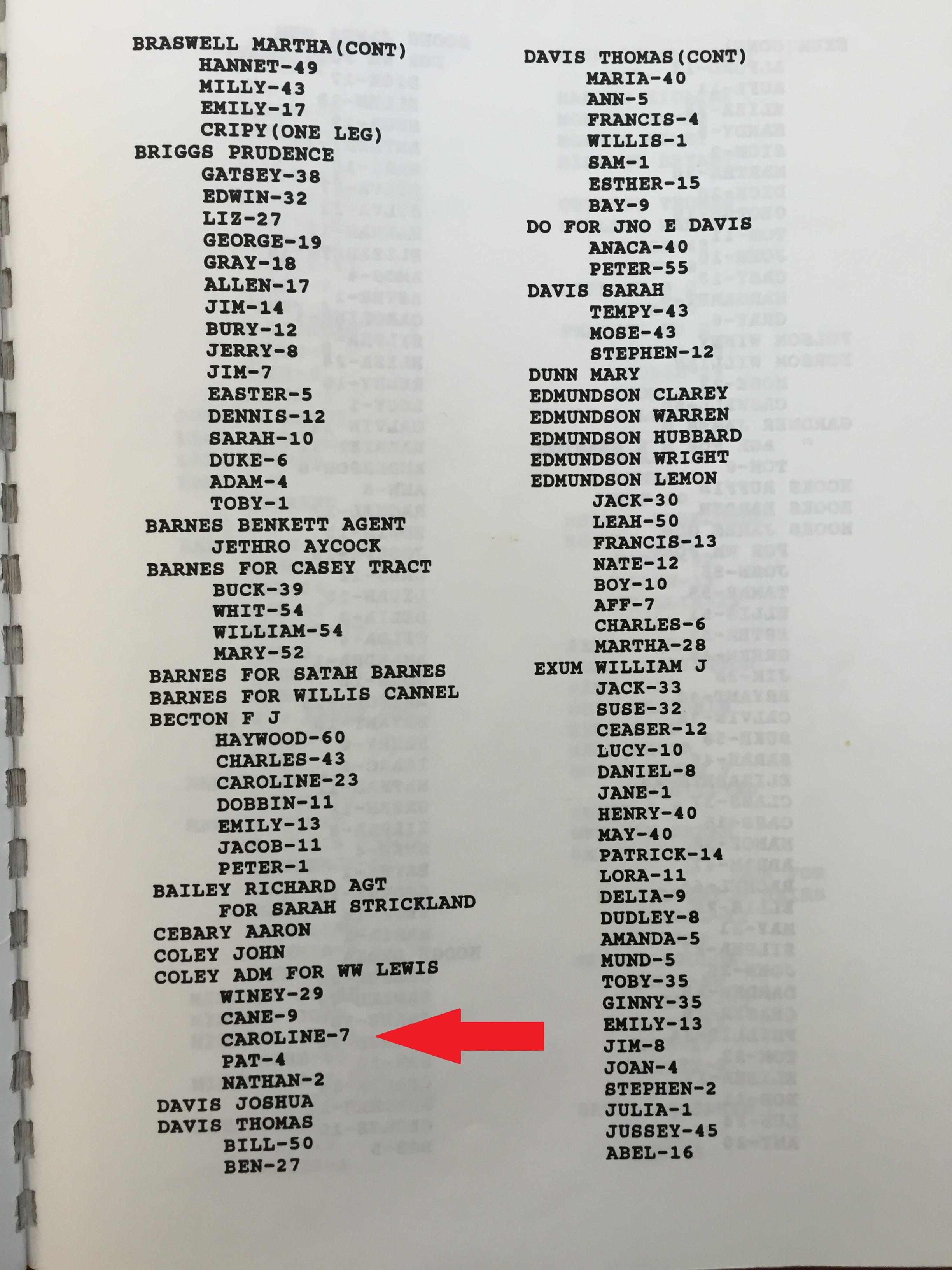
  • In 1863, North Carolina’s Confederate government levied a tax on slaveholders across the state. Tax lists survive for only a few counties. (Most deliciously for me, Rowan is one.) I have not been able to find Wayne County’s anywhere, but fortuitously — and a little suspiciously — they were abstracted in Martha Ellis Will’s Wayne County North Carolina Court House Records Four Books 1780-1896. The 1863 tax list of Davis District, shows John Coley, Administrator of Estate of W.W. Lewis, with five taxable slaves. It’s the first record of Winnie and her children:  Winey, age 29; Cane, age 9; Caroline, age 7; Pat, 4; and Nathan, 2. [Who was W.W. Lewis? Coley himself is not listed with slaves, but the 1860 slave schedule tells a different story. There he reported owning 114 men, women and children. And where were Winnie’s other children?]

 John_Coley_Adm

  • At #272 of the 1870 census of Pikeville, Wayne County, the unmarried 55 year-old John Coley heads a household of possibly related white folks. In every direction, there is evidence of his toppled fiefdom — African-Americans bearing the surname Coley. Were they related to him? To each other? How? (And the non-Coleys in the neighborhood — who among them were also John’s former slaves, men and women who’d disdained his name?) For now, a few. At #270, Trecendia Coley, 36, with Peter, 5, and Dallas Coley, 5. At #273, Winney Coley, 41, with John R., 17, Phillipp, 11, and Mack Coley, 5. At #276, Peter Coley, 50, Harret, 44, Devrah, 16, Delliah E., 15, Napolian, 14, Nicholas, 12, and Thomas V. Coley, 7. At #281, Thomas Coley, 35, Charlotte, 27, Branton, 8, Bealie, 6, Trecendia, 4, Harriett, 1.
  • On 5 May 1872, Patrick Coley, son of Peter Coley “sen.” and Winney Coley, married Debby Coley, daughter of Peter Coley and Hannah Coley in Greene County. [The 1870 mortality schedule of Wayne County records the death of 52 year-old black farmer Peter Coley of Pikeville. Was he Peter Sr.? Also, though no ages are listed on the marriage license, the 1880 and 1900 censuses show Patrick’s birth year as 1849, which is not consitent with the “Pat” listed in the 1863 tax list.]
  • On 2 Oct 1878, Richard Baker applied for a marriage license from the Wayne County Register of Deeds for Madison Artis of Wayne County, 22, colored, son of Calvin and Serena Artis, father living, mother dead, and Caroline Coley of Wayne County, age 24, colored, daughter of Adam Morris [sic, Artis] and Winny Coley, both living.  The ceremony was performed by Fred G. Becton, Justice of the Peace, on 3 Oct 1878 at Winnie Coley’s in Nahunta, before E.L. Becton, Thomas Artis, and Jonah Williams.  [Thomas Artis, son of Celia Artis, was Madison Artis’ uncle. Jonah Williams was Caroline’s uncle, Adam Artis’ brother.]
  • In the 1880 census of Pikeville, Wayne County, Winnea Coley, 71, is listed with sons Jack R., 26, Phillip, 20, and grandson Dallas Coley, 15. [71?!?! This is the same Winnie Coley listed in 1870, but her age is inexplicably 20 years off.]
  • On 5 November 1881, in Wilson County, Winnie Coley, 50, married Alex Barron, 57. The ceremony took place at minister Jessie Baker’s house in the presence of Mary Ellis, Peter Coley and Red Barnes. [Is this our Winnie? If so, she never appears elsewhere with this husband. Which Peter Coley was this?]
  • On 16 February 1882, Phillip R. Coley, 22, son of Peter Coley (dead) and Winnie Coley (living), married Ann Exum, 18, in Pikeville, Wayne County, in the presence of witnesses Christopher Coley, Gard Coley and Olin Coley. [“Grad” Coley appears in the 1870 census in household #279 as the son of Howell and Amy Coley. In 1886, Gard married Ollin Coley [Sr.]’s daughter Miranda. Their witnesses were Philip R. Coley, Dennis Coley and Christopher Coley. Christopher appears in the 1870 census of Pikeville, Wayne County, as the son of Lafayette and Julia Coley. Philip R. Coley witnessed Christopher’s 1885 marriage to Sarah Powell. Ollin Coley Jr. married Christopher’s sister Imogen in the presence of Philip R., Dennis and Christopher Coley in 1885.]
  • On 11 Apr 1888, Charles Battle applied for a marriage license for Cain Artis of Wayne County, age 35, black, son of Adam Artis and Winny Artis, both living, and Margaret Barnes of Wilson County NC, age 38, black, daughter of Sherard Edmundson, dead.  P.D. Gold, minister of the gospel, performed the ceremony on the same day at Margaret Barnes’ home in Wilson before H.G. Phillips, Henrietta Clark and Mary J. Davis.
  • On 26 February 1891, William Coley, 22, son of Napolion Hagans and Winney Hagans, of Gardner’s Township, Wilson County, married Minnie Woodard, daughter of Alfred and Sarah Woodard of Taylor’s township, Wilson. Cain Artis applied for the license and stood as a witness.
  • In the 1900 census of Wilson, Wilson County: Willie Coley, 30, wife Minnie, 30, children Effie M., 8, and James M., 6, mother Winnie Coley, 65, and sister Zilley Coley, 38. [Where was Zilley in previous censuses? Or was she, in fact, Minnie’s sister?]
  • On 21 July 1909, in Wilson, Wilson County, William Coley, 42, son of Pole Hagans and Winnie Coley, married Mary Mercer, 34, daughter of Sam and Julia Mercer. Jonah Williams, Primitive Baptist Minister, performed the ceremony at the home of W.M. Coley in Wilson.
  • Winnie is not found in the 1910 census or beyond and presumably died between 1900 and 1910.
  • On 23 March 1917, farmer Cain Artis died in Wilson County of pulmonary tuberculosis.  His death certificate reports that he was born March 1851 to Adam T. Artis and Winnie Coley, both of Wayne County NC.  Informant for the certificate was W.M. Coley of Wilson NC.
  • On 15 December 1920, Phil R. Coley died in Nahunta, Wayne County, of stomach cancer. His death certificate reports that he was born around 1861 to Peter Coley and Winnie [no last name], both of Wayne County. J.A. Coley was informant.
  • On 26 January 1928, William Coley died in Wilson County of pulmonary tuberculosis. His death certificate reports that he was born about 1867 to Pole Hagans and Winnie Coley, both of Wayne County.  Informant for the certificate was Mary Coley of Wilson NC.
  • On 3 September 1934, Jack Revis Coley died in Nahunta, Wayne County, of bladder and prostate cancer. His death certificate reports that he was born about 1850 to Peter Coley and Winnie Coley, both of Wayne County.  Informant for the certificate was Philip E. Coley of Fremont NC.
  • In summary, Winnie Coley was born about 1830 and died 1900-1910. Her children included Cain Artis (circa 1851-1917); Caroline Coley, born about 1854; John Revis “Jack” Coley (born in the early 1850s-1934); Philip R. Coley (circa 1860-1920); Patrick Coley (??-??); and William M. Coley (circa 1867-1928); and possibly Nathan Coley (circa 1861-??) and Lafayette Coley (circa 1842-1913).
  • Fun facts: Philip R. Coley’s son Philip Elmer Coley married Genetta Thompson, daughter of Celebus and Lillie Beatrice Artis Thompson. Lillie was a daughter of Adam T. Artis and a half-sister of Cain Artis. Genetta, then, married her half-uncle Cain’s half-brother’s son.
  • Fun facts, 2: William Coley’s father Napoleon was the half-brother of Frances Seaberry, who married Adam Artis. Thus, William’s half-brother Cain was also his first cousin by marriage.
Standard
Births Deaths Marriages, Maternal Kin, Oral History, Virginia

Kin to Thomas Jefferson.

My mother told me this long ago, and today she repeated it: “I don’t know where this came from, but they always used to say that Papa was kin to Thomas Jefferson.”

Thomas Jefferson’s mother was Jane Randolph Jefferson. Jane had a sister, Susannah Randolph, who married Carter Henry Harrison. Carter and Susannah had a son named Randolph Harrison, who had a son, Thomas Randolph Harrison; who had a son, William Mortimer Harrison; who had a son, Edward Cunningham Harrison.

“Papa” was John C. Allen Jr.  Papa was Edward C. Harrison’s son.  And so, as Thomas Jefferson’s first cousin five times removed, Papa was kin indeed.

I’ve always wondered if John Allen knew who his birth father was. This bit of family lore suggests that he did.

Standard
Births Deaths Marriages, North Carolina, Oral History, Paternal Kin, Photographs

“Well, she was pretty.”

And Mama’s daughter’s name Hattie, Hattie Mae. That’s who they named me after. I asked them why they named me Hattie after a dead person. “What, you don’t like Hattie? Well, I just thought ’twas nice.” And after I looked at the picture, I said, “Well, she was pretty.” Well, since Jack knew her, and he wanted her picture, so when I come up here, I give him the picture. And he kept it. They thought she was white, wanted to know what old white girl was that. And the frame was out on, right on whatchacallem street now where Mildred live, it was out there on her back porch, and I saw the frame, and I asked something about the picture, what happened to the picture, and she said she didn’t know what happened to it, it was some of Daddy’s stuff he brought here. I said, “Well, I know ’cause I gave him the picture, that frame where was sitting right out on the back porch.” He wanted it, and it was Bessie — not Bessie, but Hattie, Mama’s daughter Hattie. I said, “’Cause they grew up together.” “I don’t know who that old white girl was. I don’t know what happened, … he brought the stuff when he got sick, you know. Waited on him, you know… And he died, so…” Never did find out what ever come of the picture. They thought ’twas a white woman.

Mama never talked about her. But A’nt Nina, she would tell everything. Mama got mad with her, said, “You always bringing up something. You don’t know what you talking ’bout.” So she’d go behind — Mama wouldn’t want her to tell things. And she never did say, well, if she said, I wouldn’t have known him, but I never did ask her who Hattie’s daddy was. I figured he was white. Because she looked — her hair and features, you know, white.

IMG_1643

It’s hard to see, but here lies the first Hattie Mae.  Born just seven months before their marriage, Jesse Jacobs Jr. adopted Sarah Henderson‘s daughter as his own. (I need to clean this stone next time I’m in Dudley. I’m ashamed I left it like this this time.)

Interview of Hattie Henderson Ricks by Lisa Y. Henderson; all rights reserved.

Standard
Maternal Kin, North Carolina, Other Documents, Photographs

Aunt Golar makes fashion history.

I’m not sure how it is that I didn’t write this months ago. When I went home for Christmas, there was a manila envelope on my dresser, postmarked U.K. I was puzzled. Who would be sending something from England to my parents’ house? I ripped it open, and a slender paperback slid into my hand, a scholarly journal — Fashion, Style & Popular Culture, volume 2, number 1.

journal

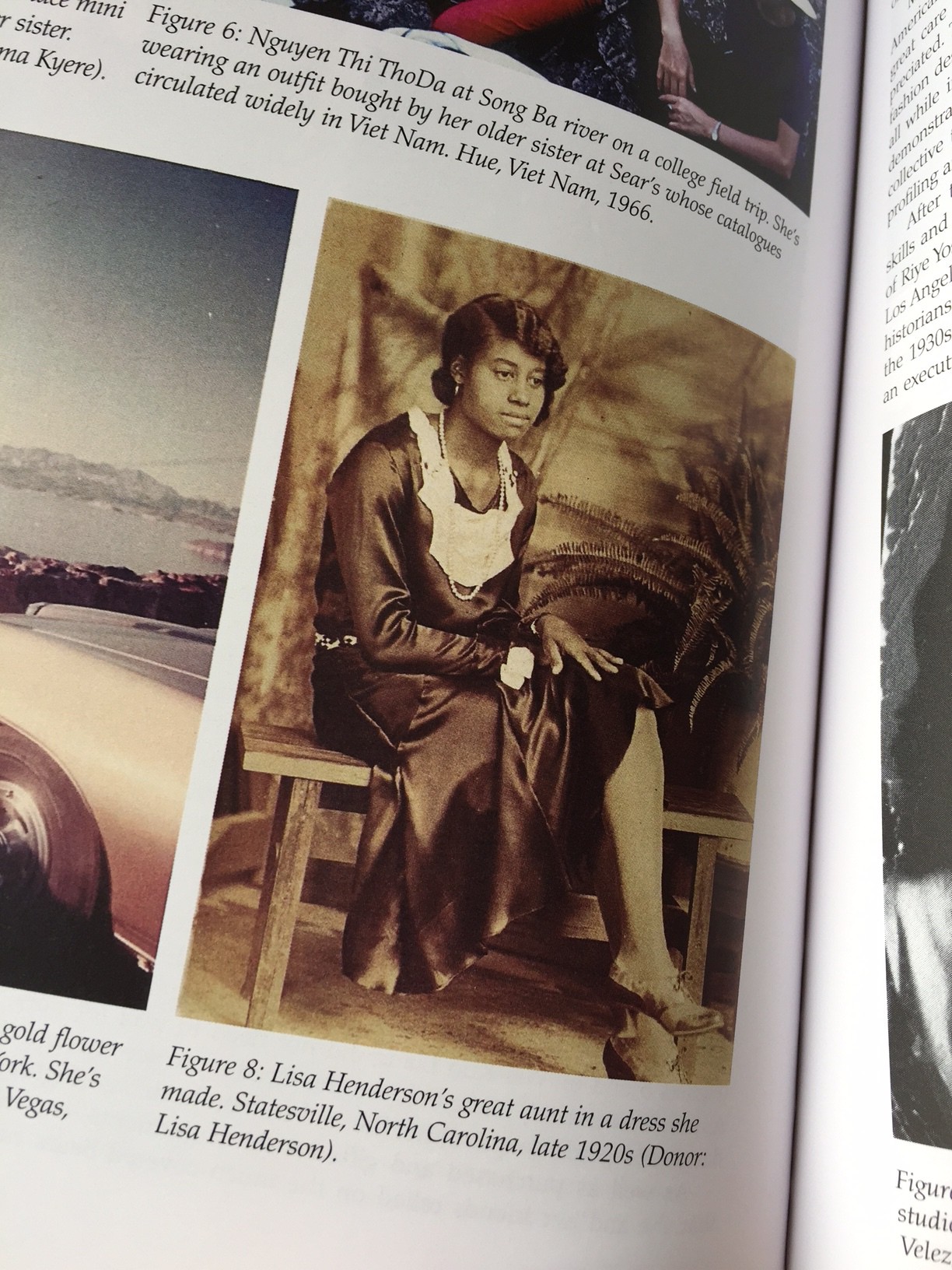
I scanned the contents and suddenly remembered. Some years ago, I contributed photographs of my people to Min-Ha T. Pham’s Tumblr, Of Another Fashion. In the journal article, “Archival intimacies: Participatory media and the fashion histories of US women of colour,” Pham discusses “the critical and curatorial aims, materials and methods that underpin a digital fashion archive devoted to the histories of US women of colour ….” arguing for “the utility of participatory media in efforts to create not only new historical records of minoritized fashion histories but also new systems of record-keeping.” Among the photos illustrating the piece is one of my grandmother’s aunt, Golar Colvert Bradshaw.

Golar

Standard
Births Deaths Marriages, DNA, Enslaved People, Maternal Kin, Virginia

DNA Definites, no. 20: Harrison.

Edward Cunningham Harrison … was John C. Allen Sr.’s biological father.

A recap: my great-grandfather’s mother, Mary Brown, married Graham Allen in 1876 in Charles City County, Virginia, during her pregnancy. Except that he was a white man, we knew nothing of John’s birth father’s identity, and I didn’t really expect ever to.

However, a few months ago, I got an estimated 3rd cousin DNA match at Ancestry DNA. I was intrigued. I have only six matches at that level. Three are with known paternal cousins, and all are African-American. Except this one. A.B. is all Great Britain and Ireland and Scandinavia and Europe West.

I sent A.B. a message, and then a follow-up. She responded, and we briefly explored a dead-end or two. I examined A.B.’s family tree more closely. Two of her great-grandfathers were from Richmond, Virginia, which is just up the road from a couple of the counties in which my maternal grandfather’s forebears lived. One of A.B.’s great-grandfathers was Edward C. Harrison; the other, John S. Ellett. I inquired about both men, and she told me that her Harrisons had lived in Charles City County. We were getting warm. I asked A.B. to upload her raw data to Gedmatch, where I quickly determined that she is a solid second cousin match to my mother and maternal uncle. I told her that I believed that we were related through my great-grandfather and that Edward C. Harrison was the right age and in the right place at the right time to have been his father. A.B. immediately asked what she could do to help figure out the connection. I asked if she would test with 23andme, and she readily agreed. So did her sister.

A couple of weeks ago, their results posted. My mother, my uncle, my sister and all six of my first cousins have tested with 23andme. All of us match A.B. and her sister M.H. The closeness of the DNA matches confirm a recent common ancestor, and all signs pointed toward Harrison. I needed to eliminate Ellett though.

Screen_Shot_2015-04-14_at_8.53.25_PM

A.B. and my mother, 267 cM total match.

In reviewing my matches, I noticed that T.N., a long-time and fairly close match, also listed Harrison among his surnames.

Screen_Shot_2015-04-14_at_4.44.55_PM

From my mother’s 23andme matches — sisters M.H and A.B., T.N.’s mother, and T.N.

I also found that T.N. matches A.B. and her sister and, most importantly, they all share matching segments of the same chromosomes with my Allens. This “triangulation” proves that all of us descend from a common ancestor.

Screen_Shot_2015-04-10_at_10.26.58_PM

Partial screenshot of comparisons of chromosome matches of T.N. to my mother, A.B., M.H., and my uncle. (That Chromosome 7 segment gave me life. It’s the stuff of dreams.)

I sent T.N. a message and mentioned that, based on chromosome share, I thought that our common ancestor was William Mortimer Harrison, father of Edward C. Harrison.  T.N. responded, forwarding an old email from his uncle that detailed his family’s history. T.N., in fact, is descended from Edward C. Harrison’s sister Caroline and thus from William M. Harrison, as I’d guessed. He is a third cousin to A.B. and to my mother, and he has no Ellett ancestry. Thus, Edward C. Harrison is confirmed as A.B. and my mother’s direct ancestor. (T.N. is descended from a separate Harrison line through Caroline’s husband James P. Harrison, her distant cousin. Relative chromosome shares between A.B. and my line, however, eliminate James as our common ancestor.)

Through Edward, we are descended from or related to the oldest colonial families of Virginia — Harrisons, Randolphs, and Carters, among others. A signer of the Declaration of Independence. Two presidents. Pocahontas. (Yes.) These families were also owners of several of the large plantation houses still standing in Charles City County, including Westover and Berkeley. (At this time, however, I don’t think that any of my forebears were enslaved in the area.) I’m not sure how John Allen’s mother Mary Brown met Edward C. Harrison or what the nature of their relationship was. She was from Amelia County, and there was a Harrison branch there, but I don’t know if she knew them.

A.B. is ecstatic to learn that her grandfather had a half-brother. So is her sister M. My family, too, is amazed. I’m hoping that, with their help and some deep sleuthing, I will learn more about the circumstances of John Allen’s birth. And I may meet A.B. when she comes to Georgia next month.

The truth will out. DNA tells the tale.

Standard
Births Deaths Marriages, Maternal Kin, Newspaper Articles, North Carolina, Other Documents

Aunt Ida May revisited.

Ancestry.com’s North Carolina Marriages data collection is not through demystifying my kin. A previously unknown marriage license clarified a question I had my great-great-aunt Ida’s life. If Eugene Stockton were her husband, I wondered here, why was she a Stockton in the 1910 and 1920 censuses, but referred to as his sister-in-law? In gaining an answer, I also uncovered a terrible tragedy.

Ida May Colvert‘s first marriage license was so hard to find because she married under her mother’s maiden name, as Ida May Hampton. The license lists her parents as John and Adline Colvert, but they did not marry until 1905, just over a month after Ida married Dillard Stockton on 27 December 1904. (Ida’s age is listed as 21 on the license, which is almost surely too high. Her birth year as recorded in various documents varies widely, but averages about 1885.) Dillard’s parents were listed as Henry and Frances Stockton, which seems to indicate that Dillard and Ida’s second husband Eugene shared a father and were half-brothers. (Eugene’s mother was Alice Allison [or maybe McKee] Stockton.)

42091_334850-01124

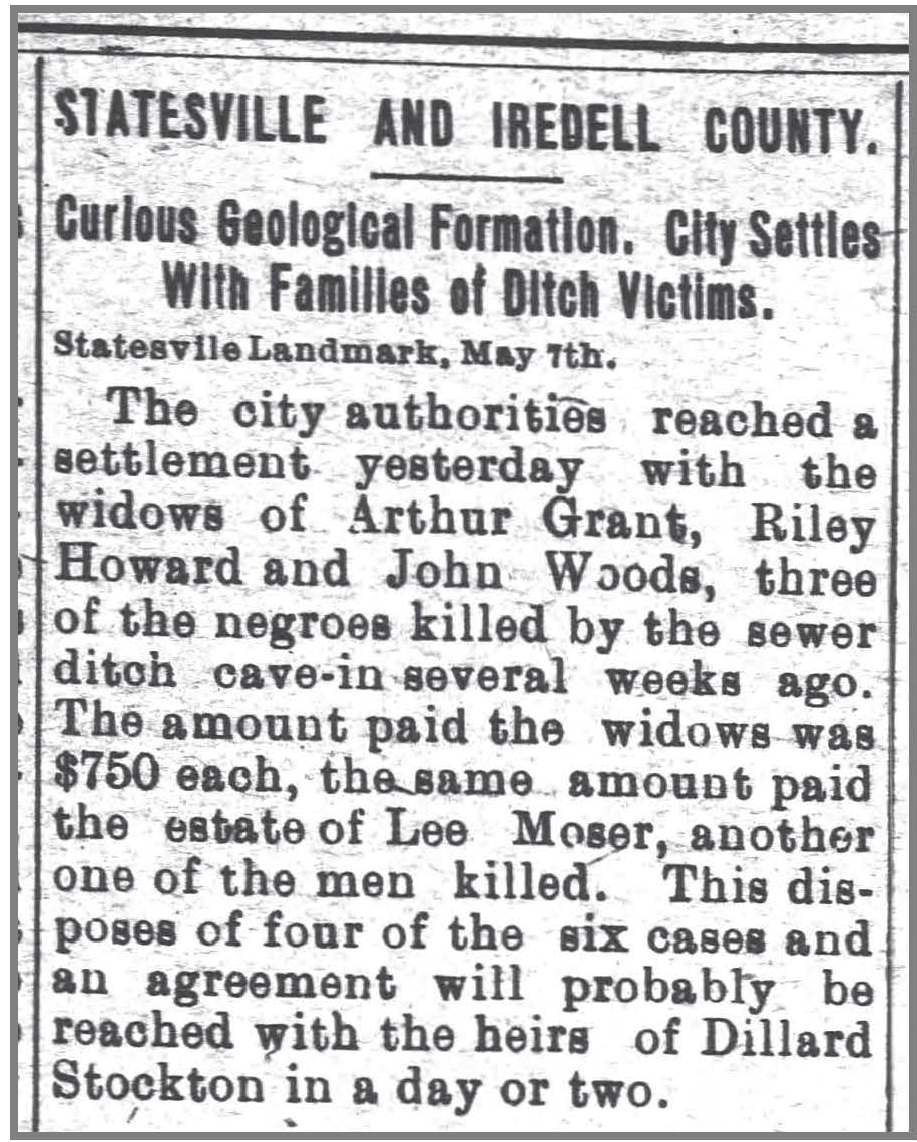
Ida was a Stockton Stockton then. But what happened to her first husband, Dillard? A quick Newspapers.com search turned up the awful story:

Statesville_Record__amp__Landmark_3_12_1907_Dillard_Stockton_killed

Statesville Record & Landmark, 12 March 1907.

A little over two years after they married, Dillard Stockton and five other African-American men were crushed by a cascade of soil and scaffolding in a Statesville ditch. [Surely my grandmother knew this story?]

Race STreet

The stretch of Race Street in which the cave-in occurred.

For all the breathless detail of the initial report of the tragedy, greater Statesville soon moved on. As reported in the local paper, within two months, the city had settled four of the deaths with payments of $750 (roughly $19,000 today) and were close to settling with the remaining survivors, including Ida May Colvert.

Carolina_Watchman_5_15_1907_Dillard_stockton_sett

Dillard Stockton is buried in Statesville’s Green Street/Union Grove cemetery. I snagged this photo from findagrave.com. I don’t recall seeing it during my recent visit and don’t know if it’s near the Colvert graves.

91759891_133944306122

A horrifying post script:

W_S_Union_Republican_5_12_1907_Harry_Stockton__039_s_death

Winston-Salem Union Republican, 12 May 1912.

Standard
Agriculture, Business, North Carolina, Paternal Kin

“They call me Tom Pig.”

The eighth in an occasional series excerpting testimony from the transcript of the trial in J.F. Coley v. Tom Artis, Wayne County Superior Court, November 1908.

Defendant introduces TOM ARTIS, who being duly sworn, testifies:

My name is Tom Artis. They call me Tom Pig. I own some land, 30 acres. (Plaintiff objects.) I have been living on the 30 acre tract of land 25 years, except one year. I mortgaged this land to Mr. Exum. (Plaintiff objects.) I don’t know about how long it was. About 25 or 30 years. (Plaintiff objects.) I don’t know what became of that mortgage. I got Hagans to take it up. (Plaintiff objects.) I don’t know who was present when I got Hagans to take it up. When Hagans agreed to take it up, Mrs. Exum, Hagans and myself were present. I own the 30 acre tract and lived on the the tract adjoining. After Hagans took up the papers, he told me that I could build on that place, or on the 24 acre piece. He said he thought it best for me to build on mine, he might die sometime, and there might be some trouble about me holding the house. I did so. He furnished the lumber, and I did the work. I decided to build on his side. After I built there I had been paying the 800 lb. of lint cotton year in and year out. (Plaintiff objects to each and every statement of the foregoing evidence.) The 800 lb. of cotton was to keep up the taxes and the interest of the money. (Plaintiff objects.) I have been paying this 800 lb. of cotton all the time. (Plaintiff objects.) I left that place one year. I left because my house got in such a bad fix, and I couldn’t stay there, and run my business like I wanted to, and I went over to Mr. Jones’. I rented the land. I rented it to Simon Exum. He gave me 950 lb. for the 30 acre place. I rented the Calv Place and the Adam Artis place. I moved back after one year at Mr. Jones’ place. I built on the Hagans place. Since then I built the piaza and shed room, to my own expense. Borrowed money from Hagans. I paid him back. He didn’t pay for the repairing of it. He furnished some shingles. Got 1/4 covered. I never asked W.S. Hagans to sell the 30 acre tract of land. I never said to Hagans in the presence of Reid or anybody else that I wanted im to sell it. I never asked anybody to buy the 30 acre tract of Hagans. Not the 30 acre tract. I had a conversation with Mr. Coley with reference to buying that land. I was talking about the Calv place. My land wasn’t brought in. The Calv place is the place I rented and lived on. That’s the land I spoke to Mr. Coley about buying from Hagans. He said if Mr. Cook and Hagans didn’t trade to send him a note. I told Hagans, he said tell him Coley, if his hands were not tied. I remember going over to Mr. Coley’s mill with Hagans. I didn’t hear any conversation bwteen Hagans and Coley with reference to buying this tract of land. They were off from me. I didn’t know what they were talking about. I heard them say when they came back to the buggy, Hagans said that he would see him again shortly. I don’t know if he said what day. Next I heard after that was that Hagans had sold it all to Mr. Coley, mine and all. I never rented the 30 acre tract of land. I know Jno. Rountree. I never asked him to go to Will Hagans and ask him to give me an opportunity of buying the 30 acre piece of land. I never said to Will Hgans, Jno. Rountree or Henry Reid, or anybody that I wanted Hagans to give me the opportunity of seeing my boys in Norfolk, so I could buy the 30 acrea piece. I asked Hagans what he would take for the acre back of my huose, of the Calv place. I told him I would buy that. His answer was, “Can you find a buyer for the other part of the Calv place.” I told him I didn’t know. He walked about his buggy house door. He said, “Uncle Tom” I can’t take what that mortgage calls for for your land, land is so much more valuable now than it was when yours was given. It passed off at that. Next I heard he had sold it to Coley.

To be continued.

——

N.B. Calvin “Calv Pig” Artis was Tom Pig Artis’ brother. He sold the Calv Pig place to Napoleon Hagans in 1879. (Tom and Calvin apparently derived their nicknames from their father Simon Pig Artis, who had been an enslaved man.)

Standard
Births Deaths Marriages, North Carolina

In memoriam: William S. Powell.

Renowned North Carolina historian William S. Powell died last week. He was 95.

I came into my deep interest in history late in my undergraduate career, and I never took a class in the history department at the University of North Carolina. I did have an encounter with Dr. Powell, though.

I had just encountered Walker Colvert on microfilm for the first time. The 1900 federal census of Iredell County, North Carolina, listed the 74 year-old former slave as Virginia-born, and I wondered how I might ever determine where he might have come from. Afloat in naivete, I called Dr. Powell’s office and asked for an appointment. I wanted to understand migration patterns into North Carolina’s western Piedmont, and I thought “who better to ask?” Dr. Powell was welcoming and patient and betrayed no sign that he did not entertain curious English majors everyday. I came away from my brief visit with a strong suggested-reading list and even a personal tip that he knew of Colverts from the Staunton, Virginia, area. Three years later, I was enrolled in the graduate program in American History at Columbia University.

Standard