
Special thanks to cousin A.W.P., granddaughter of Dr. and Mrs. Joseph H. Ward, for bringing this to my attention:

Yes.

Special thanks to cousin A.W.P., granddaughter of Dr. and Mrs. Joseph H. Ward, for bringing this to my attention:
Yes.
A couple of weeks ago, I spent a delightful Friday afternoon in Augusta, Georgia, getting to know my cousin M.H. and his wife C.H. M.’s grandmother was Emma McNeely Houser, beloved and much-admired aunt of my grandmother Margaret Colvert Allen. M. and C. were every bit as warm and friendly as I’d expected, and the whole time we laughed and swapped stories. I wish he’d been able to meet my grandmother.
Here’s me and M.:

And here’s my great-grandmother Carrie McNeely Colvert Taylor, Aunt Emma holding a grandchild, Aunt Minnie McNeely Hargrove, and Uncle John McNeely, sometime in the early 1940s in Jersey City, New Jersey:

As I’ve written about here, visits to Norfolk, Virginia, to spend time with cousin Tilithia at her cafe were highlights of my grandmother’s childhood. They later lost contact, however, and it was not until I connected with B.J., a descendant of Tilithia’s sister Mattie Brewington Braswell, that I learned that Tilithia lived until 1965. I wish Mother Dear had known that.
In my earlier post, I mentioned that Tilithia was married to railroad fireman Walter Godbold during the years after World War I that my grandmother visited. “Her marriage to Godbold did not last,” I noted, “and the 1930 census found him back in Rocky Mount NC (described as divorced) and her still in Norfolk, holding herself out to be a widow while maintaining the little restaurant at 426 Brambleton Avenue.”
Ancestry.com’s Virginia Divorce Records database shed some light on this fractured set-up:
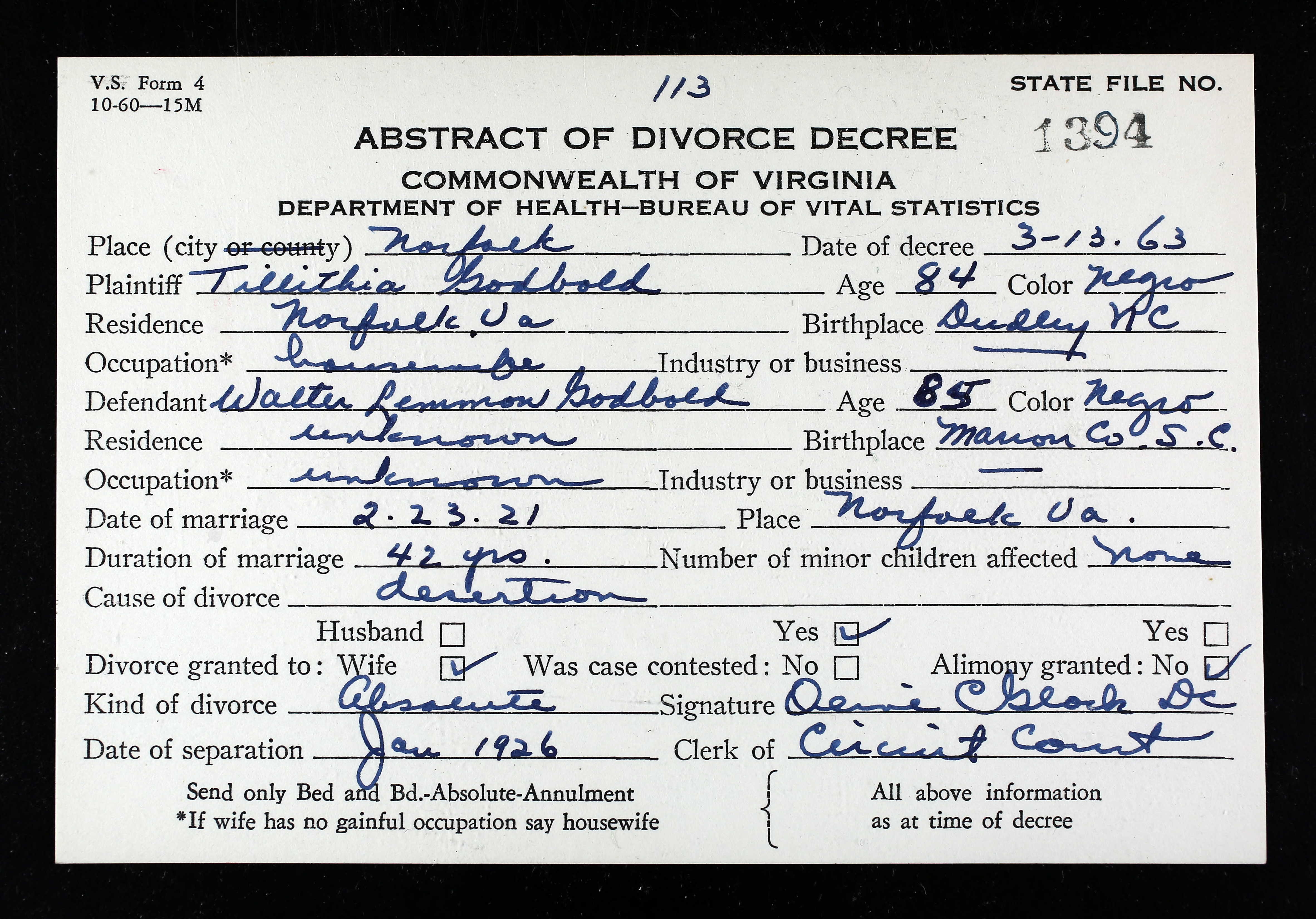
Yes. Apparently, Tilithia and Walter — married in 1921 and separated in early 1926 — stayed married for nearly 40 more years. Only in 1963 did Tilithia receive the divorce she finally filed for (and Walter contested.) Grounds: desertion. Walter was not new to that game, though he turned the tables in his go-round with Tilithia. Here’s the divorce record noting the dissolution of a previous marriage to a woman from his hometown, granted seven months before he married Tilithia:

And what could have led an 84 year-old woman to seek a divorce from a man she probably had not seen in decades? A third shot at love. Less than a month after her marriage to Godbold was dissolved, Tilithia married John Carter Dabney, a retiree nearly twenty years her junior.

This union, if happy, did not last long. A year and-a-half later, on 21 November 1965, Tilithia Brewington King Godbold Dabney passed away. Her heart failed, but presumably did not break.

On 4 September 1945, the “Colored News-Briefs” column of The Hopewell Times, included this brief passage:

That Graham Whirley‘s death by gunshot was not reported salaciously says a lot about the regard in which he was held both inside and out of his community in Hopewell.
Three days later, the Colored News-Briefs column carried a detailed account of Graham’s funeral, held at New Vine Baptist Church in Charles City County the previous Tuesday:

“Will My Mother Know Me There?” — we’ll come back to that.
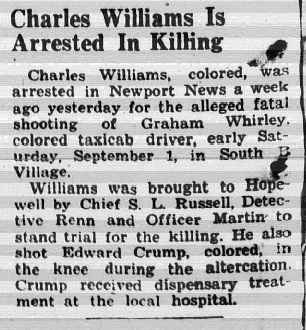
This brief piece was published 14 September. I haven’t yet found follow-up articles that reveal details of Graham Whirley and Charles Williams’ fatal encounter or of the outcome of Williams’ trial. What I have found, however, are numerous examples of the esteem in which Hopewell’s working-class African-American community held this relatively young man.
The first mention, on 8 December 1936, was a sweet one — “Miss Susie Whirley of Richmond was in the city last week visiting her brother at his home in City Point.” Though Graham’s social life — party attendance and motor excursions — received remarks (especially when he was courting a woman called Miss Carrie B. Lightly,) his singing brought the most notice. Time after time, the colored news noted that he had “rendered” a beloved hymn at a Baptist church in or around Hopewell:
In the middle of this, on 22 May 1944, the column announced that “Mr. and Mrs. Graham Whirley of City Point have returned after spending their honeymoon in Baltimore, Maryland.” That, of course, was where his half-brother John Whirley and sister Matilda Whirley Brinage lived. Just sixteen months after he remarried, Graham Whirley, taxi driver and sought-after soloist, was dead. Despite his move across the James River, he had never left his home church, and he is buried at New Vine.
Another treasure from Ancestry.com’s new Virginia vital records. The death certificate of my great-grandfather Lon W. Colvert‘s half-sister, Henrietta Colvert: 
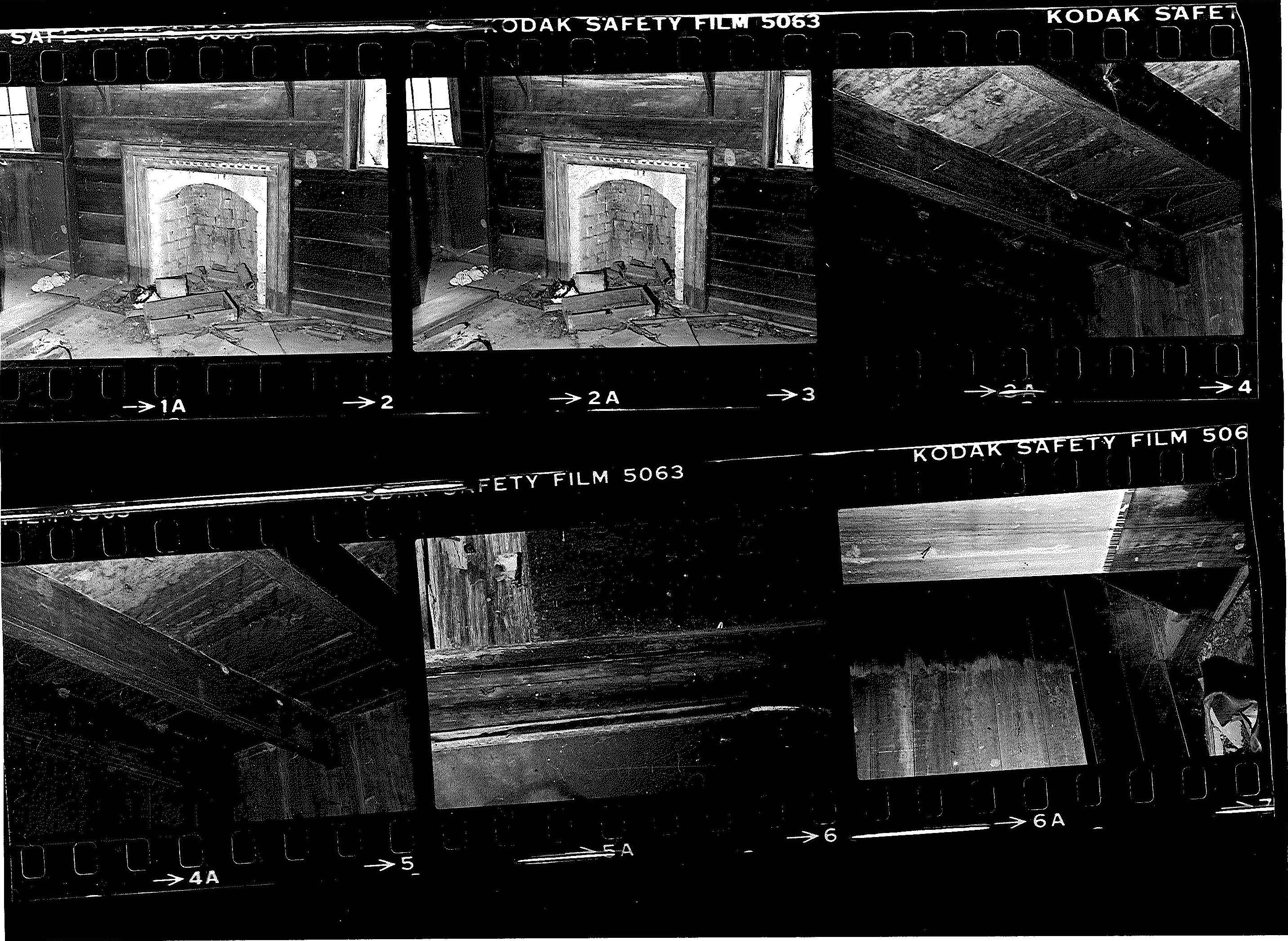
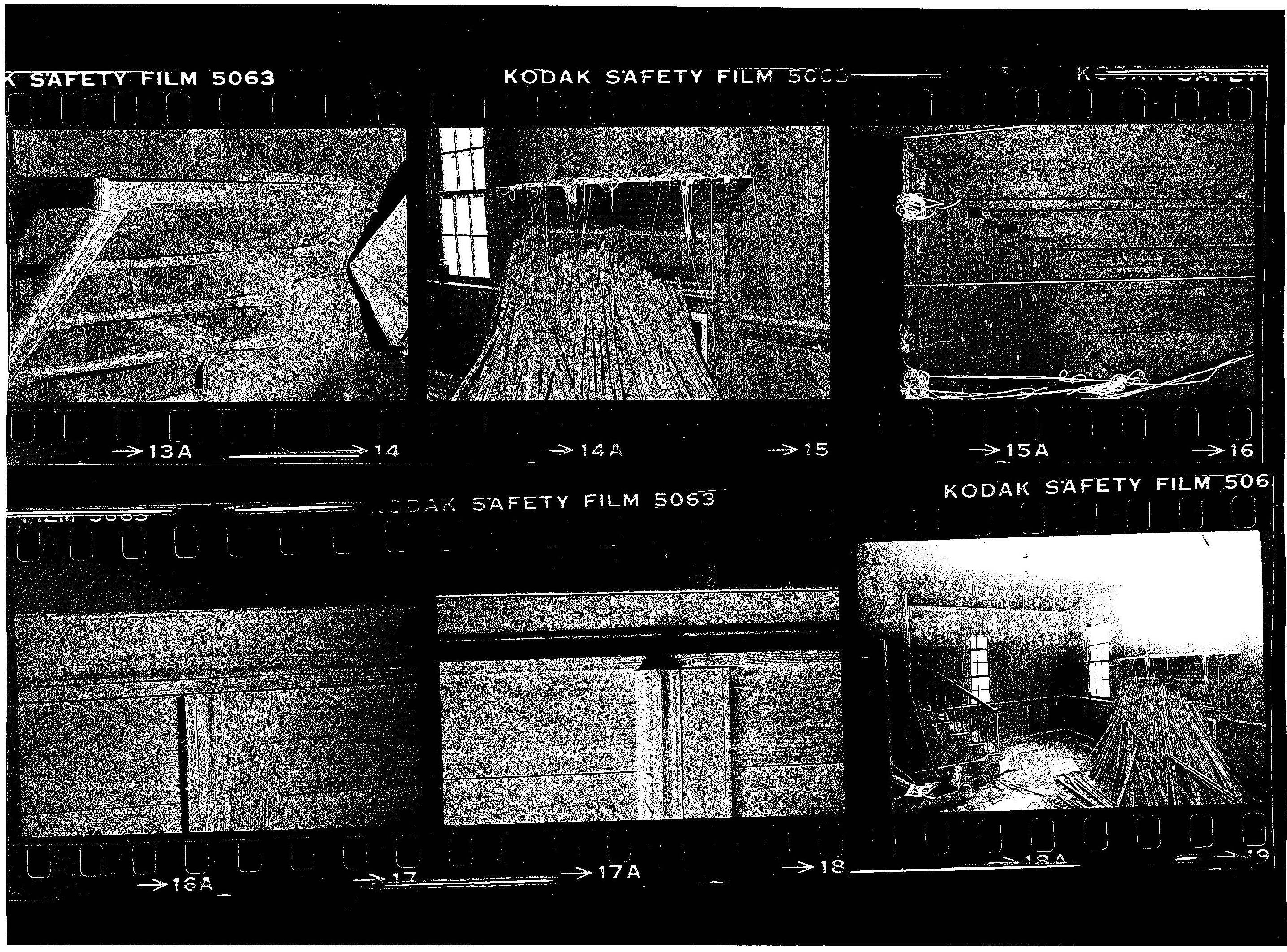
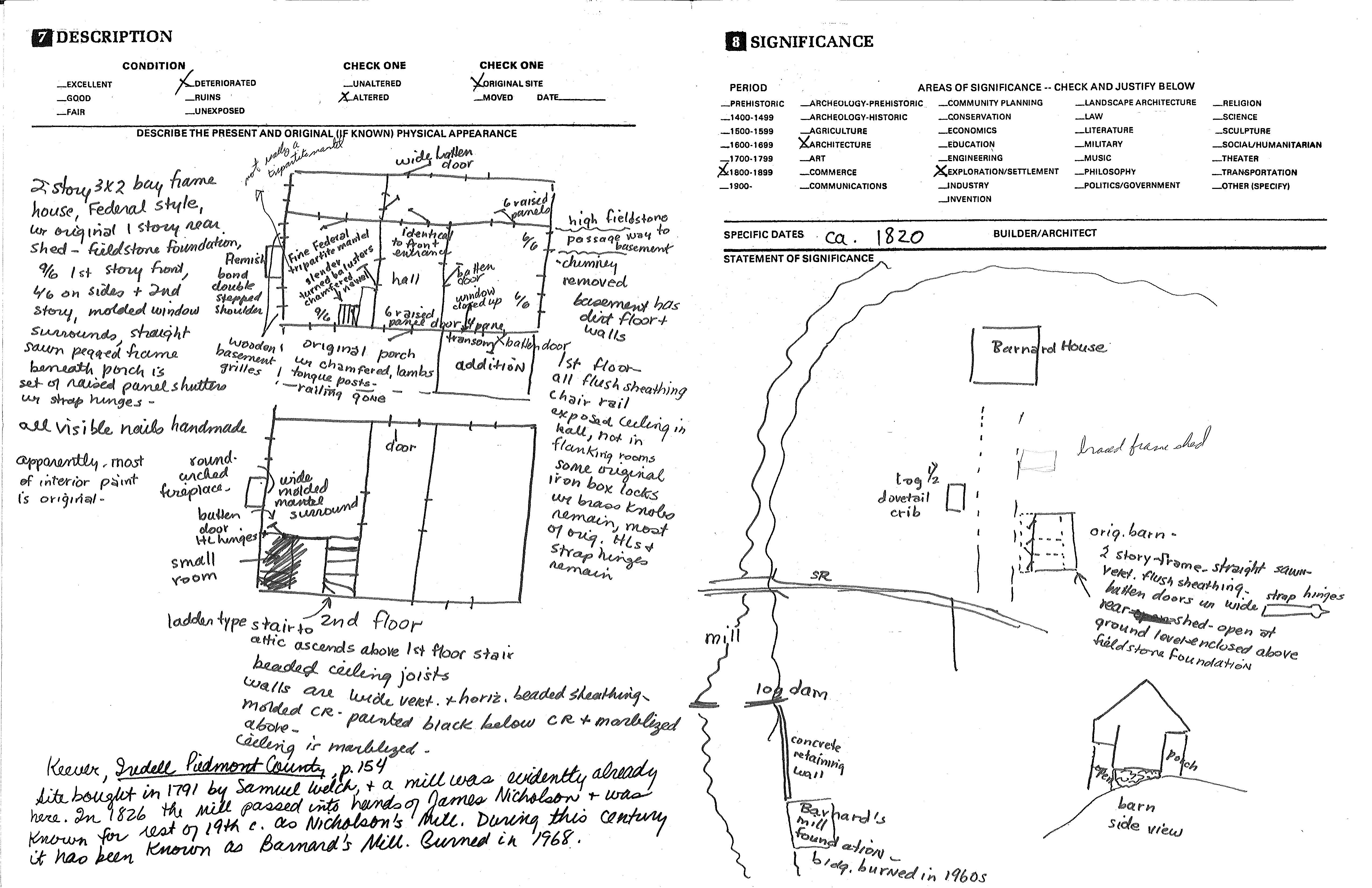
Photographs from the Welch-Nicholson House and Mill Site National Register nomination file held at the North Carolina Historic Preservation Office, North Carolina Department of Cultural Resources, Raleigh. Many thanks to File Room Manager Chandrea Burch and National Register Coordinator Ann Swallow.
My great-great-grandmother Harriet Nicholson Tomlin Hart walked these rooms.
This, of course, is all gone now. Burned to the ground one night in the 1980s.




The Commonwealth of Virginia has thrilled and astonished me by making vital records available via Ancestry.com. Yesterday, cousin Barbie Jones notified me that the databases were up and open, and I thank her for part in the gargantuan task of indexing these documents.
Just as with North Carolina Marriages a couple of months ago, Virginia Birth, Marriage and Death Records are unveiling little mysteries and setting records straight.
I’ll start with the Allens.
In the 1900 census, Graham Allen is listed in Charles City County, Virginia, with wife Mary, sons Alexander and Edward, and grandsons Milton and Junius. My assumption has always been that Graham and Mary’s eldest daughter Emma was the mother of the younger boys.
Last night, I found this:

So, yes. Conjecture confirmed. Milton William Allen — the middle name is new to me– was 16 year-old Emma’s son. Who was Mrs. Laura Ray, “friend”? And Milton was alive as late as 1958??? Where was he living?
But then I found this:
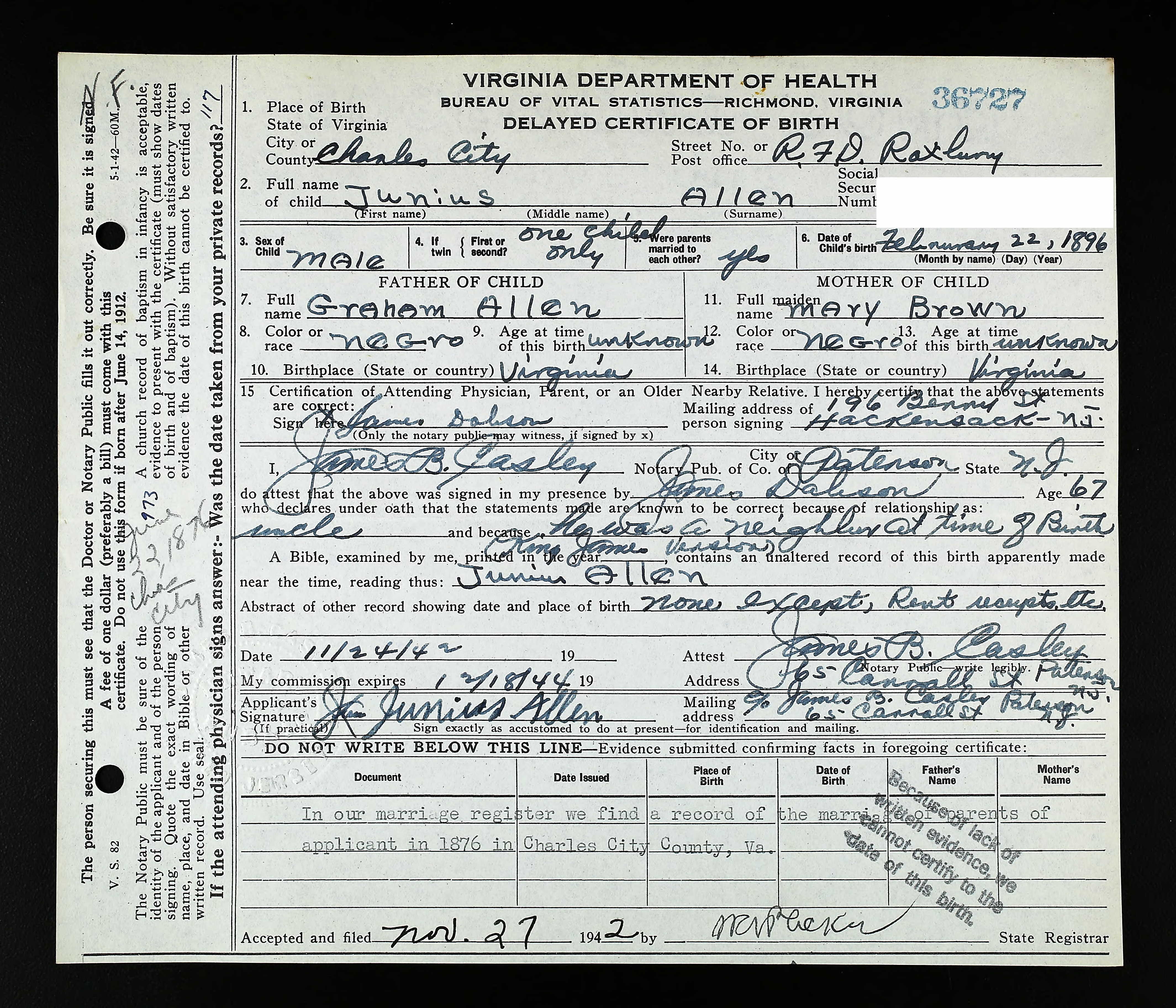
Is this right? Was Junius really Graham and Mary’s youngest child? (For a fact, my grandmother told me Junius was John C. Allen‘s brother, but I figured this was a manner of speaking.) And who is James Dobson, “uncle” and “a neighbor at the time,” who attested to Junius’ birth for this delayed certificate? And when did Junius move to Paterson, New Jersey? And there was once a King James Bible recording family births and deaths?
And then I found Emma Allen Whirley and two of her children:

No surprises, but who was informant Joseph Ghee?
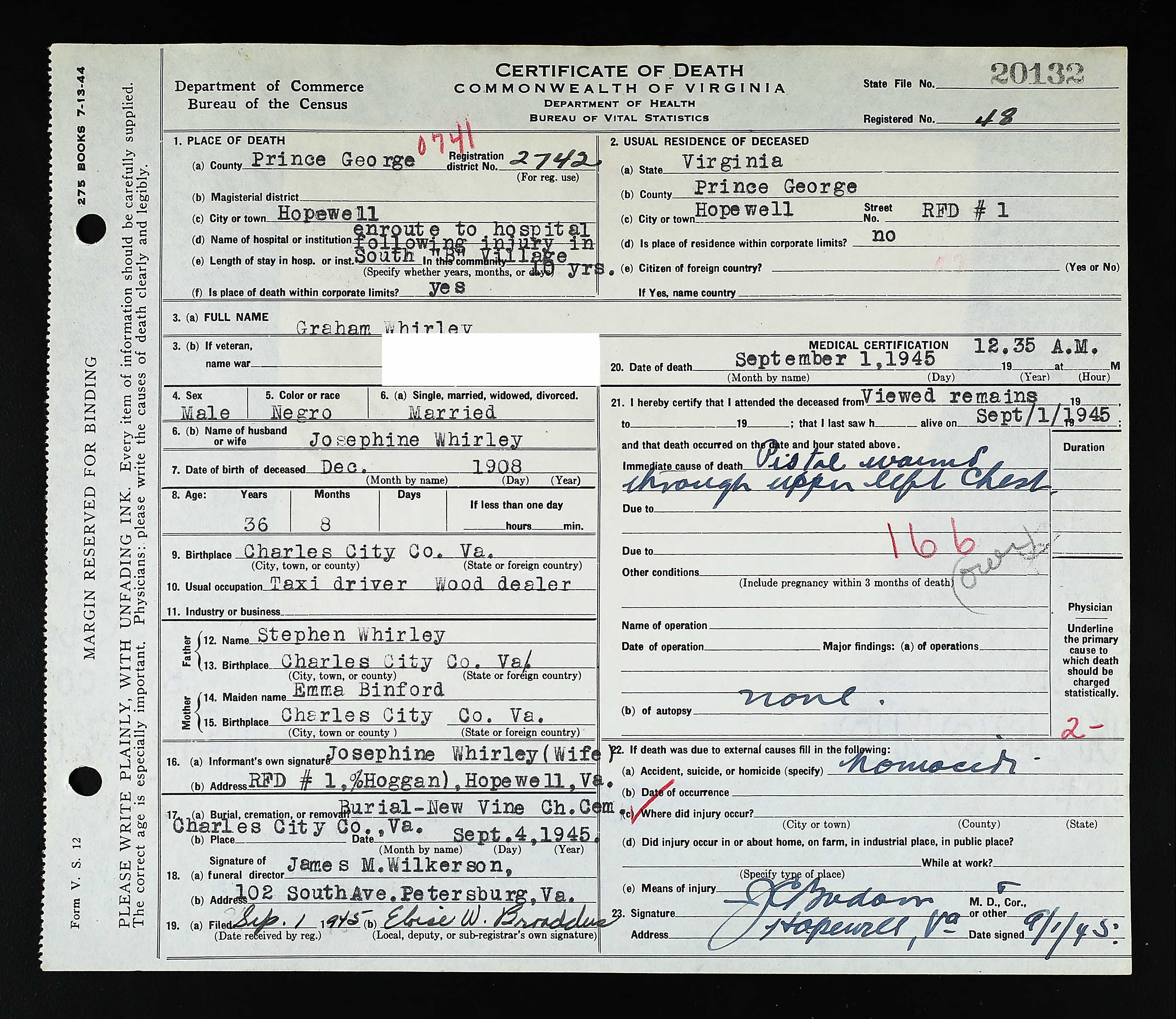
A bit of a sad surprise. As I wrote here, Graham’s brother Samuel is the one who’d had a brush with infamy, yet Graham ends up shot in the chest. Where was South “B” Village? Taxi driver and wood dealer? And where did his wife pull “Binford” from as Emma’s maiden name?

Samuel Whirley, at least, lived a longish life.
What I’ve found after just a bit of looking:


I mused earlier that it was hard to believe that of Mary Brown Allen’s children, only John and Emma had children. Emma’s sole known grandchild died childless, leaving my great-grandfather’s relatively few descendants as the only extant Allens. (By my count, we number only 25 across three generations. Twenty-five.) These additional records do not change that scenario. Neither Samuel nor Graham Whirley had children, and I’ve seen no evidence that Junius or Milton did.
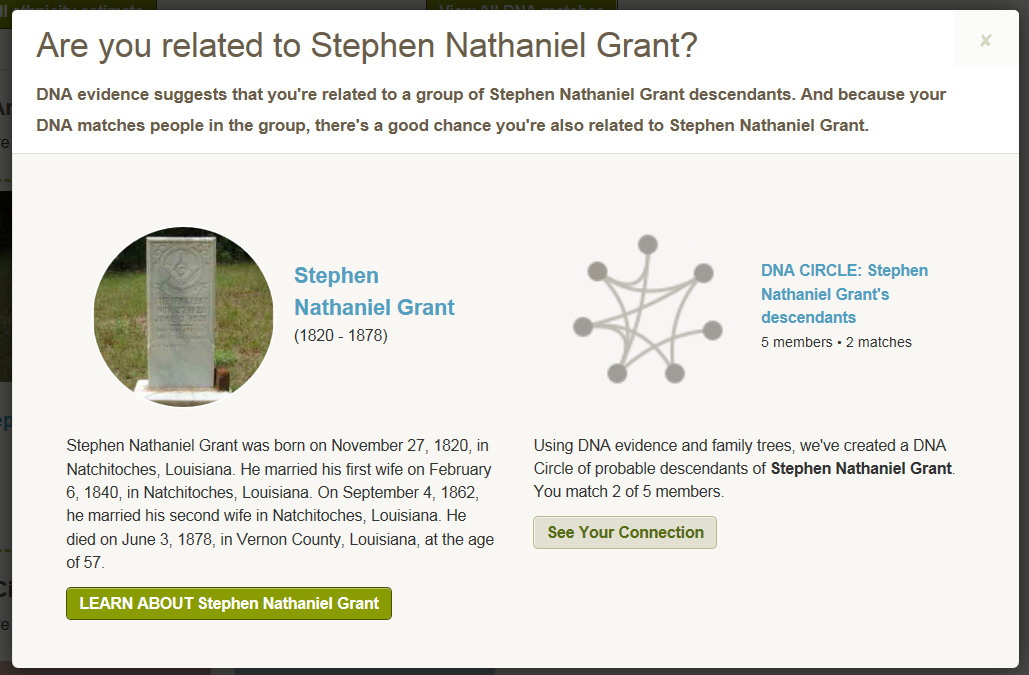
I don’t know. Am I?
Ancestry.com’s New Ancestor Discovery “is a suggestion that points you to a potential new ancestor or relative—someone that may not be in your family tree previously. This beta launch is our first step toward an entirely new way to make discoveries, and a way to expand how we do family history.”
Ancestry’s bio of this NAD (it’s based on a compilation of 143 user family trees, and so may be way inaccurate): Stephen Nathaniel Grant was born on November 27, 1820, in Natchitoches, Louisiana, to Stephen Grant and Marie Louise Saidec. He married Marie Celine Armand on February 6, 1840, in Natchitoches, Louisiana. On September 4, 1862, he married Marie Adelaide Elizabeth Armand in Natchitoches, Louisiana. He lived in Natchitoches, Louisiana, from 1850 to 1865 and moved to Calcasieu, Louisiana, sometime between 1865 and 1870. Stephen died on June 3, 1878, in Vernon County, Louisiana, at the age of 57, and was buried in Leesville, Louisiana.
At first glance, I’m puzzled. Natchitoches? All my roots lie north of South Carolina and east of the Appalachians. “Grant,” though. That stirs an antenna.
My great-grandmother Bessie Henderson‘s putative father was Joseph Buckner Martin (1868-1928). Buck’s parents were Lewis H. Martin (1836-1912) and Mary “Polly” Ann Price (1836-1902). Lewis H. Martin was the son of Waitman G. Martin (1810-1866) and Eliza Lewis (1813-??). Waitman G. Martin was the son of Lewis Martin (1779-1820?) and Charity Grant (1788-1864?).
Charity Grant was my great-great-great-great-great-grandmother. Is Ancestry picking up a connection this distant? It has matched me to collateral Price and Lewis descendants. Maybe Grant then.
I know very little about Charity Grant. Unsourced internet information asserts that she was born 7 October 1788 in Wayne County to Ephraim Grant (1765-1864) and Nancy Kinchen. The date of her marriage to Lewis Martin is unknown; their other children were Lavinia G. Martin (1812-1899), Abraham George Martin (1815-1862) and Henderson Napoleon Martin (1821-1877). (Henderson Martin married Bethany Lewis, daughter of Urban and Susan Casey Lewis, and sister of Waitman’s wife Eliza Lewis.) Charity allegedly died in 1864 in Onslow County. There’s a lot about this I don’t trust though. I consulted Marty Grant’s website, http://www.martygrant.com, which contains the most detailed accounting of the evidence regarding early Wayne County Grants available. He lists a daughter Charity for Ephraim and Nancy, but notes that she was born in 1824 and married Martin Johnston. The only other early reference that I have for Charity is Michael Grant’s 1818 Wayne County estate record, which mentions Charity Martin as the purchaser of “7 bus. & 3 Pecks corn” at his estate sale. (It also lists Elisha, John and Stephen Grant among Michael’s creditors.) Michael Grant was a close neighbor of William and Elisha Grant in the 1790 Wayne County census. Marty Grant conjectures the three as brothers and Charity as William’s daughter.
I dug a little deeper on Stephen Nathaniel Grant. (Meaning, I tried to make sense of the mish-mash of information in the trees of his descendants on Ancestry.) With no attribution, all seem to agree that Stephen’s father was also named Stephen Grant, born 1770 in Tolland, Connecticut, died 1821 in Ouachita Parish, Louisiana. Stephen Sr.’s father is also uniformly listed as Ephraim Grant, born 1726 in Tolland, Connecticut.
These Stephens and Ephraims stretching from New England through North Carolina to Louisiana are intriguing, but what’s my link?
Ancestry.com assigned Stephen N. Grant to me as a New Ancestor Discovery on the basis of a DNA Circle. “Using DNA evidence and family trees, we’ve created a DNA Circle of probable descendants of Stephen Nathaniel Grant. You match 2 of 5 members. … Because of this, there is a good chance (up to 70%) you could be either a descendant or relative of Stephen Nathaniel Grant.” (There’s a lot of wiggle room there, notice.)
Here are the five people in Stephen Grant’s DNA Circle by Ancestry user name:
For now, I have no idea how I relate to M.G. or J.F. (especially at the predicted closeness), or if Stephen Grant was closely related to Charity Grant, or if Grant is a red herring and some other common ancestor ties me to these two.
More revelations from Ancestry.com’s updated North Carolina marriages database:

No mystery why I didn’t find this earlier. Jonah Wiggins? No, actually, Jonah Williams, brother of my great-great-great-grandfather Adam Artis. And though I knew Pleasant Battle was from the Battleboro area, I don’t think I’d ever searched Edgecombe records for their marriage license.
Here’s the marriage bond:
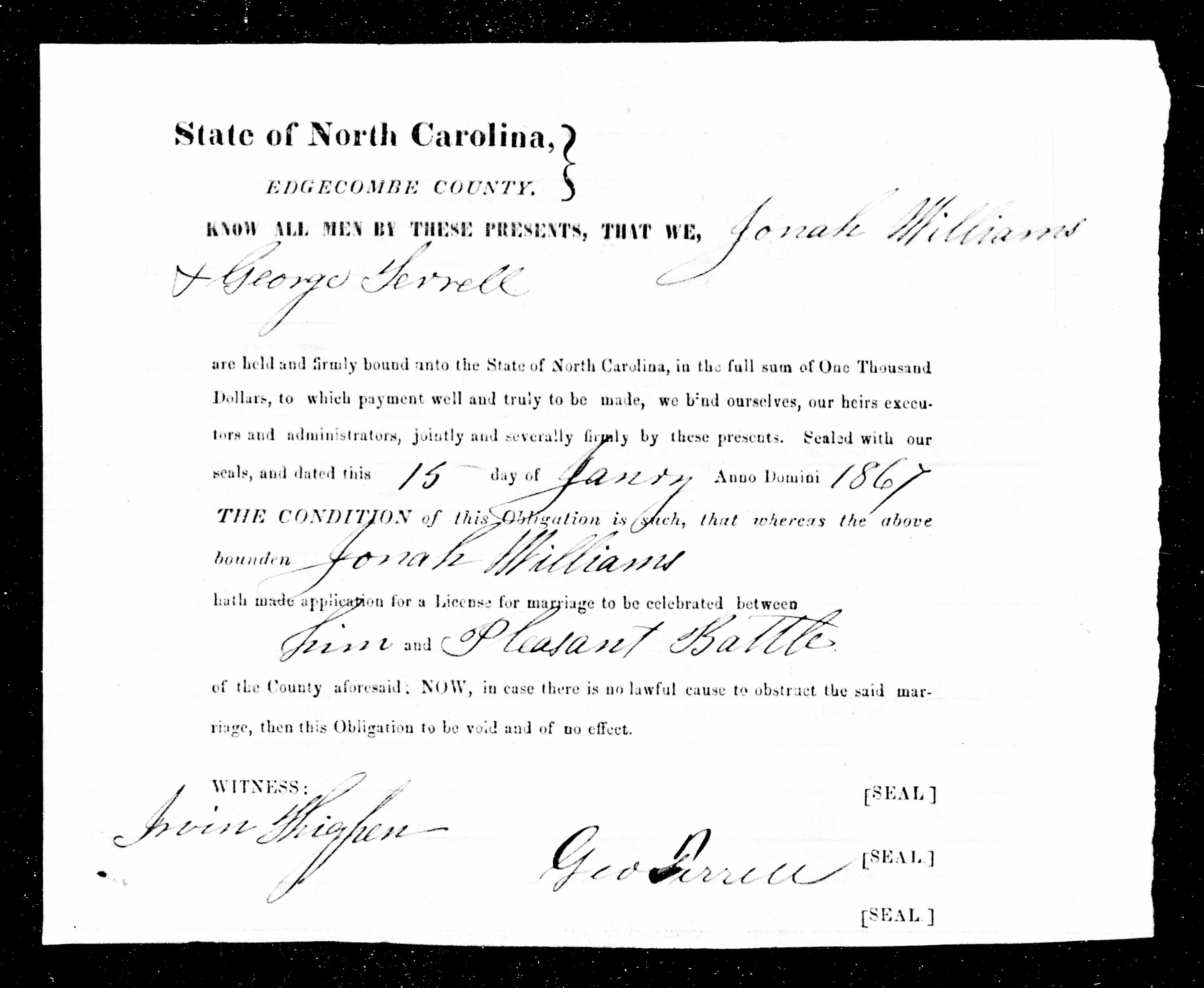
I don’t know who George Terrell was to Jonah. He and his wife Martha Lindsey, who married a few days before Jonah and Pleasant, appear in the 1870 census of Cokey township, Edgecombe County.
And here’s the marriage license. I am a little surprised that Jonah was married by a Justice of the Peace, rather than a minister of the gospel, but perhaps he was not yet the man he would become:

I’ve written about Angeline McConnaughey Reeves and her family — particularly her daughter Carrie Reeves Williams. But what of her other children?
——
A short notice appeared in the 14 March 1895 edition of the Charlotte Observer:
Frank Eccles and Ada Reeves, colored, were married Tuesday night. The groom is Farrior’s man “Friday.” He is a good citizen and deserves happiness and prosperity.
Five years later, the census taker trudging through Charlotte’s Fourth Ward knocked at the door of 413 Eighth Street. Forty-two year-old Angeline Reeves likely answered the door. In response to the enumerator’s queries, she identified her husband Fletcher as the head of household and detailed the three children remaining at home — 18 year-old Frank, 16 year-old Edna, and 12 year-old John. Daughter Ada, her husband Frank and 4 year-old son Harry were probably living in Charlotte, but seem to have given the enumerator the slip.
Frank married Kate Smith in Charlotte in 1902; their ill-fated story is told here. Edna was next to wed. In 1905, at the Mecklenburg County Courthouse in Charlotte, William H. Kiner applied for a marriage license for himself, age 25, of Boston, Massachusetts, colored, son of Anderson and Agnes Kiner, and Edna Reeves, age 20, of Charlotte, colored, daughter of Fletcher Reeves and Angeline Reeves. Robert B. Bruce, minister of the AME Zion Church, united them in matrimony on 5 April 1905 at the bride’s residence. According to Kiner family researcher Peggy Jorde, William Henry Kiner, actually a native of Staunton, Augusta County, Virginia, had come to Charlotte to study theology at Biddle University.
William and Edna’s first son, Addison F., was born in Charlotte in 1906, but by the following summer, when son Carroll Milton arrived, the Kiners were permanent residents of Massachusetts. Carroll has two birth records, one listing his birth place as Oak Bluffs, and a second listing Cambridge. On the first, William’s occupation was described as theological student.
Edna Reeves Kiner was not the only one of Fletcher and Angeline’s children to pack up and move north to the Bay State. The 1910 census of Cambridge, Middlesex County, shows William H. Kiner, wife Edna E., children Addison F., 4, and Carroll M., 2, sister-in-law Ada Ecles, and brother-in-law John H. Reeves living at 8 Rockwell Street. William worked as a clothes presser in a tailor shop, Ada as a servant, and John as a hotel waiter. Ada’s husband Frank (and son Harry) are nowhere to be seen, but “Aida” Eccles appears a second time in Cambridge as a servant in the household of George W. Clapp, a self-employed chemist.
John Reeves’ stay in New England did not last long. In April of 1915, at the age of 26, he died of tuberculosis in a state hospital.
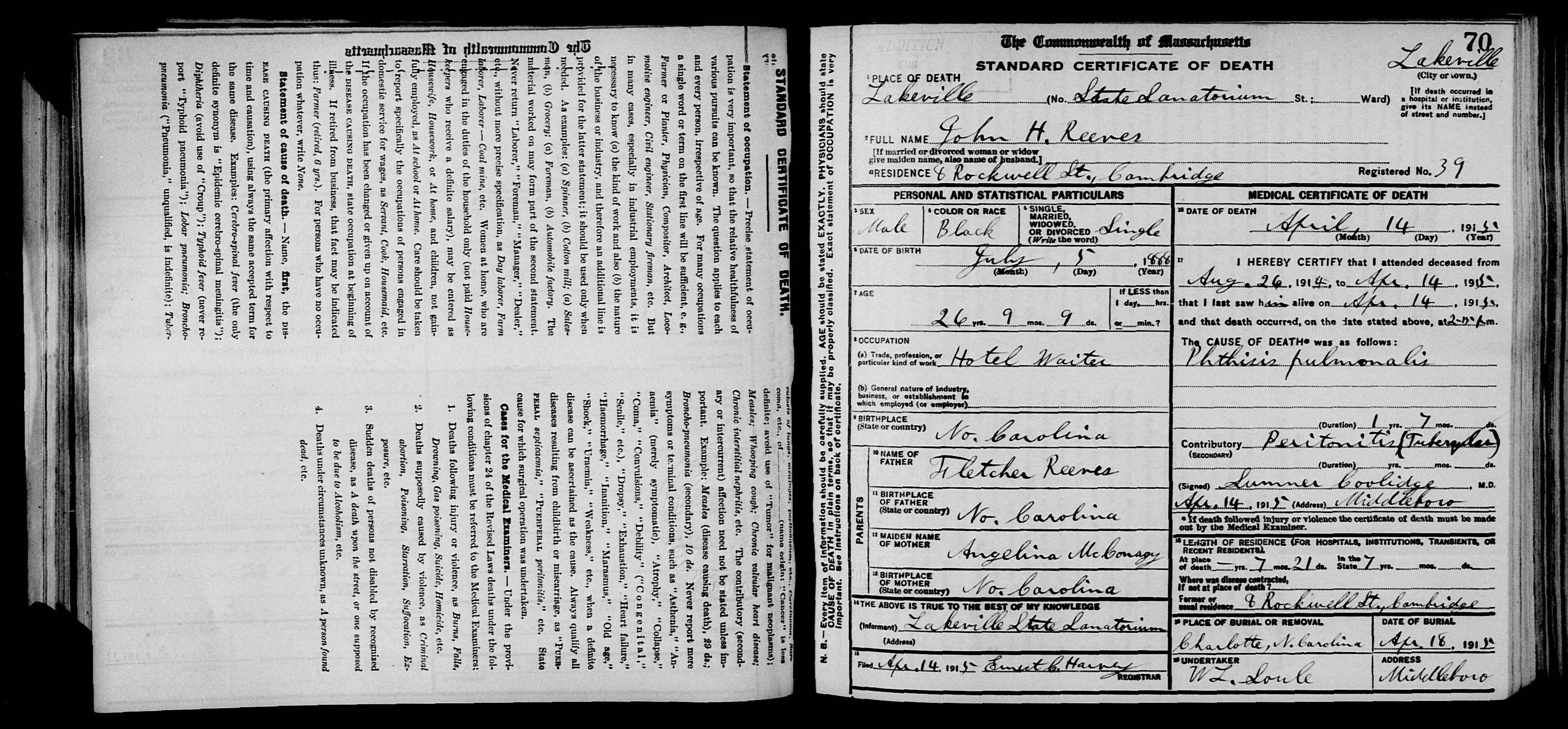
Meanwhile, it’s not clear that William Kiner was ever able to respond to his religious calling. When he registered for the World War I draft in 1918, he was working as a chipper in a foundry at Hunt-Spiller Corporation.

Two years later, when the 1920 census of Cambridge was recorded, William was described as a chipper in a shipyard. His family, still at 8 Rockwell Street, included wife Edna E. and children Addison F., Carroll M., and Evelyn C. Kiner. Ada Eccles and her 23 year-old son Harry Eccles, a laundry janitor, had found their own lodging and appear in the 7th Ward at 65 Grigg Street.
I have found no death certificate for William H. Kiner, but assume that he died between 1923, when he last appears in a Cambridge city directory, and 1930. In the latter year, the census taker listed his widow widow Edna M. Kiner, her children Addison F., Carrell M., and Evelyn C., plus aunt (sister, actually) Ada M. Eccles living on Essex Street in Cambridge in the household of Joseph S. Blackburn, a black Kentucky-born railroad porter, and his wife Cynthia, a beauty shop manicurist born in Maine. Addison worked as a department store elevator operator and Carrell as a shoestore porter.
The Kiners emerged from the Great Depression decentralized. In 1940 census, Edna Kiner was over the river in Boston, Suffolk County, living in an apartment or shared house at 361 Massachusetts Avenue. Her son Carroll Kiner, a 32 year-old shoe store porter, lived in Cambridge with his Virginia-born wife Ella and three year-old daughter Caroline at 27 Pleasant Street. Addison Kiner was not captured in the census, but he seems to have remained in Massachusetts and was active in Cambridge’s small African-American social scene.

The Afro-American, 20 June 1942.
Daughter Evelyn C. Kiner had completely escaped the Bay State orbit, however, having moved to New York City and begun work as a social worker with the Department of Welfare. She was living in the heart of Harlem at 172 West 127th Street, between Lenox Avenue and what was then Seventh Avenue. She quickly integrated into the Harlem world and over the next ten or years or so appears half-a-dozen times in the social columns of the New York Age. Evelyn’s primary social activities swirled around her membership in the National Urban League Guild, but she was also actively involved in civic outreach through the Church of the Master, a Presbyterian congregation at West 122nd and Morningside.
City directories show that Edna’s sons remained in the Boston area the remainder of their lives. She, however, moved to New York to live with Evelyn in her declining years and died there in August 1969. I don’t know exactly when Carroll died, but I’m a little haunted by how closely my path crossed with Addison and Evelyn. In the fall of 1986, I arrived in Cambridge, Massachusetts, for my first semester of law school. My residence hall, a graceless, L-shaped brick hulk, was at the campus’ far northwest corner, at Massachusetts Avenue and Everett Street. (I lived on the fourth floor of Wyeth Hall that year. Michelle Robinson Obama lived in the suite one floor above.) Unbeknownst to me, if I had walked a mile straight up Mass Ave, turned left on Walden Street, and knocked at No. 28, Addison Kiner would have answered the door. As far I can tell, he lived there for the three years that I was in Cambridge. He died 7 May 1990. After law school, I enrolled in graduate school at Columbia University. For the two years I was there, I lived in an apartment building on 121st Street, at the crest of the hill between Broadway and Amsterdam. Walking west down 121st led me to the edge of Morningside Park. Had I descended through it — and I didn’t in that era, which was crazy, crack-ravaged Manhattan at its nadir — I’d have landed on the plain of central Harlem just a block or two from Evelyn Kiner’s beloved Church of the Master. She died in February 2003, and the church was demolished six years later.
 Scuffalong: Genealogy.