Uncategorized

52 Ancestors in 52 Weeks: 1. Fresh start.

I tried the “52 Ancestors” challenge in 2014.

I failed.

I mean, I surely blogged about more than 52 relatives last year, but the constraints of the weekly format didn’t really work for me, and I faded out after posting four. This year’s challenge is a bit different. Each week is themed. As Amy Johnson Crow explained:

“The vast majority of people who responded the survey I did a few weeks ago said that they would like to continue with optional weekly themes. So, we’re going to give it a try. The weekly themes are strictly optional. They are meant to give you some ideas on who to focus on. (Isn’t choosing the week’s ancestor often the hardest part?!)

The themes are going to be general — one might even say “ambiguous.” I’m doing that on purpose. I’m hoping to inspire, rather than dictate.”

I’m picking up the gauntlet again, though I’m cheating a bit at the outset. The theme for the first week in January is “Fresh Start.” This is it.

Standard
Enslaved People, Land, Maternal Kin, North Carolina

38 acres.

So, I found this deed today on the Iredell County Register of Deeds’ site:

Screen Shot 2015-01-03 at 11.07.21 AM

A number of things strike me:

  • John Walker Colvert never registered a deed for this or any other property. Neither did his father Walker Colvert.
  • The property bordered that of John Greenberry “J.G.” Colvert, a son of William I. Colvert, who had been Walker and John Walker’s master.
  • “For further description and title, see deed of G.W. Mullis to G.B. Morgan. Also see will of Walker Colvert — Will Book 6 at page 483.” George W. Mullis was the father of Daniel A. Mullis, one of the witnesses to Walker’s will.
  • Though the deed was not registered until 1904, Mullis sold the 38 acres for $250 to Gabriel B. Morgan on 2 April 1863. Lying in the northeast corner of the Richardson tract on Hunting Creek, the parcel was bounded as follows: “Beginning at a hickory thence South (58) fifty-eight poles to a stone thence near south [sic] a conditional line 114 (one hundred & fourteen) poles to two oaks near a branch, then north to Beatys line thence East with said line to the beginning containing thirty eight acres more or less….” (Deed Book 30, page 234)
  • In the 1870 census, Walker reported owning $100 of real property. It is not clear when he bought the 38 acres, presumably from Morgan.  He is listed in Union Grove township, just west of Eagle Mills township in Iredell County. His close neighbor is Beeson Baty, presumably of the “Beaty’s line” named in the deed.
  • Walker made his will in 1901; it was probated in 1905. Walker’s widow Rebecca was his primary beneficiary, but everything passed to John after her death in 1915.
  • As an aside, Walker and Rebecca’s daughter Elvira married Richard Morgan, son of Richard Madison and Hilda Morgan, in 1874. Had Richard and his mother belonged to G.B. Morgan?
  • P.P. mentioned that D.A. Mullis lived in the vicinity of Mullis Road and Zion Liberty Road. I’ve marked that intersection with the left-most arrow on the map below. As the deed described, this area is near Hunting Creek, which crawls across the middle of the image, and is at the eastern edge of Union Grove township. The second arrow marks the point at which I photographed the creek from the Eagle Mills Road bridge. The third points in the direction of Nicholson Mill. As the crow flies, the map depicts an area no more than a couple of miles wide.

Screen Shot 2015-01-04 at 1.56.36 PM


Standard
Maternal Kin, North Carolina, Paternal Kin

Blog blessings.

  • On October 23, I blogged about connecting with D.J., a descendant of my great-great-great-grandparents Adam T. Artis and Robert and Mary Eliza Balkcum Aldridge via Lillie Bell Artis Thompson McDaniel Pridgen (1891-1935). A month and a half later, quite separately, I heard from P.M. via this blog. P.M. is also descended from Lillie Bell, though from her marriage to Celebus Thompson. (D.J. is from her second marriage, to McDaniel Whitley.) To my surprise, P.M.’s great-grandmother, Lillie Bell’s daughter Genetta Thompson, married Phillip Elmer Coley, a grandson of Winnie Coley. In her short life, Lillie Belle had twelve or so children. Many migrated north to New York and New Jersey, though, and I had not been able to trace them forward. So glad Scuffalong is bridging that gap!

Genetta Thompson Coley

Genetta Thompson Coley.

  • Just after Christmas, P.P. commented on “All of my possessions to have and to hold,” which featured by great-great-great-grandfather Walker Colvert‘s will. She identified Daniel Mullis, one of the witnesses to the document, as her ancestor. P.P. not only lives in the Eagle Mills area, she’s an avid genealogist and local history buff, she’s my cousin! Her great-grandmother Rebecca Ann Nicholson Barnard was a sister of my great-great-great-grandfather James Lee Nicholson. P.P. has a lifetime of knowledge about northeastern Iredell County and has volunteered to help me in any way possible. Two things she’s already shared: (1) The Welch-Nicholson house didn’t just fall down from age and neglect. It was torched by hooligans out on arson spree. This was back, probably, in the 1980s, not very long after the house achieved historic register status. (2) “Cowles” is pronounced COLES.
  • Around the same time I heard from P.P., I received a message from P.W. She’d been talking to her grandmother about family history, jotted down some names, Googled them, and immediately found “Where we lived: 114 West Lee Street.” To my amazement, she is a descendant of Madie Taylor Barnes, who migrated to New York City during the Great Depression and lost touch with her North Carolina family. I’m looking forward to talking to P.W.’s grandmother soon.
  • And then today: M.S. left a comment noting that her great-great-great-grandfather baptized my great-great-great-grandfather James L. Nicholson in 1842, and she’s a descendant of John A. Colvert, an owner of my great-great-great-grandfather Walker Colvert!

Photo courtesy of Patricia Smith Muhammad.

Standard
Uncategorized

You will find something.

“… there is a vast mass of things in the world, and the act of creation that cuts through them divides the things that might have happened from those that did. … I did and do believe, after all that I’ve seen and done, that if you project yourself into the mass of things, if you look for things, if you search, you will, by the very act of searching, make something happen that would not otherwise have happened, you will find something, even something small, something that will certainly be more than if you hadn’t gone looking in the first place, if you hadn’t asked your grandfather anything at all. … There are no miracles, no magical coincidences. There is only looking, and finally seeing, what was always there.”

and

“I told her that I, too, was interested in facts, of course, that we had started out on this long series of journeys because we wanted to find the facts. But I said that because of what we’d heard on our trips, I’d also become extremely interested in stories, in the way that the stories multiplied and gave birth to other stories, and that even if these stories weren’t true, they were interesting because of what they revealed about the people who told them. What they revealed about the people who told them, I said, was also part of the facts, the historical record.”

— Daniel Mendelsohn, Lost: The Search for Six of Six Million

——

Yesterday, New Year’s Eve, Scuffalong:Genealogy had its best day ever — more than 400 views. In no small way because of your support, I start 2015 renewed and reinvigorated in my quest to find and share my stories. Thank you.

Standard
DNA, North Carolina, Paternal Kin, Photographs

DNAnigma, no. 16: Neighbors.

A plus of growing up in the vicinity of the places your ancestors lived: every once in a while, you’ll discover that your childhood friends (or enemies, ha!) are actually your kinfolk. Just today, I noticed a match with a woman whose name sounded vaguely familiar. I checked her family tree, saw her grandfather’s name, and — bingo! — she’s the first cousin of R., one of my closest childhood friends. R.’s family lived up the street from mine, and I remember my match and her sister, who grew up in Virginia, visiting them. I zapped a message to R.’s sister on Facebook — “We’re COUSINS!” — and she is as stunned as I. I have NO IDEA what our connection is, but I’m about to put my back in this.

IMG_0385

Me, R. and J., 1966. Cousins!

Standard
Maternal Kin, Paternal Kin

Do not be lulled.

“This place of the unrepresentable, the unknowable, and, in the language of Toni Morrison, the ‘unspeakable,’ is where the slave lives. It is where a slave woman named Doll Shoeboots lived until her old age. Unlike Harriet Jacobs, though, who told her unknowable story in her own words, Doll did not write. A record of Doll’s interior life, her ruminations and fleeting thoughts, might reveal something of her world to us. But like millions of other slave women, Doll left nothing behind that attests to her character, her strategies and ideologies, the quality of her days and years. The available sources on Doll’s life are a reflection of that life itself — limited, ambiguous, and fragmented.

To write about Doll, then, is to pay tribute to her life, a life that would otherwise be lost to history. But do not be lulled. To write about Doll is also a wholly inadequate exercise. For every scrap about her past that I have scavenged and reconstructed here might just as well have been captured by a chapter of blank, white pages. …

Thus Tiya Miles limns the dilemma that, in collusion with bone-laziness, thwarts my attempts to put written order and sense to my family’s stories. What justice do mere names and dates and scraps of record and wispy memory do to the fullness of these long lives, each lived in the same jam-packed 24-hour increments that you and I experience?

[Miles’ work, Ties That Bind: The Story of an Afro-Cherokee Family in Slavery and Freedom, explores the relationship of Doll, her Cherokee husband, and their descendants — yes, there are a few of you who have legitimate claim to being part-Indian — and the interweaving pulls and tugs of family and race.]

——

I wrote this passage a couple of years ago.  I began Scuppernong: Genealogy last year as a compromise with paralysis, a way to pay small tribute rather than none at all. Along the way to 500+ posts and nearly 33,000 views, I have broken through brick walls, been a resource for other questers, met new kin, and connected with an amazing community of genealogists. My small tributes, shallow and incomplete as they may be, thus return reward beyond measure.

Standard
Enslaved People

Roots.

Christmas 1976.

My father was, and is, a voracious reader and tucked under the tree was the most talked-about work of the season, especially among African-Americans — Alex Haley’s Roots. I’d read about it, I’m sure, in Ebony or Jet. “The Saga of an American Family.” I cracked open the hefty volume after Christmas dinner … and didn’t put it down until the wee hours of the 26th when I’d turned the 700th page.

155689a_lg

Over the long course of that late night, I started wondering about my own Kizzys and Kunta Kintes. Though Roots, largely fictional, is not the miraculous straight line back to the Mother Land that most of us believed it to be when we read the book (or, better yet, sat glued to the TV eating up the mini-series — all those black folk!), it stirred in African-Americans a little anger and a lot of pride and a great desire to reclaim their people and know their pasts. Though I was still a child, Roots was that same spark for me, and I am grateful to Alex Haley for it.

Standard
Maternal Kin, Oral History

Christmas crazy.

In which my mother’s mother reminisces about Christmas with my grandfather and Santa Claus innocence lost:

How did you all celebrate Christmas? Did you get a tree and all that or what did you do?

Ohhh, Daddy was Christmas crazy. He was Christmas crazy, honey. He would buy everything in the world he could afford. And fruitcake. We would make fruitcake. He would help me stir ‘em and cook ‘em, and one time we made some and it didn’t look dark like fruitcake usually is, and I said I wonder why … He said, “Well, I tell you what, let’s put some cocoa in it to make it dark.” [Laughs.] And he used to stir ‘em for me, stir the cake for me and beat the eggs. The batter. He was a better cook than I was. He really taught me to cook.

What about Christmas when you were a child? When you were little?

We had nice Christmases. Walker and Golar and Mat were older than we were, and they used to have to pass through our room some kind of way to get to the front. When they’d come home, when they’d come in the back porch, they would have to pass through that room. And I was a big girl and should have had more sense. But they passed through there, and — I thought Santa Claus brought oranges and apples and everything else. And they thought that we were asleep. They came through our room for something, and they thought that we were asleep, and my brother said, “Did you bring the oranges out the car?” And I mean it just upset me so bad, I didn’t know what in the world to do because I thought Santa Claus was in the morning and everything else. “Did you get the oranges out the car?” Boy, that took care of my Christmas. I don’t know how old I was either, but it never excited me anymore after that. And we used to give gifts – everybody got a gift. I mean, it wouldn’t be anything. A pair of socks or something, but we would wrap all the gifts and things. And our bedroom had a grate in it. You know what a grate is?

Like in the floor?

No, no, no. In the fireplace. It had a grate and invariably we would fire this grate for New Year’s during the holidays, you know. And when Mama and Golar would go – why they had to go all the way to town at the last, you know. Now, it gets dark now. They didn’t stay all that long, but I would be so frightened. I would just be so frightened while they were gone. And we used to have to always have oyster stew on New Year’s night, and that’s what we used to be waiting for. For Mama to come back and bring the oysters for the stew, and the oysters were clean before we went to bed.

——

No photos or other artifacts exist from my mother’s or grandmother’s childhood Christmases. Plenty do from mine, however, including these fine verses:

996086_10151875262788527_351515647_n

Merry Christmas!

Interviews of Margaret C. Allen by Lisa Y. Henderson; all rights reserved.

Standard
Maternal Kin, Photographs, Virginia

Remembering Julia Allen Maclin.

I found this photo on the Newport News Public Library’s website. Posted in material related to the Virginiana Collection, the picture is captioned: “Junior Class of 1923 stands before the renovated Huntington High School on 18th Street.”

africanAmerican_1

I am fairly certain that the woman I encircled is my great-aunt Julia Allen Maclin, who was born 109 years ago today. I know that this terribly grainy side shot is her:

IMG_4954

Happy birthday, Aunt Julia.

Standard
Business, Newspaper Articles, North Carolina, Paternal Kin, Vocation

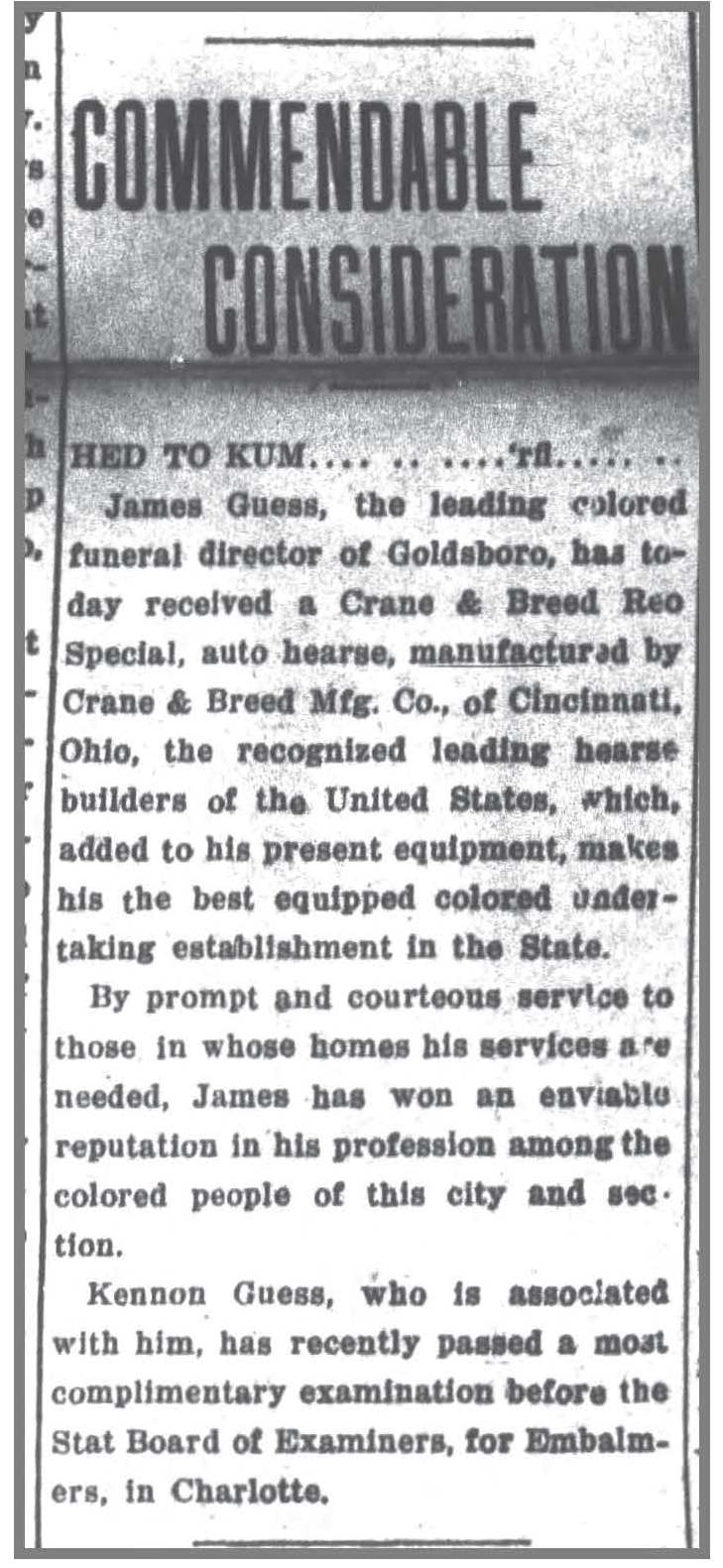
The leading colored funeral director.

Gboro_Daily_Argus_7_27_1920_James_Guess

Goldsboro Daily Argus, 27 July 1920.

 The esteemed James N. Guess was married to Annie Smith, daughter of Isham and Nancy Henderson Smith. [Small world moment: His nephew Kennon Guess married Esther Edwards of Greene County. I knew Mrs. Guess (later, Askew) as a first grade teacher at elementary school and as a neighbor in Wilson.]

Standard