
My grandmother’s maternal uncle, Edward Murray McNeely, made the local paper with his enthusiasm to fight in the Great War.

Statesville Sentinel, 12 April 1917.
My grandmother’s maternal uncle, Edward Murray McNeely, made the local paper with his enthusiasm to fight in the Great War.
Statesville Sentinel, 12 April 1917.

Twenty-five years ago today, I submitted the first draft of my master’s essay prospectus to Professor Barbara J. Fields of Columbia University. The thesis itself took another year-and-a-half to complete. In between, I submerged myself in the North Carolina State Archives and the literature of free people of color and forged an unwavering fascination with their time and place in Southern antebellum history. Though I found frustratingly little direct evidence of my own ancestors’ apprenticeship, I gained a depth of understanding of their circumstances and community that has served my genealogical research well.
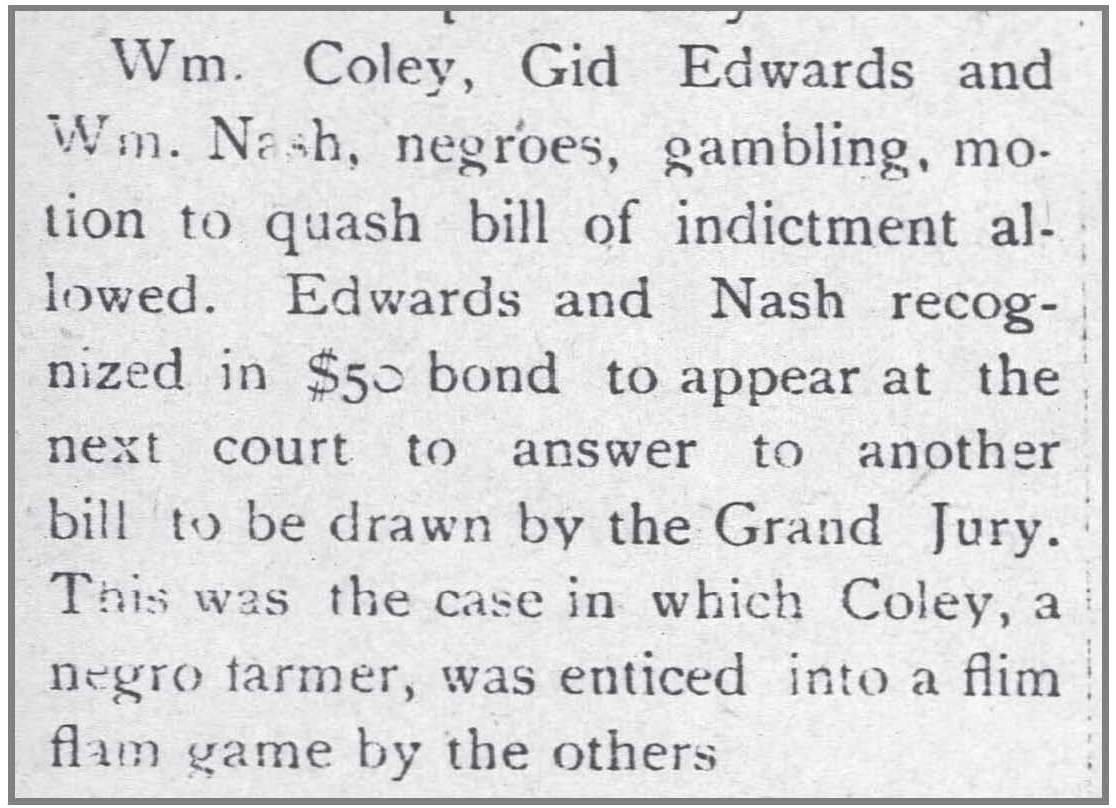
Wilson Daily Times, 26 October 1899.
The whole sorry story appeared in the 27 October 1899 edition of the paper. William Coley was Napoleon Hagans‘ oldest (perhaps) son, born about 1867 in Wayne County to Winnie Coley, and I originally thought that he was the one bamboozled. With closer reading, though, I noticed that this William Coley was still living in Wayne County in 1899 and was described as an “old negro.” Napoleon’s son was in his early 30s and living in Wilson at the time, so I’ve revised my opinion.
While I’m at it, though, here’s what I know about “my” William Coley:
I can’t find him in the 1870 census, but in the 1880 census of Nahunta, Wayne County, Winnie Coley is listed with sons Nathan, 19, and Willie, 12.
On 25 Feb 1891, Cain Artis applied for a marriage license in Wilson County for William Coley, son of Napoleon Hagans and Winney Coley, both living, and Minnie Woodard, daughter of Alfred and Sarah Woodard. The marriage was performed on 26 Feb 1891 by Presbyterian minister George Carson, with Cain Artis and Hilliard Ellis as witnesses. Cain was William’s half-brother; his mother was also Winnie Coley. Further, Cain’s father, Adam Artis, married Napoleon Hagans’ half-sister, Frances Seaberry.
In the 1900 census of Wilson, Wilson County, Willie Coley, 30, is listed with wife Minnie, 30, children Effie M., 8, and James M., 6, mother Winnie Coley, 65, and sister Zilley Coley, 38.
William seems to have been missed again in the 1910 census. Sometime between 1900 and 1920, his wife Minnie died, and he married a woman named Mary. It also seems likely that son James died during this period, as there is no World War I draft registration for him. Daughter Effie Mae married Arthur McCarter on 27 February 1910 in Wilson.
In the 1920 census of Wilson, Wilson County, living on Roberson Street: Will Coley, 50, wife Mary, 47, and granddaughters Ruth and Nannie Coley. Will worked as a public house mover. Minnie Ruth and Nannie Mae were actually McCarters, daughters of William’s daughter Effie (also known as Ethel) Coley McCarter. As I have not found Effie or her husband in the 1920 census, they may have died early as well.
Cain Artis died 23 March 1917 in Wilson County of pulmonary tuberculosis. His death certificate, for which William “W.M.” Coley provided information, noted that Cain was colored, was born March 1851 to Adam T. Artis and Winnie Coley, was married, and was a farmer.
William Coley himself died 26 Jan 1928 at the age 61 of the same dread disease that killed his brother Cain. His wife Mary Coley informed the registrar that he was the son of Pole Hagans and Winnie Coley, was a farmer, and resided at Route 3, Wilson.
1860 – 18 January. Eliza Seaberry [Levisa Hagans Seaberry] purchased 3.5 acres in Wayne County from Bryan Minshew for the odd sum of $109.37. How (and why) did she make this purchase instead of her husband Aaron?
1860 – In the federal census of Wayne County, Aaron Seaberry reports owning $100 real estate. This is likely his wife’s purchase above.
1862 – The deed for Minshew-Seaberry sale was recorded in Wayne County.
1867 – 13 February. Aaron Seaberry filed a mortgage deed conveying to his stepson Napoleon Hagins a “tract of land lately conveyed by Bryant Minshew to Louisa Seabery, wife of Aaron, all interest therein, also one grey mare, four head of cattle, nine head of hogs, all household and kitchen furniture … and 12 barrels of corn, about one thousand two hundred pounds of fodder & about nine hundred pounds of pork, one wagon & cart, and all the farming implements of every description of the said Aaron Seaberry” for $500. “The condition of this deed is such that whereas, the said Aaron Seaberry is justly endebted to the said Napoleon Hagins in the sum of one hundred & seventy dollars with interest from the first of February 1866, money paid by the said Hagins to William J. Exum for the said Seaberry and at his request and also the sum of two hundred dollars, loaned by the said Hagins to the said Seaberry, the precise date whereof is not remembered, but which the said Seaberry thinks was about eighteen months prior to the date hereof, and whereas the said Seaberry is justly indebted to the said William J. Exum as agent for J.M. Caho in the sum of thirty six dollars & twenty some cents, with interest from 1st January 1861 due by open account & also in the sum of sixty one dollars and thirty eight cents, due by note, the date of whereof is not now remembered by the said Seaberry, but supposed to have been given about two years ago…” The deed carried a condition that Hagans sell the conveyed property to pay off Seaberry’s debts, with the balance to be paid to Seaberry.
1870 – Napoleon Hagans appears in the federal population census of Nahunta, Wayne County, with $3000 personal property, but no reported real property. Is this accurate? What personal property could Hagans have owned of such value?
1871 – 1 January. Hagans purchased two tracts, totaling 221 acres, in Wayne County for $3500 from William Bryant and wife Sarah. The first was on the east side of Aycock Swamp and bounded by Hooker, Fort, Caho and Rodgers; it contained 48 acres and had been conveyed by Ruffin Hooks to J.P. Rodgers in 1861. The second was on Aycock Swamp, contained 173 acres and had been conveyed by John V. Sherard, administrator of the estate of Jesse Coleman, in August 1859. Both tracts were conveyed by William J. Exum to William Bryant and wife Sarah in 1867.
1871 – 4 January. Aaron Seaberry purchased 91 ¼ acres for $700 from Eliza Sauls. The deed notes that Seaberry and Napoleon Hagans would pay the $700 on 1 January 1872.
1874 – 25 July. Adam and Frances Seaberry Artis purchased three tracts of land totaling about 109 acres from her half-brother, Napoleon Hagans. All three are on or near Watery Branch, an east-flowing tributary of Contentnea Creek. The first two documents are a mortgage deed and deed of sale for two tracts on the creek. The third is a deed of sale for an additional nine acres nearby. Notably, this last is land upon which Adam had lived in prior years, as it contained the graves of his first wife, Lucinda Jones Artis, and a child. Hagans purchased 9 ¼ acres for $275 from Adam Artis and wife Frances, who was Hagans’ half-sister.
1874 – 21 April. A justice of peace examined Celia Bailey, wife of William Bailey, to determine her consent to her husband’s sale of land to Hagans. Hagans’ records do not show a copy of the deed for the sale, and it does not appear in Wayne County deed books. Apparently, it was not filed.
1878 – No date. Hagans purchased 3 acres for $45 from William J. Exum and wife. The deed was not recorded until 3 Nov 1885.
1880 – The federal agricultural census of Wayne County shows N. Hagans with 75 improved acres and 200 unimproved, valued at $2000.
1880 – Hagans testified to a Senate Committee that he owned 485 acres purchased for $5500 and a town lot purchased for $500. All his property was acquired after the war. “I rented a farm and started on two government horses. I went to the tightest man I knew and got him to help me. I rented from Mr. Exum out there.” [Why the discrepancy in acreage and value with what he reported to census takers? If his testimony was accurate, there were several deeds that went unfiled, including that for the town lot.]
1882 – 2 January. Hagans purchased 6 acres for $1 from W.J. Carr and wife Lizzie. The tract was situated at Sauls X Roads, beginning in “center of the road leading to Bul-head [in Greene County] near where the Wm Durden old hors stall stood,” along the road to a ditch, then to Fremont road, then to the cross roads, then back to Bullhead road. Sauls Crossroads was later known as the town of Eureka. “Bullhead road” is S. Church Street leading from Eureka, which becomes Faro Road and then Bullhead Road when it crosses the Greene County line. “Fremont road” is present-day Highway 222. This tract, then, was at the very heart of present-day Eureka (which remains, frankly, little more than a crossroads.)
1885 – 29 October. Hagans purchased 307.74 acres for $5075 from Thomas Edmundson and wife.
1885 – 31 October. Hagans purchased 4 acres from Burden West and wife Martha and Freeman West and wife Elizabeth. The tract adjoined “Napoleon Hagins formerly William Bryant W.B. Fort.”
1886 — Hagans bought land in Greene County from G.A. Jones and others.
1888 – 2 February. Hagans purchased 71.23 acres for $1500 from Mary Exum. The tract was on the Spring-Bank road bounded by Thomas Edmundson, Hagans, Jack Yelverton, Beaver Dam Branch and Spring Branch.
1888 – 22 July. Hagans and wife Absala sold 24 acres to Essex Farmer for $650. The tract adjoined Thomas Artis, “the Jack Wilson land” and Zilphy Artis, bounded by road leading from Sauls X Roads to Stantonsburg, being lot #3 in division of lands of Celia Artis and containing 34 acres. “Absala” signed her name “Appie Hagans,” and Hagans signed with an X. This is the land purchased in 1879 from Celia Artis’ son Calvin. Zilpha Artis was Calvin’s sister. John “Jack” Wilson married another Zilpha Artis, the sister of Hagans’ brother-in-law Adam Artis. Farmer apparently never paid off his mortgage as tract included in 1899 partition of Hagans’ estate.
1889 — Hagans bought land in Greene County from T.F. Jones and others.
1893 – 3 March. Hagans purchased 25 acres for $270 from J.W. Aycock and wife.
1894 – 4 January. Hagans purchased a lot on Pine Street, measuring 26′ x 220′, in Goldsboro for $700 from A.A. Williams.
1896 – 24 August. Napoleon Hagans died, almost a year to the day after his wife. They are buried just west of their house near Fremont.
1899 – 21 March. Partition of Napoleon Hagans’ lands, consisting of two tracts in Nahunta township containing 173 and 48 acres, described in deed from William Bryant to Napoleon Hagans; a tract containing 3 acres described in deed from W.J. Exum to Hagans; two tracts containing 75 ¾ and 6 acres, described in deed from Patsey Hall et al. to Napoleon Hagans; three tracts containing 39 ¼, 30 and 8 1/3 acres, described in deed from O.L. Yelverton et al. to Hagans; a tract containing 4 1/8 acres, described in deed from [omitted] to Hagans; a tract containing 25 acres, described in deed from J.W. Aycock to Hagans; a tract containing 9 ¼ acres, described in deed from Adam Artis to Hagans; a tract containing 24 acres, described in deed from Calvin Artis to Hagans; and a tract containing 30 acres, described in deed from Mary A. Exum to Hagans. Total acreage, approximately 475 2/3.
We drove up from Wilson to Soul City a few times in the mid-1970s, when my mother’s brother Charles C. Allen was city planner for the project. My memories are fleeting: the iconic Soul City sign, a scattering of house trailers, a large white “plantation house” cum operations center, and tick-infested fields. I was maybe 10 or 11; I wasn’t paying attention. We didn’t know it at the time, but we had another family link to Soul City. Floyd McKissick’s wife, Evelyn Williams McKissick, was the granddaughter of Mathew W. Aldridge and niece of my grandmother’s cousins Mamie Aldridge Rochelle and Fannie Aldridge Randolph.
Thanks to Will Robinson for his good work and to my cousin Bill Hagans for entrusting me with the preservation of these documents!

 William and Sarah Bryant are selling land to the renowned (and maybe a little infamous) Napoleon Hagans in 1871.
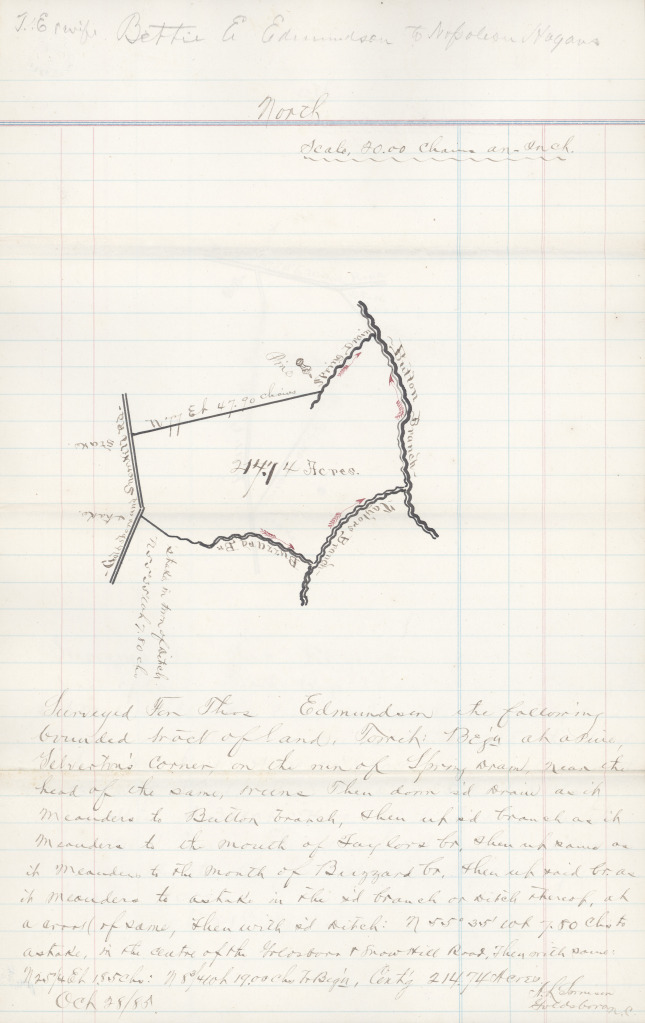 Plat of Edmundson land being sold to Napoleon Hagans. Did you know I used to be a land surveyor?
Last week when Lisa Henderson was in town to give her presentation, she also brought by a collection of family deeds for me to digitize. My focus at graduate school was in the digitization of historic, archival records so anytime someone brings me musty old documents, I am very happy. These deeds are records that may not be in the state archives and if they are they are not easy to access. Very few of North Carolina’s historical records have been digitized so anyone that wants access has to plop down at the archives and sort through them. Hopefully, in the not too distant future, all of their holdings will be digitized…
View original post 133 more words
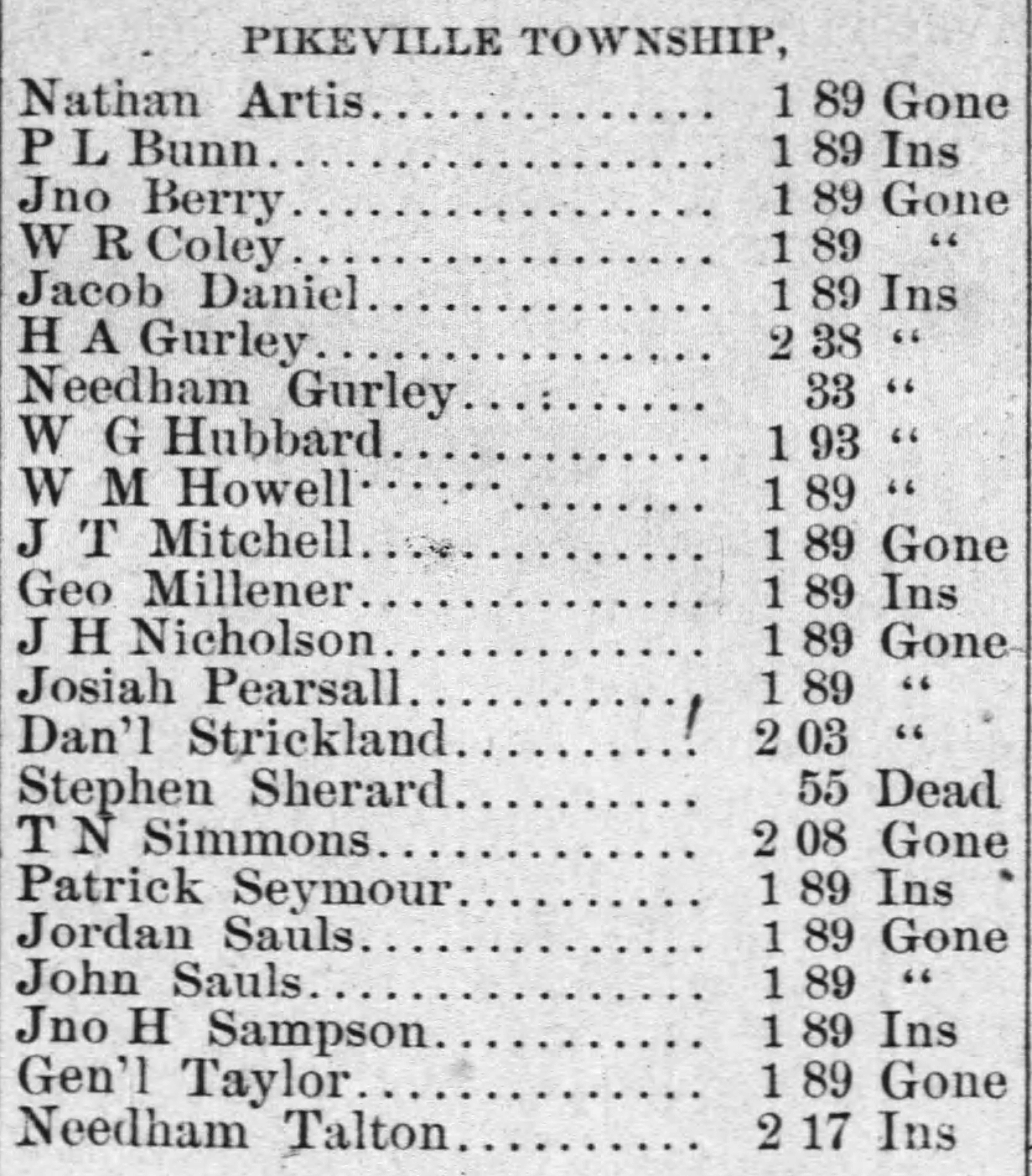
Scrolling through old notes, I found two more Artises — Nathan and John — who migrated to Arkansas, probably in the 1880s.
Here’s what I know about them:
Goldsboro Headlight, 1893.
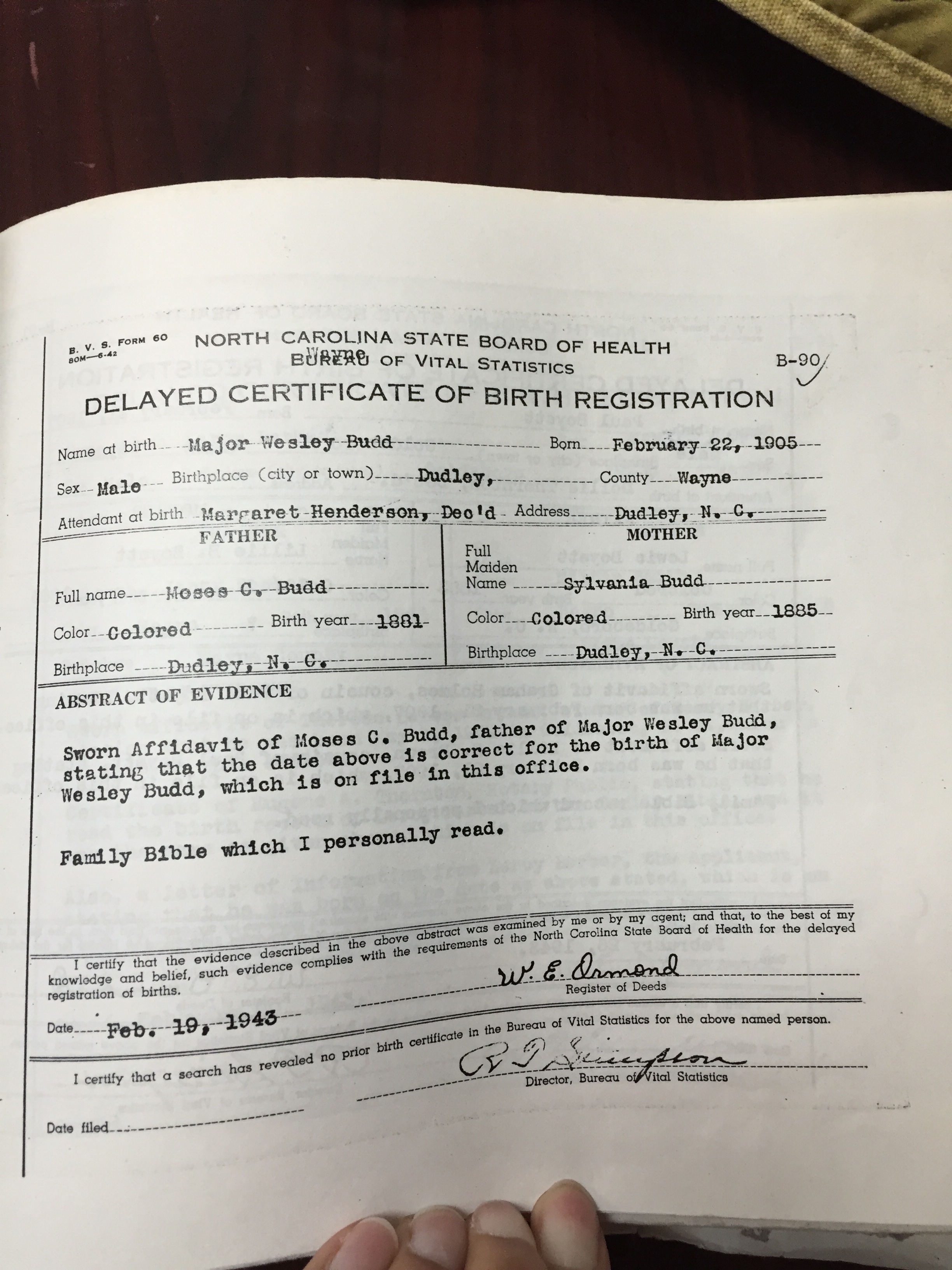
When I was home last week, I had some time to kill, so I spent an hour or so in the Wayne County Register of Deeds office, flipping through Delayed Birth registers. North Carolina did not mandate vital records until 1913, but people born before that year could obtain a “delayed” certificate if they could provide certain proof of their birthdate.
What struck me:

 Scuffalong: Genealogy.