Other Documents

One lovely blog? Why, thank you!

In recent days, I’ve been twice nominated for a One Lovely Blog Award. Many thanks to Maryann Barnes and Tiffiny for their thoughtfulness and kind words. It’s always nice to know that one is not only heard, but appreciated.

The “rules” for the award:

  • Thank the person who nominated you and link to that blog.
  • Share seven things about yourself.
  • Nominate 15 bloggers you admire (or as many as you can think of!)
  • Contact your bloggers to let them know that you’ve tagged them for the One Lovely Blog Award.

Seven things:

  • I was born in a segregated hospital in Wilson, North Carolina.
  • I drew my first family tree in a fifth grade school project.
  • In a chance conversation in the spring of 1985, I learned that census records were on microfilm at my university library. I knew my great-grandmother’s name; I looked for it. When I found her living with her grandparents in 1910, I nearly passed out. I’ve been researching ever since.
  • My master’s thesis examined the involuntary apprenticeship of free children of color in Wayne County, North Carolina.
  • I descend from members of nearly every strata of antebellum North Carolina society – enslaved people, free people of color, Native Americans, white yeomanry, the white planter class. (I blog about free people of color at http://www.ncfpc.net.)
  • Since at least the Revolutionary War, all my ancestors have been born in either North Carolina or Virginia.
  • I have a Sankofa tattoo.

Blogs I admire (at the moment — the list changes):

Standard
Births Deaths Marriages, Free People of Color, North Carolina, Other Documents, Paternal Kin, Religion

He was faithful in all his houses.

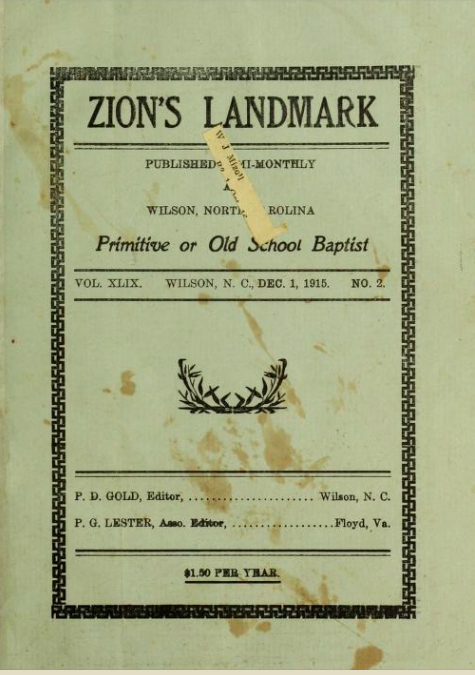
The Wilson Daily Times was an afternoon paper in my day. It was lying in the driveway when I arrived home from school, and I could read it first if I put it back like it was — pages squared and neatly folded. (Even today, I shudder at a sloppy newspaper, flipped inside out and pages sprawling.) The Daily Times‘ roots are in Zion’s Landmark, a semi-monthly newsletter begun in 1867 by Pleasant Daniel Gold. Elder Gold (1833-1920), pastor of Wilson Primitive Baptist Church, filled the periodical with sermons and homilies, ads for homeopathic remedies, testimonials, altar calls and, most enduringly, obituaries of Primitive Baptists throughout eastern North Carolina.

African-Americans did not often make it into the pages of the Landmark, but P.D. Gold held Jonah Williams in considerable esteem. Gold preached my great-great-great-great-uncle’s funeral and published in the Landmark a lengthy obituary by Brother Henry S. Reid, clerk at Turner Swamp Primitive Baptist Church:

Screen Shot 2014-10-12 at 10.41.54 PM

Screen Shot 2014-10-12 at 10.37.49 PM

Screen Shot 2014-10-13 at 7.34.42 AM

And what does this piece add to what I already know about Jonah Williams?

  • A marriage date for him and Pleasant Battle — 4 January 1867.
  • Some confusion about their children. I knew Pleasant had a slew of children from a previous marriage to Blount Battle. However, I had four children for Jonah and Pleasant — Clarissa (the surviving daughter referred to in the obit), Willie F. (1872-1895), Vicey (1874-1890), and J.W., whom I know only from a stone in the Williams’ cemetery plot. I’m thinking now that this is a foot marker, rather than a headstone, and I’ll revise my notes.
  • Jonah joined Aycock Primitive Baptist Church, part of the Black Creek Association, around 1875.
  • Around 1895, he and others were permitted to leave Aycock and form Turner Swamp Primitive Baptist Church, the first “organized colored” P.B. church in the area. The Black Creek Association ordained Jonah when he was called to serve at Turner Swamp.
  • Elder P.D. Gold preached Jonah Williams’ funeral.

Text found at https://archive.org/details/zionslandmarkse4919unse_0

Standard
Maternal Kin, Migration, North Carolina

William B. McNeely.

John Wilson McNeely‘s elder brother, William Bell McNeely, was born about 1804 in Rowan County. Their father was Samuel McNeely; their mother, Nancy Van Pool. The first known record of William’s life is John Van Pool‘s will, dated 13 October 1825 and probated in Rowan County at August term, 1827.  The document named John’s sons David, Jacob, and John Van Pool; his daughters Nancy [McNeely], Margaret [McNeely] and Maria Van Pool; son-in-law Samuel McNeely; grandson Elihu N. Pool; and granddaughters Eliza Pool and Margaret T. Pool. Samuel McNeely was named executor, and witnesses were John McNeely Sr. and Jr. and William B. McNeely. (“Senior” and “junior” did not necessarily mean father and son in that era. Rather, as “II” can today, a “junior” could simply be a younger relative with the same name. Margaret Van Pool married Samuel McNeely’s brother John McNeely, who was named after his father. However, John McNeely the elder died in 1801, so could not have been the Sr. here. If Samuel’s brother John himself had a son John, he would have been rather young to have been a legal witness in 1825. Long story short, I don’t know which John McNeely in the will is Margaret’s husband, or who the other one is. William B., of course, was Samuel’s son and may simply have been close at hand.)

Five years later, on 1 Aug 1832, William B. McNeely married Elizabeth McNeely in Rowan County. Undoubtedly cousins, their exact relationship is not known. Within just a few years, the family would leave North Carolina forever, headed west to Missouri to claim a land grant.

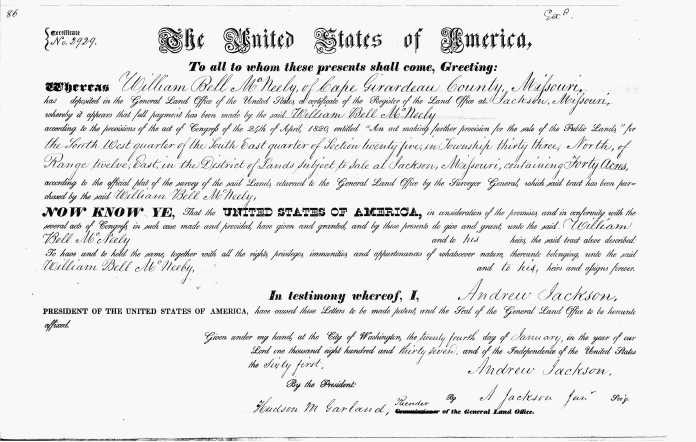
On 24 Jan 1837, William Bell McNeely of Cape Girardeau, Missouri, deposited a certificate with the registrar of the Jackson, Missouri, land grant office.  He registered a parcel described as the southwest quarter of the southeast quarter of section 25 in township 33, north, of Range 12, east and measuring 40 acres.
RHUSA2007B_MO0620-00086 copy

On 17 September, 1839, William B. McNeely married Elizabeth McPherson in Cape Girardeau County. William’s son Samuel was then about 4 years old, and it does not appear that William and his second wife had any children together.

On 10 Dec 1841, William McNeely made his final payment on the purchase of the parcel, which was located in Perry County, and took title. He had not finished moving though. In 1850, the censustaker of Saint Francois County, Missouri, counted among that county’s residents farmer William McNealy, 46, wife Elizabeth, 46, and Samuel E., 15. William claimed real estate valued at $300. Ten years later, after the formation of a new county, the family is listed in the Middlebrook postal district of Iron County: North Carolina-born farmer William B. McNeely, 56, wife Elizabeth, 56, and 7 year-old Catherine Green.  William claimed $2000 in real estate and $500 personal property.  Next door, son Samuel E. McNeely, 26, and his young family —  wife Emily, 20, and daughter Elizabeth, 5 mos. — appear.  Samuel reported $50 personal property.

William was too old to serve during the Civil War, and I have found no record that Samuel did either. William did, however, sign a loyalty oath in 1864.

In the 1870 census of Ironton, Iron County, Missouri, in Township 32, Range 3 East: Wm. B. McNeely, 66, farmer, appears with wife Elizabeth.  William claimed $2500 real estate; $200, personal property.

Meanwhile, back in North Carolina, William’s brother John W. McNeely edged toward death. John’s demise in mid-summer of 1871 makes clear the totality of William’s break with his home state. John’s administrator, Joshua Miller, initially named his heirs as his widow, “Acenith McNeely a sister reported to be in Missouri and a Brother name not known and residence not known.” A little information trickled in, and Miller’s next report  identified “Wm. B. McNeely, age 65, residing in Missouri Post Office unknown.” Though William had been in Iron County at least twenty years by then, Miller never found him (or Acenith), and the estate was settled without him.

Sometime between 1870 and 1880, William was again widowed. He appears in the census of Liberty, Iron County, in the household of his son, farmer S. McNeely, 45, with wife E., and children Ellen, Thomas, Owen, Margarett, Nancy, Charles, and George D. Samuel’s daughter Elizabeth — El. Huff — and her children William, 2, and Sam, 6 months, also lived in the house.

By 1900, Samuel McNeely was an elderly hired man living and working in Shoal Creek, Bond County, Illinois, some 125 miles northeast of Iron County. Samuel’s children, by this time, have moved west to Arizona and California. His father is not with him in Illinois and does not appear in the Missouri census. Most likely, he did not live to see the new century.

Standard
DNA, North Carolina, Paternal Kin

DNA Definites, no. 16: Henderson.

Hard on the heels of my first Henderson match* comes another.

K.H.’s family tree shows that he or she is a descendant of Susan Henderson Wynn, half-sister of my great-great-great-grandfather Lewis Henderson. I’ve reached out to the woman who administers K.H.’s account — bizarrely, she’s someone who reached out to me a year or ago about some Artis research she was doing for a friend — to confirm the connection.

*By this, I mean a Henderson who is not also an Aldridge. They are my double-cousins, and much closer on the Aldridge side.


Standard
Maternal Kin, Migration, Newspaper Articles, North Carolina, Vocation

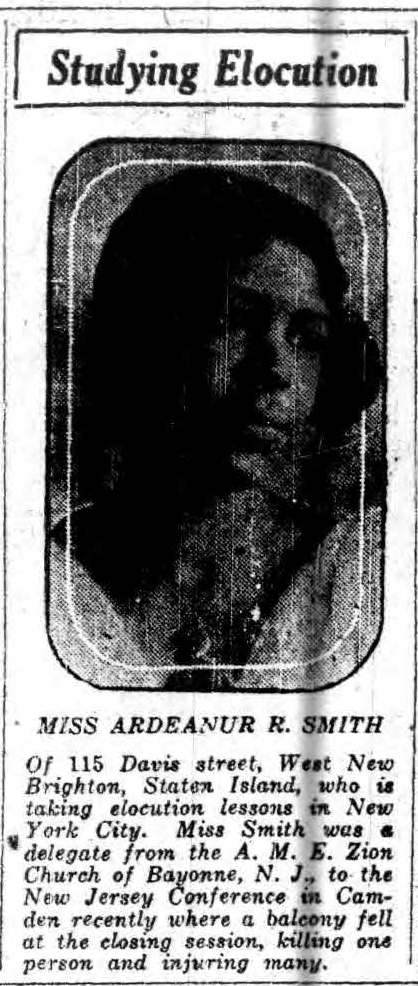
Ardeanur, elocutionist.

 Pitt_Courier_6_2_1928_Ardeanur_Smith

Pittsburgh Courier, 2 June 1928.

This brief blurb intrigues me any number of ways:

(1) Ardeanur R. Smith? This is the first I’ve seen of a middle initial for Cousin Ardeanur.

(2) Smith? My grandmother said Ardeanur married somebody she ran off with when she was a teenager. However, every mention of her I’ve found dating before 1947 — and she is elusive in official records — names her as Smith, her maiden name. In her uncle John McNeely’s 1947 obituary, she’s a Hart for the first time. I have no idea what Mr. Hart’s first name was, where they married, or how long they stayed that way.

(3) Elocution? This may absolutely be a function of me failing to ask the right questions, but, as much as I heard about Wardenur playing the organ on the radio, I never heard my grandmother speak of Ardeanur’s singing or speaking career.

(4) And who was Ardeanur’s publicist that he or she managed to get her name and photo in the Pittsburgh Courier? And not for the last time.

(5) Staten Island?

(6) “Where a balcony fell at the closing session”?!?!?

Standard
Migration, Newspaper Articles, North Carolina, Paternal Kin

That glorious climate of Arkansas.

Perhaps this sheds some light on Gus Artis and his sister Eliza Artis Everett‘s migration to Arkansas from North Carolina well after the Exoduster era:

Goldsboro_Headlight_11_6_1889_Arkansas_migrantsGoldsboro Headlight, 6 November 1889.

On 27 November 1889, the Wilson Mirror reprinted a Goldsboro Argus piece that described Williams and Herring as “railroad hirelings and speculators.” “However much the desire should be divided among our people — and by this we mean the white people — for the negro to exodus this country or remain, the solid, stubborn truth shall not be kept from the poor, deluded, half-informed negro, that this is his home, the climate of his nature; that our people are the most tolerant and generous in the world; and his best friends, and that, therefore, he should stay right here where his associations date back through the centuries; where his faults, and there are many (but who of us is without faults?) are borne with from custom; where his privileges as a free citizen are unquestioned and untrammeled, and where his destinies are linked by law with the whites, who, under a Democratic administration, have for twenty years paid 90 per cent. of his government and education, while he has furnished 90 per cent. of the crime and ignorance of the State.”

Best friends, indeed.

The 20 December 1889 issue of the Wilmington Messenger chimed in the mockery, noting that “Peg leg Williams and Silas Herring have not dissolved copartnership. Peg leg is now in [Goldsboro], and he and Silas are as active as bees in inducing the “coons” of this section to leave their homes of peace and plenty here, to go the far off miasmatic lands of the West, there to die like cattle with the black tongue.”

Robert “Peg-Leg” Williams is memorialized in 100 Americans Making Constitutional History: A Biographical History, edited by Melvin I. Urofsky. Described as the most famous and successful of Southern “emigrant agents, Mississippi-born Williams, a Civil War veteran, assisted 16,000 African-Americans in leaving North Carolina in the wake of discriminatory labor laws passed in 1889.

*Kizzy Herring Herring, who applied for her husband’s Civil War pension from Lonoke County, Arkansas, was another who left Wayne County for the West. So, I suspect was Guy Lane, Jr., son of Guy and Sylvania Artis Lane, who decamped from Wayne County to Memphis, Tennessee, sometime between 1880 and 1900. Did he just not quite make it to Arkansas? Or did he double back to the city after deciding that Arkansas did not suit?

Standard
Education, Maternal Kin, Newspaper Articles, North Carolina

David C. McNeely’s erratum.

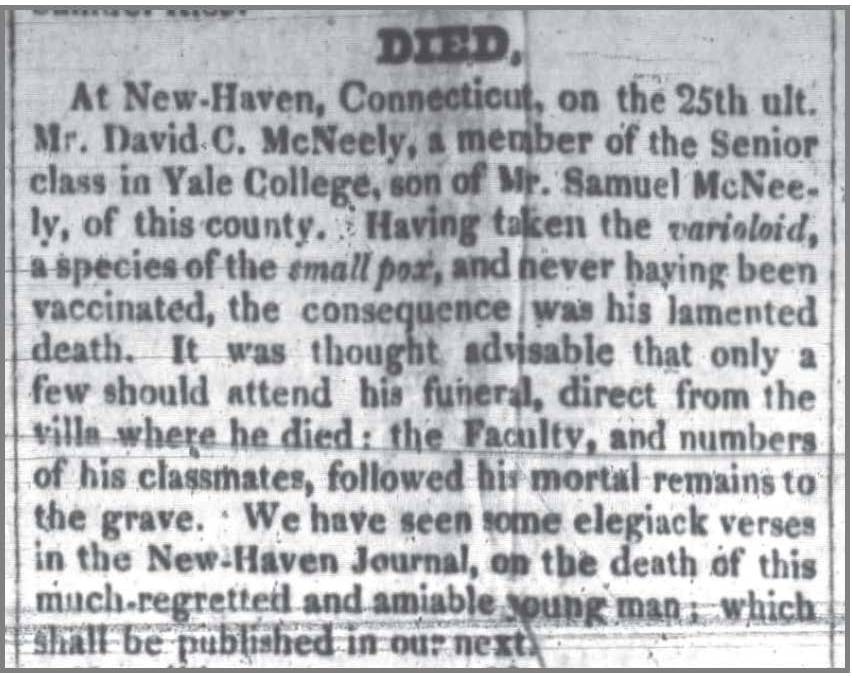
Eons ago, one of the first documents I found related to my great-great-great-grandfather John Wilson McNeely‘s family was an 1828 obituary for his brother David C. McNeely, a student at Yale College.

Western_Carolinian_4_22_1828_death_of_David_McNeely

Western Carolinian, 22 April 1828.

Wow, I marveled. There could not have been many Scotch-Irishmen from the backwoods of Piedmont North Carolina studying at Yale at that time.  What a terrible loss this must have been for John and his family. I entered David’s name into my Family Tree Maker tree alongside Samuel McNeely’s other children William and Acenith (or Acintha).

And then the other day, I found this:

Western_Carolinian_4_29_1828_David_McNeely_correction

Western Carolinian, 29 April 1828.

Oh. … Okay. … So all my sentiments hold — except the loss to John. David was not Samuel McNeely‘s son after all, but James McNeely’s.

If there was one James McNeely in Rowan County in the first quarter of the 19th century, there were a dozen, and I have been singularly unsuccessful at teasing apart and differentiating them. Evidence shows that Samuel and his son John W. had close relationships with several James. However, the will of Samuel’s father John McNeely (1724-1801) lists no heir named James, only John, Alexander and Samuel and their sister Ellinor McNeely Bell. It is past time that I pull together a chart or a list or a something that summarizes links I’ve found among these McNeelys and may reveal previously unnoticed clues.


Standard
North Carolina, Other Documents, Paternal Kin

Eureka! … Not.

I was flipping through an old notebook and came across this abstract of entries in the 1912-1913 city directory of Wilson, North Carolina:

Taylor, Bertha, laundress, h 114 w Lee

Taylor, Greenman, h Stantonsburg rd nr Rountree av

Taylor, Hennie, dom, h 114 w Lee

Taylor, Jordan, lab, h Stantonsburg rd nr Rountree av

Taylor, Mack, driver, h 114 w Lee

Taylor, Mattie, laundress, h 114 w Lee

Taylor, Robert, barber, h 114 w Lee

Taylor, Roderick, barber Paragon Shaving Parlor, h 114 w Lee

The house at 114 West Lee Street belonged to my great-grandfather Michael (“Mike,” not “Mack”) Taylor. Bertha, Hennie, and Mattie were his younger daughters. Roderick was his only son. Jordan and Greeman, over on Stantonsburg Road, were Mike’s niece Eliza’s husband and son. But who in the world was Robert Taylor?

Robert … Robert … An epiphany! Of course! This was Robert Perry, son of Mike’s wife Rachel‘s sister Centha Barnes Perry! The boy grew up in Mike and Rachel’s household and quite naturally he was sometimes known as Robert Taylor! … Right?

Well, perhaps, but this is not him. Robert Perry was only 9 years old in 1912. Not only would a child not have been plying a trade at that age, he would not be counted among the adults included in a city directory. (Even Rachel was omitted, as “dependent” homemakers did not make the cut either.)

So, who was this Robert Taylor who both lived in Mike Taylor’s house and worked in the same trade as Mike’s son Roderick?

Census records do not show an African-American Robert Taylor in all of Wilson County in the 1900 or 1910 censuses. In 1920, however, there is Robert Taylor, age 36, a laborer, with wife Mary G., age 29, living at 611 Green Street. Now this is really puzzling.

Two years earlier, when Roderick Taylor registered for the World War I draft, he stated his birth year as 1883, his occupation as barber, and his address as 611 East Green Street. There is no “Roderick Taylor” listed in the 1920 census, but in 1930, at 610 [sic, house numbers shifted in the early 1920s] Green Street, there is barber Roderick Taylor, 45, wife Mary J., 39, and three children.

While it is conceivable that there were both a Robert Taylor and Roderick Taylor of the same age, living in the same houses, with wives of the same name and age, and working in the same profession, it seems unlikely. Rather, in an era in which “Roderick” was rare name, an inattentive census taker or canvasser might easily have heard “Robert” when making his inquiries. Absent further independent evidence that a Robert Taylor existed, I conclude that Roderick’s doppelgänger is a figment of error.

Standard
Births Deaths Marriages, Land, Maternal Kin, Newspaper Articles, North Carolina

John W. McNeely’s heirs.

John Wilson McNeely died childless in July 1871. Or at least, you know, childless in any way that mattered to probate court. He had not made a will, so his heirs at law were his widow Mary McNeely McNeely and his two surviving siblings. His son Henry W. McNeely did not warrant notice.

In August, Joshua Miller, administrator of John’s estate, and Mary McNeely filed a Petition to sell Land for Assets against John’s brother William B. McNeely and sister Acintha McNeely or Corryer [or, as most commonly spelled, Corriher.]  McNeely’s debts totaled about $2000, and his estate was valued at only $800, of which $300 had been set off for his widow.  At death John had owned “about 235 acres on Catheys Creek in Rowan County adjoining the lands of Joshua Miller, Frederick Menus, Dr. F.A. Luckey, and others” and valued at about $7/acre.  This property was to descend to William, age 65, believed to be living somewhere Missouri, and Acintha McNeely or Corryer, age 60, living somewhere in Tennessee.

On 8 September, justice of the peace John Graham, J.M. Harrison, and S.A.D. Hart allotted a year’s provision to Mary McNeely, which included a mouse-colored mule worth $125, four horseloads of hay, 500 bundles of fodder, two hogs, one sow and four pigs, one old buggy and harness, 37 pounds of bacon, two bushels of Irish potatoes, one ax, an old washtub, one “foalding leg table,” one “old poplar cubbard & contents,” one waterbucket and washpan, a half dozen chairs, one candlestand, one bureau, an old looking glass, two beds and furniture, one small Bible, two Hymn books, four handtowels, and three “table cloth.”

William and Acintha were never located,* and, on 31 October, Joshua Miller sold the remainder of John’s personal property at auction. The items sold included a “crout” stand, 550 shingles, “sythes,” a log-chain, tanner’s knives, a cross-cut saw, ceiling-dogs, moulding planes, “clevis & strechers,” planes, “waggon cloth,” “hackel & chain oil,” a cultivator, a tar bucket, five sheep, nine hogs, a red calf, a blue calf, two cows, two horses, a mule, a bureau, mirror, a small table, two beds and furniture, a book case, a clock, two chests, two pairs of boots, shoe tools, sheep skins, a map, Scotts Bible, another Bible, a hymn book, 14 lots of books, a razor and strop, an armchair, ten chairs, one counterpane, a coon skin, two padlocks, a slate, and 240 1/2 acres of land sold at $10.80/acre for a total of $3266.19 1/4.

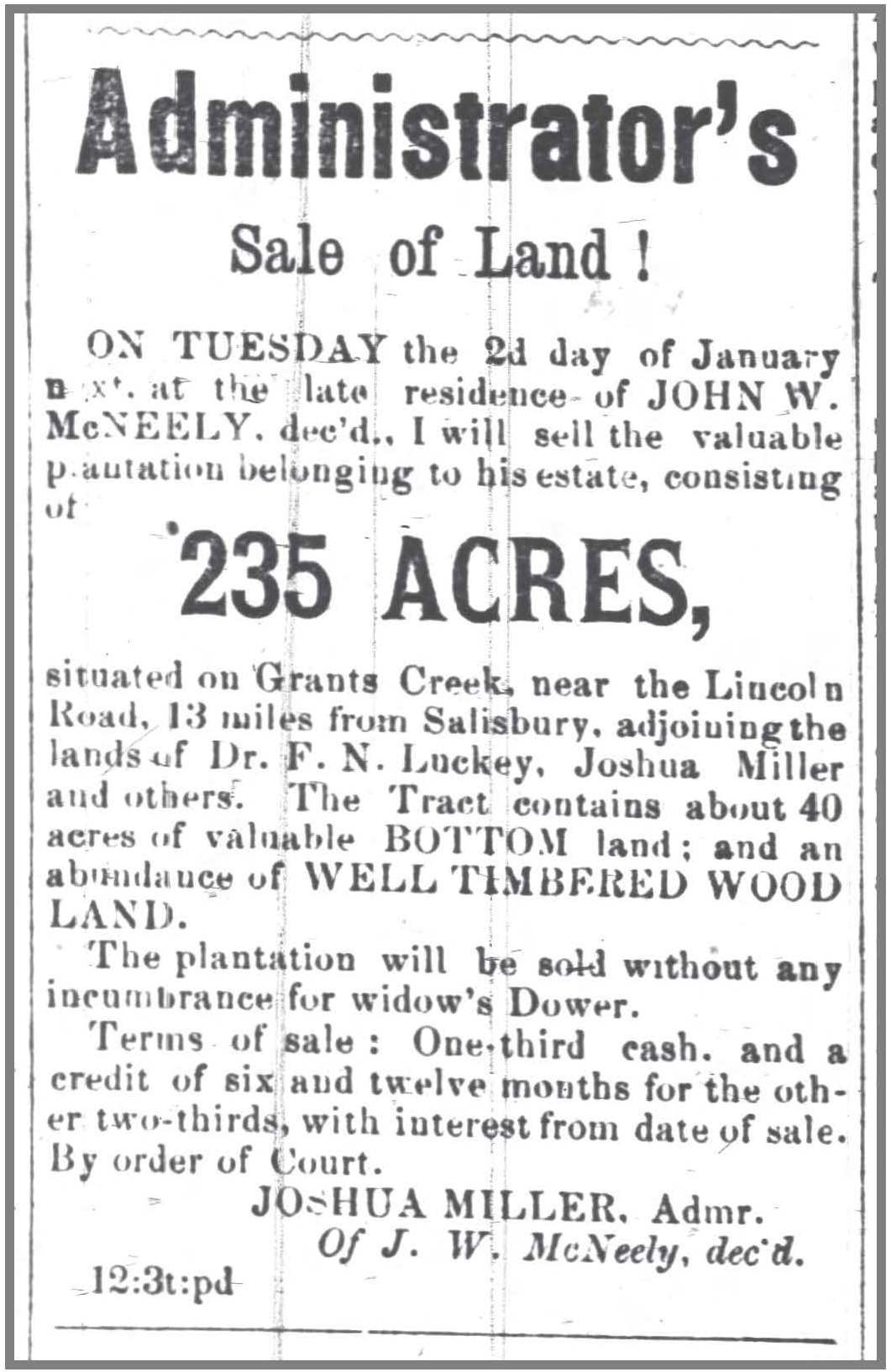
The land sale apparently did not go through, and six weeks later, Miller advertised the sale of 235 acres from John’s estate.

Carolina_Watchman_12_8_1871_Notice_Sale_JW_McNeely_land

Carolina Watchman, 8 December 1871.

It is likely that Henry McNeely’s mother Lucinda worked in John W. McNeely’s household until he died. The 1870 census of Atwell township, Rowan County, lists J. Wilson McNeely and wife Mary at household #292; Henry W. McNeely, wife and children, including a son John Wilson, at #293 (this Henry was NOT John W.’s son, though he was certainly a nephew by marriage and/or cousin); then Lucinda, her son Henry and two grandchildren at #294 and Lucinda’s son Julius, wife and nephews at #295. I have no doubt that Lucinda and her offspring lived on John McNeely’s land. Or that the sale of John’s 235 acres forced them off. By 1880, they were living just north in Mount Ulla township, where Julius bought a small farm.

*I have never found a trace of Acenith McNeely Corriher, but William Bell McNeely outlived his brother by 13 years. More later on his life in Iron County, Missouri.

Standard