DNA, North Carolina, Paternal Kin

DNAnigma, no. 15: Barnes?

Barnes is far and away the most common surname in Wilson County. It is the “Smith” of Wilson, so common that two Barneses who meet, without further reason, will not wonder if they are kin. It would not occur to them that they might be. My cousin has a Barnes maternal line, and a Barnes paternal line, and married a Barnes. None are connected. My Wilson County roots are neither wide nor deep, so I only have one Barnes line, and it’s a little iffy. Nonetheless, 23andme has matched my and my father’s chromosomes with W.B. and estimates that they are 3rd to 5th cousins, .58% share. (W.B. doesn’t match my cousin, despite her many Barnes lines.)

W.B.’s patrilineal line is traceable to John Barnes, born about 1860, probably in Wilson County. Shortly before 1880, John married Harriet Batts, daughter of Orange and Mary Batts. I have not found a death certificate for John, but census records indicate that he died before 1920. Is he the connection? If he is, the tie is in an earlier generation, as there is no John Barnes in my files.

W.B. also has an ancestor named Nancy Barnes Horne, daughter of Gray and Bunny Barnes and wife of Simon Horne Jr. Is she the connection? Is the connection a Barnes at all?

W.B. is a 3rd to 5th cousin to my father. I know all kinds of 3rd to 5th cousins. In real life. How can I have NO CLUE what our relationship is this one? 23andme and Ancestry DNA are wonderful tools that have been invaluable in confirming connections, but their deeper impact has been to drive home just how little I know.

Standard
Births Deaths Marriages, Oral History, Paternal Kin, Photographs

Remembering Nina F. Hardy.

My parents married in 1961. When my mother arrived in Wilson shortly after, my father took her around to meet the elders who had not been able to travel to Virginia for the wedding. Along the way, they stopped at Dew’s Rest Home. As my mother stepped through the door, Aunt Nina threw up a cautionary hand: “Wait. You ain’t expecting, is you?” My mother, mortified: “No, ma’am!” “All right. ‘Cause it’s some uggggly folks in here!”

My paternal grandmother had a thousand stories about Nina — with a long I — Frances Faison Kornegay Hardy. Though she called her “aunt,” Nina in fact was her cousin. She was born March 15, 1882, probably in northern Duplin County, to John Henry Aldridge and Addie Faison. (John H. Aldridge, born 1844, was the son of John Mathew Aldridge, and first cousin of my grandmother’s grandfather, John W. Aldridge.)  She seems to have been married briefly to Joe Kornegay in 1899 in Wayne County, but I have not found her in the 1900 census. By 1910, she had made her way 40 or so miles north to Wilson and was boarding in the household of Jesse and Sarah Jacobs as “Nina Facin.” The census also shows a “Nina Facon” living and working as a servant in the household of Jeff Farrior in Wilson. Though described as white, this is almost surely Aunt Nina, who cooked and cleaned for the Farriors most of her working life. Though she and her husband lived just outside Wilson on what is now Highway 58, she was at home only on her days off.

Said my grandmother:

Aint Nina lived up over the Farrior house on Herring Avenue.  Herring’s Crossroads, whatever you call it.  And that’s where she come up there to live.  Well, the maid, as far as the help, or whoever, they stayed on the lot, where they’d have somewhere to sleep. So Aint Nina was living on Nash Road, way down there, and when we went to see her, me and Mamie would run down there five miles. She was working for Old Man Farrior then.  When she was living out in the country, she was working for white people, and so she went up to their house and cooked for them.  And when we’d go down to her house, she’d have to come from up there and cook when she get home.  So we would go and spend a day, but it would be more than likely be on her day off.  But when we had the horse and buggy, Mama drove out there once, and we went, I went with Papa with the wagon to where you grind corn to make meal, down to Silver Lake or whatever that place was down there.  Lord, them were the good old days.  

The Farriors, their back porch was closed in.  It had windows.  And had a marble floor in the back, and that stairway was on, where it was closed in on the back porch, you could go upstairs, and there was a room up there.  You couldn’t go from out of that room into the other part of the house.  You had to come back down them steps then go in the house.  And that’s where Aint Nina stayed.  I said, Lord, I wouldn’t want to have stayed up there.  And then something happen … She had to come down and go down the steps, go upstairs, I mean, and come out of the kitchen, and then go up them steps out on this porch in her room.  So she stayed up there.  Lord, I wouldn’t want to stay up there.  She get sick out there, she couldn’t get nobody.  I didn’t see no – I was up in there one time, and I went up there just to look around.  Well, she had a nice room, nice bed and chair and dresser and everything.  There was a whole set in the room where she was.  That was the only time I was up there. But I wouldn’t want to stay up there.

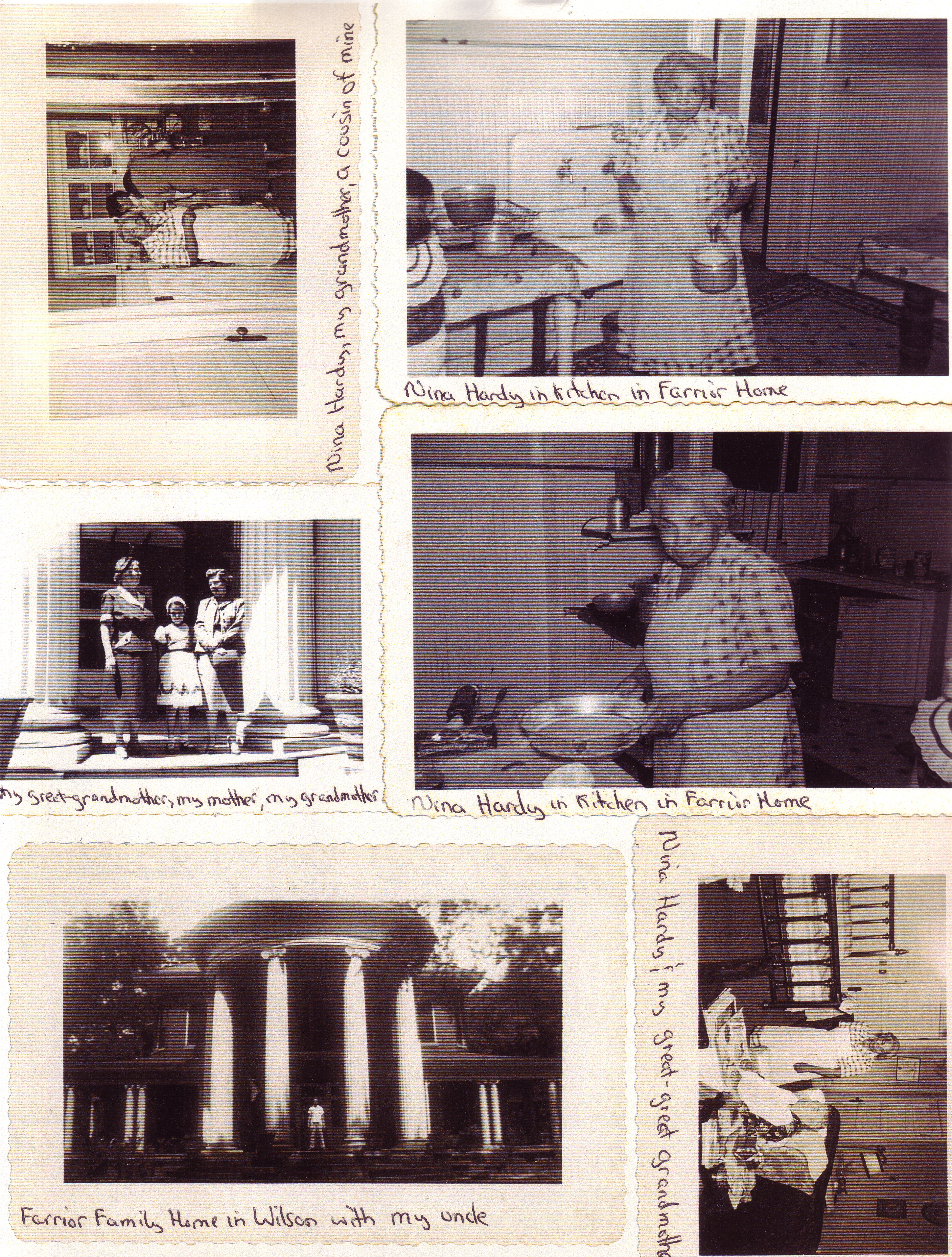
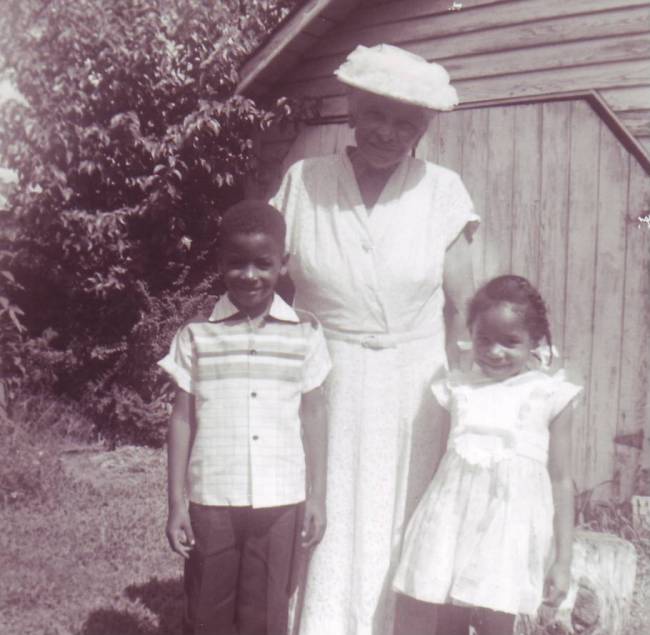
In 2004, J.M.B., a Farrior descendant, sent me copies of several photos of Aint Nina. My grandmother had described her (“She wasn’t real short.  But she was heavy built, and she had big limbs.  But she wasn’t that fat, but she just had big limbs and had a big face.”), and I had seen a couple of pictures of her before, like this one, taken in the mid-1950s with my uncle’s children:
Image

And this one,

IMG_0019

[There’s a photo booth shot that I can’t find right now. But I will.  UPDATE: I found it. 1/3/2016]

But these …

Scan10002

… these touch me. Nina at work. Nina in a kitchen with a floured pan, perhaps making biscuits, perhaps the dumplings my grandmother relished. Nina, her own legs aching, tending to whitefolks. The columned Farrior mansion, since torn down, with Nina’s little room tucked out of sight.

In 1917, Nina married Julius Hardy in Wilson township. It is likely their house that my grandmother and great-aunt visited out on Nash Road:

They had guinea chickens.  A car run over a chicken and killed it, and it kept going.  And we, me and Mamie, was going out there, and we picked up the chicken and carried it ‘round there.  And Aint Nina poured water and scald the chicken and picked it and cooked it, and we had the best time eating it.   Wont thinking ‘bout we was going out there to eat.  And so we come walking in there with that chicken, and she wanted to know, “Well, where’d you get that?”  “A car run over it, and we picked it up and brought it on over so you could cook it.”  And she said, “Yeah, it’s good.  A car just killed it?”  And it wasn’t too far from the house.  And I reckon it was one of her chickens anyhow.  Honey, she cooked that old stewed chicken, had to put pastry and vegetables in it.  Lord, we stayed out all that time, then had to come home from way out there.  But we was full. 

And her brother, his name was James Faison, lived across the street from her, and his wife, and I think the lady had been married before because they wasn’t his children.  It was two girls.  And he worked at the express, at the station.  The place was on that side, Nash Street station was over on this side.  Baggage used to come over there.  The baggage place where’d you take off the train.  That’s where you put it over on that side at that time.  And he was working over there.

Nina was a font of information about the family back in Dudley that my grandmother barely knew. Mama Sarah was impatient with questions about the past. Nina, on the other hand …

Mama never talked about her daughter Hattie.  But A’nt Nina, she would tell everything.  Mama got mad with her, said, “You always bringing up something.  You don’t know what you talking ’bout.”  So she’d go behind — Mama wouldn’t want her to tell things.  And she never did say, well, if she said, I wouldn’t have known him, but I never did ask her, who Hattie’s daddy was.  I figured he was white.  Because she looked — her hair and features, you know, white.

Even as she waited on others, Nina struggled with her health:

But she was kind of sickly, and I went up there for something.  See ‘bout her.  Carry her something.  And then when her leg was sore, and she come to stay with us.  Oh, she stayed with us a long time ‘cause she had to go to the doctor, had to be taken to the doctor with that leg.  That leg was still big.  But it was much bigger than the other one.  But it healed over.  But it was so knotty-looking, like it’d heal up and draw up in places, and it just looked so bad, and so she’d wear her dresses long.  But she had big feet!  Oooo, she had big feet.  With those big legs … And she was the one that Mama made Mamie iron her clothes on Sunday.  ‘Fore you even got to playing, had to get her clothes.  She was at Rocky Mount in the hospital with that leg.  They had operated on that leg and Mama would go every Sunday and take her clothes, bring her dirty clothes home and wash ‘em and bring them back to her.  So, Lord, we had a time with that.  And I looked at that big leg and just said, ‘Wooo….  What in the world is that?’  Looked like it just swelled up.  And I saw a lady right here in Philadelphia.  I had passed, and I seen her, and she had a great big leg.  And so by that woman having that big leg, I said, ‘Lord have mercy, I hope I don’t get that.  I wonder what’s wrong with it?  How come the swelling won’t go down in it?’  People don’t know what they’ll have to go through….  Yeah, ‘cause we went over there, and you didn’t have — it was an open sore, and it was always running.  She had to keep her foot up and had to keep the flies from on it, and so I said, well, finally it got better, but that leg healed up, it drawed up and you could tell where the sore was all on her leg.  And that leg was much bigger than the other one.  It took a long time to heal.  It was all healed up though before she died.

Image
In the photo above, taken in her last years at the rest home where she protected my young mother from a disastrous maternal impression, Nina smiles her same sweet smile despite ailing legs wrapped and swollen feet encased in split loafers.
N Hardy Death Cert
Aint Nina died 20 March 1969, just five days after her 86th birthday. Frances Sykes Goodman, granddaughter of Nina’s aunt Frances Aldridge Wynn, was the informant on her death certificate. She was buried in Rest Haven, Wilson’s black cemetery. (I’ve walked that graveyard and never seen her stone. Is her grave unmarked? If it is, and I can find it, it won’t be.)
Standard
Newspaper Articles, North Carolina, Paternal Kin

Cousin Mamie in the news.

As I’ve mentioned, for reasons unclear, my grandmother was close to her father’s first cousins, sisters Fannie Aldridge Randolph of Philadelphia, Pennsylvania, and Mamie Aldridge Abrams Rochelle of Union, South Carolina. Among my grandmother’s papers, I found cards and notes from Cousin Mamie, including this one sent in early 1980:

ALDRIDGE -- M Rochelle to H Ricks re Article

And here’s the article itself:

ALDRIDGE -- M Rochelle Article

Standard
Births Deaths Marriages, Maternal Kin, North Carolina

Family cemeteries, no. 10: Green Street.

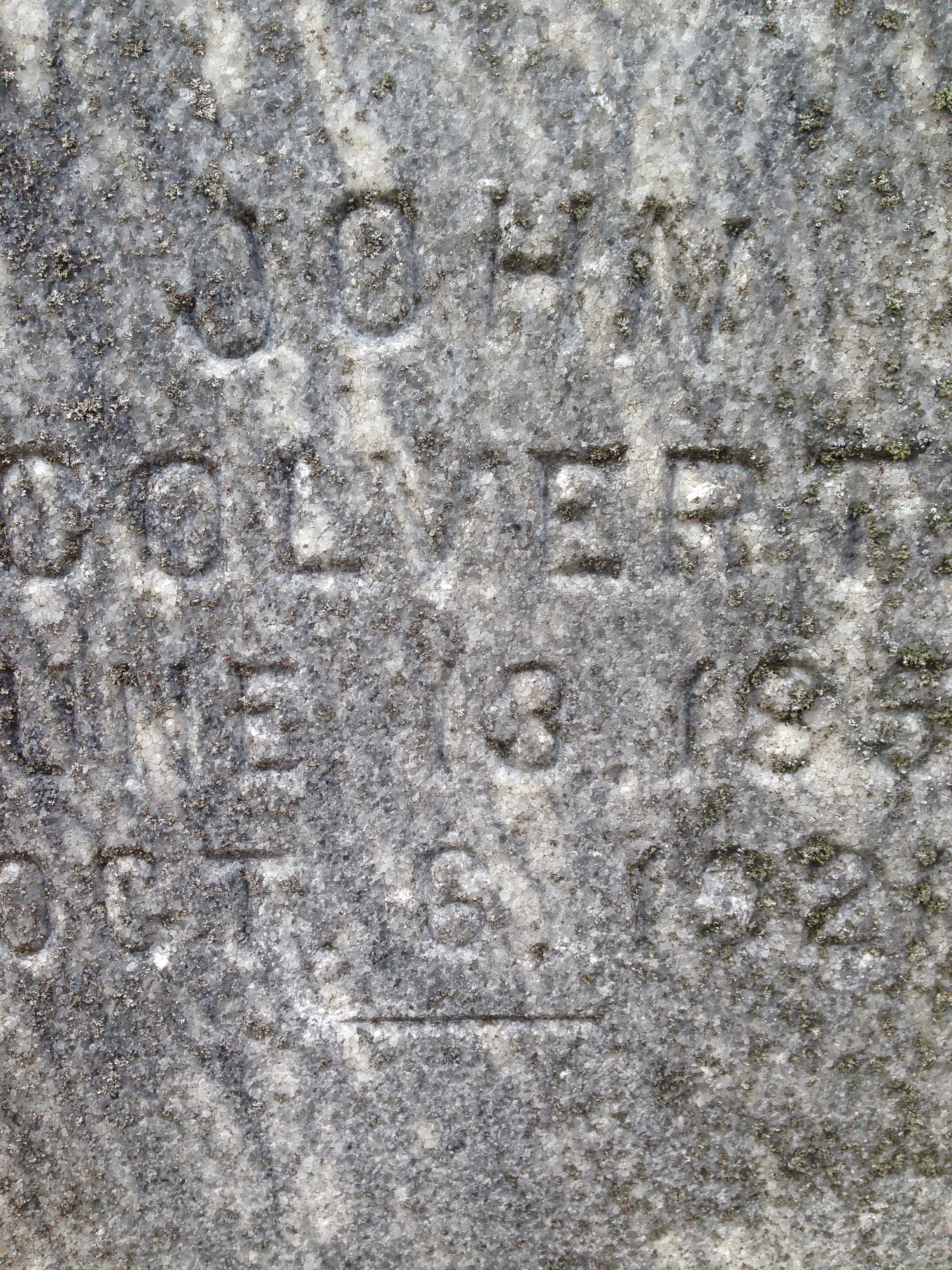
Green Street cemetery is a three-acre square smack in the middle of Statesville’s African-American southside. My great-aunt’s house faced the graveyard, but I don’t recall anyone ever talking about family members being buried there. Nonetheless, several years ago, I found three: my great-great-grandfather John W. Colvert, his wife Adaline Hampton Colvert (the double stone below) and their daughter Selma Eugenia Colvert, who is buried nearby. I suspect that others rest there, including John Colvert’s parents, his son Lon W. Colvert, Lon’s first wife Josephine Dalton Colvert, and his children Walker Colvert and Golar C. Bradshaw.

IMG_4585

IMG_4588

Standard
Enslaved People, Maternal Kin, North Carolina

McNeelys enumerated.

Perhaps he ticked them off on his fingers: “One female, aged 24 to 36. … One female, under ten years of age. … Three males, all under ten….” The enumerator for the 1840 federal census of Rowan County dutifully recorded the information that Samuel McNeely provided, inking in  small numerals in the appropriate column under “SLAVES.” The adult female was Lucinda. The female child was her daughter Alice, and two of the males were her sons John and Julius. It is likely that the third boy was also Lucinda’s, as Samuel was not likely to have purchased a small child and Alice was too young to bear children.

Samuel died in 1843 and, under the terms of his will, son John W. McNeely inherited slaves Lucinda and her offspring. In the 1850 slave schedule, John reported owning eight slaves: a 34 year-old black female [Lucinda]; a 19 year-old black female [Alice]; a 17 year-old black male [John]; a 14 year-old black male [the third boy above, name unknown]; a 12 year-old black male [Julius]; a 9 year-old mulatto male [Henry, Lucinda’s son by John W. McNeely]; a 2 year-old mulatto male [Joseph Archy, Alice’s son]; and a 1 year-old black female [probably Alice’s daughter Mary].

In 1860, John W. McNeely reported only seven slaves: a 44 year-old black female [Lucinda]; an 11 year-old black female [Mary]; a 22 year-old black male [Julius]; a 19 year-old mulatto male [Henry]; a 12 year-old mulatto male [Archy]; a 9 year-old black male [Alexander “Sandy,” who was probably Alice’s son]; and a 7 year-old black male [John Stanhope, who was probably Alice’s son.]  The same seven appear, by name finally, in the 1863 Confederate tax valuation. [A vexatious question: Where was John Rufus in 1860 and 1863? When he married in 1866, he reported John W. McNeely as his former owner. Had he in fact spent his final years of servitude under a different master?]

And then came freedom. In the 1870 census of Atwell township, Rowan County, at household #294: Lucinda McNeely, age 54, domestic servant; Henry McNeely, 29, school teacher; Joseph A. McNeely, 22, farm laborer; and Elizabeth McNeely, 13, “attends school.” [According to my grandmother, this Elizabeth was Henry’s daughter, abandoned by her mother at his doorstep.] At #295: Julius McNeely, 32, farm laborer; wife Mary McNeely, 25, “keeps house”; and nephews Alex’r McNeely, 17, farm laborer; and John S. McNeely, 18, farm laborer. [On the other side, at #292: John W. McNeely, 63, and wife Mary, 63, and at #293: Henry W. McNeely, 35; wife Nancy E., 24; and children Margaret, 3, and John W., 1. This Henry W. McNeely, son of James H. McNeely, was John W.’s cousin, though the exact relationship is unclear.]

Standard
Enslaved People, Free People of Color, Land, Newspaper Articles, North Carolina, Paternal Kin, Vocation

Black carpenter makes name for himself.

I’ve been pulling together a descendant chart for Daniel Artis. In part, I want to keep the names straight and, in part, I’m trying to see if I’m related to any of the other Edwardses, Saulses or Artises I grew up with. Tonight I Googled some random names from this family and up popped this, published just three days ago in Kinston.com, the on-line version of the Kinston Free Press. Andrew Sauls’ father was Isaac Sauls, son of Isaac Sauls, son of Prior Ann Artis Sauls Thompson, daughter of Daniel Artis, brother of my great-great-great-great-grandmother Vicey Artis Williams.

[Update, 7 March 2014: I emailed the Free Press journalist and two days later — yesterday — got a call from Andrew Sauls himself! He lives on land his grandfather bought in 1920 (plus 400 more); confirmed that the Artis Town sign is gone; knew M.’s grandfather, “Cousin Booker T.,” well; and promised to show me around Sauls-Edwards-Artis territory next time I’m home!  — LYH]

Standard
North Carolina, Paternal Kin

Long-lost cousins.

M. had the same first name — an unusual one in that time and place — and last initial as my first cousin. We met when I, a year too young, tagged along to my cousin’s Brownie Scout meetings. M. and I discovered that we lived down the street from one another and from then until my family moved away three years later, we were inseparable.

Several years ago, I did some basic genealogical research on M.’s mother’s family. Her grandfather was a Greene County Edwards, and I was able to trace his ancestry back to slavery. I gratified by the achievement, but nothing in what I found resonated on a personal level.

Fast forward to last week. While hunting for Artis Town, I revisited an Edwards cemetery that I first encountered five or ten years ago while driving Greene County back roads. As I noted here, this time I realized that these Edwardses were also Artises, descendants of Daniel, the brother of my great-great-great-great-grandmother Vicey Artis Williams. Standing there, mulling this over, I started thinking about M.’s family, her Edwardses, and wondering …

When I got back to my parents’ house, I hopped onto the internet. Twenty minutes, and a lot of scribbling and charting later, there it was. M.’s grandfather was the grandson of Mariah Sauls Edwards, who was the daughter of Prior Ann Artis Sauls Thompson, who was the daughter of Daniel Artis. In other words, M. is my cousin, too!

P.S. I figured all this out the day before M.’s birthday. A little present for us both.

P.P.S. An iron-clad childhood rule: “Don’t get in anybody’s car unless we have given you permission.” I broke it twice before the lesson took. The second and last time, I was about seven. I was playing down at M.’s house when her grandparents announced that they were about to ride down Greene County. I ran home to see if I could go with them. Nobody was home. I decided for myself and hopped in the car. I don’t remember much about the short visit — a white farmhouse on brick pillars standing on a slight hill, maybe? — but now I wonder. Was I visiting my own kin?

Standard